Sharing life with a cute, furry Serial Killer….

Oh Heavens!! Spring approaches…. Don’t get me wrong, I love this time of year, all the new life and the promise of Summer to come…. For me, there’s just one drawback, Lola has woken up! Being a fair weather cat, she has been content to stay indoors and sleep most of Winter….

My problem is one many a cat owner will sympathise with…. Spring is prime hunting season….need I say more…. With 7.4 million cats in the UK, it’s estimated between them they catch some 275 million items of prey each year, approximately 20% of which are birds. I’m thankful that Lola is not particularly fond of birds (Lewes is the one I have to watch for that) – but she will try her luck if the opportunity arises. Lola’s preference is for rodents, especially rats….

It is impossible to tell whether a kitten is going to grow to become a prolific hunter; some cats don’t hunt at all, while others are like Lola…. However, just about all cats have an overwhelming desire to hunt, they are born with the instinct.

Through play, they learn the techniques; they develop co-ordination and master how to judge speed and distance…. Eye, stalk, pounce, grab….

cat 3
Photo credit: ‘Mousing’ broterham via Foter.com / CC BY-NC Original image URL: https://www.flickr.com/photos/broterham/5497129942/

The mother cat will teach her kittens; firstly by bringing prey back and eating it in front of them. She will then bring back dead prey for them to eat. Next, she will bring live prey for them to play with….and learn. Finally, the mother will take her brood out hunting with her….

cat 1
Photo credit: ‘Feral cat mom and 3 kittens’ Chriss Pagani via Foter.com / CC BY-NC-ND Original image URL: https://www.flickr.com/photos/nwartist/3947695767/

Female cats, (especially those that have been neutered), are far more likely to bring prey home…. A cat without kittens may find it necessary to attempt to feed her human…. So, that rodent dropped at your feet really is a gift for you…. Of course, our reaction to such a present is “Arghhhh!!” – but really we should show appreciation and gratefulness, as this is a real compliment. In the wild, there is a pecking order to who gets first bite of the kill; it is usually the alpha-male, as head of the family. So, by a cat gifting to you its hard-earned quarry, take it as being acknowledged as ‘alpha-human-cat’….

If Lola comes in with a dead something or other, it is not normally a gift for me, (as far as Lola is concerned, alpha-cat is Lola). Sometimes, she will donate her kill to Lewes, I think out of pity, as he is rather hopeless and lazy in the hunting department – thank goodness! Invariably, she will devour it herself, leaving a pile of guts behind – for me to clear up; (actually, now I come to think of it, in Lola’s eyes, I may well be at the bottom of the pecking order)…. Cats tend to eat the heads and more muscular parts of their kills, rejecting the innards….

When I do get gifts, they are usually still very much alive. I am still, apparently, viewed at being at the ‘kitten’ stage; Lola is obviously concerned that I am not capable of looking after myself, I need educating…. I need to learn how to hunt….possibly she has realised her human eats no meat…. Vegetarianism is not a lifestyle choice a cat can comprehend….

****

In this household, we have what we jokingly refer to as the ‘Mediaeval cat flap’…. John’s DIY skills, (bless him), usually involve large slabs of oak…. We needed to come up with a Lewes proof cat flap, as he rips the doors off of conventional ones, in order to let himself out…. We would probably get a slap on the wrist if Heritage knew we had cut a hole in a Victorian, or possibly earlier, door (whoops! They may know now….) – but I am sure future generations of felines will still be enjoying its benefits for years to come…. Had they of had cat flaps in the Middle Ages, I am certain they would have been very similar to this one….and I must say, it works rather well! The door can be slammed shut in a hurry and the bolt slid across….a necessity with the likes of Lola around….
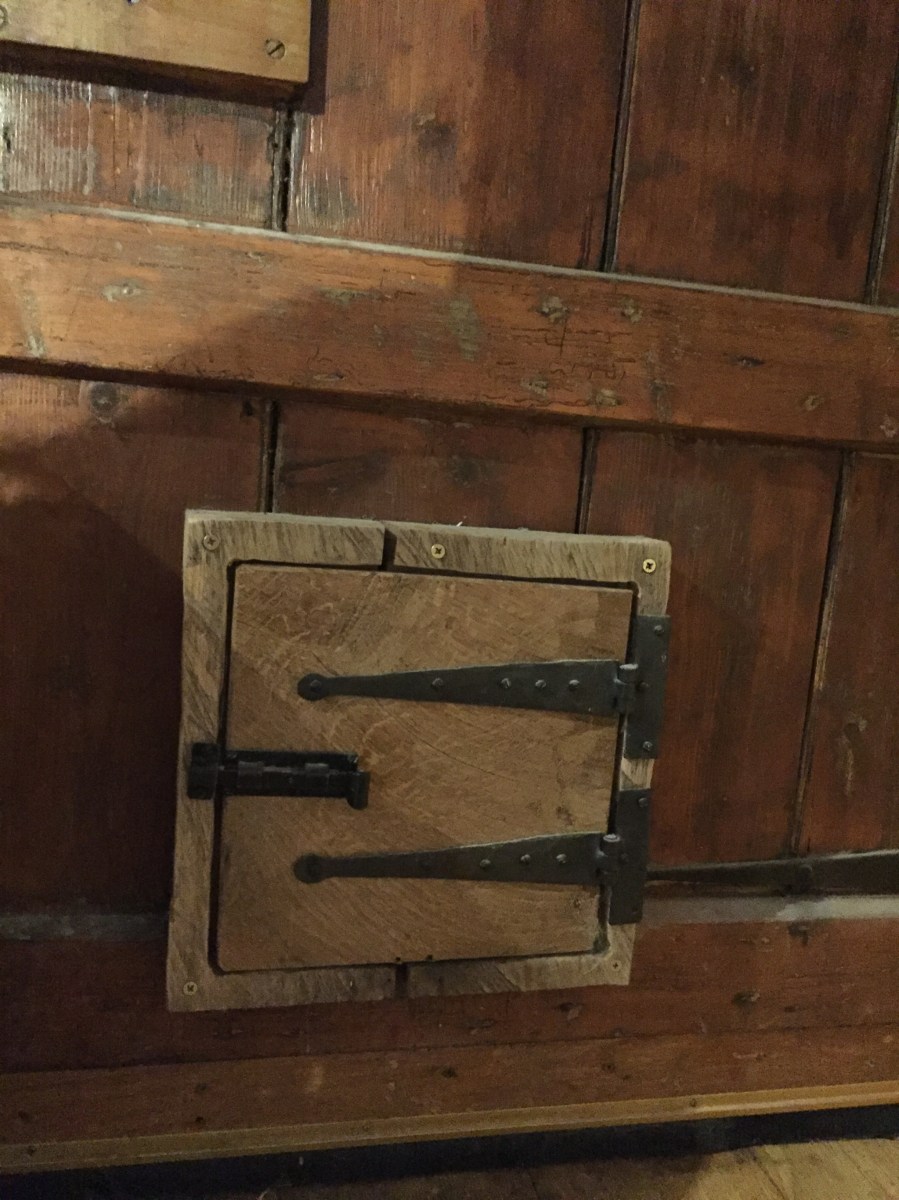
IMG_1502

Only this morning I heard the familiar ‘yowling’ that alerts Madam is home with the spoils of her morning’s hunt…. This is my signal to sprint and bolt the cat flap. Lola was not in the best of humour this morning, so my refusing to allow her and what ever rodent was hanging from her jaws entry, did not go down well. After spending a few minutes trying to ram-raid her way in, she eventually gave up and walked off in disgust. A gift of dead vole was left on the doorstep for me. Now, I could look at this ‘gift’ in one of two ways: either she was saying ‘don’t worry, I understand. I’ll leave your present outside, to show there’s no hard feelings’. More likely though, it was left out of protest, as she knows I hate dead things; like I said, she was not in good humour, as she’d had a worming treatment earlier this morning. Of course, a necessary evil, especially for cats who are keen hunters. I have given up trying to hide powders in their food and attempting to get either of them to swallow a tablet is not a good idea, if I want my hand to stay intact; so, I opt for the spot-on method…. Equally unpopular, it takes two of us to hold down and administer it – but is the least stressful option for all of us….

I have read the various information available on how to discourage cats from hunting, or at least make them less successful…. A collar with a bell is frequently recommended…. Personally, I shy away from cat collars, having experienced a couple of mishaps with previous cats. Luckily, no real harm was done on either occasion but it could have been very different…. Aware of collars getting caught up on branches and shrubs etc. I always chose the soft ones with the safety elasticated piece sewn into them – one of our cats, Bruno, managed to get his lower jaw stuck through his collar whilst grooming…. Bruno was a rescue cat, who had been feral; he was always sweet-natured with us but when this incident happened, he momentarily became quite wild again….removing the collar from his mouth was no easy feat…. The second time happened with Gemma, who somehow got her front leg trapped in her collar, again one very panicked cat…. In both cases the collar had to be cut off, (I am just so thankful somebody was around each time it happened) – and now I vow no cat of mine will wear a collar….

One thing I do try to adhere to though, is keeping both Lewes and Lola in at night. Cats are more successful at hunting at night, particularly in the early hours….

The other piece of advice often given, is one that makes me smile…. Apparently, a well fed cat is less likely to hunt. Firstly, these two couldn’t be better fed, food is always available to them; secondly, Lola seems to treat her kills as ‘appetisers’. The moment she has finished devouring her ‘first course’, she will rush to her food bowl and empty it. So much for that theory….

Cats typically eat small, multiple meals over the course of the day…. I always make sure there is a plentiful supply of dried food available. Pouches are demanded at various times during the day, especially by Lewes, who cannot bear the sight of a half empty bowl – he also has the infuriating habit of sucking the jelly off and spitting out the lumps…. This cat has an obsession with food; he is not really a hunter, although he will go after birds if given half a chance but luckily without much success. Lewes has two main functions in life, eating and sleeping. Any opportunity to eat and he’s there, if it’s in a bowl and looks remotely like cat food, he’ll have it. This includes rabbit feed; which does, I suppose, look a little like cat biscuits – although I can’t imagine it tastes anything like them. Doesn’t seem to bother him though, I’ve lost count of how many bowls of alfalfa hay nuggets he’s scoffed his way through…. Another favourite trick is to sit by the recycling bin in the kitchen – just in case a piece of packaging is dropped in that’s worth a lick – ham wrappers preferably….

I sometimes question whether we have really domesticated the cat or have they actually trained us to suit their needs…. Cats became our companions about the same time man started growing his own food. With the beginning of agriculture came the need to store crops and grain, which of course brought the problem of vermin, in the form of rats and mice….which in its turn, attracted wild cats…. Speculation suggests domestication of the cat started some 12,000 years ago in the Middle East. It is thought the cat we know today descends from a Middle Eastern wild cat named Felis Sylvestris – translating literally as ‘cat of the woods’….

cat 4
Photo credit: ‘Chat Sauvage Felis Sylvestri’ Luciano 95 via Foter.com / CC BY-NC-SA Original image URL: https://www.flickr.com/photos/giuss95/1391855473/

It didn’t take long for those first farmers to realise the benefits of having wild cats around. In return for their mice catching skills, the felines had access to warm shelter and a plentiful supply of food, maybe with the occasional prepared meal thrown in….

Trying to pin point exactly when cats became domesticated has proven very difficult to do accurately. There is very little difference between the skeleton of a wild cat and that of the cat we know; so, archeological finds have been hard to distinguish. However, a dig on the island of Cyprus unearthed a grave dating back 10,000 years; the person within had been buried with a cat….

It seems ironic that we try to seek ways of discouraging our domestic cats from their natural instinct of hunting, when it was for this very reason we encouraged them to share our lives in the first place….
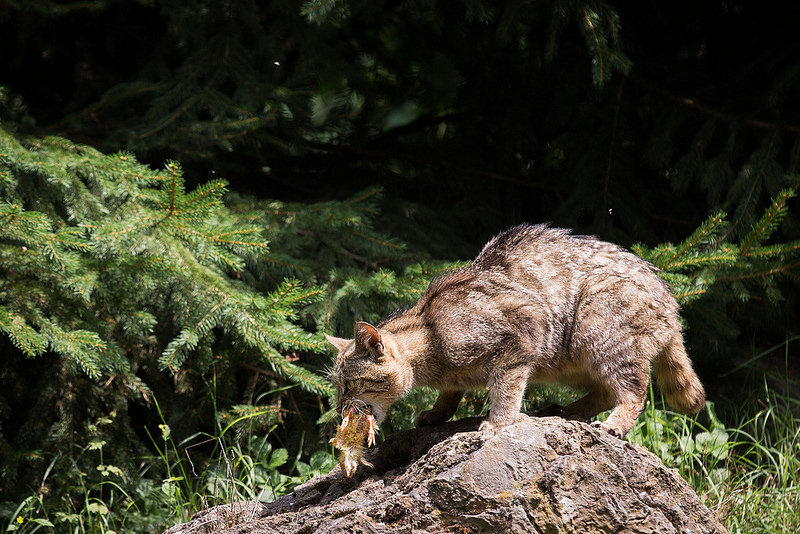
cat 2
Photo credit: ‘Wild Cat’ Cloudtail the Snow Leopard via Foter.com / CC BY-NC-ND Original image URL: https://www.flickr.com/photos/blacktigersdream/16684641742/

I just take comfort from the fact that apparently, as they get older the desire to hunt lessens…. Although, knowing my luck, Lola will be a geriatric serial killer….
007


Bring back the stocks…I say!!

There have been a few times in the past, when I have jokingly remarked it would be fun to see a set of stocks on the village green…. I may not have been saying that if I had lived in this house a couple of hundred years ago, even less so if I had been one of its first occupants….

stocks-1
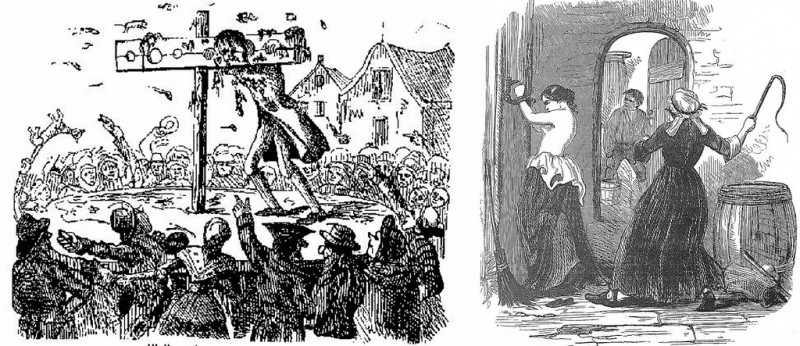
Photo credit: ‘Punishment in 18th century Bristol by John Latimer’ brizzle born and bred via Foter.com / CC BY-ND Original image URL: https://www.flickr.com/photos/brizzlebornandbred/10242020225/

Wind back to when No.3 was first built – England would still have been governed under the Feudal System. Feudalism was introduced when William I took control after the Norman Conquest in the 11th Century; it was to become the way of Mediaeval life. As William was still also the Duke of Normandy he had to divide his time between England and France, so was absent for many weeks at a time. Therefore, he needed people he could trust to run things for him in his absence. In order to do this, he divided the country up into large chunks, similar to the counties we know today. These plots of land were ‘given’ to those he considered the most trustworthy, namely those that had fought with him and were prepared to die for him. The land was not ‘given’ to them unconditionally, they had to swear an oath of loyalty and collect taxes for the King. The noblemen (barons, earls and dukes) were the most important men in their allotted portion of land, they were known as ‘tenants-in-chief’. They in turn divided the land further into smaller pieces, called Manors, which were entrusted to Norman knights, who had also served well in battle. Each also had to swear an oath and it was his duty, as Lord of the Manor, to manage the land and its occupants. He had to collect taxes on behalf of the tenant-in-chief and provide soldiers from amongst the men living within his Manor to fight when ever needed. It was also the lord’s responsibility to ensure law and order was upheld….

stocks-6
Photo credit: Image taken from page 210 of ‘The History of England from the earliest dawn of authentic record…Embellished with…engravings.’ The British Library via Foter.com / No known copyright restrictions Original image URL: https://www.flickr.com/photos/britishlibrary/10999381745/

The Manorial Court dealt with crimes that were of a less serious nature. Courts were held at regular intervals throughout the year and all villagers were required to attend, or face a fine. Trial was by jury, which consisted of twelve men, selected by the villagers. A steward, chosen by the lord, was in charge of the Court. The  community was divided into groups, called tithings, each tithing represented by ten adult (over the age of 12) men, who were then responsible for each other’s behaviour. If one member (or part of his household) broke the law or behaved in an inappropriate way, it was the duty of the other nine tithe members to bring them before the Court.

More serious crimes were referred to the King’s Court; these included murder, treason, heresy and witchcraft. Trial by jury did not come to the King’s Court until 1275. Before this time, trial was by ‘ordeal’; it was believed God would decide whether a person was innocent of the crime he or she had been accused of. There were three types of ordeal used to determine a person’s fate:-

Ordeal by fire: The accused was made to walk a distance of approximately 9 foot holding a red-hot iron bar, (or similarly, picking up a stone from a boiling cauldron of water). The hands would be bandaged. Three days later the bandages would be removed, if the wounds showed no signs of healing, the person would have been pronounced ‘guilty’….

Ordeal by water: The accused would have been thrown into water with their hands and feet bound together; if they floated, they were declared ‘guilty’….

Ordeal by combat: Reserved for noblemen. The accused would fight with his accuser, usually to the death; the victor being considered the one in the ‘right’….

In 1215 the Pope made a ruling that priests must not help with enforcing ordeals (as it was his belief they were wasting too much of God’s time) – as a result the King’s Court also became trial by jury. This was actually not popular with the people, some thought those with a grudge against them may use the system to their own advantage. In 1275 a law was introduced permitting the use of torture if trial by jury was refused. Torture was also used to extract confessions or to get the names of accomplices and other information about the crime in question….

Punishments were issued to fit the crime and reflect the social standing of the person who had been found guilty. The worse the crime, the harsher the punishment. For serious crimes, death was usually inevitable; as well as murder, treason and witchcraft, highway robbery and the stealing of livestock carried death sentences….

Although prisons existed, they were used as a holding place for people awaiting trial rather than as a punishment. They were squalid places, lack of food and disease often meant prisoners died before even coming before the Court. Prison sentences were usually not an option as the money to keep long-term prisoners was not available; it was cheaper to either execute or mutilate them….

Most towns had a gibbet. People were hung on them and their bodies left to rot to act as a deterrent to others. Witches were strangled or in severe cases, burnt. Sometimes beheading was used as a form of execution. Serious theft could result in hands being cut off, branding may have been used, along with other barbaric punishments, such as the poking out of eyes. Punishments and executions were always in public….

stocks-15
Photo credit: ‘Gallows’ Jaime Perez via Foter.com / CC BY-NC Original image URL: https://www.flickr.com/photos/jaimeperez/452796686/

Courts were often biased, the poor discriminated against and judgement would often have been known before the case even came to trial. If somebody did not turn up to attend the Court they were automatically considered to be an outlaw; their possessions would have been seized, becoming the property of the King. Outlaws would often band together and live in hiding; of course, one of the most famous being Robin Hood….

Lesser crimes were dealt with within the community and it was up to the Lord of the Manor to decide a fitting punishment. The Middle Ages had a tendency to use ridicule to punish petty crimes, public humiliation was common practice. Anything from being forced to wear an animal mask to being publicly flogged…. Not working hard enough, cheating on a spouse, blasphemy, not observing the Sabbath and being drunk and disorderly were all punishable crimes in Mediaeval England….

Petty theft could result in being given extra, unpaid work and/or a fine. Slacking at work would warrant a flogging….

Women who nagged, scolded and gossiped could find themselves the centre of the utmost ridicule….by being forced to wear a ‘scold’s’ bridle. Although it looked like a torture contraption it was not really designed as such, more for humiliation. It consisted of a metal bridle that strapped about the head and had ‘bits’ that went into the mouth. Sometimes the bits had spikes to prevent the woman from talking. She would then be paraded through the streets for up to twelve hours; some bridles even had bells attached to them, to add to the indignation….

Another punishment used for women who found themselves fallen from grace was the ducking-stool, popular especially in the 16th and 17th centuries. The offending woman was strapped into a chair on the end of a long pole; she was then repeatedly dropped into a river or lake…. The last recorded ducking in England was in the Herefordshire town of Leominster. Jenny Pipes was a notorious scold and was dunked in 1809. In 1817, Sarah Leeke was found guilty of the same crime; fortunately for her, the water in the ducking pond was too low, instead she was wheeled around the town strapped in the ducking chair, to receive the ridicule of the townsfolk….

stocks-11
Photo credit: ‘The Ducking Stool at Leominster’ copyright John Phillips and licensed for reuse under creative commons license CC SA Wikicommons

Another variation of this was the cucking-stool, in which the guilty person was made to sit, to endure being paraded through the streets….

To us now, the  ducking-stool may conjure up quite a comical image…. However, it was a terrible ordeal for the woman concerned. Deaths did occur, either through drowning or shock. In more severe cases, for example a person accused of witchcraft, the chair would be held under the water for several minutes, repeatedly. If the accused survived it would be assumed they were guilty. If they drowned, the only consolation would be their name was cleared….

stocks-10
Photo credit: Image from page 90 of ‘Essentials of United States history’ (1911) Internet Archive Book Images / No known copyright restrictions Original image URL: https://www.flickr.com/photos/internetarchivebookimages/14756866006

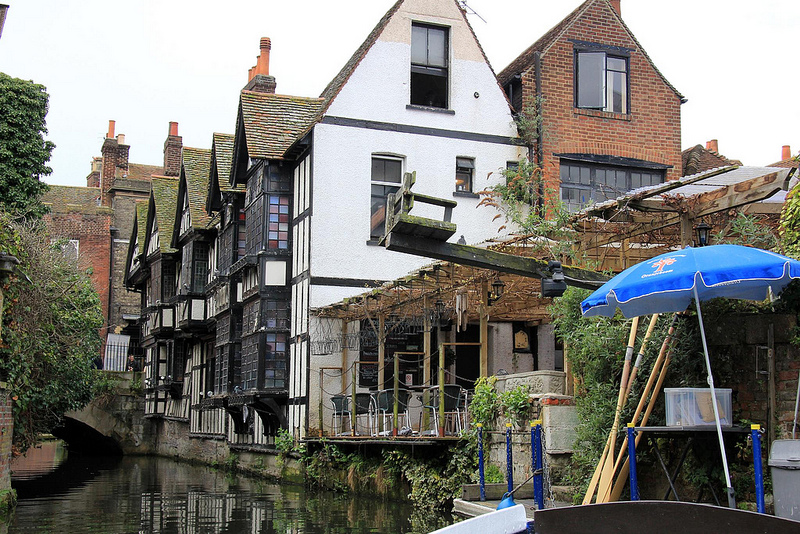
In the City of Canterbury, Kent, the original ducking chair can still be seen in its place at the back of the Weavers House Pub on the banks of the River Stour….

stocks-9
Photo credit: ‘Canterbury Historic River Tours’ Karen Roe via Foter.com / CC BY Original image URL: https://www.flickr.com/photos/karen_roe/7217331258/

Of course, one form of punishment we commonly associate with days gone by is that which got me on to this subject in the first place….the stocks; (and we must also contemplate their cousin, the pillory, too)….

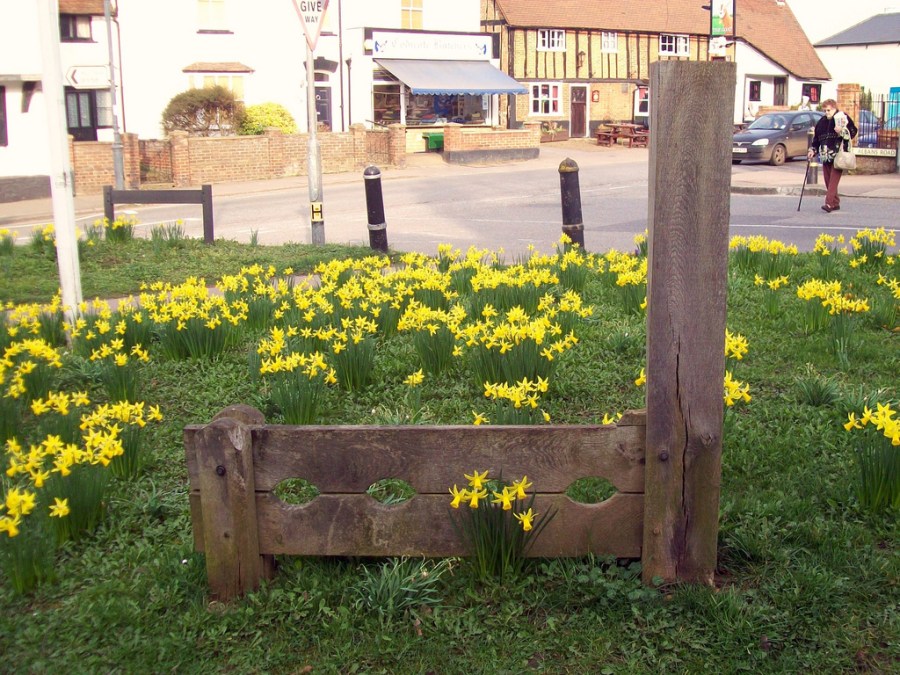
The stocks go back to at least Anglo-Saxon times…. A wooden construction, where the convicted person would sit and have their ankles trapped in holes within the structure and sometimes their hands too.  Occasionally, although not commonplace, even the neck would be entrapped. Most stocks were capable of holding at least two prisoners at one time….

stocks-13
Photo credit: ‘Stocks’ Kasper Veste via Foter.com / CC BY-SA Original image URL: https://www.flickr.com/photos/kasper_veste/4443518243/

In 1351 the parliament of King Edward III passed a law prohibiting labourers from leaving their home Manor to look for better paid work. After the Black Death there was a desperate shortage of labour – workers were in a situation where they could demand better conditions and wage increases…. To curb this the Statute of Labourers was instated….all upstarts were sentenced to the stocks. In 1405 it was made law that every town and village in England should have them….

stocks-4
Photo credit: ‘St Leonard’s Church Shoreditch’ Alan Denney via Foter.com / CC BY-NC-SA Original image URL: https://www.flickr.com/photos/alandenney/14633649205/

A spell in the stocks could last anything from a few hours, to days, even weeks! A part from the obvious discomfort of being pelted with rotten fruit, vegetables, eggs and possibly even worse, the fact the prisoner was unable to shift position in all that time, has to be taken into consideration; that and our great British weather….!!

stocks-14
Photo credit: ‘Stocks, Codicote’ Peter O’Connor aka anemone projectors via Foter.com / CC BY-SA Original image URL: https://www.flickr.com/photos/anemoneprojectors/5545843719/

Stocks and pillories were always positioned in the most prominent place in the town or village….be it the market square, near to the church or on the village green….

The pillory tended to be used for slightly more serious offences. Similar to the stocks but this time the person was in a standing position with their head and wrists entrapped. A term in the pillory was usually shorter, not normally more than a day. Additional punishments may have been administered, depending on the crime. Sometimes the victim’s ears might be nailed to the pillory, to stop movement of the head. Often, the prisoner’s ears would be ripped off through their struggles; if the ears were still intact at the end of the ordeal, they were more than likely to have been cut off at the time of opening the pillory anyway. Branding the face of the criminal, nose slitting and even boring through the tongue with a red-hot iron were all punishments some prisoners of the pillory had to endure….

stocks-2
Photo credit: ‘laurel & hardy’ pinch of salt via Foter.com / CC BY-NC-ND Original image URL: https://www.flickr.com/photos/pinchofsalt/1623455610/

Being drunk and disorderly, cheating, blaspheming, not observing the Sabbath, or simply being a vagrant could result in a spell in the stocks or pillory. However, it was possible, if a person was well liked in a town or village, that no real hardship was suffered. Some places stipulated only soft missiles could be thrown, to prevent stoning….

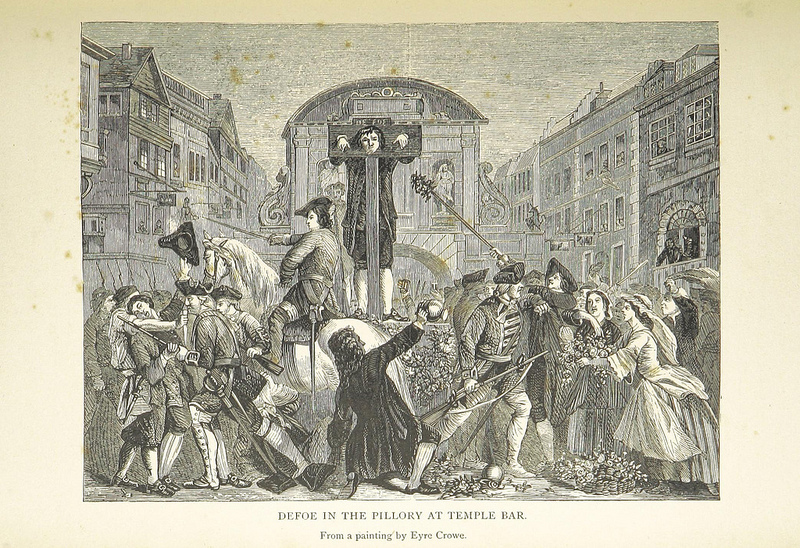
In 1703, Daniel Defoe, a popular writer of the time, was sentenced to the pillory because his work ‘The Shortest Way with the Dissenters’ was considered seditious libel (criticising and discrediting the King and Church). In the July of 1703 he was taken on three consecutive days to some of the busiest parts of London; The Royal Exchange in Cornhill, Cheapside and finally Fleet Street, to spend an hour each time in the pillory. Huge crowds were expected to turn out and mock him and hurl whatever they deemed fitting; however, all that was thrown at Defoe were flowers, whilst his friends read extracts of his work to onlookers….

stocks-5
Photo credit: Image taken from page 146 of ‘Daniel Defoe : his life and recently discovered writings : extending from 1716 to 129. [With plates, including a portrait.]’ The British Library via Foter.com / No known copyright restrictions Original image URL: https://www.flickr.com/photos/britishlibrary/11090698076/
The pillory was abolished in 1837. The stocks, although never officially abolished, began to die out in England in the early 19th Century. The last recorded case of them being used was in Rugby, Warwickshire in 1865.

Most stocks were made of wood (although there have been examples made of iron), so many of the original stocks deteriorated and rotted over time. However, many villages, proud of their old stocks, have managed to preserve them as a reminder of the ‘olden days’. Several villages local to Dunsfold still have theirs, including Chiddingfold and Alfold. Dunfold’s have long gone – and after learning all this, I am not quite so sure now that I would like to see a new set on the green after all….

stocks-12
Photo credit: clare_and_ben via Foter.com / CC BY-NC-ND Original image URL: https://www.flickr.com/photos/benandclare/3710415485/
stocks-3
Photo credit: ‘Pillory’ balaji shankar via Foter.com / CC BY-NC Original image URL: https://www.flickr.com/photos/balaji_shankar/584749163/