“Pop the kettle on….we’ll have a nice cuppa & a mince pie….”

Britain – a nation of tea drinkers and cake eaters….

In recent years TV shows such as The Great British Bake Off have lured us into the kitchen to try out our baking skills – I’ll bet there’s plenty a festive treat coming out of Britain’s kitchens in the run up to this Christmas…. Mince pies, Christmas cakes and puds, Yule logs – the Season wouldn’t be the same without them – so much a part of our traditional celebrations – but do we ever stop to consider why we eat such fare at this time of year….?
pies 3
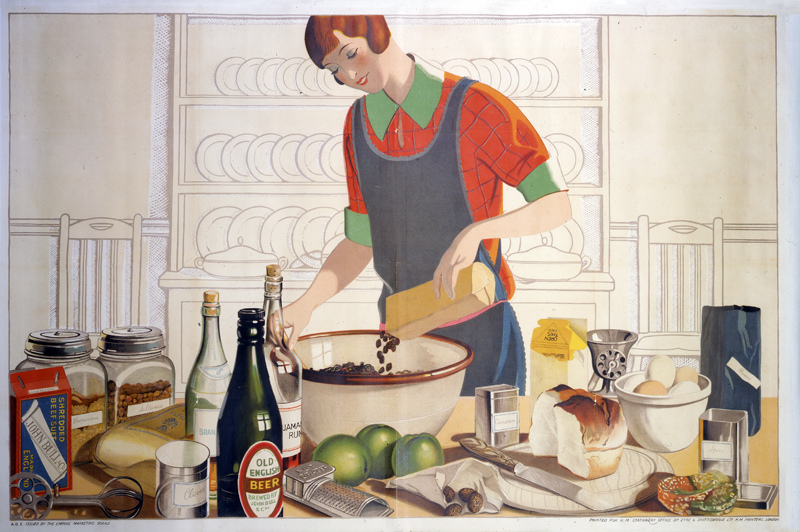
Making the Empire Christmas Pudding The National Archives UK via Foter.com / No known copyright restrictions Original image URL: https://www.flickr.com/photos/nationalarchives/5263978078/

Here in the UK, Brits will munch their way through some 300 million mince pies over the festive period – but the sweet, rich, dried fruit mixture we are all used to filling our pies wasn’t always like that…. We can thank the Victorians for the version we know and love today….
pies 2
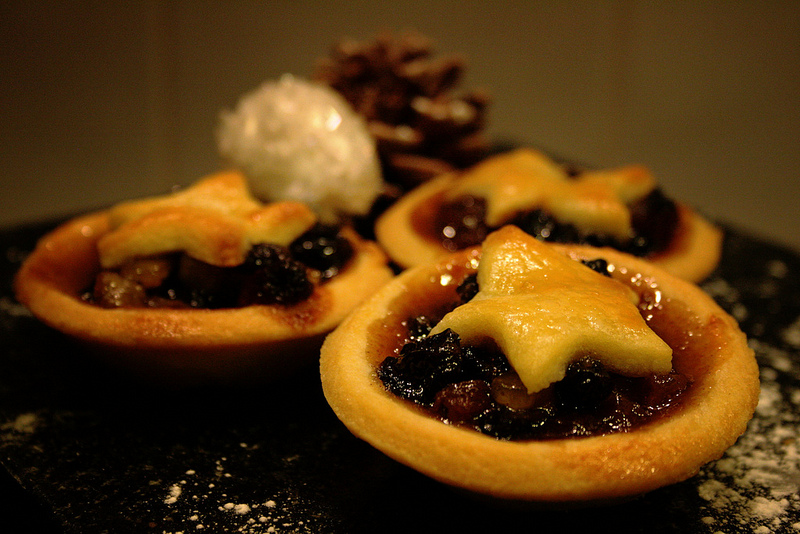
Homemade mince pies Eldriva via Foter.com / CC BY-ND Original image URL: https://www.flickr.com/photos/eldriva/8172923611/

A clue to the beginnings of this confection is in the name – ‘mince’…. Other early names include ‘Mutton pie’, ‘Shrid pie’ and ‘Christmas pie’…. It is thought Crusaders returning from the Middle East brought home with them recipes and knowledge of Middle Eastern cookery – combinations of meat and dried fruits, laced with spices such as cinnamon, cloves and nutmeg…. Our Western interpretation gave us the original filling for the mince pie….using meat such as lamb. These first pies were usually formed into an oval shape to represent the crib of the Baby Jesus – sometimes a pastry baby would have decorated the top…. In time mince pies were to become a status symbol at the banquets of the wealthy – a chance to show off as to whose pastry chef could create the most elaborate, exciting shapes….

There was a belief in the Middle Ages that eating a mince pie on every one of the 12 days of Christmas brought wealth for the coming year…. (Really? Pass that plate of pies over here then)….
pies 19
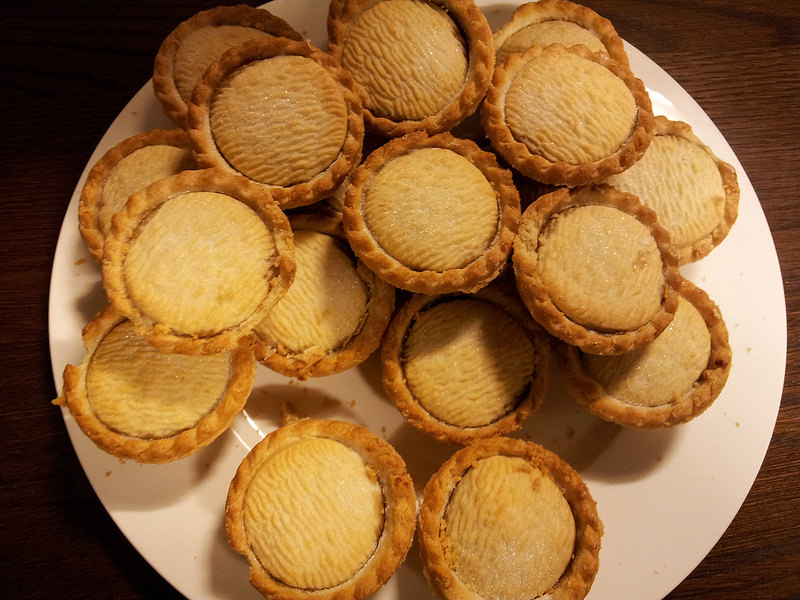
Mince pies oatsy40 via Foter.com / CC BY Original image URL: https://www.flickr.com/photos/oatsy40/15443417714/

Our Christmas pudding also has its roots in the Middle Ages; it originates from a 14th Century pottage known as ‘Frumenty’. Made from beef, mutton, prunes, currants, raisins, wine and spices, its consistency was more of a soup. It was meant as a light meal and was eaten in the days leading up to the festive season – the idea being to prepare the body for the on-coming splurge of over-indulgence….

By the end of the 16th Century the porridge was evolving. By 1650, with the addition of eggs, oatmeal, beer, spirits and extra dried fruit, it had become reminiscent of the traditional pudding of the Christmas dinner we know today…. Once again it was the Victorians who adapted it into its now familiar form….

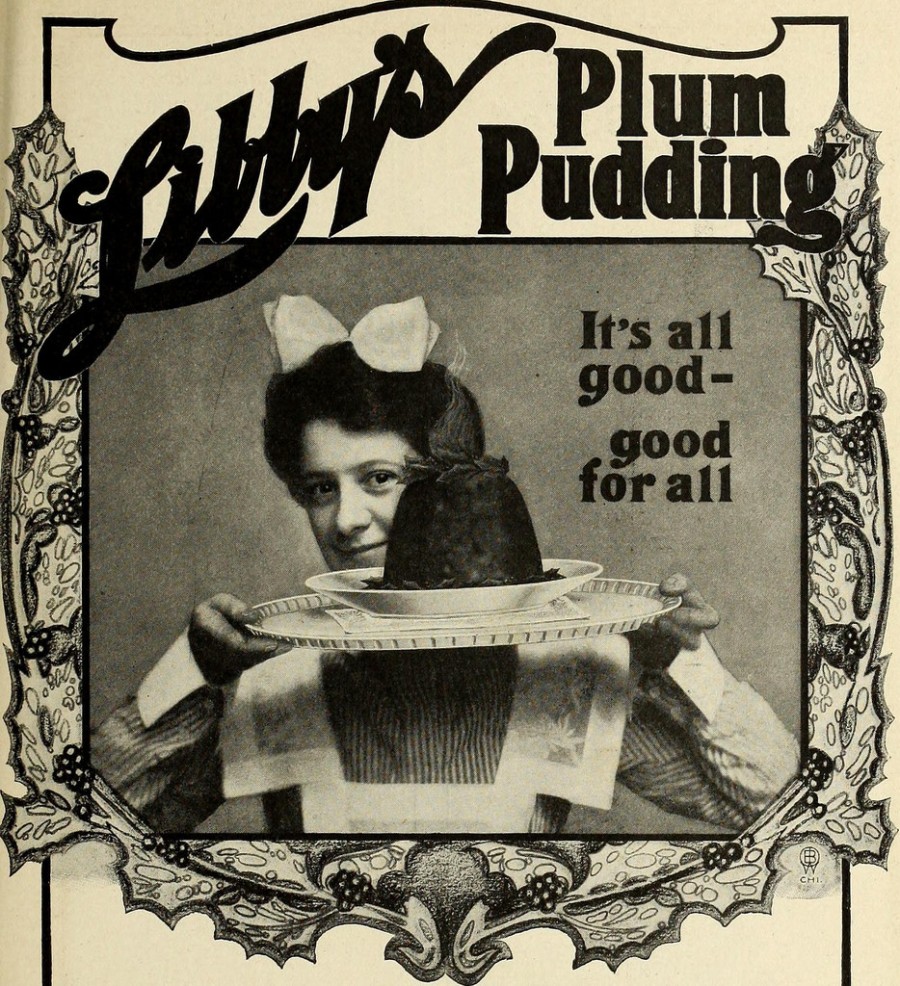
Before the 19th Century puddings were boiled in a cloth – it was the Victorians who began to put the mixture into bowls and moulds. By the 1830s most ordinary families would have had a traditional ball-shaped pudding – if it happened to be on the ‘heavy’ side it would have been jokingly referred to as a cannon ball…. Richer families may have enjoyed more elaborately shaped puds – moulded into shapes such as castles…. At this time Christmas pudding was also commonly known as Plum pudding – as the Victorians used ‘plum’ as another name for raisins….
pies 6
Image from page 288 of “St. Nicholas [serial]” (1873) Internet Archive Book Images via Foter.com / No known copyright restrictions Original image URL: https://www.flickr.com/photos/internetarchivebookimages/14783740952/
Family recipes would have been handed down from generation to generation. Puddings would be made at least a month (sometimes up to a year) before – and left to mature. Cooking meant steaming or boiling the pudding for several hours – nowadays, the majority of us whack them in the microwave….

Of course, with the Christmas pudding comes a whole host of traditions and superstitions. One belief being that the pudding should be made on the Sunday before the beginning of Advent. To bring good fortune for the coming year each member of the family taking a turn to stir the mixture – from East to West – in recognition of the 3 Wise Men – making a wish as they did so…. It was thought the recipe should consist of 13 ingredients, one for Jesus and each of the 12 Disciples…. The tradition of placing holly on the top is a representation of the thorny crown worn by Jesus at the Crucifixion…. Brandy (or another spirit) poured over and set a flame – to show the power of the love of Jesus….

This Sunday became known as ‘Stir-up Sunday’ – taking its name from the obvious – but also from the Collect of the Book of Common Prayer for the Sunday before Advent….

“Stir up, we beseech thee, O Lord, the wills of thy faithful people, that they, plenteously bringing forth the fruit of good works, may by thee be plenteously rewarded, through Jesus Christ Our Lord, Amen”….

Then there are other traditions associated with the Christmas pudding – such as the hiding of a coin within it. This can be traced back to the eating of ‘Twelfth Night Cake’ during the early 1300s, when a dried pea or bean was placed inside the cake. The first coins to be hidden in our puddings were either a penny or silver farthing. Later it commonly became a threepenny bit but the one that will spring to mind for many of us is the sixpence. Nowadays, some families may still carry on the tradition; I expect a few £1 coins will find their way into this year’s puds….

In days gone by it wasn’t just the lucky coin that got popped into the pudding; other tokens were often added – a wishbone for luck; a button for a bachelor; a thimble for a spinster; a ring for someone soon to marry….

Nowadays, most of us buy our puddings ready-made – we spend approximately £48 million on them every year and some 25 million are consumed…. I wonder what Mary Kettilby – who in her 1714 book ‘A Collection of above Three Hundred Receipts in Cookery, Physick and Surgery’ shared the first known printed recipe for Christmas pudding – would have thought about that….

From the Christmas pudding comes our traditional Christmas cake…. During the 16th Century people began to save some of the pudding mixture, substituting the oatmeal for flour and adding eggs and butter to make a cake ready for Easter…. Richer families would decorate their cakes with marzipan and add spices to represent the exotic spices brought as gifts by the Wise Men. From these Easter fruit cakes evolved the Christmas cake….

Originally it was eaten on the 5th of January – ‘Epiphany’ and became a popular form of the Twelfth Night cake…. During the 1830s the focus changed from the 12th Night to Christmas Day itself…. Victorian bakers began to use icing to decorate the cakes with snowy scenes. Egg white icing dates back to the 1600s – but after its use on Queen Victoria’s wedding cake in the 1840s it became known as ‘Royal’ icing; this became the preferred icing on the Christmas cake – and so popular were they at Victorian gatherings by the 1870s we had the Christmas cakes we are familiar with today….

Again there are superstitions attached to the traditional Christmas cake…. It was thought to be unlucky to cut the cake before the dawn of Christmas Eve….and as with the mixing of the Christmas pudding ‘Stir-up Sunday’ rituals were observed…. Traditionally being made in November, the cake is then ‘fed’…. Small quantities of alcohol, usually sherry, brandy or whisky, added at regular intervals through small holes pierced into the un-iced cake….

Naturally, there are traditions that vary from region to region: in Yorkshire, for example, it is popular to eat Christmas cake with cheese! It may sound strange to some but since cheese and fruit compliment each other so well, it actually makes a perfect marriage…. Being a traditional winter cheese, Wensleydale is a good choice….

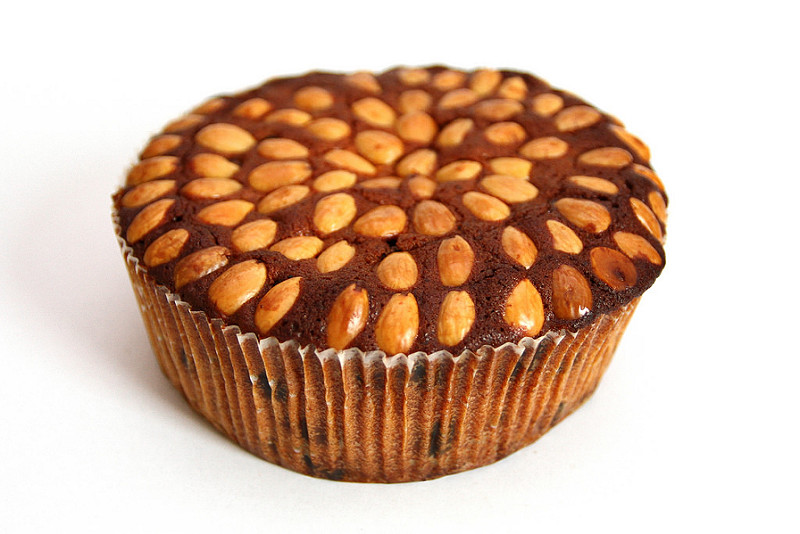
Scotland has its own traditional Christmas fruit cake – the renowned Dundee cake. It was in the Scottish eastern coastal city of Dundee that this cake was first commercially produced….
pies 10
Rural Matters via Foter.com / CC BY-NC Original image URL: https://www.flickr.com/photos/47027921@N05/15781834252/

It is said the cake was first made for Mary Queen of Scots during the 16th Century – as she did not like cherries….and most fruit cakes of the day contained them…. Scottish bakers came up with the idea of using almonds instead….

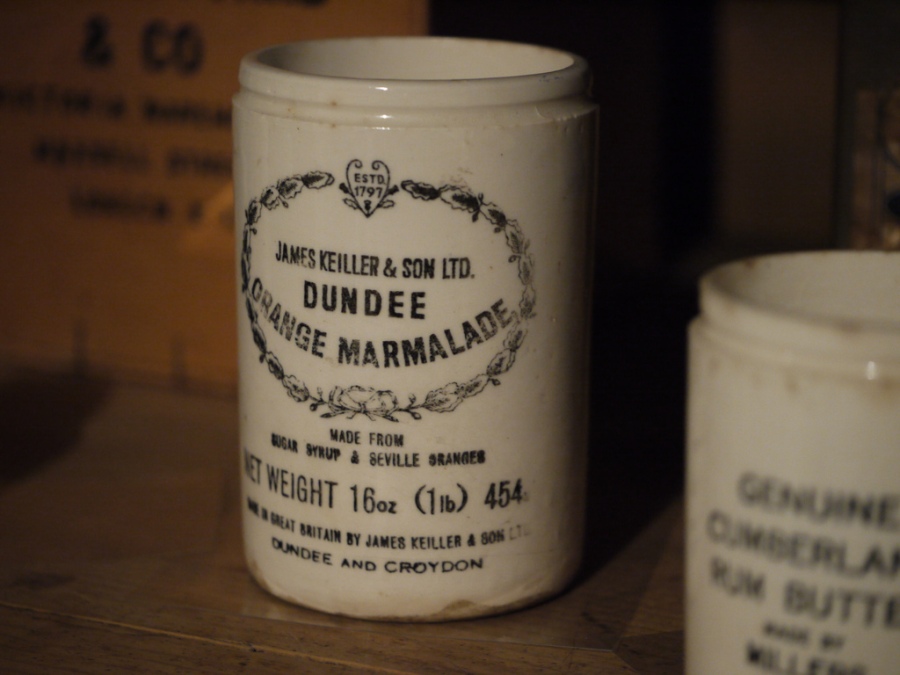
A couple of hundred years later, during the 1760s, Janet Keiller was running her small shop in Seagate, Dundee – where she produced and sold confectionery and preserves…. The story goes that her husband, John, purchased a large quantity of Seville oranges; part of the cargo of a ship that had been forced into harbour to take shelter from a raging storm. The rather bitter fruit, not really suitable for every day eating, was passed its best and so Janet used the oranges by modifying an existing quince jam recipe. To it she added the shredded peel of the fruit, thus creating a new kind of marmalade…. (Marmalade comes from ‘marmelo’, meaning ‘quince’ in Portuguese)…. And so became the famous Keiller’s Dundee Marmalade – which took its place at so many a breakfast table….
pies 17
Marmalade Jar Smabs Sputzer via Foter.com / CC BY Original image URL: https://www.flickr.com/photos/10413717@N08/5734581069/

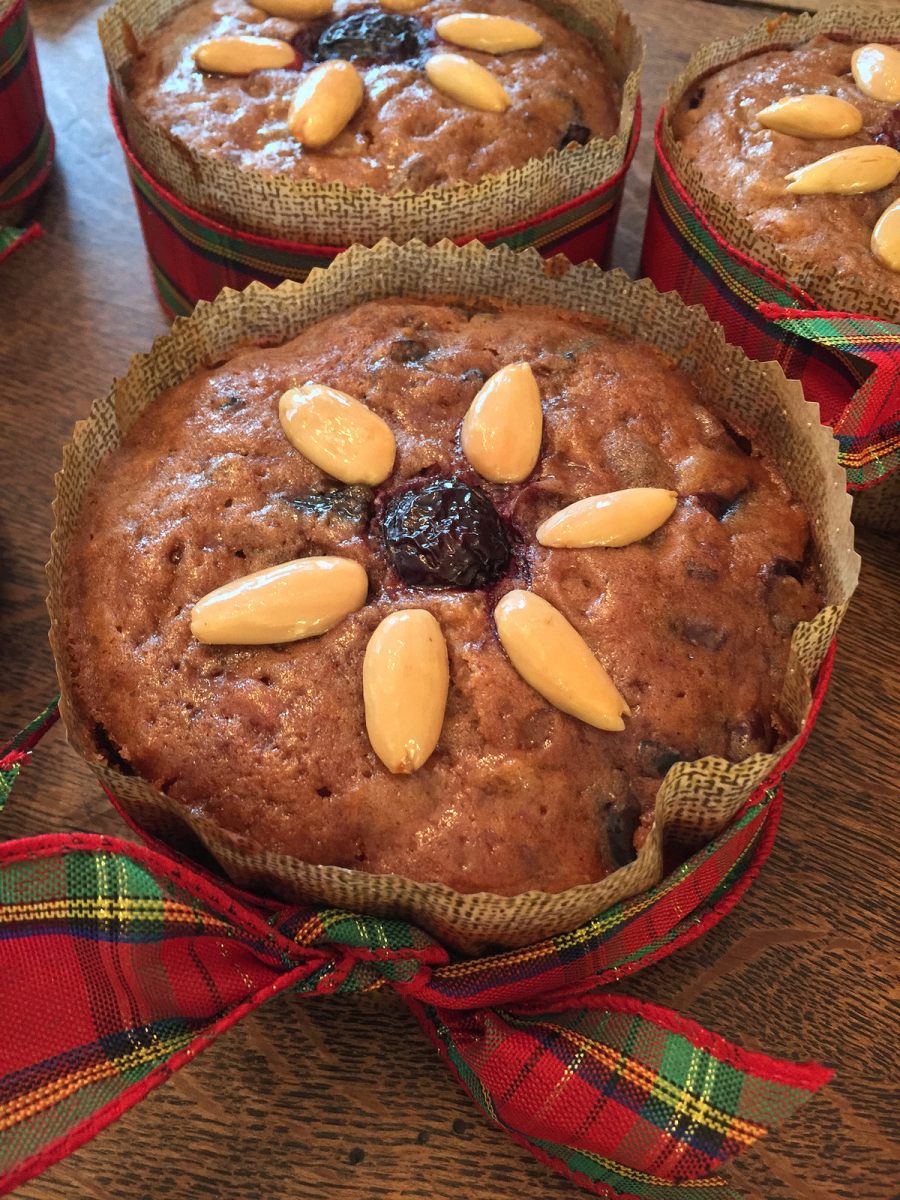
In 1797 Janet, then 60 years old, set up in business with her son, James, trading initially as James Keiller, changing to James Keiller and Son in 1804. Janet created a unique version of the Dundee cake – using their own candied orange peel and topping each cake with whole, blanched Spanish almonds. This was the first Dundee cake to be produced on a commercial scale….and was a massive success for the business. Even after the deaths of both her husband and son, Janet continued to run the Company with her daughter-in-law, Margaret…. So popular and in demand was the cake, that it was soon embraced by other bakers, both North and South of the border….

Understandably, the Scots are very proud of the heritage of this cake and are eager to protect its origins with a Protected Geographical Indicator (PGI). In November 2014 the then Scottish Food Secretary, Richard Lochhead MP, launched a national consultation. An application was made to the EU under the ‘Protected Food Name Scheme’, which covers regional and traditional foods where the origins and authenticity can be guaranteed. If satisfied that a particular food has the correct characteristics, reputation and quality to the area it has been named after, the EU can award a PGI mark…. So, fingers crossed for Dundee that their cake may attain the same status held by the likes of the Cornish pasty and Champagne….
pies 11
veworthy via Foter.com / CC BY-NC Original image URL: https://www.flickr.com/photos/25785573@N06/39012740301/

Dundee cake is not the only festive fare we associate with Scotland. Christmas time sees the shelves of our shops stacked with tartan packaging that contains the traditional delight that is shortbread…. The origins of Scottish shortbread comes from the Medieval ‘biscuit bread’. The word ‘biscuit’ literally means ‘cooked twice’. Left over dough from bread making was slowly dried out in the oven to make a hard rusk. Gradually, this evolved; the yeast was replaced by butter and shortbread as we know it came to be….

To start with shortbread was an expensive luxury and used only at special occasions; weddings, Christmas, New Year…. Especially New Year – being offered to ‘first footers’ – and for the Pagans – as Yule cakes; symbolising the Sun…. (We’ll come to the importance of Yule very shortly)….

Mary Queen of Scots once again makes an appearance in the history of Scottish baking – she was obviously a lady with a very sweet tooth…. Apparently she was particularly fond of Petticoat Tails – a thin, crispy, buttery shortbread – traditionally flavoured with caraway seeds…. If the Queen favoured something, naturally it was bound to catch on….

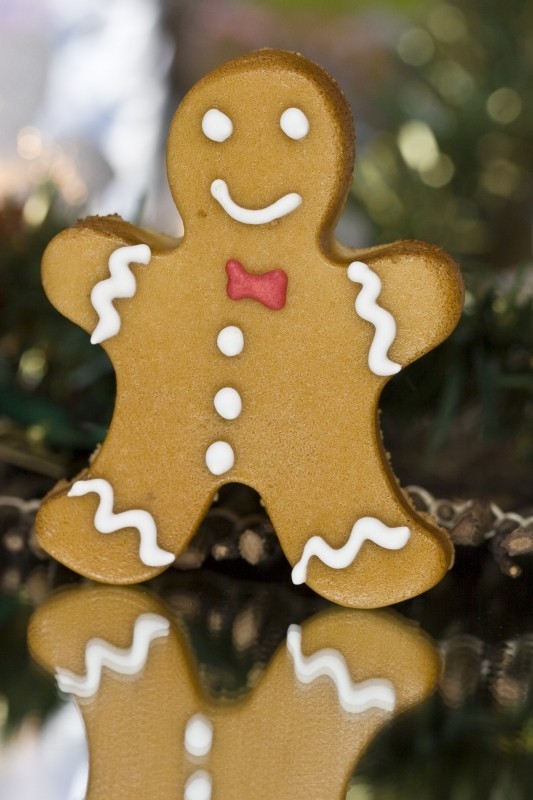
Another UK queen can be attributed to another popular biscuit of ours at Christmas time…. The Gingerbread Man….
pies 14
Gingerbread Man via Foter.com

Gingerbread dates to the 15th Century….but the first gingerbread figures can be documented to the Royal Court of Queen Elizabeth I in the 16th Century – when she had figures made to resemble her important quests to amuse them. In fact, she even had her own Royal Gingerbread Maker….

There was also a belief, among the Common-folk, that the ginger spice kept you warm in the winter, fighting those winter ails…(that’s a good enough excuse for eating ginger biscuits)…. Also, at this time, people believed in magic and witchcraft – some still do…. Gingerbread men were given to young women by witches and magicians as love tokens…. All the young woman had to do was get the man she desired to eat the gingerbread man that had been specially prepared for him – and then he would be hers….

“Run, run, fast as you can,
You can’t catch me, I’m the gingerbread man!”
                                                              -The Gingerbread Man – Nursery rhyme, 1800s

So, finally we come to the Yule log….

Burning the Yule log was originally a Nordic custom; Yule for the Winter Solstice…. The chosen log, or sometimes even a small tree, would ceremoniously be brought into the house – big enough to burn for the 12 days of Christmas. The largest end would be put into the hearth and then slowly fed in over the time – maybe it would be decorated with holly and ivy (to invite friendly sprites) and doused with cider or ale, before being left to smoulder for the 12 days…. Ash is the traditional wood, being a herb of the Sun; Ash brings light at the time of the Solstice…. Yule, when the dark half of the year gives way to the light – the shortest day comes to pass…. It also celebrates the rebirth of the Oak King – or Sun King…. The Yule log is the highlight of the Midwinter Solstice; it must have been harvested from the family’s own land – or at the very least given to them as a gift – never bought – money must never exchange hands…. Each year a piece of the log would be saved to light the next year’s Yule log…. The ashes from the burnt wood said to guard against evil and have medicinal properties; it was even thought to protect from lightning…. Spread upon the fields it promised a good future crop….

Traditionally in England, Oak was the chosen wood, in Scotland – Birch; whereas, in Devon and Somerset, huge bunches of Ash twigs were burnt instead of a log – symbolising the twigs gathered by the shepherds to warm Mary, Joseph and Baby Jesus….

Yuletide, Yulefest – eventually to become Christmastide – one of the many Pagan traditions hijacked by the Christian Church….

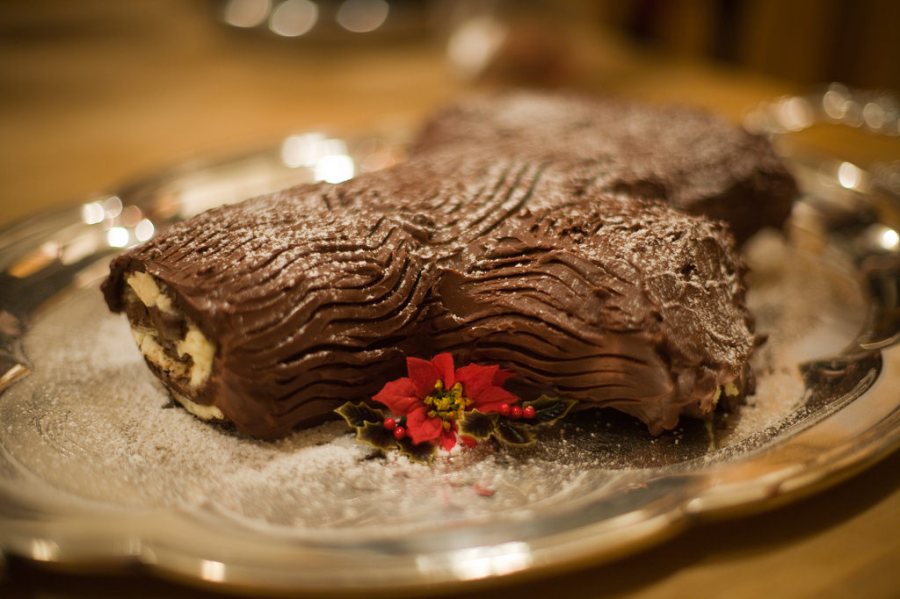
The actual Yule log cake possibly originates to the 1600s – sponge cake dates at least to 1615; the first known such recipe attributed to Gervaise Markham’s “The English Huswife”….
pies 15
Buche de Noel nerdcoregirl via Foter.com / CC BY-SA Original image URL: https://www.flickr.com/nerdcoregirl/3170159856/

Nowadays, we all love that roulade, with its decadent chocolatey taste – along with all those other festive treats, that we may somewhat take for granted…. Did you know however, it is possible we are all technically breaking the law by indulging in them? On the 22nd December 1657, the Puritan Council of the biggest bah-humbug Christmas party-pooper of all time – one Oliver Cromwell – banned all Christmas festivities…. Nativity plays, carol singing, parties – all forbidden…. Mince pies, Christmas puddings, Yule logs – all became a definite ‘No No’…. In a bid to try and stop gluttony, one of the cardinal sins, these treats that we all enjoy so much, became illegal, as they were considered to be forbidden Pagan pleasures….

It is thought the laws were abolished when Charles II came to the Throne….although there are those who believe the laws still stand today – even though Royal approval was granted to the good old Christmas pud, when in 1714 King George I (the ‘Pudding King’) reinstated it as part of the Christmas meal….

Now, we Brits are always being told by ‘The Powers That Be’ that we’re all far too podgy and it’s not good for our health…. wouldn’t it be awful if our Government decided to reinforce some of those quaint, old, long-forgotten British laws in an attempt to make us all slimmer….? So, Ssshhh! Keep this quiet – we don’t want to go giving them any ideas… Go put the kettle on….let’s have that mince pie and a cup of tea….

Merry Christmas!! X

“Where do you want me to stick the tree, Santa…?”

“I believe in everything until it’s disproved. So I believe in fairies, the myths, dragons. It all exists, even if it’s in your mind. Who’s to say that dreams and nightmares aren’t as real as the here and now?…”  John Lennon

fairy 8
Believe I Tinkerbell chris.alcoran via Foter.com / CC BY-NC-ND Original image URL: https://www.flickr.com/photos/alc_chris/9723710634/

Do you believe in fairies? There’s plenty of folk who do…. How many among us have strapped on our ‘gossamer’ wings, slipped into a tutu, popped a plastic tiara on our heads and pranced around waving a sparkly wand, pretending to be one? Of course, as a child, I hasten to add – to do so as an adult would cause a few raised eyebrows; it would most probably be viewed as a borderline fetish…. But make-believe and fairy tales are as much a part of childhood as Santa Claus and the Easter Bunny….

fairy 1
Faeries Fouquier via Foter.com / CC BY-NC Original image URL: https://www.flickr.com/photos/fouquier/6485890383/

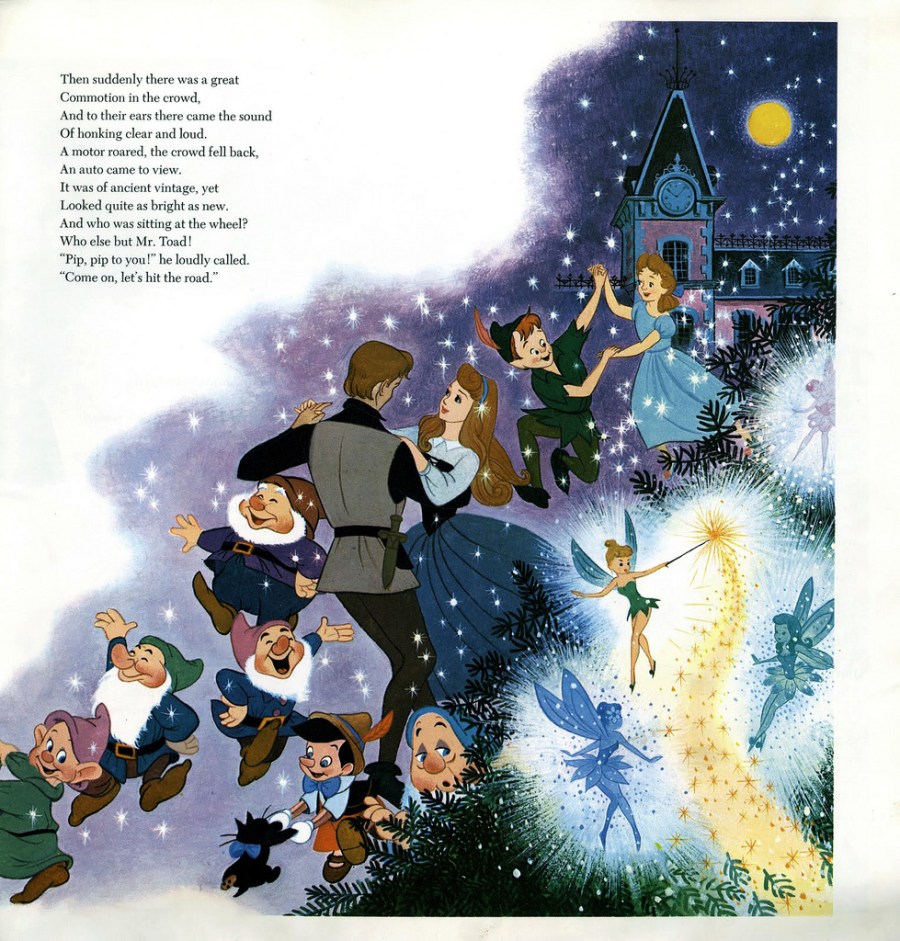
Thanks to popular children’s authors, such as Enid Blyton – and the wonderful films of Walt Disney – the stereotypical fairy is a firmly fixed image in our minds….

fairy 10
A Christmas Adventure in Disneyland 05 – Snow White Tom Simpson via Foter.com / CC BY-NC-ND Original image URL: https://www.flickr.com/photos/randar/10919556055/

However, the term ‘fairy’ actually covers a large range of supernatural, mythical beings…. Elves, goblins, banshees, pixies, brownies, kelpies, sprites, leprechauns, mermaids, changelings, nymphs, gnomes and seelies, to name but a few, can all be described as fairy folk..

But our modern-day nostalgic, affectionate view of the Tooth Fairy or pantomime fairy godmother – (let’s face it, Cinderella would never have got to the ball without one) – has not always been the case…. Wind the clock back to the Middle Ages and people lived in constant fear of them….

“Fairies, black, grey, green, and white. You moonshine revellers, and shades of night. You orphan heirs of fixed destiny, Attend your office and your quality….” William Shakespeare

Fairy folklore is prevalent in Celtic regions…. There is a belief, by some, that they are an ancient race who have inhabited the Earth since long, long ago and that they are descended from the Tuatha De Danann – the tribe of the High Priestess Dana, one of the most ancient Celtic goddesses…. Fairies are said to be able to see the future; they know all about the secrets of herbs and animals….they perform magic…. Sometimes they are friendly and helpful to humans but at other times they can be evil and troublesome – meddling in human affairs….

In fact – so unpopular were the fairy folk that extremes were taken not to even utter their name – they became referred to as ‘Little People’ or ‘Hidden People’; they were often regarded as ‘fallen angels’ – not quite good enough to be accepted into Heaven but not bad enough to be sent to Hell…. The notion of the fairy goes back long before the advent of Christianity; indeed, Pagan beliefs tell us these little folk live within holly bushes and hawthorn trees…. Later the focus switched to the Christmas tree, from the Pagan celebrations of the Midwinter festival, particularly those of Germany and Scandinavia….

Here in the UK, the first Christmas trees didn’t arrive until the 1830s – when they were introduced to us by Prince Albert. In the beginning a figure or picture of the Baby Jesus was put on top of the tree. In 1841 pictures appeared in newspapers of the tree belonging to Queen Victoria and Prince Albert, proudly displaying its angel perched upon the top; naturally the idea caught on…. Since that time most of our trees are adorned with either a star, to represent the Star of Bethlehem as seen by the Wise men – or an angel to symbolise Gabriel from the Nativity….over time many a tree topper evolved from an angel to a fairy….

fairy 11
Winter fairy katmary via Foter.com / CC BY Original image URL: https://www.flickr.com/photos/katmary/5227747833/

Although – there is another ‘tongue-in-cheek’ reason as to why we have a fairy adorning the top of so many of our Christmas trees…. It is the tale of a rather ‘bad day at the office’ for a poor, stressed out Santa Claus….

Santa was having a tough time of it; the elves were on strike, demanding more pay – so the toy making schedule was running way behind…. When Santa finally got around to loading the sleigh he found half the reindeer had bolted and the other half were pregnant…. On piling the sacks of presents into the sleigh, a floor board broke – sending toys tumbling in all directions…. At some point in the proceedings, Mrs Claus announced that her mother was coming to stay, which did not improve his humour…. With a sigh of frustration, Santa decided he needed a strong drink – only to find the elves had polished off all his booze. As if all this wasn’t enough, he somehow managed to clumsily drop the empty cider flagon and it smashed in to smithereens at his feet. Now in a somewhat foul mood he fetched the broom to sweep the fragments of broken pottery away, only to find the mice had been chewing at the bristles…. So, he really wasn’t in the best frame of mind when there came a knock on the door. Grumbling and cursing he flung open the door and found a rather sweet fairy standing there holding a Christmas tree…. “Merry Christmas, Santa…. Where would you like me to stick the tree?…”

fairy 2
Fairy’s toadstool katmary via Foter.com / CC BY-NC-ND Original image URL: https://www.flickr.com/katmary/5513557007/

This story is obviously intended as a bit of fun. Fairies appear in so many of our well-known stories and in even more that have long been forgotten…. Perhaps the oldest record in English literature dates back to the 13th Century and was by historian, lawyer, Churchman, Statesman and writer, Gervase of Tilbury (1150-1220). He, of course, was writing at a time when belief in the Little People was common place. Not having scientific explanations for the many natural phenomenons of the World, supernatural causes took the ‘blame’, not least the fairy folk…. People would go to great lengths to deter fairy visitors; St. John’s wort and yarrow were thought to ward them off….whereas hawthorn, foxgloves and groundsel were all attractive to them. At the time of Hallowe’en offerings would be made in an attempt to keep them sweet….

fairy 12
Water fairy katmary via Foter.com / CC BY-NC Original image URL: https://www.flickr.com/photos/katmary/4778581609/

In the time since Gervase of Tilbury fairies have been a subject explored by writers of all genres…. From verse penned by English poet Edmund Spenser to the writings of French author Charles Perrault.

fairy 4
Image from page 34 of “Una and the red cross knight, and other tales from Spenser’s Faery Queene,” (1905) Internet Archive Book Images via Foter.com / No known copyright restrictions Original image URL: https://www.flickr.com/photos/internetarchivebookimages/14596799959/

As children, we were all familiar with the stories by Hans Christian Anderson  and J.M. Barrie – who in his Peter Pan could arguably have created one of the most well-known fairy characters of all time – Tinkerbell….

“Fairies have to be one thing or the other, because being so small they unfortunately have room for one feeling at a time….”  J.M. Barrie, Peter Pan

Then, as part of our schooling, most of us would have studied the works of Shakespeare in one form or another….possibly coming across Titania, Queen of the fairies in A Midsummer Night’s Dream or perhaps the mischievous sprite Ariel in the Tempest….

Maybe the musical among us relate more to the Dance of the Sugar Plum fairy….from the Nutcracker – and probably one of the best recognised pieces of ballet music….

The Sugar Plum Fairy was not actually a character who appeared in the original story – ‘The Nutcracker and the Mouse King’ – written in 1816 by E.T.A. Hoffmann and upon which the ballet is based…. Tchaikovsky used some of the original numbers from the ballet to produce his Nutcracker Suite – he wrote ‘The Dance of the Sugar Plum fairy’ for a musical instrument he had excitedly purchased in Paris – the Celestra…. Looking like a small piano it produces a sound resembling tinkling bells…. Nowadays, we often associate this piece of music with Christmas….

For those who would like to believe that fairies really do exist there are obvious signs to look out for…. It is said that the time they are most likely to be seen is around Beltane, when Mother Nature is awakening from her slumber. For many, stumbling across a fairy ring is the only proof needed that they do indeed exist among us.

fairy 5
Walter Jenks Morgan (British, 1847-1924), “A Fairy Ring” sofi01 via Foter.com / CC BY-NC Original image URL: https://www.flickr.com/photos/sofi01/11406300036/

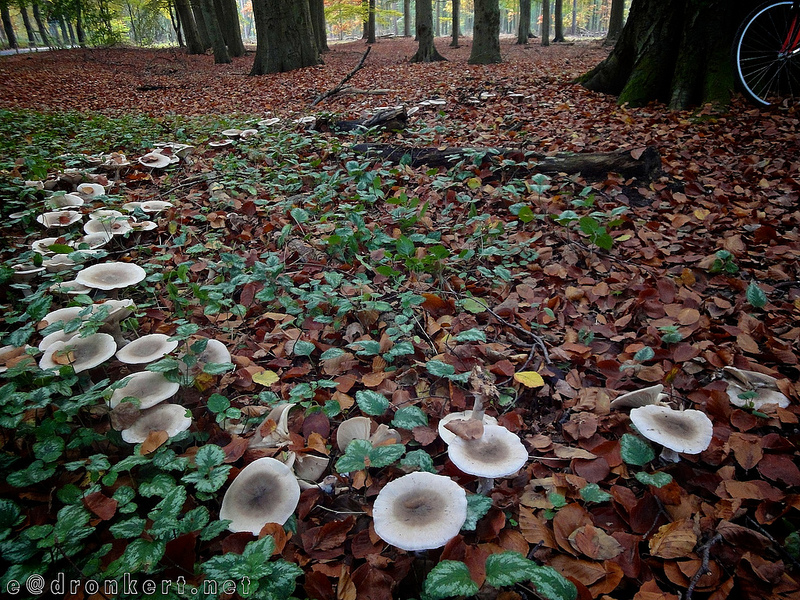
A fairy ring is a naturally occuring circle of mushrooms or toadstools; it is believed to be a place where fairies dance and sing – and many view it as a dangerous place for humans – it is full of dark magic and best avoided at all costs…. In Germany they are known as ‘witches rings’; in Dutch superstition it is where the Devil churns his milk….

fairy 6
Grote heksenkring in Lage Vuursche ednl via Foter.com / CC BY-NC-SA Original image URL: https://www.flickr.com/photos/dnet/8148844932/

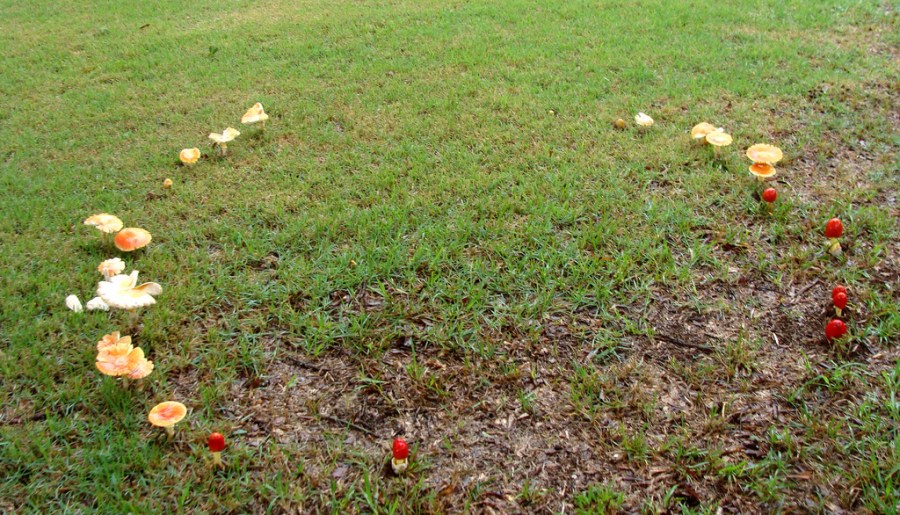
The main part of the fungi that produce these rings is located under the soil; it feeds upon the nutrients it finds there, pushing further and further out in a circular shape, searching for new food – the circle increasing in size as time goes by…. Periodically up pop the toadstools, creating the ring we are familiar with…. Some rings can be hundreds of years old; the largest one ever found is in Belfort, France –  it is some 2,000 feet (600 metres) in diameter and about 700 years old…. So, are fairy rings magical? Perhaps not when one pops up in the middle of your well manicured lawn….

fairy 7
Fairy Ring in a lawn Martin LaBar (going on hiatus) via Foter.com / CC BY-NC Original image URL: https://www.flickr.com/photos/martinlabar/6017436516/

As fairies are such a major part of European folklore it’s only fair to say every region, county or even village will have its own tales to tell….not least Dunsfold….

Vaguely, I remembered hearing there was some connection with fairy folk and the village, when we first moved here some twelve or thirteen years ago…. So, I thought a little digging was required….

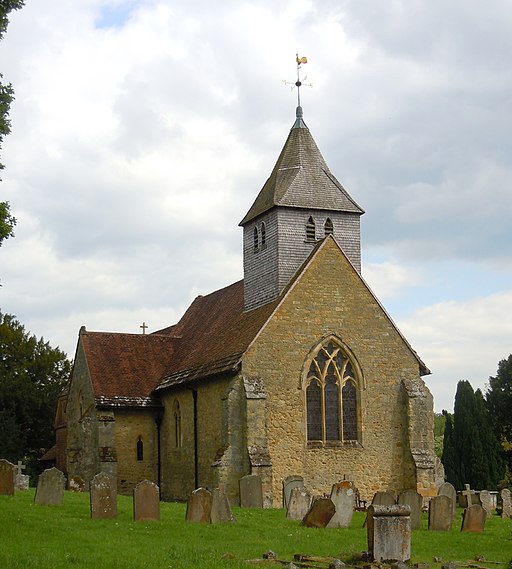
Turns out the story originates from the building of the church back in the 13th Century…. Saint Mary’s and All Saints is situated about a mile from the centre of the village; in days gone by it would have been a long, wet, muddy walk every Sunday – wellie boots would not have been an option…. It is built on the site of an ancient chapel and close by is a holy well, sacred from very early times and most likely a place of Pagan worship…. It is believed the waters from the well have medicinal properties and are able to cure afflictions of the eye…. There are tales of the Virgin Mary making an appearance there and it has often been a place of pilgrimage for Roman Catholics…. When the time came for a new church to be built in Dunsfold, it is believed many of the villagers wanted it to be located nearer to the centre of the village…. However, traditionalists argued that it should be constructed on the existing sacred site (as was often the case at the beginning of Christianity). Naturally, the truth gets lost over the centuries – but it appears there were altercations between the builders and those who wanted the place of worship to remain at the existing Holy site…. Certain events were blamed upon the ‘Pharisees’….not to be confused with the biblical Pharisees and Sadducees; this is actually the Sussex and Wealden dialect double pluralisation of ‘fairy’…. The mortals wanted the church to be built within the confines of the village – the Pharisees desired it to remain at the sacred site….eventually tradition won….

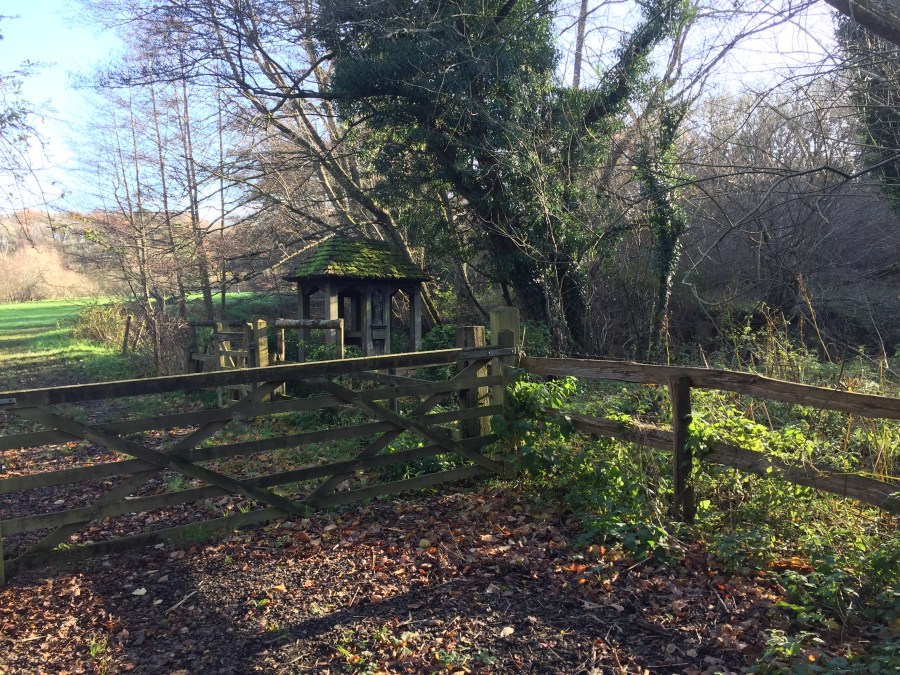
Feeling a little guilty, that in all the years of living in Dunsfold, I have never once gone in search of this sacred well, I decided I had better go and find it…. So, on Saturday afternoon, accompanied by Jordan (my 17-year-old son) – I did just that…. A chilly, late November afternoon – but blessed with glorious sunshine – we set off on a winter’s stroll….albeit a very short one…. In all honesty I had been expecting a bit of a hike – but the well is only a short distance from the church – down a footpath and situated on a tributary of the River Arun….

IMG_3178

There is not a lot to see…. A covered shrine of the Virgin Mary which was dedicated by the Bishop of Guildford on September 29th 1933….

However, it has an air of mystery surrounding it – and I have a feeling it has many more secrets and stories to be uncovered…. Maybe this will be continued….

So….do you believe in fairies? Personally – as a woman – I think I might be one!

“There is a latent fairy in all women, but look how carefully we have to secrete her in order to be taken seriously. And fairies come in all shapes, colours, sizes and types, they don’t have to be fluffy. They can be demanding and furious if they like. They do, however, have to wear a tiara. That much is compulsory….”  Dawn French, A Tiny Bit Marvelous

“Don’t mess with the fairies….”  David C. Mitchell, The Bone Clocks

fairy 13
pexels.com


Ride that broomstick…!

When you think of a witch, what image do you conjure up? Is it the one of an unkempt, old crone – dressed in black, with a flowing cape and pointy hat? Is she stirring a cauldron or flying on a broomstick, with her faithful cat? Where on Earth does this notion come from? Blame it on the drugs….

broom1
Going Home tsbl2000 via Foter.com / CC BY-ND Original image URL: https://www.flickr.com/photos/68942208@N02/16365078410/

Our vision of what a witch should supposedly look like is a fairly recent concept…. Go back to the pictures drawn by Medieval artists, during the times of the mass hysteria surrounding witchcraft – and a very different story is depicted….Wanton, naked women, cavorting with the Devil – if they did happen to be clothed, it was likely to have been in very ordinary attire of the day; any hat would most probably have been a simple bonnet. It wasn’t until the early 1700s that Western European artists began to draw witches with long pointed hats, possibly to symbolise devil horns, an indication to ‘dark magic’ – very likely coming from the Salem witch trials, after witnesses claimed to have seen the Devil himself – ‘a large man in a high-crowned hat’…. Later, during Victorian times, children’s books elaborated and exaggerated the image, adding the long black flowing cloak….

broom8
“Witches” Artist Hans Baldung 1508 Source: R.Decker, Hexen, Frontispiz (2004) This is a faithful photographic reproduction of a two-dimensional, public domain work of art

Back in the Middle Ages the World would have been a very scary place to live in….lack of scientific knowledge meant answers to the unexplained had to be found elsewhere…. For any situation – good or bad – that could not be accounted for by the obvious – it had to be down to magic…. People lived in constant fear of otherworldly beings….ghosts, fairies, monsters, witches…. At the same time, life was hard in so many other ways – not least the challenge of providing enough food to feed the family; not having the option of nipping to the local supermarket meant finding supplementary foods for the diet in any way possible – foraging was common-place….It is hardly surprising therefore, that certain plants were happened upon that had adverse effects on the body and mind – (indeed, the beginnings of our modern-day medicine can be attributed to some of these discoveries)…. Some of these discoveries would have actually of provided effects on the mind that some would have found rather pleasurable….

We may consider drug taking for recreational purposes a modern-day problem but people have been using mind-altering drugs since prehistoric times…. The earliest evidence of an alcoholic beverage dates back to 7,000-6,600 BC. Pottery shards discovered by archeologists, in the ancient Chinese village of Jiahu, were found to have remnants of an alcoholic drink consisting of ingredients such as rice, honey and fermented fruit….

Archeological finds in Mexico, Guatemala, El Salvador and Honduras suggest hallucinogenic mushrooms were used between 500 BC and 900 AD. Fossil remains of a hallucinogenic cactus – ‘San Pedro’ – were found in a Peruvian cave and date back to between 8,600 and 5,600 BC. Finds in Northern Mexico and Southern Texas of Mescal bean seeds, dating from the end of the 9th millennium BC to 1,000 AD, all point to evidence Mankind has used hallucinogens almost from the beginning of his time on this planet…. A long with proof of opium being used from the mid 6th millennium BC, to South Americans chewing cocoa leaves 8,000 years ago and Argentinians smoking pipes as far back as 2,000 BC – it seems Man has always been getting high on some kind of drug or other….

So, what were they up to in The Middle Ages? As is so often the case, many a discovery is made by accident…. Bread has long been part of the staple diet of the World and Rye-bread would have been the most common type consumed in Medieval Europe…. Rye is susceptible to a fungus called ‘Ergot’ – eaten in large quantities this fungus can be fatal but smaller amounts cause a hallucinogenic reaction. Accounts from between the 14th and 17th Centuries record Europeans dancing through the streets, jabbering nonsense and foaming at the mouth after consuming Rye-bread infected with Ergot. Very often, large groups of people would carry on like this until they collapsed from exhaustion; when asked, they frequently claimed to have seen wild visions…. It became known as St. Vitus’s Dance – so named after the 4th Century Sicilian martyr, St. Vitus – Patron Saint of Dancers. We would nowadays liken the effects of Ergot to those of LSD….

Human nature, being what it is, meant there were those keen to experiment and gain knowledge to exactly what certain plants could do to the body – not always with the best of intentions…. Dabbling with ‘herbal remedies’ and in some cases outright poisons formed the basis of many an accusation of witchcraft….

broom5
Witch’s tools http://www.chrisbirds.com via Foter.com / CC BY-NC-ND Original image URL: https://www.flickr.com/photos/118292762@N02/16339427989/

In 1324, Lady Alice Kyteler was the first ever accused witch in Ireland….after some very damning evidence collected with which to condemn her…. Alice Kyteler was born as an only child in 1280 – By all accounts, those who knew her, thought her to be arrogant and bossy – she wasn’t much liked…. However, certain aristocratic gentlemen seemed to find her attractive and she went through a quick succession of wealthy husbands, each coming to an untimely end…. Rumours began to circulate…. At the age of 44, Alice was on her 4th husband, Sir John Le Poer…. Eventually, as the rumours became more rife, Le Poer became suspicious and carried out a search of his wife’s bed-chamber…. What he found were items referring to the Devil and evidence that Alice was an expert in the art of poisoning. Drawing the conclusion that she intended him to be her next victim, Le Poer sent his finds to the Bishop of Ossory….

The Bishop, one Richard De Ledrede, was a man on a mission – he was obsessed with exposing witches…. Alice, her son – William Outlawe (from her first marriage) and her personal maid, Petronilla de Meath, were all arrested….

The rumours continued to grow, stories became embroidered – tales of her sacrificing animals, performing black magic in local churches and carrying on with a strange man called Robert Artisson – who some believed could manifest himself as a black cat – (was this a symbolisation of the Devil?) – all added fuel to the fire…. The Bishop, although he hunted rigorously, never did manage to find this elusive man….

It all became too clear that Alice had indeed murdered her previous 3 husbands and aimed to kill her 4th…. Her reason? Pure greed, a desire to gain more money….

However, the Bishop did not have the power to bring Alice to trial…. Witchcraft and sorcery was overseen by the Lord Chancellor of Ireland, who happened at the time to be a certain Roger Outlawe, a relative of her first husband…. Outlawe and other rich relatives supported Alice and had the Bishop imprisoned within a castle for 18 days…. On eventually regaining his freedom, De Ledrede resumed his quest to bring Alice to justice….but by then she had fled to England, leaving behind her maid and even her son to face the consequences…. William begged for forgiveness, which he was granted – but in return he had to pay for a new roof for St. Mary’s Cathedral…. The maid, Petronilla did not have such luck – under torture she admitted Alice had taught her the art of witchcraft…. She was flogged and burnt at the stake on November 3rd 1324…. Alice was never heard of again….

broom10
Burning witches, with others held in stocks 14th Century Author: Anonymous Public Domain Source: http://molcat1.bl.uk/llllmages/Ekta%5Cmid/E124/E124110.jpg

There are many plants Alice could have used to make her poisons…. Some of the most common belong to the Solanaceae family. Consisting of approximately 98 genera and some 2,700 species, many of these plants will be very familiar to us today….potatoes, tomatoes, aubergines, peppers, chillies, foxgloves, petunias, tobacco and deadly nightshade to name but a very few….

Written references to deadly nightshade being used as a ‘flying ointment’ go back to at least the 9th Century…. Deadly nightshade, if taken orally, can speed up the heart and be fatal; however, when applied to the skin in small quantities it can cause hallucinations…. People began to make the connection to how certain plants could make an impact upon them and started to experiment in how to use them safely…. Mixing a concoction of deadly nightshade, hemlock, henbane, mandrake and wolfbane, usually in a base of animal fat, produced a potent balm called ‘flying ointment’…. All of these plants contain hallucinogenic chemicals known as ‘tropane alkaloids’ – causing vivid dreams that take the user to another world of fantasy – full of pleasure….feasting, dancing, singing and loving…. (apparently)….  Perhaps not so much ‘black magic’ but simply chemistry…. For those who found the World a particularly hard place to live in back in the day – such escapism must have been so very tempting…. For women, particularly, exploring their own sexuality, liberation and self-pleasure – totally unthinkable at the time – this would have been seen as a link to the Devil himself….

However, ingesting any of these ingredients causes a problem, in the form of nausea and vomiting. It became realised that the body can absorb in other ways….namely through the sweat glands – particularly those located in the armpits and genital regions….

Now…. I have often wondered why witches are associated with broomsticks – but never in a million years would I have suspected a reason such as this…! The broomstick, or besom broom, a symbol of feminine domesticity – yet at the same time, a phallic, sexual symbol – or perhaps in the case of the witch – one of femininity gone wild and out of control….

broom7
Image from page 293 of “St. Nicholas [serial]” (1873) Internet Archive Book Images via Foter.com / No known copyright restrictions Original image URL: https://www.flickr.com/photos/internetarchivebook images/14772736232/
The besom broom was often used in Pagan fertility rituals….poles, pitchforks, brooms – in fact anything resembling a phallic object – were carried by folk dancing through the fields, jumping as high as they could, to encourage the crops to grow…. Then there is the traditional ‘jumping of the broomstick’, a feature of the Wicca hand-fasting ceremony – the broom being a reference to new beginnings, sweeping away the old…. The besom is also used in Wicca to cleanse and purify a space which is to be used for a ritual ceremony – sweeping out negative energies….

broom6
Jumping the broom! morgan.cauch via Foter.com / CC BY-NC-ND Original image URL: https://www.flickr.com/photos/67297972@N04/6444876189/

So, why the connection with the witch of the Middle Ages? For that, we need to refer back to the application of that ‘flying ointment’…. Having discovered it could be applied to the sweat glands, especially those that are in a very intimate place if you happened to be a woman, a utensil was required in order to apply it…. What better than the handle of one of the most common household items – the humble broomstick!! Yes, I’m serious….they really did do just what you’re thinking…. It puts a whole new definition on ‘riding that broomstick’…!

“In rifleing the closet of the ladie,
they found a pipe of oyntment,
wherewith she greased a staffe,
upon which she ambled and galloped
through thick and thin….” – English historian Raphael Holinshed – 1324 –
with reference to the evidence collected against Lady Alice Kyteler…

“The vulgar believe, and the witches confess,
that on certain days or nights they anoint a staff
and ride on it to the appointed place or anoint
themselves under the arms and in other hairy places….”
– Theologian Jordanes de Bergamo – ‘Quastio de Strigis’ – 1470

I will never look at a broomstick in the same way again….

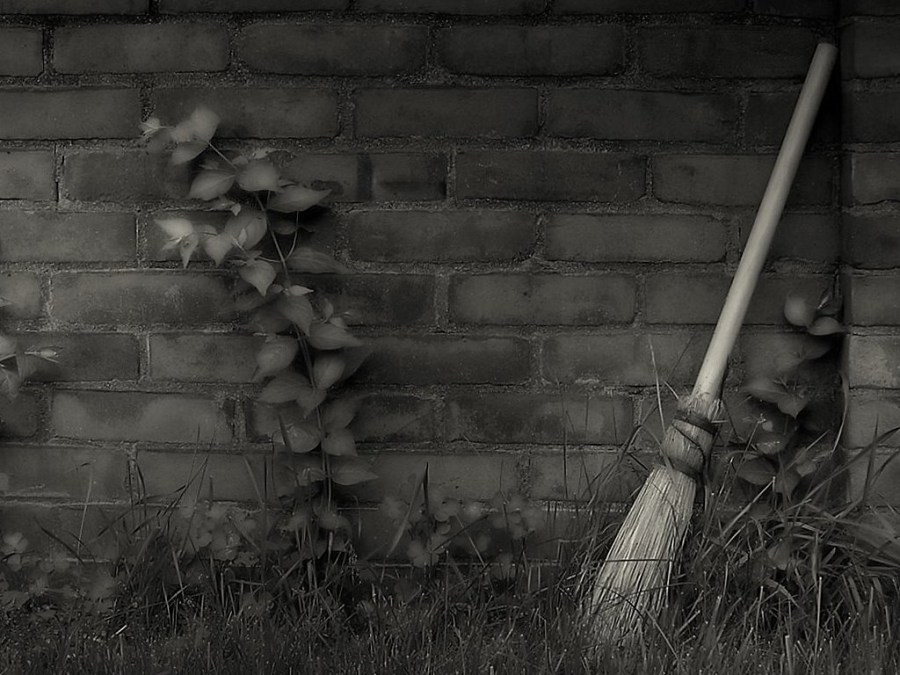
broom2
Besom in the Corner It’sGreg via Foter.com / CC BY-ND Original image URL: https://www.flickr.com/photos/itsgreg/514745734/

Eyes to the skies….over Dunsfold….

I suppose you would hardly call Dunsfold a “chocolate box” village – however, it does have a certain charm all of its own. Indeed, William Morris once described its church as being the most beautiful in all of England; Saint Mary’s and All Saints can even claim to have the oldest pews in the Land…. The church was built in the late 13th Century, on the site of a Norman chapel, close to a holy well, which was once visited by pilgrims, as it was believed its waters could cure diseases of the eye….

skies21

Dunsfold is a village in the county of Surrey, in the South East of England; it lies in the Weald (the area between the North and South Downs) – 14km South of Guildford and the nearest town being Godalming. It is neighboured by Cranleigh, said to be the largest village in England…. Dunsfold covers an area of 16.06 km² (6.2 sq miles) and the 2011 Census recorded a population of 987, with 467 dwellings, some of which are particularly old…. The village is surrounded by farmland and woodland and is situated at the base of the Surrey Hills…. Dunsfold itself is spread out over grass-land and common-land, with several ponds of notable size, attributed to being located on Wealden clay…. There is an extensive network of bridal-ways and footpaths in and around it, enabling walkers to explore and discover the village and surrounding area…. Maybe the privately owned deer-park – with its herd of white fallow deer – or within the village itself, the pub – (The Sun Inn)….or the cricket pitch – the village shop, with its own post office (a ‘hub’ of local life) – the fire station…. Yes! I did just say ‘fire station’…. Why on Earth would a village the size of Dunsfold need one of these? Ah! Now that is because it is the location of something that really does put it on the map….Dunsfold Aerodrome; (well to be correct half the area the airfield occupies does actually officially lie within the boundaries of the neighbouring village of Alfold)…. “Never heard of it”….many of you will mutter – but you may well of heard of one of the BBC’s most popular TV shows – Top Gear….

skies11
Top Gear! Fenners1984 via Foter.com / CC BY-NC-ND Original image URL: https://www.flickr.com/photos/fenners/9367527706/

Even if you are not a fan and don’t watch it, no doubt you will recall the controversy that surrounded it in recent times…. Since 2002 the aerodrome has been home to Top Gear; one of the hangers is used as a studio and it is the residence of the famous test track, (designed by Lotus test drivers), with its Hammerhead, Chicago and Wilson Bend…. A test track now also used by local driving schools for the under 17s to learn how to drive a car, before venturing out on to the public highways….where my own boy, Jordan, is taking a lesson this very coming Saturday morning…. Wish him luck as he’s let loose on that very famous test track….

Of course, the use of the aerodrome doesn’t just stop there; the track itself is used for cycle racing during the summer months and until recent years the airfield was the base of the Surrey Air Ambulance. It is also home to many businesses, including warehouses, storage and offices….but we must come back to the filming…. A part from Top Gear a number of other popular TV programmes have been recorded there; Panorama, Watchdog, Spooks and the well-known ITV science fiction drama Primeval, to name but a few. Several major films have also made use of the location, such as The Da Vinci Code, Nanny McPhee and the James Bond movie Casino Royale. One of the main reasons Dunsfold Aerodrome is such an attractive proposition for film makers is down to its resident Boeing 747 – the only one in Europe that is used exclusively for filming. The 747 was in service with British Airways until its retirement in 2002; it was then bought by a company called Aces High Ltd., who specialise in supplying aircraft for film and TV work. You may have seen it in the series ‘Come Fly with Me’, starring Matt Lucas and David Walliams….or perhaps more recently when it was dressed as Air Force One in the 2016 film London has Fallen….

skies23
Photo credit: Andrew Ebling Boeing 747 G-BDXJ (previously known as City of Birmingham)

Dunsfold Aerodrome also holds various events, from supercar racing to the annual Wings & Wheels airshow and motoring display. Held every August Bank Holiday, the two-day show attracts some 40,000 visitors; it was first held in 2005 with the aim of fundraising for numerous charities. Although the roar of noisy ‘planes may not be everyone’s cup of tea, many villagers either gather on the Common or watch the air display from their gardens…. The weekend before last was indeed August Bank Holiday and we were, for once, blessed with glorious weather….perfect to spread a picnic rug out on the grass and enjoy what was a spectacular show…. For those actually attending the event there is obviously so much more to see; motoring demonstrations, static displays, all kinds of cars – vintage to supercars, monster trucks to military vehicles – for those inclined there’s something for everyone…. For the rest of us, observing from the outside, it’s all eyes to the skies…. The most adrenaline fuelled contribution has to come from the Eurofighter Typhoon; the roar from its twin EJ200 engines sends a thrill that goes right through you….

This year we were also treated to displays from the Norwegian Historic Vampire Pair, B17 Sally B, RAF Chinook and the Tigers Army Parachute Display Team.

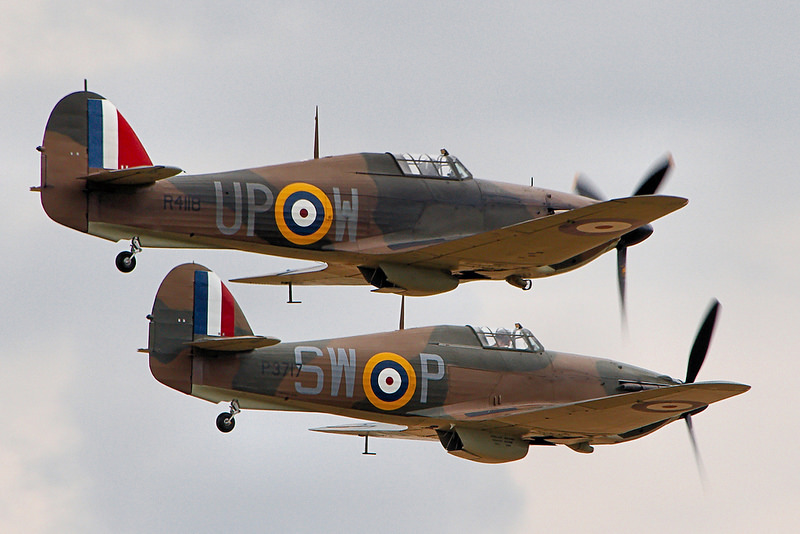
A Hurricane, Spitfire, Messerschmitt 109 and Mustang added some nostalgia….(usually the Battle of Britain Memorial Flight attends the show but unfortunately, due to technical problems it was absent this year).

skies9
Hurricanes – Flying Legends 2017 Airwolfhound via Foter.com / CC BY-SA Original image URL: https://www.flickr.com/photos/24874528@N04/35625023842/
skies8
Spitfire and ‘109’ – Flying Legends 2013 Hawkeye UK via Foter.com / CC BY-SA Original image URL: https://www.flickr.com/photos/ajw1970/9293981825/

We were entertained by The Blades, chasing each other across the skies and saw a variety of helicopters, including the Apache…. Then of course, there was everyone’s favourite….The Red Arrows – The Royal Air Force Aerobatics Team; their motto being “Éclat” – meaning “excellence”….for they really are the best of British….

The Red Arrows are pictured as they fly in tight formation during display training
The Red Arrows are pictured as they fly in tight formation during display training Defence Images via Foter.com / CC BY-NC-ND Original image URL: https://www.flickr.com/photos/defenceimages/5038167323/

The Red Arrows were formed in late 1964 and flew for the first time in 1965. Prior to this time there were several other aerobatics teams operating; it was felt too much time was being spent by pilots practising and so it was decided to amalgamate the teams into one. 1947 saw the first jet team of de Havilland Vampires based at RAF Oldham; in 1950 another team of 7 Vampires formed and were the first to use smoke trails in their display. Hawker Hunters were used for the first time in 1955.

The first official RAF team was formed in 1956 and used a uniform colour scheme of black – they became known as The Black Arrows…. In 1958 they set a World record by performing a loop and barrel roll involving 22 Hunters. They were the RAF’s premier team until 1961, when the role was taken over by The Blue Diamonds, with their 16 Hunters. 1960 saw the arrival of The Tigers with their supersonic Lightnings, who sometimes performed co-ordinated displays with The Blue Diamonds…. In 1964 the position of lead RAF display team was taken over by The Red Pelicans, flying 6 BAC Jet Provosts. At the Farnborough Air Show, that same year, another team flying 5 yellow Gnat Trainers from No.4 Flying Training School also flew….they were known as The Yellowjacks….

skies14
Yellowjack Gnat G-MOUR Take Off eppingforestdc via Foter.com / BY-NC-ND Original image URL: https://www.flickr.com/photos/eppingforestdc/12790881633/

Initially The Red Arrows flew Folland Gnat Trainers, which were inherited from The Yellowjacks; the Gnat being less expensive to run and maintain than other fighters. The ‘planes were painted red, possibly in homage to The Red Pelicans but also because the colour is more visible and thus safer….

That first season saw the team fly 65 displays, the first public performance being the Biggin Hill Air Fair  on May the 15th 1965. In 1968 the team increased to 9, allowing that classic diamond that has become the team’s trademark formation….

skies2

RAF Fairford in Gloucestershire was the first base used by The Red Arrows but after Fairford became the test flight centre for Concorde in 1966, The Arrows moved to RAF Kemble. 1983 saw another move, this time to RAF Scampton in Lincolnshire, (famous for its role in the Dambusters raid in 1943). Scampton was closed in 1995 and The Arrows moved to nearby RAF College Cranwell; but as they were still using the airspace above Scampton, for practise purposes, the runway and emergency facilities had to be maintained…. So, on the 21st of December 2000 The Red Arrows returned to Scampton and it has become their permanent base and will remain so until at least the end of the decade….

The Gnats flew 1,292 displays in total and were replaced by the Hawk in 1980…. In 2002 the team flew with Concorde over London as part of Queen Elizabeth II’s Golden Jubilee celebrations and again, a decade later, The Arrows flew a fly past for her Diamond Jubilee…. They were also included in the 2012 opening ceremony of the London Olympic Games…. Each year they have a packed programme of air shows to attend; for example, Sunday the 27th of August they were here with us in Dunsfold at midday – then at 5.30pm they were entertaining the crowds at the Rhyl Air Show on the North East coast of Wales…. 2017 is the 53rd season for the team, which now consists of 9 pilots and 91 support members…. Long, long, long may they continue….

Dunsfold Aerodrome itself was built by the Canadians, as a Class A bomber airfield – it took just 6 months to build! It was known as Royal Canadian Air Force Station Dunsfold – later it was to become RAF Dunsfold….

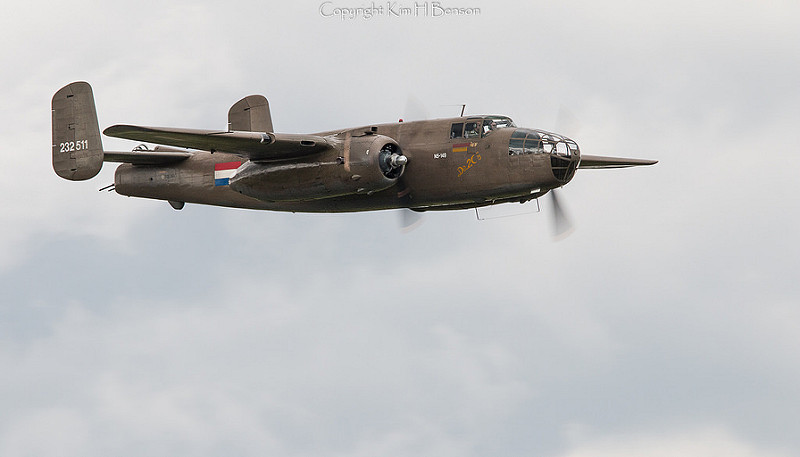
Life as an airfield began on the 11th of May 1942. The very first ‘plane to arrive at Dunsfold, on the 20th of July 1942, was a RCAF Tiger Moth – de Havilland DH.82 – a 1930’s bi-plane…. Some of the first aircraft to be based at the airfield included Curtiss Tomahawks and North American Mustangs. Later the B-25 Mitchell Bombers and Mosquitoes became resident…. 1944 saw the arrival of Spitfires, Typhoons and Tempests….

skies17
B-25 Mitchell Kimbenson45 via Foter.com / CC BY-NC Original image URL: https://www.flickr.com/photos/kimbenson45/14879394927/
skies24
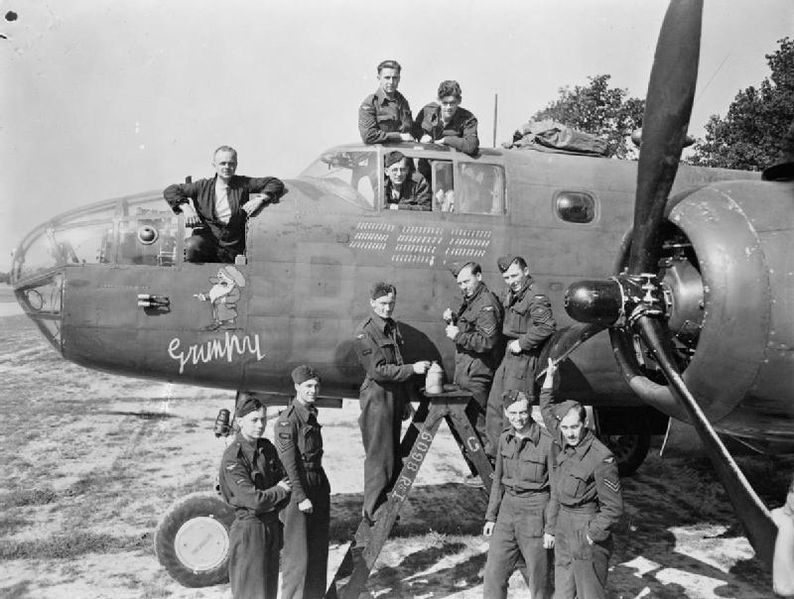
Ground personnel of No.98 Squadron RAF, who serviced North American Mitchell Mark III, HD372 ‘VO-B’ aka ‘Grumpy’ Date WW2 Photo CH 13734 from collections of the Imperial War Museums.
skies25
Mitchell Mark II arriving back at Dunsfold after sortie over enemy targets in France – 1943. Photo CH 11037 from collections of the Imperial War Museums.

After World War 2, the airfield was used to repatriate prisoners of war. Using Dakota, Stirling, Halifax and Lancaster aircraft, over 47,000 were brought back to British soil….

Dunsfold was declared an inactive airbase by the RAF in 1946. It was then employed by Skyways Ltd., an early British airline, which went on to become established as the largest non-scheduled passenger and cargo air service in Europe…. It also notably played an important civilian part in the Berlin Airlift…. As another ‘arm’ to its business, Skyways refurbished ex-RAF Spitfires and Hawker Hurricanes for the Portuguese Air Force…. Skyways went into liquidation in 1950….and so enter a new chapter in the history of Dunsfold Aerodrome…..

In 1950, the Hawker Aircraft Company took on the lease for the site and it became the development site for the Hunter Jet Fighter….a jet fighter that was to remain in military service until 2014, when it was still being used by the Lebanese Air Force….

In October 1960, Hawker Siddeley flight tested what was to become the Harrier; in 1961 the final assembly and test flying of the Harrier and Hawk trainer aircraft came to Dunsfold.

skies19
Spanish Harrier joseluiscel via Foter.com / CC BY-NC-SA Original image URL: https://www.flickr.com/photos/joseluiscel/35193485382/

The Hawker Company, based at Kingston, used Dunsfold Aerodrome as its test flight centre for testing and also the refurbishing of Hawks, Gnats, Harriers, Hunters, Sea Hawks and Sea Furies…. The Dunsfold site was protected by the Official Secrets Act right up to the 1990s and so limiting public access…. In 1977 Hawker Siddeley became part of British Aerospace…. In 1999 British Aerospace announced its closure of operations in Dunsfold….

Before closing this blog post, I feel it is important to remember all those who lost their lives at Dunsfold; those who flew from the airfield during WW2 and also the losses that occurred in the years to follow…. In 1975 a test flight of a Hawker Siddeley encountered a bird-strike shortly after take-off….which resulted in an emergency landing. The ‘plane over-shot the runway and ended up hitting a car on the A281 – killing all 6 occupants…. The aircraft then went on to burst into flames in a field….all 9 passengers and crew survived….

In 1986 Deputy Chief test pilot Jim Hawkins was killed, whilst testing a developmental Hawk 200, when it crashed on to farmland…. In June 1998 a Hawker Hunter crashed prior to an airshow….the pilot John Davis was killed…. (BAE, in those days, used to hold a staff family fun day, which included an airshow – it attracted some 13,000 visitors….a predecessor perhaps to Wings & Wheels)….

The most recent crash was in 2014 but luckily no major injuries were incurred….

In 2002 the site was sold to the Rutland Group and Dunsfold Park Ltd was formed. Thanks to this present ownership we have the likes of Top Gear and Wings & Wheels….and not to mention the many other fabulous events and productions it hosts; plus it is still an operational airfield for private and business flights…. Controversially, its future hangs in the balance….because of the proposal to build 1,800 houses on it. Obviously, this is a very emotional issue for many, one that divides opinion. An impending decision from the Government will soon decide its fate….I wont say which side of the fence I am on – but I think you can probably guess….

P1000234

Moving mountains….

For me, the best time of the year has to be Spring…. New beginnings – the promise of Summer to come….anticipating long hot sunny days and warm, balmy evenings…. After enduring months of dreary winter weather, surely we deserve just this? OK – this particular summer started on a very positive note – soaring temperatures, unbroken spells of sunshine…but then – Well! What the hell happened? The jet stream apparently….

I can’t moan too much…. I am very fortunate, as I have just had a fabulous two-week holiday in a part of the World that has become very dear to me…. When I first met John, nearly 15 years ago, he introduced me to a region in the South of France, somewhere very special to him…. A place we have visited almost every year since…

In the early days we would all travel down together; leaving at a very anti-social hour to catch an early ferry from Dover to Calais. The car would be fully laden, every inch of available space utilised – one year we even transported a sofa bed on the roof….

009

It was never the most comfortable of journeys, one that took the best part of 36 hours, including an overnight stop. John loves the drive – Jordan and I are less keen…. The final straw for me came the year we were unable to find somewhere to stay overnight and ended up ‘kipping’ in the car….only to breakdown the following morning, on the motorway just as we were about to cross the Millau Bridge… Not an ideal start to a holiday – especially as this particular one was rather special – it was our honeymoon…!

Nowadays, things are much more civilised. John still drives down – he heads off a couple of weeks before us, taking all our baggage and paraphernalia with him…. He’s happy – as he gets a bit of time to himself, does a few chores and unwinds…. Jordan and I then fly down to join him – leaving home at a very respectable 11am and arriving in Perpignan around 7 in the evening – where John meets us….

I love making the journey this way – it’s far more relaxed and I get to spend a little quality time with my son. Once landed, we’re off the plane, through passport control – and as we have no baggage – we’re out of the airport and into the car in a jiffy…. Perfect….!

Once we are out of the hustle and bustle of Perpignan, we’re on the road across the Plain of Roussillon to Llauro, a French Catalonian village, about half an hour’s drive away…. As the scenery rolls by I look out for the familiar landmarks, not least the majestic peaks of the mountain the is Le Canigou….

022

It is perhaps its isolation that makes Canigou stand out so much – whereas other mountains are surrounded by massive peaks within their range, Pic du Canigou stands proudly alone…. At an elevation of 2,784m (9134ft) it was, until the 18th Century, thought to be the highest peak of the Pyrénées – (This accolade actually goes to Anéto in the Province of Huesca, at 3,404m or 11,168ft)…. By mountain standards,  Canigou is not a massive peak, it is only the 395th highest in France alone….but this does not make it any less impressive….

Visible from much of Southern Languedoc-Roussillon, Canigou lies west of Perpignan and about 10km, as the crow flies, from Prades, a small town in the Eastern Pyrénées – and is within the Parc Naturel regional des Pyrénées Catalanes (Regional Natural Park of the Catalan Pyrenees). Canigou became a Listed Grand Site de France in 2002….

can 3
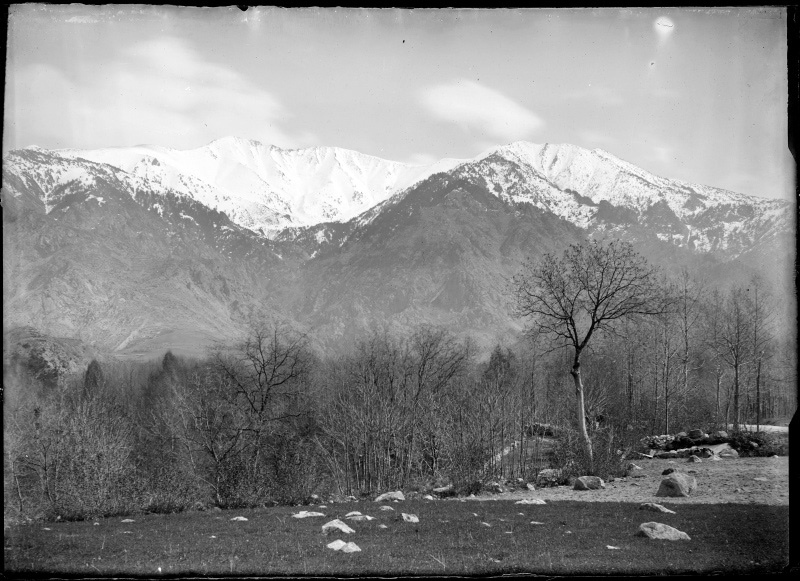
Le Canigou Museumdetoulouse via Foter.com / CC BY Original image URL: https://www.flickr.com/photos/museumdetoulouse/5953252959/

To the people of Catalan it is the sacred mountain – ‘La Muntanya Sagrada’. Canigou is a symbol of unity for those living on different sides of the border but sharing the same land….a physical and spiritual landmark…. For many, to climb it, is in fact a pilgrimage….

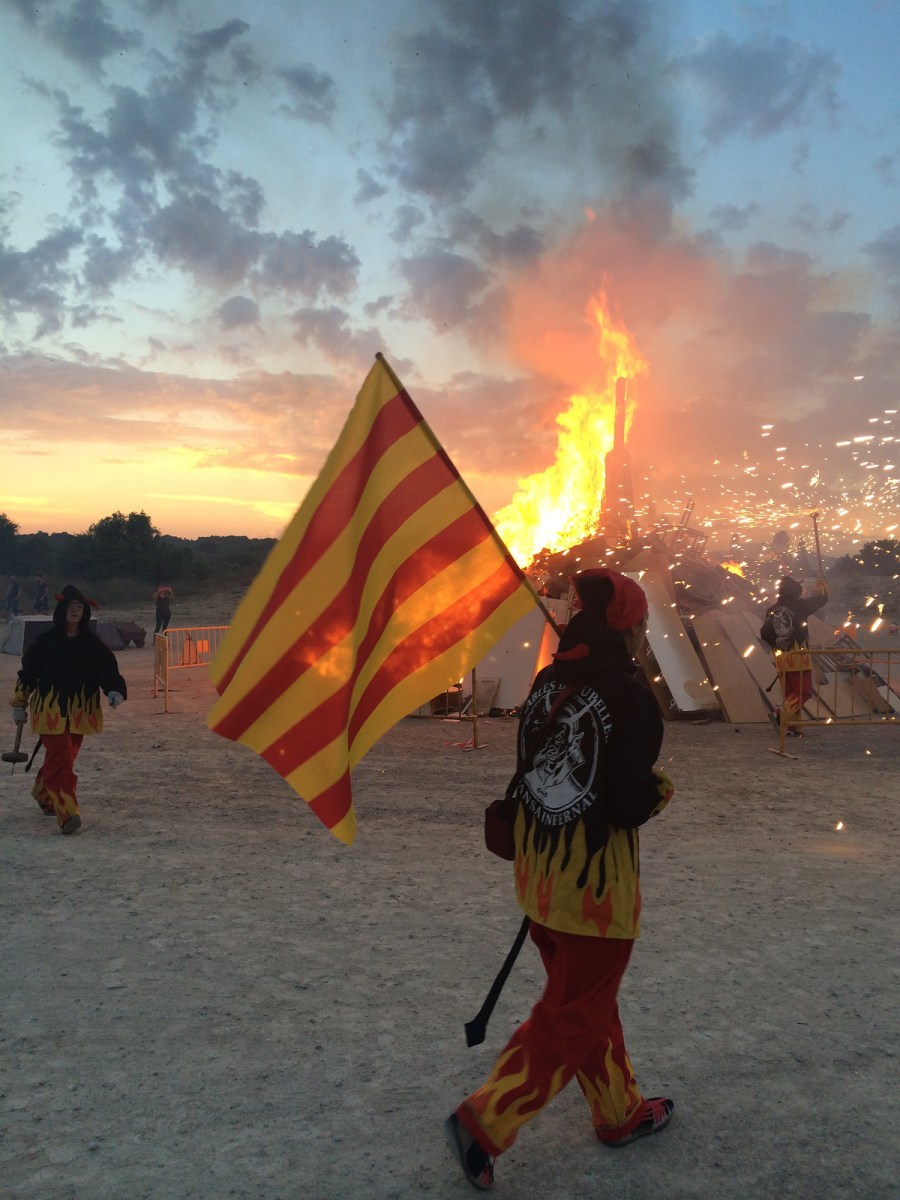
Many myths and legends surround the mountain and being the spiritual home of Catalan it is a place where French and Spanish Catalonians gather for certain celebrations. One such time being the Nuit de Saint-Jean – or the eve of Saint John’s Day – on the 23rd of June (which also coincides with the Summer Solstice). Saint John’s Day is the feast day of Saint John the Baptist – ‘Féte de la Saint-Jean’ – and is a Catholic celebration. On the night of the 23rd a fire is lit on the summit of Canigou – known as the ‘Flama del Canigó’ – the Ceremony of the Canigou Flame. A vigil is held throughout the night and from the flame torches are lit and relayed all across the Pyrenees and Catalonia, to light bonfires elsewhere…. Some sources say up to 30,000 fires are ignited from this flame….

can 6
Flama del Canigo 2014 Ajuntament de Cubelles via Foter.com / CC BY-NC-SA Original image URL: https://www.flickr.com/photos/ajcubelles/14503731145/

The weekend before Saint John’s Day sees the ‘Trobade’, which comes from the Catalan ‘Trobada’ – meaning ‘meeting’. Bundles of wood are taken to the summit where they are deposited – hidden within these bundles are messages of friendship, love and peace….

The first Sunday in August is also a notable date in the Canigou calendar – it is when the ‘Course du Canigou’ or Canigou Race takes place. It entails a 34km course, with a 2,180m climb, from the spa resort town of Vernet-les-Bains at the base of Canigou, to the summit and then back again…. Not for the faint hearted…!

can 7
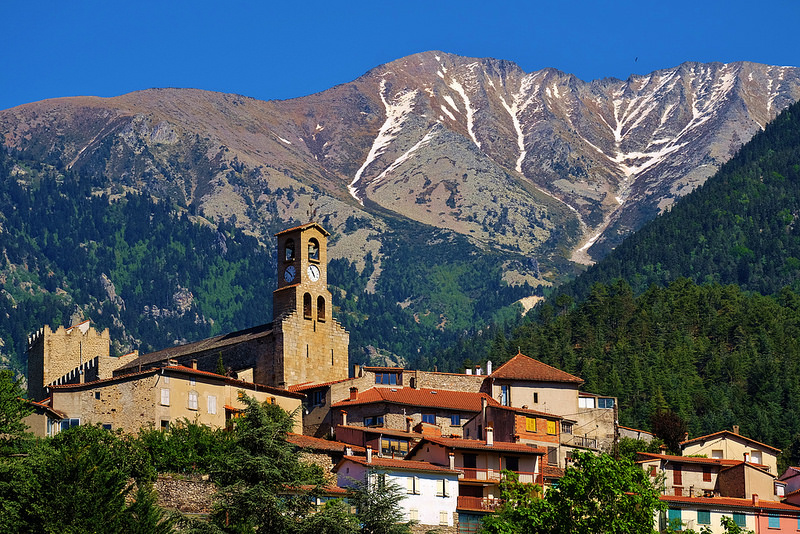
Vernet les Bains et le Pic du Canigou Thierry Llansades via Foter.com / CC BY-NC-ND Original image URL: https://www.flickr.com/photos/llansades/19021462329/

Personally, I have yet to climb to the summit of Canigou, the furthest I have been is to the Chalet des Cortalets, one of the starting points often chosen by those making a more serious ascent…. My son puts me to shame in this respect, he and John climbed to the top a while ago, when Jordan was just eleven or twelve years old….

057

The locals often say it is a savage mountain….the weather can be unpredictable, with fog and storms arriving with very little warning. In deed this was the case the time I visited, one moment it was glorious sunshine – the next we were amidst a ferocious thunderstorm…. So it is advisable to check the forecast thoroughly before attempting to make an ascent and to be aware the weather can change in an instant…. The best time to climb is June to September; it is wise to leave early in the morning to avoid the heat of the day. Some choose to spend the night before at one of the refuges, for example Cortalets, where  climbers and walkers can sleep, cook and refresh free of charge…. There is also a café at Cortalets….

can 1
Massif du Canigou, Refuge de la Jasse des Cortalets Thierry llansades via Foter.com / CC BY-NC-ND Original image source: https://www.flickr.com/photos/llansades/35317991041/

On the North side of the mountain there are jeep tracks; it is possible to drive a certain distance before having to resort to foot…. There is more than one way to tackle the climb – a popular choice is from the afore-mentioned Chalet des Cortalets; at 2,150m it is roughly a 3.5 hour round trip to the summit and back. Another well-known route is from the Mariailles Refuge – this is, perhaps, for more seasoned adventurers as it is approximately an 8 hour round trip….

DSCF0180

From the base to between 800 to 1,000m a Mediterranean climate prevails; between 1,000 to 1,700m it becomes a mountain climate. Venture up further, between 1,700 and 2,300m a sub-alpine climate is found and then 2,300m to the top it is an alpine climate…. Generally snow is continuous over 1,800m from mid-November through to May….

On the way up there is plenty of flora and fauna waiting to be discovered; you never know you may just spot a marmot or a vulture and there are plenty of eagles to be seen soaring in the skies….

On reaching the summit there is a cross to be found – often decorated with the Catalan flag and always adorned with offerings from climbers and pilgrims alike…. There is also an orientation table….

The view from the top is that of the Pyrénées Mountain range, the Roussillon Plain and the Mediterranean Sea…. On a clear day, Barcelona can be seen, which is 200km south, as the crow flies….

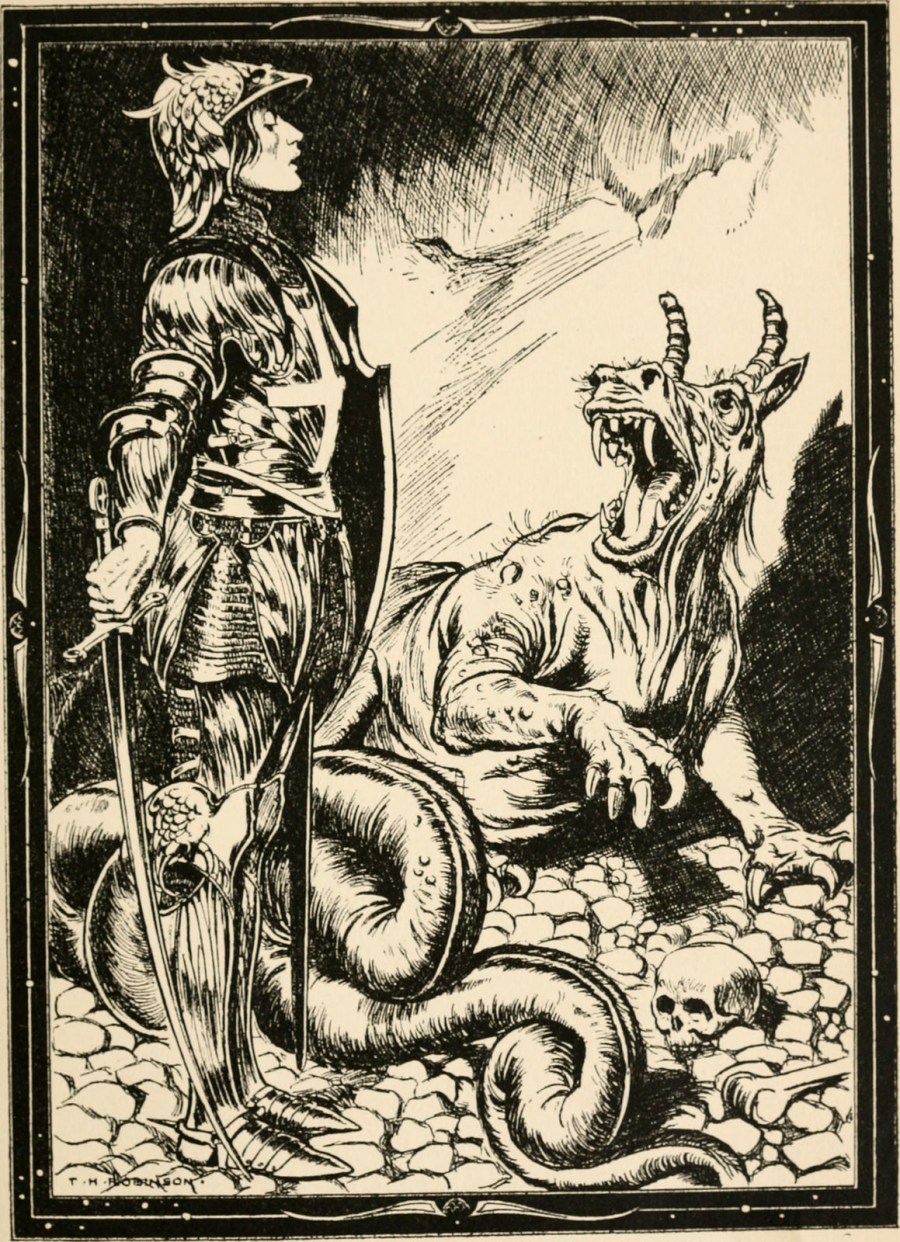
It is said the first ascent of the mountain was made by Peter III of Aragon in 1285 – (there is some discrepancy, as recorded by Italian monk – Fra Salimbene – as to whether he actually made it to the summit). Legend has it the king claimed to have thrown a stone into a lake on the mountain…. From the water emerged a dragon, so vast that when it flew into the sky it obscured the sun, blotting out the daylight….

For those not brave enough to attempt the climb to the summit, Canigou has two ancient monasteries at its foot that are well worth a visit….Saint-Michel-de-Cuxa and Martin-du-Canigou….

can 5
Abbaye Saint-Michel-de-Cuxa Phillipe Garcelon via Foter.com / CC BY-NC-SA Original image URL: https://flickr.com/photos/philgar/14819474690/

We visited Abbey-Saint-Martin last year. Quite a steep climb that zig-zags up the mountain side – but I’m glad we made the effort…. Built on a rocky peak, at the beginning of the 11th Century, by Count Guifred, it was a Benedictine Abbey for 800 years. It eventually fell into ruins but has since been restored and is now a spiritual retreat for members of the Communauté des Béatitudes – who are very welcoming to visitors, so during the holiday season it does tend to be quite busy…. On reaching the top, one simply has to take the path that climbs above the Abbey – to look down on what is one of the most stunning views imaginable….

The great-grandfather of Count Guifred was reportedly the founder of the Catalan dynasty. According to legend it was he who created the Catalan flag. Mortally injured in battle, he dipped his fingers into his own blood and drew them across his shield, creating four red stripes….he declared this was to become the ‘flag of Catalan’….

The first written references found relating to Canigou are in Latin from 949; ‘Montis Canigonis’ and ‘Monte Canigone’. The first written Catalan reference dates to 1300; ‘Canigó’ – from this comes the French – ‘Canigou’….

can 2
Image taken from page 189of ‘Promenades dans les Pyrenees. (2e Serie.) [with illustrations.] The British Library via Foter.com / No known copy right restrictions Original image source: https://www.flickr.com/photos/britishlibrary/11220814564/
One of the greatest Catalan poets, Spanish writer Jacint Verdaguer (1845-1902), celebrates Canigou in his works. In 1877 he wrote ‘Canigó, L’Atlàntida’ – an epic poem consisting of ten books! In it he covers many wonders such as the creation of the Mediterranean Sea, the discovery of the Americas and the sinking of Atlantis…. Manuel de Falla’s opera, ‘Atlàntida’ is based upon it….

can 8
Jacint Verdaguer, per Ramon Casas, 1901 Diari La Veu – http://diarilaveu.com via Foter.com / CC BY-NC-SA Original image URL: https://www.flickr.com/photos/diariveu/27458499185/

Canigou can only be described as one such wonder in itself….the way its majestic beauty dominates the Roussillon Plain…. Sometimes it looks peaceful and calm, with the sunlight glinting upon it…. Other times it looks moody and angry…. Occasionally it can’t be seen at all, as it is shrouded in mist and cloud…. Whatever mood Canigou is in – I, for one, never tire of looking at it….

At the end of each holiday it’s time to pack the car up again for the return journey. We all drive back together as I have not successfully managed to persuade John that it is absolutely necessary for Jordan and I to fly both ways…. It is an epic 18 hour non-stop door to door trip – and quite frankly a bit of a killer…. When we set off at first light I take one last look at Canigou – waking from its slumber – and I whisper ‘au revoir – until next time’…. I like to think Canigou bestows a little of its magic upon us, to see us home safe and sound….

1852