On this day in history : 25th July 1795 – The first stone of the Pontcysyllte Aqueduct, which carries the Llangollen Canal over the valley of the River Dee in Wrexham, North East Wales, is laid….
Credit : Arpingstone via Wikimedia – public domain
Pontcysyllte means ‘the bridge that connects’…. Designed and built by Thomas Telford and Williams Jessop it was considered a masterpiece of creative genius….and took around 10 years from design to completion….
Conceived as a waterway without locks the 307m long, 3.7m wide cast and wrought iron construction allows a cast iron trough to be supported 38m above the river on arched iron ribs…. The light but strong archways are in turn supported by 18 hollow masonry pillars; each of the 18 spans being 16m wide….
The mortar used was a mixture of lime, water and ox blood…. This may sound macabre but blood had been used in mortar for centuries; the haemoglobin found in blood helps strengthen mortar which is exposed to the elements – as it protects from breaking up in the freeze-thaw temperature cycles of climates such as ours here in Britain….
Above the 1.60m deep water trough a towpath was built and railings added to prevent pedestrians and horses from falling…. The project cost around £47K to complete – that is less than £4m in today’s terms…. The aqueduct was officially opened to traffic on the 26th of November 1805…. Since then it has been closed once every 5 years and the water drained to allow inspection and maintenance…. On the 27th of June 2009 the Pontcysyllte Aqueduct was made a World Heritage Site and is now a major tourist attraction….
On this day in history : 24th July 1837 – Robert Cocking, a professional watercolour artist with a keen interest in science, is the first person to be killed during a parachute jump….
Robert Cocking – Lithograph by Louisa Corbaux after J B Beeh – Public domain
In 1802 Cocking had seen Andre-Jacques Garnerin perform the first parachute jump on British soil – (the first modern parachute jump in the world was by Jean-Pierre Blanchard in 1785)…. Inspired by what he had seen Cocking wanted to improve on the umbrella-shaped design of Garnerin’s parachute…. Cocking’s ‘improved’ design was based on an inverted cone-shape – and he spent several years developing it….
Cocking’s ill-fated parachute design – Public domain
The idea was to launch his parachute from a hot air balloon and gently descend to the ground…. The venue was set at Vauxhall Gardens, London; a large crowd gathered to watch the event – and at 5pm Cocking began his ascent…. Only things were not to go according to plan….
The balloon shot rapidly upwards and the parachute was released….for a few moments it appeared to recover and hold steady – but suddenly it went into free-fall, turning inside-out and then breaking up…. Cocking plunged 5,000 feet to his death….
Cocking would have been killed instantly; his body was found in a field near to Lee, to the south east of London…. The cause of the accident was a combination of the parachute’s weight and its flimsy construction…. It was particularly weak in regards to the stitching that connected the fabric to the framework….
Following Cocking’s death parachuting became unpopular, being confined mainly to carnival and circus acts…. However, in the late 19th century safety developments, such as the advent of safety harnesses, made it viable once again….
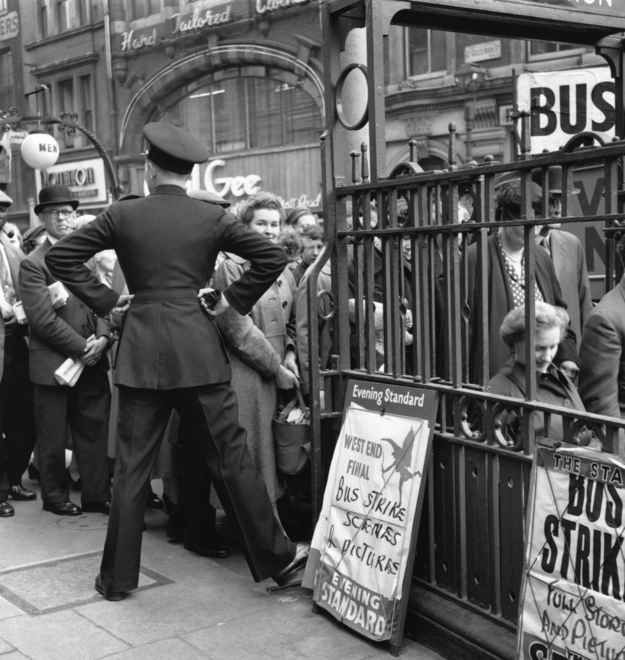
On this day in history : 23rd July 1957 – As a strike by busmen enters its fourth day there are violent scenes in towns and villages across the country….
Image via Pinterest
Around 100,000 employees of provincial bus companies had walked out on strike a few days before…. They were demanding a pay rise of £1 per week – but to date their employers had only offered 3 shillings per week, claiming this more than compensated for the rise in the cost of living since the last pay rise of 5 shillings the previous November….
Things had become heated – with anger directed particularly at those who had chosen to continue working…. Buses were vandalised, including those with passengers onboard….windows were smashed, tyres slashed and strike-breaking drivers were attacked…. One driver in Derbyshire needed hospital treatment after being hit in the stomach with an iron bar…. Another was pulled from his bus in Yorkshire, hit in the mouth and kicked in the stomach; the windows and headlights of his bus were smashed…. The Transport and General Workers Union refused to admit their members were responsible….
All things considered the strike action actually had very little effect on industry….factories, offices, shops and mines all across the land remained fully staffed…. While many work colleagues organised car shares, train companies reported that business was up by 25%…. Some employers laid on coaches to ferry their workers to and from the stations….
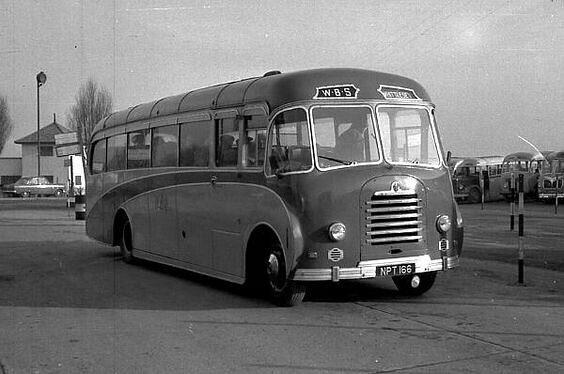
Whitlesea Bus Service – Alan Farrow via Flickr
On the 26th of July the Industrial Disputes Tribunal awarded the busmen an increase of 11 shillings, which was just over 50% of what they had asked for…. The following week bus drivers in cities such as London and Manchester, who had not officially been part of the strike action, accepted their employers’ offer for a pay rise equalling to the same amount…. As an aftermath a motion for a full inquiry into the violence that had occurred was tabled by a group of 11 Conservative MPs….
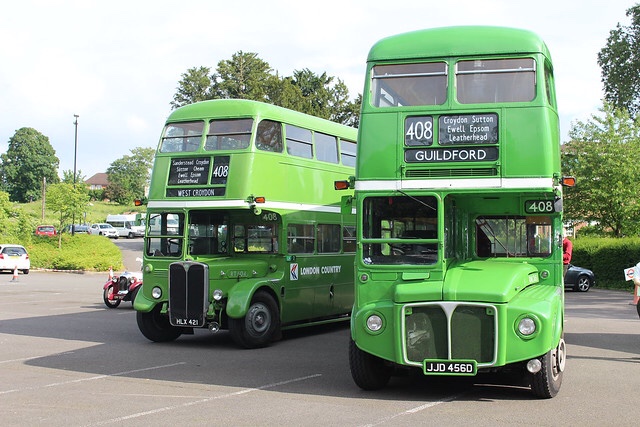
London Country Vintage Bus Running Day – Jason Thompson via Flickr
On this day in history : 22nd July 1298 – The Battle of Falkirk takes place; led by King Edward I, the English army defeats the Scots, under William Wallace – who shortly after resigns as Guardian of Scotland…..
James Grant – Public domain
King Alexander of Scotland had died mysteriously in 1286….leaving his child Margaret of Norway as heir to the throne…. King Edward I made a contract that marriage between his own son and Margaret would take place…. However, before this could happen Margaret died and no immediately obvious heir was beyond her…. Various claimants came forward to make themselves known and King Edward was asked to mediate…. Two of the most obvious candidates were Robert Bruce and John Balliol….Edward chose the latter – but immediately began to influence….he wanted to control….
Balliol rebelled and formed an alliance with France…. A furious Edward marched north, took Balliol prisoner and occupied Scotland…. William Wallace stepped in and raised another Scottish revolt…. This resulted in the humiliating defeat of the English at Stirling Bridge under the Earl of Surrey in 1297….
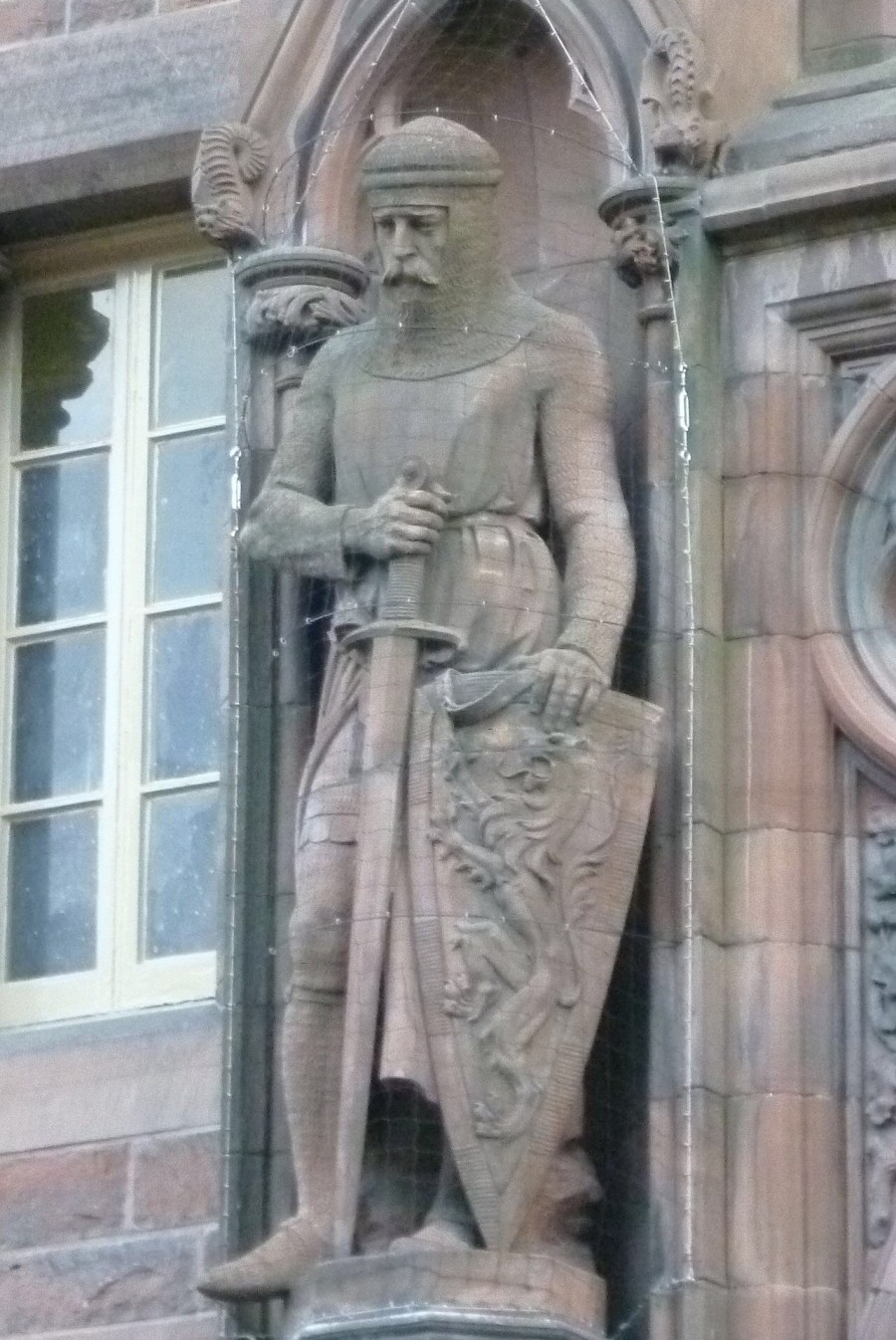
Wallace statue by D W Stevenson at the Scottish National Portrait Gallery, Edinburgh – Kim Traynor CC BY-SA 3.0
An even more furious Edward was determined to crush the Scots once and for all…. And so he was off back up north again — this time with around 2,500 mounted knights and 12,500 infantry….including English and Welsh longbow archers….
Self-yew English longbow – Hitchhiker89 at English Wikipedia – Public domain
At first Wallace tried to avoid a pitched battle – he was vastly outnumbered with just some 1,000 mounted knights and 5,000 infantry…. But eventually he was forced into battle….
On the morning of when the two sides were to meet Wallace formed his pikemen into 4 divisions – ‘schiltrons’…. A square (or circle) with the pikemen shoulder to shoulder with their pikes facing outwards – and then another row of men in armour…. The gaps between the divisions were where Wallace placed his archers….
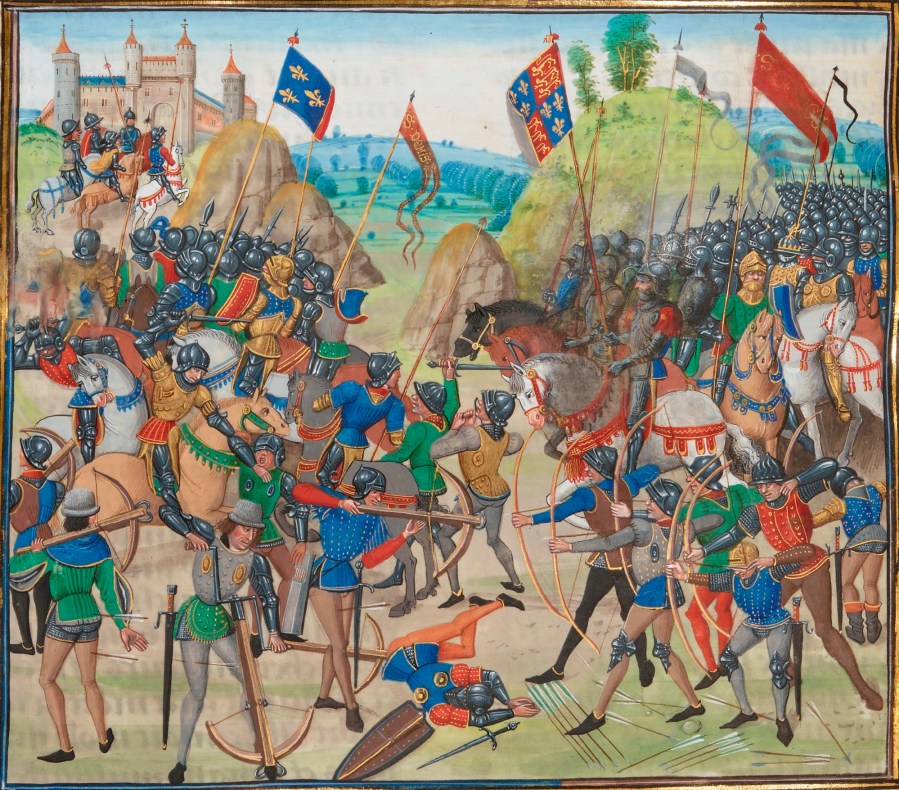
At first the Scots held out against the English…. But the steady fire from Edward’s longbowmen was relentless…. It was the first time longbows had been predominantly used by the English…. The arrows continued to rain down, along with crossbow fire and sling shot – and soon the schiltrons were broken up…. The Scots, including Wallace, fled into the nearby woods…. The longbow was to dominate battles for the next two centuries, helping the English to victory at Crecy and Agincourt….
A late 15th Century illustration of the Battle of Crecy – Jean Froissart, public domain
On this day in history : 21st July 1545 – The French invade the Isle of Wight – but their efforts are thwarted by local forces…. It is the last attempt that France makes to capture the island….
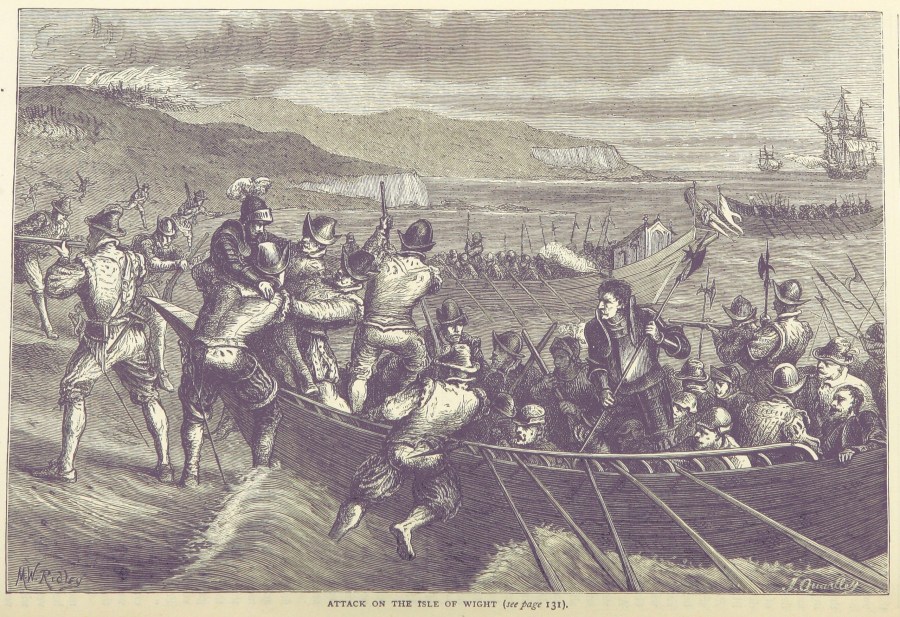
An 1873 illustration of the French landing – James Grant – Public domain
The French had a long history of attacking the Isle of Wight…. This particular last effort took place during the Italian Wars of 1542-1546 – which saw England, France, Spain, Italy and the Low Countries at war with each other….
The French and English had already met in battle twice….once in the Solent and at Bonchurch…. On the 19th of July the English had lost the Mary Rose, King Henry VIII’s flagship…. The English withdrew, hoping to lure the French into the shallow waters at Spithead….but they didn’t take the bait…. Instead they tried to make the English come to them – by invading the Isle of Wight….
A French fleet attacks Bembridge in 1545 – Public domain
The plan was that the French would land at Whitecliff Bay, cross Bembridge Down and attack Sandown…. Meanwhile another landing force would arrive at Bonchurch and march to meet the other troops at Sandown…. However, they were intercepted and engaged in battle….
It was mandatory that all men on the Isle of Wight underwent military training in order to defend the island…. The French had hoped to surprise the English with their attack but their arrival had been anticipated….The local forces had managed to reach the high points of the island – St. Boniface and Bonchurch Downs…. Although the French forces, led by Claude d’Annebault, greatly outnumbered the English, they had little knowledge of the local area…. When faced with the steep slopes they found them difficult to climb….and when they did reach the top they were met by a lot of angry Englishmen!






 Cottage Capers