On this day in history : 30th December 1983 – The death of British racing driver and long distance record breaker Violette Cordery – who was known as ‘The Long Distance Lady’….
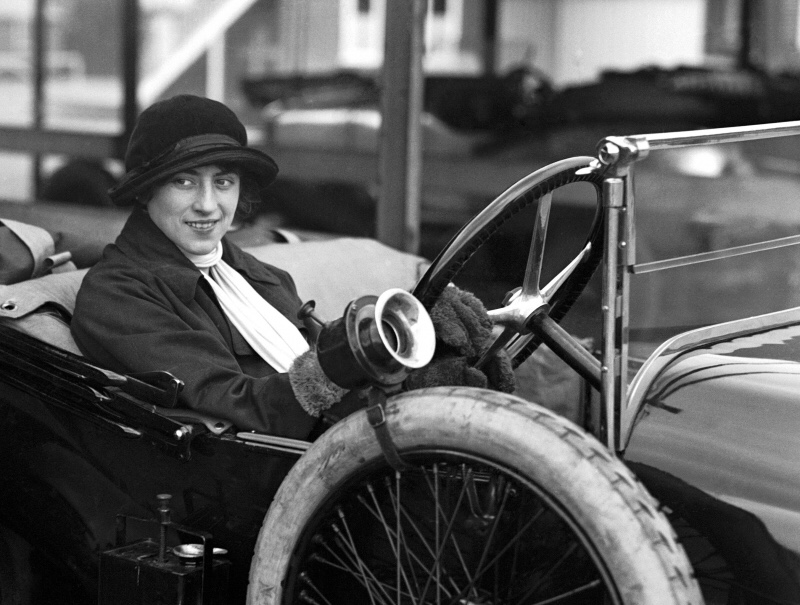
Violette Cordery, 1919 – Public domain
Violette was born in London on the 10th of January 1900…. As a young woman she was employed as a driver for Captain Noel Macklin of the Royal Naval Volunteer Reserve based at Dover…. Macklin was also her brother-in-law as he was married to her elder sister, Lucy….
Macklin had his own automobile manufacturing company, Silver Hawk Motors in Cobham, Surrey…. In 1920 he produced his Silver Hawk car, which Violette drove in the 1500cc ‘light cars’ class of the South Harting Hill Climb…. She was then to go on to compete in other motoring events…. In May 1921 she won the ladies’ race at the Junior Car Club meeting, averaging at a speed of 49.7mph throughout the race….
Her racing career continued and in 1925 she broke records in Macklin’s new Invicta car…. She won the West Kent Motor Club’s mile sprint in the 2.7 litre Invicta at Brooklands…. Then in 1926 she set a long distance record in Italy, where she drove another Invicta for 10,000 miles at an average 56.47mph…. She set another record in July 1926 in Paris, where she drove 5,000 miles averaging at 70.7mph…. This saw her win the Royal Automotive Club’s Dewar Trophy – making her the first woman to do so….
Violette Cordery, July 1927 in a touring Invicta – Image source : National Library of France CCO
In 1931 Violette and her younger sister Evelyn completed a long distance challenge at the Brooklands Circuit in Surrey…. They drove 30,000 miles in 30,000 minutes at an average speed of 61.57mph – this equated to approximately 20 days and 20 hours of driving…. The sisters won a second Dewar Trophy….
Violette married racing driver and aviator John Stuart Hindmarsh on the 15th of September 1931 in Stoke D’Abernon, Surrey…. They went on to have two daughters – but on the 6th of September 1938 she was to become widowed…. John had been test flying a Hawker Hurricane at Brooklands when the aircraft crashed, killing him…. After this Violette retired from public life; she died in December 1983 in Oxshott, Surrey….
On this day in history : 29th December 1675 – King Charles II orders the closing of all coffee houses, as he believes they are a hub of malicious gossip about the Government…. It causes a national outcry….
17th century London coffeehouse – Image : Bodleian Library, University of Oxford – Public domain
Coffee had only relatively recently arrived in Europe from Turkey and had quickly become a fashionable drink – not because it tasted good, as this early coffee really did not – but because of the buzz the caffeine gave…. People were soon addicted to it…. The first coffee house opened in Oxford in 1652, with London following in the same year with one in Cornhill…. Soon coffee houses were everywhere….
The non-alcohol serving, men only establishments became lively meeting places both for social and business purposes…. Aside from general chit-chat of the day deals would be struck, current affairs debated and pamphlets distributed…. Each coffee house would have its own particular clientele, often defined by a profession or occupation – politicians, merchants, bankers, authors and poets, artists and musicians…. Some establishments were rather more shady, favoured by criminals and pimps….
King Charles II became nervous; he was convinced that the population was plotting treason; he believed the peace of the realm was at stake with the establishments promoting rumour mongering – and that they made people idle…. And so he issued a proclamation to make coffee houses illegal – but he didn’t stop there….He also banned the selling of coffee and for good measure added to the ban the sale of tea, chocolate and sherbet….
King Charles II – by John Michael Wright – Public domain
His law to ban coffee houses was passed on the 29th of December 1675 – set to become active from the 10th of January 1676…. The law was so unpopular, including among members of his own government, that he finally backed down and the law was withdrawn on the 8th of January….
On this day in history : 28th December 1879 – The central section of the Tay Rail Bridge, Dundee, Scotland, collapses in a violent storm, as a train is passing over it…. All onboard are killed….
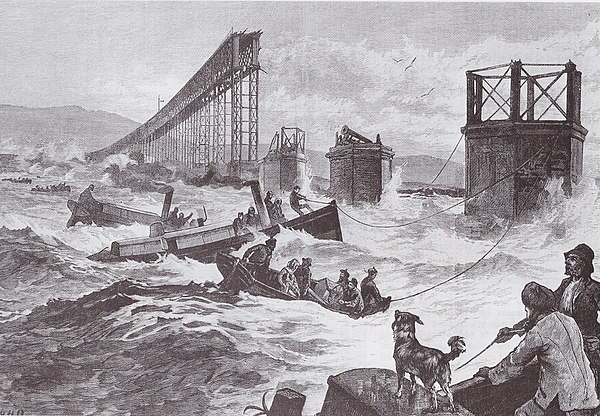
Illustration of the Tay Bridge disaster – unknown artist – Public domain
It was a Sunday evening at around 7.15pm and a storm estimated at 10 or 11 on the Beaufort Scale was raging…. Trains crossing the Tay Bridge, across the Firth of Tay, were restricted to one at a time…. It was the turn of the train from Burntisland in Fife – a train that consisted of one locomotive, its tender, five carriages and a luggage van…. Onboard were around 75 people….
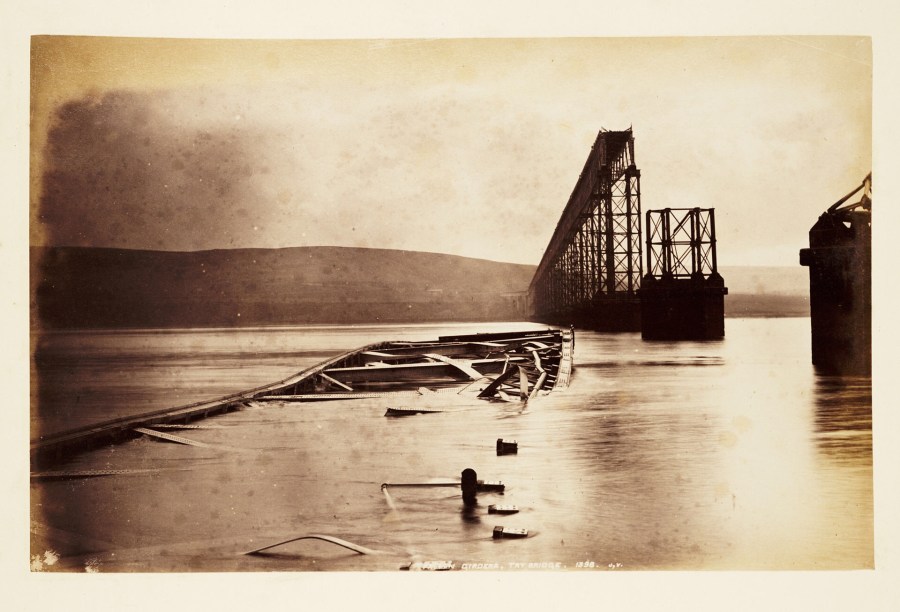
The gale was blowing down the Tay Estuary at right angles to the bridge – suddenly without warning the central navigation spans, which the train was travelling over at the time, collapsed into the Firth below – taking the train with them…. All onboard were lost….
Fallen girders – Image : National Library of Scotland – Public domain
The disaster was to shock Victorian engineers – and it is still today regarded as one of the worst structural engineering failures….
The original Tay Bridge had been designed by Thomas Bouch; he was a well-respected engineer, having much experience…. As well as the design he was also responsible for the construction and maintenance of the bridge…. Having opened in February 1878 it had only been operational for 19 months – its design had won Bouch a knighthood…. So, what went wrong?
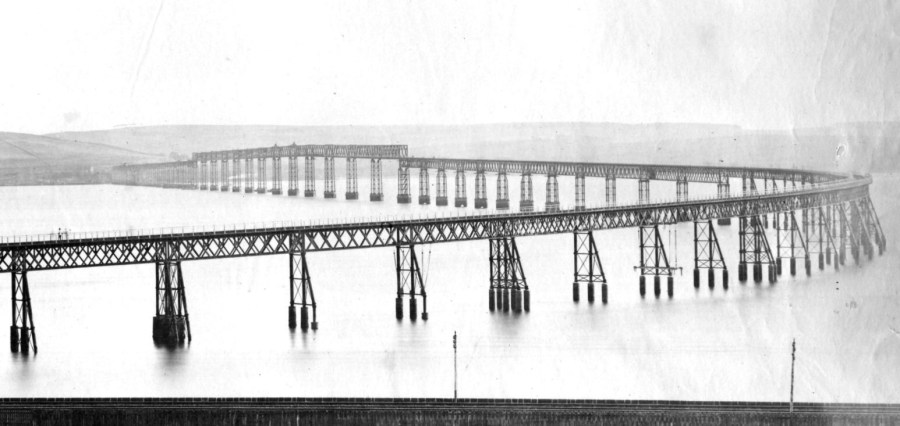
The bridge, at nearly two miles long, consisted of 85 spans – making it the longest bridge in the world at the time…. 72 of the spans were supported on spanning girders below the track – whereas the remaining 13 spans, forming the centre section, were above the track and consisted of bridge girders above the pier tops forming a through tunnel…. This gave an 88ft clearance above the water surface, enabling ships to pass beneath…. It was these high girders that fell….
Original Tay Bridge looking from the north – Unknown author – Public domain
At the following inquiry it was concluded : “The fall of the bridge was occasioned by the insufficiency of the cross bracing and its fastenings to sustain the force of the gale”…. The report went on to say if the wind bracing had been properly constructed and maintained the bridge could have withstood the storm…. All of the blame was placed on Bouch….
Fallen girders with remains of a wooden carriage – Image : National Library of Scotland – Public domainThe locomotive – which was recovered and returned to service – Image : Dundee Central Library – Public domain
Bouch died less than a year after the disaster, his reputation in tatters…. A second Tay Bridge opened on the 20th of June 1887 – this time a straight forward pier and lattice girder construction….
The current Tay Bridge – Image credit : Ross2085 via Flickr CC BY 2.0
On this day in history : 27th December 1965 – Britain’s first North Sea offshore oil drilling rig, ‘Sea Gem’, capsizes…. Thirteen men are killed with a further five more injured….
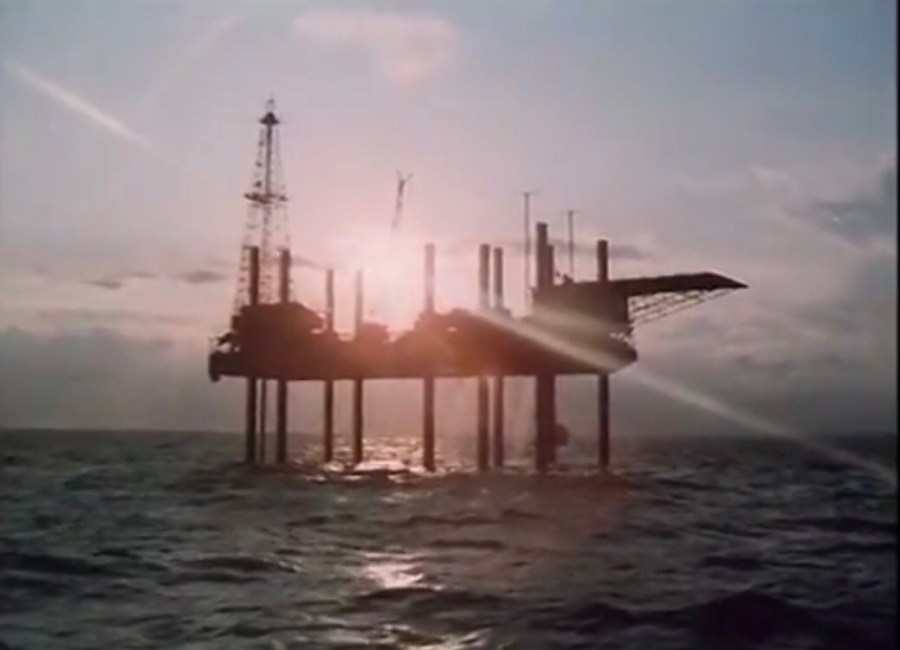
Sea Gem had started out as a 5,600 ton steel barge which in 1964 was converted to act as an oil rig for British Petroleum…. Ten steel legs were attached raising the barge to 49ft (15m) above the water’s surface…. Living accommodation for a crew of 34 was added, along with a drilling tower and its supporting structures – there was also a helipad…. The rig was the first to discover natural gas off of the British coast – and the first to light a flare over the North Sea….
Situated 42 miles off the coast of Lincolnshire Sea Gem was in the process of being moved to a new location just over two miles away…. This involved lowering the rig down on to the surface of the sea and floating it to its new site…. However, as it was lowered two of the steel legs gave way and crumpled…. The whole rig then tilted to the side – and sank….
The radio cabin went down with the rig and so the crew were unable to call for help…. However, a passing British freight ship, the SS Baltrover, witnessed what had happened – men from the rig were seen jumping into the freezing water and then clinging to wreckage…. Baltrover sent out a distress call and began a rescue operation – soon to be joined by an RAF helicopter and also a civilian helicopter…. They battled against 20ft high waves – some of Sea Gem’s crew were in the icy water for two hours…. The survivors were taken ashore to Hull….
In all thirteen men died…. In May 1966 the crew of the RAF helicopter were awarded for their bravery; Flight Sergeant John Reeson, who was the winch-man, received the George Medal…. In addition pilot Sergeant Leon Smith was awarded with a Queen’s Commendation and Flight Lieutenant John Hill, the navigator, received the Air Force Cross….
At a public inquiry it was concluded that metal fatigue had been present in a section of the suspension system connecting the legs of the rig to the hull…. Sea Gem’s well was written off and new wells were drilled in the area – that was to become known as the ‘West Sole Field’…. A new purpose built floating rig, ‘Sea Quest’, became operational in July 1966….
On this day in history : 26th December 1900 – The discovery is made that the keepers of the Flannan Isles Lighthouse have disappeared without a trace…. The mystery still remains unsolved today….
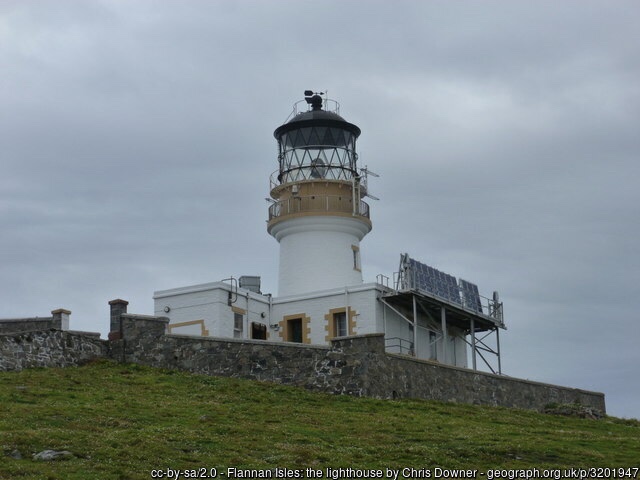
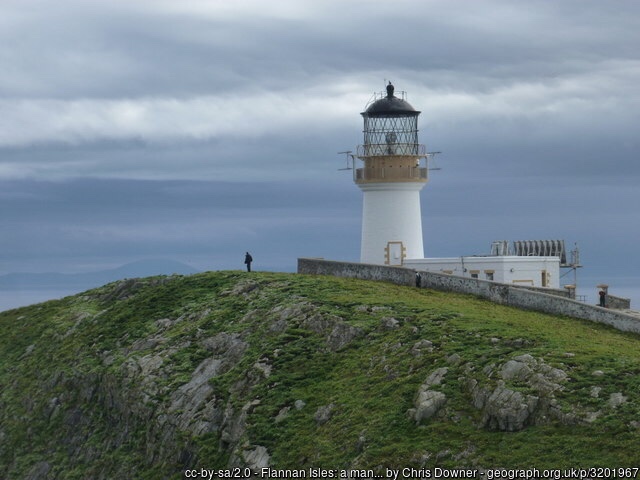
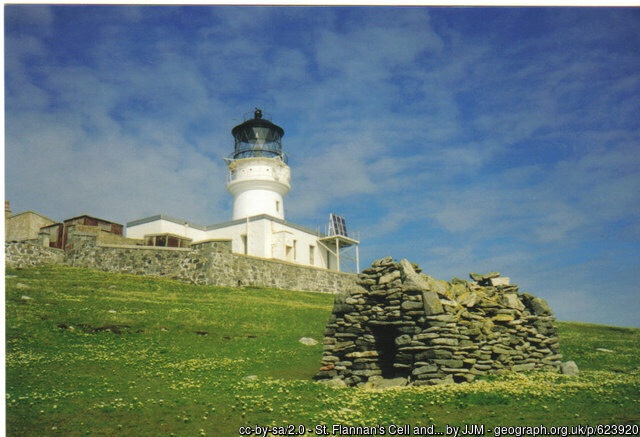
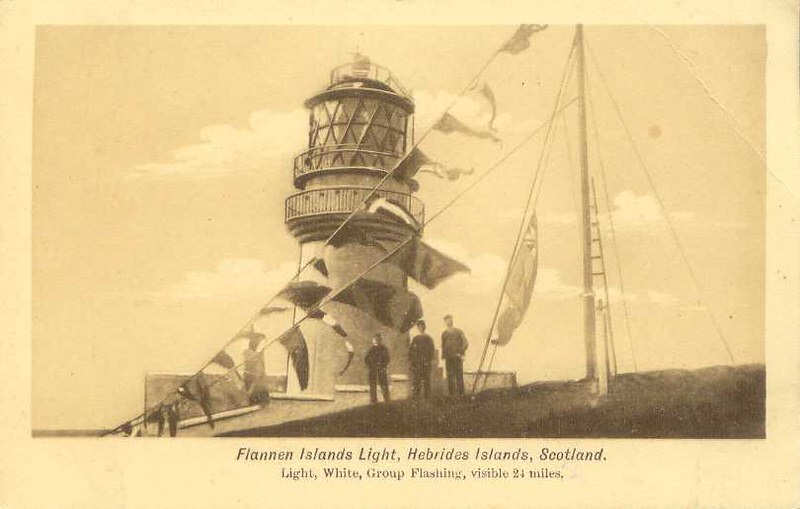
The lighthouse is to be found on Ellean Mor, one of the uninhabited Flannan Islands of the Outer Hebrides off the west coast of Scotland…. The islands were named for St. Flannan, a 6th century Irish Bishop who later became a saint…. Apart from the lighthouse, which is still in use today, the only other building to be found on the islands is a ruined chapel….
St. Flannan’s Chapel
On the 15th of December 1900 it had been noticed that there was no light shining from the lighthouse…. At the time it was manned by three keepers, James Ducat, Thomas Marshall and William MacArthur…. All were experienced, seasoned seafarers….
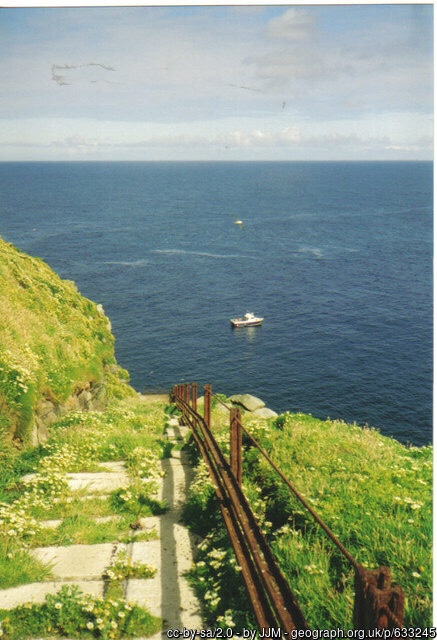
A ship, captained by James Harvey, was despatched to carry replacement keeper Joseph Moore to investigate what was going on…. When they arrived at the landing platform they were surprised to see nobody was there to greet them, as approaching visitors were always spotted well in advance…. The crew sounded the ship’s horn and sent up a flare to attract attention – but still nobody appeared…. There was no sign of life anywhere, not even the flag was flying from the flagpole….
Landing stage and pathway
Moore rowed ashore with a great sense of unease…. He could not help but notice the disarray at the landing area; a crate that housed ropes and equipment had been severely damaged…. He climbed the steep steps to the lighthouse – and found the door unlocked…. Just inside, where three sets of oilskins should have been hanging, he found just one set…. He ventured into the kitchen and discovered a chaotic scene…. A chair had been overturned and there were the remains of a meal which had obviously been abandoned half way through…. The kitchen clock had stopped…. Moore searched the rest of the lighthouse, the beds were unmade and the place was deserted….
Steps to the landing
He returned to the ship and a search of the island was organised – but there was nothing to be found…. A telegram was sent to the Northern Lighthouse Board : “A dreadful accident has happened at Flannans. The three keepers, Ducat, Marshall and the occasionalhave disappeared from the island. On our arrival there this afternoon no sign of life was to be seen on the island”…. The message went on to say the accident must have happened about a week before and that the poor fellows must have been blown over a cliff or drowned trying to secure a crate of similar…. Whatever had happened it was assumed they had been claimed by the sea….
View over the islands
On the 29th on December the Board’s Superintendent, Robert Muirhead, arrived to investigate…. He knew the three missing keepers personally, as he had recruited them…. He initially found nothing else that Moore had not already discovered – but then he turned his attention to the lighthouse logbook and found some surprising entries…. One for the 12th of December read: “Severe winds the likes of which I have never seen before in twenty years” – this in itself was odd as there had been no reported storms in the area before the 17th…. The log went on to say that James Ducat had been very quiet and that William MacArthur had been crying…. Again this did not add up – the men were all tough, in fact MacArthur had a reputation for brawling…. All three were used to life in a lighthouse – and this particular one was brand new and the safest of the safe – so it was unlikely that any of them would have cracked…. The last entry on the 15th of December read : “Storm ended, sea calm, God is over all”…. It had also been noted in the log that the men had been praying….
There were many unanswered questions – not least why the men had broken one of the strictest rules of their employment…. On no occasion whatsoever were they to leave the lighthouse unmanned – one of them had to be inside at all times…. Yet, for whatever reason, all three of them had left it….
There was much speculation as to what had happened…. Had they gone mad? Had one of them murdered the other two? Was it a sea monster that had taken them – or were they abducted by aliens? Was it the supernatural? Had they absconded to a better life? We shall never know…. The most plausible explanation is perhaps that two of them went to secure the storage crate on the landing platform – seeing his mates in trouble the third went to try and help them, only for all three to be swept away by a freak wave…. No bodies were ever found….
Over the following years future lighthouse keepers at Flannan reported strange goings on…. They told of voices crying out the names of Thomas Marshall, James Ducat and Donald MacArthur…. Considering the experience of these three lighthouse keepers – and the apparent calmness of the sea before their disappearance – maybe it is only these ghosts who will ever know what really happened….








 Cottage Capers