On this day in history….22nd January 1901

On this day in history : 22nd January 1901 – The death, at the age of 81, of Queen Victoria – who had reigned for 63 years and 7 months….
img_5657
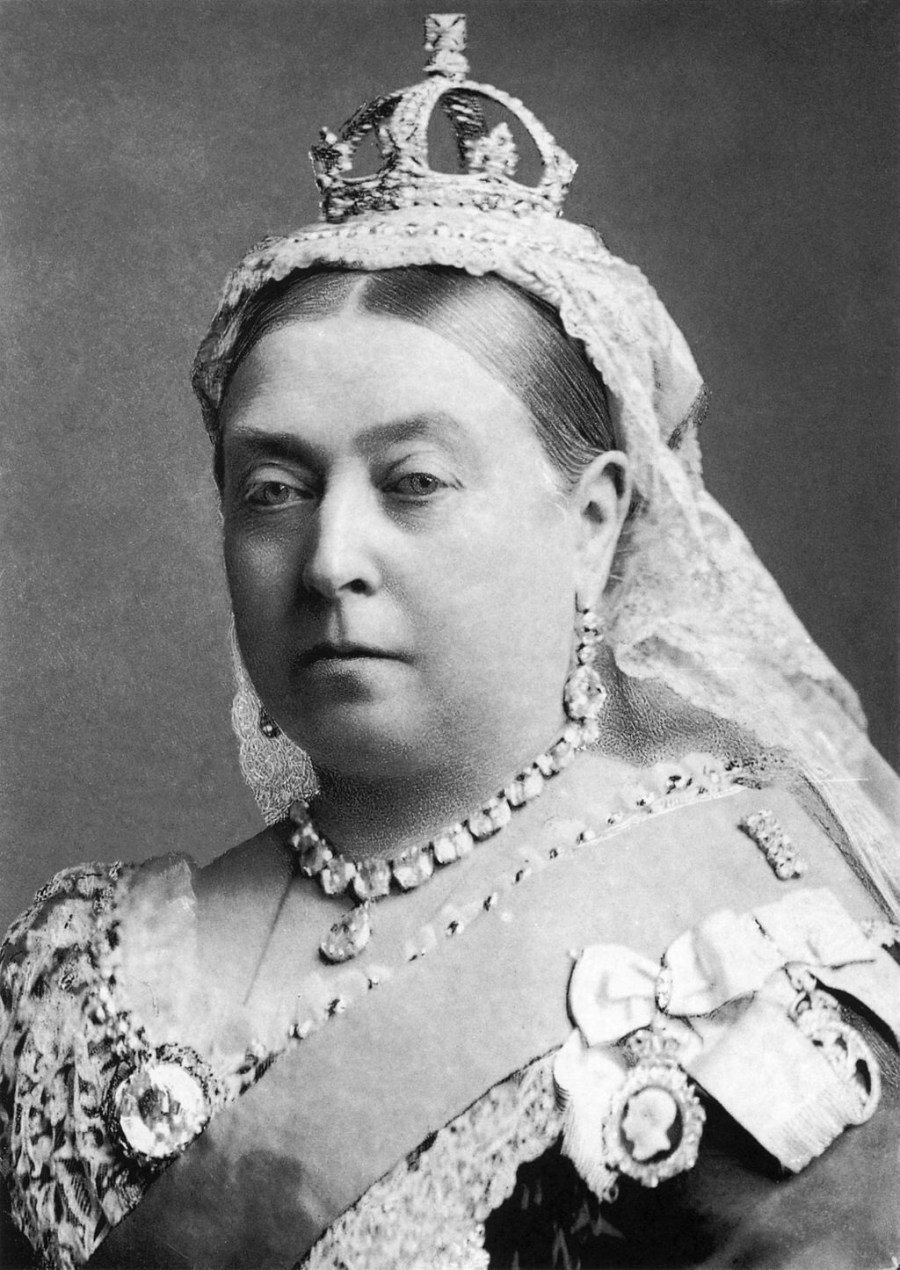
Photograph of Queen Victoria 1882 – Image credit : Alexander Bassano – Public domain

When the announcement came from Osbourne House ~ that at 6.30pm, surrounded by her family, Queen Victoria had drawn her last breath ~ it somewhat took the nation by surprise…. The Queen had been on the throne for nearly 64 years, for most people all of their living memory…. An imperative question arose…. ‘Just how exactly does one bury a monarch?’ Nobody could actually remember ever having to do so….

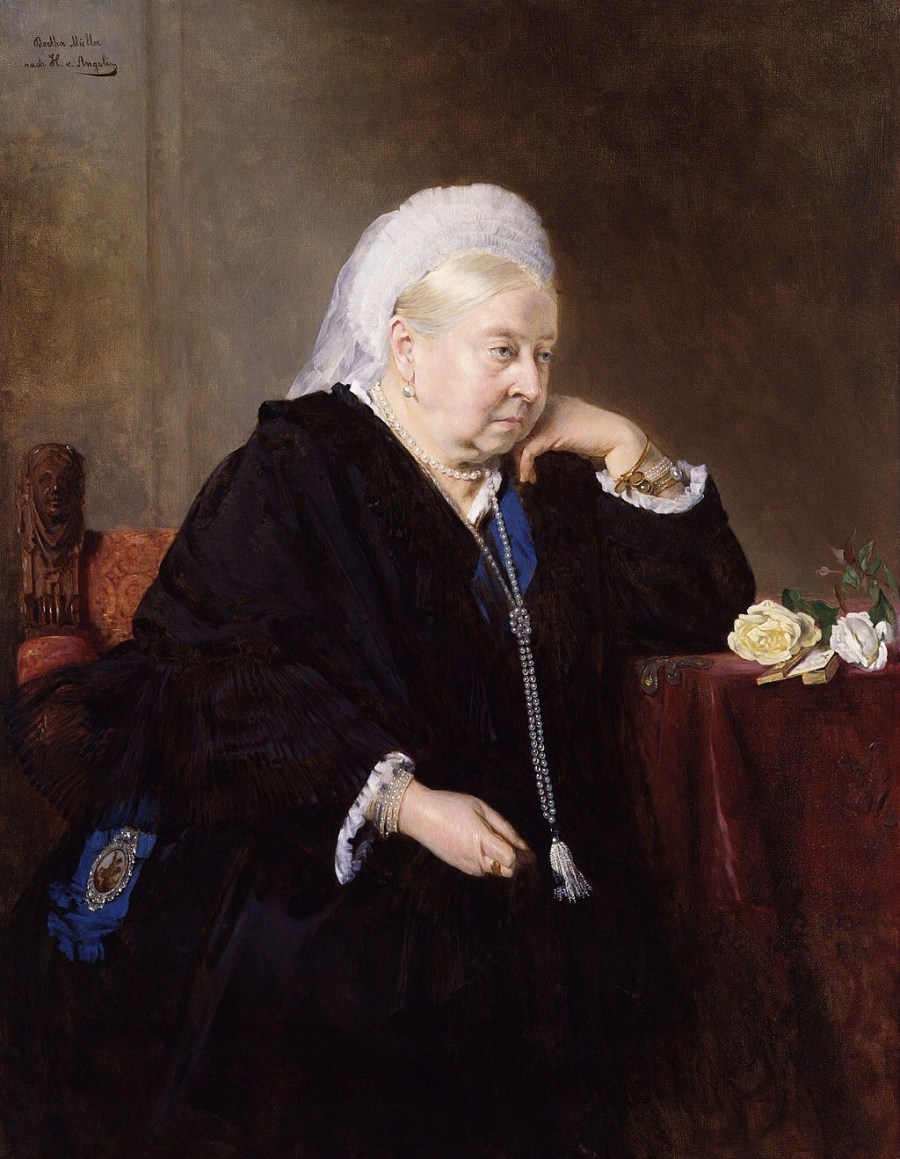
It had been kept from the public just how quickly the Queen was fading away….and even her family were in denial…. She had lost so much weight that she was but a shadow of her former self…. She was confined to a wheelchair, had all but lost her eyesight and suffered bouts of memory loss….

Queen Victoria had seen in the New Year with a sense of trepidation ~ “Another year begun, I am feeling so weak and unwell, that I enter upon it sadly”…. 1900 had been one hell of a year for the Queen…. Her daughter Vicky, Dowager Empress of Germany, had been diagnosed with terminal breast cancer; her son Alfred, Duke of Edinburgh, had died from throat cancer…. Her much loved grandson, Prince Christian Victor, had been lost to fever whilst serving with the British Army in South Africa…. And only just a few days before, Queen Victoria’s dear friend, Lady Churchill, had died in her bed whilst staying with the Queen at Osbourne House…. Then to top it all, there was the continual worry of the ongoing Boer War….
img_5656
Queen Victoria aged 80, 1899 – After Heinrich von Angeli – Public domain

The government was totally unprepared for what was to come…. Queen Victoria had expressed her wish for a full state military funeral, “befitting for a soldier’s daughter”…. There was to be no lying-in-state, no embalming and ~ even though she herself had worn widow’s weeds since the death of her beloved Albert ~ no mourning black…. She wanted a white funeral with purple trimmings, with a gun carriage and white ponies….

With only a few days to organise such a grand funeral chaos reigned…. The family argued amongst themselves and officials panicked….

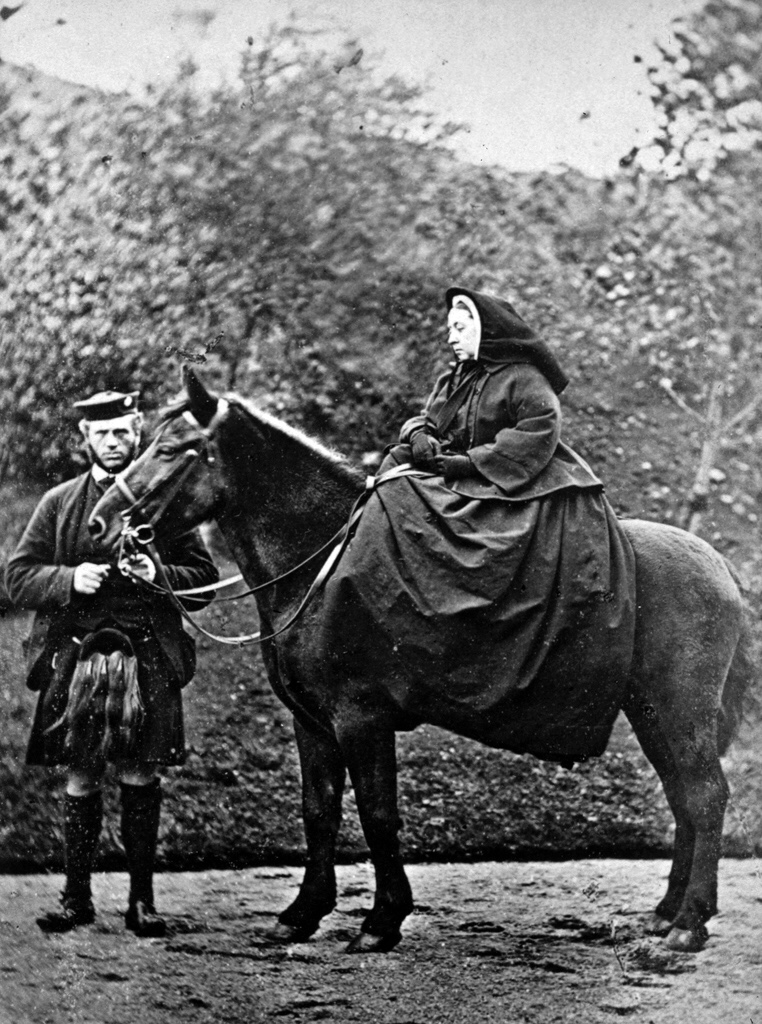
The preparation of Queen Victoria for her coffin was a closed affair, with only her doctor and a long-trusted woman servant in attendance…. The Queen was dressed in a white silk gown and her wedding veil placed over her face…. Unbeknown to the family there were some items Queen Victoria had instructed that she wished to take with her…. Secreted inside the coffin was a lock of hair, photographs and the pocket handkerchief of one John Brown…. Upon her finger she wore the wedding ring that had belonged to Brown’s mother – and which Queen Victoria had worn since his death in 1883…. John Brown was Queen Victoria’s devoted Scottish Highland servant – the two of them had been very close….
img_5655
Queen Victoria and John Brown at Balmoral, 1863 – Photograph G.W.Wilson, Public domain

On the 1st of February the funeral cortège began its long journey…. The coffin was carried onboard the Royal Yacht ‘Alberta’ across the Solent from the Isle of Wight to the mainland…. An eleven mile procession of battleships and cruisers lined the way….each firing a gun salute as the little yacht passed by…. The cortège stayed in harbour overnight before continuing by train to London’s Victoria early the next morning….

(c) Walker Art Gallery; Supplied by The Public Catalogue Foundation
The Passing of a Great Queen ; painting by William Wyllie – Public domain

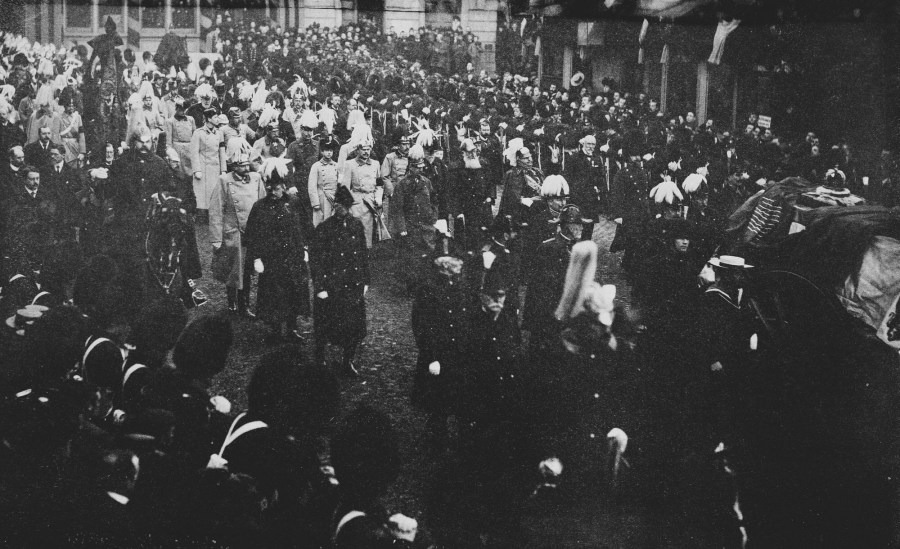
What was to follow was the largest procession since 1852 and the state funeral of the Duke of Wellington…. Through Hyde Park and on to Paddington, the Queen’s coffin high on a gun carriage was drawn by eight white ponies…. The streets, lined with mourners, remained silent….
img_5653
Queen Victoria’s funeral procession – Russell & Sons : http://www.royalcollection.org.uk – Public domain

From Paddington the coffin was taken by train to Windsor – and then to the waiting gun carriage…. It was here that disaster almost struck…. The horses, which had been kept standing in the freezing conditions for perhaps too long, broke away – nearly causing the coffin to topple…. Unable to re-harness the horses 183 bluejackets from the naval guard of honour attached ropes to the gun carriage – they then proceeded to drag it to St. George’s Chapel….

After the official funeral service a further ceremony was held on the 4th of February just for the family…. It was then that Queen Victoria’s coffin was lowered into the mausoleum that she’d had built for her Albert ~ they were together again….



On this day in history….21st January 1924

On this day in history : 24th January 1924 – The birth of Alfred Hawthorne Hill – better known to us as the slapstick comedian and actor Benny Hill….

img_5652
Waxwork of Benny Hill in character as Fred Scuttle on The Benny Hill Show – Ricardo Liberato via Wikimedia Commons

Hill was born in Southampton – both his father and grandfather before him had been circus clowns…. Hill had a variety of jobs after leaving school…. He worked in Woolworth’s, did a spell as a milkman, was a driver, a bridge operator and even a drummer – before finally becoming assistant stage manager for a touring theatre company….

In 1942 he was called up – and served as a truck driver, mechanic and search light operator in Normandy, France…. However, his talent to entertain did not go unnoticed and he was eventually transferred to Combined Services Entertainment – the division which provided entertainment to the British Armed Forces…. It was at this time he changed his name to Benny – after his favourite comedian Jack Benny….

After the War he performed on radio – and made his TV debut in 1950…. He pursued a film career, with credits including ‘Those Magnificent Men in Their Flying Machines’, ‘Chitty Chitty Bang Bang’ and ‘The Italian Job’ – amongst others….

But his real glory came from his long running TV series ‘The Benny Hill Show’…. With its sketches of slapstick, parody, mime and double entendre the show ran in one form or another from January 1955 to May 1989 – and aired in over 140 countries…. In 1971 audience in the UK peaked at more than 21 million viewers…. However, declining numbers meant that in 1989 the show was axed….

Hill never married, although he proposed to at least two women – he had no children…. By the late 1980s his health had begun to decline – and in February 1992 he was advised to have a heart bypass after a mild heart attack…. He declined….a week later he was also diagnosed with kidney failure…. Benny Hill died alone, in his armchair in front of the TV, in April 1992….

img_5651
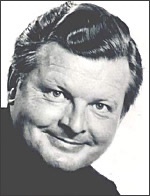
Portrait of Benny Hill, from Press Kit – Fair use

On this day in history….20th January 1987

On this day in history : 20th January 1987 – Anglican Church envoy Terry Waite is kidnapped in Beirut, where he had been attempting to negotiate the release of Western hostages….

img_5649
Terry Waite in April 1993 – Mike Harris, English Wikipedia – Public domain

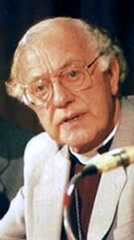
Waite had been made Secretary for Anglican Communion Affairs by Archbishop of Canterbury Robert Runcie in 1980…. His role was to work with churches abroad organising the Archbishop’s overseas trips…. It was in this role that he became involved in the case of a group detained in Iran on spying charges and he managed to successfully secure their release….Then in 1984, after negotiating with Colonel Gadaffi, he managed to secure the release of four Britons held in Libya….

img_5650
Robert Runcie, Archbishop of Canterbury March 1980 – January 1991 : Maximet – own work – Public domain

Over the following two years he was to become involved in trying to regain the freedom of four Americans being held in Lebanon by the Islamic Jihad Organisation…. He made three trips to Lebanon in all….

On his third and final trip he knew of the immense danger he was in…. He arrived in Beirut on the 12th of January 1987 to begin negotiations with the Islamic Extremist captors of the hostages….

He met with his contact who told him that the captors were willing to allow him to visit the hostages, who were apparently unwell and very depressed…. Naturally Waite expressed concerns for his own safety but was assured of safe conduct by his contact…. He asked for 24 hours to think about it and after much soul searching made his decision….

Waite felt that if he didn’t go and the captors were being truthful and had no intention of harming him or taking him captive, he would never be able to live with himself if one of the hostages were to die….

Of course, Waite was taken captive…. He was held for 1,763 days – the first four years of which he was kept in solitary confinement…. He was finally released on the 18th of November 1991, along with American academic Thomas Sutherland, who had been seized in 1985….

On this day in history….19th January 1848

On this day in history : 19th January 1848 – The birth of Matthew Webb, the English swimmer and diver who was the first recorded person to swim the English Channel….

Captain Matthew Webb
Captain Matthew Webb, July 1883 – Illustrated London News – Royal Museums Greenwich CC BY-SA 3.0

Webb was born in Dawley, near to Telford in Shropshire, he was one of twelve children….and he learned to swim in the River Severn…. At the age of 12 he joined the training ship HMS Conway and then two years later the Merchant Navy….

It was whilst serving as 2nd Mate on the Cunard Line’s ‘Russia’ that Webb was to become a hero…. The ship was sailing between New York and Liverpool when a man went overboard mid-Atlantic…. With no hesitation Webb dived in to try and save him…. His attempt was unsuccessful – but his heroic effort saw him rewarded with £100 for his bravery and awarded the Stanhope Medal – (an award which is given annually by the UK’s Royal Humane Society for the year’s most heroic rescue)…. Webb also became a celebrity because of the attention bestowed upon him by the Press…. Incidentally, this was not to be the only time Webb was to jump into the water in order to try and save a life…. He saved his own older brother, Thomas, from drowning in the River Severn in the Summer of 1863….

Webb became Captain of the steamship ‘Emerald’ – and one day in 1873 he read of the failed attempt by J.B. Johnson to swim the English Channel – and he decided he had to try himself…. So he left his job and began to train…. Initially he started at the Lambeth Baths but then progressed to the River Thames, Hollingworth Lake in Derbyshire and the English Channel itself….

img_5633
Hollingworth Lake, Derbyshire

Webb’s first attempt, on the 12th of August 1875, was unsuccessful due to high winds and rough seas…. Twelve days later, on the 24th of August, he set off again from Admiralty Pier, Dover – greased-up in porpoise oil and flanked by three escort boats…. He continued his swim at a steady breaststroke, taking a zig-zag route across the Channel of nearly 40 miles long…. Despite being stung by jelly fish and being prevented from reaching the French shore because of strong currents for some five hours, he eventually arrived at the beach just outside Calais after 21 hours and 45 minutes in the water….

Webb became a national hero, the public loved him and he basked in the glory…. He went on to pursue a professional swimming career – particularly as a stunt swimmer…. One of his stunts involved floating in a tank of water for 128 hours….

img_5632
Cariacture of Webb by Vanity Fair’s ‘Ape’ – published in 1875 – Carlo Pellegrini – Public domain

But his final stunt was one that many considered to be complete madness….an attempt to swim through the Whirlpool Rapids just below Niagara Falls…. On the 24th of July 1883 he launched himself into the Niagara River from a small boat and began to swim…. He died in a section of the river near to the entrance of the whirlpool…. He was buried in Oakwood Cemetery, Niagara Falls….

On this day in history….18th January 1996

On this day in history : 18th January 1996 – Six major environmental groups add their support to the growing campaign against the controversial Newbury bypass….

img_5621

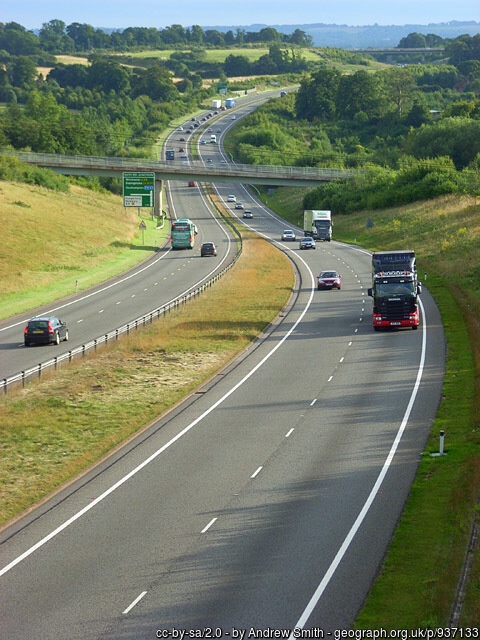
The first Newbury bypass had been built in 1963 but by the 1980s it was unable to cope with the sheer volume of traffic…. A new route was proposed following the disused Didcot, Newbury and Southampton railway line – controversially running through three sites of special scientific interest…. A part of the North Wessex Downs Area of Outstanding Natural Beauty – an English Heritage site registered as being the location of the battlefield for the first Battle of Newbury during the English Civil War – and a National Trust nature reserve…. Also along the route, areas had been identified as being the habitat of an endangered snail, the Desmoulin’s Whorl snail….particular to the local area….

Supporters of the proposed scheme insisted the new bypass would provide relief to the congested town centre of Newbury…. Those who opposed it claimed that within 10 years traffic would be back to intolerable levels – whilst they agreed there was a problem that needed to be addressed a bypass was not the answer…. The people of Newbury were divided, as many were against the scheme as were for it….

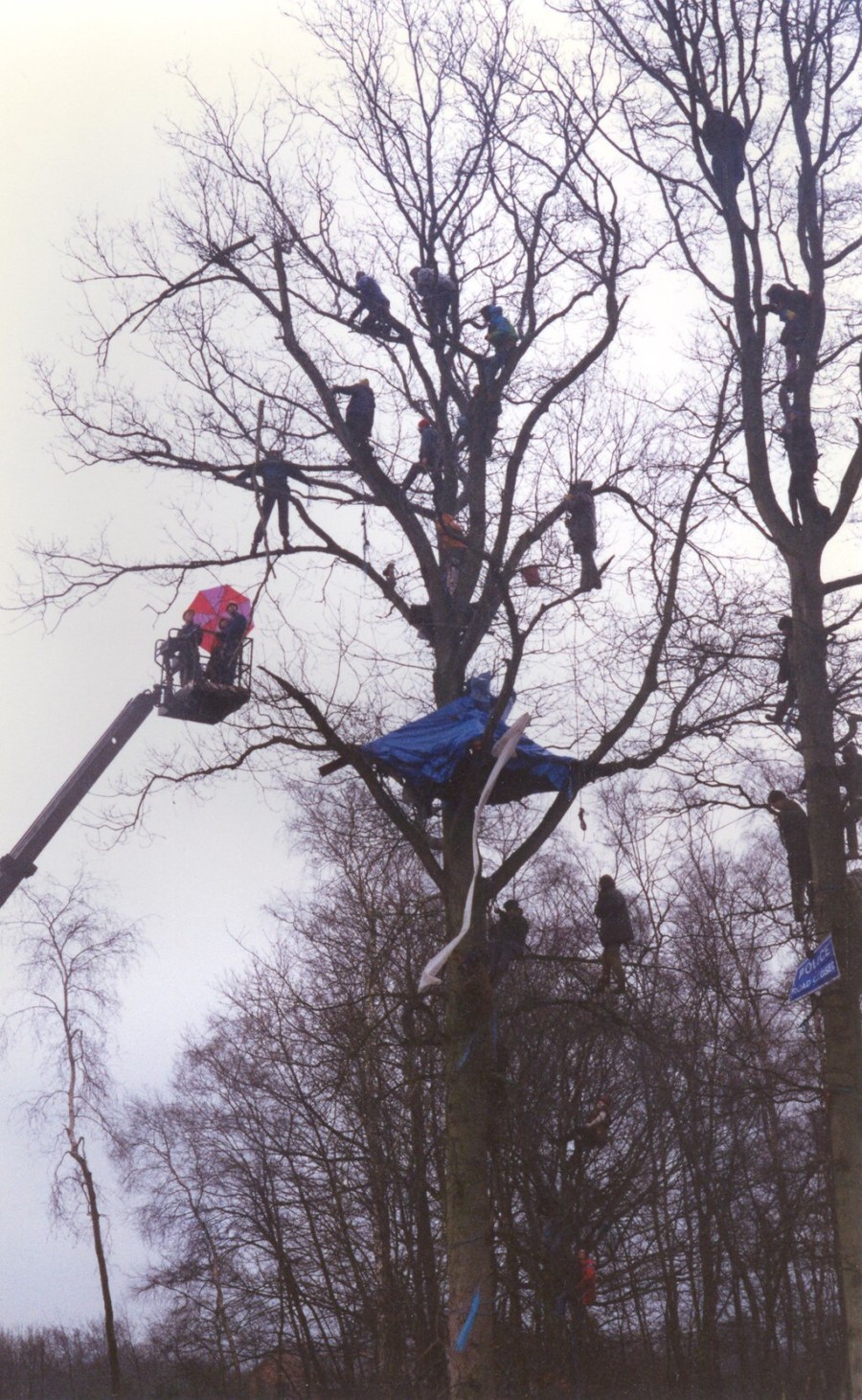
Nevertheless clearance work began on the 2nd of August 1995 with the demolition of six buildings in the way of the route…. The previous month had seen the first of the protest camps appear…. Well organised disruptions by activists caused major setbacks for the contractors….tunnels and treehouses were built and protesters used themselves as human shields to prevent plant equipment from being moved in….

img_5620
Eviction of the Tot Hill Camp, February 1996 – Nick Woolley CC BY-SA 2.5

Finally work began in earnest the week prior to the 18th of January 1996 – on the 17th some 350 trees were felled and 35 protesters arrested…. On the 18th Friends of the Earth, the Council for British Archeology, Greenpeace UK, the Royal Society for the Protection of Birds, the Wildlife Trusts and the Worldwide Fund for Nature added their support for the campaign against the scheme….

On the 15th of February 5,000 protesters from across the UK joined together to peacefully march two miles along the route – no arrests were made…. It was claimed to be the largest ever single demonstration against road building in Britain…. Among the marchers were TV presenters and local residents Maggie Philbin and Johnny Morris….

Between January and April 1996 an area of approximately 360 acres of land was cleared – including 120 acres of woodland…. Nearly 10,000 mature trees, including oak, ash and beech, were felled….

Thames Valley Police feared the policing operation could cost as much as £12m and asked the government to help meet the cost…. By December 1996 the expense had reached £5m – and a further £30m was spent by the contractors on private security….

The protest camps remained on the route until 1997…. The road took 34 months to complete, at a cost of £100m – it opened in November 1998…. Over 1,000 people were arrested during the campaign….