Is feminism obsolete…?

At risk of putting myself in the direct firing line – I am going to ask a question…. Has feminism in Western society become obsolete? I ask this purely as a lay person – I am certainly no expert on the subject – but it is something that has had me pondering recently….

Before even beginning to try to make sense of what is going on in the Western world of feminism at this present time….it would perhaps be useful to remind ourselves why the feminist movement was even necessary in the first place…. Would the Suffragettes and Suffragists – those brave women of the late 1800s and early 1900s – be raising an eyebrow at what feminism has become? Would they be horrified that women are still struggling to achieve equality in so many areas of life – or would they shake their heads in disbelief that we appear never to be satisfied…?

img_0240
Waterloo Place. Leonard Bentley via Foter.com / CC BY-SA Original image URL: https://www.flickr.com/photos/31363949@N02/16348522018/

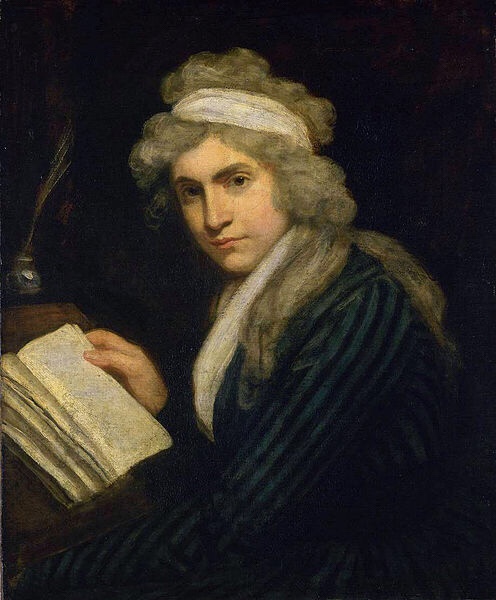
Perhaps the earliest feminist in Britain was the woman now referred to as ‘the grandmother of feminism’, Mary Wollstonecraft – with her book The vindication of the Rights of Woman in 1792…. A publication that was actually very well received in its time – but it was another century before women really began to fight for the Cause. After centuries of oppression and the ownership of women….it was the dawning of a new era….
img_0239
Wikimedia commons Mary Wollstonecraft – oil on canvas

Right up to the 20th Century there were three little words that sealed a woman’s fate – (or at least if she was married in the Church of England) – the moment she uttered ‘love, honour, obey’…. It is interesting to note the Catholic Church has never had ‘obey’ in its marriage service….

To ‘obey’ probably originated in Roman times, when daughters were the property of their fathers and then later the ownership passing to her husband – a practice to remain right up to the time of Women’s Suffrage…. For the lower Roman classes is was a case of ‘free marriages’ – the father giving his daughter to the groom…. Whereas, wealthy Romans would have had a contract, outlining property etc to be part of the dowry; this was the beginnings of legalised marriage….

The word ‘obey’ was introduced to the Church of England wedding service in 1549, when the first Book of Common Prayer was authorised by King Henry VIII. In biblical origins the wife should submit to the husband – just as the Church should submit to Christ…. Obey was taken literally within marriage – the wife and any children being the property of the man – his word was law…. Everything she owned belonged to her husband, everything she earned if she was working and any inheritance she was due….

img_0241
Smithsonian Institution via Foter.com / No known copyright restrictions Original image URL: https://www.flickr.com/photos/smithsonian/2583389217/

If she were to disobey she could expect to be punished – a good beating was often meted out….and was perfectly legal and accepted within a marriage…. Only when a woman’s life was endangered could a case be brought before the Courts – even then the sentences were often lenient. As only the most brutal cases made it as far as Court, so recorded trials of the time were just the very tip of the iceberg….

Edward Doyle murdered his wife…. He broke her ribs, beat her, scolded her with boiling water, thrust a red-hot poker into her abdomen – and then left her to die for two days; he got 15 years for man slaughter. Bearing in mind this was at a time when the sentence for stealing a sheep was 10 years transportation….and if he had killed a man he would have gone to the gallows….

Much domestic violence was fuelled by alcohol; lower classes tended to be more openly violent towards each other. Neighbours would seldom intervene, as it was seen as an everyday part of marriage. The middle classes had their share too, although in the face of respectability it more often happened behind closed doors. If a man was violent towards his wife, he was likely to be towards his children too….

A judge in the 19th Century actually deemed it was perfectly permissible for a man to beat his wife providing the stick he used was no thicker than his thumb…. Hence the saying ‘rule of thumb’….

So, a man could beat his wife senseless on a regular basis – but she was not at liberty to divorce him…. Marriage, being the ‘glue of society’ was to be preserved at all costs…. A wealthy woman, who could prove her spouse’s abuse or infidelity may have been able to obtain a legal separation (at a hefty cost, approx £1,500 – equate that to modern-day terms)….but neither would have been permitted to remarry. However, one little dalliance on her part and her husband could divorce her immediately – keeping any money, property or possessions she brought with her to the marriage – and stopping her from ever seeing her children again…. In any divorce case the children automatically stayed with the father….

In 1853 the Aggravated Assaults Act was passed in Parliament – after Mr Fitzroy, the MP for Lewes, pushed against inadequate penalties handed out to perpetrators…. Sentences and fines were increased but still after 1853 newspapers were full of reports of wife-beating….

In 1857 the Divorce and Matrimonial Clauses Act was passed – giving women the option of divorce on the grounds of cruelty…. In 1870 the Married Women’s Property Act gave women the right to the possession of their own earnings…. In 1882 married women were given the same rights as unmarried women with regards to property – meaning any possessions, money, land or property she owned before marriage did not automatically pass to her husband…. A further Act in 1893 gave married women control over any property acquired during the marriage; for example, an inheritance….

It was a start but there was still a long way to go…. It was no wonder women often regarded marriage as slavery…. By the late 1800s the situation was becoming a lot less tolerated and at the tail end of the Victorian era the Women’s Suffrage Movement began….
suff 5
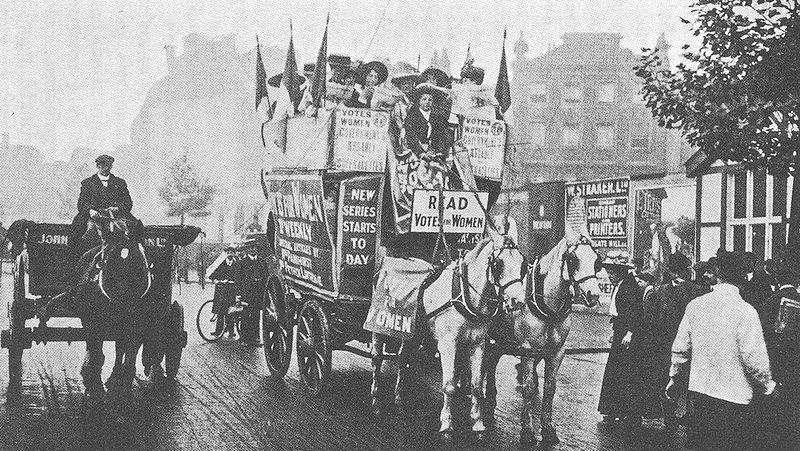
Members of the Women’s Social and Political Union campaigning for women’s suffrage in Kingsway circa 1911 Public domain https://commons.wikimedia.org/wiki/File%3AWSPU_in_Kingsway.jpg

Feminism is often divided into three ‘waves’…. The definition of feminism – ‘the advocacy of women’s rights on the grounds of the equality of the sexes’ – is exactly what the Women’s Suffrage Movement was all about….equality. The Victorian idea of women, in the home bringing up the children – whilst the men got on with earning the money and running the Country….did not sit well with all…. Women were no longer content to remain silent and let the menfolk decide what was right for them, their lives and the rules and regulations they had to live by….they wanted their say….they wanted a part in the decision making….they wanted the Vote….

suff 9
British suffragette with a poster, giving out newspapers Ch. Chusseau-Flaviens https://flickr.com/photos/george_eastman_house/2678367136/in/set-72157606224254056/

Finally, in 1918 women over the age of 30 and who were property owners were granted the Vote…. In 1928 women got the Vote at the age of 21 – the same age as men…. Equality, at least on this score, had been won…. Incidentally, it was also in 1928 that, prompted by the Suffrage Movement, the Church of England began to offer an alternative option in the marriage ceremony…. No longer was the bride required to promise to obey – both she and the groom could vow to love and cherish one another….

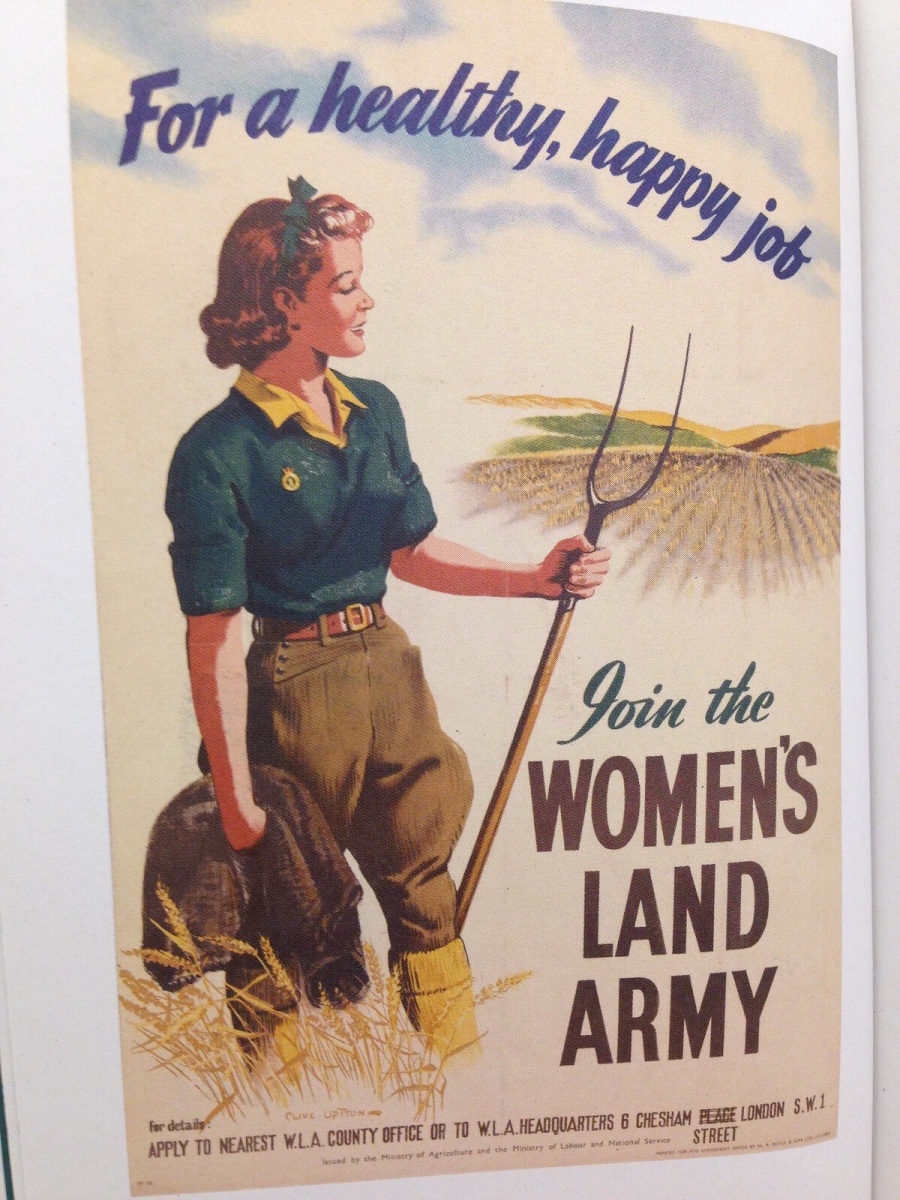
The 1930s was an era of progression for women – but it was the arrival of World War 2 that brought real employment opportunities for women….with so many men away fighting, jobs had to be filled.
img_0242
Women’s Land Army WW2 Melinda Young Stuart via Foter.com / CC BY-NC-ND Original image URL: https://www.flickr.com/photos/melystu/36500701432/

However, once the war years were over women were expected to beat a hasty retreat back to the kitchen to make way for their returning menfolk. Having had a taste of freedom and independence, understandably many were not willing to become submissive and reliant once again….

img_0247
We Can Do It! The U.S. National Archives via Foter.com / No known copyright restrictions Original image URL: https://www.flickr.com/photos/us national archives/3678696585/

So, in the 1950s a second wave of feminism ensued – the battle for equal rights in the form of the Women’s Liberation Movement (Women’s Lib for short). This wave lasted through to the 1980s; its focus being on equality in marriage, sex and sexuality and the workplace…. Equal pay and control over their own bodies….

It was during the 1960s and 70s that the Movement splintered into two groups; the equal rights feminism wanting equality with men on a political/social front and then the radical feminist – who wanted even bigger changes. Radical feminism tended to be advocated by younger women who wanted change to attitudes surrounding gender, race, sexuality and class…. The 1960s saw the sexual revolution – starting with the arrival of the contraceptive pill in 1961 – (in the beginning only available to married women)….

1964 saw a revision to the Married Women’s Property Act; allowing women to keep half of any savings made as a couple should the marriage break up….

img_0243
Abingdon Street Leonard Bentley via Foter.com / CC BY-SA Original image URL: https://www.flickr.com/photos/313633949@N02/11149517464/

In 1967 the Abortion Act legalised abortion for a pregnancy of up to 24 weeks. Available only to married women, two doctors had to consent that the pregnancy would be harmful to the mother’s physical or mental health – or that of her unborn child’s….

Women continued to make progress in politics; Barbara Castle became the first female Secretary of State in 1968 – meanwhile women were striking for equal pay…. 850 women machinists working for Ford in Dagenham walked out – disputing that their work was defined as ‘unskilled’ – they demanded the same pay as their ‘skilled’ male colleagues…. (Bearing in mind it was still perfectly legal when advertising a job to state whether the position was open to specifically male or female – women were often required to do ‘unskilled’ work)….

More radical feminists were turning their attention to events objectifying women – such as the Miss World Beauty Contest, which was first held in 1951. Stating that they found it ‘insulting and undermining that women were judged solely on looks’ – activists threw flour bombs at the 1970 contest being held at the Royal Albert Hall, London….

1975 was the United Nations International Year of Women – to raise global awareness of Women’s Rights. Since that year International Women’s Day has been celebrated every year on March the 8th by countries all around the World….

img_0246
Pyjama Party Parade Toban B via Foter.com / CC BY-NC Original image URL: https://www.flickr.com/photos/tobanblack/3341804527/

1975 also saw the formation of the National Abortion Campaign – defending women’s rights to make decisions about their own bodies….and the Sex Discrimination Act was passed in Parliament – protecting women (and men) from discrimination on the grounds of their sex and marital status in areas such as education, training and employment….

Margaret Thatcher became Britain’s first female Prime Minister in 1979 – to become known as the ‘Iron Lady’…. Eight years later Diane Abbott became the first black woman to be elected to the House of Commons….

Although the Women’s Rights Cause was heading in the right direction alarmingly one very sensitive and emotive area was slow to change – the matter of domestic violence, particularly the definition of rape within marriage….

“But the husband cannot be guilty of Rape committed by himself upon his lawful wife, for by their mutual matrimonial consent and contract the wife hath given herself up in this kind unto her husband which she cannot retract” – A principle which was established in 1736 by Chief Justice Hale….

No challenge to this was made in Court until 1949…. A woman had obtained a Separation Order from the Magistrates – after which she was assaulted by her husband – it was decided he could be charged with rape as she had in fact revoked her consent…. However, in 1954 another woman had petitioned for divorce but shortly afterwards was attacked and raped by her estranged husband, causing her actual bodily harm…. The Court refused to charge her husband – saying that by petitioning for divorce she had not revoked her consent…. It took until 1991 for rape within marriage to become a crime….

The first women’s refuge opened in Chiswick, West London in 1971 – providing a safe place for women and children who had been abused by husbands….

In 1981 Princess Diana married Prince Charles, bucking the trend and breaking the Royal precedent by not agreeing to obey in their wedding vows; instead she promised to ‘love, comfort, honour and keep’….

img_0256
The Wedding of Prince Charles & Princess Diana France 1978 via Foter.com / CC BY-SA Original image URL: https://www.flickr.com/photos/51764518@N02/16648236045/

In 2006 a Church of England report said traditional vows with obey were being used by some men to justify domestic violence…. The report urged Church ministers to emphasise to couples about to marry that men and women were equal in the eyes of God…. Part of the worry being that victims of domestic violence could blame themselves, thinking they were deserving of the abuse….

It could be said the 1980s were the turning point with regards to the attitude surrounding sexism in the workplace. No longer were women willing to tolerate being held back from advancing in their careers, any more than they were going to continue putting up with the stereotypical office ‘perv’, with his lecherous remarks and bottom pinching…. It was the dawning of political correctness as we know it now; women were becoming empowered in the workplace, more and more senior positions were being filled by females…. By venturing deeper into what had predominantly been a male World, women started to ‘play’ harder too…. The ‘ladette’ culture started to emerge – rowdy hen parties to rival the most raucous stag-dos…. Ladies Nights – screaming, laughing and heckling at the evening’s entertainment – often comprising of groups of oiled, well-toned young men, such as the Chippendales…. The role being reversed – women objectifying men…. After thousands of years of male dominance – the girls were letting their hair down and having fun….

img_0238
Meathead Movers on Foter.com / CC BY-SA Original URL: https://www.flickr.com/photos/meatheadmovers/6882982905/

Still the fight for women’s equality went on…. Challenging gender roles, highlighting freedom of choice over reproductive rights; birth control, abortion, and to choose when or even if to have a family…. Raising awareness of rape and violence towards women; seeking a way to stop oppression….stopping the sexual objectification of women….

When we look at our lives as we lead them today and compare them to those lives of women only 100 years ago – we realise what a long way we have come…. Of course, there are those who would argue it has taken too long and we still have a long way to go…. We are now in a third wave of feminism; one that is more radical….

img_0245
Radical Women ctrouper via Foter.com / CC BY Original image URL: https://www.flickr.com/photos/cecooper/6201405107/

It seems every time the radio or TV is turned on, a newspaper opened or the internet logged on to, there is at least one story hitting the headlines…. Sexual harassment and bullying in Westminster – Harvey Weinstein – Oxfam…. Women groped at a men-only charity event at the Dorchester by senior figures from politics and business…. Formula 1 to drop grid girls as from this coming season, as the image no longer fits in with modern-day society….

img_0244
F1 2012 Indian GP Grid Girls Yasunari Goto via Foter.com / CC BY-NC-ND Original Image URL: https://www.flickr.com/photos/got_got/8134262592/

A previous example of this: The Sun had topless Page 3 girls in its newspaper for 44 years – this stopped in 2015…. No more pictures of bare boobs at the breakfast table (yet women shunned for breast-feeding in public)….this must have been viewed as a victory by radical feminists…. On the other hand though – could it be said this was actually removing choice for women? What about those who choose to make a career from glamour modelling or other related work….is it the aim that this option be denied to them….?

Then there is the issue of the gender pay gap…. For nearly 50 years it has been law that men and women doing the same job should be paid the same…. The gender pay gap and equal pay are not the same thing…. The gender gap looks at the average hourly earnings between men and women. Figures released in April 2017 by the Office of National Statistics revealed across the UK men earned 18.4% more than women (this is down from 27.5% in 1997). Of those earning less than the living wage, 62% are women…. UK companies with 250 or more employees have to publish their gender pay gap by April 2018…this will effect about 9,000 companies, who will have to publish this information on a government website….

Of course, two people doing the same job, regardless of gender, should be paid the same hourly rate – there is no question about that….but there are other factors that should be taken into consideration…. There are fewer women in senior roles, most top jobs are still taken by men. Taking time out to have children often means women are slower to advance in their careers. Women are more likely to do part-time jobs, which are often lower paid…. These facts are going to have an impact on the average figures….
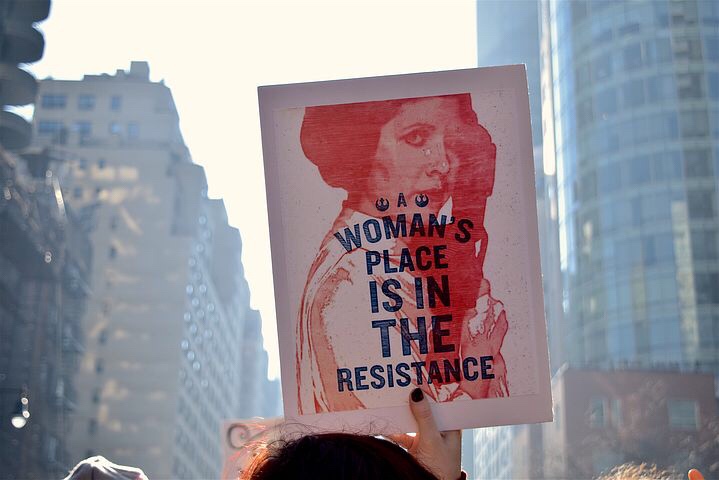
img_0252
Image via Pixabay

Tesco is at the moment facing a £4bn equal pay claim; a legal challenge by women working in Tesco stores, earning less than their male colleagues working in the warehouses. Their argument being the value of their work is comparable…. Also currently under the spotlight on equal pay is the BBC. A news correspondent having a salary some £10,000pa below that of her male colleagues doing the same job…. A National radio presenter paid one-third that of her male co-host…. Another BBC local radio station co-host breakfast presenter, paid half the salary her male counterpart receives….and the award-winning National radio presenter being told ‘the BBC doesn’t do equal pay’….

There is no denying that there are still many examples of women being discriminated against….and it’s only right each case is individually addressed. There is also no doubt feminism is doing a great job in raising awareness of rape, domestic violence and sexual harassment…. However, is there a danger of modern feminism becoming negative? Could it not be said we already have equality? What exactly is it we want….complete role reversal….supremacy in a unisex World? Are we becoming the gender of ball-breakers…? That’s a lot of questions, I know – but ones that will hopefully make us consider if what we are actually fighting for is actually now an outdated cause….

It would be a very under-educated view that feminists hate men; a real feminist cares just as much about men’s rights. Equality should be for all, regardless of gender, sexual preference or race…. What we should be focusing on is not just women’s rights – but human rights….

img_0250
Image via Pixabay

We owe so much to the Suffragettes and Suffragists – but their work is now done. Of course there are still sexist men out there – (sexist women too) – but they are a minority….most men abhor sexism and thoroughly support equality – they have proved that time and time again. It’s now time to move on; there is no getting away from the fact men and women are not the same….women bear the responsibility of childbirth – nothing is going to change that – it is what Nature intended…. For nearly every woman who decides to have a family this is going to have an impact on her career – what is important though, is this is not set in stone – at least in this day and age we have choices….

img_0251
Image via Pixabay

There is no doubt that men are, on the whole, physically stronger; there will always be jobs that are more suited to them….women just need to accept that – if she can demonstrate an ability to do the job just as well, then there is nothing stopping her…. The same goes for men choosing to do what in the past would have been viewed as a more feminine profession….there are fewer and fewer boundaries….. It’s about equality and getting on with doing what each and every one of us are individually best at….and as a united front….

img_0254
Image via Pixabay

Women are generally now no more oppressed than anybody else in Western every day modern society; opportunities are open to all…. One issue that does still keep rearing its ugly head is the sexual exploitation we are hearing so much about currently….it is dominating our news headlines…. Whilst it would be insensitive to generalise, as this is such a serious matter, it does have to be filtered…. Many historic accusations have been made – some appear to be quite insignificant and almost petty….the workplace 30 years ago was a very different place to now; a sleazy remark, a pat on the knee was quite normal behaviour back then….not right by today’s standards – but that’s how it was…. Of course more serious incidents did happen and those need to be dealt with – that said though, we have to let go of the past and move forward, looking after each other and fighting for equal rights for everyone…. We need to look to the future…. I personally am heartened, as I think this really is beginning to happen….
img_0253
Image via Pixabay

The Captivating Spell of Witch Hazel….

January and February can be dreary months, no place more so than in the garden; whilst a few bulbs are beginning to make their presence known, it takes a brave flower to face the cruel, harsh elements of Winter…. A few do rise to the challenge though – winter pansies and jasmin, hellibores and of course, witch hazel….


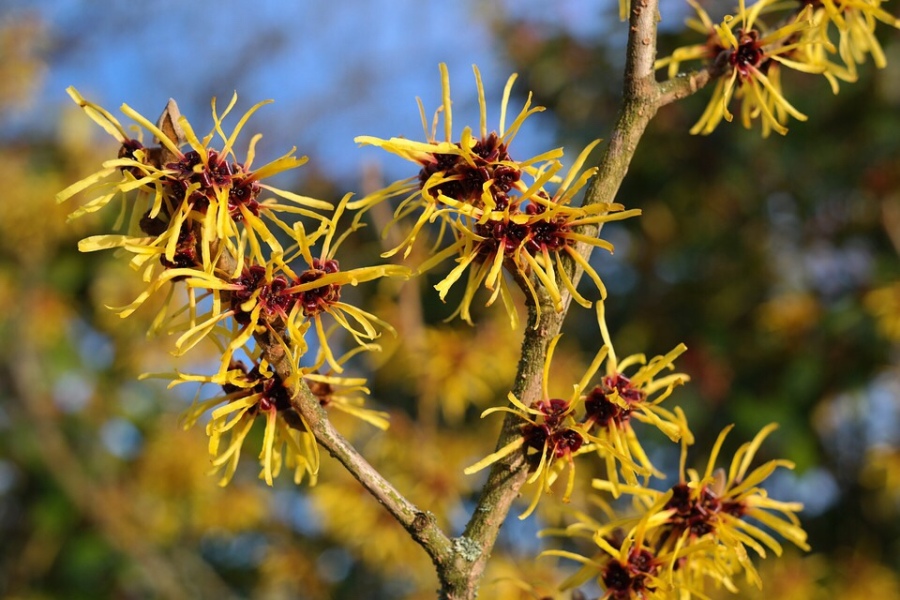
The one we have here in this garden, Hamamelis mollis (Chinese witch hazel) has done itself proud this year…. Planted soon after we moved in, some thirteen or fourteen years ago, it has taken its time to establish and get its roots down; this is the first year it has really flowered well….

img_3290
Hamamelis mollis

‘Hamamelis’ literally means ‘together with fruit’ – flowers, fruit and next year’s leaf buds can all appear together on the plant…. It is a shrub with several tricks up its sleeve; its early flowers, the foliage that turns to pleasing Autumn colour before the leaves fall….and then it has its party-piece…. The Hamamelis produces a seed pod in the form of a two-part capsule that contains just one black, glossy seed – the pod explodes open and can catapult the seed up to 30ft away….


Witch hazel is a genus of flowering plants in the Hamamelidaceae family; there are four species native to North America, one in Japan and another in China….

The first to be called witch hazel – because of its resemblance to the European hazelnut tree – is the Native American species H.virginiana. It was discovered in 1687 and first grown in England by Henry Compton, the Bishop of London….

img_0198
Witch Hazel along the Appalachian Trail – UGArdener via Foter.com / CC BY-NC Original image URL: https://www.flickr.com/photos/ugardener/5160810695/

The Japanese variety (H.japonica), which is similar to H.virginiana but with bigger flowers, was first introduced to Europe in 1863. In Japan the witch hazel is known as ‘mansaku’ – translating as ‘rich crop’. Folklore says when the flowers appear in great numbers a good crop is predicted for the coming harvest….

img_0199
Hamamelis japonica – ashitaka-f studio k2 via Foter.com / CC BY-NC-SA Original image URL: https://www.flickr.com/photos/iwahige/12010335123/

The Chinese (H.mollis) was first marketed in the West by the Arnold Arboretum, Massachusetts, in 1914. Although similar to H.viginiana it has a much stronger scent and is sometimes considered to be the most attractive of the witch hazels, as its flowers have a less twisted appearance. Native to central and Eastern China, it matures into a large shrub or even small tree, but potentially reaches only up to 10ft in height in our gardens….

img_0202
20120223_UBCBG_HamamelisMollis_Cutler_DSCO6514 via Foter.com / CC BY Original image URL: https://www.flickr.com/photos/wlcutler/6778791480/

The Latin ‘mollis’ means ‘soft’ and refers to the leaves which turn a buttery yellow in the Autumn. The yellow flowers are usually tinged red at the base, with 4 long petals, 4 short stamens and grow in clusters. Flowering from mid to late Winter through to early Spring, it is an ideal plant to cut a few stems from to bring indoors, so that its lovely citrusy fragrance can be enjoyed….

img_0201
Hamamelis mollis ‘Princeton Gold’ – Tie Guy II via Foter.com / CC BY-NC-SA Original image URL: https://www.flickr.com/photos/versicolor/3278823053/

Since the 1930s hybrids have been produced from the two Asian species, forming the Hamamelis Xintermedia hybrids: the first named ‘Arnold Promise’ arriving in 1963 has fragrant, yellow flowers. In 1969 ‘Diane’ was brought to us, with its lightly scented red flowers and long flowering season. Since the mid 80s a whole host of new varieties have been introduced to the market….

img_0203
Hamamelis ‘Diane’ – LEMills via Foter.com / CC BY=NC-SA Original image URL: https://www.flickr.com/photos/8366835@N05/2338781939/

Witch hazel is a fabulous feature plant; the darker varieties produce spectacular Autumn colour, changing from green to yellow, to orange and finally to dark red…. It is perfect for the British climate, as the winter chill is needed for full flowering potential to be achieved; it is incredibly frost tolerant and is disease resistant…. Witch hazel is easy to grow but prefers non-chalky soil and is extremely low maintenance….with no need for pruning – just remove any dead wood….

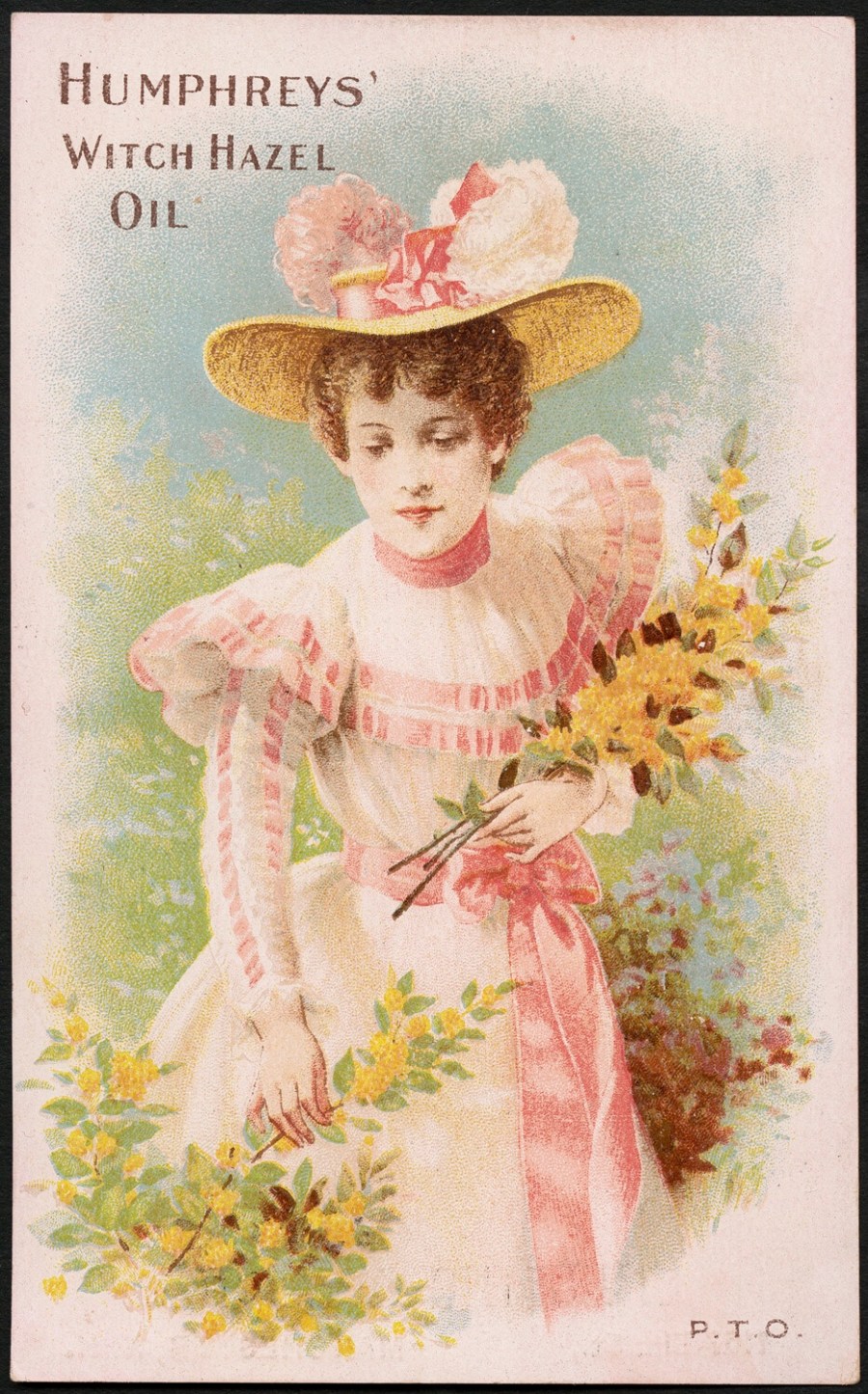
Of course, witch hazel’s talents don’t stop there…. The bark, twigs and leaves contain tannins and polyphenols which can be extracted and added to water (sometimes with alcohol) to produce distilled witch hazel…. Thomas Newton Dickinson, a Baptist minister, was the first to distill witch hazel commercially. He built a distillery in 1866, after learning of its medicinal properties from Native American Indian tribes. He used 86% double distilled witch hazel with 14% alcohol – the brand is still available today….and little has changed to its formula….

Witch hazel is a natural astringent – removing excess oil from the skin and shrinking the pores. It helps prevent spots, blackheads and blemishes and is one of the best treatments for acne…. It is often added as an ingredient to beauty and health products….

img_0205
Humphreys’ Witch Hazel Oil (front) – Boston Public Library via Foter.com / CC BY Original image URL: https://www.flickr.com/photos/boston_public_library/855829956/

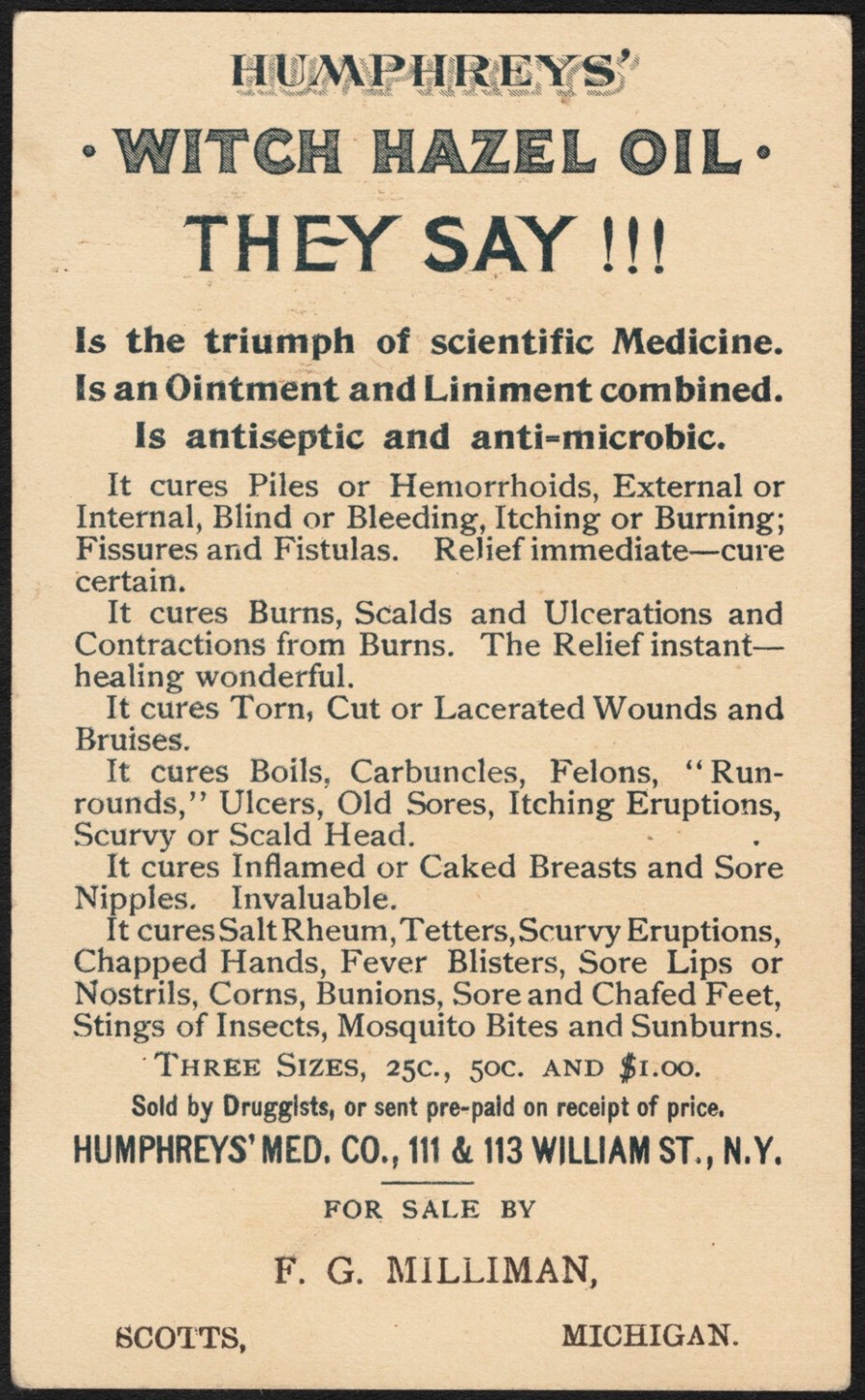
It is useful to help fight signs of aging and can reduce puffiness and brighten the eye area – (just take care not to get in the eye itself, as it will sting)…. It is also known to help fade bruises and speed up the healing process….

Applied to minor cuts and scrapes witch hazel will stem. Bleeding and is a good choice for the cleansing of wounds – (especially the shop bought variety as it usually contains isopropyl alcohol)…. Used after shaving it will stop any nicks from bleeding and will help prevent razor burn….(good to use after a wax treatment too, ladies)….


It will also relieve the itching caused by insect bites and stings – sooth a baby’s nappy rash and will cool down sun burn…. It is thought to help eczema….

A few drops inserted into the ear canal will help break down troublesome ear wax…. It can help varicose veins, by temporarily reducing the swelling and so relieving pain…. It is a common ingredient used in haemorrhoid treatments….

To sooth a sore throat, gargle with natural (no alcohol) witch hazel; it can ease the symptoms of tonsillitis, laryngitis and sinusitis….

Pure witch hazel will also help reduce the swelling and discomfort associated with gum disease and can relieve the pain of a troublesome wisdom tooth…. Mix together a teaspoonful of pure witch hazel with a drop of clove oil and myrrh oil to rub on the gums of a teething baby….

img_0207
Humphreys’ Witch Hazel Oil – an ointment for the people (back) – Boston Public Library via Foter.com / CC BY Original image URL: https://www.flickr.com/photos/boston_public_library/8557191659/

As you can see witch hazel really is one of Mother Nature’s most precious natural remedies; can you really afford not to have a bottle to hand in your bathroom cabinet…?

There seems to be no end to the wonders of witch hazel…. If you missed the last blog post but would like to read more about this very special and versatile plant How divine….


How divine….

I have always assumed that Witch Hazel (Hamamelis) earned its name because of its remarkable healing properties and its use by the wise-women of the Middle Ages – it appears I couldn’t have been more wrong….


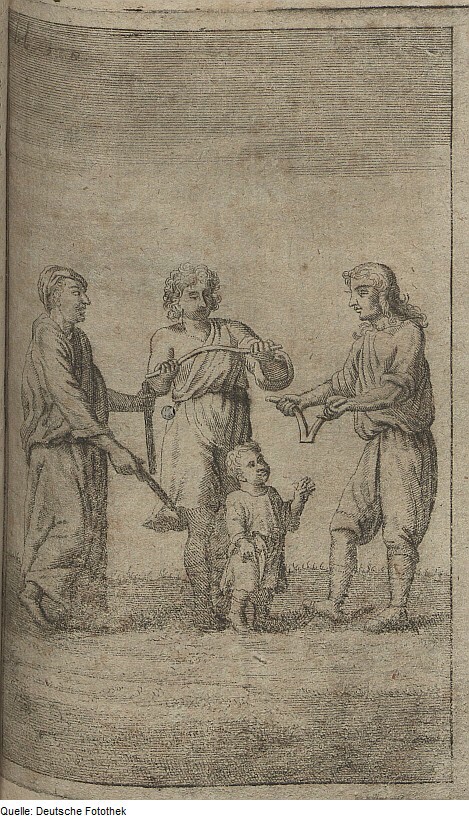
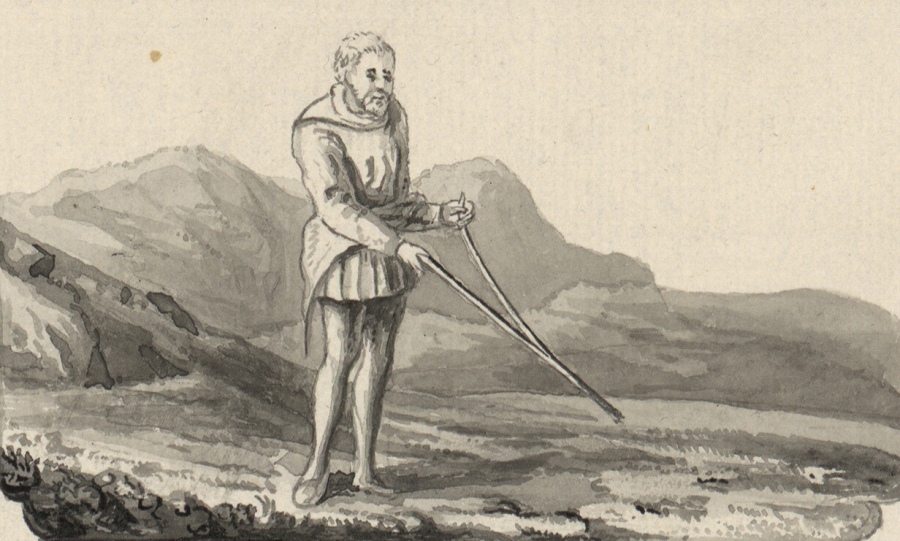
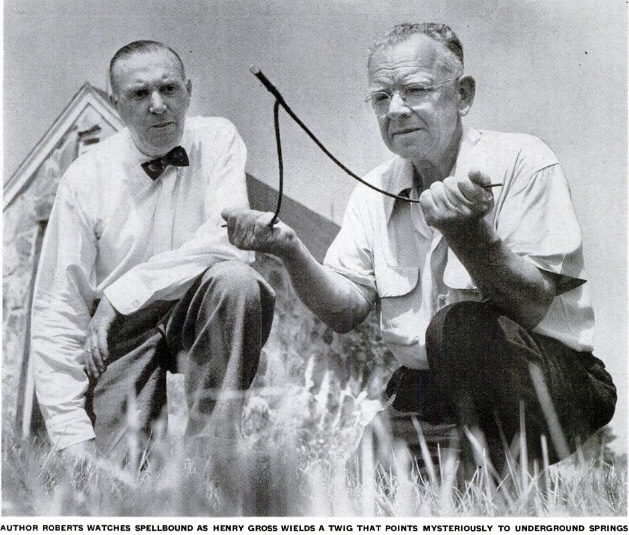
Four native species of Witch Hazel are to be found in North America: Hamamelis mexicana, H. virginiana, H. vernalis and H. ovalis; another is to be found in China, H. mollis and a further one in Japan, H. japonica….. It was the Native American Indian people who taught early settlers how to use the twigs of Witch Hazel as divining rods, providing an alternative to the Hazel and Wych Elm they were more familiar with back in the UK and Europe…. The name Witch Hazel derives from that connection; ‘wych’, an old Anglo Saxon word, meaning ‘to bend’ – and also from the Middle English word ‘wiche’ (that in turn coming from the Old English ‘wice’) – both meaning ‘bendable’ or ‘pliable’….

img_0112
Image pixabay.com

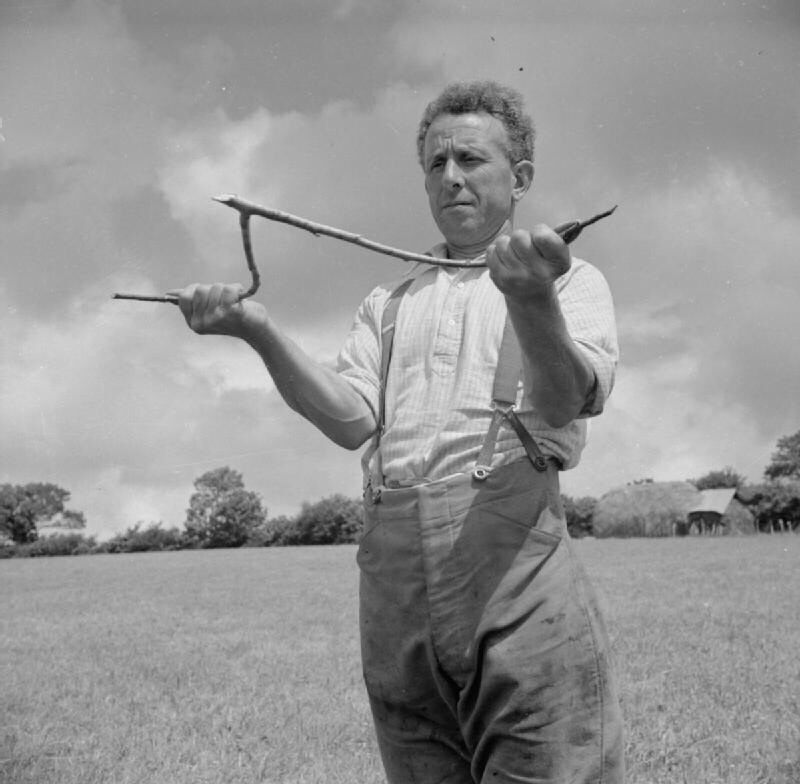
Divining or dowsing (water witching in the US) is a way of detecting underground water…. However, dowsing is not just restricted to locating water; it can be used to search for metal ores, oil, gemstones….ley lines, archaeological remains – even missing persons….pretty much anything with an ‘energy’ source. Sometimes it is also used to diagnose certain medical ailments; (this is permitted in the UK and Europe – but not in the United States)….


Dowsing, in one form or another, has been used for thousands of years – from time before written history. Perhaps the oldest reference to it discovered so far is from a cave drawing found in Tassili, Algeria – which is over 8,000 years old. The oldest known written record comes from China, 2205 BC….

Even the Christian Bible could be said to have interpretations: Moses striking the rock and releasing water (Exodus 17) or the Magi could be argued to have practised a form by their use of astrology as an aid to navigation…. Ironically, it is the Christian Church that in Medieval times declared dowsing as breaking the 1st Commandment ~ “I am the Lord thy God, thou shalt not have any strange gods afore Me”…. The Church believed dowsing was practising superstition, one of the deadly sins….it became associated with the Devil – his powers believed to control the divining rods….

img_0108
Image Wikimedia Commons

Certainly we know dowsing was used by the Ancient Egyptians and Chinese…. Possibly the original purpose was for predicting the future or determining if an accused person was guilty of a crime…. However, dowsing as we know it today seems to have originated in Germany, particularly in the Harz mountain area (incidentally thought of as a stronghold of Paganism), where it was used to locate metal ores underground for the mining industry…. Coins discovered in the region, dating to the 10th Century, appear to have been produced to celebrate the founding of a silver mine – the image depicted upon them being that of a dowser – proving the skill to have been very valuable in Germany at the time…. It was during the 15th Century that dowsing was introduced to the UK – when it came with German miners coming to work in British mines….

img_0103
Image Wikimedia Commons

In 1518 Martin Luther, a German professor, priest, composer and key figure in the Protestant reformation in the 1500s, condemned dowsing as witchcraft- it was he who claimed it broke the 1st Commandment….

img_0111
Martin Luther – Image Wikimedia Commons

Strangely, only twelve years after Luther’s condemnation, Georg Bauer, a German physician and mining expert, wrote a paper and it was to become one of the most important works on the subject of mining (and the use of dowsing was included within it) of the time…. Nobody condemned him….raising the question as to whether the Medieval Church had more of a problem with authority rather than the actual act of divining itself….

In 1659 Jesuit Gaspar Schott, a German scientist specialising in physics, mathematics and natural philosophy – and one of the most learned and knowledgeable men of his time – declared dowsing as satanic….

Despite opposition from the Church dowsing was still used up to the 19th Century as a way of finding metal, coal and water…. It was Victorian scientists who claimed it was an invalid method – and having no place in a world where science was coming along in leaps and bounds….

However, even in these present days of scientific knowledge – where dowsing is still treated with skepticism – there are a surprising number of professionals who use the method; surveyors, architects, engineers….to name just a few….

img_0110
Image Wikimedia Commons

It is thought just about anyone can dowse…. May be it is a natural instinct we have inherited from our ancient ancestors – after all animals can detect water from miles away, so once upon a time, did we possess a natural ability to do the same? Children especially are thought to have a natural flair….

img_0102
Image Wikimedia Commons

Traditionally – as mentioned before – Hazel or Wych Elm are the preferred choice of divining rod…. Elm and Hazel – along with Ash, Rowan and Willow – are thought to have magical powers…. Nowadays metals are often used, such as copper or aluminium – even wire coat hangers bent to shape have been proven to work…. (Occasionally a dowser may choose to work with a pendulum rather than rods)…. The idea is, when the rods are held in the correct way and the dowser moves slowly around the area he is searching if the source is found the tips of the rods may twitch, point down or cross over….


Of course there are the skeptics among us who will say it is because the dowser is so mentally in-tune with what they are looking for that they will involuntarily move the rods themselves…. Or perhaps the energy from the source stimulates the muscles in the nervous system – some sort of electro-magnetic impulse…. There are others who just ‘poo-poo’ the whole idea….

If you do happen to witness a dowser at work it can be quite an incredible thing to see….

Personally, I am very open-minded about the subject, being fortunate enough to have had some first-hand experience. It was during the early stages of the restoration work we undertook on the cottage….we were in the process of trying to work out where the underground LPG tank should be buried in the front garden – realising that one part of the garden seemed prone to ‘sinking’…. Being in direct line with the back door, one thought was that perhaps it was the site of a disused well…. A digger-driver friend, with us at the time to help with the groundworks, suddenly surprised us by whipping out a pair of divining rods…. He then proceeded to slowly cover the area, holding the rods out in front of him….and sure enough when he came to the sunken part the rods sprang to life…. We were amazed…. Unable to resist having a go myself, Colin showed me how to hold the rods correctly and I had a try….and no word of a lie – it worked! The rods, completely independently, dipped down and crossed at the tips – as if they had a mind of their own….

Sadly, even after digging quite a way down, no water was to be found at that particular spot…. Nowadays a flower bed lies there, although nothing really successfully grows in it as the ground continues to sink away – countless barrows of soil have been used over the years to top it up – so we are not entirely convinced there is nothing there to be found….We are planning to redesign that part of the garden this coming Spring – perhaps a little more investigation work is required….

Bless this Child….

Having recently read a few books set in the Victorian era, I happened across a custom that I had not heard of before – the ‘Churching’ of women after childbirth. Doing a quick search I discovered it had connections to Candlemas; being so close to February 2nd, it seemed an appropriate time to find out more….

‘Candlemas’ – ‘Feast of the Presentation of Our Lord Jesus’ and ‘Feast of the Purification of the Blessed Virgin Mary’…. The 2nd of February being the day the Virgin Mary attended the Temple after the birth of Jesus, to be purified; Luke (2:22) – a Jewish rite, washing the sin of childbirth away. There were some who thought a woman to be ‘unclean’ and ‘unholy’, as she had engaged in sexual activity; holiness being virginity and celibacy – she required purification to be accepted back into society….

img_0146
“The Holy Family in the Temple” – Lawrence OP via Foter.com / CC BY-NC-ND Original image URL: https://www.flickr.com/photos/Paullew/24542239067/

There is no evidence to say women were thought to be unclean after giving birth at the beginning of Christianity – that was a notion to arrive later on. Indeed, at first it appears to be quite to the contrary, the Churching ceremony began purely as a blessing of thanksgiving that the woman had survived the ordeal of childbirth – for until the beginning of the 20th Century giving birth was the single most common cause of death amongst women….

Because of high infant mortality it became practice to baptise babies as soon as possible after birth. Statistics from the 1700s alone show two-thirds of children in London died before they were 5 years old, many of these failing to reach their second birthday. Starvation and disease among the poor claimed many lives; affluent mothers did not feed their own babies, employing a wet-nurse instead – this in itself could easily pass on infection….

Very often, due to still being in recovery, the mother would miss the baptism of her newborn – during which would be a blessing for the new parents. So a second blessing for the mother began to establish; a simple ceremony…. The woman would come to the church entrance and kneel with a lighted candle – (an acknowledgement to the Feast of the Presentation; the candle would be blessed and then used in the home). The priest, wearing a stole, would then bless her with Holy water; she would then take the edge of his stole and he would lead her into the church and to the altar, where she would once again be blessed with Holy water…. She had been welcomed back into the church after her period of absence whilst she recovered….To me this sounds like a gentle, caring ceremony….

“Benedictio mulieris post partum” ~ (The blessing of a woman after giving birth)….

img_0147
“Christening gown” – anyjazz65 via Foter.com / CC BY-ND Original image URL: https://www.flickr.com/photos/49024304@N00/22156803722/

The problems began to arise during the Middle Ages; some preachers began to link the mother’s absence from the church and the baptism, with her ‘impurity’. The link to being unclean comes from the Book of Leviticus (12:1-8), which pronounces women as being unclean for one week after giving birth to a son and two weeks for a daughter. The mother was then to wait for between 1-2 months before she could be purified…. (The 40 days of the Leviticus law for purification)….

It wasn’t until the 4th and 5th Centuries that women began to be separated from the rest of society at the time of childbirth…. Indeed Pope Gregory the Great condemned the separation – deeming it would appear like a punishment to women – but gradually the practice was to become the ‘norm’….

Nowadays we often give birth in hospital and come home the same day…. Up to the middle of the 20th Century we could expect to stay in hospital for up to 10 days…. Before 1900 it wasn’t unusual for a woman to be bedridden for up to 6 weeks after childbirth….

img_0148
“Photo Shoot : Child Baptism” – Divine in the Daily via Foter.com / CC BY-ND Original image URL: https://www.flickr.com/joeandsarah/2851994323/

During the time leading up to the 17th Century wealthy European women were cut off from the outside World at the time coming up to the birth and then for a considerable period after; kept away from husbands and older children – to be attended by midwives, ladies-in-waiting and female relatives…. This term was referred to as ‘lying-in’….or ‘confinement’ as it later became commonly known as…. The room would be specially prepared; it had to be sealed from all outside influences – heavy drapes at the windows – in some cases even to the extremes of blocking up keyholes! Most probably in an attempt to keep out evil spirits. A fire would be kept burning in the hearth – very often the room would have been stifling – and with the lack of fresh air – foul-smelling too….

It is debatable as to whether all Victorian women went into confinement before birth. For the lower classes this is an improbability as they would have had the need to continue working and looking after the family for as long as possible. Certainly though, for the richer classes, this may well have been the case…. In a time of prim and proper morals – but also rather a lot of vanity – baby bumps were not aesthetically pleasing. Pregnancy would have been concealed for as long as possible; in fact until 1860 there were no scientific tests available to determine pregnancy – women generally waited 5 months to make sure…. At a time when fashion dictated the wearing of tight corsets it was probably when this became an impossibility that the woman went into ‘hiding’. Special corsets for expectant mothers were designed, with expandable laces to accommodate the growing belly – but the wearing of corsets during pregnancy began to disappear in the 1840s….

img_0157
“Victorian Maternity Dresses” – Jvstin via Foter.com / CC BY-NC-SA Original image URL: https://www.flickr.com/photos/jvstin/30530098061/

As advertising the fact one was pregnant was not the ‘done thing’ certain terms to describe the condition came into vocabulary: ‘in the family way’, ‘with child’, ‘in a delicate condition’ or for those who wanted to put it more crudely ‘in the pudding club’ – terms that have somewhat stayed with us….

As for all the women before them, giving birth for a Victorian woman was a critical time; statistics show in 1876 the mother’s death rate was 1 in 200. Before the 1840s it was considerably higher than that; for before that time it wasn’t considered necessary for those in attendance at the birth to even wash their hands! Hygiene was simply not on the agenda…. It was Dr. Ignaz Philipp Semmelweis, a Hungarian doctor, who became known as ‘The Saviour of Mothers’ – after he ordered all his students to wash their hands in a solution of chlorinated water and lime before examining mothers…. The idea caught on and after that the infant mortality rate fell from 18% to 6%….

img_0151
Ignaz Philipp Semmelweis – Public Domain

Malnutrition meant poorer women were often anaemic and in poor health – which meant the expectant mother and unborn child were at risk from the onset. Lack of Vitamin D and calcium could lead to rickets in the woman – giving the possibility of a contracted pelvis – making birth even more difficult. If problems did arise, few options were available. Before the sterilisation of equipment almost all caesarean sections proved fatal for the mother and were only ever performed to try and save the child if there was no hope for her – (without any anaesthetic of course)….

img_0156
Jason Lander via Foter.com / CC BY Original image URL: https://www.flickr.com/photos/eyeliam/7353085948/

If the actual birth didn’t kill, then there was the risk of blood poisoning afterwards. Often a piece of the placenta would be left behind and gangrene would set in….

Obviously, there were no antibiotics available at the time; just as there was no pain relief until the mid 1800s. Chloroform or ether was the first anaesthetic to be used in a difficult birth, in January 1847 by Scottish physician James Simpson. It was he who attended Queen Victoria after she was persuaded to use anaesthetic for the birth of Prince Leopold in 1853 – so pleased was she that she made the physician a Baron.

img_0150
James Young Simpson – Public Domain
img_0149
Queen Victoria, Prince Albert and their nine children – 26th May 1857…. Public Domain

After the Queen had used anaesthetic it became more accepted; up until that point the Church had disapproved of the use of pain relief, saying it was a sin to intervene, God had not wished the process to be painless. Some went as far to say it was a punishment for womankind, for Eve’s temptation of Adam….

img_0152
Pexels.com

Of course, even if mother and child survived the birth, infant mortality remained high. Families tended to be large (in 1800 the average family had 7 children); richer classes wanted a son and heir and would carry on producing until one arrived. Whereas, poorer families needed lots of children to work and help support the family. Most women would be giving birth every 18-24 months – each time putting her own and that of her child’s life at risk…. There was little option in the way of birth control and any that did exist was frowned upon by the Church….

img_0145
“Two young girls” – National Science and Media Museum via Foter.com / No known copyright restrictions. Original image URL: https://www.flickr.com/photos/nationalmediamuseum/2781022364/

There was no hard, fast rule as to how long a woman should be confined to bed after childbirth. Doctors often advised at least 9 days but anywhere between 5-15 days was considered normal. For some women it was a welcome rest (one thought is it was introduced to stop women being forced back to work straight away); for others confinement literally meant imprisonment….

For many of these women the ceremony of Churching was a time to rejoice – it marked the end of their confinement – they could once again get together with family and friends and celebrate their new-born child…. For some, especially those living in villages, social life revolved around the church – the choir, Sunday school, church outings and events….many knew little of life beyond the village…. Victorians were God-fearing and the parson would dominate the village – so it was very often his views that dictated those of his flock – therefore, although for many the ritual of Churching was a joyous occasion for others is was a matter of needing to be ‘purified’ before being accepted back into the church and society…. It was perhaps ‘pot-luck’ as to the view-point the parson concerned took on the matter – was it a blessing and giving of thanks to “the safe deliverance and preservation from the great dangers of childbirth” (from the Church of England Blessing) or indeed a cleansing of her sins…?

img_0154
Pexels.com

Towards the end of the Victorian era, due to advancement in science, people began to question the old religious beliefs; the likes of Charles Darwin were partly responsible for this. His ‘Origin of the Species’ – the theory mankind was not created by God but had evolved just like any other species, caused many attitudes to change – but obviously this did not happen over night….

There were still plenty who were of the opinion if a woman was unchurched after giving birth she was unclean…. They would be offended if they came across her in the street; if she were to enter another’s household she would be certain to bring bad luck – for some it was taken to the extreme that she was unable to prepare food even in her own home in case she should taint it….

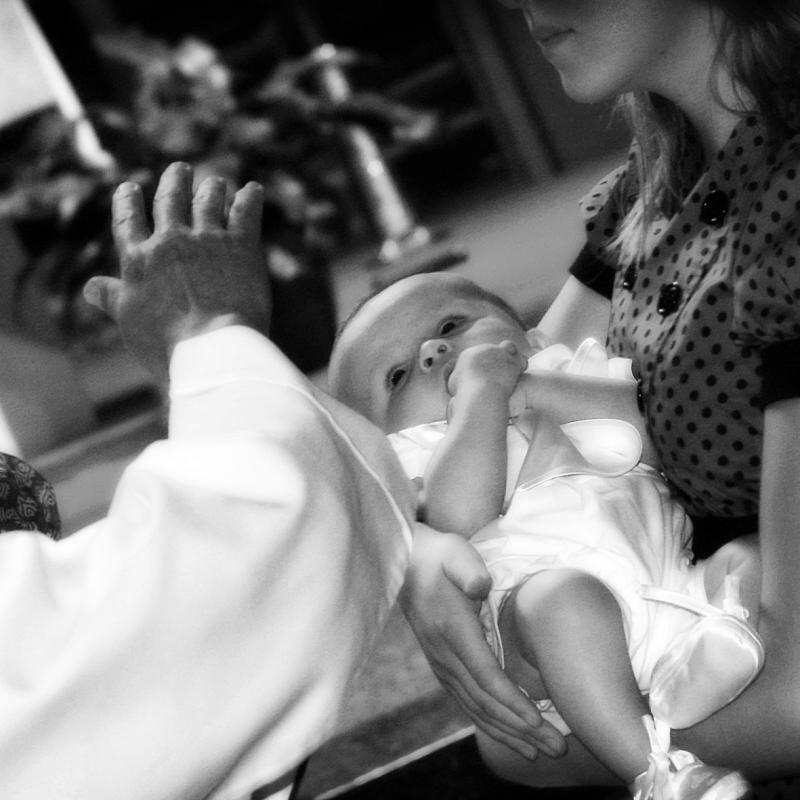
By the early 1900s many women were beginning to feel aggrieved about being labelled ‘unclean’ – but ‘old school’ mothers and grandmothers could be very persuasive; so for many the rite continued…. It was eventually officially dropped by the Catholic Church in the mid 1960s but in some communities it still, to some degree, carried on right up to the 1980s…. Today Western Christianity no longer observes it (although it is still retained in Orthodox churches). Nowadays the mother is blessed as part of the child’s baptism ceremony….

img_0144
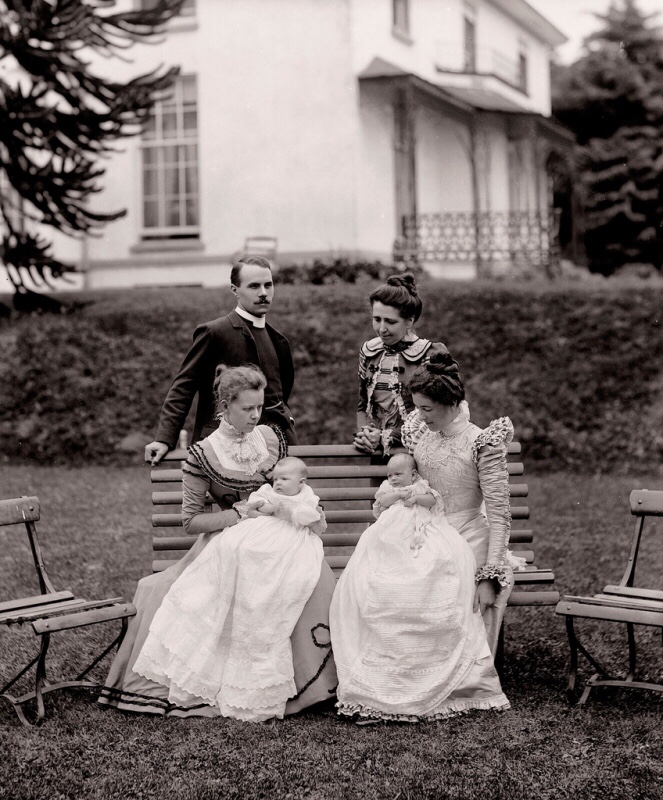
“Christening Day” – National Library of Ireland on The Commons via Foter.com / No known copyright restrictions. Original image URL: https://www.flickr.com/photos/nlireland/6446134239/

I was quite surprised, on reading through the comments on a couple of on-line forums covering the subject – at just how much effect Churching has had on some women even now…. Women who had been Churched in the 50s/60s/70s often express how angry and bitter they feel at the demeaning treatment they received – some even said it turned them away from the religion they had grown up with…. That is such a shame – but just goes to show how interpretation can influence opinion…. One thing I am sure we’re all agreed on now – bringing a child into the World is a wondrous miracle; one that should be celebrated not repented for…. Whether we are religious or not – we should all give thanks that we live in the times that we do – childbirth will never be easy – there will always be risks – but it’s nothing compared to what womankind had to go through before us….

img_0155
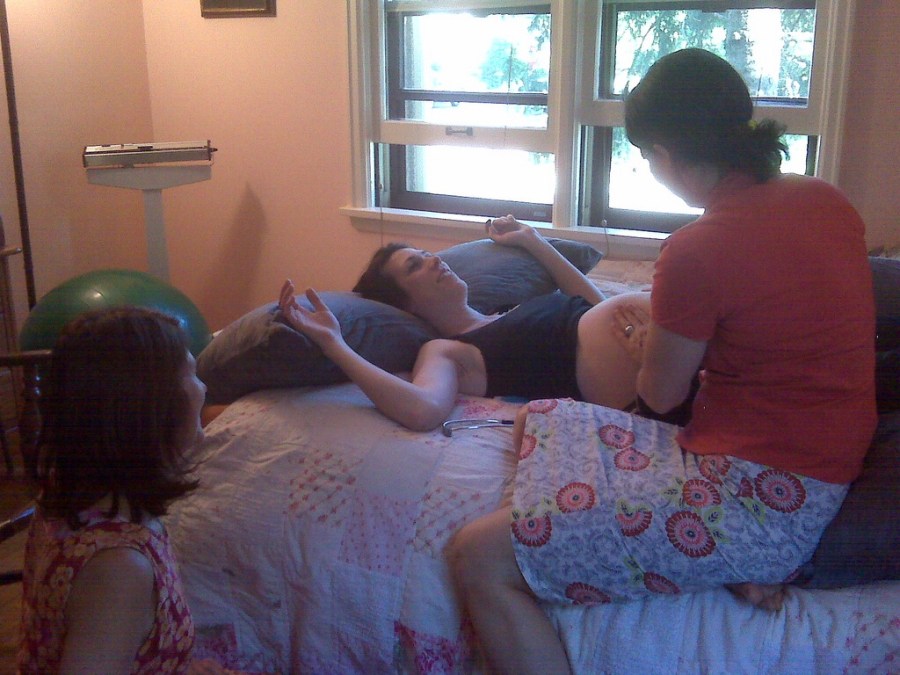
“Midwives” – kc7fys via Foter.com / CC BY-SA Original image URL: https://www.flickr.com/photos/jonathancharles/4647336564/
img_0153
Pexels.com

Over your own Personal Rainbow….

Out of all the natural meteorological phenomena of the World – thunderstorms, hail, snow, drought, St. Elmo’s fire – there are so many – but the rainbow has to be one of the most beautiful and cheering among them….


Every time you spot one you can be safe in the knowledge it is a gift especially for you…. Even if you are seeing it with a group of other people, you can be assured each of you are seeing your own unique rainbow – as they are in fact an optical illusion….

Sunlight is made up of many colours but we generally see it as ‘white light’. If the sun is behind you and there happens to be moisture in the air ahead of you, be it rain, fog or perhaps even a fountain or waterfall – and if the angle is right – you may be lucky enough to see one….


The sun has to be low in the sky – less than 42 degrees above the horizon; the lower the sun the bigger the arc – a full bow can only be seen when the sun is exactly on the horizon (either at sunrise or sunset)….

img_0092
Max Pixel

Any other time only a partial arc is seen…. To be correct a rainbow actually forms a full circle; usually we are too low down to see this but you may be fortunate enough to observe it if you are high up a mountain or in an aircraft….

img_0080
Wikimedia Commons

Water is denser than air; as a sunbeam descends to Earth the light passes to a water droplet in the air – as is does it decreases in speed and changes direction – this is called ‘refraction’…. The light then splits into the separate colours; each colour has its own different wavelength that slows down at a different rate to the others – the term for this being ‘dispersion’…. If the angles are right, some of the light entering the water drop will be ‘reflected’ from the inside edge of the drop and will exit – once again being refracted – passing back from water to air….to the eye of the observer and a rainbow can be witnessed….


To our eyes there are seven colours: red, orange, yellow, green, blue, indigo, violet….red having the longest wavelength and violet the shortest…. But what we don’t see with the naked eye is the whole host of colours in between – there are actually over a million of them…!

img_0081
Courtesy Magic Foundry

Back as far as 350 BC Aristotle, the Greek philosopher, was applying his enquiring mind to the rainbow – but it was Isaac Newton, during the 17th Century, who proved – by using a prism – that white light is made up of a spectrum of colours. Originally he only identified five colours; he added orange and indigo later….

As children we are often taught rhymes or other ways to remember the colour sequence of a rainbow; such as – ‘Richard of York gave battle in vain’ – or the name of a fictional character ‘Roy G. Biv’….

img_0086
Pexels.com

As with any phenomenon or unexplained occurrence, before the time of understanding, many myths and legends surrounded the rainbow….some of which are still with us today….

In Norse mythology the rainbow was a bridge (Bifrost) and it connected Earth with the home of the gods…. Eventually it was destroyed by war….

img_0089
Max Pixel

In Japan it was also seen as a bridge; one for departed ancestors to return to Earth…. Whereas, in Hindu mythology, Indra – god of thunder and war – used the rainbow as an archer’s bow to shoot arrows of lightning….

For the Aboriginal people, the ‘Rainbow Serpent’ created the World and all life upon it…. In Christianity God created the rainbow as a sign to Noah, that He would never flood the Earth again (Genesis 9:13)….


In Medieval Germany there was a belief that no rainbows would appear in the skies for forty years before the end of the World….so to spot one was always a good omen…. ‘So the rainbows appear, the World has no fear, until thereafter forty years’…. – anon….

To a Celtic Druid a curve symbolises the crescent moon – the divine feminine presence – representing fertility, provision, prosperity and magic…. ‘Kambonemos’ – the Celtic rainbow – means ‘curve of the sky’…. Arches, crescents, anything of a curved shape, is reminiscent of an expectant mother’s belly and the life within…. Celtic lore says to make love under a rainbow will ensure pregnancy will happen…. A rainbow is the promise of a new life to come….

img_0083
Pexels.com

There are those who believe to see a double rainbow means a chance to follow dreams is about to be delivered – an opportunity is going to come your way….


Then there is the myth that we are all familiar with; the pot of gold at the end of the rainbow….

Legend has it that when the Vikings invaded Ireland, they plundered gold from all across the land and buried it to keep it safe….and when they eventually left they forgot to take some of it with them…. Now, the Leprechauns, who knew that all gold rightly belonged to the fairy folk, had been watching as to where the Vikings had hidden the treasure and quickly dug up the forgotten gold and reburied it, away from prying human eyes – for as far as they were concerned, the Vikings were human, therefore, all humans were to be mistrusted…. So goes the tale – where the end of the rainbow falls so lies buried a Leprechaun’s pot of gold….

img_0094
Max Pixel

There is another little story about a Leprechaun and his gold…. This little fella had been tricked by a human into revealing where his treasure was hidden – buried under a bush, surrounded by other identical bushes…. The man needed a shovel to dig up the gold – and so he tied a red ribbon around the bush and gave the Leprechaun strict instructions not to remove it – whilst he went off to find something to dig with…. On his return he discovered the wily Leprechaun had tied red ribbons to every bush in the vicinity….clever little chap….

img_0072
Foter.com

My personal favourite story is the Native Indian tale of how the rainbow came to be….

All the colours of the World had an argument; each believed it was the most important and served the greatest purpose on Earth…. Green declared it was the sign of hope and life, being the colour of leaves and grass….food for all the animals…. Without Green there would be no life…. Blue scoffed; being the colour of the sky and the sea, surely it was the most needed…. In the sky clouds could be found, from which rain – drawn from the sea – falls, bringing life to the land…. Yellow laughed; the sun, moon and stars are all yellow – they make you happy and bring warmth to the World…. Orange interrupted that it was the colour of the fruits and vegetables that obtain the vital vitamins to sustain life…. Red’s blood finally boiled….as it – being the colour of blood. – was sure it had the most important role; the colour of love, passion and the warning of danger…. Purple was enraged – and claimed it was the colour of Royalty – it stood for authority and wisdom – it stood for power…. Then a little voice piped up….it came from Indigo…. “What about me? I represent thought – I am for prayer and spirituality….I am the colour of silence….” Unbeknown to the squabbling colours, Rain had been listening in…. Finally, unable to stand the bickering any longer, it sent a flash of lightning accompanied by a crash of thunder…. Above the din Rain shouted “You fools – do you not realise you are all as important as each other? Without each other you are nothing…. Now, all join hands and come with me”…. Which they did – and from then on, every time it rained, they were reminded of how much they meant to each other and joined hands across the sky to form a great bow of colour….giving a sign of peace, love and hope for the future…. A sign for us mortals; for when we look up and see a rainbow we should reflect and show appreciation to each other....
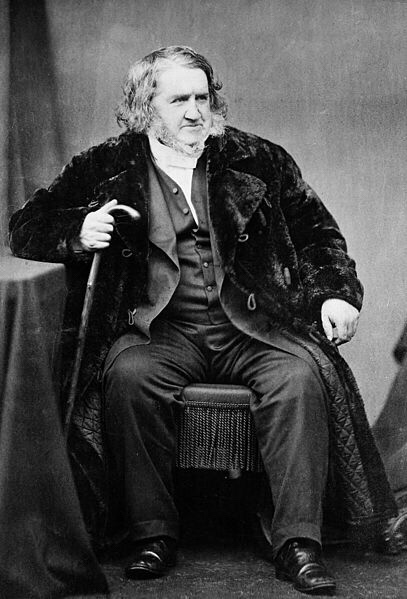
img_0101
Max Pixel
Somewhere over the rainbow way up high
There's a land that I heard of once in a lullaby
Somewhere over the rainbow skies are blue
And the dreams that you dare to dream really do come true....

Someday I'll wish upon a star
And wake up where the clouds are far behind me
Where troubles melt like lemon drops
Way above the chimney tops that's where you'll find me....

Somewhere over the rainbow bluebirds fly
Birds fly over the rainbow why then on why can't I...?

                                                                                                            ~ Over The Rainbow ~ 

img_0088
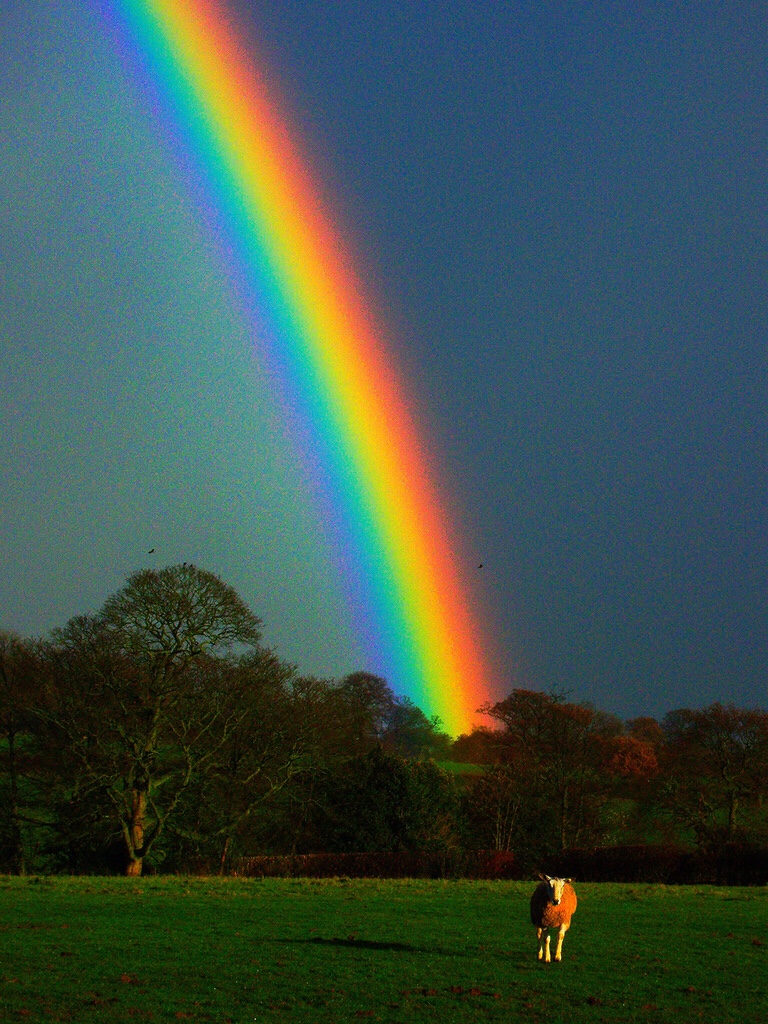
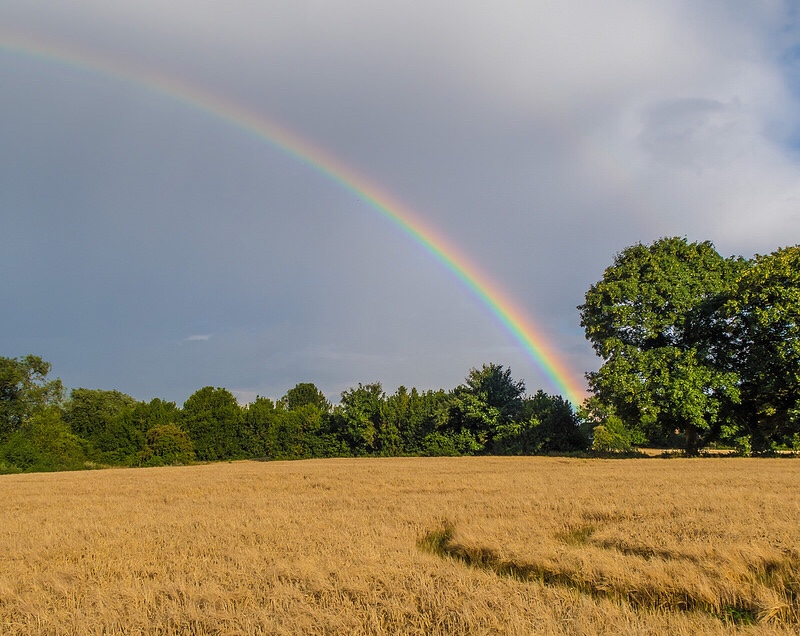
Rainbow over the fields Charles D P Miller via Foter.com / CC BY Original image URL: https://www.flickr.com/photos/cdpm/36126703402/