On this day in history….16th February 1878

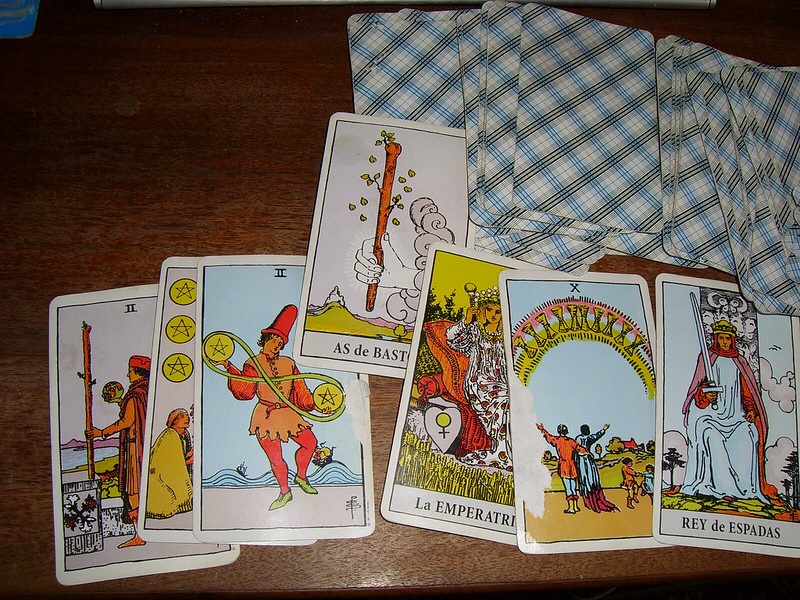
On this day in history : 16th February 1878 – The birth of Pamela Colman Smith – the writer, artist, illustrator and occultist, who created the classic Rider-Waite deck of tarot cards….

Lots of us have had our cards read at some time or other, whether for fun – or as a way of helping to gain understanding or comfort during difficult times in our lives…. Tarot cards, as a pack of playing cards, have been around since the mid 15th Century – the first documented being in Milan, Ferrara, Florence and Bologna…. Early cards were hand painted and so there were very few packs around – with the invention of the printing press mass production became possible….img_5995

Around 1789 Etteilla, the pseudonym of Jean-Baptiste Alliette, the French occultist who first popularised tarot divination, was the first to have a pack of tarot cards designed specifically for occult purposes…. Nowadays the three most common decks used are the Tarot of Marseilles, the Thoth Tarot deck, devised by Aleister Crowley with Lady Frieda Harris and the Rider-Waite deck….

Poet and mystic Edward Waite wanted a fully illustrated deck of tarot cards – the only one at the time was the ‘Sola Busca’, which was created for a wealthy family in Milan during the 1490s…. It was Pamela Colman Smith he turned to for the design of his own set….

img_5993
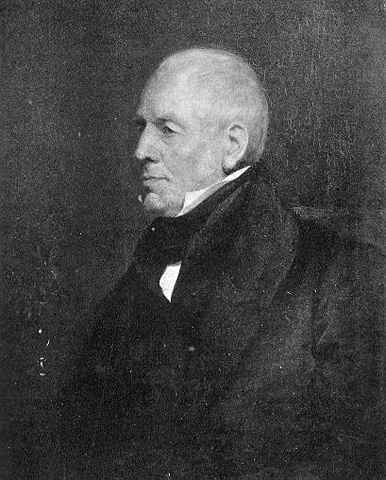
Arthur Edward Waite, in the early 1880s – Public domain

Pamela was born in Pimlico, London, to wealthy parents who had a large circle of influential friends…. Her mother, Corinne Colman, was Jamaican and her father, Charles Edward Smith, a white American…. Pamela, known to her friends as ‘Pixie’, was an only child and spent the first decade of her childhood in Manchester, before living in Jamaica for a while….

In 1893 she moved to America and at the age of 15 enrolled at the newly founded Pratt Institute, studying art under artist, photographer and print maker Arthur Wesley Dow, chairman of the Institute…. Pamela, with her natural and mature talent, embraced the Art Nouveau and Symbolism styles of the time….

Corinne Colman died – Pamela took her mother’s death hard and it affected her health…. She left the Institute in 1897, before gaining her degree…. She returned to be with her father and took up work as an illustrator….

She became involved with the Lyceum Theatre group, headed by Ellen Terry, Bram Stoker and Henry Irving…. She toured the country with them, designing costumes and sets…. Then, when she was 21, her father died….once more hitting her hard….

By 1901 Pamela had established her own studio in London…. She would hold weekly meetings for artists, actors and writers, which reflected her bohemian lifestyle…. Some of her illustration projects included work on ‘The Illustrated Verses of William Butler Yeats’ and works by Bram Stoker…. She also produced written work of her own, such as ‘Widdicombe Fair’ and ‘Annancy Stories’ and started her own magazine ‘The Green Sheaf’…. Also around this time she was actively involved in the Women’s Suffrage Movement….

In 1907 prominent photographer and art promoter Alfred Stieglitz gave her space to hold an exhibition in his New York gallery; she was the first artist he had allowed to do so…. It was also around this time that she met, through Yeats, Edward Waite – and they became friends…. It was in 1909 that he commissioned her to do the artwork for the tarot deck he wished to create…. He suggested she drew on the 15th entry Sola Busca cards for inspiration, which she did – although it was also widely thought that the characters in her tarot deck were based on her own social circle….

Pamela was the first to use characters even on the lower cards; previously images of groups of cups, wands, swords and pentacles were used…. The result Pamela achieved was a deck of 78 beautifully illustrated cards, which sold at a cost of 6 shillings – a huge amount of money in the day…. They were first published in November 1909, by publisher William Rider – giving the Rider part of the name….

This photograph of Pamela Colman Smith, by an unknown photographer, was first published in the October 1912 issue of ‘The Craftsman’ in an article entitled ‘The Fairy Faith and Pictured Music of Pamela Colman Smith’…. She was 34-years-old at the time and I think you will agree the photograph portrays a woman with an appealing charm and maybe a mischievous streak….

img_5974
Pamela Colman Smith – Public domain

She converted to Roman Catholicism a couple of years later – and some ten years after that opened a rest home for priests in Cornwall, using an inheritance she had received…. Over 100 million sets of the Rider-Waite tarot deck are in circulation around the world, making it the most popular set ever…. Pamela was paid a small fee for producing the designs – but she did not receive royalties…. She carried on working, producing art work for the World War 2 campaign and other commissions – but never recognised a significant commercial success…. She died on the 18th of September 1951, penniless…. Her unsold artwork was auctioned off to settle her outstanding debts….img_5994
On this day in history….15th February 1842

On this day in history : 15th February 1842 – The death of Archibald Menzies, Scottish surgeon, naturalist and botanist – who introduced us to species such as the Douglas Fir and the Monkey Puzzle tree….

img_5965
Archibald Menzies – Public domain

Menzies was born on the 15th of March 1754 in Weem, near to Aberfeldy, Perthshire…. After a basic education at Weem Parish School he went to work as a gardener for Sir Robert Menzies, the chief of the Menzies Clan – who had an interest in newly discovered plants….

Young Menzies had four brothers, all of which were also gardeners…. One of them, William, went to Edinburgh to work at the Royal Botanic Gardens established by Professor John Hope in 1763…. Menzies then went to work alongside his brother and soon impressed Hope, who was Professor of Botany at Edinburgh University…. Hope was particularly taken by a herbarium collection of rare Scottish plants that Menzies had put together…. It was he who encouraged Menzies to study at the university and so between 1771-1780 he studied medicine, surgery, chemistry and botany….

After leaving university Menzies spent a period working as a doctor’s assistant in Wales, before joining the Royal Navy and becoming assistant surgeon on HMS Nonsuch…. It was in 1786 that he was appointed ship’s surgeon on HMS Prince of Wales, after a recommendation by Professor Hope to Sir Joseph Banks…. HMS Prince of Wales sailed to the North Pacific, along a route which was to include the west coast of North America, the Sandwich Islands (now Hawaii) and China…. When on dry land he spent much of his time collecting new species of plants…. On his return to Britain in 1789 he was elected as a fellow of the Linnean Society in London, the world’s oldest biological society….

1790 saw him setting sail once again, this time as naturalist on board HMS Discovery, under the command of Captain George Vancouver – it was to be a five year voyage around the world…. It was whilst over-wintering in Hawaii that Menzies and Lieutenant Joseph Baker, along with two other men, made the first recorded ascent of Mauna Loa, one of the five volcanoes that form Hawaii….

img_5966
HMS Discovery – Public domain

It was also on this voyage that Menzies was to first record the Douglas Fir Pseudotsuga menziesii, one of the most prominent trees of western North America….

img_5967
Douglas Firs – Walter Siegmund – own work – CC BY-SA 2.5

And it was whilst in Chile that he dined with the Viceroy…. When the dessert arrived it contained some nuts that he had never seen before – so he took some back to the ship and planted them…. On return to England one of the saplings was planted at Kew – it lived for nearly 100 years – and was the first time Britain had been introduced to the Monkey Puzzle tree Araucaria araucana….

img_5968
Monkey Puzzle Tree at Kew Gardens

Menzies spent some time in the West Indies before retiring from the Royal Navy and returning to England…. He practiced as a doctor in Notting Hill, London and was appointed President of the Linnean Society…. He died in London and was buried in Kensal Green Cemetery…. Although married he had no children….

On this day in history….14th February 1477

On this day in history : 14th February 1477 – Margery Brews sends a Valentine’s Day message to John Paston in Norfolk – it is the oldest known such message written in the English language….

img_2407
Letter of Margery Brews to John Paston, February 1477 (London, British Library) – Fair Use

The letter was uncovered by the British Library when a collection of 15th century private correspondence was bought from the Paston family in the 1930s…. The family rose from being peasants to aristocracy in just a few generations…. Clement Paston, who died in 1419, was a peasant but who had been able to give his son William a good education – enabling him to study law….

The letter was rediscovered in 1999 when curator Dr. Chris Fletcher was searching for exhibits…. Margery addresses her letter…. “Be my olde Valentine”…. She writes to her fiancé John, that she has asked her mother to try and persuade her father to increase her dowry…. But she then goes on to say that if he loves her he would marry her anyway…. Her letter begins…. “Unto my right well-beloved Valentine, John Paston, Squire be this bill delivered” …. She signed it…. “Be your Voluntyne / Margery Brews”….

Margery was a Norfolk gentlewoman and the letter was written on her behalf by Thomas Kela – a clerk of Sir Thomas Brews…. Margery and John Paston did indeed eventually marry and by all accounts went on to have two children – one of which, William, became a prominent figure at the court of King Henry VIII….

img_2408

Meanwhile, the oldest printed Valentine card known was published on the 12th of January 1797 by John Fairburn of 146, Minories, London….

img_2406
The oldest printed Valentine, courtesy of York Museums Trust – yorkcastlemuseum.org.uk

The card is part of the collection of York Castle Museum, York. It is a delicate piece, with piercing at the corners to resemble lace and is adorned with flowers, doves and Cupids and is hand-coloured after printing. The verse around the edge reads… “Since on this ever Happy Day, All Nature’s full of Love and Play, Yet harmless still if my design, ‘Tis but to be your Valentine”….

It was sent by Catherine Mossday to Mr. Brown of Dover Place, Kent Road, London. Her handwritten message inside reads:-

“Mr Brown,

As I have repeatedly requested you to come I think you must have some reason for not complying with my request, but as I have something particular to say to you I could wish you make it all agreeable to come on Sunday next without fail and in doing you will oblige your well wisher

Catherine Mossday”

Intriguing! I wonder if that story had a happy ending….

img_2409

On this day in history….13th February 1958

On this day in history : 13th February 1958 – The death of Dame Christabel Pankhurst – eldest daughter of Emmeline Pankhurst and co-founder of the Women’s Social and Political Union….

img_5960
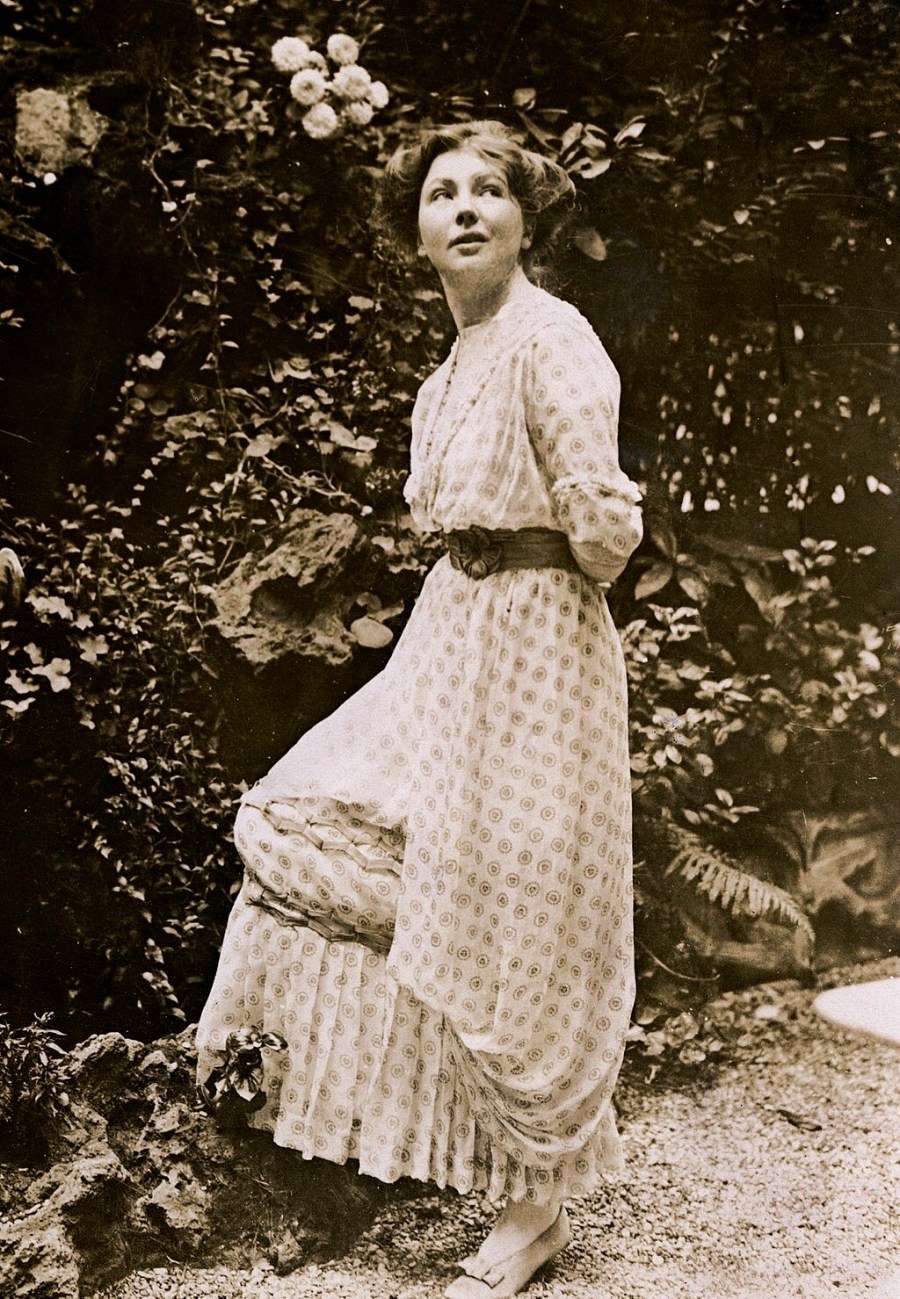
Christabel c.1913

Christabel Harriette Pankhurst was born on the 22nd of September 1880 in Manchester…. Her mother owned a small shop at the time and her father, radical socialist Richard Pankhurst was a barrister…. Christabel and her two younger sisters, Sylvia and Adela, attended Manchester High School for Girls and then Christabel went on to the University of Manchester to study law….

In 1893 Richard and Emmeline formed a branch of the new Independent Labour Party (ILP) and in 1895 Richard stood as ILP member for Gorton in the General Election…. Christabel and Sylvia became involved in the campaign, in which Richard got a respectable amount of votes but lost to the Conservatives…. It was whilst Christabel and Sylvia were in Geneva in 1898 – as part of an extended European holiday – that they received a message to hurry home as their father was ill…. By the time they had arrived Richard had died from a perforated ulcer….

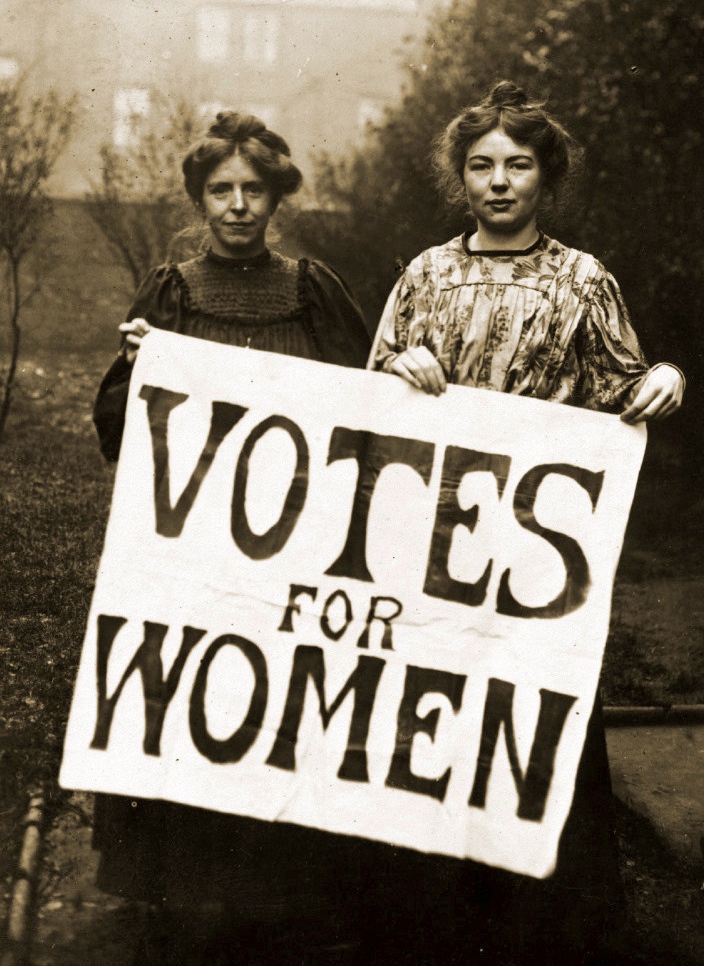
In 1903 Christabel and her mother founded the Women’s Social Political Union….adopting the slogan ‘Deeds not words’…. Christabel was arrested and imprisoned for the first time in 1905 – she and fellow suffragette Annie Kennedy disrupted a Liberal Party meeting in Manchester by unfurling a banner proclaiming ‘Votes for Women’…. Her actions caught the attention of the world, even more so because of her imprisonment – her arrest and subsequent treatment afterwards prompted Emmeline to begin to take more militant action….

img_5962
Anne Kenney and Christabel Pankhurst c.1908 – Public domain

Upon her release Christabel embarked on a campaign including more direct action…. She helped organise large rallies and as civil disobedience escalated was involved in arson attacks and even bombings…. In 1906 she obtained her law degree – but being a woman was not permitted to practice…. Instead she used her legal training to produce speeches and pamphlets – she was appointed ‘Organising Secretary’ of the WSPU and earned the nickname ‘Queen of the Mob’….

Christabel was jailed several times and went on hunger strike…. The authorities began to use the ‘Cat and Mouse Act’…. A cruel procedure – women on hunger strike would be released from prison to recover, often after having endured traumatic and painful force feeding, only to be re-arrested to finish their sentences once their health had improved…. Between 1913 and 1914 Christabel lived in Paris to avoid re-arrest….

Whilst in exile she continued to help run the Suffrage campaign, mainly in an administrative role…. It was at this time the publication ‘The Suffragette’ was founded….

img_5959
‘The Suffragette’ – the newspaper edited by Christabel Pankhurst ~ the Emily Wilding Davison memorial issue – Public domain

Returning to the UK at the start of World War I Christabel was re-arrested to serve a three year sentence…. However, after immediately going on hunger strike she only served 30 days of her sentence….

At the end of the War some women were granted the Vote and Christabel decided to stand as a Women’s Party candidate in the 1918 General Election…. She was narrowly defeated by the Labour Party candidate standing against her….

Christabel moved to California in 1921…. She became an Evangelist and prominent member of the Second Adventist Movement, later lecturing and writing books on the Second Coming…. She returned briefly to Britain during the 1930s and it was in 1936 that she was created a Dame…. At the onset of World War II she went back to the States, to live in Los Angeles….

On the 13th of February 1958 her housekeeper found her passed away – sitting in a straight-backed chair, there was no obvious indication as to how she had died…. She was 77-years-old…. Christabel was buried in the Woodlawn Memorial Cemetery, Santa Monica, California….

img_5958
Christabel Pankhurst DBE c.1910

On this day in history….12th February 1554

On this day in history : 12th February 1554 – The executions of Lady Jane Grey – also known as ‘The Nine Days Queen’ – and of her husband Lord Guildford Dudley….

Jane was the great-granddaughter of King Henry VII (through his daughter Mary) and cousin to King Edward VI…. Her parents were proud of this royal heritage – and being the committed Protestant family that they were – swore their allegiance to King Edward and renounced the Catholic faith….

img_5940
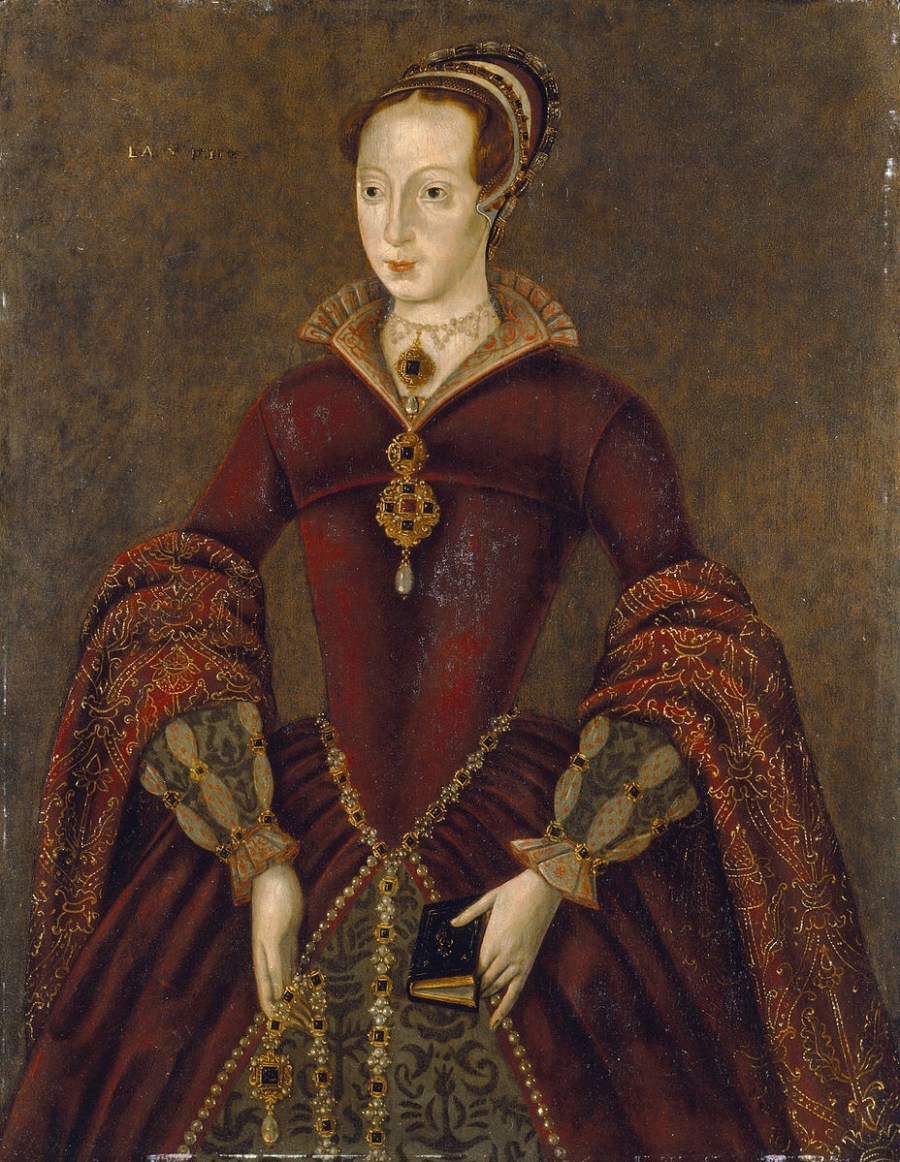
Lady Jane Grey – Public domain

In May 1553 a triple wedding took place at Durham House, the London Town house of the Bishop of Durham…. 16-year-old Lady Jane married a 19-year-old Lord Guildford Dudley, an English nobleman – her sister, Catherine, married Lord Herbert and Lord Guildford’s sister, Katherine, tied the knot with Henry Hastings…. The wedding breakfast that followed afterwards must have been quite a celebration!

Edward VI, the son of King Henry VIII, had been crowned King of England at just 9 years of age…. The Third Succession Act 1544 restored Henry’s daughters’, Mary and Elizabeth, rights to be in line for succession to the throne – even though technically they were still regarded as being illegitimate (on account of the father’s marriages to their respective mothers being annulled)….

In January 1553 the now 15-year-old Edward became unwell with a fever and cough – which continued to worsen…. Edward wanted to protect the reformed Church of England – he didn’t want the crown to fall into the hands of his Catholic half-sister Mary Tudor…. In fact he didn’t want either of his illegitimate sisters to take the throne should anything happen to him….and so he decided to change his will…. He nominated his cousin Lady Jane Grey – and her male heirs after her – as successors to the throne….

Edward died on the 6th of July 1553, although his death was not announced until 4 days later – his cause of death was probably tuberculosis…. Lady Jane Grey was proclaimed Queen of England on the 10th of July – something she was not overly happy about, she was reluctant to accept the crown and refused to name her husband King – making him Duke of Clarence instead….

img_5941
The crown offered to Lady Jane Grey, as imagined in the 1820s : Jane and Guildford standing – after C.R. Leslie – Public domain

Of course, Mary Tudor was not going to take all this lying down – as soon as news broke of Edward’s death she began to muster her supporters…. She was in fact the popular choice of the people – and it wasn’t long before the Privy Council (the then body of advisers to the Sovereign) switched their allegiance to Mary…. On the 19th of July Mary Tudor was proclaimed Queen of England….

Jane and Guildford were imprisoned at the Tower of London – she in the Gentleman Gaoler’s quarters and he in Beauchamp Tower….

At the trial Jane was referred to simply as Jane Dudley, wife of Guildford…. She was charged with high treason, as was her husband, two of his brothers and former Archbishop of Canterbury Thomas Cranmer…. All were found guilty – and all were sentenced to death…. Her crime being that she had assumed the title and power of Monarch….the evidence – documents she had signed ‘Jane the Quene”…. I’ll bet she didn’t half curse Edward!

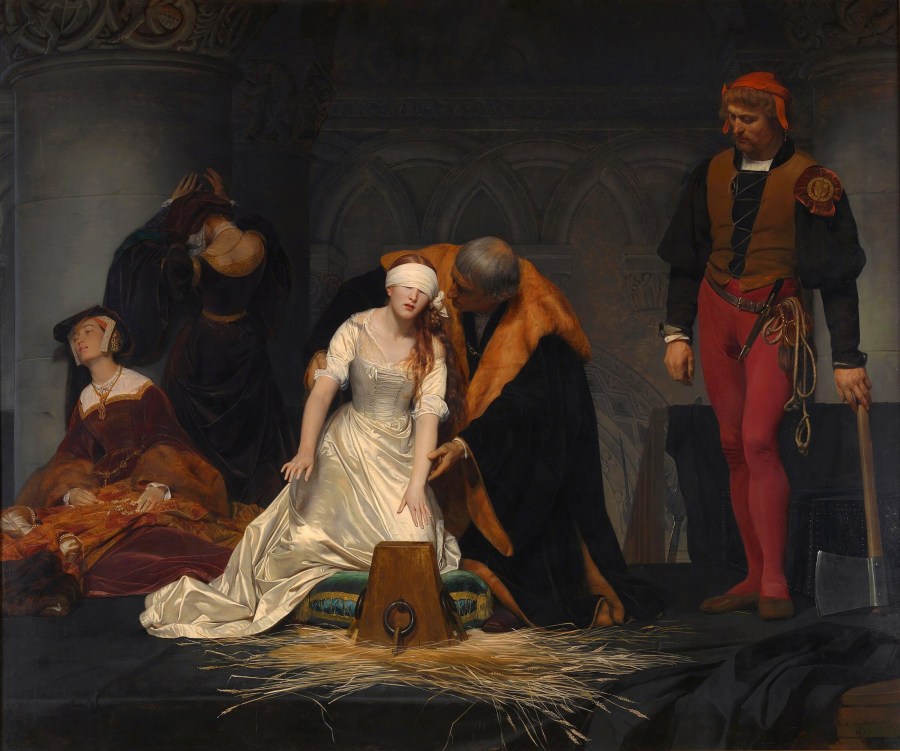
On the morning of the 12th of February Guildford was taken to Tower Hill to be publicly beheaded…. Lady Jane would have seen his departure from her rooms….just as she would have seen the horse and cart arrive back with his headless corpse…. It is said that she cried out “Oh Guildford, Guildford!” …. Then she was taken out to Tower Green to meet the same fate….

img_5942
The execution of Lady Jane Grey, by French painter Paul Delaroche, 1833 – National Gallery, London – Public domain