On this day in history : 24th October 1983 – Dennis Nilsen, a civil servant from North London, goes on trial at the Old Bailey – accused of six murders and two attempted murders….
Mug shot of Nilsen – Full Sutton Prison – Fair use
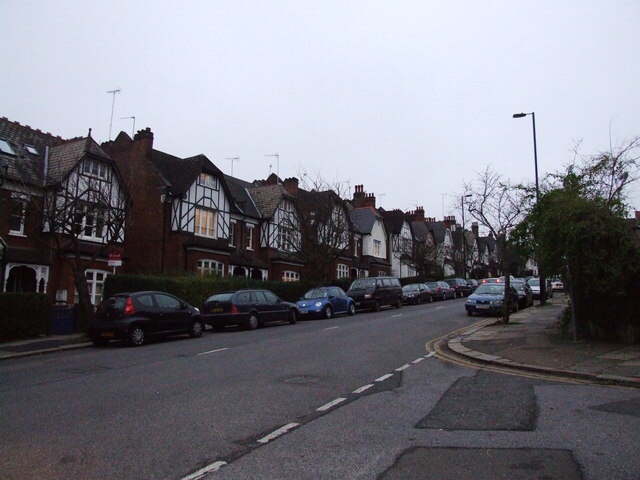
37-year-old Nilsen had been arrested after human remains were found in a blocked drain at his home in Muswell Hill…. The tenants at the flats had complained to the landlord about the drains smelling – it was a plumber who made the grisly discovery….
Cranley Gardens, Muswell Hill – where Nilsen occupied an attic flat – Image credit : Chris Whippet CC BY-SA 2.0
After a search of Nilsen’s flat the remains of three bodies were found; the bones from at least eight others were discovered at his former home in Cricklewood, Northwest London…. Nilsen admitted to further murders, telling police he had killed fifteen or sixteen….
Nilsen would meet his victims in pubs; they were always male – some were homeless, some were homosexual and some were prostitutes…. He would invite them back to his flat for a drink – and would then strangle them using a tie or electrical cable…. He would usually spend the night lying in bed beside the corpse and would invariably have, or attempt to have, sex with it….
He disposed of the bodies in a variety of ways…. He hid them under floorboards, in a wardrobe, in suitcases and even under the sink…. Having spent eleven years in the Army he had learned butchery skills in the Catering Corps…. He cut up many of his victims, burying limbs in the garden – or burning body parts on a bonfire…. He even flushed remains down the toilet….
Fair use
When Nilsen came to trial he pleaded not guilty to all charges, citing diminished responsibility due to a mental defect…. The jury retired on the 3rd of November to deliberate but were unable to reach a unanimous verdict…. The next day the judge agreed to accept a majority verdict and at 4.25pm on the 4th of November a guilty verdict was delivered an all six counts of murder…. Nielsen was sentenced to life in prison and it was ordered that he should not be eligible for parole for 25 years….
During his time in prison Nilsen wrote his autobiography History of the Drowning Man – but this was denied publication…. On the 12th of May 2018 he died of a pulmonary embolism (a blockage in an artery of the lungs)….
On this day in history : 16th October 1902 – In the village of Borstal, in Kent, a detention centre for young offenders is opened…. It is the first of several such custodial institutions, which become known as borstals….
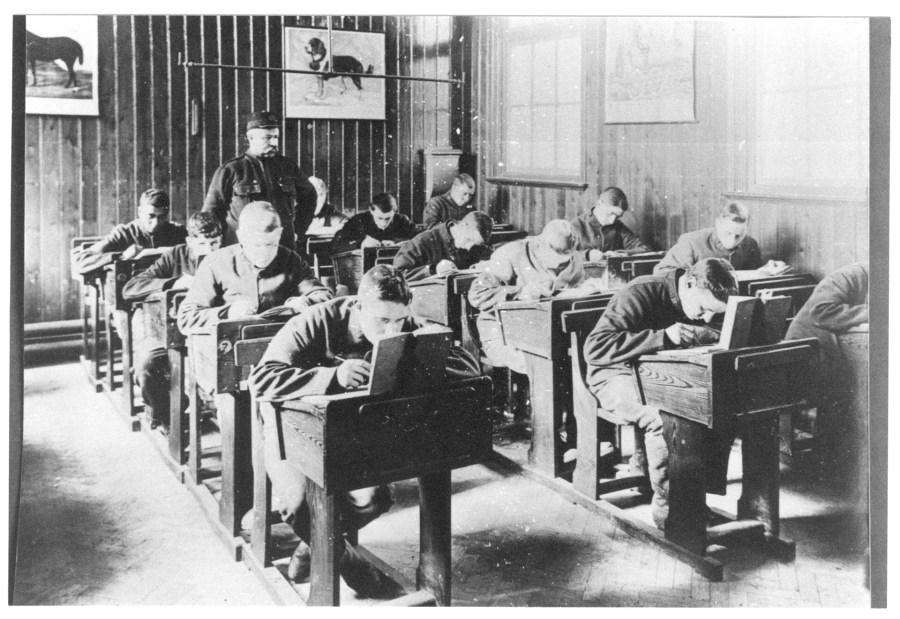
Young offenders in the schoolroom at Borstal (now known as Rochester Prison), circa 1906 – Public domain
It was in 1895 that the Gladstone Committee first proposed the concept of the ‘borstal’ – seeing a need to separate young people from the influence of older convicts in adult prisons…. Those under the age of 16 were already segregated after the introduction of Industrial Schools, a new reformatory system to correct wayward behaviour as an alternative to prison…. The Gladstone Committee sought to find a solution for those in the 16-21 age group….
An experimental scheme was conducted at Bedford Prison commencing in 1899…. This was then extended to a part of the existing prison in Borstal; the new institution being kept entirely separated from the main adult prison…. The young inmates were given physical exercise, schooling and training for future work…. The skills taught included trades such as brick-laying, carpentry, farming, agriculture, metalwork and cookery…. Sentences were generally between two and three years, with supervision after discharge….
The Prevention of Crime Act 1908 saw the scheme come officially into force; in 1910 a second institution was established at Feltham and was then followed by others, including Portland…. The first for girls was opened in Aylesbury in 1909 and offered training in skills such as housework, cookery, laundry, sewing, gardening and farming….
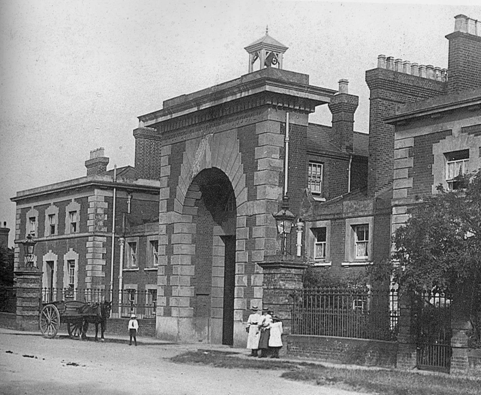
Aylesbury Prison, where the first Borstal for girls was established – Public domain
Discipline was strict but with corporal punishment used only as a last resort…. Other punishments such as withdrawal of privileges, docked wages, reduction of food rations and confinement were implemented instead…. The birch could only be imposed by a visiting magistrate and was only ever administered to males over the age of 18…. In the ten year period between 1926-36 it was only used on 7 occasions…. Caning was used in Northern Ireland but was not authorised in England, Scotland and Wales…. Borstals should not be confused with approved schools, which were a different type of youth correction institution, based more on boarding schools – the cane was used in approved schools….
The Criminal Justice Act 1982, officially abolished the borstal system in the UK, being replaced by youth custody centres, or detention centres…. Since the 1960s and 1970s the old borstal system had been viewed as out dated…. In 1972 Community Order sentences began to appear – with offenders undertaking unpaid work to provide services for the benefit of the community….
On this day in history : 4th September 1739 – The execution of Michael Curry for the murder of the landlord of the Three Horseshoes Inn at Hartley, near to Whitley Bay…. Curry was then gibbeted overlooking the scene of his crime….
Image credit : Draco2008
On the headland, overlooking the causeway towards St. Mary’s Bay, Whitley, North Tyneside a blue plaque can be found…. It reads:
‘On 4th September 1739 Michael Curry was executed for the murder of the landlord of the Three Horseshoes Inn, Hartley. His body was afterwards hung in chains from a gibbet at this spot within sight of the scene of his crime. Ever since that gruesome event this headland has been known as Curry’s Point’….
Image credit : Draco2008
The plaque was erected on the 4th of September 1989, to mark the 250th anniversary of the macabre happening…. Michael Curry was a glass worker at the local glassworks in Seaton Sluice…. Following his conviction for the murder of landlord Robert Shevill he was hanged in Newcastle….and then, as was common practice of the times, his tarred body was left in sight of the crime scene…. It was a practice known as ‘gibbeting’ – or ‘hanging in chains’….and was intended to discourage others from committing similar offences…. Gibbets were usually placed where they would be highly visible, frequently at crossroads or by busy waterways….
Captain Kidd hanging in chains – Public domain
The Murder Act 1751 made this practice into a regulated procedure…. ‘In no case whatsoever shall the body of any murderer be suffered to be buried’….meaning the corpse of the executed murderer had to be either publicly dissected or left to rot hanging in chains…. The practice was finally formally repealed by statute in 1834…. The last two men to be gibbeted in England were William Jobbing and James Cook – both in the same year of 1832….
On this day in history : 10th August 1949 – The execution of serial killer John George Haigh – otherwise known as the ‘Acid Bath Murderer’….
John Haigh – Police photograph taken at Horsham Police Station, 1949 – Public domain
Haigh was born into an affluent family in Stamford, Lincolnshire and he was brought up in the village of Oakwood, in the West Riding of Yorkshire…. His parents were members of the Plymouth Brethren, a conservative, non-conformist, evangelical Christian movement….
Academically bright Haigh won several educational scholarships and was fond of classical music…. He often attended concerts and he himself was a talented pianist…. He won a scholarship to Wakefield Cathedral where he became a choirboy…. However, by the time he was 21 things began to manifest as signs of what was to come…. He was dismissed from his job after being accused of stealing from the petty cash box – then in July 1934 he got married….but in the same year was jailed for fraud…. His new wife left him and had their baby daughter adopted; his parents disowned him….
On release from prison in 1936 Haigh moved to London and found employment as a chauffeur to wealthy amusement arcade owner William McSwan…. At the same time he continued to live his fraudulent life, masquerading as William Cato Adamson, a solicitor with offices in London, Guildford and Hastings…. He ‘specialised’ in selling phoney stocks and shares…. However, as academically bright as he may have been, spelling was obviously his Achilles heel…. His scam was uncovered after a schoolboy error was noticed on his ‘official’ solicitor’s letterhead – he had missed the ‘d’ out of Guildford…. He was sentenced to a further four years in prison….
He was released at the beginning of World War Two and immediately resumed his life as a career fraudster – resulting in several more prison sentences…. The problem was that his victims kept reporting him – it eventually dawned on him that they couldn’t if they were dead! He spent the remainder of his latest prison sentence devising the perfect way of getting rid of them….
Haigh became fascinated with the methods used by French murderer Georges-Alexandre Sarret – who dissolved bodies by using sulphuric acid…. Haigh started to experiment using various types of acid on mice…. He discovered it took 30 minutes to dissolve a field mouse – he began to calculate how long it would take and how much acid he would need to dissolve a full grown man….
After being released from prison he took a job in the accounting department of an engineering company…. Then one day he happened to bump into his former employer, William McSwan – who had now become a landlord with tenants in multiple properties, owned by his parents…. He had an extremely lavish lifestyle and Haigh was insanely jealous….
A few months later he arranged to meet McSwan and then lured him to the basement of a warehouse he had rented…. He hit McSwan over the head – and then after putting his body into a 40-gallon drum poured sulphuric acid over him…. When he returned two days later he found the body had turned to a sludge – and so he tipped it down a convenient manhole….
Haigh told McSwan’s parents that their son had gone into hiding to avoid being called up for military service…. He then took over the collecting of rents from the tenants…. When McSwan’s parents became suspicious when their son failed to return at the end of the War Haigh was to lure them to his warehouse basement, where they too met the same fate…. Haigh then sold their possessions for around £8,000 by forging their signatures and moved into Onslow Court Hotel in Kensington…. He kept their car and dog though!
Haigh developed an acute gambling habit and so the money did not last long…. He began to look for his next victims…. He also decided he needed bigger premises, where he could store more drums of acid – and so he rented a larger warehouse on Leopold Road, Crawley, West Sussex….
He then went to view the house of Dr Archibald Henderson and his wife Rose, which was on the property market…. He made up some pretext to get the doctor to visit his warehouse and once there, shot him in the head…. Receiving a call from Haigh to say that her husband was unwell Rose rushed to Leopold Road – where she too was shot…. The bodies of the husband and wife were then dissolved in acid….
Haigh was still living at Onslow Court Hotel and was befriended by a wealthy fellow resident, 69 year old widow Olive Durand – who fancied herself as a bit of an entrepreneurial inventor…. On hearing that Haigh worked for an engineering company she sought his advice on an idea she had for artificial fingernails…. On the 18th of February 1949, feigning interest and a desire to help her, Haigh took her to his warehouse – and murdered her….
Now, Haigh had overlooked one important factor when he rented his new warehouse – it had no convenient manhole…. He had to resort to dumping the sludge from his acid drums on a pile of rubble at the back of the building….
It did not take long for this to be discovered…. 28lbs of body fat, part of a foot and gall stones were found, along with a piece of denture, which was identified as belonging to Olive by her dentist…. Haigh was arrested and taken to Horsham Police Station; he confessed to the six murders – and to three more…. He claimed to have also killed a girl from Eastbourne, a woman from Hammersmith and a man called Max – although no evidence could be found….
Peel House, the former Sussex Police Headquarters at Horsham – where Haigh was held
At his trial Haigh pleaded insanity – even saying that he drank the blood of his victims…. His claim was dismissed…. It took the jury just minutes to find him guilty…. Mr Justice Travers Humphreys passed the death sentence and he was taken to the condemned cell at Wandsworth Prison…. Haigh was hanged by Albert Pierrepoint on the 10th of August 1949….
Haigh in custody – Image credit : Mitch Hell via Flickr
On this day in history : 25th June 1953 – John Christie is sentenced to hang for the murder of his wife and then hiding her body under the floorboards of their Notting Hill home, 10 Rillington Place….
John Christie – Fair use
Before his own trial Christie had been a key witness for the Crown in another murder trial – that of Timothy Evans, another resident at the Notting Hill address…. Evans had stood trial, accused of the murder of his wife and child – and although the murder charge for his wife was not pursued he was convicted of killing his daughter and was sequently hanged….
Christie himself was no stranger to the criminal world…. Throughout his adult life he had committed a string of petty crimes and had spent time in prison…. He had served a three month sentence for stealing postal orders whilst working as a postman, nine months for theft, six months for assaulting the prostitute girlfriend he had briefly lived with and another three months for stealing a car from a priest he had befriended….
Christie had a troubled childhood and grew up with some abnormal ideas on how a healthy sexual relationship should be conducted…. He married Ethel in 1920 but because of his sexual hang-ups was impotent with her – he could only perform with prostitutes and so he continued to use their services…. After four years the marriage broke up – but in 1933, after his last prison sentence, they got back together….
In December 1938 the Christies moved into the ground floor flat of 10 Rillington Place in the Ladbroke Grove area of Notting Hill…. Ten years later, in the April of 1948, Timothy Evans and his pregnant wife, Beryl, moved into the top floor flat…. She gave birth to a little girl soon after, who they named Geraldine – and then in the November of 1949 Beryl discovered that she was pregnant again…. The couple were worried as they could not afford to have another baby – and so Christie said he could help them, by performing an abortion…. Only, what he actually did was strangle her and because his depraved sexual gratifications now included necrophilia – he then raped her….
When Evans arrived home Christie claimed she had died during the termination procedure…. As abortion was illegal he managed to convince Evans that they had to hide Beryl’s body and he also persuaded him to leave Geraldine with him and to go to relatives in Wales to lay low for a while…. When Evans returned to London and wanted to see his daughter Christie refused….
On the 30th of November 1949 Evans went to the police and explained he had accidentally killed Beryl by giving her a potion to end her pregnancy…. He said that he had hidden her body in a sewer – but after a search the police could not find a body…. Evans then told the truth – how Christie had offered to help them and how he, Evans, had found his wife dead on returning home from work…. He explained how Christie arranged for the disposal of her body and somebody to look after Geraldine while he disappeared to Wales….
But this late admission of the truth only added to the tangled web that had already been woven…. A search of 10 Rillington Place revealed the bodies of both his wife and child hidden in an outside wash house…. Evans was then tried for murder, the jury took just 40 minutes to find him guilty…. After a failed appeal Timothy Evans was hanged on the 9th of March 1950….
Timothy Evans, 1949 – Fair use
Ethel Christie was last seen on the 12th of December 1952…. Christie told people that he had been offered a good job out of the area and that his wife had gone on before him…. He eventually moved out of Rillington Place on the 20th of March 1953, booking seven days lodgings in King’s Cross…. However, he had only been there four nights when Beresford Brown, the new tenant at 10 Rillington Place, discovered the remains of three women in an alcove which had been wallpapered over…. When the news broke Christie left his lodgings and took to wandering London, sleeping rough…. The police eventually caught up with him on the 31st March 1953, on the Embankment near to Putney Bridge….
A total of eight female bodies in all were found at Rillington Place…. Those of his wife, Beryl and baby Geraldine Evans and five others:- Ruth Fuerst, a 21-year-old Austrian prostitute – Muriel Amelia Eady, a work colleague of Christie – Kathleen Maloney, prostitute – Rita Nelson, who was six months pregnant – and Hectorina MacLennan, who Christie had befriended, along with her boyfriend, Alex Baker….
At first Christie only confessed to the murders of the three bodies that had been found in the alcove and that of his wife…. He eventually admitted to Beryl’s murder – but not that of Geraldine…. He went on trial for the murder of his wife – in the same court that Evans had been convicted in – on the 22nd of June 1953…. He pleaded insanity but the jury rejected this plea – and after just 85 minutes of deliberation found him guilty…. There was no appeal….
Christie was hanged by Albert Pierrepoint, who had also executed Evans, on the 15th of July…. Two-hundred people people waited outside the prison to see the execution notice…. After being restrained for the procedure to take place Christie had complained that his nose was itching – only to be told by Pierrepoint that it wouldn’t bother him for much longer….
10 Rillington Place was demolished – in the 1970s the whole street was redeveloped…. Timothy Evans was granted a posthumous pardon in 1966….
Memorial garden on the approximate location of 10 Rillington Place