On this day in history : 25th June 1953 – John Christie is sentenced to hang for the murder of his wife and then hiding her body under the floorboards of their Notting Hill home, 10 Rillington Place….
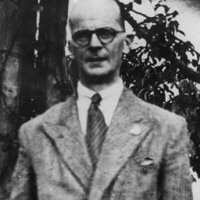
John Christie – Fair use
Before his own trial Christie had been a key witness for the Crown in another murder trial – that of Timothy Evans, another resident at the Notting Hill address…. Evans had stood trial, accused of the murder of his wife and child – and although the murder charge for his wife was not pursued he was convicted of killing his daughter and was sequently hanged….
Christie himself was no stranger to the criminal world…. Throughout his adult life he had committed a string of petty crimes and had spent time in prison…. He had served a three month sentence for stealing postal orders whilst working as a postman, nine months for theft, six months for assaulting the prostitute girlfriend he had briefly lived with and another three months for stealing a car from a priest he had befriended….
Christie had a troubled childhood and grew up with some abnormal ideas on how a healthy sexual relationship should be conducted…. He married Ethel in 1920 but because of his sexual hang-ups was impotent with her – he could only perform with prostitutes and so he continued to use their services…. After four years the marriage broke up – but in 1933, after his last prison sentence, they got back together….
In December 1938 the Christies moved into the ground floor flat of 10 Rillington Place in the Ladbroke Grove area of Notting Hill…. Ten years later, in the April of 1948, Timothy Evans and his pregnant wife, Beryl, moved into the top floor flat…. She gave birth to a little girl soon after, who they named Geraldine – and then in the November of 1949 Beryl discovered that she was pregnant again…. The couple were worried as they could not afford to have another baby – and so Christie said he could help them, by performing an abortion…. Only, what he actually did was strangle her and because his depraved sexual gratifications now included necrophilia – he then raped her….
When Evans arrived home Christie claimed she had died during the termination procedure…. As abortion was illegal he managed to convince Evans that they had to hide Beryl’s body and he also persuaded him to leave Geraldine with him and to go to relatives in Wales to lay low for a while…. When Evans returned to London and wanted to see his daughter Christie refused….
On the 30th of November 1949 Evans went to the police and explained he had accidentally killed Beryl by giving her a potion to end her pregnancy…. He said that he had hidden her body in a sewer – but after a search the police could not find a body…. Evans then told the truth – how Christie had offered to help them and how he, Evans, had found his wife dead on returning home from work…. He explained how Christie arranged for the disposal of her body and somebody to look after Geraldine while he disappeared to Wales….
But this late admission of the truth only added to the tangled web that had already been woven…. A search of 10 Rillington Place revealed the bodies of both his wife and child hidden in an outside wash house…. Evans was then tried for murder, the jury took just 40 minutes to find him guilty…. After a failed appeal Timothy Evans was hanged on the 9th of March 1950….
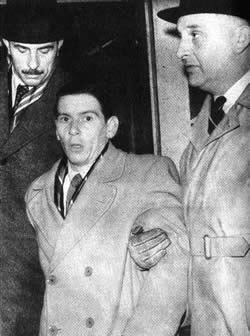
Timothy Evans, 1949 – Fair use
Ethel Christie was last seen on the 12th of December 1952…. Christie told people that he had been offered a good job out of the area and that his wife had gone on before him…. He eventually moved out of Rillington Place on the 20th of March 1953, booking seven days lodgings in King’s Cross…. However, he had only been there four nights when Beresford Brown, the new tenant at 10 Rillington Place, discovered the remains of three women in an alcove which had been wallpapered over…. When the news broke Christie left his lodgings and took to wandering London, sleeping rough…. The police eventually caught up with him on the 31st March 1953, on the Embankment near to Putney Bridge….
A total of eight female bodies in all were found at Rillington Place…. Those of his wife, Beryl and baby Geraldine Evans and five others:- Ruth Fuerst, a 21-year-old Austrian prostitute – Muriel Amelia Eady, a work colleague of Christie – Kathleen Maloney, prostitute – Rita Nelson, who was six months pregnant – and Hectorina MacLennan, who Christie had befriended, along with her boyfriend, Alex Baker….
At first Christie only confessed to the murders of the three bodies that had been found in the alcove and that of his wife…. He eventually admitted to Beryl’s murder – but not that of Geraldine…. He went on trial for the murder of his wife – in the same court that Evans had been convicted in – on the 22nd of June 1953…. He pleaded insanity but the jury rejected this plea – and after just 85 minutes of deliberation found him guilty…. There was no appeal….
Christie was hanged by Albert Pierrepoint, who had also executed Evans, on the 15th of July…. Two-hundred people people waited outside the prison to see the execution notice…. After being restrained for the procedure to take place Christie had complained that his nose was itching – only to be told by Pierrepoint that it wouldn’t bother him for much longer….
10 Rillington Place was demolished – in the 1970s the whole street was redeveloped…. Timothy Evans was granted a posthumous pardon in 1966….
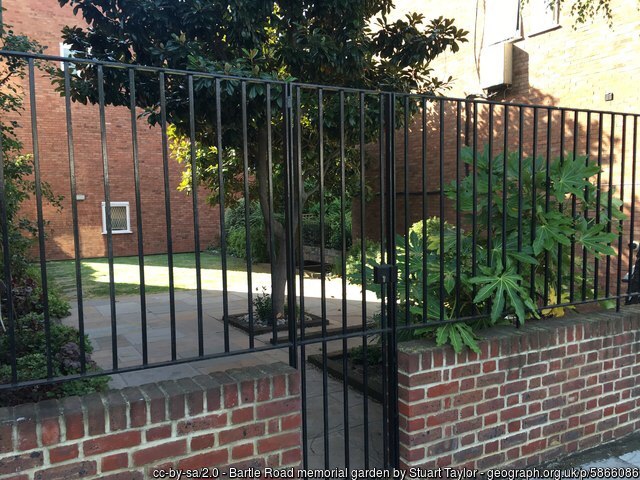
Memorial garden on the approximate location of 10 Rillington Place
On this day in history : 3rd January 1946 – The execution for treason of William Joyce – the Nazi propaganda broadcaster, known to the British public as ‘Lord Haw-Haw’….
Photograph of Joyce taken some time between 1939 & 45 – No known copyright restrictions – Archives of the Law Society via Flickr
‘Haw-Haw’ was a term first coined by Jonah Barrington of the Daily Express…. It actually referred to a number of announcers, with their exaggerated English accents, broadcasting during WW2 to the United Kingdom from the German radio station ‘Reichssender’, in Hamburg…. However, in time the name was to become primarily associated with Joyce….
Broadcasts would always start with “Germany calling, Germany calling”…. The aim was to attempt to break the morale and spirit of the British people – along with that of the allied troops…. Inaccurate reports of the sinking of ships and the shooting down of aircraft…. Urging the British to surrender – attacking the government and the British way of life…. Of course, most people knew it was propaganda – but at a time of heavy censorship it was often used as a way to try and find out information as to what may have become of a missing loved one…. Whilst not illegal to listen to the broadcasts it was discouraged – despite this some 18 million people in Britain are believed to have listened on occasion….
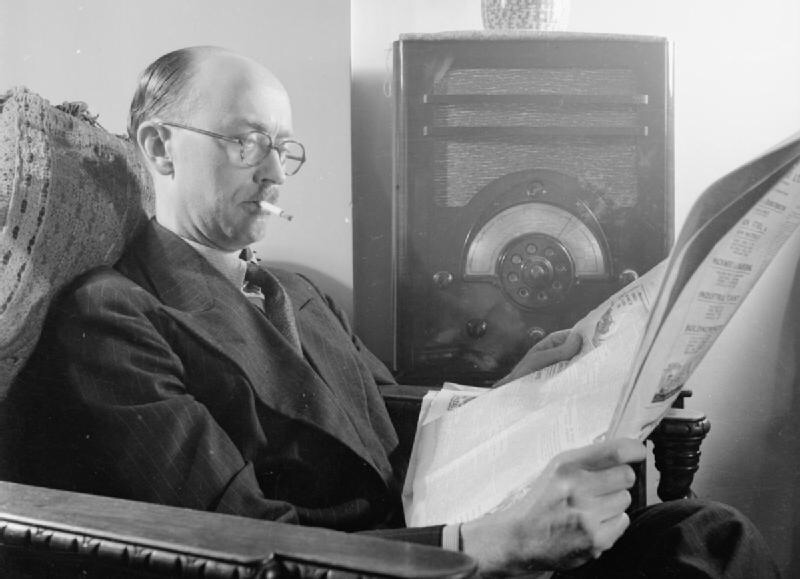
From the collections of the Imperial War Museums
So, how did the likes of Joyce come to be working for the Germans during the war? To understand this it is necessary to learn more about the background of the man….
William Brooke Joyce was born on the 24th of April 1906, in Brooklyn, New York…. He was the son of immigrants – his father was Irish and his mother Anglo-Irish…. When Joyce was 3-years-old the family returned to live in Galway, Ireland….
In 1921, during the Irish War of Independence, Joyce was recruited as a courier by Captain Keating of British Army Intelligence, in the fight against the IRA…. After an attempted assassination on him Joyce was taken to England for his safety…. He was recruited into the Worcester Regiment – but soon discharged after it was discovered he was underage….
Joyce remained in England and finished his education at Kings College School, Wimbledon…. He then studied at Birkbeck College – part of the University of London – graduating with a first-class honours in English…. After being turned down for a position with the Foreign Office he took a job as a teacher….
He began to take a keen interest in Fascism…. It was on the 22nd of October 1924, whilst attending a meeting for Jack Lazarus, Conservative candidate for North Lambeth, that Joyce was attacked by Communists…. He received a deep razor slash across his right cheek, leaving him with a prominent scar from his ear lobe to his jaw….
Joyce took a paid job in the British Union of Fascists (BUF), under Sir Oswald Mosley – and in 1934 he was made Director of Propaganda…. It was after being sacked by Mosley in 1937 that he joined a splinter group, the National Socialist League…. On learning that the British authorities intended to arrest him Joyce fled with his wife in August 1939 to Germany – just before the outbreak of WW2…. He became a naturalised German citizen in 1940 and managed to get a job at the Rundfunkhaus (the German equivalent of Broadcasting House)…. Here he made radio announcements and wrote scripts – but he was to go on to become the best-known of the propaganda broadcasters….
Still frame from 1943 – Allied propaganda cartoon – ‘Tokio Jokio’ – depicting Joyce as Lord Haw-Haw – ‘Lord Hee-Haw, Chief Windbag’
His final broadcast was made on the 30th of April 1945, during the Battle of Berlin…. He finished the broadcast with “Heil Hitler and farewell” – the following day Radio Hamburg was seized by the British – but Joyce had managed to make his escape….
Nearly a month later, on the 28th of May, Joyce was captured at the German/Danish border by British intelligence officers…. During his arrest he was shot through the buttocks – as he had gone to his pocket to produce his false passport but the officers had believed him to be armed….
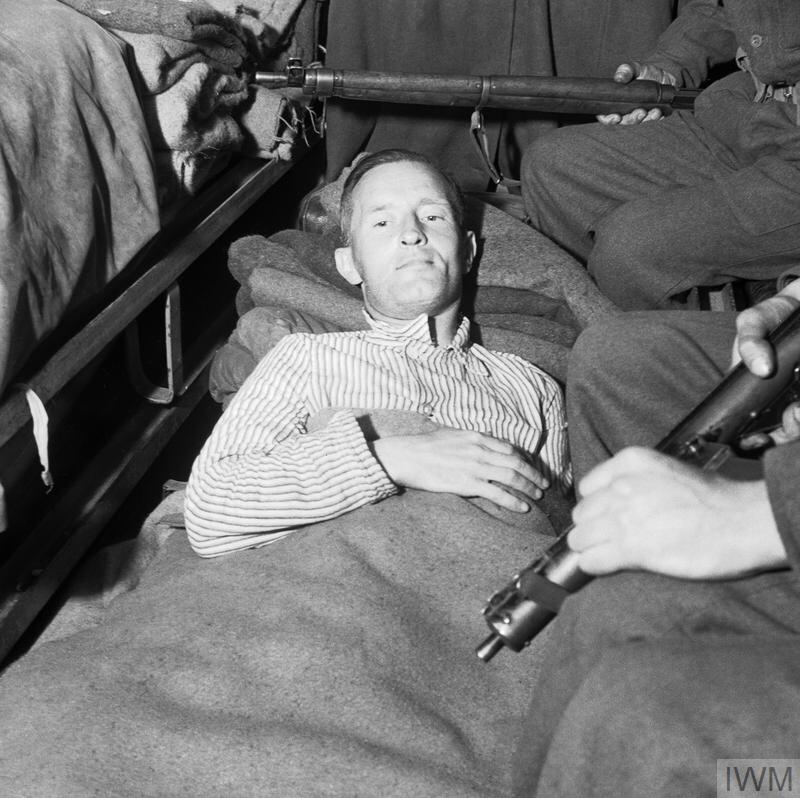
THE CAPTURE OF WILLIAM JOYCE, GERMANY, 1945 (BU 6910) William Joyce lies in an ambulance under armed guard before being taken from British 2nd Army Headquarters to hospital. He had been shot in the thigh at the time of his arrest. Copyright: � IWM. Original Source: http://www.iwm.org.uk/collections/item/object/205192927
Initially it was thought that due to his American nationality Joyce would have to be acquitted – it was reasoned that he could not be convicted of treason against a country that was not his own…. However, at his trial it was successfully argued that since he had obtained a British passport, by not revealing his true nationality, he had in fact had allegiance to the King and country whilst the passport was valid – and this happened to be the period of time during which he was working for Germany…. Joyce was convicted and sentenced to death on the 19th of September 1945….
The sentence was upheld on the 1st of November 1945 after an appeal – and he was executed at Wandsworth Prison on the 3rd of January 1946 by hangman Albert Pierrepoint…. As he went to the gallows Joyce was unrepentant – as he fell the pressure from the drop split the old scar on his face wide open….
Joyce was buried in an unmarked grave within the prison walls but – after a long campaign by his daughter – in 1979 his body was reinterred in Galway, Ireland….
On this day in history : 28th October 1986 – Jeremy Bamber is jailed for life for the White House Farm murders – where he killed five members of his own family….
Bamber shortly after his arrest – Fair use
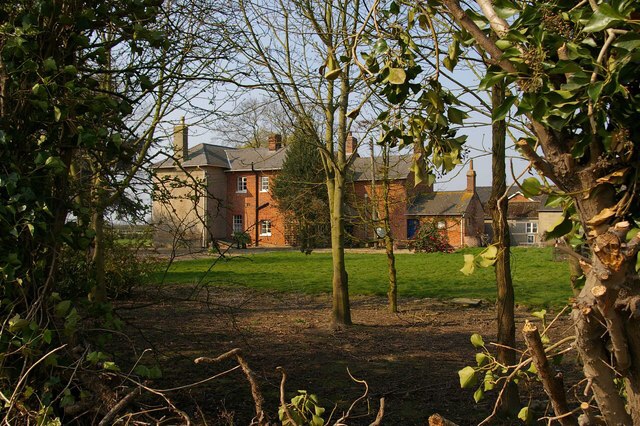
The Bambers were a wealthy farming family, living at White House Farm, a large Georgian property near to Tolleshunt D’Arcy in Essex…. Jeremy was legally adopted by the family as a baby…. Four years previously they had also adopted a baby girl, Sheila….
White House Farm (in 2007) – Image credit : Glyn Baker CC BY-SA 2.0
After leaving school Bamber’s adoptive father paid for him to travel to Australia and New Zealand…. Here he reputedly became involved in drug smuggling – and also broke into a jewellery shop, stealing two valuable watches….
Once he had returned to the UK and after a few casual jobs, Bamber began to work for the family farm…. However, he was resentful of the low wage – despite living rent free in one of the family’s cottages and having been given a car…. He further showed his lack of appreciation by committing a robbery at the caravan park owned by his family….
Bamber’s adoptive parents Neville and June Bamber – Fair use
Bamber’s adoptive sister, Sheila, had been treated in hospital for schizophrenia…. On the 7th of August 1985 at 3.30am 24-year-old Bamber phoned the police to say his father had phoned him and told him that Sheila had got hold of his gun and had gone berserk with it…. When the police arrived at the house they found her dead, with the gun lay on her chest – along with a Bible…. Her mother lay dead in the same room, her father was found dead in the kitchen and Sheila’s 6-year-old twin boys lay dead in their beds upstairs….
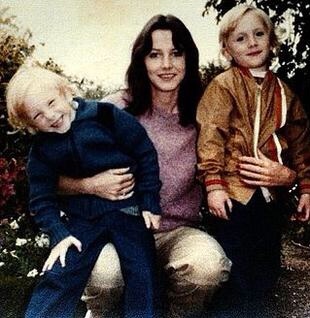
Sheila and her twin boys, Daniel and Caffell (around 1984) – Fair use
At first police believed that Sheila had killed them all before turning the gun on herself…. But when Bamber’s girlfriend came forward and said that he had talked about killing his parents forensic tests were carried out and revealed his fingerprints on the gun…. Bamber had been set to inherit £436,000….
As the guilty verdict was read out at Chelmsford Crown Court Bamber showed little reaction…. Judge Mr. Justice Drake described him as “Warped and evil beyond belief”…. He then handed down five life sentences….
Bamber has always protested his innocence…. In July 2001 an inquiry was launched into the case and it was referred back to the Court of Appeal…. In December 2002 Bamber lost his appeal….
On this day in history : 13th August 1964 – The last two criminals to face the death penalty in Britain are simultaneously hanged for the murder of a laundry van driver In Cumberland….
Evans (left) : Allen (right) – Fair use
24 year old Gwynne Evans dropped to his death at the hands of hangman Harry Allen in Strangeways Prison, Manchester – whilst at exactly the precise same time 21 year old Peter Allen was hanged in Walton Jail, Liverpool by Robert Leslie Stewart….
The pair had been convicted of killing 53 year old John Alan West at his home in Seaton, Cumberland…. John West, known as ‘Jack’, was a bachelor and had worked for the Lakeland Laundry at Workington for 34 years…. He had returned home after an ordinary days work and gone about his usual evening routine…. But then, at 3am, a neighbour was woken by noises coming from West’s house…. On looking out of the window he saw a car disappearing – and he called the police…. West was found dead, with severe head injuries and a stab wound to the chest….
A search of the property revealed a raincoat which had been left behind by Evans…. In one of the pockets was a medal, along with the name and address of a Norma O’Brian in Liverpool…. The police contacted her and she confirmed that she knew Evans and that the medal belonged to him….
Evans was traced through his criminal and army records to the home of his parents – and from there they were able to find Allen…. Within 36 hours both men had been arrested – on being questioned Allen initially claimed that he had been at home with his wife on the night of the murder – however, it soon came to be that both men were blaming each other for striking the fatal blows…. Both were found guilty of murder at trial….
By now public opinion had turned against capital punishment – despite this calls for a reprieve failed…. Theirs were, however, to be the last executions in Britain….
Before the death penalty was abolished in Britain the job of hangman was surprisingly quite a sought after position… Obviously a successful applicant had to meet a strict criteria; as well as having a strong sense of discretion he had to work well under pressure, be psychologically sound and have a cast-iron stomach. Whilst every effort was made to recruit the right candidates occasionally situations arose that were beyond the tolerances of even those most qualified…. One such instance was that of the execution of Edith Thompson, it affected everyone present who witnessed it – not least the hangman John Ellis – the whole episode had a profound affect on him….
John Ellis was born on the 4th of October 1874 in Balderstone, Rochdale in Lancashire. As a young man he had several casual jobs, labouring around the Manchester area, working in mills and even trying his father’s trade of barber and hairdresser…. Later, after getting married he was to open a newsagents, which he ran with his wife and children…. But it was whilst working in a textile factory, when during a break he and some colleagues were discussing a recent hanging case, he announced “that’s the kind of job I’d like”…. His work mates laughed and pooh-poohed the idea. Ellis on a previous occasion had been heard to say “I couldn’t kill a chicken, and once when I tried to drown a kitten I was so upset for the rest of the day that my mother said I was never to be given a similar job again”….
It was at the age of 22 that Ellis applied to the Home Office to become an executioner – he passed the initial background checks and attended training at Newgate Prison. His wife was shocked – she asked “why on Earth do you want to be an executioner?” – his mother was equally outraged….
Ellis had a 23 year career as an executioner, from 1901 until 1924. The first hanging he attended was in the role of assistant to William Billington in December 1901; from 1907 he then served as chief executioner and was involved in 203 executions. He was committed to ending the condemned person’s life with humanity and with as little fuss and pain as possible – but at the same time he was a strong believer in capital punishment and would often attend trials in the capacity of observer….
John Ellis – Source: own work author Loubreezer via Wikimedia
Ellis performed many high-profile executions in his time, including several members of the IRA in the 1920s. He hanged George Smith on the 13th of August 1915 at Maidstone Prison. Better known as the ‘Brides in the Bath’ case, Smith married then drowned Alice Burnham, Beatrice Constance, Annie Mindy and Margaret Elizabeth Lofty in succession, for financial gain on account of their wills and insurance policies…. Ellis also hanged at Pentonville Prison on the 23rd of November 1910 the infamous Dr. Hawley Harvey Crippen. Dubbed the ‘Crime of the Century’ Crippen was caught by the use of the new wireless telegraph system, whilst he was making his escape to Quebec, Canada aboard S.S.Montrose – with his new lover Ethel Le Neve, after he had murdered his wife, Cora Crippen….
For all his conscientiousness there were times when Ellis’s colleagues claimed to have found him difficult to work with. One altercation he had led to a very prominent executioner of the time, Henry Pierrepoint, being struck off the Home Office list of executioners. Pierrepoint had arrived at Chelmsford Prison to perform a hanging on the 13th of July 1910 slightly worse for wear and picked an argument with his acting assistant, John Ellis. Things escalated and others present had to intervene to prevent Pierrepoint from beating Ellis up. As a consequence the Home Secretary of the time, Winston Churchill, had Pierrepoint removed from the list. Pierrepoint’s brother, Thomas, also an executioner (and father of Albert – Britain’s longest ever serving executioner) stated that it was impossible to work with Ellis….
John Ellis may have been cool and collected within his role as executioner but once in a while a case would come along that would ‘rattle’ him…. One such was that of 18-year-old Henry Jacobs, who was convicted for the murder of Lady Alice White in a robbery in 1922. Ellis had watched young Jacobs playing cricket with warders in the prison…. Another case that ‘got’ to him was the execution of Edith Thompson….
Born Edith Jessie Graydon on the 25th of December 1893 in Dalston, London, Edith was the eldest of five children. Her father, William Eustace Graydon was a clerk with the Imperial Tobacco Company and his wife, Ethel Jesse Liles, the daughter of a police constable. Edith had a happy childhood, she showed a talent for acting and dancing and excelled at arithmetic in school. She left education in 1909 and joined a firm of clothing manufacturers. In 1911 she started working for Carlton and Prior, a milliners then based in the Barbican – and she did very well for herself. She was promoted to become chief buyer for the company and regularly made trips to Paris….
It was in 1909, when she was just 15-years-old, that Edith met Percy Thompson, who was three years older than her. After a six-year engagement they married in 1916 at St. Barnabas in Manor Park. At first the couple lived in Westcliff, Southend-on-Sea, Essex but then bought 41, Kensington Crescent, a fashionable address in Ilford – they were doing OK….
Edith’s brother had a school friend, Frederick Edward Francis Bywaters, he was nine years Edith’s junior. Upon leaving school Freddy joined the merchant navy and was soon full of tales of his exotic travels – Edith found him exciting – he wasn’t a bit like her boring 29-year-old husband….
Left to right: Freddy Bywaters, Edith Thompson, Percy Thompson Courtesy of Associated Newspapers Public Domain
Freddy was to accompany the Thompsons and other members of Edith’s family on a holiday to the Isle of Wight. Percy took a shine to him and invited him to lodge with them at their Ilford home; it did not take long for Edith and Freddy to become lovers…. Percy discovered their affair and naturally was angry…. Freddy demanded that Percy divorce his wife – Percy’s response was to throw Freddy out and then give his wife a thorough beating – actually throwing her across the room….
In the garden at 41, Kensington Crescent, Ilford Author: Uclerew via Wikimedia
Freddy returned to sea and was away for a year, from September 1921 to September 1922. He and Edith exchanged frequent letters and upon his return they met….
It was on the 3rd of October 1922 that the Thompsons attended a performance at the Criterion Theatre, Piccadilly Circus, London. Afterwards they returned to Ilford by train and then as they were walking home from the station they were attacked by a man. Edith was knocked to the ground and in the struggle that followed Percy was fatally stabbed….and the attacker fled….
When the police arrived Edith was hysterical. She told them she knew who had done it and named Frederick Bywaters; she told them of her history with him – believing herself a witness and that she was doing the right thing…. Freddy was arrested; from the onset he co-operated well with the police, even leading them to where he had hidden the murder weapon. They also found amongst his possessions the letters Edith had written to him….she was duly arrested as an accomplice. Freddy insisted that Edith was not involved and continued to do so throughout the duration of the trial that was to follow….
The trial began on the 6th of December 1922 at the Old Bailey before Mr. Justice Shearman; Freddy continued to co-operate…. “I waited for Mrs Thompson and her husband. I pushed her to one side, also pushing him into the street. We struggled. I took my knife from my pocket and we fought and he got the worst of it”…. When questioned as to why he had done it…. “The reason I fought with Mr Thompson was because he never acted like a man to his wife. He always seemed several degrees lower than a snake. I loved her and I could not go on to see her leading that life. I did not intend to kill him. I only meant to injure him. I gave him the opportunity of standing up to me like a man but he wouldn’t”….
The letters were used as evidence at the trial as to Edith’s involvement. Edith had written over 60 intimate letters to Freddy, in them she used endearing terms, such as ‘darlingest’ and ‘darlint’. She referred to times she had tried to murder her husband by attempting to poison him and adding ground glass to his food. She had also sent press cuttings about murders committed through poisoning. Freddy told the Court he did not believe that Edith had really tried to kill her husband – he thought she was fantasising…. Another admission Edith made in her letters was that she had performed an abortion upon herself….
Edith and Freddy Public Domain
On summing up Mr. Justice Shearman described the letters as “full of outpourings of a silly but at the same time, a wicked affection”…. Obviously being a man of high Victorian morals he emphasised the adultery. In concluding he instructed the Jury…. “You will not convict her unless you are satisfied that she and he agreed that this man should be murdered when he could be, and that she knew that he was going to do it, and directed him to do it, and by arrangement between them he was doing it”…. The law of the time stated that if two people wished the death of another person and one carried out the deed, they were both guilty….
The Jury retired to consider….two hours later they returned a guilty verdict on both of them. Even after the verdict had been read out Freddy noisily defended Edith; the death sentence was passed….
Edith was returned to Holloway Prison and Freddy to Pentonville; both lodged appeals – both were refused. Although Edith was an adulteress, had undergone an abortion and had supposedly attempted to poison her husband, the public and press (who had up until now been totally against her) changed their opinion. A campaign for a reprieve was launched and a petition with a vast amount of signatures was presented to the Government – but still the Home Secretary refused to reprieve her…. All the while Freddy continued to protest that he alone had killed Thompson….
At 9am on the 9th of January 1923 Edith and Frederick were hanged in their respective prisons. Freddy faced his execution with bravery; his hangman was William Willis – until his last moments he still proclaimed Edith’s innocence. Meanwhile, Edith was a hysterical mess — she had lost all control of herself – she screamed and sobbed….
Edith had been convinced that she would get a reprieve – as had most of those around her. On the morning of her execution she had to be heavily sedated; when John Ellis arrived to pinion her arms she was only semi-conscious. He too had thought that she would be granted a reprieve….
Edith had to be carried to the gallows by four warders, she then had to be supported on the trapdoor whilst Ellis made his final preparations. The procedure of the execution was carried out…. The after report stated that the cause of death was fracture/dislocation of the neck and mentions some bruising. In this respect there was nothing untoward with regards to the execution procedure itself – but it was what else that happened that had such an adverse affect on all of those present….
The method of hanging used was the ‘long drop’ – as her body fell it was if though her innards came away from within her…. Blood poured down her legs…. Depending on which account of the events you read there are various reasons suggested as to why this happened. Some say she was pregnant – she had in fact gained weight whilst in prison, despite having hardly eaten…. Others think it is possible she suffered an inversion of the uterus – she had admitted to having an abortion, perhaps damage had occurred then…. If she had been pregnant she would undoubtedly have known as she would have been at least 3 months gone by then and used the pregnancy to her advantage in getting a stay of execution – and increase the likelihood of a reprieve…. Later research, carried out on condemned women in Germany just before WW2 showed that the stress these women were under often stopped them from menstruating and then the shock of the actual hanging could bring on an excessively heavy bleed. Maybe this is what happened to Edith…. Whatever the reason it is why all future condemned women in British prisons were required to wear heavily padded underwear at the time of their execution to prevent another similar occurrence….
Edith was buried in the precincts of the prison but in 1970 when Holloway was rebuilt her remains were moved to Brookwood Cemetery, in Surrey….
Grave of Edith Thompson Public Domain Source: own work by original uploader Jack1956 via Wikimedia
Several of the prison officers who were present at that fateful hanging took early retirement. Ellis himself resigned from the post of hangman the following year, blaming ill-health – some believe it was because of Edith Thompson’s execution. However, despite this he carried out a further eleven executions before finally tending his resignation in March 1924. The last execution he carried out was that of John Eastwood at Armley Prison, Leeds on the 28th of December 1923, for the murder of his wife….
Ellis started to drink heavily and became depressed; later in 1924 he attempted to take his own life for the first time by shooting himself in the jaw. As suicide was a crime at the time he was convicted for 12 months and the Judge asked for and received an undertaking that he would never attempt such a thing again….
John Ellis went on to write his memoirs – “Diary of a Hangman”….and even attempted at an acting career, playing the part of William Marwood (the executioner) in a play entitled “The Life and Adventures of Charles Peace” which featured a mock hanging. The play was ill-received being regarded as being in bad taste and closed after just a few days…. Ellis had put his own money into the production and so took his ‘gallows’ out on the road – putting on performances at venues such a seaside resorts and charging sixpence a view…. This particular public may have loved it – but the Government did less so as it made a mockery of the justice system…. Ellis claimed there was “no pension for the hangman” and he had to earn a living….
Ellis continued to have financial problems, still suffered from depression and all the while carried on drinking. It was on the 20th of September 1932 after one particularly heavy bout of drinking that he threatened to behead his wife and daughter with a razor…. He proceeded to turn the razor on himself, slashed his own throat, almost decapitating himself….
During his role as executioner Ellis felt it was his duty to ‘help’ the poor wretches through their ordeals…. It seems there was nobody there to help him through his own wretched ordeal. After he had given 23 years of service nobody from the Home Office even attended his funeral….
Please…. If you have read this through to the end then I assume you have found it of interest and I hope you’ve enjoyed it…. If you have found this via Facebook a little ‘like’ for the Cottage Capers page would be very much appreciated…. I’m not trying to sell you anything – I’m simply a blogger trying to establish myself…. Many thanX….








 Cottage Capers