Well, I for one am feeling quite proud of myself – there’s a whole stash of Easter eggs hidden at the bottom of the wardrobe, ready for this coming weekend – and they’ve been there for a whole week! Temptation has been resisted….
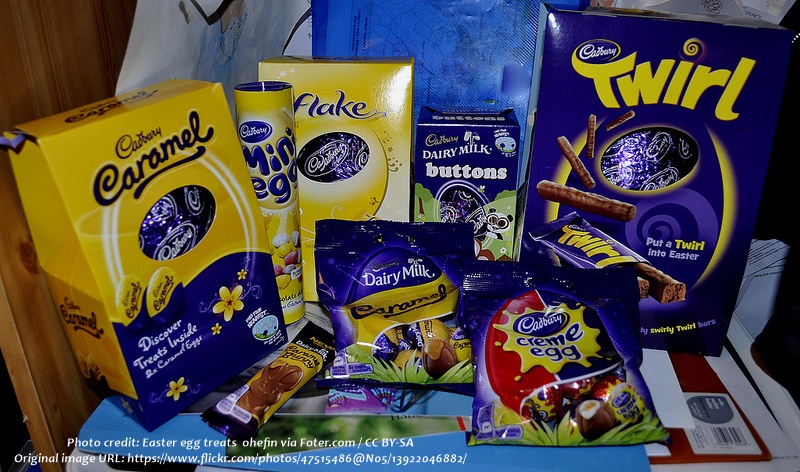
Come on, be honest….who’s already dipped in – safe in the knowledge they can easily be replaced next time a visit to the supermarket is required? Let’s face it, Easter eggs are so readily available and affordable these days, (many supermarkets regard them as lost leaders)….but this wasn’t always the case….
Early chocolate Easter eggs were an extravagant gift given by wealthier members of Victorian society – the mass commercialised eggs we know now didn’t appear until the 1950s….
To understand our love affair with chocolate we perhaps need to go back to its origins….it was certainly in a very different format to what we are familiar with today….
It was some 3,000 years ago, when Aztecs living in what is now present day Mexico, started to cultivate cacao plants, found growing in the tropical rainforests of Central America. The Aztecs were actually attempting to produce a form of beer; the cacao beans were fermented, roasted and ground – they were then mixed with water, honey, vanilla, chilli and other spices to make a hot, frothy, alcoholic chocolate drink – which was believed to have spiritual powers….
As the Aztecs began to dominate Mesoamerica in the 14th Century, they took their craving for cacao with them. So precious became the beans that they actually formed a currency; in the 1500s a hen could be purchased for 100 beans….
It was during the 1500s that the Spaniards set off to the Americas for the purpose of trading with the Aztecs for their silver and gold – but on returning home to Spain, they also carried with them the sacred chocolate drink. Cacao became a rare and precious commodity, a symbol of wealth and power, enjoyed mainly in the Spanish Royal Courts. The Spaniards sweetened the beverage with sugar and added cinnamon for flavour to suit their own palates; they managed to keep their chocolatey indulgence a secret for nearly a century. It was when the daughter of Spanish King Phillip III married French King Louis XIII, taking her love of chocolate with her, that France became privy to the secret – but soon it spread to other European Royal households too….
Such was the demand, that plantations were established in the equatorial regions to grow cacao and sugar. Disastrously, native Aztec workers were wiped out by diseases brought over by the Europeans; it was then African slaves were imported to work the plantations….
Chocolate remained a luxury only to be enjoyed by the aristocracy until 1828; which is when a Dutch chemist, by the name of Coenraad Johannes van Houten, invented the cocoa press. The press enabled the fatty cocoa butter to be squeezed from the roasted cacao beans, leaving behind dry ‘cakes’ which could then be ground – to give cocoa powder. This powder could then be mixed with liquids and other ingredients to make an edible chocolate….
It was J S Fry of Bristol that made the UK’s first chocolate bar in 1847. Early chocolate contained 50% fat, making it hard to digest. Starch and other ingredients were added to make it taste better but it was still bitter and had a gritty consistency….
It is probably the French and Germans who can be attributed for producing the very first chocolate Easter eggs, in the early 1800s. They would have been solid, as this first chocolate would have been too difficult to mould….
Eggs have always been associated with Easter, being symbolic with fertility, rebirth and the beginning; the Church adopted the egg to represent the Resurrection. With the rise of Christianity, many existing Pagan customs were adopted; eggs had long been used in Spring celebrations, with their connection to new life….
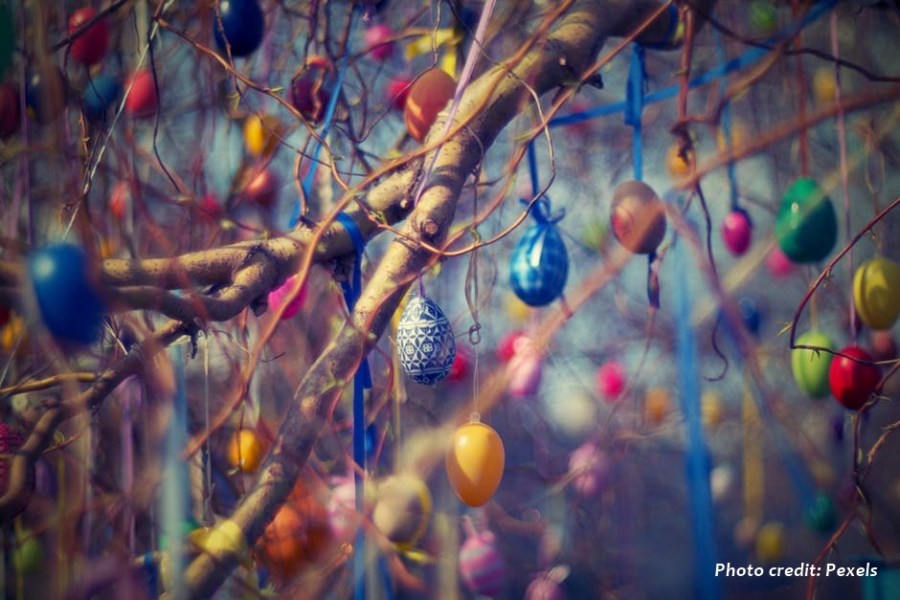
The ancient Greeks, Romans, Persians and Egyptians all dyed eggs as part of their festivities, a tradition that was set to continue, right up until today. In the Middle Ages chicken, duck and goose eggs were all dyed and painted; the Victorians had cardboard eggs that were sometimes covered with satin and decorated, whilst Carl Fabergé made the famous jewelled creations for the Russian Tsar and Tsarina….
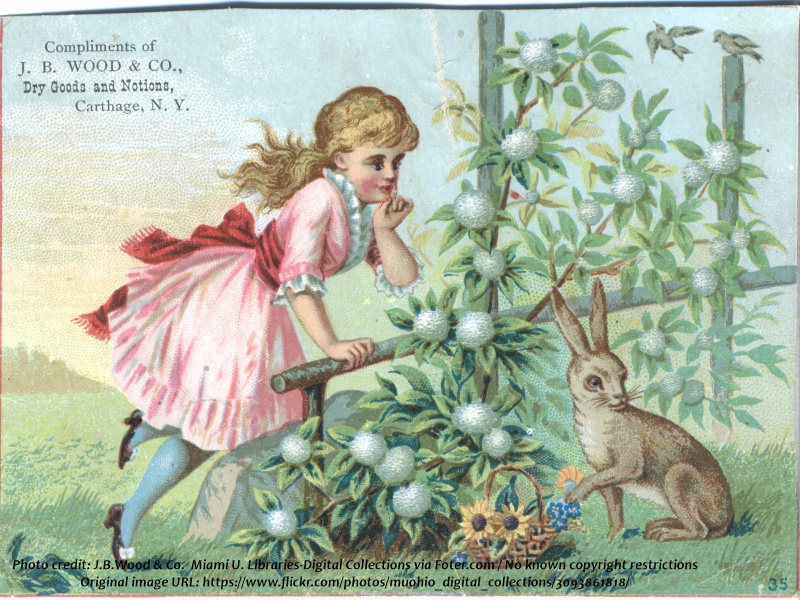
The Easter bunny was also popularised in the 19th Century, once again probably stemming from Pagan origins; Eostre, the goddess of fertility, was often depicted as a bunny. Children were (and many still are) led to believe that the Easter bunny decorated the eggs and hid them for the traditional Easter egg hunt. Some countries have their own variations of the ‘bunny’ – in Switzerland it is a cuckoo and in parts of Germany a fox, that has responsibility for Easter egg duties….
Early Easter eggs would have been highly decorated to suit Victorian tastes; adorned with large marzipan flowers and elaborate piped icing techniques, these frivolous gifts were just for the rich….
In 1866, the Birmingham chocolate makers Cadbury, imported a brand new type of cocoa press, enabling a method of halving the fat content of the chocolate; making it better tasting and smoother – so it could be more easily moulded. In 1873, Frys produced the first moulded chocolate eggs at their Union Street factory in Bristol. Cadbury followed two years later and soon others copied. Business began to boom and the custom spread to the USA. It was in 1879 that Rodolphe Lindt invented a conching machine that enabled a chocolate with a luxurious, velvety texture to be made. By 1893 Cadbury had nineteen different patents (a lot for those days) – their first eggs were filled with sugared almonds; the chocolate confectionery business was coming on in leaps and bounds. Further advancements in techniques heralded the introduction of milk chocolate; 1905 saw the arrival of Cadbury’s Diary Milk chocolate bar and with it the first milk chocolate eggs…. Frys and Cadburys merged in 1919….
Photo credit: Image taken from page 166 of ‘The Baby’s Museum: or, Rhymes, jingles and ditties, newly arranged by Uncle Charlie’. The British Library via Foter.com / No known copyright restrictions Original image URL: https//www.flickr.com/photos/britishlibrary/11156885235/
Rationing of chocolate during World War 2 meant it was the 1950s before Cadbury introduced eggs aimed at children. At this point in time chocolate eggs were still an expensive luxury and a child would have been lucky to receive one. Since then the market has exploded, now most kids can expect to receive several eggs….
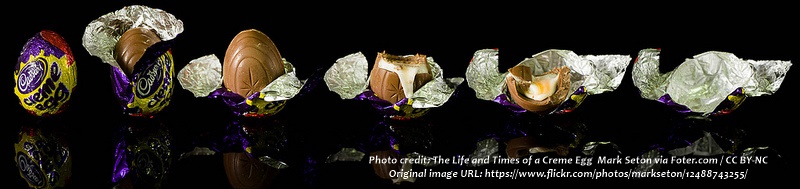
I must admit, I have always been partial to a Cadbury’s Creme egg….but did you know it was launched in 1963 as Fry’s Creme egg? Clever chap, that Mr Fry….I wonder what he would have thought of the chocolate market today…? Worldwide, we spend over £60 billion annually on the sweet confectionery….
Happy Easter and I do hope the Easter bunny hops down your way….
Please…. If you have read this post through to the end – then I assume you have found it of interest and I hope you’ve enjoyed it…. If you have found this via Facebook, a little ‘like’ for the Cottage Capers’ page would be very much appreciated – a like and a follow would be even better…. I’m not trying to sell you anything – I’m simply a blogger trying to establish myself…. Many thanX….
It was during a family day out to the Portsmouth Historic Dockyard, that we acquired a new cat…. Not a real one, I hasten to add – but a replica of Able Seaman Simon…. We thought he would be an amusing addition to No.3, as being so realistic he would be bound to catch a few unsuspecting visitors out – and he has, he’s given us a few laughs….
Whilst researching for my last blog post – “A black cat called ‘Lucky’….”-I kept stumbling across references to the real Simon and intrigued, I realised I had to know more….
Ships have had cats since ancient times…. The Ancient Egyptians carried them on their Nile boats. The Vikings are known to have had them as far back as the 8th Century…. It was Phoenician* cargo ships that first brought cats to Europe, approximately 900BC…
*An ancient civilisation on the Eastern Mediterranean coastal region : now known to us as Lebanon, Israel, Jordan, Gaza and Syria.
Ship’s cats are thought to have spread cats across the World…. Moggies on ‘shore leave’ had ‘romances’, genes spread, as kittens grew and had families of their own, so the kitties we know today came to be….
Cats were an important part of the crew of ships in days gone by; trading, exploration and naval ships all employed their services to control rodents….
Photo credit: The HMAS AUSTRALIA [11] STORY, ca 1950, and other animal stories – Argus Collection, SLV, Courtesy Geoff Eastwood Kookaburra2011 via Foter.com / CC BY-NC-SA Original image URL: https://www.flickr.com/photos/41311545@N05/14114943580/It wasn’t just the cargo that needed protecting from vermin. Rats and mice are notorious gnawers; ropes and wood were chewed and in time and with progression they happily munched their way into electrical wiring too…. Then the ship’s supplies had to be taken care of, a crew of hungry men away at sea for months, maybe years at a time, needed sustenance…. Plus rats and mice carry disease. What better way to deal with this, than with a mouser? Cats also gave comfort to these men….away from home for long periods of time, they provided a link to the life left behind….and then there was superstition….
The ship’s cat was also thought of as a mascot, it brought luck. It was believed the resident moggy could protect against the elements of the weather. There was also a belief storms could start from the magic stored within their tails…. If a cat fell or was thrown overboard a terrible storm would ensue…. If the ship managed to survive this, then it would have to endure nine years of bad luck…. The cat’s behaviour also gave signs to the sailors. If when grooming, it licked its fur against the grain – a hail storm was coming. If it sneezed, rain was on its way, if it started to act in a frisky manner, the wind was going to get up…. There is some truth in all this…. A cat’s inner ear is very sensitive, (this is what allows it to land in an upright position when falling) – this sensitive inner ear is able to detect changes in the weather…. low atmospheric pressure can often make our own domestic cats nervous and restless….
Black cats were the preferred choice, as they were thought to be extra lucky. Polydactyl cats were also very popular. Polydactylism is a congenital physical anomaly, which results in there being more toes than usual on one or more paws. Normally a cat has a total of 18 toes, 4 on each hind paw and 5 on the front ones. Polydactyls can have as many as 8! They were favoured by sailors because of their extraordinary climbing and hunting abilities….
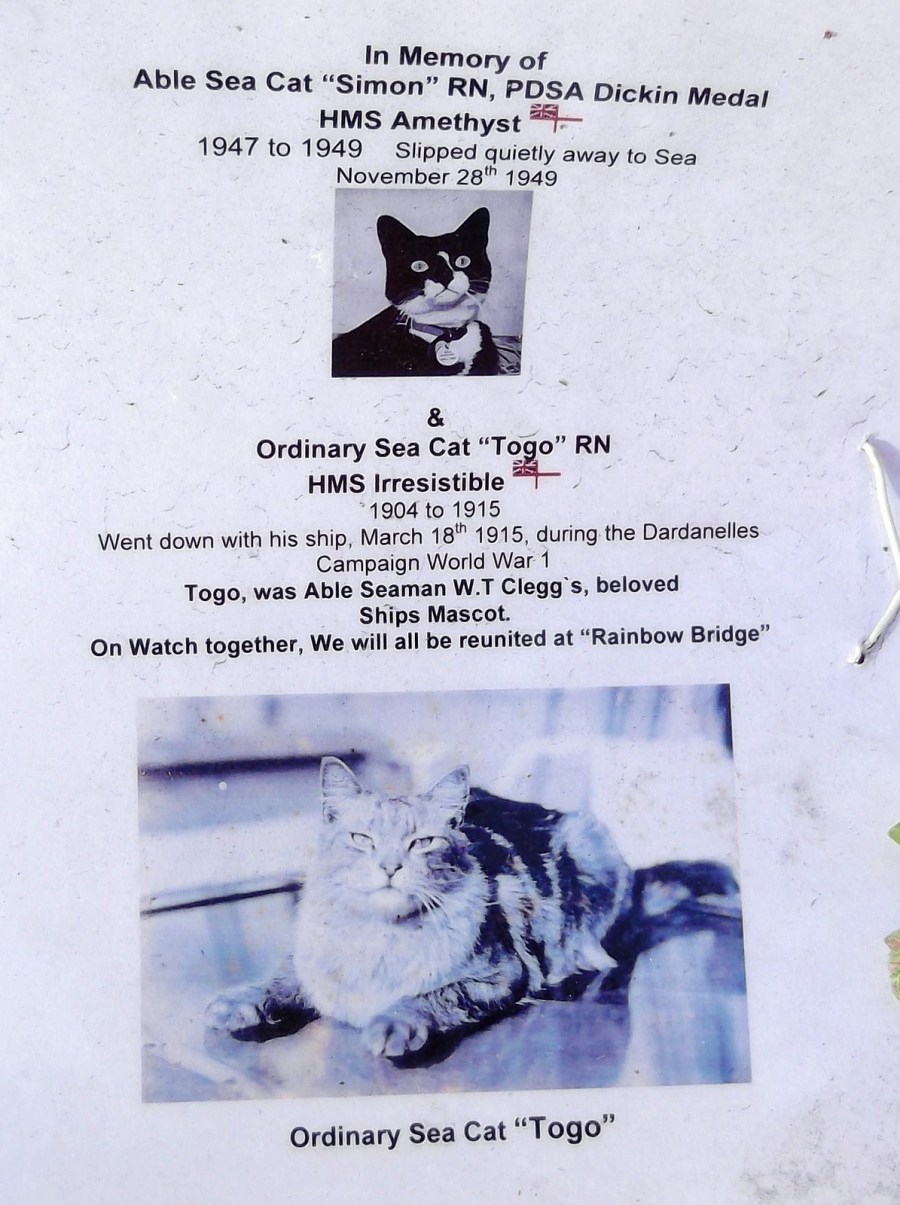
Many ships still have cats onboard today, although the Royal Navy banned all animals in 1975 for hygiene reasons. There have been many notable feline voyagers, such as Jenny, the Titanic’s cat. She survived the sinking of the Titanic on that disastrous maiden voyage and was transferred to Titanic’s sister ship, Olympic, where she lived in the ship’s galley, along with her kittens…. Tiddles served on a number of Royal Naval aircraft carriers; born on HMS Argus and then spending time on vessels such as HMS Victorious, Tiddles clocked up over 30,000 miles on his travels…. Or, what about Blackie? The little cat Churchill found so endearing. Blackie resided on HMS Prince of Wales during World War 2. The ship carried Churchill to meet Franklin D Roosevelt to agree the Atlantic Charter. On leaving the ship, Churchill stopped to say ‘good-bye’ to Blackie. Caught on camera, the resulting photograph went the equivalent of today’s ‘viral’…. Blackie was renamed Churchill and went on to survive the sinking of HMS Prince of Wales…. Then, there was Emmy – of RMS Empress of Ireland. Emmy was an orange tabby who never missed a voyage, until May 28th 1914, when she darted off and refused to be coaxed back. Reluctantly, the ship had to leave without her; not having their lucky mascot was a bad omen for the crew. The following morning, in thick fog, RMS Empress collided with SS Storstad at the mouth of the St. Lawrence River. Over 1,000 lives were lost…. Did Emmy have a premonition? But of course, the ship’s cat I’m here to talk about is Able Seacat Simon….
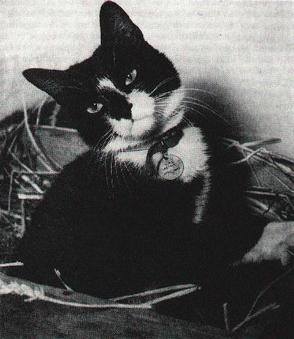
Simon’s story, as a sea cat, starts in March 1948, when he was found wandering the dockyards of Hong Kong, by 17 year old Ordinary Seaman George Hickinbottom. The cat was then about a year old and in a bad way, he was starving and unwell. George, obviously being a bit of a softy, smuggled the puss back onboard the ship he was serving on, HMS Amethyst – a Royal Naval modified Black Swan-class sloop, modified after World War 2 and re-designated a frigate….
Simon quickly became a favourite amongst the officers and crew alike. He earned his keep by catching the rats which were a problem on the lower decks of the ship. He was a cheeky little chap, who liked to leave presents in the beds of his fellow crew mates, in the form of dead rodents….and one of his most favoured sleeping places was in the Captain’s cap….
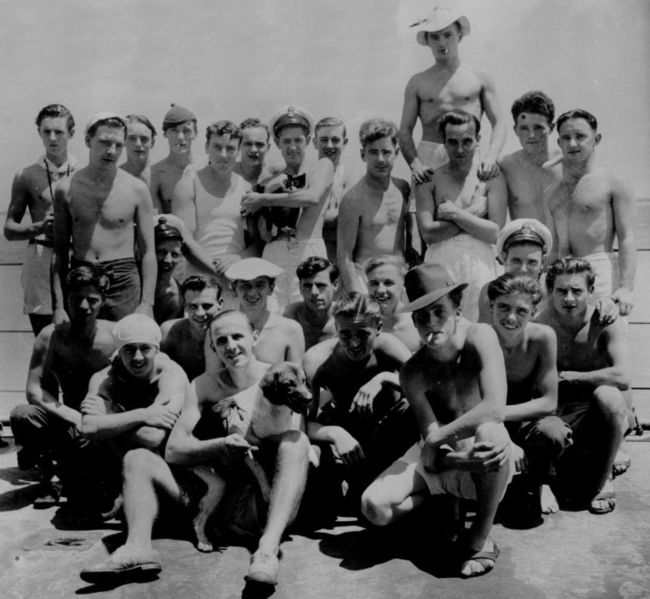
“By Lt. Commander K. Stewart Hett, M.B.E., R.N. Ret [Public domain], via Wikimedia Commons=” “https://commons.wikimedia.org/wiki/File%3ACrewmen_of_HMS_Amethyst_F-116.jpg”The ship changed command. The new Captain, Lieutenant Commander Bernard Skinner, instantly fell in love with Simon. Skinner’s first mission, in command of HMS Amethyst, was to replace HMS Consort as guard ship to the British Embassy in China…. Sadly, it was to be his first and last….
April 20th 1949 – HMS Amethyst was steaming up the Yangtse River, between Shanghai and Nanking (Nanjing), when it was fired upon by the People’s Liberation Army, the armed forces division of the Communist Party of China; what was to unfold was the Amethyst Incident or better known as the Yangtse Incident…. The ship was about to become trapped on the Yangtse River for three months, during the Chinese Civil War….
It was 8.30am and a burst of small arms fire from the PLA suddenly erupted from a field gun battery situated on the North side of the river. It fell well short of Amethyst and the crew assumed its intended target had been the south bank; so, unfurling their large Union flags and increasing speed, they carried on their way….
An hour later, further up river at Kiangyin (Jiangyin) they came under fire again, this time it was more than obvious that it was intended for them. The first shell passed overhead but then in quick succession the wheel house, bridge and power room were all hit. Commander Skinner was in his cabin at the time, along with Simon…. A shell tore through, severely wounding Skinner, who died of his injuries soon after…. Simon was also badly hurt and fled into the depths of the ship….
All personnel on the bridge had been injured; out of control, Amethyst turned violently to the left and grounded on a bank. Unable to defend herself, as the firing circuits to her guns had been disabled when the power room was hit, the ship was helpless….
First Lieutenant Geoffrey L. Weston assumed command, even though he himself had been injured too. Still the PLA shells continued, exploding in the sick bay, port engine room and finally the generator. The last transmission made from Weston stated : ‘Under heavy fire. Am aground in approx. position 31.10′ North 119.50′ East. Large number of casualties’. These co-ordinates were actually incorrect, the ship was 32.20′ North, not as stated; it is unknown how this error was made, it could have been Weston himself, the signal operator or recorded wrongly in the log books….but it just shows how chaotic the situation must have been at the time….
The order was given to fire the ship’s guns in local control but as Amethyst was positioned in such a way and totally disabled, the guns could not be turned on the PLA batteries. Only the stern turret was operational but was soon hit. Still the PLA kept on firing….causing more and more casualties on Amethyst….
At some time between 10 and 10.30am, Weston ordered anyone who could be spared to leave the ship and get ashore. A small boat was launched and some crew members swam, immediately the PLA’s attention was turned on them….evacuation had to be aborted. In total 59 crew and 4 Chinese mess boys successfully made it to shore. (The following day, with help from Chinese Nationalists and a sampan, the wounded from Amethyst were got to shore and then taken to hospital. That left 60 unwounded men and Simon onboard). At 11am the shelling stopped but movement was restricted for fear of attracting PLA sniper fire…. 22 men had been killed and 31 injured….
At 3pm HMS Consort arrived, having been summonsed to Amethyst’s aid – Consort was flying 3 Union flags and 7 white ensigns; she was immediately fired upon and had to pass the stricken Amethyst at speed. Two miles down river, she turned and headed back to try again, once more heavy fire meant she had to abandon the attempt (but not without using her full armament on the PLA). Consort herself had now sustained serious damage, 10 men had been killed and 23 injured….
HMS Amethyst was refloated at just after midnight on the 21st of April. A message came through to say HM Ships London and Black Swan were on their way to escort the damaged Amethyst – and to be ready…. When they arrived, they too were heavily shelled and had no choice but to retreat : 3 were killed and 14 wounded….
On April 22nd, The Assistant British Naval Attaché, Lieutenant Commander John Kerans, came aboard and took command. Over the next few days, Amethyst attempted to move several times but was unable to make much progress as each time she came under fire. Eventually, she was forced to anchor off of Fu Te Wei….
Five days after his retreat to the depths of the ship, hunger forced a badly injured Simon up on to the deck. Immediately he was taken to the medical bay. His face was severely burnt, he had lost all of his whiskers and he had to have 4 pieces of shrapnel removed. His heart had been seriously weakened, he was not expected to survive the night….
Against all the odds, Simon did make it through to the following morning and slowly he made a recovery. He spent his time in the sick bay snuggling up with and comforting the injured seamen….
On April 30th, the PLA demanded that Britain, France and the US immediately withdraw all their troops from China. They also wanted an admission that it was HMS Amethyst that had fired first and that she was unlawfully in Chinese waters. The PLA did not recognise any treaties made by the previous Chinese Government and Britain. Kerans refused to accept the demands and Amethyst stayed under PLA siege for 10 weeks; vital supplies were prevented from being taken onboard, the Communists determined to make conditions as difficult as possible…. It wasn’t until 1988 that the PLA Commander, Ye Fei, finally admitted the Communists had fired first….
During these weeks of imprisonment, Simon made himself useful. Over the weeks, anchored in the river, Amethyst had become over-run with rats; the little black and white cat made it his mission to get rid of them, including the notorious, hard to catch, king-rat, ‘Mao Tse-tung’ – so named by the crew…. The affectionate little soul raised the morale of the marooned sailors and managed to bring a little cheer….
On July 30th 1949, under cover of darkness, HMS Amethyst slipped her chain and heading down river, made a mad dash for freedom. She followed closely in the wake of a passenger ship, Kiang Ling Liberation, in the hope of confusing the PLA. It worked….the Communists turned their fire on the passenger ship, as a result, sinking it with heavy civilian casualties…. Amethyst was able to make her escape….
At 5am on July 31st, HMS Amethyst approached the PLA forts at Par Shan (Baoshan) and Woosung (Wusong) for a pre-planned rendezvous with the destroyer HMS Concord, who had been ordered to be ready with full gun support. Luckily, Amethyst went undetected by the PLA batteries and the famous signal was sent : ‘Have rejoined the fleet south of Woosung. No damage. No casualties. God save the King’. The two ships managed to make it down river, clear the river mouth and eventually at midday they arrived at the Saddle Islands. After a brief stop, HMS Concord lent HMS Amethyst sailors to form a functional crew and both ships sailed to Hong Kong. If the mad dash for freedom had not of worked, then the intention of the Captain was to blow the ship up….
A film was made of the Yangtse Incident, with Amethyst being brought out of storage to play herself…. Her engines were no longer operational and her sister ship ‘Magpie’ was used for any movement scenes…. Amethyst was scrapped soon after the film was made….
Simon became famous, the World’s press taking his story to heart. He was awarded the Dickin Medal, (the animal equivalent to the Victoria Cross), initially instituted in 1943 to honour the working animals in World War 2. He was also awarded a Blue Cross Medal, the Amethyst Campaign Medal and given the rank of ‘Able Seaman’. Lt. Stewart Hett was appointed ‘Cat Officer’ to deal with the thousands of letters sent to Simon by well-wishers and on Amethyst’s return to Plymouth there was a huge welcome for him….
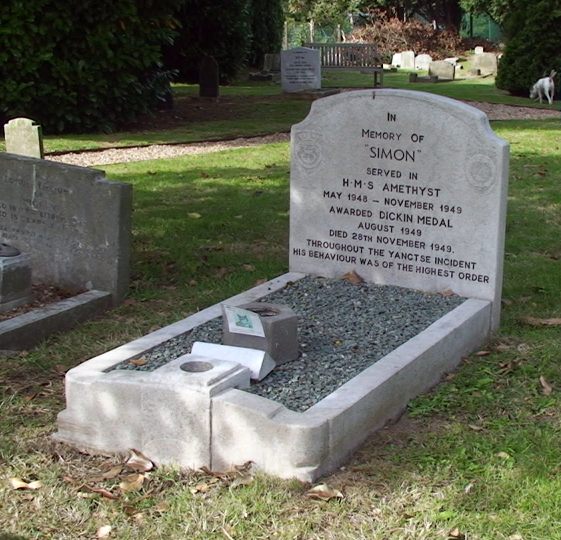
The Nation loved him – but like all animals entering the UK, Simon had to go into quarantine. He was sent to an animal centre in Surrey; he hated it and was thoroughly miserable. Whilst in quarantine, Simon contracted a virus…. Although everything possible was done for him, due to complications from his war injuries, Simon passed away on November 28th 1949; four days before actually receiving his Dickin Medal, which had to be awarded posthumously….
Simon was buried at the PDSA Ilford Animal Cemetery in East London. Hundreds of people, including the crew of Amethyst attended his funeral…. Simon was just two years old….












 Cottage Capers
.jpg)

