Within these walls….

Eager to use every inch of available space in No.3, our attention turned to the area under the stairs, that for some reason had been ‘bricked up’ – literally, it was inaccessible.  As we set about removing the bricks, I jokingly remarked to John, “I hope we don’t find a body under here….”

John made a hole big enough to poke his head through and using a torch, peered into the darkness…. Inside could only be described as resembling a ‘midden’ – and there on top of a mound of earth, lay a bone! Slightly nervous of what we were about to find, we continued to break our way in…. What we found was an assorted pile of rubbish and a quantity of animal bones, we can only assume what we had unearthed was a very old rat’s lair….
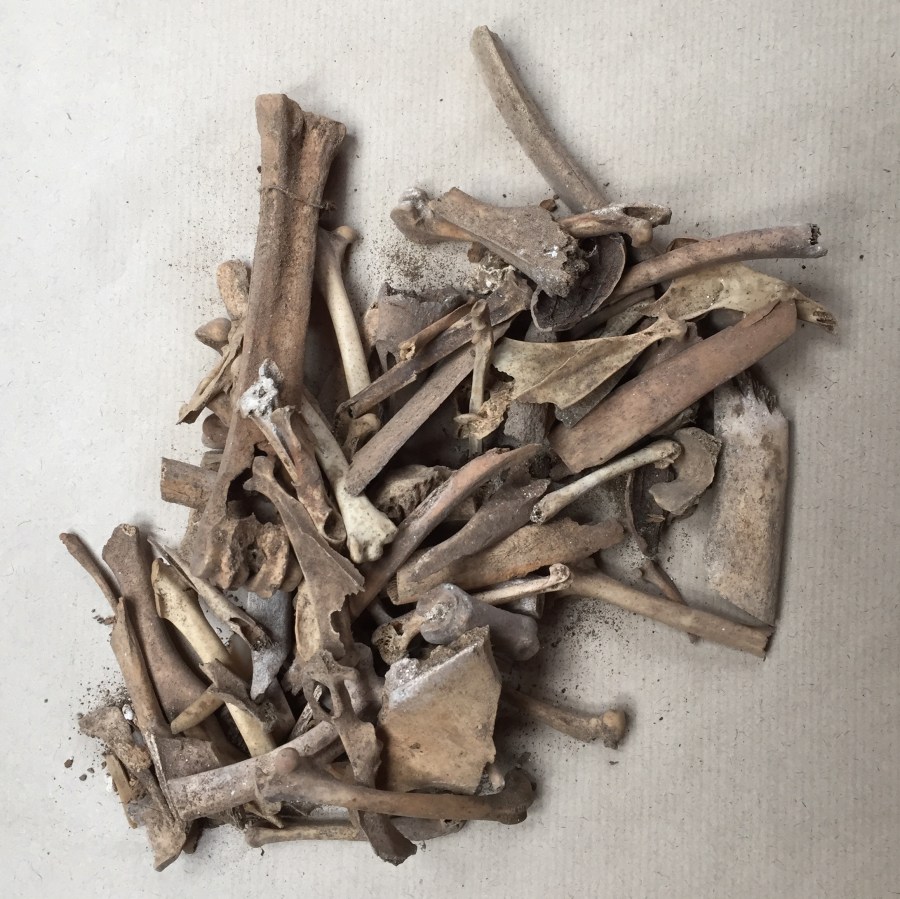
wb-13-bones-at-no-3
Bones found under the stairs of No.3….

Oddly though, amongst the debris were a collection of marbles and another of old bottle tops…. We never did get to the bottom of why the under stairs had been bricked up (perhaps it really had been a midden and previous occupants, long gone by, couldn’t be bothered to clear it out – who knows) ; it now serves as a very useful cupboard space….

As this was one of the last areas to be explored, I think we were secretly hoping we were going to find something like a ‘concealed shoe’….or perhaps some other ‘offering’ hidden away….protecting the house from evil spirits. We had gone over just about every other inch of the place and all we had found were a few hairgrips under a window sill, a magazine from the 1950s under the bath and a few giant acorns stashed in a hole in a beam….

‘Caches’, the correct term for offerings, (from the French ‘cache’ – meaning to give), are items that have been concealed somewhere in a building; under floors, above ceilings, up chimneys, around windows and doors, plastered into walls….
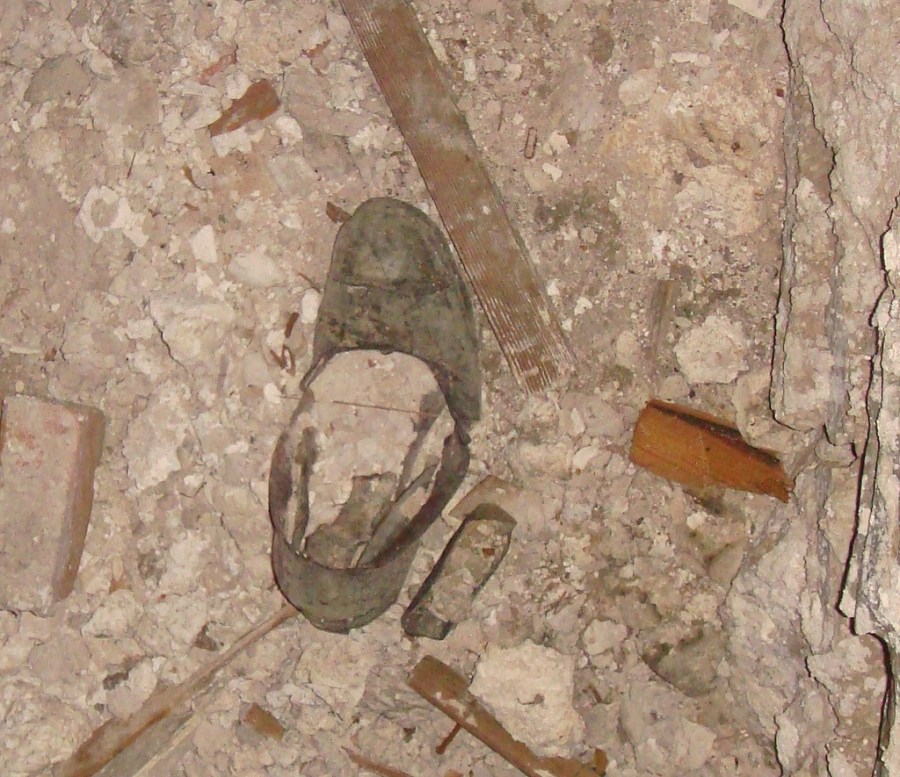
wb-7-shoe-in-wall
Photo credit : ‘Semaphore Reno 004’ – Marlene Manto via Foter.com / CC BY-NC  Original image URL: https://www.flickr.com/photos/marlenemanto/2874151309/    (Shoe plastered into wall….)

They were believed to protect the inhabitants from evil influences; witches, ghosts, demons and the like. It was a custom that was with us for centuries, only really dying out at some point in the last century (may be the advent of burglar alarms made people feel safer?!)…. It is not a custom that was confined just to the UK, by any means; such offerings have been found in buildings all over Europe, parts of Scandinavia, North America, Australia, even China….

Shoes are the most common; nearly always a single shoe, usually well worn and often repaired. In days gone by, as much use as possible would be gleaned from possessions, unlike the throw away society we know today….

wb-9-concealed-shoes-east-anglia
Photo credit : Edmund Patrick – CC BY-SA 3.0  Collection of concealed shoes from East Anglia held by St. Edmundsbury Heritage Service

About half of the shoes recorded have been those of children; it was believed the innocence and purity of children would over power evil spirits…. The earliest shoe that has been found to date was discovered behind the choir stalls in Winchester Cathedral, the stalls were originally built in 1308; it is thought the shoe may have been there since that time….

It is assumed many shoes are found and simply thrown away, never to be recorded. Northampton Museum has a ‘Concealed Shoe Index’ that it has been compiling since the late 1950s; it has approximately 2,000 entries. Shoes have been found in a large variety of buildings : monasteries, churches, hospitals, theatres, schools, even army barracks. They have been discovered in pubs and breweries, museums, factories and of course private dwellings, from tiny cottages to manor houses, even the likes of Hampton Court Palace….

The shoe is the only item of clothing that truly takes on the form of the wearer, it shapes itself to the foot…. It was believed that the spirit of a deceased person would be trapped in the shoe – a ‘spirit trap’…. It is thought this belief comes from the 14th Century, when it is said John Schorn, the Rector of Marston, Buckinghamshire, cast the Devil into a boot, thus entrapping him….

The largest cache found in the UK was in a 400 year old cottage, which was being renovated in Snowdonia, Wales. Here, building contractors found nearly 100 single shoes buried under a chimney stack. The nearest recorded example of a concealed shoe being found to here, was in the neighbouring village of Hascombe. A house was undergoing repair work and from the rafters fell an 18th Century child’s shoe….its heel broken down where the child had continuously pulled it on and off….and the toe was worn through.

Although many think the ‘concealed shoe’ was to keep away evil influences, there are also others who believe shoes were hidden as a fertility offering. Shoes have long been associated with fertility. In Lancashire, there is an old custom called ‘smickling’ – it involves trying on the shoes worn by a woman who has recently given birth, supposedly this brings luck in conceiving…. Casting a shoe after a bride departing for her honeymoon was another old tradition, even today we still tie shoes to the car of a newly wed couple….

Bröllopsfotografering Frida Pettersson och Pontus Svensson 2007-07-28
Photo credit : Just Married – Johan Lindqvist Fotografi via Foter.com / CC BY-NC-ND Original image URL: https://www.flickr.com/photos/johanlinqvist/4297282191/

Some think the connection between shoes and fertility is reflected in an old English nursery rhyme from Mother Goose :

There was an old woman who lived in a shoe;
She had so many children she didn’t know what to do;
She gave them some broth without any bread;
Then whipped them all soundly and sent them to bed….

wb-11
Photo credit : Internet Archive Book Images “Mother Goose’s Melodies : or songs for the nursery” (1879) via Foter.com/No known copyright restrictions : Original image URL: https//www.flickr.com/photos/internetarchivesimages/14583156277/

This rhyme dates to 1794 and there are some that think it refers to King George II, who’s wife, Caroline, had eight children. George II had the nickname ‘Old Woman’ and it was widely believed that Caroline was the one with the real power….

Of course, it wasn’t just shoes that were used as caches. Other items of clothing have often been found; gloves, hats, belts, breeches, jackets. In a thatched cottage, in Pontarddulias, South Wales, a mid 18th Century corset was found in a wall…. It is not just clothing that has been found; objects such as coins, spoons, knives, books, goblets, pots, pipes, children’s toys and dolls and more macabre things, horses skulls and mummified cats….

Dried cats have been found on numerous occasions. It was thought the presence of the cat would deter vermin, such as rats. However, there was another reason cats were hidden within the house, cats were believed to be highly susceptible to detecting evil spirits : and because of their connection to witches, it was the belief that they would provide protection from such….

wb-8-mummified-cat-seaforth
Photo credit : Radarsmum67 via Foter.com / CC BY Mummified cat, found between floorboards in the attic of a Victorian house, built 1879, being renovated in Seaforth…. Original image URL: https://www.flickr.com/photos/radarsmum67/27029137971/

Witchcraft was greatly feared in centuries gone by. Witches bottles are also regularly found, no where more so than in East Anglia, where the belief in witches was very strong indeed…. Very often they are discovered buried under a fireplace, the floor or plastered into a wall. It was believed that as long as the bottle was kept well hidden and remained unbroken, the ‘spell’ contained within would keep on working…. The origins go back to the 1500s and they are particular to the Elizabethan period….

The earliest bottles to be found were typically ‘Bartmann jugs’ – made from salt glazed stone. During the 1500s and 1600s, Bartmann jugs were made throughout Europe but most especially in Germany. Shaped in the form of a bearded man, their intended use was to store food and drink. They were also manufactured in England, either by copycat potters or German immigrants. Because of the malevolent face of the bearded figure, it became adopted by many as the perfect vessel for a witch’s ‘spell’….

The contents were usually prepared by the local ‘witch’ or folk healer. The spells would be used not only to ward off evil but very often in an attempt to cure an affliction, condition or illness. Earlier spells would contain something personal of the person it was intended for, usually urine but sometimes hair or nail clippings….

Later witches bottles were often made of glass…. They would be filled with red wine, rosemary, pins and needles. The bottle would be buried and it was believed evil spirits would be caught on the pins and needles, drowned in the wine and then banished by the rosemary….

Other ‘ingredients’ could be added to the bottle; depending on the requirements of the particular spell – sea water, stones, earth, ashes, feathers, shells, vinegar….

Sometimes, instead of burying the bottle it would be hurled into the fire, causing it to explode; so if someone was thought to be ‘cast under a spell’, it would be broken….

Generally though, it was customary to bury the bottle, especially under the fireplace….

Now, there’s somewhere we’ve never looked…. Any one got a spade….?

wb-1
Photo credit : The British Library via Foter.com / No known copyright restrictions  –  From the Ingoldsby Legends. Illustrated by Cruickshank, Leech and Tenniel (People’s edition) [A selection]  Original image URL: https://www.flickr.com/photos/britishlibrary/11276749235/

Learning to appreciate my creature comforts….

To say I wasn’t the happiest bunny in the warren last week, is perhaps an understatement….

Living in the ‘sticks’, we have no mains gas and so rely on an LPG tank. This works just fine – until someone forgets to check the levels and the gas runs out…. I am a miserable moo at the best of times during the winter months, I detest the cold – to have no heating or hot water equals a total disaster for me. So, when total disaster struck last week, I was not happy at all and I let everybody know about it! Eventually, a certain member of the household snapped back at me – “For goodness sake! It’s only been a couple of days, imagine what it used to be like….”

This got me thinking…. If this house could talk, what would it have said to me? I’m certain something like – “You lightweight wimp! I could tell you a tale or two….”

Now, I can only try to imagine what it must have been like for the first occupants of this house….pretty grim I should think. I looked around my kitchen and attempted to visualise what it would have looked like some 650 years ago….

The ‘cooker’ doubling up as the ‘central heating system’ would have been an open fire in the middle of the floor – fireplaces with chimneys hadn’t been invented yet. The place would have been thick with wood smoke, most of it being drawn up into the rafters to eventually find its way out but still permeating into everything. Having no windows as such (draughts had to be kept at bay and glass was a rare, expensive commodity), meant it would have been very dark….

Rush lights, a simple form of lighting, would have been readily available. Wild rushes were gathered and then dried, enabling the skin to be stripped off to reveal a firm inner pith, which would be soaked in animal fat. This produced a ‘torch’ that could be fixed to the beams to provide light. They did not last for long and needed a watchful eye to prevent nasty accidents from happening. If I look closely at some of the beams in here, I can see evidence of scorch marks where rush lights had been left to burn too low…. If a household was wealthy enough, tallow candles may have been used instead….

Scorch marks on the beams in the kitchen of No.3, caused by rush lights being allowed to burn too low….

Cooking was probably a fairly simple affair. Meat was a rarity; if it was available, it was most likely to be pork. Rabbits would have been plentiful for the lucky ones, who were granted permission to catch them, by the Lord of the Manor. If the family owned a pig, it was normal to slaughter it at the beginning of Winter, to provide for the coming months and because it was impractical to feed such livestock over this period….

Generally, the family’s daily diet consisted of one main meal per day ; coarse barley bread and ‘pottage’ – a type of stew made from grain and vegetables (that had been grown in the vegetable patch)….

med-6
Photo credit: ‘Anglo-Saxon Pottage and Maslin Bread’ – Learning Lark via Foter.com / CC BY Original image URL: https://www.flickr.com/photos/44282411@N04/8367532621/

Modern day example of ‘pottage’ – post Sir Walter Raleigh !!

med-4
Photo credit: jean louis mazieres via Foter.com / CC BY-NC-SA  IMG_3081D Hendrick Terbrugghen. From 1588-1629. Utrecht.’ Esai bought his birthright to his eldest for a mess of pottage’ – Old Testament. Berlin Gemaldegalerie  : Original image URL: https://www.flickr.com/photos/mazanto/14502159278/

Nuts would have been gathered in the Autumn. As would acorns, to fatten the pig. Cheese would have been made from goats milk (or cow if the family was wealthy enough to have one). Chickens scratched around the yard, providing a supply of eggs, perhaps they would have been accompanied by the odd goose. It is highly likely sheep would have been kept, for their wool…. The most prized beast to own would have been an ox – to help work the land….

med-16
Photo credit: ‘Traditional ploughing’  IFPRI-IMAGES via Foter.com / CC BY-NC-ND             Original image URL: https://www.flickr.com/photos/ifpri/14328235549

Animals were highly valuable; this is why, so often, they were kept in the house overnight….

med-14
Photo credit: ‘dead_horse_composite’      Cali.org via Foter.com / CC BY-NC-SA Original image URL: https://www.flickr.com/photos/caliorg/6152714203/

Bears and wolves still roamed the English countryside in those days, as well as the occasional chancing ‘rustler’. Keeping the animals at such close quarters brought its problems, a part from the obvious of not being house trained, (which in its turn attracted flies), there were the fleas; the house would have been a haven for all kinds of creepy crawlies….and vermin! Rats and mice would have been in abundance….

I am often to be heard complaining about mud on the floor – (my lot aren’t very well house trained either) – but back in the day, these floors would have been made of mud, with straw strewn across them…. Contrary to belief, people in Mediaeval times did attempt to keep their homes relatively clean – the straw was periodically swept out and replaced….

They also made an effort to keep themselves clean, although bathing would have been a warmer weather activity, when rivers and streams could be used…. Clothes would have been changed and washed on a fairly frequent basis. Of course, there was no running water – that had to be brought in daily – the ‘loo’ would have been a bucket, that needed emptying every day into a nearby stream….

Most likely, the first occupants of this house were a yeoman and his family. A yeoman had a slightly higher standing than a foot soldier but lower than a knight or nobility. He would have owned and worked land but at the same time served his Lord. He would have been trained to use the bow and quite possibly a sword and dagger, he would have taken part in fighting on behalf of his Lord….

med-17a
Photo credit: Internet Archive Book Images – image from page 390 of “The book of romance” (1902) Archive Book Images via Foter.com / No known copyright restrictions  Original image URL: https://www.flickr.com//photos/internetarchivebookimages/14750418874/

His home would have been more substantial than that of a peasant or ‘serf’ – its size depending on his wealth. This particular one probably belonged to a fairly modest yeoman but was well constructed for its time. Furniture would have been sparse – benches and stools (as opposed to chairs), with a wooden table and a chest in which to keep clothes and valuables. Possibly, a simple bed or two but more likely, straw matresses on the floor. Various hooks would have been situated around the place from which possessions and provisions were hung…. The whole family and any servants they had (if affluent enough), probably all lived together in one room….

med-1
Photo Credit: ‘Interior in the middle ages’ – smiling_da_vinci via Foter.com / CC BY-NC Original image URL: https://www.flickr.com/photos/smiling_da_vinci/14117932

The lady of the house had many tasks to attend to on a daily basis, possibly with a servant to help; although, in a house of this size, that is unlikely to have been the case…. Keeping the house clean (as best she could) and making rush lights were part of the day to day routine. She would have been responsible for feeding the family, making the pottage, cheese, bread etc : Milking the cow or goats, collecting eggs, feeding the animals, tending the vegetable plot….

The sheep needed shearing, the wool washing and carding. Then it was her job to spin it and quite possibly weave the resulting yarn to make cloth, from which she made clothing for the family. Breeches and tunics for the men; an ankle length gown or two for herself. She also wore a surcoat (a type of over dress), a smock, maybe a cape and being married, a wimple (a drape covering the head, tucking around the neck and chin)….

Her spinning usually accompanied her where ever she went, so as to fill in any ‘spare’ moments she may have had….

She was also in charge of all the laundry and any mending or patching that needed doing….

Being a yeoman’s wife, her clothing would have been of better quality than that of a peasant. The family probably would have had enough money to be able to buy linen and dyes to colour the wool. Greens and blues were favoured (reds and purples being kept for the upper classes and royalty). Wearing yellow was discouraged, as this was the colour worn by women of ill repute! Certain fabrics, such as silk were not allowed, as these were reserved for the higher classes….

She would, almost certainly, have had several children to look after. Education was extremely rare, so generally children would have been set to work as soon as they were old enough….

As if she didn’t have enough to do already, the housewife would have been expected to help her husband on the land; sowing, reaping, threshing, even ploughing….

A typical yearly calendar for a yeoman would entail :

January/February : Plough and harrow the land. Spread manure. Plant trees and hedges. Prune fruit trees.
March/April : Sow wheat, rye, oats and barley. Scour the ditches and maintain coppices.
May : More of the same. Wean the lambs.
June : Wash and shear the sheep. Manure the fields ready for summer ploughing.

med-20
Photo credit: Virtual Manuscript Library of Switzerland via Foter.com / CC BY-NC  Scene from ‘Labors of the month June’  Original image URL: https://www.flickr.com/photos/e-codices/9420762986/

July : Make hay. Get wood in ready for Winter.
August : Harvest, probably using hired help.
September/October : Sow rye, then wheat. Make cider. Prune hedges and trees. Plant rose bushes. Attend local fairs selling produce, buying and bartering for required provisions.
November : Slaughter animals. Put straw out to rot, ready for next years manure. Bring in any animals intended to overwinter. Cover asparagus and strawberry beds.

med-15
Photo credit: Virtual Manuscript Library of Switzerland via Foter.com / CC BY-NC  Scene from ‘Labors of the month November’  Original image URL: https://www.flickr.com/photos/e-codices/8144142310/

December : Plough land ready for beans. Gather fuel.

Then at the end of the year, a few days would have been taken off (just tending to absolutely necessary tasks, such as the animals), to feast and celebrate Christmas. Then the cycle would begin all over again, bearing in mind life expectancy was just mid forties, that was if they were lucky….

med-7
Photo credit: hans s via Foter.com / CC BY-ND https://www.flickr.com/photos/archeon/

There is no denying, life was tough….full of hardship, pain and discomfort….

Next time the gas runs out, or we experience a power cut….I shall remember all this before I open my mouth to complain….I have learnt my lesson….