
May Day – a time to celebrate the coming of summer – a time of joy, hope and love – a time to have some fun…. So, let’s go and crown the May Queen, grab some Morris men and do a turn around the maypole….

Where did all this malarkey come from? May Day originates from the Pagan festival of Beltane, which falls exactly six months after November 1st (Pagan New Year) and half way between the spring equinox and summer solstice; it is the peak of spring, a time of abounding fertility…. Beltane is the anglicised name for the Gaelic May Day; it comes from the Celtic god ‘Bel’ (meaning the bright one) and ‘teine’, the Gaelic word for fire. Put together Beltane translates as ‘Bright Fire’. As it is a fire festival, traditionally bonfires are lit to honour the sun and to ask the god Bel to ensure a good harvest….
The earliest May Day celebrations can be traced back to the Romans; young people celebrated the arrival of spring by performing dances dedicated to Flora, the goddess of spring….
In the Pagan festival the Maiden goddess is a manifestation of Flora. The Oak King, also known as Jack-in-the-Green or simply the Green Man, falls in love with her and wins her hand…. They are the May King and Queen, symbols of the sacred marriage, the union of Earth and the sky (Heiros Gamos) – re-enacted in May Day celebrations by the Lord and Lady of the May….


Another term we use when referring to a wedding is ‘jumping the broomstick’. In times gone by, if a couple could not afford or did not want to get married in Church, they would literally jump over a broomstick laid on the ground. This symbolised crossing over a threshold from one life to another – by doing so they would have been accepted in the community as husband and wife…. There are those who still choose to make a commitment to each other in this way today….

The Green Man is a character who appears in many of the May Day celebrations and traditions we know today – in fact there is many a public house across the Land that bears the name…. During the 16th and 17th Centuries, people would make garlands and wreaths for the May King and Queen – things became competitive, the garlands became more and more elaborate….in time the leaves of the Green Man completely engulfed him….

The colours associated with Beltane are:- red – for strength, passion and vitality; white – for cleansing, purity and to get rid of negativity; green – for growth and fertility. Beltane also has its connected sacred trees:-
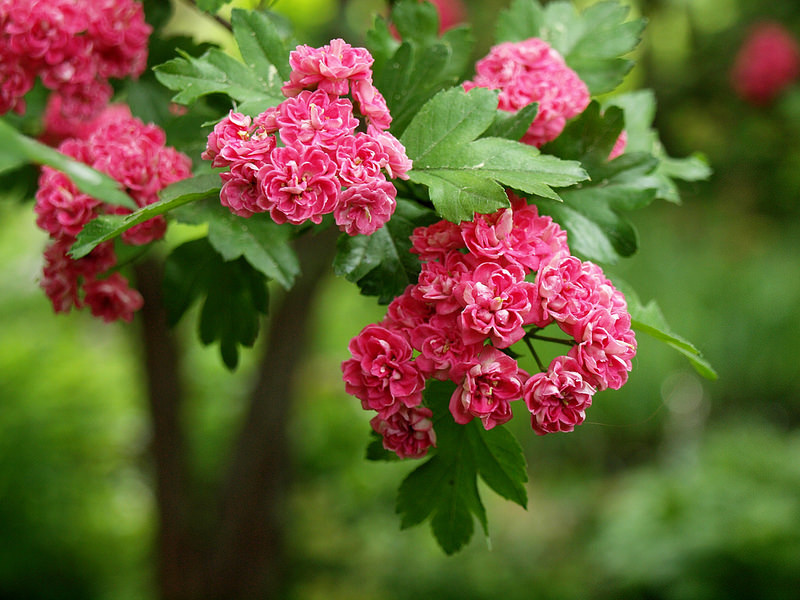
Hawthorn: the tree that bears the may blossom. Traditionally Beltane commenced when the hawthorn bloomed; it is the symbol of sexuality and fertility. May blossom would have been used to decorate the home at Beltane – but at no other time, as it was then considered unlucky….
Rowan: representing protection and healing. Branches would have been put over the doors of houses and barns to protect from faeries as they awoke from their winter sleep. People wore sprigs of rowan for personal protection….
Birch: seen as a feminine tree; it is among the first to have leaves in the spring. Traditionally it is used to make besom brushes (this is where we get the term ‘a new broom sweeps clean’). Eostre, the Celtic goddess of spring, is associated with birch – wreaths of it given by lovers as gifts to each other….the traditional wood for the maypole is birch….


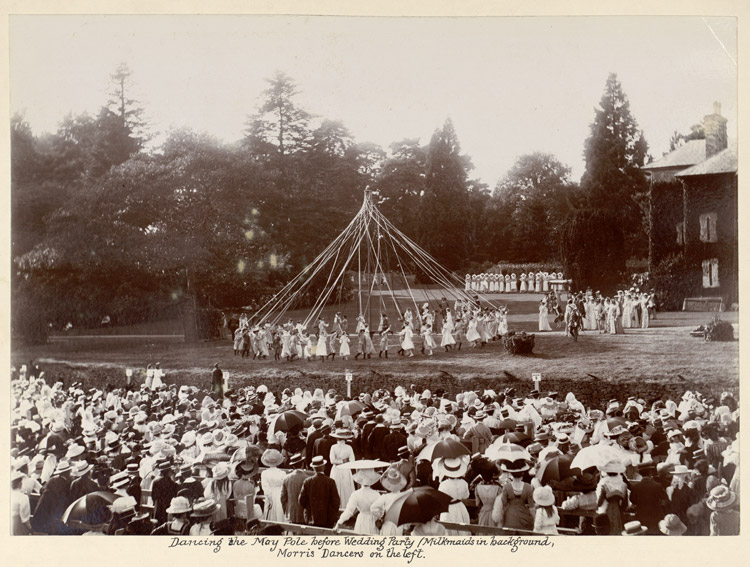
Very often the festivities around the maypole were led by Morris dancers. The Morris Dance is a form of English folk dance that has undergone some 500 years of evolution. Possibly the name comes from the French ‘morisque’ meaning a dance. It became ‘morisch’ in Flemish (who influenced many European customs). Eventually it became known as ‘moryssh’ in English and finally ‘morris’. The earliest record of Morris dancing in England is May 1448. In the beginning it was a dance performed just by one or two people and was popular in the Royal courts – the dancers would wear elaborate, fancy costumes….
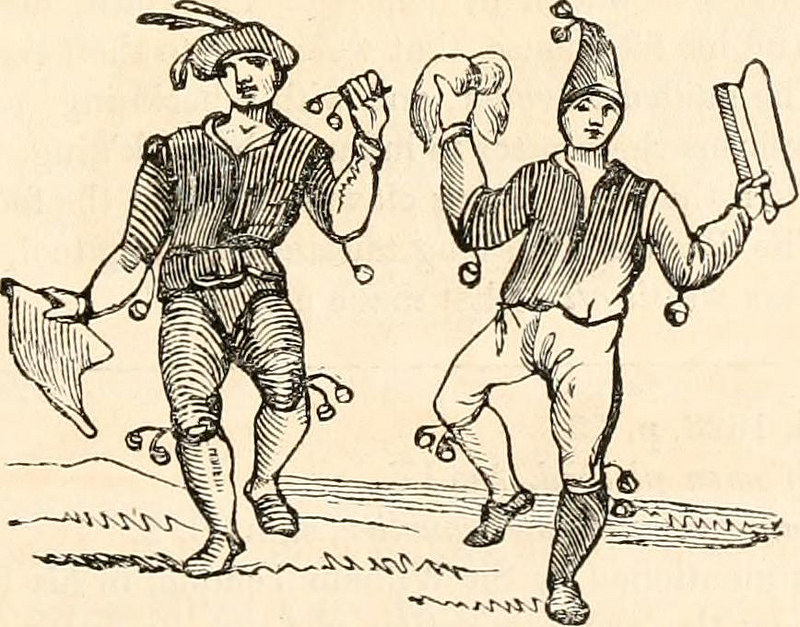
By the 16th Century Morris dancing had become part of many religious festivals. In Mediaeval and Renaissance England the Church brewed wassail and other ales, which were sold at occasions such as weddings, christenings and wakes and at Whitsun…. It was a method of fund-raising for the Church…. As time went on, Morris dancing became associated with other village celebrations such as fetes and May Day…. It was particularly popular in Tudor times….
Many May Day celebrations were banned by the Church in the 16th Century due to their Pagan origins; although some Roman Catholics continued to celebrate May 1st with the ‘May Crowning’ of the Blessed Virgin Mary. The ban incited riots; 14 men were hanged as a result and a further 400 were pardoned by King Henry VIII….

May Day, which has always been associated with fun, revelry and fertility, disappeared once again during the civil war, when Oliver Cromwell’s Puritans took control of much of the Country in 1645. Cromwell banned maypoles, describing them as ‘heathenish’….
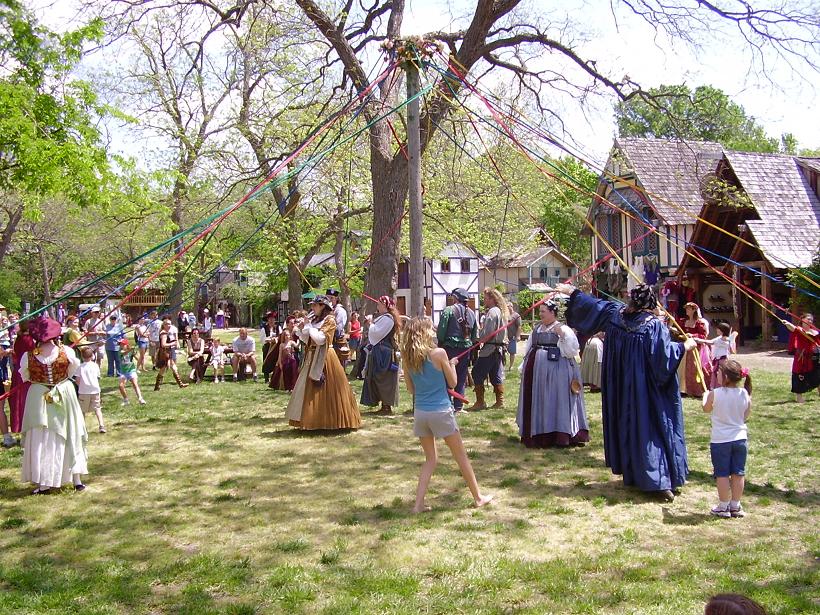
At the Battle of Worcester in 1651, Cromwell defeated King Charles II, who fled to Europe to spend the next nine years in exile. Cromwell ruled Britain like a Puritan dictator. After his death in 1658, the monarchy was restored and Charles was invited back. He was reinstated in 1660 – known as the ‘Merry Monarch’ he was determined to bring back the fun; to show a return of the good times he had a giant 40ft maypole erected in the Strand, London….
Morris dancing had also been actively discouraged under Cromwell’s Puritan rule but it too made a hearty return under Charles…. By the mid 1700s it had become practised by common folk. The fancy clothes disappeared, ordinary attire was worn, decorated with flowers and ribbons….
May Day celebrations went into decline during the Victorian era…. The Victorians disapproved of bawdy behaviour; the Green Man died out altogether. The traditional Lord and Lady of the May who had boisterously presided over festivities were replaced by the more demure May Queen…. Morris dancing was considered to be old-fashioned, as new forms of entertainment had come along – although some villages still kept it going….


The Labour Government introduced May Day as an official holiday in 1978; the first Monday in May is now a bank holiday….


Please…. If you have read this post through to the end then I assume you have found it of interest and I hope you’ve enjoyed it…. If you have found this via Facebook, a little ‘like’ for the Cottage Capers’ page would be very much appreciated – a like and a follow would be even better…. I’m not trying to sell you anything – I’m simply a blogger trying to establish myself…. Many thanX….
 Cottage Capers