On this day in history : 29th August 1842 – The signing of the Treaty of Nanking by Britain and China, ending the first of the Opium Wars…. It also sets the foundations for Britain’s leasing of Hong Kong….
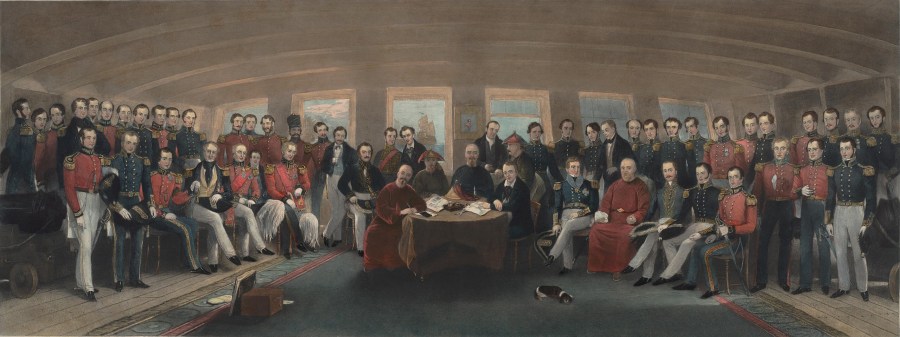
Signing of the Treaty of Nanking on board HMS Cornwallis – by Captain John Platt, Bengal Volunteers – Engraved by John Burnet – Public domain
The first Opium War lasted from 1839 to 1842; Britain invaded the Chinese mainland and occupied the island of Hong Kong in 1841 and then used it as a military base…. When Britain finally won the war Hong Kong was ceded to the British in the Treaty and so became part of the Empire….
British bombardment of Canton from the surrounding heights, May 1841 – Edward H. Cree – Public domain
A second Opium War resulted in Britain acquiring further territory – the southern part of the Kowloon Peninsula and Stonecutters Island…. In June 1898 a deal was struck between the Chinese and British agreeing that Britain would lease Hong Kong and the surrounding territories for 99 years….
It was during the 1970s that Britain and China began to consider Hong Kong’s future colonial status – and by the beginning of the 1980s negotiations to return it to China were underway…. After two years of tough bargaining a joint declaration was signed – agreeing that Britain would withdraw from Hong Kong on the 1st of July 1997….
City view of Kowloon, Hong Kong Island and the Hong Kong skyline – Ryan Cheng CC BY-SA 2.0
On this day in history : 28th August 1207 – Liverpool is granted a Royal Charter by King John – officially making it a Borough of England….
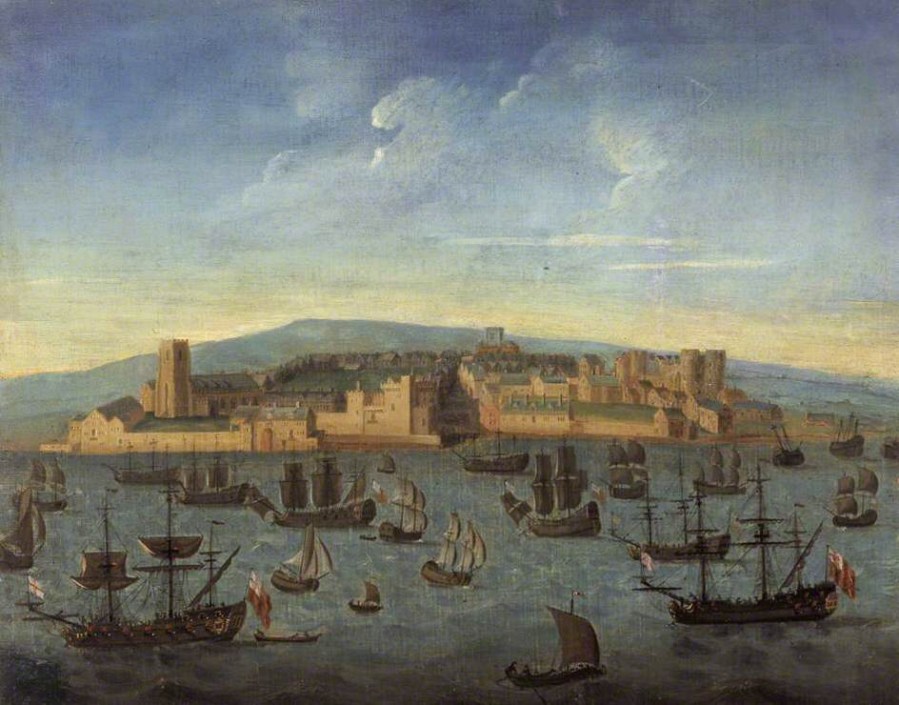
Liverpool in 1680 – the earliest known image of Liverpool – (c) Merseyside Maritime Museum; Supplied by The Public Catalogue Foundation – Public domain
Liuerpul (as it was known then – coming from the Old English ‘liver’, meaning thick or muddy and ‘pol’ for pool or creek) – literally meant a pool with muddy water…. Originally it started as a tiny fishing village on the banks of the Mersey – at the time of the Domesday Book in 1086 it was not even big enough to warrant a mention….
By the time the Royal Charter was issued the village had just seven streets formed in the shape of a letter ‘H’…. King John needed to establish a port in northwest England to defend English interests and trade in Ireland…. Liverpool quickly grew into a busy port, helped by a weekly market that attracted visitors from a far…. A small castle was even built to help defend it (later to be demolished in 1726)….
A further charter was granted to the townsfolk in 1229, giving the merchants of Liverpool permission to form a guild – enabling the town to become self-governing…. The first mayor was elected in 1351 and the Borough of Liverpool continued to flourish…. In 1715 Liverpool became home to the World’s first-ever wet dock….and was given city status in 1880….
On this day in history : 27th August 1979 – Lord Louis Mountbatten is killed when the IRA detonate a remote-controlled 50lb (23kg) bomb upon his boat….
Lord Mountbatten in 1976 – by Allan Warren CC BY-SA 3.0
Lord Mountbatten, a second cousin of Queen Elizabeth II and uncle of Prince Philip, had been enjoying a fishing trip with family members as part of a family holiday…. His boat, Shadow V, was sailing off the coast of County Sligo, Ireland when the bomb exploded….
Fisherman pulled 79-year-old Lord Mountbatten from the water – he was still alive but died before being brought ashore; both off his legs had been blown off….
Also onboard the boat were his eldest daughter, Patricia (Lady Brabourne), her husband John (Lord Brabourne) and their 14-year-old twins, Nicholas and Timothy…. Nicholas was killed, along with a 15-year-old crew member, Paul Maxwell…. Lord Brabourne’s 83-year-old mother, Doreen, died from her injuries the following day….
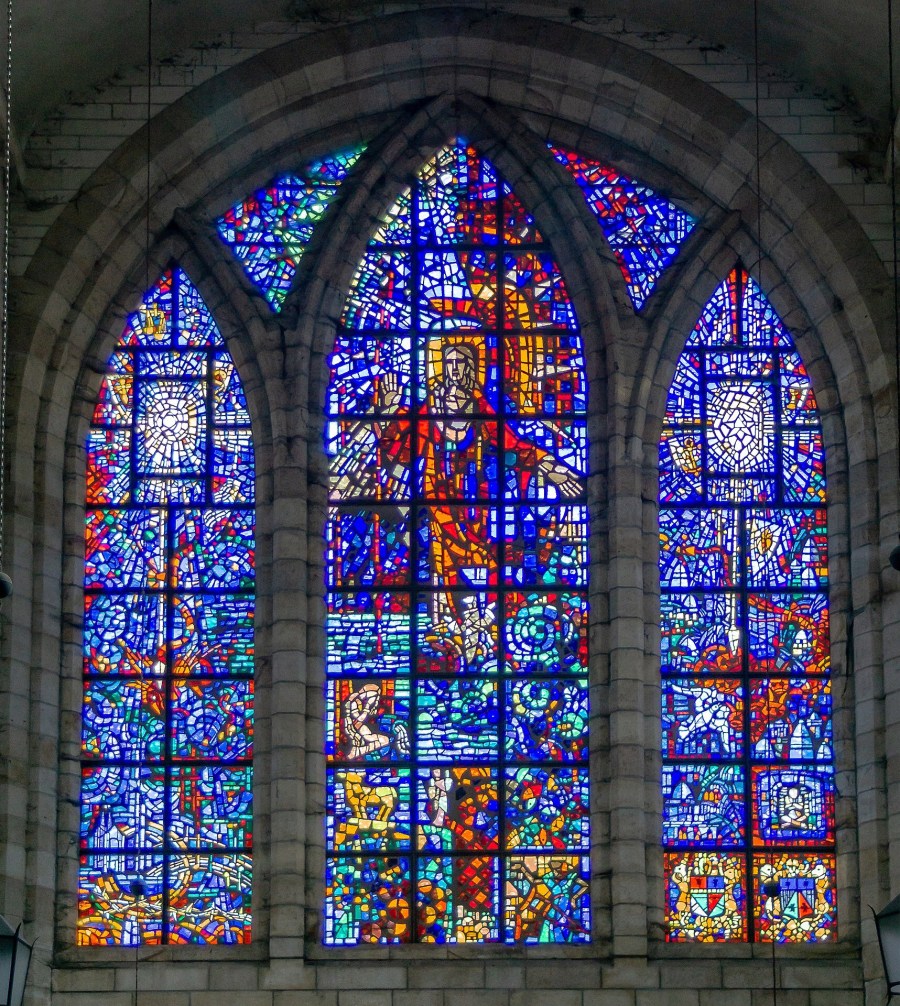
“Christ in Triumph over Darkness and Evil” by Gabriel Loire (1982) – at St. George’s Cathedral, Cape Town, South Africa – in memory of Lord Mountbatten – Rainer Halama CC BY 4.0
On this day in history : 26th August 1346 – King Edward III and his son, Edward the Black Prince, lead and win the Battle of Crécy – against Philip VI of France….
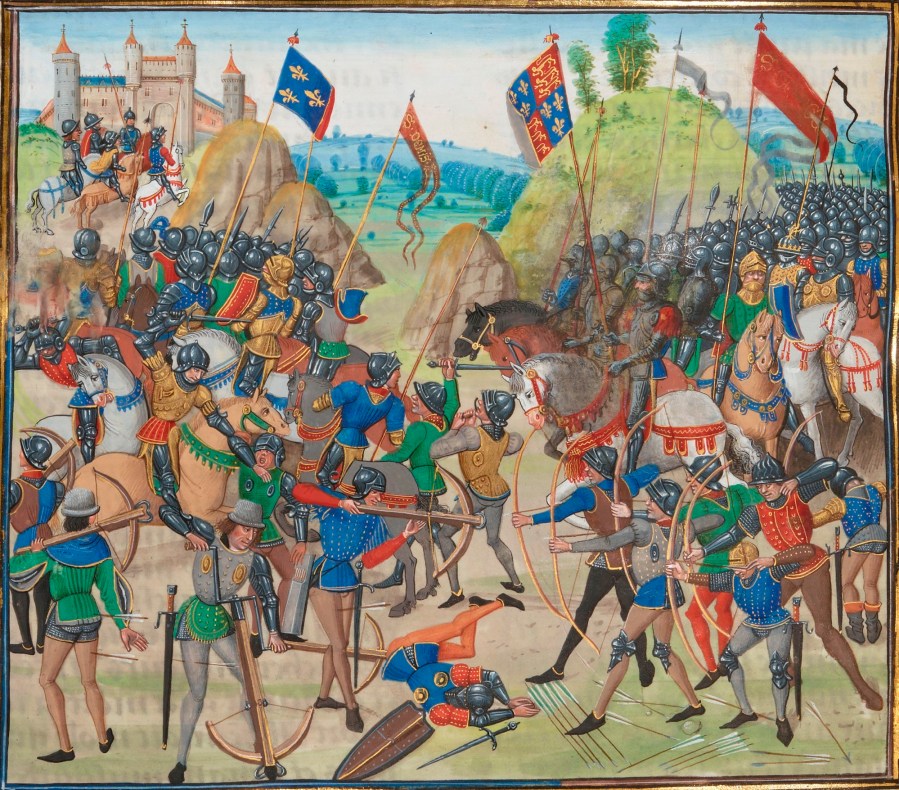
The Battle of Crecy, from a 15th Century illuminated manuscript of Jean Froissart’s Chronicles – Public domain
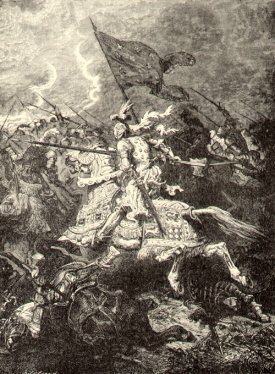
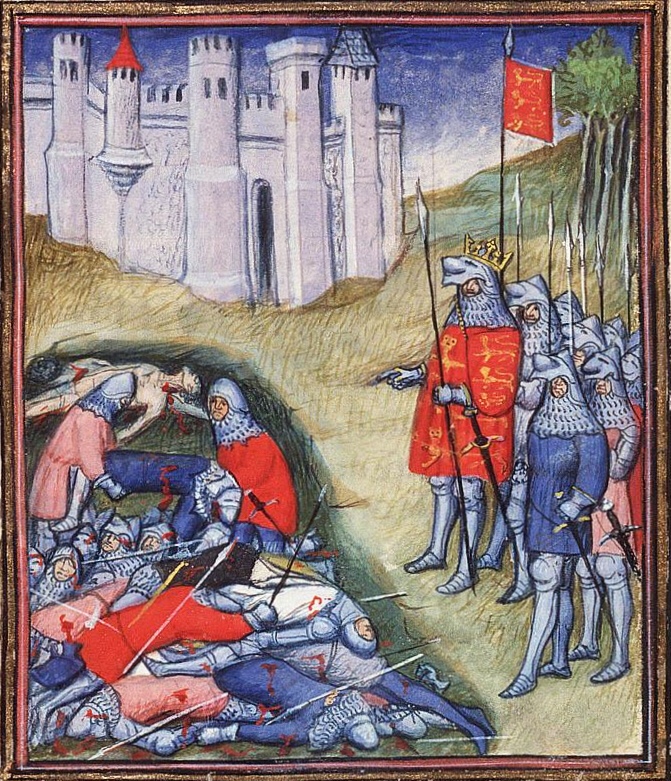
Crécy, which was then a village in northern France, was one of the most famous battles of the Hundred Years War…. King Edward’s army faced a much larger French force, who were renowned for their skills with the crossbow…. However, the crossbow was no match for the English longbow – and to add to French woes they had forgotten to bring their shields with them, leaving them extremely vulnerable! The crossbowmen retreated – but such was the fury of the French knights – seeing the retreat as cowardice – that they slaughtered their fleeing countrymen…. Only when the knights took up their own turn to attack did they realise the full might of the English longbow and they themselves were to face slaughter….
Battle of Crecy (19th Century engraving) – Public domain
The battle was described as ‘a political catastrophe for the French Crown’ and ‘a total victory for the English’…. There is a legend – and it can only be described as such, as having no proven truth – that King Edward’s men did not kill the French crossbowmen that they captured…. Instead they cut off the two fingers needed to fire their bows…. It is said this is where the ‘V sign’ insult originates from – it became the two-fingered salute to the French before battle commenced….a gesture that has been used by the British – and later the Commonwealth countries ever since….
Edward III counting the dead on the battlefield of Crecy – Virgil Master (illuminator) – Public domain
On this day in history : 25th August 1688 – The death of Welsh pirate and privateer Sir Henry Morgan – who raided Spanish settlements and shipping in the Caribbean….
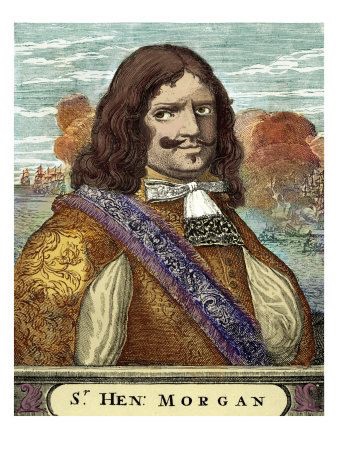
Sir Henry Morgan, from a 17th Century woodcut – Public domain
Morgan, his image known to us as the face used on the Captain Morgan brand of rum, was born in South Wales around 1635…. Little is known about his early life, or indeed how he came to travel to the West Indies…. One theory is that he was kidnapped and taken to Barbados where he was forced to work as a servant…. Another more plausible explanation is that he may have been part of the Caribbean expedition against the Spanish in 1654 ordered by Oliver Cromwell…. However, it is likely that in the early 1660s he became involved with a group of privateers attacking Spanish settlements in the Caribbean and Central America…. At the time privateering was a good opportunity for young men to make their fortunes….as privateers were permitted to keep some of their plunder for themselves – a kind of legalised piracy….
Morgan led successful attacks on many major settlements, including Puerto Principe and Port Bello – and made raids on Maracaibo and Gibraltar – and with his prize money was able to buy sugar plantations….
Attack on Puerto Principe – Public domain
In early 1666 he married his cousin, Mary Morgan – the daughter of his uncle, who was Jamaica’s Deputy Governor…. With these connections Morgan himself was later to become Lieutenant Governor of Jamaica….
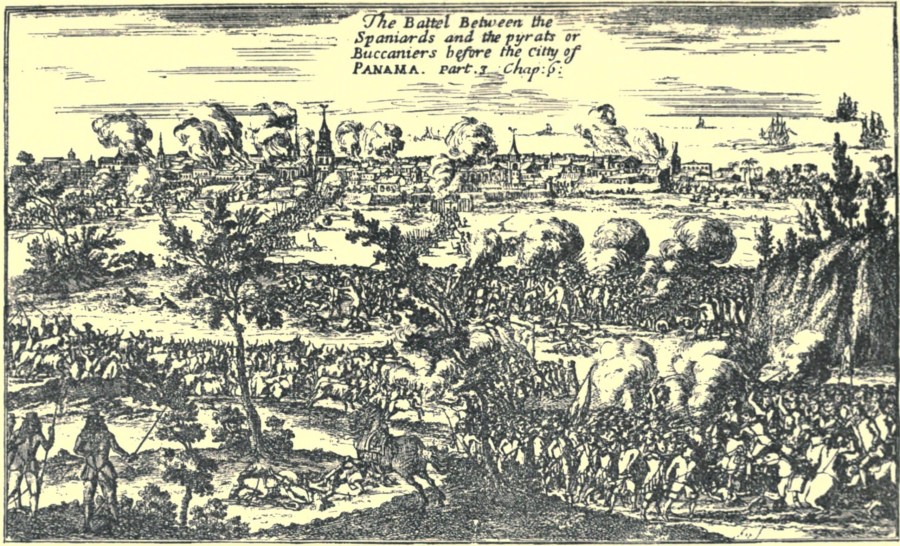
In 1671 Morgan led what was to become a disastrous attack on Panama City – the capital of Spanish America and thought of as one of the wealthiest cities in the world…. Despite his men being vastly outnumbered such was Morgan’s reputation that the Spaniards fled – but not before burning the city to the ground and taking all their riches with them…. Also, unbeknown to Morgan, a treaty had been signed between England and Spain – to add to the debacle Morgan had actually attacked during peace time….
Morgan attacking Panama – Public domain
Morgan was arrested and taken before the Governor of Jamaica – from there he was transported to London, where he was held on a charge of piracy…. However, it was not long before England was at war again, this time with the Dutch – putting England’s sugar trade at risk…. King Charles II enlisted Morgan’s help – he knighted him and sent him back to Jamaica….
Morgan ended his days in the West Indies – drinking rum, involving himself in politics and running his plantations….by the time of his death he owned 109 slaves…. The cause of his death is unknown – my bet would be it had something to do with all that rum….
Captain Morgan Black Label from the 1970s – A product of Jamaica, Guyana and Barbados produced by the Seagram Company – Image credit : Rssutor CC BY-SA 4.0







 Cottage Capers