On this day in history….28th December 1879

On this day in history : 28th December 1879 – The central section of the Tay Rail Bridge, Dundee, Scotland, collapses in a violent storm, as a train is passing over it…. All onboard are killed….

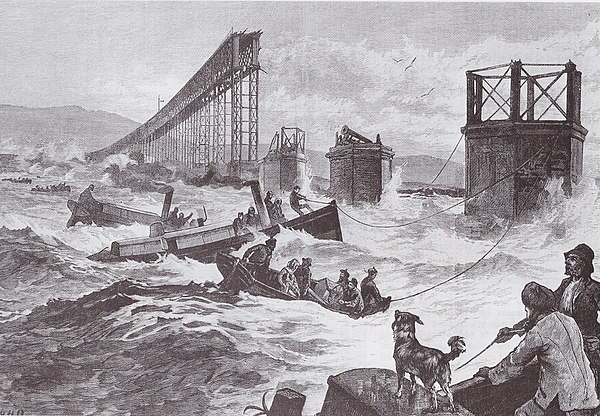
Illustration of the Tay Bridge disaster – unknown artist – Public domain

It was a Sunday evening at around 7.15pm and a storm estimated at 10 or 11 on the Beaufort Scale was raging…. Trains crossing the Tay Bridge, across the Firth of Tay, were restricted to one at a time…. It was the turn of the train from Burntisland in Fife – a train that consisted of one locomotive, its tender, five carriages and a luggage van…. Onboard were around 75 people….

The gale was blowing down the Tay Estuary at right angles to the bridge – suddenly without warning the central navigation spans, which the train was travelling over at the time, collapsed into the Firth below – taking the train with them…. All onboard were lost….

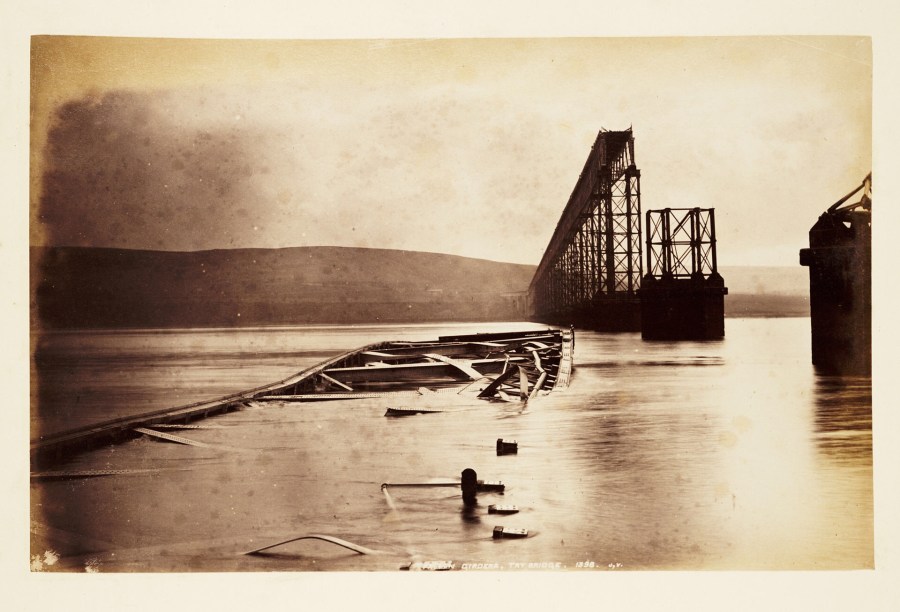
Fallen girders – Image : National Library of Scotland – Public domain

The disaster was to shock Victorian engineers – and it is still today regarded as one of the worst structural engineering failures….

The original Tay Bridge had been designed by Thomas Bouch; he was a well-respected engineer, having much experience…. As well as the design he was also responsible for the construction and maintenance of the bridge…. Having opened in February 1878 it had only been operational for 19 months – its design had won Bouch a knighthood…. So, what went wrong?

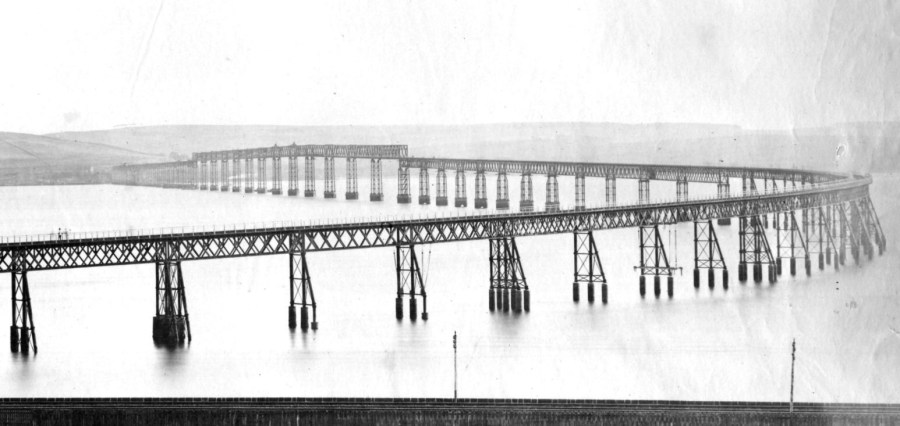
The bridge, at nearly two miles long, consisted of 85 spans – making it the longest bridge in the world at the time…. 72 of the spans were supported on spanning girders below the track – whereas the remaining 13 spans, forming the centre section, were above the track and consisted of bridge girders above the pier tops forming a through tunnel…. This gave an 88ft clearance above the water surface, enabling ships to pass beneath…. It was these high girders that fell….

Original Tay Bridge looking from the north – Unknown author – Public domain

At the following inquiry it was concluded : “The fall of the bridge was occasioned by the insufficiency of the cross bracing and its fastenings to sustain the force of the gale”…. The report went on to say if the wind bracing had been properly constructed and maintained the bridge could have withstood the storm…. All of the blame was placed on Bouch….

Fallen girders with remains of a wooden carriage – Image : National Library of Scotland – Public domain
The locomotive – which was recovered and returned to service – Image : Dundee Central Library – Public domain

Bouch died less than a year after the disaster, his reputation in tatters…. A second Tay Bridge opened on the 20th of June 1887 – this time a straight forward pier and lattice girder construction….

The current Tay Bridge – Image credit : Ross2085 via Flickr CC BY 2.0

On this day in history….26th December 1900

On this day in history : 26th December 1900 – The discovery is made that the keepers of the Flannan Isles Lighthouse have disappeared without a trace…. The mystery still remains unsolved today….

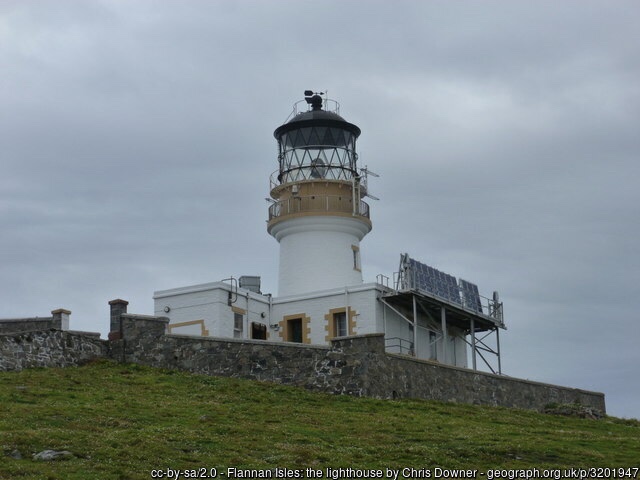
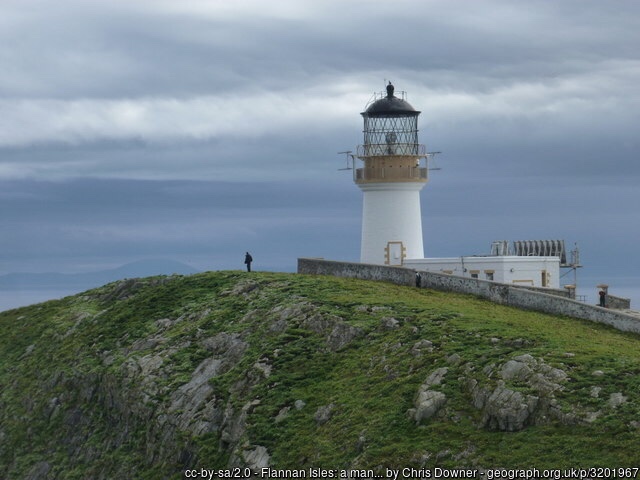
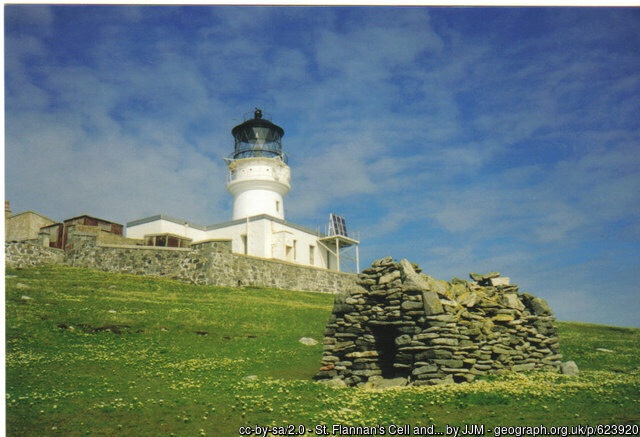
The lighthouse is to be found on Ellean Mor, one of the uninhabited Flannan Islands of the Outer Hebrides off the west coast of Scotland…. The islands were named for St. Flannan, a 6th century Irish Bishop who later became a saint…. Apart from the lighthouse, which is still in use today, the only other building to be found on the islands is a ruined chapel….

St. Flannan’s Chapel

On the 15th of December 1900 it had been noticed that there was no light shining from the lighthouse…. At the time it was manned by three keepers, James Ducat, Thomas Marshall and William MacArthur…. All were experienced, seasoned seafarers….

A ship, captained by James Harvey, was despatched to carry replacement keeper Joseph Moore to investigate what was going on…. When they arrived at the landing platform they were surprised to see nobody was there to greet them, as approaching visitors were always spotted well in advance…. The crew sounded the ship’s horn and sent up a flare to attract attention – but still nobody appeared…. There was no sign of life anywhere, not even the flag was flying from the flagpole….

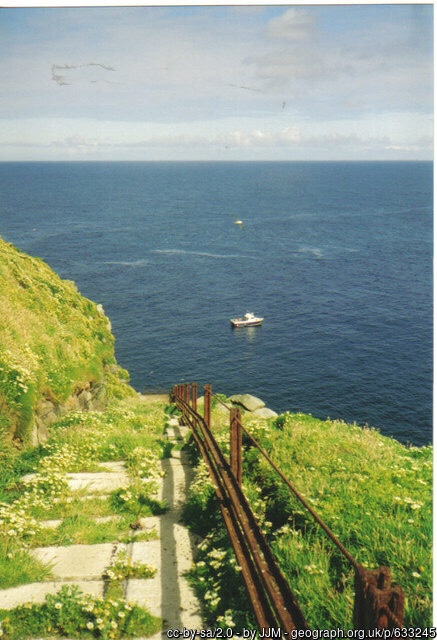
Landing stage and pathway

Moore rowed ashore with a great sense of unease…. He could not help but notice the disarray at the landing area; a crate that housed ropes and equipment had been severely damaged…. He climbed the steep steps to the lighthouse – and found the door unlocked…. Just inside, where three sets of oilskins should have been hanging, he found just one set…. He ventured into the kitchen and discovered a chaotic scene…. A chair had been overturned and there were the remains of a meal which had obviously been abandoned half way through…. The kitchen clock had stopped…. Moore searched the rest of the lighthouse, the beds were unmade and the place was deserted….

Steps to the landing

He returned to the ship and a search of the island was organised – but there was nothing to be found…. A telegram was sent to the Northern Lighthouse Board : “A dreadful accident has happened at Flannans. The three keepers, Ducat, Marshall and the occasional have disappeared from the island. On our arrival there this afternoon no sign of life was to be seen on the island”…. The message went on to say the accident must have happened about a week before and that the poor fellows must have been blown over a cliff or drowned trying to secure a crate of similar…. Whatever had happened it was assumed they had been claimed by the sea….

View over the islands

On the 29th on December the Board’s Superintendent, Robert Muirhead, arrived to investigate…. He knew the three missing keepers personally, as he had recruited them…. He initially found nothing else that Moore had not already discovered – but then he turned his attention to the lighthouse logbook and found some surprising entries…. One for the 12th of December read: “Severe winds the likes of which I have never seen before in twenty years” – this in itself was odd as there had been no reported storms in the area before the 17th…. The log went on to say that James Ducat had been very quiet and that William MacArthur had been crying…. Again this did not add up – the men were all tough, in fact MacArthur had a reputation for brawling…. All three were used to life in a lighthouse – and this particular one was brand new and the safest of the safe – so it was unlikely that any of them would have cracked…. The last entry on the 15th of December read : “Storm ended, sea calm, God is over all”…. It had also been noted in the log that the men had been praying….

There were many unanswered questions – not least why the men had broken one of the strictest rules of their employment…. On no occasion whatsoever were they to leave the lighthouse unmanned – one of them had to be inside at all times…. Yet, for whatever reason, all three of them had left it….

There was much speculation as to what had happened…. Had they gone mad? Had one of them murdered the other two? Was it a sea monster that had taken them – or were they abducted by aliens? Was it the supernatural? Had they absconded to a better life? We shall never know…. The most plausible explanation is perhaps that two of them went to secure the storage crate on the landing platform – seeing his mates in trouble the third went to try and help them, only for all three to be swept away by a freak wave…. No bodies were ever found….

Over the following years future lighthouse keepers at Flannan reported strange goings on…. They told of voices crying out the names of Thomas Marshall, James Ducat and Donald MacArthur…. Considering the experience of these three lighthouse keepers – and the apparent calmness of the sea before their disappearance – maybe it is only these ghosts who will ever know what really happened….

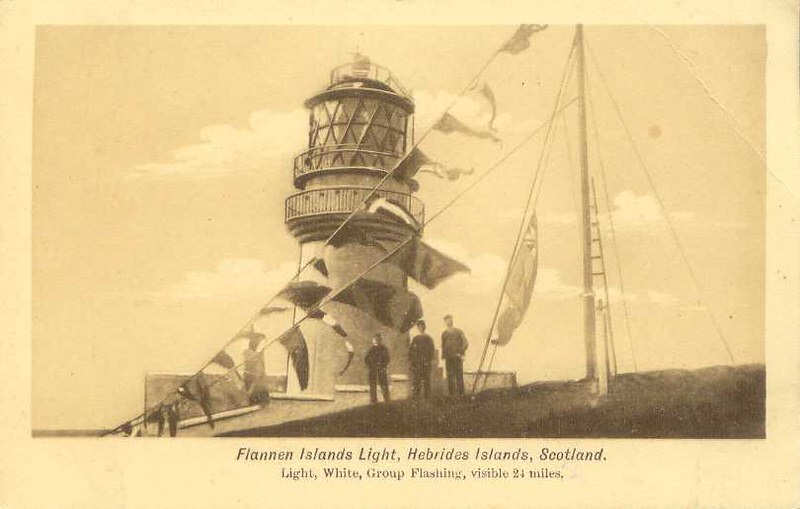
Flannan Isles Lighthouse, 1912 postcard – Image credit : CartoonPeril2011 via Flickr

On this day in history….14th October 1881

On this day in history : 14th October 1881 – Scotland’s worst ever fishing disaster occurs when a Berwickshire fishing fleet gets caught in a violent storm – 189 fishermen lose their lives….

Granite memorial in Eyemouth; depicts a broken sailing mast – Image credit : Walter Baxter CC BY-SA 2.0

Locals still know the day, when some 29 boats were swallowed by the sea off the south coast of Scotland in hurricane force conditions, as Black Friday…. Most of the fleet was from Eyemouth; 129 men from the town drowned, around 10% of the male population…. A further 24 from Burnmouth died, 15 from Newhaven-by-Edinburgh, 11 from Cove, 7 from Fisherrow, Musselburgh and 3 from Coldingham….

Bronze memorial at St. Abbs, figures of women and children looking out to sea – Image credit : Karen Bryan CC BY-SA 2.0

Fishing, being such a vital part of the economy, meant the fishermen had ignored the weather forecast that day…. Times were hard and not being able to afford losing a day’s income meant the fleet had set out as usual…. By lunchtime their worst fears were being realised – they were caught in the most violent of storms…. Those boats that could headed back to harbour but some were already beginning to sink, many more capsized and others were smashed against rocks…. The only glimmer of brightness out of this dark time being when fishing boat Ariel Gazell limped back into harbour at Eyemouth two days after the storm….

Eyemouth Harbour – Image credit : Peter Nisbet at English Wikipedia – Public domain

A massive relief fund was launched to help the families of the lost fishermen and the community – more than £5m in today’s equivalent was raised….

A commemorative tapestry of the tragic event can be seen in Eyemouth Museum….

On this day in history….23rd August 1305

On this day in history : 23rd August 1305 – Sir William Wallace, Scottish patriot, is hanged, drawn, beheaded and quartered in London….

Statue of William Wallace, Aberdeen

After the English had been defeated at the Battle of Stirling Bridge in 1297 Wallace was appointed Guardian of Scotland and remained so until his defeat in the Battle of Falkirk in July 1298….

In 1305 he was captured and handed over to King Edward I and brought to trial on the charge of treason – to which he responded “I could not be a traitor to Edward, for I was never his subject”….

Wallace’s trial in Westminster Hall – by Daniel Maclise – Public domain

Following the trial Wallace was taken to the Tower of London…. Here he was stripped naked and then dragged through the streets of the city behind a horse….to the Elms at Smithfield…. He was hanged, drawn and quartered…. He was also emasculated and eviscerated – his private parts and bowels burned before him…. Wallace was then beheaded and his body cut into four parts…. His head, dipped in tar to preserve it, was displayed on a pike on top of London Bridge…. His limbs were sent to Perth, Stirling, Newcastle and Berwick to be displayed separately….

On this day in history….3rd September 1954

On this day in history : 3rd September 1954 – The National Trust buys Fair Isle, the remote island situated between Shetland and Orkney, in a bid to help secure its future….img_3803

Fair Isle, which is just 3 miles long and 1.5 miles wide, is probably the most remote inhabited island of the British Isles…. and is located 24 miles from the Shetland mainland…. The population of around 60 mostly live on the south end of the island; there is a shop, a community hall, a fire station and a primary school – which typically has between 5 and 10 pupils at any one time…. Older children generally tend to receive their secondary education off the island….


Fair Isle is not connected to the National Grid – but has its own Fair Isle Electricity Company…. From the 1980s this consisted of two diesel generators and two wind turbines…. Since 2018 24-hour electricity has been supplied by three wind turbines, solar panels and batteries….

img_3804

The main occupations of the islanders include fishing and crofting – and of course the island is famous for its Fair Isle knitwear….which was made popular in the 1920s by the Prince of Wales, who frequently wore a Fair Isle jumper whilst playing golf….img_3805

Ownership of the island had changed hands many times over the centuries; in 1900 it had a population of around 400 – but this number was to dramatically dwindle…. From 1948 Fair Isle belonged to George Waterson, an ornithologist from Edinburgh – and it is he who set up a bird observatory, which became recognised worldwide…. Fair Isle is home to many rare species of birds…. Using a grant of £5,000 from the Dulverton Trust the National Trust bought the island with plans to continue research into migratory bird life…. At the time of the National Trust taking on ownership the population of Fair Isle had fallen to an all-time low, with just 45 inhabitants…. In 1956 a conference organised by the National Trust was held on the island to discuss ways of saving its economy…. Nowadays tourism plays a major part….img_3802

In 2010 a new observatory was built at a cost of £4m, consisting of a two-storey wooden lodge, capable of accommodating 30 guests…. It even boasted a small bar for the evenings – no doubt proving popular as there is no public house on the island…. Tragically this new observatory was destroyed by fire on the 10th of March 2019…. But the people of Fair Isle are resilient – plans are already well underway and all efforts are being made to reopen in 2021….img_3806