On this day in history….19th July 1941

On this day in history : 19th July 1941 – Winston Churchill adopts the ‘V for Victory’ hand sign – after referring to the Victory campaign, which had spread through Europe, with approval in a speech….

img_3585
Winston Churchill, British Prime Minister, giving a V sign in 1943 – British Government, public domain

On January the 14th 1941 Victor de Lavelaye, former Belgian Minister of Justice and director of the Belgian French-language broadcasts on the BBC (1940-44) suggested that Belgians adopt a ‘V’ for ‘Victoire’ – in an attempt to raise morale during World War 2…. In a BBC broadcast de Lavelaye claimed “the occupier, by seeing this sign, always the same, infinitely repeated, would understand that he is surrounded, encircled by an immense crowd of citizens eagerly waiting his first moment of weakness, watching for his first failure”…. Within weeks chalked ‘V’ signs were appearing on walls across Northern France, Belgium and the Netherlands….

The BBC started a ‘V for Victory’ campaign….with assistant news editor Douglas Ritchie taking on the persona of ‘Colonel Britton’…. Ritchie suggested the BBC should use an audio ‘V’ – using the dot-dot-dot-dash Morse Code for the letter ‘V’…. Beethoven’s Fifth Symphony has the same rhythm – so this was used by the BBC as a call-sign for its foreign language broadcasts to occupied Europe for the rest of the War….

img_3587
American V for Victory campaign – showing the dot-dot-dot-dash of Morse Code – public domain

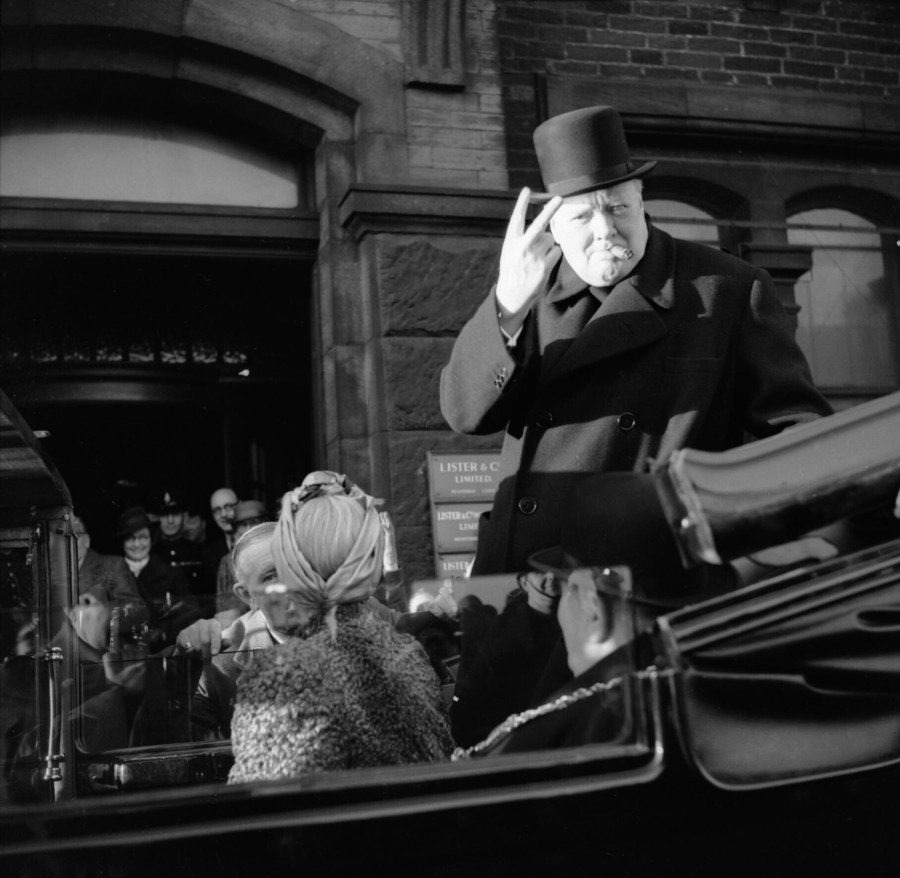
Churchill – and other allied leaders too – adopted the ‘V’ sign hand signal…. Sometimes Churchill gestured with a cigar between his fingers…. In the beginning he used the sign with his palm facing towards him – and his Aides had to explain to him what this version meant! So, later he used it with his palm facing out…. However, one can’t help thinking that perhaps it was his misuse that made it so popular….
img_3586
Churchill, initially unaware of the meaning of this particular gesture! – War Office official photographer, Horton (Capt.) – Public domain

On this day in history….15th November 1899

On this day in history : 15th November 1899 – Winston Churchill, whilst working as a war reporter for the Morning Post, is captured in South Africa by the Boers…. He escapes a few weeks later….

Churchill in the dress uniform of the 4th Queen’s Own Hussars at Aldershot, 1895 – Public domain

25-year-old Churchill had arrived in Cape Town on the 30th of October 1899…. A couple of weeks later the armoured train he was travelling on, accompanying a scouting expedition into Boer-occupied territory, was ambushed and partially derailed….

Churchill was captured – (it is rumoured by Boer Louis Botha – later to become Prime Minister of South Africa) – and although a civilian he was sent to a prisoner of war camp for British officers, in a converted school in Pretoria…. Churchill was considered a good catch and a significant bargaining tool for the Boers….

Four weeks later, on the 12th of December 1899, Churchill made his dramatic escape by managing to climb over a wall…. He had with him £75 and some chocolate…. He managed to get onboard a coal train and by hiding among the coal sacks got out of the area…. However, once he left the train he found himself walking for miles and miles without a clue of where he was heading…. Eventually hunger and thirst got the better of him and he banged on the door of a house he was passing to ask for food…. As luck would have it he chose the home of one of the only Englishmen in the neighbourhood, John Howard, the manager of a local colliery…. Howard agreed to help Churchill and hid him in the mine and then with the aid of another Englishman, Mr. Dewsnap, Churchill was smuggled on to a wool train….

The train took him to Portuguese occupied East Africa – from here he made his way back to Durban…. By now there was a £25 reward on his head – ‘dead or alive’….

Churchill returned to the battle front and took part in the Battle of Spion Kop and the relief of Ladysmith…. Towards the end of the war he and his cousin, the Duke of Marlborough, returned to Pretoria to demand the surrender of the guards at the prisoner of war camp where he had been held….and the release of the British officers being held there….

Churchill in 1900 – Public domain