The Captivating Spell of Witch Hazel….

January and February can be dreary months, no place more so than in the garden; whilst a few bulbs are beginning to make their presence known, it takes a brave flower to face the cruel, harsh elements of Winter…. A few do rise to the challenge though – winter pansies and jasmin, hellibores and of course, witch hazel….


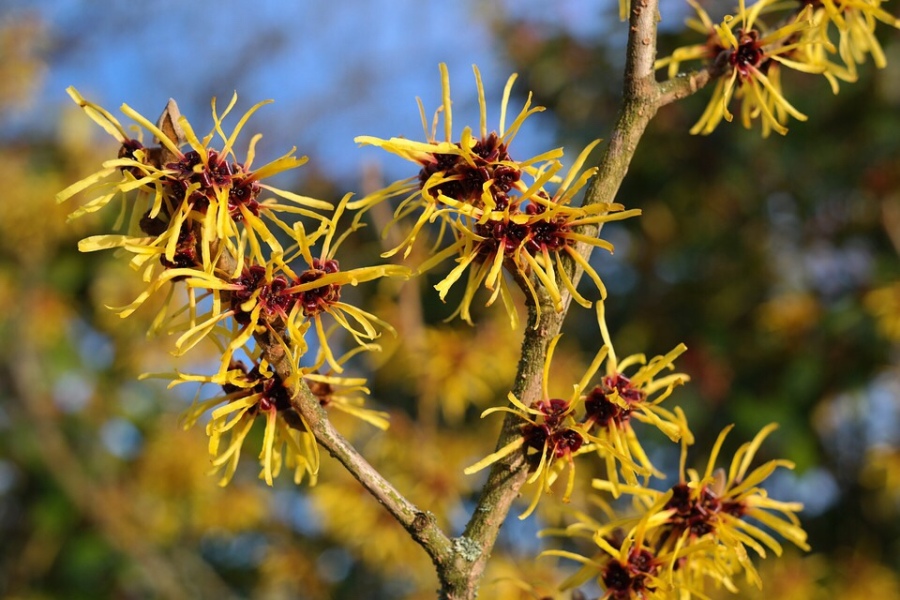
The one we have here in this garden, Hamamelis mollis (Chinese witch hazel) has done itself proud this year…. Planted soon after we moved in, some thirteen or fourteen years ago, it has taken its time to establish and get its roots down; this is the first year it has really flowered well….

img_3290
Hamamelis mollis

‘Hamamelis’ literally means ‘together with fruit’ – flowers, fruit and next year’s leaf buds can all appear together on the plant…. It is a shrub with several tricks up its sleeve; its early flowers, the foliage that turns to pleasing Autumn colour before the leaves fall….and then it has its party-piece…. The Hamamelis produces a seed pod in the form of a two-part capsule that contains just one black, glossy seed – the pod explodes open and can catapult the seed up to 30ft away….


Witch hazel is a genus of flowering plants in the Hamamelidaceae family; there are four species native to North America, one in Japan and another in China….

The first to be called witch hazel – because of its resemblance to the European hazelnut tree – is the Native American species H.virginiana. It was discovered in 1687 and first grown in England by Henry Compton, the Bishop of London….
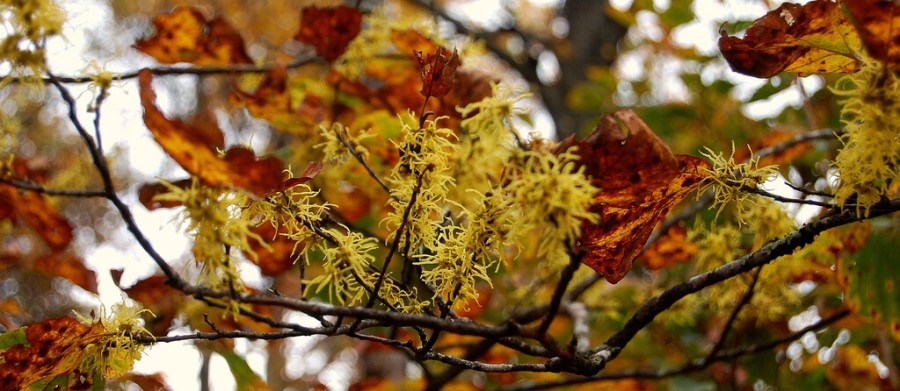
img_0198
Witch Hazel along the Appalachian Trail – UGArdener via Foter.com / CC BY-NC Original image URL: https://www.flickr.com/photos/ugardener/5160810695/

The Japanese variety (H.japonica), which is similar to H.virginiana but with bigger flowers, was first introduced to Europe in 1863. In Japan the witch hazel is known as ‘mansaku’ – translating as ‘rich crop’. Folklore says when the flowers appear in great numbers a good crop is predicted for the coming harvest….

img_0199
Hamamelis japonica – ashitaka-f studio k2 via Foter.com / CC BY-NC-SA Original image URL: https://www.flickr.com/photos/iwahige/12010335123/

The Chinese (H.mollis) was first marketed in the West by the Arnold Arboretum, Massachusetts, in 1914. Although similar to H.viginiana it has a much stronger scent and is sometimes considered to be the most attractive of the witch hazels, as its flowers have a less twisted appearance. Native to central and Eastern China, it matures into a large shrub or even small tree, but potentially reaches only up to 10ft in height in our gardens….

img_0202
20120223_UBCBG_HamamelisMollis_Cutler_DSCO6514 via Foter.com / CC BY Original image URL: https://www.flickr.com/photos/wlcutler/6778791480/

The Latin ‘mollis’ means ‘soft’ and refers to the leaves which turn a buttery yellow in the Autumn. The yellow flowers are usually tinged red at the base, with 4 long petals, 4 short stamens and grow in clusters. Flowering from mid to late Winter through to early Spring, it is an ideal plant to cut a few stems from to bring indoors, so that its lovely citrusy fragrance can be enjoyed….
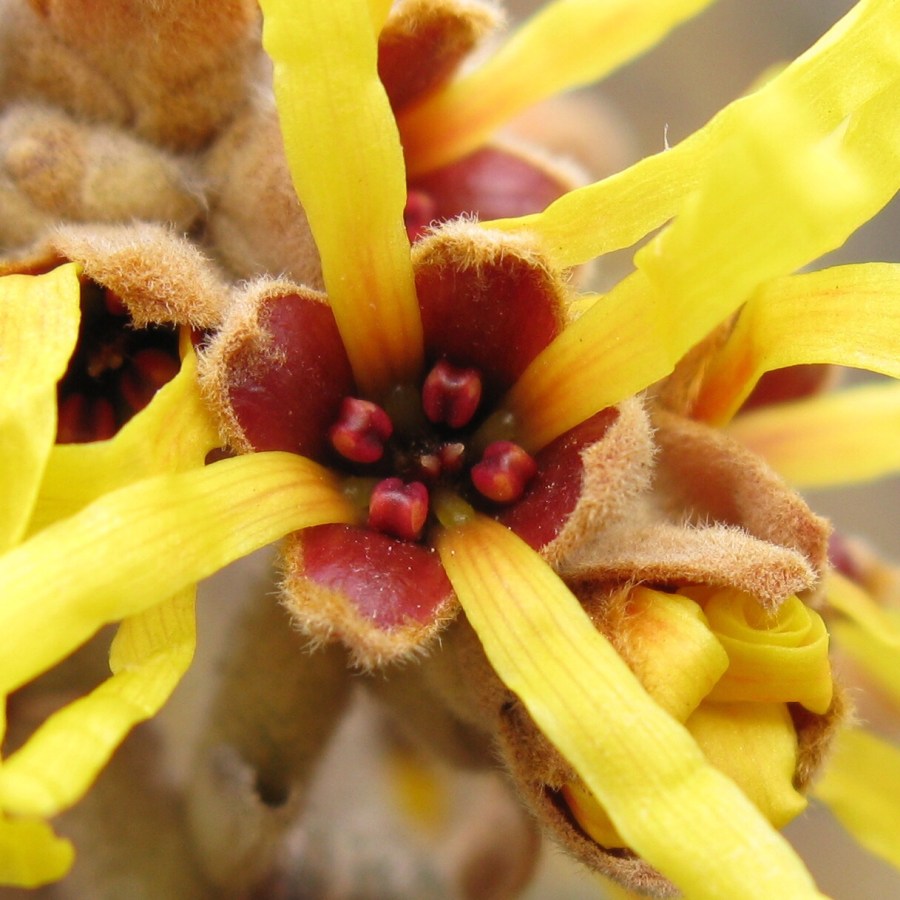
img_0201
Hamamelis mollis ‘Princeton Gold’ – Tie Guy II via Foter.com / CC BY-NC-SA Original image URL: https://www.flickr.com/photos/versicolor/3278823053/

Since the 1930s hybrids have been produced from the two Asian species, forming the Hamamelis Xintermedia hybrids: the first named ‘Arnold Promise’ arriving in 1963 has fragrant, yellow flowers. In 1969 ‘Diane’ was brought to us, with its lightly scented red flowers and long flowering season. Since the mid 80s a whole host of new varieties have been introduced to the market….

img_0203
Hamamelis ‘Diane’ – LEMills via Foter.com / CC BY=NC-SA Original image URL: https://www.flickr.com/photos/8366835@N05/2338781939/

Witch hazel is a fabulous feature plant; the darker varieties produce spectacular Autumn colour, changing from green to yellow, to orange and finally to dark red…. It is perfect for the British climate, as the winter chill is needed for full flowering potential to be achieved; it is incredibly frost tolerant and is disease resistant…. Witch hazel is easy to grow but prefers non-chalky soil and is extremely low maintenance….with no need for pruning – just remove any dead wood….

Of course, witch hazel’s talents don’t stop there…. The bark, twigs and leaves contain tannins and polyphenols which can be extracted and added to water (sometimes with alcohol) to produce distilled witch hazel…. Thomas Newton Dickinson, a Baptist minister, was the first to distill witch hazel commercially. He built a distillery in 1866, after learning of its medicinal properties from Native American Indian tribes. He used 86% double distilled witch hazel with 14% alcohol – the brand is still available today….and little has changed to its formula….

Witch hazel is a natural astringent – removing excess oil from the skin and shrinking the pores. It helps prevent spots, blackheads and blemishes and is one of the best treatments for acne…. It is often added as an ingredient to beauty and health products….

img_0205
Humphreys’ Witch Hazel Oil (front) – Boston Public Library via Foter.com / CC BY Original image URL: https://www.flickr.com/photos/boston_public_library/855829956/

It is useful to help fight signs of aging and can reduce puffiness and brighten the eye area – (just take care not to get in the eye itself, as it will sting)…. It is also known to help fade bruises and speed up the healing process….

Applied to minor cuts and scrapes witch hazel will stem. Bleeding and is a good choice for the cleansing of wounds – (especially the shop bought variety as it usually contains isopropyl alcohol)…. Used after shaving it will stop any nicks from bleeding and will help prevent razor burn….(good to use after a wax treatment too, ladies)….


It will also relieve the itching caused by insect bites and stings – sooth a baby’s nappy rash and will cool down sun burn…. It is thought to help eczema….

A few drops inserted into the ear canal will help break down troublesome ear wax…. It can help varicose veins, by temporarily reducing the swelling and so relieving pain…. It is a common ingredient used in haemorrhoid treatments….

To sooth a sore throat, gargle with natural (no alcohol) witch hazel; it can ease the symptoms of tonsillitis, laryngitis and sinusitis….

Pure witch hazel will also help reduce the swelling and discomfort associated with gum disease and can relieve the pain of a troublesome wisdom tooth…. Mix together a teaspoonful of pure witch hazel with a drop of clove oil and myrrh oil to rub on the gums of a teething baby….
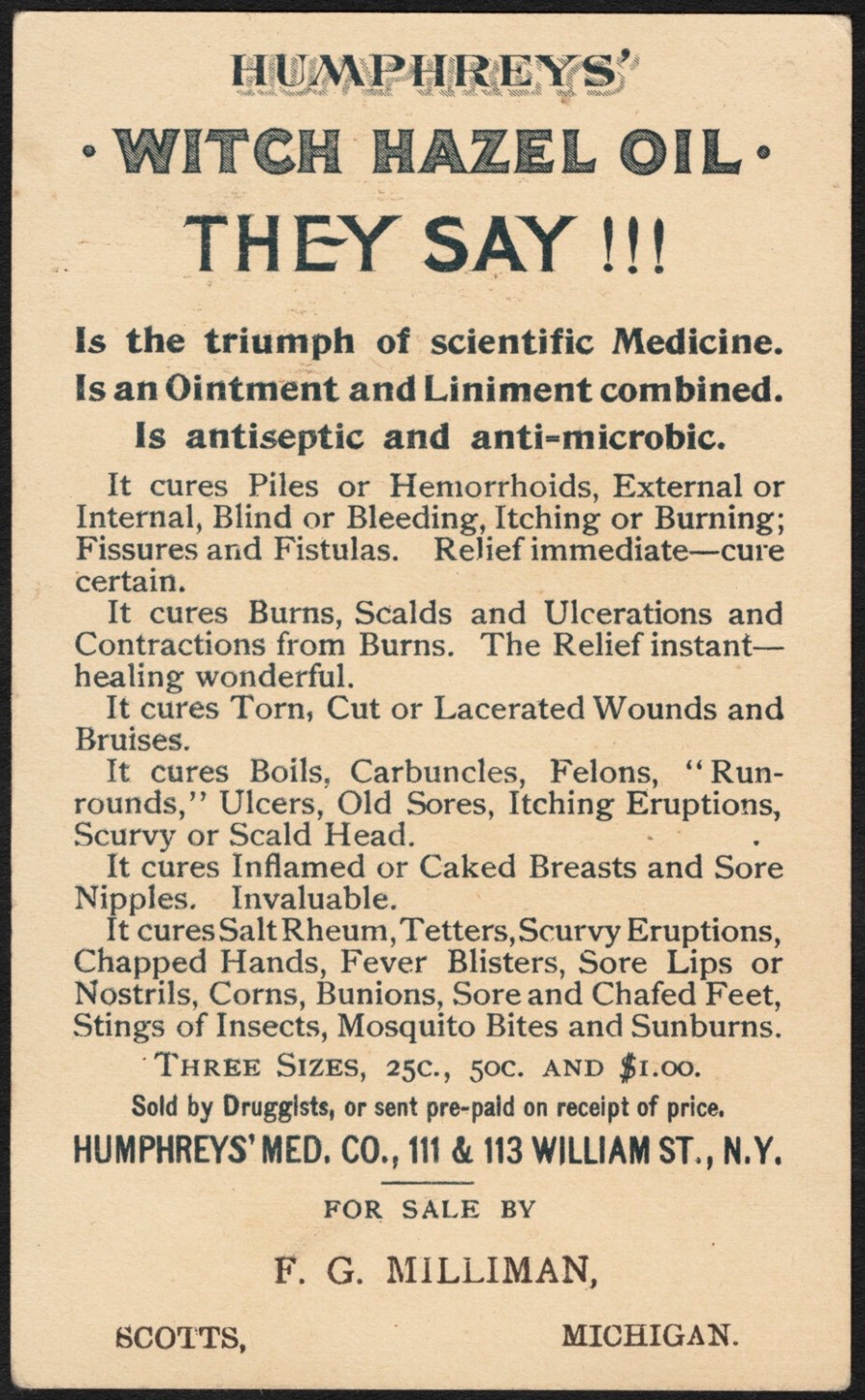
img_0207
Humphreys’ Witch Hazel Oil – an ointment for the people (back) – Boston Public Library via Foter.com / CC BY Original image URL: https://www.flickr.com/photos/boston_public_library/8557191659/

As you can see witch hazel really is one of Mother Nature’s most precious natural remedies; can you really afford not to have a bottle to hand in your bathroom cabinet…?

There seems to be no end to the wonders of witch hazel…. If you missed the last blog post but would like to read more about this very special and versatile plant How divine….


How divine….

I have always assumed that Witch Hazel (Hamamelis) earned its name because of its remarkable healing properties and its use by the wise-women of the Middle Ages – it appears I couldn’t have been more wrong….


Four native species of Witch Hazel are to be found in North America: Hamamelis mexicana, H. virginiana, H. vernalis and H. ovalis; another is to be found in China, H. mollis and a further one in Japan, H. japonica….. It was the Native American Indian people who taught early settlers how to use the twigs of Witch Hazel as divining rods, providing an alternative to the Hazel and Wych Elm they were more familiar with back in the UK and Europe…. The name Witch Hazel derives from that connection; ‘wych’, an old Anglo Saxon word, meaning ‘to bend’ – and also from the Middle English word ‘wiche’ (that in turn coming from the Old English ‘wice’) – both meaning ‘bendable’ or ‘pliable’….

img_0112
Image pixabay.com

Divining or dowsing (water witching in the US) is a way of detecting underground water…. However, dowsing is not just restricted to locating water; it can be used to search for metal ores, oil, gemstones….ley lines, archaeological remains – even missing persons….pretty much anything with an ‘energy’ source. Sometimes it is also used to diagnose certain medical ailments; (this is permitted in the UK and Europe – but not in the United States)….


Dowsing, in one form or another, has been used for thousands of years – from time before written history. Perhaps the oldest reference to it discovered so far is from a cave drawing found in Tassili, Algeria – which is over 8,000 years old. The oldest known written record comes from China, 2205 BC….

Even the Christian Bible could be said to have interpretations: Moses striking the rock and releasing water (Exodus 17) or the Magi could be argued to have practised a form by their use of astrology as an aid to navigation…. Ironically, it is the Christian Church that in Medieval times declared dowsing as breaking the 1st Commandment ~ “I am the Lord thy God, thou shalt not have any strange gods afore Me”…. The Church believed dowsing was practising superstition, one of the deadly sins….it became associated with the Devil – his powers believed to control the divining rods….

img_0108
Image Wikimedia Commons

Certainly we know dowsing was used by the Ancient Egyptians and Chinese…. Possibly the original purpose was for predicting the future or determining if an accused person was guilty of a crime…. However, dowsing as we know it today seems to have originated in Germany, particularly in the Harz mountain area (incidentally thought of as a stronghold of Paganism), where it was used to locate metal ores underground for the mining industry…. Coins discovered in the region, dating to the 10th Century, appear to have been produced to celebrate the founding of a silver mine – the image depicted upon them being that of a dowser – proving the skill to have been very valuable in Germany at the time…. It was during the 15th Century that dowsing was introduced to the UK – when it came with German miners coming to work in British mines….

img_0103
Image Wikimedia Commons

In 1518 Martin Luther, a German professor, priest, composer and key figure in the Protestant reformation in the 1500s, condemned dowsing as witchcraft- it was he who claimed it broke the 1st Commandment….

img_0111
Martin Luther – Image Wikimedia Commons

Strangely, only twelve years after Luther’s condemnation, Georg Bauer, a German physician and mining expert, wrote a paper and it was to become one of the most important works on the subject of mining (and the use of dowsing was included within it) of the time…. Nobody condemned him….raising the question as to whether the Medieval Church had more of a problem with authority rather than the actual act of divining itself….

In 1659 Jesuit Gaspar Schott, a German scientist specialising in physics, mathematics and natural philosophy – and one of the most learned and knowledgeable men of his time – declared dowsing as satanic….

Despite opposition from the Church dowsing was still used up to the 19th Century as a way of finding metal, coal and water…. It was Victorian scientists who claimed it was an invalid method – and having no place in a world where science was coming along in leaps and bounds….

However, even in these present days of scientific knowledge – where dowsing is still treated with skepticism – there are a surprising number of professionals who use the method; surveyors, architects, engineers….to name just a few….

img_0110
Image Wikimedia Commons

It is thought just about anyone can dowse…. May be it is a natural instinct we have inherited from our ancient ancestors – after all animals can detect water from miles away, so once upon a time, did we possess a natural ability to do the same? Children especially are thought to have a natural flair….

img_0102
Image Wikimedia Commons

Traditionally – as mentioned before – Hazel or Wych Elm are the preferred choice of divining rod…. Elm and Hazel – along with Ash, Rowan and Willow – are thought to have magical powers…. Nowadays metals are often used, such as copper or aluminium – even wire coat hangers bent to shape have been proven to work…. (Occasionally a dowser may choose to work with a pendulum rather than rods)…. The idea is, when the rods are held in the correct way and the dowser moves slowly around the area he is searching if the source is found the tips of the rods may twitch, point down or cross over….


Of course there are the skeptics among us who will say it is because the dowser is so mentally in-tune with what they are looking for that they will involuntarily move the rods themselves…. Or perhaps the energy from the source stimulates the muscles in the nervous system – some sort of electro-magnetic impulse…. There are others who just ‘poo-poo’ the whole idea….

If you do happen to witness a dowser at work it can be quite an incredible thing to see….

Personally, I am very open-minded about the subject, being fortunate enough to have had some first-hand experience. It was during the early stages of the restoration work we undertook on the cottage….we were in the process of trying to work out where the underground LPG tank should be buried in the front garden – realising that one part of the garden seemed prone to ‘sinking’…. Being in direct line with the back door, one thought was that perhaps it was the site of a disused well…. A digger-driver friend, with us at the time to help with the groundworks, suddenly surprised us by whipping out a pair of divining rods…. He then proceeded to slowly cover the area, holding the rods out in front of him….and sure enough when he came to the sunken part the rods sprang to life…. We were amazed…. Unable to resist having a go myself, Colin showed me how to hold the rods correctly and I had a try….and no word of a lie – it worked! The rods, completely independently, dipped down and crossed at the tips – as if they had a mind of their own….

Sadly, even after digging quite a way down, no water was to be found at that particular spot…. Nowadays a flower bed lies there, although nothing really successfully grows in it as the ground continues to sink away – countless barrows of soil have been used over the years to top it up – so we are not entirely convinced there is nothing there to be found….We are planning to redesign that part of the garden this coming Spring – perhaps a little more investigation work is required….