On this day in history : 15th August 1941 – The execution by firing squad, at the Tower of London, of Corporal Josef Jakobs…. It is to be the last ever execution at the Tower….
The Miniature Firing Range, Tower of London – ‘The Shed of Death’ – Photograph from the collections of the Imperial War Museums
Jakobs, born in Luxembourg in 1898, was a German spy – who during World War Two worked for the Abwehr, the German Army’s intelligence department….
On the 31st of January he was flown into Ramsay, Huntingdonshire from Schipol Airport, Holland…. He parachuted from the aircraft and landed in a field but broke his ankle in the process…. The following morning, to get the attention of two farmers, Charles Baldock and Harry Coulson, who were working nearby, he fired his pistol into the air….
The Home Guard were notified and Jakobs, still wearing his flying suit, was arrested…. He was carrying £500 in British currency, a radio transmitter, forged identity papers – and a German sausage! He also carried a photograph of German singer and actress Clara Bauerle, who was his lover and also a spy…. She was already in England and the idea was for him to join her….
Josef Jakobs – Fair use
Jakobs was transferred to Cannon Row Police Station in London, where he gave a voluntary statement to MI5…. He was then taken to Brixton Prison Infirmary where his ankle was treated before being held at Dulwich Hospital for the next two months….
His court martial took place on the 4th and 5th of August 1941 at the Duke of York’s Headquarters in Chelsea…. The British had been aware that he was coming to England as they had been informed by a double agent, Welsh Nationalist Arthur Owens…. Jakobs was found guilty and sentenced to death….
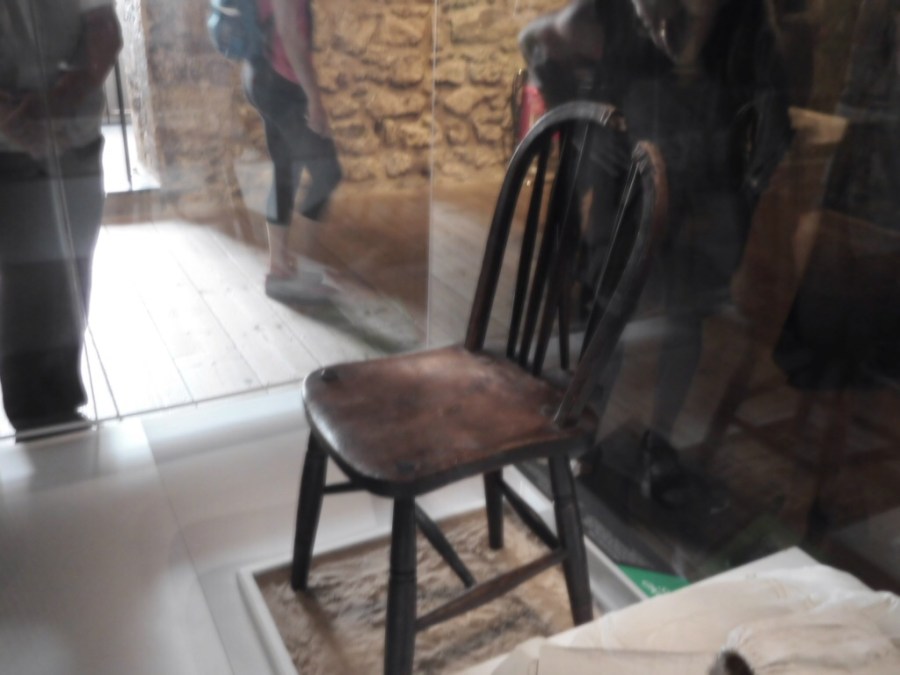
The execution took place ten days later at the miniature rifle range at the Tower of London…. Jakobs was tied blindfolded to a Windsor chair…. Eight soldiers of the Holding Battalion Scots Guards took aim with their 303 Lee-Enfields at a white cotton target pinned above his heart…. At 7.12am a silent signal was given by Lieutenant-Colonel C.R. Gerard…. Jakobs died instantly; five bullets hit him, three of the soldiers had been issued with blanks…. Jakobs was buried in an unmarked grave in St. Mary’s Catholic Cemetery, Kensal Green, London….
The Windsor chair on which Jakobs was executed – Image credit : Hu Nhu – own work – CC BY-SA 4.0
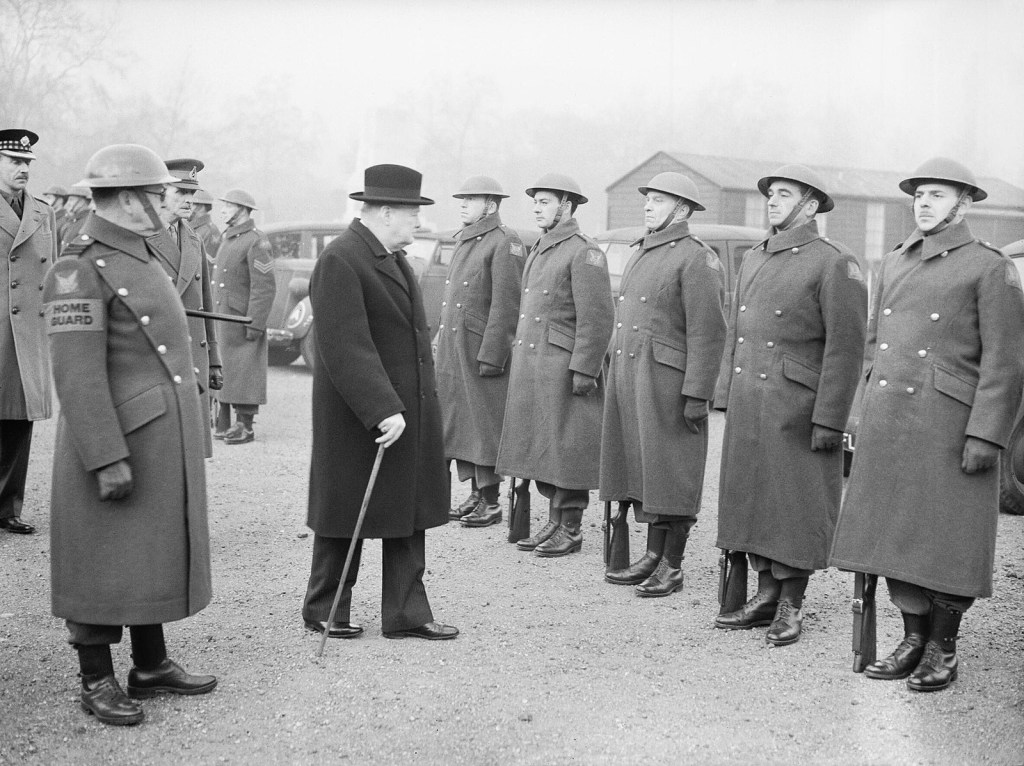
On this day in history : 23rd July 1940 – Winston Churchill changes the name of the Local Defence Volunteers to the Home Guard….
From the collections of the Imperial War Museums
The LDV had been set up in May 1940; Anthony Eden, the Secretary of State for War, called for men between the ages of 17 and 65 to sign up for the new force…. Very often they were in fact men above and below this age, or those deemed unfit for active service…. In the beginning it was very much a ‘make-do’ organisation, with improvised uniforms and weapons….
However, it evolved into a well-equipped and trained army of some 1.7 million men – not only ready for a possible invasion but also involved with bomb disposal and manning coastal artillery and anti-aircraft guns….
The Home Guard was stood down on the 23d of December 1944 – during its existence 1,206 men lost their lives through serving it….
On this day in history : 26th June 1939 – Private Rupert Alexander, Service No. 10000001, signs up to the Middlesex Regiment, as Britain’s first National Serviceman….
The Spring of 1939 saw the deterioration of international relations and Prime Minister Neville Chamberlain had to consider necessary preparations in case Britain found itself at war with Nazi Germany…. Parliament approved the Military Training Act which required men to undertake 6 months military training…. In the beginning this was limited to men between the ages of 20 to 22…. Some 240,000 registered for service….
War was declared on the 3rd of September 1939 and the National Service (Armed Forces) Act came in…. Now all men between 18 to 41 had to register…. There were some exemptions, such as those medically unfit and some key professionals, including farmers, engineers, bakers, doctors and the clergy…. Tribunals were held for conscientious objectors – who were usually assigned essential non-combat tasks it their hearings were successful….
Tribunal for conscientious objectors in Britain during WW2 – Public domain
In December 1941 a second National Service Act was passed…. The age was extended for men, up to the age of 60…. It meant all men up to this age were expected to do some sort of war effort work, such as police and civilian defence – those under the age of 51 were required to be available for military service….
All unmarried women, or widows without children, between the ages of 20 to 30 were liable to be called up to do work related to the war…. Pregnant women were not exempt but were generally not called up….
On this day in history : 3rd January 1946 – The execution for treason of William Joyce – the Nazi propaganda broadcaster, known to the British public as ‘Lord Haw-Haw’….
Photograph of Joyce taken some time between 1939 & 45 – No known copyright restrictions – Archives of the Law Society via Flickr
‘Haw-Haw’ was a term first coined by Jonah Barrington of the Daily Express…. It actually referred to a number of announcers, with their exaggerated English accents, broadcasting during WW2 to the United Kingdom from the German radio station ‘Reichssender’, in Hamburg…. However, in time the name was to become primarily associated with Joyce….
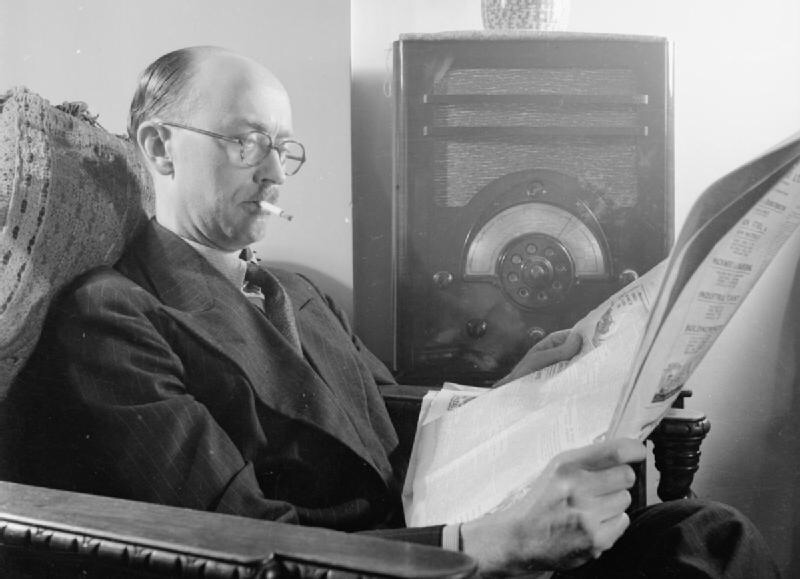
Broadcasts would always start with “Germany calling, Germany calling”…. The aim was to attempt to break the morale and spirit of the British people – along with that of the allied troops…. Inaccurate reports of the sinking of ships and the shooting down of aircraft…. Urging the British to surrender – attacking the government and the British way of life…. Of course, most people knew it was propaganda – but at a time of heavy censorship it was often used as a way to try and find out information as to what may have become of a missing loved one…. Whilst not illegal to listen to the broadcasts it was discouraged – despite this some 18 million people in Britain are believed to have listened on occasion….
From the collections of the Imperial War Museums
So, how did the likes of Joyce come to be working for the Germans during the war? To understand this it is necessary to learn more about the background of the man….
William Brooke Joyce was born on the 24th of April 1906, in Brooklyn, New York…. He was the son of immigrants – his father was Irish and his mother Anglo-Irish…. When Joyce was 3-years-old the family returned to live in Galway, Ireland….
In 1921, during the Irish War of Independence, Joyce was recruited as a courier by Captain Keating of British Army Intelligence, in the fight against the IRA…. After an attempted assassination on him Joyce was taken to England for his safety…. He was recruited into the Worcester Regiment – but soon discharged after it was discovered he was underage….
Joyce remained in England and finished his education at Kings College School, Wimbledon…. He then studied at Birkbeck College – part of the University of London – graduating with a first-class honours in English…. After being turned down for a position with the Foreign Office he took a job as a teacher….
He began to take a keen interest in Fascism…. It was on the 22nd of October 1924, whilst attending a meeting for Jack Lazarus, Conservative candidate for North Lambeth, that Joyce was attacked by Communists…. He received a deep razor slash across his right cheek, leaving him with a prominent scar from his ear lobe to his jaw….
Joyce took a paid job in the British Union of Fascists (BUF), under Sir Oswald Mosley – and in 1934 he was made Director of Propaganda…. It was after being sacked by Mosley in 1937 that he joined a splinter group, the National Socialist League…. On learning that the British authorities intended to arrest him Joyce fled with his wife in August 1939 to Germany – just before the outbreak of WW2…. He became a naturalised German citizen in 1940 and managed to get a job at the Rundfunkhaus (the German equivalent of Broadcasting House)…. Here he made radio announcements and wrote scripts – but he was to go on to become the best-known of the propaganda broadcasters….
Still frame from 1943 – Allied propaganda cartoon – ‘Tokio Jokio’ – depicting Joyce as Lord Haw-Haw – ‘Lord Hee-Haw, Chief Windbag’
His final broadcast was made on the 30th of April 1945, during the Battle of Berlin…. He finished the broadcast with “Heil Hitler and farewell” – the following day Radio Hamburg was seized by the British – but Joyce had managed to make his escape….
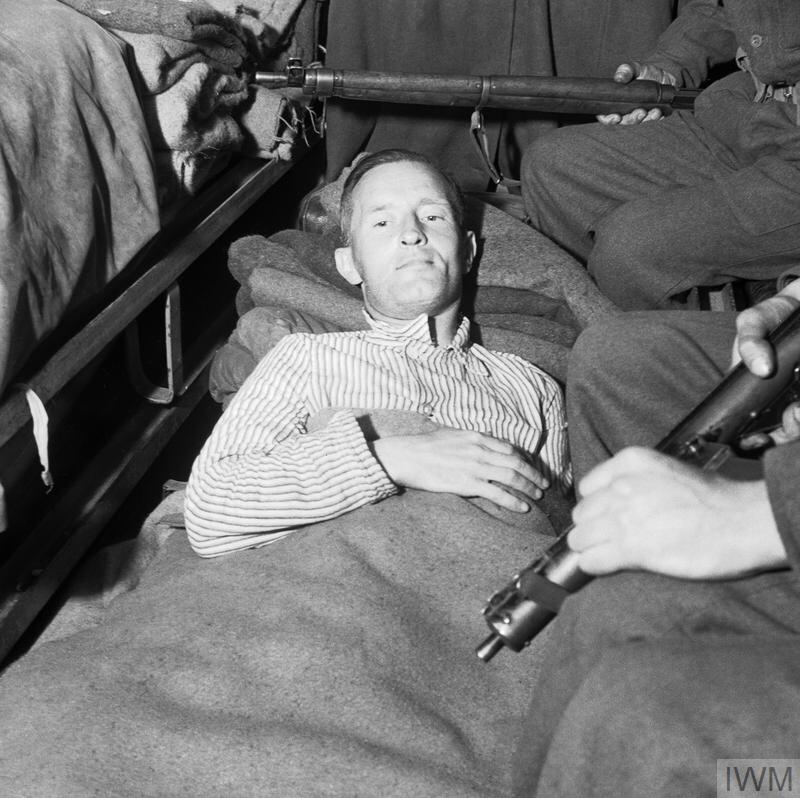
Nearly a month later, on the 28th of May, Joyce was captured at the German/Danish border by British intelligence officers…. During his arrest he was shot through the buttocks – as he had gone to his pocket to produce his false passport but the officers had believed him to be armed….
THE CAPTURE OF WILLIAM JOYCE, GERMANY, 1945 (BU 6910) William Joyce lies in an ambulance under armed guard before being taken from British 2nd Army Headquarters to hospital. He had been shot in the thigh at the time of his arrest. Copyright: � IWM. Original Source: http://www.iwm.org.uk/collections/item/object/205192927
Initially it was thought that due to his American nationality Joyce would have to be acquitted – it was reasoned that he could not be convicted of treason against a country that was not his own…. However, at his trial it was successfully argued that since he had obtained a British passport, by not revealing his true nationality, he had in fact had allegiance to the King and country whilst the passport was valid – and this happened to be the period of time during which he was working for Germany…. Joyce was convicted and sentenced to death on the 19th of September 1945….
The sentence was upheld on the 1st of November 1945 after an appeal – and he was executed at Wandsworth Prison on the 3rd of January 1946 by hangman Albert Pierrepoint…. As he went to the gallows Joyce was unrepentant – as he fell the pressure from the drop split the old scar on his face wide open….
Joyce was buried in an unmarked grave within the prison walls but – after a long campaign by his daughter – in 1979 his body was reinterred in Galway, Ireland….






 Cottage Capers