On this day in history….28th August 1906

On this day in history : 28th August 1906 – The birth of Sir John Betjeman – much loved broadcaster on British television and one of the most popular British Poets Laureate of all time….

Sir John Betjeman, 1961 – Public domain

Born John Betjemann, with a father of Dutch descent, the family name changed to Betjeman at the time of World War One, to make it appear a little less German….

After finishing his education Betjeman declined employment in the family’s furniture business…. In his early schooling he was taught by poet T.S. Eliot – and then later, whilst at Oxford University, his tutor was a young C.S. Lewis…. However, whereas Eliot was encouraging and inspiring Lewis was not so supportive, regarding Betjeman as an ‘idle prig’…. The feeling was mutual – in return Betjeman found Lewis demanding and uninspiring as a tutor…. He was to leave Oxford without a degree and went on to work in a variety of fields – as a private secretary, a period as a school teacher and then as a film critic for the Evening Standard…. Betjeman had first had his poetry published whilst at Oxford, in the university magazine The Isis…. His first book of poems, Mount Zion, was published in 1931….
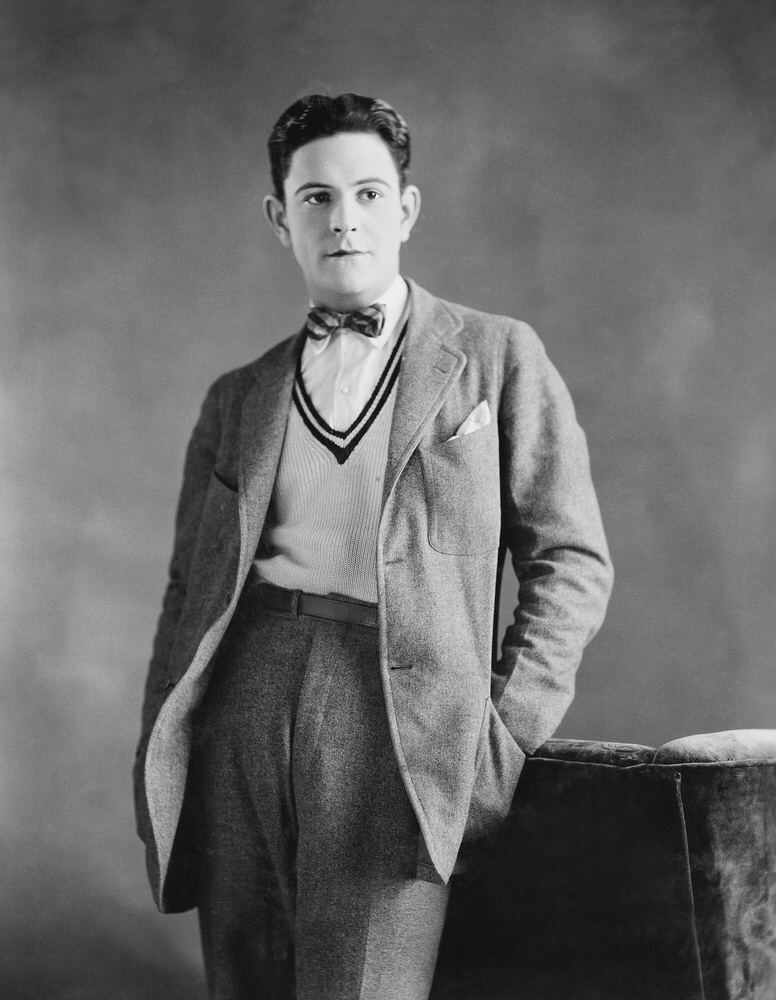
A young Betjeman – Public domain

It was in 1932 that his broadcasting career began, a radio programme about the proposed destruction of Waterloo Bridge…. The previous year he had become assistant editor of The Architectural Review – as a result of his love for buildings and their history…. Betjeman was to become a founding member of the Victorian Society, aimed at protecting our Victorian and Edwardian heritage and architecture…. His first book on the subject, Ghastly Good Taste, was published in 1933…. It was also in this year that he married travel writer the Hon. Penelope Chetwode, the only daughter of Field Marshal Lord Chetwode…. They were to have two children, a son Paul and daughter Candida – the marriage was to break down in the late 1940s….

Betjeman was rejected for active military service in 1939 – instead he did work for the films division of the Ministry of Information…. He still did regular radio work, something that was to continue throughout his life – including interviews, documentaries, panel shows, even game shows – and of course poetry readings…. By 1937 the BBC was making regular screen broadcasts and Betjeman’s first television appearance was on a programme named How to Make a Guidebook…. From the 1950s he was to become a familiar face on television….

In 1960 he was to be awarded a CBE and then in 1962 he was knighted…. He succeeded Cecil Day Lewis as Britain’s Poet Laureate in 1972…. Later in his life he was to suffer from Parkinson’s disease – and was prominently featured in campaigns for Parkinson UK…. He died in Cornwall on the 19th of May 1984….

The following poem, ‘Slough’, is from John Betjeman’s 1937 collection Continental Dew…. The poem was written to show his dismay at the industrialisation of Britain…. Slough being a prime example – as it was used as a dumping ground for surplus war materials after World War One – and had also seen around 850 new factories built….

Come friendly bombs, and fall on Slough
It isn’t fit for humans now,
There isn’t grass to graze a cow
Swarm over, Death!

Come, bombs, and blow to smithereens
Those air-conditioned, bright canteens,
Tinned fruit, tinned meat, tinned milk, tinned beans
Tinned minds, tinned breath.

Mess up the mess they call a town -
A house for ninety-seven down
And once a week for half-a-crown
For twenty years,

And get that man with double chin
Who’ll always cheat and always win,
Who washes his repulsive skin
In women’s tears,

And smash his desk of polished oak
And smash his hands so used to stroke
And stop his boring dirty joke
And make him yell.

But spare the bald young clerks who add
The profits of the stinking cad;
It’s not their fault that they are mad,
They’ve tasted Hell.

It’s not their fault they do not know
The birdsong from the radio,
It’s not their fault they often go
To Maidenhead

And talk of sports and makes of cars
In various bogus Tudor bars
And daren’t look up and see the stars
But belch instead,

In labour-saving homes, with care
Their wives frizz out peroxide hair
And dry it in synthetic air
And paint their nails.

Come friendly bombs, and fall on Slough
To get it ready for the plough.
The cabbages are coming now;
The earth exhales

Of course, no offence intended if you live in Slough – this poem could have been written about so many places… What is poignant for me is that this was written in the 1930s – and nothing much has changed…. Except that we’re now finally beginning to accept we have to do something about it….

On this day in history….27th August 1995

On this day in history : 27th August 1995 – The death of cartoonist Giles – famous for his cartoons in British newspaper The Daily Express and for the annuals found in so many of the nation’s Christmas stockings each year….

Fair use

Ronald ‘Carl’ Giles was born in Islington, London on the 29th of September 1916…. His friends thought he looked like the actor Boris Karloff and so this earned him the nickname ‘Karlo’ which later became shortened to ‘Carl’….

Giles was the son of Albert Giles, a tobacconist and his mother was the daughter of a Norfolk farmer – he spent most of his childhood summer holidays on the farm…. After leaving school at 14, with no formal art training, he went on to work as an office boy for Superads – an advertising agency…. He was to progress up the ladder to become a junior animator of cartoons….

From 1935 he was to work for Alexander Korda, who was one of the main animators for the first full length British colour cartoon film with sound – The Fox Hunt…. He then went on to join Roland Davies in Ipswich, who was setting up an animation studio….

After the death of his brother in 1937 Giles returned to London and started working for the left wing weekly publication Reynolds News, where he produced, amongst others, the cartoon strip Young Ernie…. He was to come to the notice of John Gordon, editor of the Sunday Express, who in 1943 offered Giles a job on the Daily Express and Sunday Express…. At a temptingly much higher salary it was an offer Giles could not refuse – and so he left Reynolds News to work for the Express Group – his first publication appearing in the Sunday Express on the 3rd of October 1943…. Giles was later to say that he felt some guilt – as his political allegiances lay more with the views of Reynolds News….he did not like the Express’s politics…. However, the money was better than good….by 1955 he was earning the equivalent of around £200K a year in today’s terms, for producing three cartoons a week….

Giles had been declared unfit for war service as he was deaf in one ear and blind in one eye following a motorcycle accident…. So instead during World War 2 he made animated short films for the Ministry of Information…. He also served for a time as a war correspondent to the Coldstream Guards, who liberated Bergen-Belsen…. He was to interview Josef Kramer, the camp commandant, who turned out to be a fan of Giles’s…. Kramer was later hanged for his war crimes….

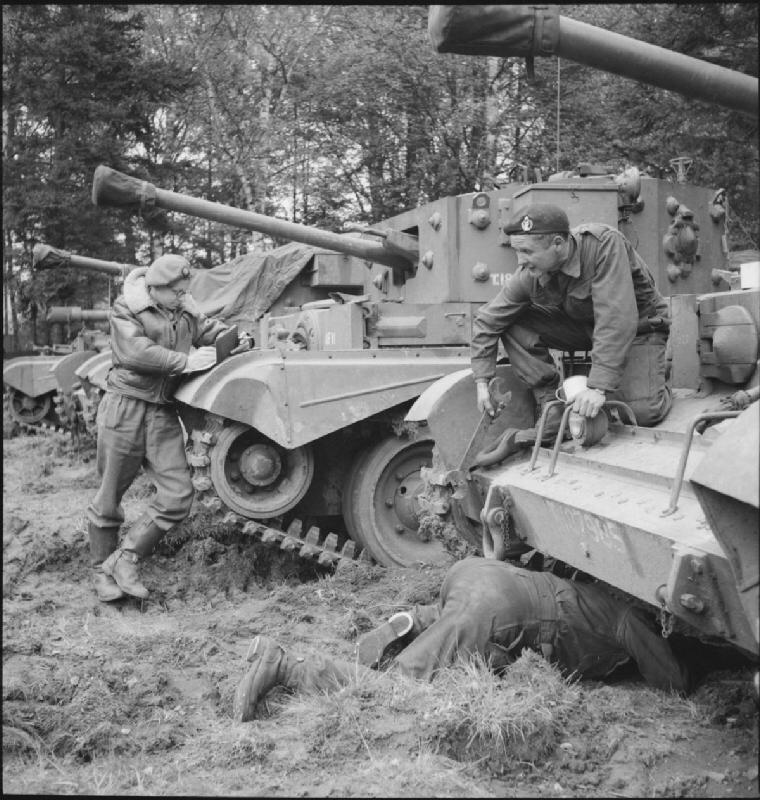
Giles sketches whilst leaning on the front of a tank, whilst his comrades work on the vehicles – From the collections of the Imperial War Museums

In 1942 he married his first cousin Sylvia Joan Clarke…. They were to be married for over fifty years but had no children…. They made their home at Witnesham, near to Ipswich, Suffolk – and here they spent the rest of their lives….

Among Giles’s many thousands of fans were members of the royal family; a request often came from the Palace for originals of his work…. In 1959 he was awarded with an OBE….

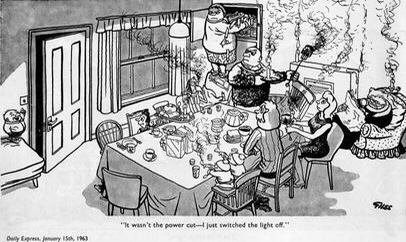
The characters we usually associate with his work include the matriarch ‘Grandma’ and ‘Chalkie’, the school teacher – who was modelled on one of his own former schoolmasters…. These characters and others of the extended Giles family first appeared as a published cartoon on the 5th of August 1945…. Many of his cartoons made reference to, or even quoted the headlines of the current news stories of the day….

The first Giles Annual appeared in 1946 and the series still runs today…. Giles left the Daily Express in 1989 but continued at the Sunday Express until 1991…. In the last decade of his life he was plagued by ill health…. His sight loss was increasing and he was becoming more and more deaf….In 1990, due to poor circulation, he had both of his legs amputated…. Then on Christmas Day 1994 his wife died…. Giles was never to get over her death – eight months later, on the 27th of August 1995, he passed away in Ipswich Hospital…. He was aged 78….

The Giles Family ‘Powercut’ – published January 15th 1963 – Fair use

On this day in history….26th August 1906

On this day in history : 26th August 1906 – The birth of English tennis player Bunny Austin – the last Briton to reach the final of the men’s singles at Wimbledon until Andy Murray….

Bunny Austin – Image credit (cropped) : Willem van de Poll – Dutch National Archives CC BY-SA 3.0

Henry Wilfred Austin got his nickname ‘Bunny’ from a popular Daily Mirror cartoon strip of the time Pip, Squeak and Wilfred….the latter being a rabbit…. It was a nickname that he carried throughout his whole life, as it had been his school mates who had given it to him….

It was Bunny’s father who pushed his son into a sporting career…. He was brought up in South Norwood, London in a large, comfortable family home which he shared with his parents and sister…. His was a middle class childhood, with servants and a public school education…. He joined the Norhurst Tennis Club at the age of six….

In 1921 Bunny won the under 16s singles in the Public School Boys’ Tournament at Queens…. In 1922 he won the junior championships in the singles, doubles and mixed doubles and then in 1923 the singles and doubles at the tournament…. Success continued to be his; in 1926, his first year at Wimbledon, he made it all the way to the men’s doubles semi-finals….

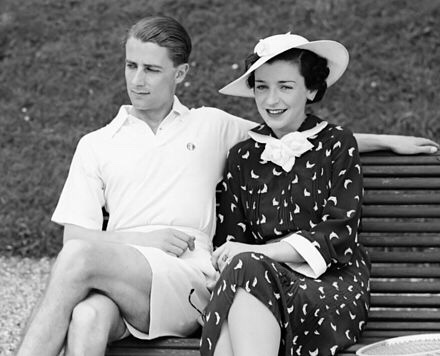
By the end of 1929 Bunny had ranked ninth in the world and for the next three years he was seeded sixth at Wimbledon…. It was also in 1929 that he met English actress Phyllis Konstantinos, whilst onboard a transatlantic cruise liner travelling to America for the US Open…. They were to become a celebrity golden couple and were married in 1931, going on to have two children…. Theirs was a life of glamour, with friends such as Daphne Du Maurier, Ronald Colman, Harold Lloyd and Charlie Chaplin…. Bunny would often play tennis with Chaplin – he was even known to play the odd set or two with the Queen of Thailand….

Bunny Austin and his wife, 1936 – Image credit : Willem van de Poll – Dutch National Archives CC BY-SA 3.0

In 1932 Bunny reached his first Wimbledon singles final…. He was the first Englishman to do so in a decade – but he was to lose to American Ellsworth Vines in three sets…. However, in 1933 he was back and reached the quarter finals…. Then in 1938 he was to meet Donald Budge, one of the best world players of the era, in the Wimbledon final…. Bunny could only manage to win four games…. 1939 was to be his last Wimbledon – he was seeded No.1 but was beaten by American Elwood Cooke in straight sets….

The British Public had to wait until 2012 before another Briton reached the Wimbledon men’s singles final again…. Andy Murray went on to win the title for the first time in 2013….the first British player since Fred Perry in 1936….

Bunny Austin died in 2000, on his 94th birthday….

Hungary-England Davis Cup match 1929 – Bunny Austin far left – Public domain

On this day in history….25th August 1804

On this day in history : 25th August 1804 – Alicia Thornton rides her horse, Vinigrillo, over a four mile race at York Racecourse to become the first known female jockey….

Public domain

Even though she rode side-saddle Alicia was an accomplished horsewoman; she was known for her skills and frequently rode with the hounds….

Not a great deal is known about her early life; her maiden name was Maynel and she was the wife (or possibly mistress) of Colonel Thomas Thornton – who was keen on horses, sport and gambling….

Alicia challenged her brother-in-law, Captain Flint, to a horse race…. Thornton, sensing a good bit of sport, offered her his racehorse, Vinigrillo and placed a bet on her to win….

The race took place at what is now York racecourse, in front of a crowd of what is believed to be around 100,000 – and was for a prize of 500 guineas…. Although Alicia’s horse led for the first three miles she eventually lost the race to Flint…. However, she won the hearts of the crowd for her pluck, attire and demeanour…. Thornton earned himself a horse whipping from Flint as he refused to honour the bet….

The following year, at the same York meeting, Alicia rode against Frank Buckle, known to British horse racing followers of the time as ‘The Governor’…. He was legendary; this time Alicia won….

In 1806 she ran off with a soldier….

Public domain

On this day in history….24th August 1814

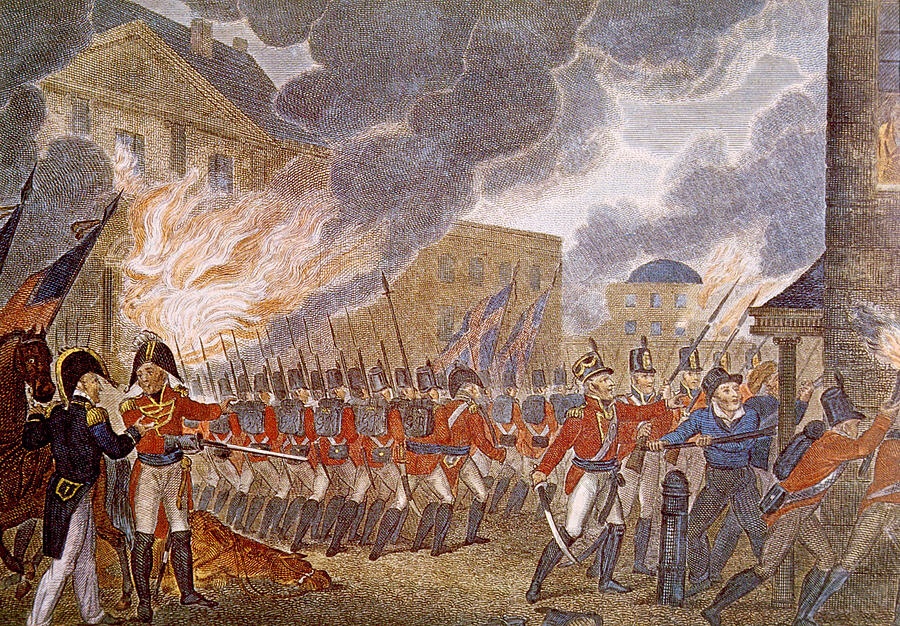
On this day in history : 24th August 1814 – British troops capture Washington DC and set fire to the White House, in retaliation for the American attack on York, Ontario, Canada in June 1813….

The Burning of Washington – an illustration from the 1816 book ‘The History of England, from the Earliest Periods, Vol.1’ – by Paul M Rapin de Thoyras – Public domain

The British had taken their time in planning their revenge attack on America….whose troops during the Canadian attack had burned down government buildings…. Washington was chosen as it was easily accessible from the sea, had a weak defence and was symbolic in its importance….

An initial battle took place between the British and American troops outside of Washington – known as the Battle of Bladensburg, the Americans were easily defeated – and the British advanced on Washington….

President James Madison had been aware of the impending British invasion…. He had attended the Battle of Bladensburg, leaving his wife, Dolley, to pack up important papers and items of value at the White House, which was then known as the Presidential Mansion…. She had been warned to be ready to flee at a moments notice…. By the time the British arrived the President and his wife were on their way to Maryland….

The British troops began setting fire to buildings in the capital, including the Library of Congress and other local landmarks…. On arriving at the White House the British soldiers had the cheek of sitting down to finish off a meal that had been abandoned in the occupants’ haste to get away – (waste not, want not!)…. Once the British had satisfied their appetites they set the building ablaze…. But the one thing they had not accounted for was the weather….

Public domain

The following day a tremendous thunderstorm hit the area…. The accompanying winds were so strong that roofs were torn from houses….and so torrential was the rain that it doused out the fires that had been raging in the city…. The storm lasted for a good two hours and at least two British soldiers were killed….

The British withdrew from Washington that very night…. The Americans were able to return to their capital to see what damage and destruction had been done….

The White House and the city were rebuilt – with Thomas Jefferson donating his collection of books to restock the Library of Congress….