Pond life….

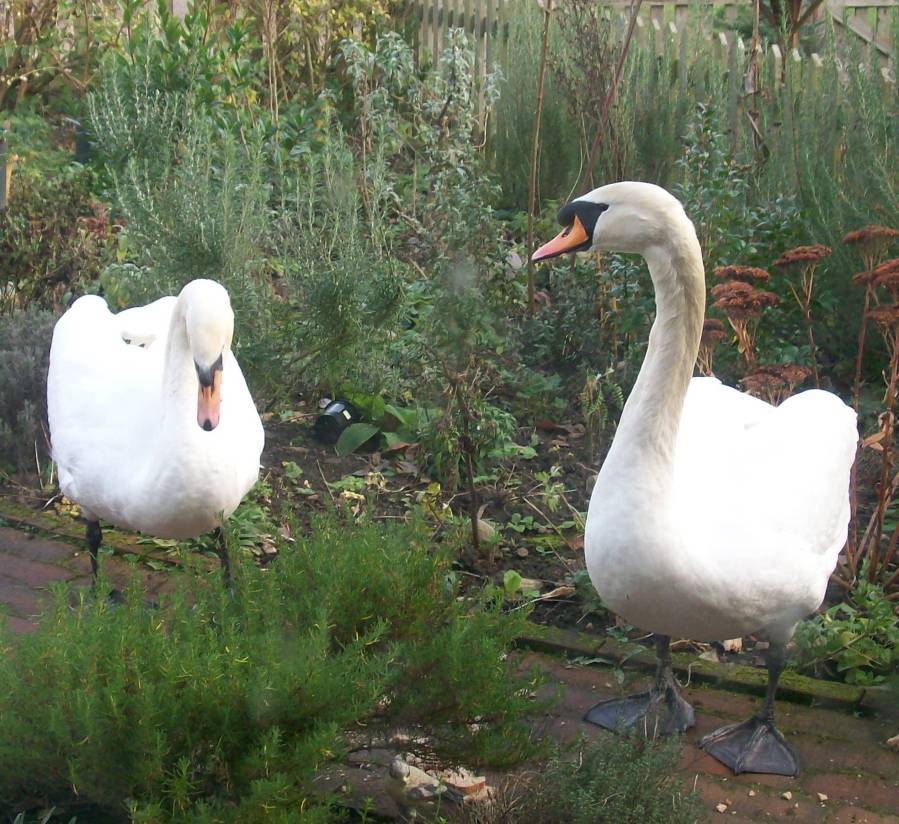
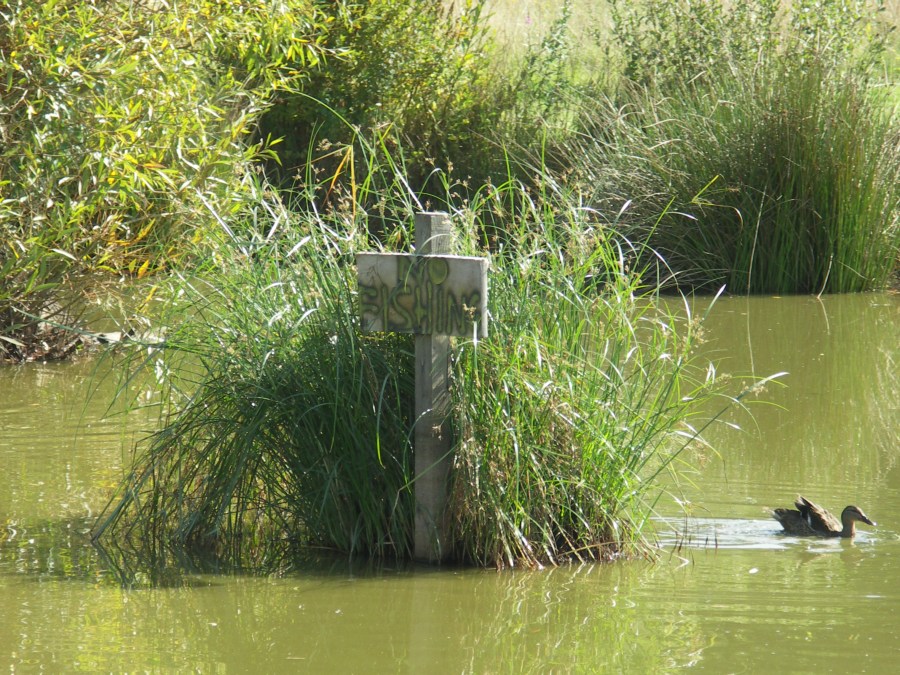
In the early days of our living at No.3, the nearby pond, a part from the odd coot or moorhen, was pretty much devoid of birdlife. All that was to change in the Autumn of 2006, with the arrival of two mute swans….

Being an animal lover, I couldn’t resist feeding them. It didn’t take long for them to realise they were on to a good thing. Not being content for me to decide when it was meal time, they would come and find me when they were hungry.
1190

Naturally, they acquired names, “Cobblers” and “Penelope” – a play on the terms for a male and female swan (cob and pen) – cheesy, I know….

Not knowing an awful lot about swans at that time, we assumed we knew which was which of the pair…. One had a much darker orange beak than the other and the ‘knob’ located at the top of the beak, was far more prominent. So this was obviously the male….

“Cobblers” was ringed. He had a certain gentleness to his nature, willingly accepted food from the hand and seemed used to people. “Penelope”, on the other hand, was not ringed and much wilder….

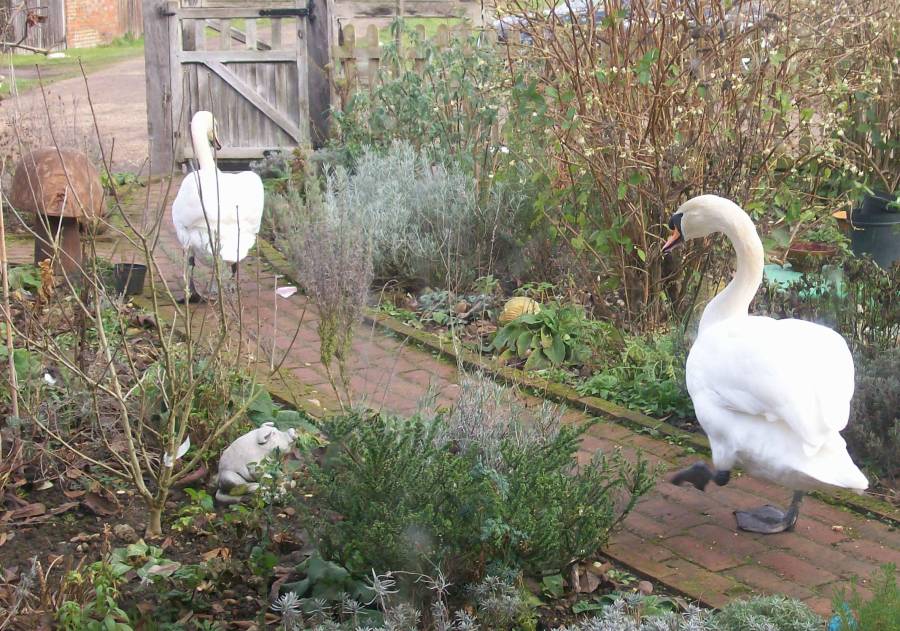
The pair would divide their time between the nearby pond and the one a little further up, by the main road. They seemed quite content with their lot….
369
“Come on dear, it’s time we were going…”


Then, a few months later – the unspeakable happened…. The two of them had chosen to spend the night on the roadside pond – during the early hours, “Cobblers” was shot dead. As it is a criminal offence to harm, let alone kill a swan, the police attempted to find out who was responsible for such a despicable act but sadly to no avail….

A post mortem was carried out by a local vet and from this, through his ring, it was discovered that “Cobblers” originated from Hampton Court…. He had indeed been,  a very Royal swan….

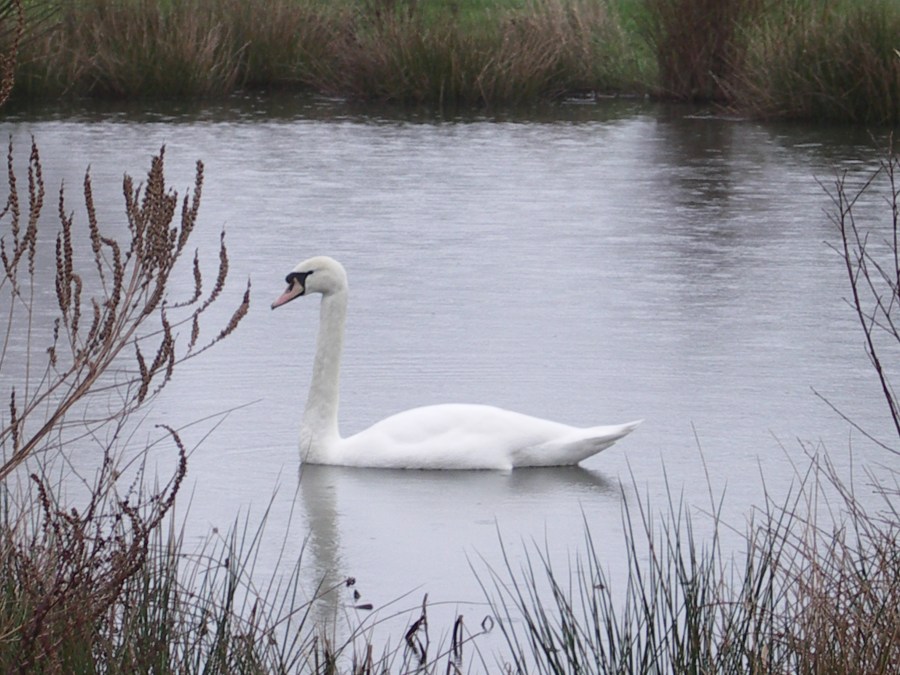
“Penelope” was understandably very subdued after losing her companion, swans grieve, just as we do. I carried on with the feeding but a few weeks later, she disappeared and I thought that was that. Imagine my delight, when a couple of months later, I glanced out of the window and saw a swan on the pond. I grabbed some bread and rushed out….
KONICA MINOLTA DIGITAL CAMERA

I know this might sound daft….but something ‘clicked’ with that bird in that instance. “Penelope” made eye contact and held my stare…. It was a surreal moment, one I will never forget – I felt as if I was being ‘read’. A bond was formed, one that holds fast to this day….

A few weeks later, she disappeared again, once more to return a while later. This became the pattern for the next year or so….

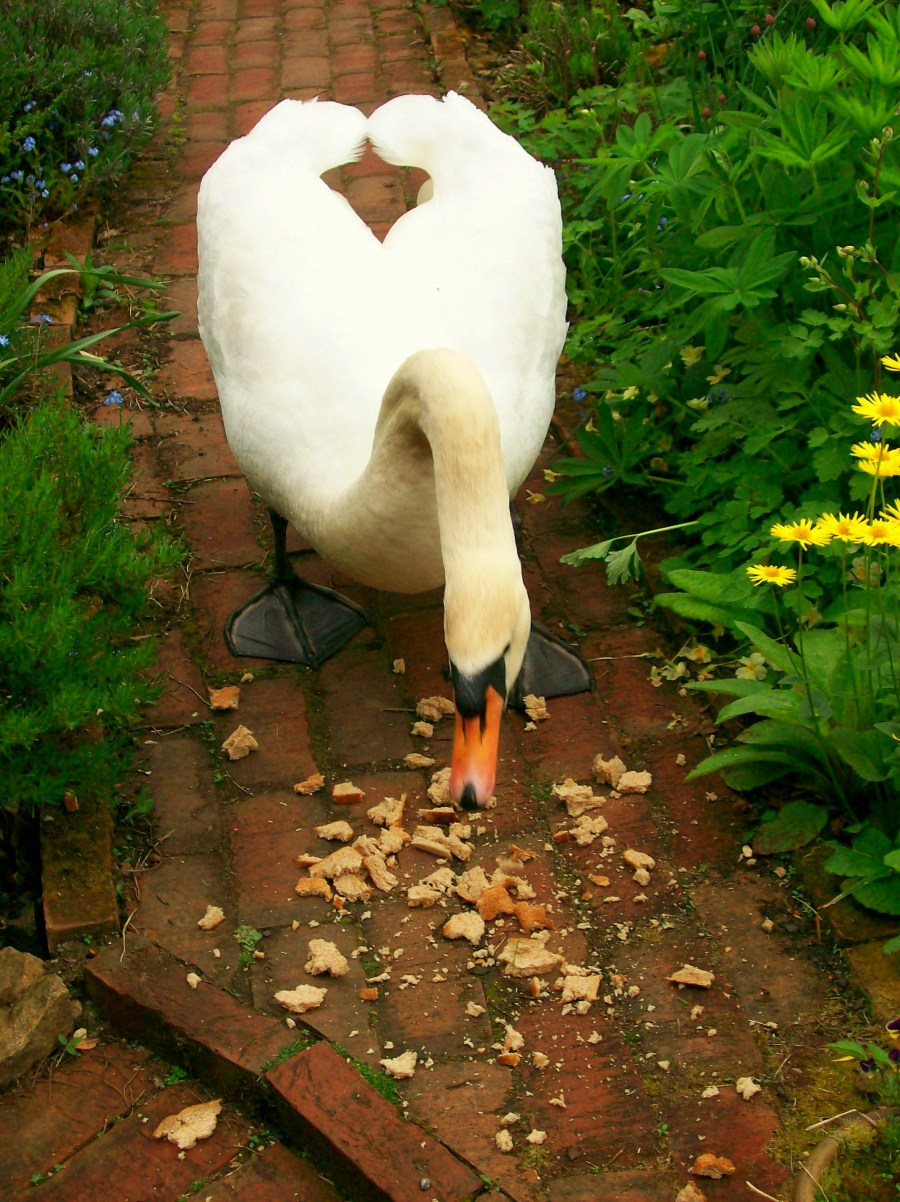
Over that time, “Penelope” underwent some changes. She appeared to get bigger, her neck thickened, her beak became darker and the caruncle (the correct term for the knob on the beak) increased in size. You have probably guessed where this is going by now…. “Penelope” was in fact a male….!!
1145

On his original arrival in 2006, he had obviously been a juvenile. Cygnets take up to a year to loose their brown feathers and become white. They are not ready to breed until they are about four years old. Whether “Cobblers” had actually been male or female, I don’t know….possibly the pair had been parent and son….

Luckily, “Penelope” seemed completely unconcerned by the mistaken identity….
KONICA MINOLTA DIGITAL CAMERA

It’s all in a number….

No.3 is undoubtedly old, the exact year it was built is unknown but we have a rough idea. Whilst carrying out the restoration work, we were approached by the Domestic Buildings Research Group, who were interested in having a close look at the structure of the house. It was an excellent opportunity, as we had it virtually stripped back to its wattle and daub at the time and the timber framing was completely exposed.

Accompanying the group were a couple of archeologists and a dendrochronologist. Although dendro samples were taken, it was unfortunate that it was not possible to obtain one that would give an accurate enough reading for tree ring dating. A successful sample needs to have at least eighty visible rings. Carbon dating is another option, we have promised ourselves that one day we will look into having this done.

However, the archeologists were able to provide us with a rough guide to the time of construction, by the nature and style of the timber framing, particularly the lack of purlins (horizontal roof beams) and the long wind braces. The estimate they gave was circa 1350.

Incidentally, a successful dendro analysis was undertaken on another house in the village, The Forge, dating it to 1254. So, that tells us there was a settlement of a certain size here at that time. There is no written record before 1291 that refers to the village – although, it is possible there is reference in the 1086 Domesday to a chapel, that once stood where the village church is now situated. The existing church was built around 1290.

Back in the day, it is most likely that most of this area would have been predominantly woodland, typically oak. Timber framed buildings would often have been built from trees growing in situ. Possibly a saw pit would have been dug close by and clay for wattle and daub locally sourced. The digging of clay would result in impressions which would then naturally fill with water. This explains why there is often a pond in the immediate vicinity of a timber framed building.

These early builders and carpenters were highly skilled, very often working as mobile units, moving from site to site, constructing buildings surprisingly quickly. The smallest trees possible for the job in hand would be selected, the builds would tend to be constructed in the winter months from green wood. Seasoned wood, especially oak, is very hard to work with. Being green, the wood would be susceptible to twisting, thus giving that ‘crooked’ charm so many of these cottages and houses exude.

This particular cottage is a two bay, open hall house, with one and a half storeys. It is timber framed with brick infill on the lower level and lime washed wattle and daub/render infill to the upper level. It has a steeply pitched, plain tiled, hipped roof with end gables. Of course, at one time it would have been thatched. It has its original outshot.

A hall house, to put it simply, is basically just that – a ‘hall’. A simple , one main room dwelling. Sometimes, one or two smaller rooms, for the storage of food etc., would be included at one end. A more affluent family home may possibly of had another section at the other end for privacy and somewhere to keep valuables. Generally though, the whole ‘community’ (this would include the family and any servants they may of had if they were wealthy enough), all lived together in the main hall.

A hearth in the middle of the room provided a fire for warmth and cooking. The resulting smoke would have been drawn up into the roof area to a vent.

There are still many examples of these buildings around but few remain relatively unchanged. Sometimes, they become so unrecognisable through modernisation over the ages, that it is only when work is undertaken that happens to expose tell tale, soot blackened roof beams, that the origins become evident.

This cottage is an unspoilt example of an early house. At some point after 1540 a chimney was added and an inglenook fireplace incorporated. At a later date the house was extended and the fireplace became enclosed within the building rather than being on an outside wall. I assume it was all one house at that time because nowadays, that ‘extension’ is a separate cottage in its own right – we are actually semi-detached. It is possible it was originally added as a ‘dower’ cottage – maybe to provide accommodation for an elderly relative…. I speculate. This extension would have been less than half the size of the main house but it has been enlarged since.

I am not at all sure when the outshot was added or whether it was in fact part of the main build.

There are four main types of timber framed house. Box frame, post and truss, aisled and cruck. Of course, builders would of added their own variations and modifications to a particular style. This house appears to have been built following the aisle method, although having said that, it is not entirely true to form.

An upper floor was added, possibly in the 1400’s, to half the house, leaving the remaining half still open hall. The beams supporting this floor are substantial, almost ‘over engineered’ when compared to those of the ceiling added at a later date to the other half of the house.

The later addition would have happened about the time the fireplace was built, also it is likely this is when the staircase was installed. Originally, access to upstairs would have been via what was basically a ladder. Amongst the large ceiling beams of what is now the dining room, is an area that has been infilled with much smaller ones, this is quite obviously where the ladder was situated. I, for one, am relieved access to upstairs is no longer by this method….!!

Love at first sight? I hardly think so….

When my then future husband, John, told me that his dream was to live in an old timber framed house, it came as no surprise. Being a tree surgeon he has a natural obsession with wood, especially oak. However, I thought it would remain just that – a dream…. I should have known better than to underestimate him….

One evening, shortly after putting his own house on the market and moving in with Jordan (my then 2 year old son) and myself, John arrived home, obviously excited about something. It soon became apparent what – “I think I might have found us a project!” – he announced. He’d had a meeting with his estate agent and conversation had turned to the type of property we may be interested in. It so happened the agent knew of one that might ‘tick all the boxes’….

Now, had I of known John for slightly longer at that point, I would of had an inkling of what exactly his idea of a project was and alarm bells would have been ringing…. I still had a lot to learn….

It was on a particularly filthy evening (lashing with rain and howling a gale) in October 2003, that we set out to view this project of John’s for the first time. It was just under an hours drive from our then home but to an area I was totally unfamiliar with. It seemed like an endless journey down narrow, twisting country lanes. For all intents and purposes, I could have been in a foreign land – I was completely lost! It makes me smile when I think back on that journey – how well I know every twist and turn of those lanes now….

Eventually we arrived in the middle of what seemed like….nowhere! We had driven up a bumpy, unmade road and come to a halt at a dark and gloomy dead end – the only light to be seen, was that escaping from the odd chink in the curtains of a few houses, clumped together in a vast expanse of….nothingness! Behind an apology of a hedge stood a dilapidated, sorry looking cottage. This was obviously ‘it’ – the potential project. John’s enthusiasm was unabated but I had a distinct sinking feeling as we knocked on the neglected door with its peeling paint….

Once inside, the first thing to hit me was an overwhelming sense of claustrophobia. The ceiling was so low, only 6 foot from the cold, flagstone floor. We had entered from outside straight into a dreary sitting room – the only cheer came from the fire blazing in a magnificent inglenook. My thoughts were – “You have got to be joking…. You can’t honestly expect us to live here….!”

We were shown around the property and I was imagining ghosts and ghoulies in every dark, shadowy corner…. I’ve always had an overactive imagination. Needless to say, I was unimpressed at that first viewing and it took a bit of persuading for me to return for a second look….

Seeing the cottage again, this time in daylight, I was slightly more heartened. It was a Sunday afternoon and the sun was shining. Now it could be appreciated it was not situated in a vast expanse of nothingness but actually on a stretch of common land with a pretty pond close by. Just beyond was a hive of activity. A large bonfire was being constructed in readiness for the coming November 5th celebrations and it seemed as if the whole village had turned out to help. The sense of community spirit was infectious….

Looking around inside once again, I was pleasantly surprised. Knowing what to expect this time, the lowness of the ceiling was not quite so imposing – in fact it felt rather cosy. Still though, I had major reservations about the overall state of the place. It was with a degree of reluctance that I allowed myself to agree to our making an offer on the cottage…. My one stipulation was – ‘all building and renovation work was to be completed before we moved in’…. I refused to live in a building site. The deadline….before Jordan started school. Well, that backfired. We moved into the building site the day before Jordan started school!!

So, that was how it came to be that we were now the proud owners of what was, in my mind at that time, a derelict, tumbledown, disaster waiting to happen….

It was hardly love at first sight….


So, the journey begins….

Restoration work to No.3 started in the Spring of 2004. What was to follow can only be described as an ‘experience’. We were completely green and naïve, neither of us having ever attempted such a venture before…. We made mistakes and plenty of them…. Some are still waiting to be put right today.

Would I do it all again? Probably not….but I’m glad to have had the experience. I feel I know this old cottage more than intimately…. Having been stripped, virtually back to its bare ‘bones’ – it has revealed its soul to us….

When you start a large scale project, it’s a little like embarking on a long journey – or in this particular case – a never ending one! Very often, it’s only when you pause and look back, that you can appreciate just how far you have come….

Obviously, I have been reflecting a lot recently, on the time we spent renovating No.3 and   it has all come flooding back (especially after digging out the photos) just how big a task we undertook….


There were times of frustration and despair. On many an occasion I asked myself the question “why the hell are we doing this?” If I’m honest, in the very beginning, I was not sold on the idea of restoring such an old property…. Although I like to think of myself as a creative person, I had trouble visualising the end result. John and I had made several visits to the Weald and Downlands Open Air Museum. He was totally fascinated in the way these old places were lived in all those centuries ago (I always knew he had been born in the wrong era) – I was terrified he was expecting us to live in a similar manner! Of course, I should have had more faith….

There were many setbacks and hurdles along the way but somehow we overcame them. To be truthful, although there was a rough plan in place, we pretty much made it up as we went along. That was something we learnt right at the onset – plans have to adaptable!

Possibly, you are considering or are actually undertaking a similar venture. Hopefully, you are managing to take it all in your stride – but if, like I did, you sometimes find it all a bit daunting and ‘too much’, then I hope this will give you heart…. It’s always good to know that there are others who know what you are up against. If it’s a word of encouragement you need – then you’ve come to the right place. Trust me, it might seem like an awfully long road but it’s definitely worth it in the end!

Maybe you are just curious to know what it is like to live in a place like this…. I will endeavour to give you a flavour of that….

Or perhaps you are more interested in our swan family. I promise they will feature frequently….

So, whatever your reasons, thank you – it’s nice to have you along…. I’ll quit waffling now and get on with the story….

scan_20161203-6