The restoration and living in of an English country cottage
Author: cottagecapers
Hi, I'm Hazel....
I write purely for pleasure; I love to delve in history, customs, traditions and nature....or whatever else grabs my attention at the time....
I am in no way an expert on what I choose to write about - I simply love to find out about things.... Whilst I always endeavour to get the facts right - occasionally I may get things wrong.... I guess you could call this my disclaimer....
I hope you enjoy reading my blog posts.... If so please give me a follow on Twitter or sign up via email for future posts.... If you are on Facebook Cottage Capers has a page with lots of ‘mini blogs’ and snippets.... It’s where we ‘like-minded’ folk can interact.... Hope to meet you again soon....
On this day in history : 27th August 1979 – Lord Louis Mountbatten is killed when the IRA detonate a remote-controlled 50lb (23kg) bomb upon his boat….
Lord Mountbatten in 1976 – by Allan Warren CC BY-SA 3.0
Lord Mountbatten, a second cousin of Queen Elizabeth II and uncle of Prince Philip, had been enjoying a fishing trip with family members as part of a family holiday…. His boat, Shadow V, was sailing off the coast of County Sligo, Ireland when the bomb exploded….
Fisherman pulled 79-year-old Lord Mountbatten from the water – he was still alive but died before being brought ashore; both off his legs had been blown off….
Also onboard the boat were his eldest daughter, Patricia (Lady Brabourne), her husband John (Lord Brabourne) and their 14-year-old twins, Nicholas and Timothy…. Nicholas was killed, along with a 15-year-old crew member, Paul Maxwell…. Lord Brabourne’s 83-year-old mother, Doreen, died from her injuries the following day….
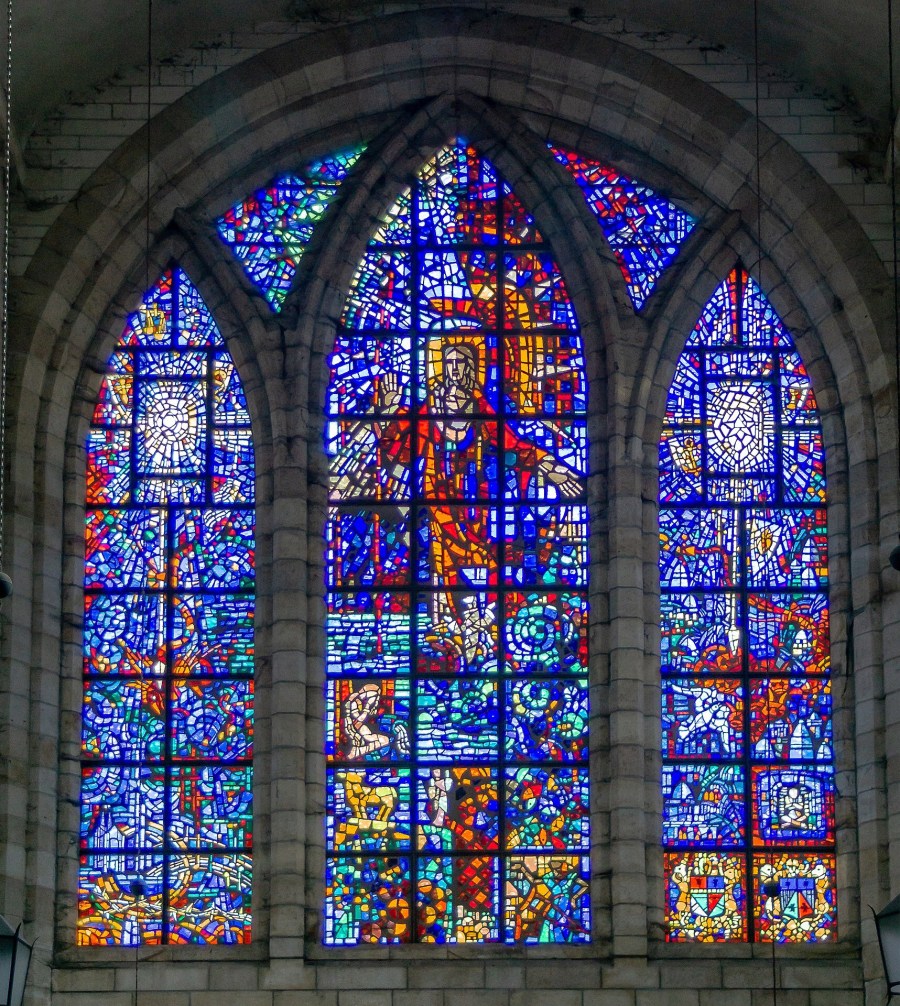
“Christ in Triumph over Darkness and Evil” by Gabriel Loire (1982) – at St. George’s Cathedral, Cape Town, South Africa – in memory of Lord Mountbatten – Rainer Halama CC BY 4.0
On this day in history : 26th August 1346 – King Edward III and his son, Edward the Black Prince, lead and win the Battle of Crécy – against Philip VI of France….
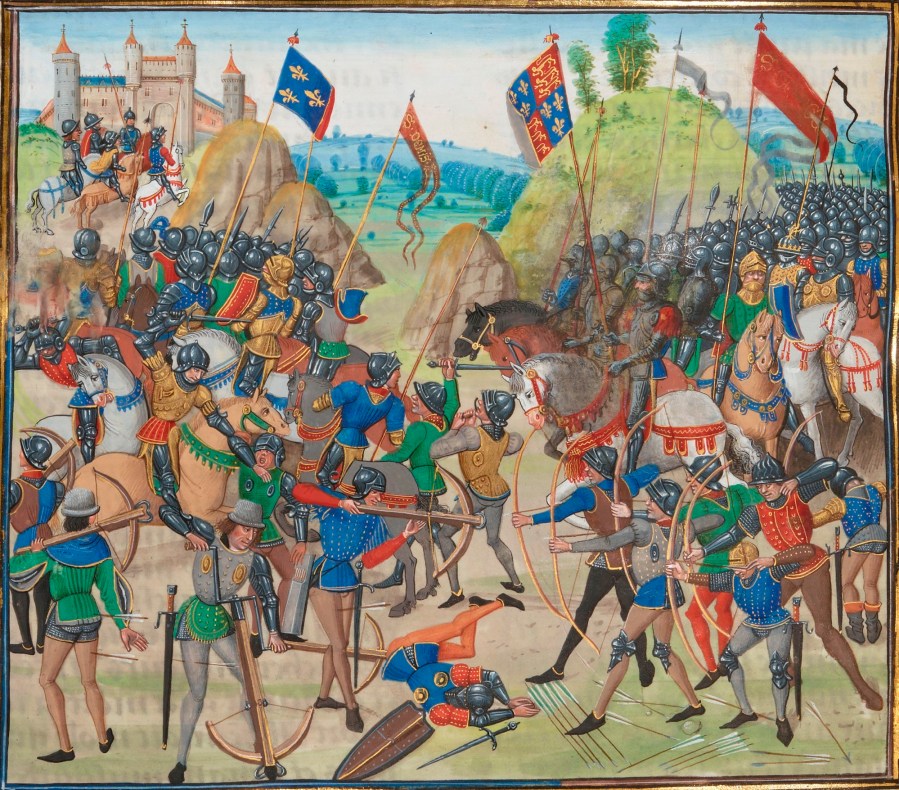
The Battle of Crecy, from a 15th Century illuminated manuscript of Jean Froissart’s Chronicles – Public domain
Crécy, which was then a village in northern France, was one of the most famous battles of the Hundred Years War…. King Edward’s army faced a much larger French force, who were renowned for their skills with the crossbow…. However, the crossbow was no match for the English longbow – and to add to French woes they had forgotten to bring their shields with them, leaving them extremely vulnerable! The crossbowmen retreated – but such was the fury of the French knights – seeing the retreat as cowardice – that they slaughtered their fleeing countrymen…. Only when the knights took up their own turn to attack did they realise the full might of the English longbow and they themselves were to face slaughter….
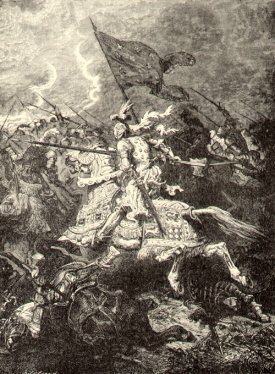
Battle of Crecy (19th Century engraving) – Public domain
The battle was described as ‘a political catastrophe for the French Crown’ and ‘a total victory for the English’…. There is a legend – and it can only be described as such, as having no proven truth – that King Edward’s men did not kill the French crossbowmen that they captured…. Instead they cut off the two fingers needed to fire their bows…. It is said this is where the ‘V sign’ insult originates from – it became the two-fingered salute to the French before battle commenced….a gesture that has been used by the British – and later the Commonwealth countries ever since….
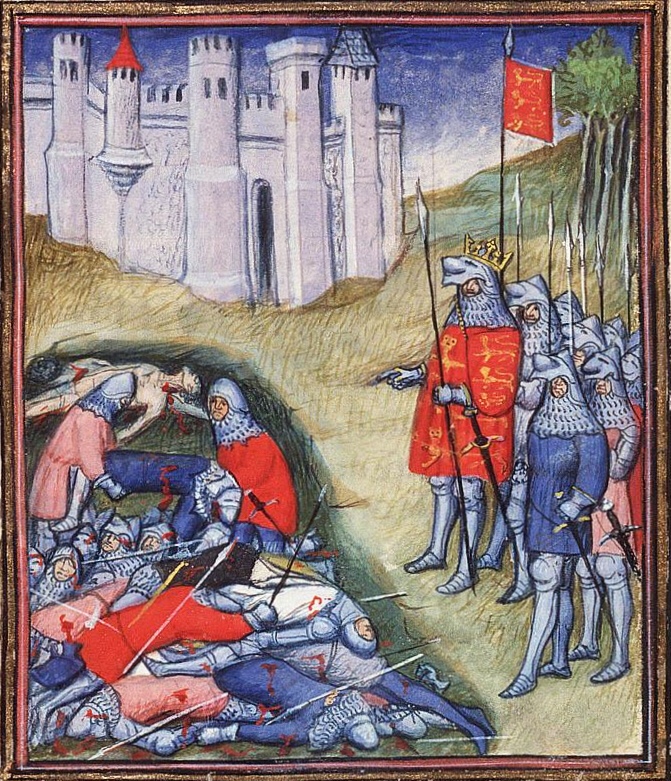
Edward III counting the dead on the battlefield of Crecy – Virgil Master (illuminator) – Public domain
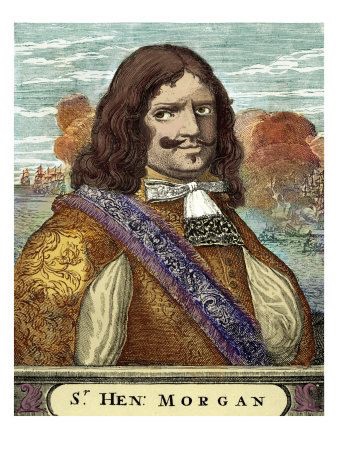
On this day in history : 25th August 1688 – The death of Welsh pirate and privateer Sir Henry Morgan – who raided Spanish settlements and shipping in the Caribbean….
Sir Henry Morgan, from a 17th Century woodcut – Public domain
Morgan, his image known to us as the face used on the Captain Morgan brand of rum, was born in South Wales around 1635…. Little is known about his early life, or indeed how he came to travel to the West Indies…. One theory is that he was kidnapped and taken to Barbados where he was forced to work as a servant…. Another more plausible explanation is that he may have been part of the Caribbean expedition against the Spanish in 1654 ordered by Oliver Cromwell…. However, it is likely that in the early 1660s he became involved with a group of privateers attacking Spanish settlements in the Caribbean and Central America…. At the time privateering was a good opportunity for young men to make their fortunes….as privateers were permitted to keep some of their plunder for themselves – a kind of legalised piracy….
Morgan led successful attacks on many major settlements, including Puerto Principe and Port Bello – and made raids on Maracaibo and Gibraltar – and with his prize money was able to buy sugar plantations….
Attack on Puerto Principe – Public domain
In early 1666 he married his cousin, Mary Morgan – the daughter of his uncle, who was Jamaica’s Deputy Governor…. With these connections Morgan himself was later to become Lieutenant Governor of Jamaica….
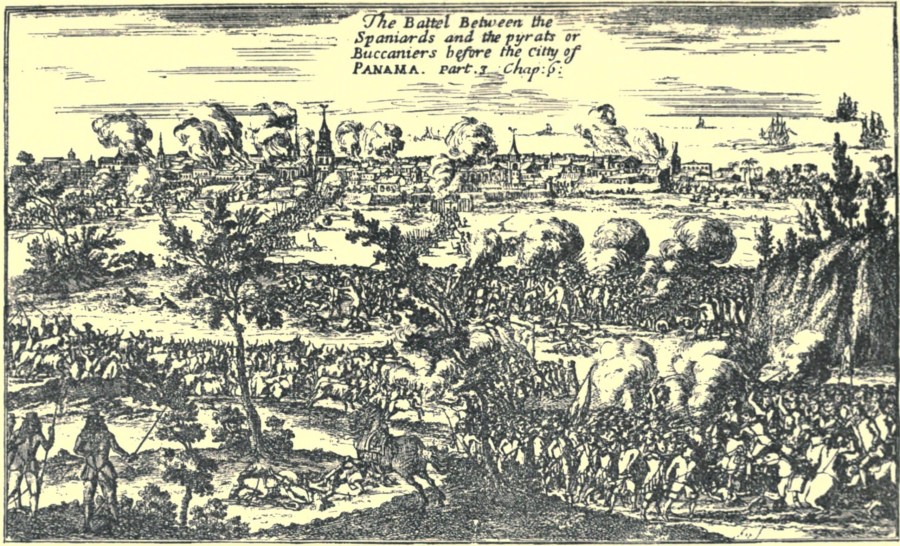
In 1671 Morgan led what was to become a disastrous attack on Panama City – the capital of Spanish America and thought of as one of the wealthiest cities in the world…. Despite his men being vastly outnumbered such was Morgan’s reputation that the Spaniards fled – but not before burning the city to the ground and taking all their riches with them…. Also, unbeknown to Morgan, a treaty had been signed between England and Spain – to add to the debacle Morgan had actually attacked during peace time….
Morgan attacking Panama – Public domain
Morgan was arrested and taken before the Governor of Jamaica – from there he was transported to London, where he was held on a charge of piracy…. However, it was not long before England was at war again, this time with the Dutch – putting England’s sugar trade at risk…. King Charles II enlisted Morgan’s help – he knighted him and sent him back to Jamaica….
Morgan ended his days in the West Indies – drinking rum, involving himself in politics and running his plantations….by the time of his death he owned 109 slaves…. The cause of his death is unknown – my bet would be it had something to do with all that rum….
Captain Morgan Black Label from the 1970s – A product of Jamaica, Guyana and Barbados produced by the Seagram Company – Image credit : Rssutor CC BY-SA 4.0
On this day in history : 24th August 1847 – Charlotte Brontë sends her manuscript for ‘Jane Eyre’ to London publishers Smith, Elder and Company – under the pseudonym Currer Bell….
image : Uploaded to en.wikipedia by Chick Bowen – Public domain
It was not unusual for female authors at this time to write under a male name…. Women authors were not taken as seriously as their male counterparts – it was assumed women’s heads were full of fluff and frivolity; they were deemed as having no perception of the real world – their place was in the home…. The Brontë sisters collectively felt that their work would not be regarded as being feminine and would be looked upon with prejudice if their real gender was revealed….
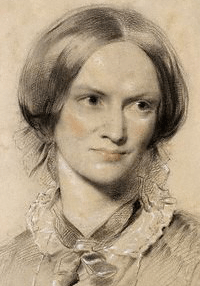
Charlotte Bronte – George Richmond Public domain
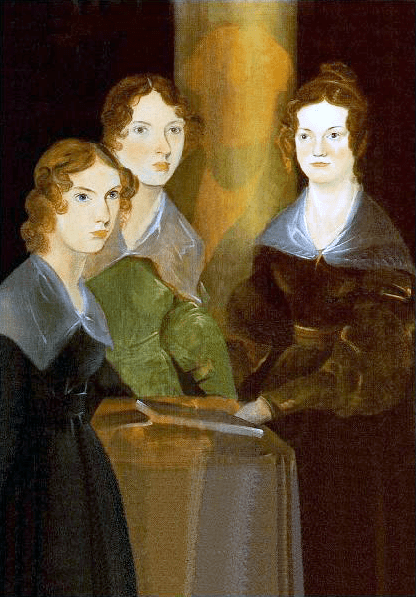
Charlotte, who was the eldest of the three sisters, had been unable to find a publisher for her first manuscript, ‘The Professor’ – however, Smith, Elder & Co of Cornhill expressed an interest to any longer works Currer Bell may wish to send…. So towards the end of August 1847 ‘Jane Eyre’ was submitted and published six weeks later….and was an instant success, gaining good reviews…. Because little was known about the author suspicions began to form that Currer Bell may be a woman – strengthening when ‘Wuthering Heights’ by Ellis Bell (Emily Brontë) was published – and then ‘Agnes Grey’ by Acton Bell (Anne Brontë)…. In 1848 the sisters admitted to their assumed names….and became celebrated in literacy circles – and their novels became classics of English literature….
Anne, Emily and Charlotte Bronte, painted by brother Branwell Bronte – Public domain
On this day in history : 23rd August 1944 – An American Liberator bomber crashes into an English village school in Feckleton, Lancashire – killing 61 people, 38 of whom are children….
Two recently refurbished B-24 bombers had departed from Warton Aerodrome at 10.30 in the morning on a test flight, when a violent storm blew up…. Both aircraft were recalled to the USAAF airbase and as they approached visibility was greatly reduced because of the torrential rain and 60mph gusts of wind….
B-24H Liberator bomber – similar to the one that crashed. Image : United States Army Air Forces – Public domain
Pilot John Blosmendal, in the first of the two bombers, reported to the control tower that he was going to abort his landing attempt and would circle around again – only his aircraft was to disastrously crash into the Holy Trinity Church of England village school, which lay to the east of the airfield…. The right wing of the B-24 was ripped from the fuselage as it hit a tree-top; it then impacted with the corner of a building…. The fuselage of the 25-ton bomber then continued to plough a path of destruction, partly demolishing three houses and ‘The Sad Sack Snack Bar’ – which catered for the American servicemen stationed at the base…. The aircraft then burst into flames, whilst another inferno raged, caused by the ruptured fuel tanks of the bomber, at the infants school….
The Feckleton air disaster instantly claimed the lives of the B-24’s three crew members, thirty-four children, a teacher, six American servicemen, one RAF airman and seven staff at the snack bar…. A further four children, a teacher, an American serviceman and three RAF airmen died later in hospital – and many more people were injured….
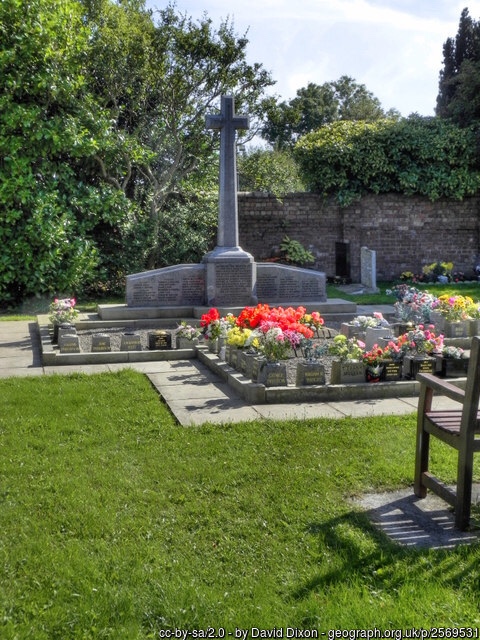
Feckleton Air Disaster Memorial and Remembrance Garden






 Cottage Capers