On this day in history : 20th February 1757 – The birth of John ‘Mad Jack’ Fuller – Squire of the hamlet of Brightling, Sussex. An MP, philanthropist and builder of follies….
John Fuller, who was better known as ‘Mad Jack’ preferred to be called ‘Honest John’…. Was he mad? No, just eccentric….
Many associate Fuller with his follies – of which he built several which can be seen around the village of Brightling ~ ‘Folly: foolish and useless but expensive undertaking’….
Fuller’s Tower – some think built so he could oversee the restoration work of Bodiham Castle….
However, there was so much more to the man…. He was born in Stoneham, Hampshire – but his father, the Reverend Henry Fuller, died when the young Fuller was just 4-years-old…. After he had finished his education at Eton he embarked on a military career – by the age of 22 he was a captain of a light infantry company in the Sussex Militia. In 1776 he was appointed High Sheriff of Sussex – a post lasting a year…. 1798 saw him as a captain in the Sussex Gentlemen and Yeoman Company….
To discover how he came to be Squire of a hamlet in Sussex we need to wind back to when he was 20-years-old…. It was on the death of his uncle that he inherited the Rose Hill Estate (now Brightling Park) – along with a plantation in Jamaica…. Fuller was a staunch supporter of slavery – having slaves on his inherited plantation…. He notoriously once claimed ‘West Indian slaves lived in better conditions than many people in England’….
Fuller was elected to parliament at the age of 23 and served as MP for Southampton until 1784 and then for Sussex from 1801 to 1812 – when he retired from politics. Fuller was rather fond of his drink – leading to a series of incidents in Parliament – one in particular involving the Speaker….
But there was also a very generous and charitable side to him…. In 1822 he endowed to Eastbourne its first lifeboat and in 1828 financed the building of the first Belle Tout Lighthouse, off of Beachy Head (a temporary structure, replaced by a permanent granite building in the 1830s). Also in 1828, on the 18th of September, he purchased Bodiam Castle at auction for 3,000 guineas – to save it from destruction….
Among his other notable projects was the building of the Observatory of Brightling – designed by Robert Smirke….
Perhaps one of his most generous bequests was to the Royal Institution (founded in 1799 and devoted to scientific research and education) of which he was a supporter. Initially given as a loan – but later written off – he donated £1,000 – over £100,000 in today’s terms…. In 1828 he established the Fuller Medal of the Royal Institute and in 1833 founded the Fullerian Professorship of Chemistry and later the Fullerian Professorship of Physiology….
Fuller never married, although at the age of 33 he did propose to Susannah Arabella Thrale, the daughter of politician Henry Thrale and authoress Hester Thrale – but his proposal was rejected…. He died on Friday the 11th of April 1834 at his London home – 36, Devonshire Place….and he was buried under one of his own follies…. He had built ‘The Pyramid’ in 1811 in the churchyard of St. Thomas à Becket Church in Brightling as a future mausoleum….
There’s an old saying…. “Red shoes and no knickers!” What it is really referring to is someone who’s all for show but has no substance – they are bothered about the ‘flashiness’ of the look – but not the basics – like wearing knickers! We might chuckle at the idea of going ‘commando’ ~ or the slightly less liberated amongst us may raise an eyebrow and think only a loose woman would dare to do such a thing…. But there was a time when it was the complete opposite….until the mid 1800s it was considered improper for a woman to have anything between her legs ~ and that included knickers! (This is why women rode horses side-saddle)….
Fashion in 1898 – original photograph by Leopold-Emile Reutlinger – French photographer : Public domain
Roman men and women wore a ‘shorts’ like garment, resembling a loincloth, called a subligaculum. Women also wore a bandage of cloth or leather around the chest, called a strophium or mamilare – perhaps an ancient equivalent to the modern-day bra. It took until 1913 for the modern version to arrive – and was thanks to Mary Phelps Jacob with her pair of hankies tied together with ribbons….
During the 1400s men began to wear ‘braies’, adopted from a type of trouser originally worn by Celtic and Germanic tribes. Made of wool or leather (and later cotton or linen) they generally hung to the knee or mid-calf, resembling today’s shorts…. Women wore shifts and a chemise – any other form of underwear for the nether-regions was thought unnecessary – as warmth was the main priority and the thicker fabrics of skirts and dresses of the time was deemed sufficient….
Stays or corset. English c.1780 Linen twill and baleen. Hoop petticoat or pannier, English 1750-80 Plain-woven linen and cane. Chemise, English 1775-1800 Plain-woven cotton. All – Los Angeles County Museum of Art Author: PKM via Wikimedia
By 1600 ladies were wearing crinolines or farthingales – a frame of wire or whalebone; an easier, cheaper version was the ‘bum roll’ – a padded roll that was worn around the waist…. Very wealthy women wore silk stockings – (nylon stockings first emerged in 1939 and tights were invented in 1959). Clever ladies may have pinched their husband’s braies to wear underneath their crinolines to combat the droughts….
The first undergarments to become commonplace, emerging in the mid 1800s, were drawers – so named as they were literally drawn on to the body, with lacing at the back to pull in the waist. The legs were then sometimes gathered into a cuff well below the knee. They were basically two separate leg pieces joined at the waist ~ which is how we get the term ‘a pair’ of drawers, knickers or pants…. The seam running from back to front was left open….so those naughty Victorians actually invented crotchless knickers! By the 1850s drawers became more decorative and elaborate, even sometimes being made of silk – and by the end of the 1800s had become part of every day wear – even for poor women (who’s smalls may have been fashioned from scratchy sack cloth)…!
Open drawers. A. Two darts take in the fullness in the front B. Edge of drawers faced with garment bias facing; C. Ruffle sewed on with a receiving tuck. Circa 1919 Author: Celestine Leantine Schmit via Wikimedia
Meanwhile men’s braies had evolved – firstly into breeches, usually stopping just below the knee but in some cases reaching the ankles – and later, by the mid 1800s these were replaced by trousers….
The term ‘knickerbockers’ may have come from the 1809 book by Washington Irving “History of New York” featuring a Diedrick Knickerbocker, supposedly descending from the Dutch settlers of New York. Well-known caricaturist, George Cruikshank, illustrated the Knickerbocker men dressed in loose breeches, tied at the knee…. From the 1820s onwards breeches were often known as knickerbockers – and were especially popular for sporting activities…. It was not unheard of for ladies to borrow a pair of knickerbockers belonging to their husbands to wear under their dresses for a bit of added warmth – perhaps a tip handed down by their crinoline wearing grandmothers…. With the closed crotch seam of knickerbockers a new era arrived in the development of women’s underwear – and is where the name ‘knickers’ comes from….
Queen Victoria became an advocate of knickers. Being a fashion icon in her younger days her style was often copied…her hair, her clothes, her love of tartan and her love of drawers – all the fashionable women started to wear them…. From the 1870s various all-in-one combinations started to emerge ~ in the form of camisole bodices being attached to drawers…. By the 1890s Victorian knickers had grown wider at the leg hem, generally with a width of around 20 inches, with a lace frill at the knee – sometimes as much as 10 inches deep. With the wide skirts and petticoats of the period they were easily accommodated….
Photo credit: express.co.uk
It was the Great Exhibition of 1851 that first introduced the British public to ‘bloomers’ – so named after the publisher of a ladies’ magazine ‘The Lily’ – American Amelia Jenks Bloomer – who was also a devotee of women’s rights…. Fellow feminist Elizabeth Smith Miller had designed a range of clothing aimed at freeing women from the restrictive garments society expected them to wear – namely the unreasonably tight corsets and cumbersome skirts…. She took her inspiration from the clothes worn by Middle Eastern and Central Asian women. One of the ideas she came up with was a pair of loose-fitting trousers that gathered at the ankle, which were to be worn under a tunic-type dress. Amelia Bloomer decided to promote this style and started to wear it in public ~ and by 1849 these ‘trousers’ had become known as ‘bloomers’….
“Bloomer” dress of the 1850s. Public domain via Wikipedia
However, although they were popular amongst the more liberated young women of Britain, they were soon to become undeservedly associated with loose morals and so generally were not accepted in Britain ~ and all because a campaign to promote them went terribly wrong….
On the 6th of October 1851 a grand Bloomer Ball was held at the Hanover Square Rooms in London, to launch and publicise this radical new form of women’s clothing…. Only ladies wearing bloomers were admitted – but unfortunately most of the ‘ladies’ that turned up wearing them were prostitutes…. As the evening wore on it developed into a fracas ~ men were forcing their way in to ‘carry on’ and cavort with the ‘ladies’ – in the end it turned into such an orgy of a brawl that the services of the Metropolitan Constabulary were required….
After this unfortunate event bloomers became condemned by the more refined women of society – they became associated with the loose and fallen…. Amelia Bloomer’s vision of practical, more relaxed apparel – suitable for sporting and leisure activities (such as her mountain climbing outfit – an open skirt reaching the knee, revealing the rest of the leg encased by a frilly legging) – was not for us Brits…. Good job we don’t have too many mountains here in the UK then….
Amelia Bloomer – September 1851. Source: ‘The Lily’. Public domain via Wikipedia
So, ladies’ knickers continued along the road of evolution to become as we know them today…. Brands started to appear – Triumph (have the bra for the way you are) started making underwear in 1886, Silhouette followed in 1887 and Pretty Polly first appeared in 1919…. Our ‘unmentionables’ became more talked about – words crept into our everyday vocabulary, such as ‘lingerie’ – coming from the French word for linen ‘lin’ – things made from linen….
During the 1920s some women were still wearing drawers (those crotchless ones) but most found knickers more comfortable. Wider, shorter ones came into vogue; known as ‘French knickers’ or ‘ skirt knickers’ the style was more suitable for the shorter, closer fitting fashions of the Flapper era…. These replaced the cami-knickers popular in the Edwardian period; by this time much finer fabrics such as lawn were being used….
Image credit: Emma Benitez – DreamDate Art via flickr
Nylon was invented in 1935 by Wallace Carothers. The slinkier clothing of the 1930s demanded undergarments to provide a smoother line – it was early days for nylon but it helped enable this…. Skirts had become shorter and the hemline of knickers rose accordingly…. Around 1924 knickers also became known as ‘panties’….adopting the American term….
True Vintage English Nylon Knickers Image credit: Emma Benitez – DreamDate Art via flickr
With the onset of World War 2 – rationing meant drastic means had to be employed….many women had to resort to wearing knitted knickers ~ or if really lucky a best pair made from parachute silk….
Utility Underwear – Clothing Restrictions on the British Home Front, 1943…. A woman and two girls model utility underwear. Left to right: a woman’s wool vest (costing 4/2 and a half d and 3 coupons), and wool panties (costing 3/11 and 3 coupons; 11 year old girl’s wool vest (costing 4/-1/2d and 2 coupons) and rayon lock-knit panties (costing 3/4 and 2 coupons); 4 year old girl’s wool vest (costing 3/6 and a half d and 1 coupon) and wool knickers (costing 1/5 and a half d and 1 coupon) Date: 1943 Photo D 13088 from the collections of the Imperial War Museums
By the 1940s and 50s most women had started wearing ‘briefs’ and the majority of which were made of cotton and so could be included in the laundry boil wash…. Silk was kept for special occasions…. During the 1950s nylon and elastic became commonplace – and this really revolutionised underwear – more machine-made merchandise meant our smalls were more readily available….
1949 saw the first frilly knickers at Wimbledon. American tennis player Gertrude Moran – “Gorgeous Gussy” – scandalised Wimbledon officials with her saucy outfit – even prompting a debate in Parliament….
“1949 ‘Gorgeous’ Gussy Moran asked the Wimbledon organisers if she could wear coloured clothing. Her request was turned down, so tennis fashion designer Ted Tinling created a dress incorporating lace-trimmed knickers which even triggered a debate in parliament. Photographers lie flat on the ground in order to shoot her knickers”…. Via Mazzeo Construction & Tourism on pinterest.com
In the 1960s totally nylon knickers became the norm….and the double gusset arrived. Full briefs reached the waist – but a lower cut became known as ‘hip huggers’ – later they became cut even lower and were christened ‘bikini pants’…. With more figure hugging fashions VPL became an issue that needed to be addressed…. Elongated pants, known as ‘long johns’ or ‘demi johns’ were still being worn but only as practical pants to keep warm in winter….
1974 saw the invention of the ‘thong’ – which was to become really popular in the ’90s…. The 1980s brought us designer knickers with the likes of Calvin Klein and Sloggi….the name emblazoned across the top so it could be viewed peeping above the top of the waistband of a garment – both men and women were guilty of this….
German model with sixpack Artist Kevin Goerner via Wikimedia
The ’80s also brought us that impractical contraption – the ‘teddy’…. An all-in-one body garment, usually made of silk or satin – but other cheaper options of silky polyesters were readily available ~ with fiddly snap fasteners under the crotch ~ an absolute nightmare if the call of nature needed to be answered urgently…. Teddies offered no support as we’d all supposedly started visiting the gym by then and were well toned and so didn’t need any extra support…. Perhaps it was a garment really designed and better designated to the bedroom – or the bin. Crotchless knickers had also made a come back by then…. The eighties had a lot to answer for….
Nowadays we have plenty of choice….briefs, bikinis, tangas, thongs, g-strings, boy shorts, hip huggers, Brazilians….. We can choose our own comfort…. Wonder what they’ll come up with next….
‘Manikins in Underwear’ Manikins in their underwear in Marks & Spencer in Exeter…. The Local People Photo Archive via flickr
Image credit: Emma Benitez – DreamDate Art via flickr
Please…. If you have read this post through to the end – then I assume you have found it of interest and I hope you’ve enjoyed it…. If you have found this via Facebook, a little ‘like’ for the Cottage Capers page would be very much appreciated…. I’m not trying to sell you anything ~ I’m simply a blogger trying to establish myself…. Many thanX….
There was a time, not so long ago, when many of us associated lavender with little old ladies and viewed it as being slightly old-fashioned…. How times have changed – now it appears we cannot get enough of it…. Whether it’s the current trend for French Shabby Chic or our love affair with English nostalgia – lavender certainly earns a place in either category….
A couple of weeks ago I found myself wandering through the fields of a lavender farm…. It was a thoroughly delightful way to spend an afternoon – with the sun blazing down, the gentle buzz of bees and the fluttering of butterflies….and oh that glorious scent.
It wasn’t hard to imagine being in Provence but it was in fact far from the sunny depths of Southern France…. To be precise this lavender farm is located just 15 miles from the heart of London; Mayfield Lavender is situated in the North Surrey Hills, not far from Carlshalton. When it was founded some 13 years ago it was one of only 15 commercial farms in the UK; now there are over 30, a number that is growing year by year…. But what may come as a surprise is that once upon a time this area of Surrey, particularly Mitcham, Carlshalton, Sutton, Merton and Wallington was the capital of English lavender….
The history of lavender use goes back at least 2,500 years – certainly the Egyptians used it in the mummification process. It is quite likely it first came to these shores with the Romans….lavender’s origins are believed to be from the Mediterranean, India and the Middle East. Today it is cultivated not only in its native regions but throughout much of the rest of the World – North and South America, Australia, New Zealand, Russia, Japan, Europe….and of course, Britain….
The uses for lavender are endless…. It’s name derives from the Latin ‘lavare’ meaning ‘to wash’. We know the Romans used it to scent their clothing, bed linen (as it deters bed bugs and lice) and in their baths….
It was also the Romans who discovered the medicinal properties of lavender. The oil is used as an anti-inflammatory, an antiseptic and disinfectant. It can help soothe insect bites, stings, sunburn and minor burns, small grazes, cuts and acne. It helps with indigestion and heartburn and can ease headaches and migraines – it can even help travel sickness. Of course, lavender is also well-known as a relaxation aid, reducing stress levels and inducing sleep….
Recorded evidence of its use in Britain starts in the 12th Century…. Washerwomen in Northern England were called Lavenders, as they scented newly washed linen with it, as it was thought to keep moths and insects away…. It has been grown commercially in the UK since the 1500s; Queen Elizabeth I was an advocate of it – she had it scattered before her as she walked and carried posies of it….the belief being in the Renaissance period not only did it mask bad smells but actually protected against plague…. In fact she loved lavender so much that she even had a special jam made from the herb….
Such became the desire for lavender that commercial growing began; everybody was using it, from scattering it amongst the rushes strewn upon their floors, to it being the main ingredient of their nose gays…. People would of course grow the plant in their gardens – it was even cultivated in monasteries and convents – but the high demand meant growing it on a much larger scale was a viable proposition….
Surrey proved to be a particularly good region and it was Mitcham and the surrounding area that was to become the heart of lavender growth in the UK. Mitcham itself industrialised initially along the banks of the River Wandle, with varied industries including copper, iron, dye, flour and snuff. By 1750 Mitcham and nearby Merton Abbey had become the printing centre of calico cloth in England….1781 saw this expand to include silk printing…. William Morris opened a factory at Merton – ‘Merton Abbey Mills’ – and here the famous Liberty Silk printing works were based…. All this industrial activity led to the building of the Surrey Iron Railway, the World’s first public railway, in 1803….
But it was back in 1749 that the distillation of lavender water became a commercial venture on an industrial scale – led by two local physic (or medicinal herb) gardeners ~ Messrs Ephraim Potter and William Moore. Together they founded a company to produce toiletries and other products from locally grown lavender (and peppermint which was also grown in the area) – the company was called ‘Potter & Moore’….
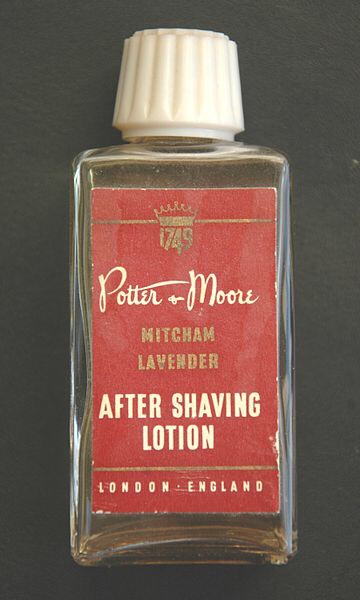
Author Motacilla via Wikimedia
The company set up a distillery to extract lavender oil in Eveline Road, Mitcham – overlooking what is now known as Figges Marsh. The business grew and flourished – and even more so when William Moore’s grandson James took over the helm…. An expert nurseryman with an excellent business head, he bought up surrounding land – by the end of the 1800s Potter & Moore owned 500 acres of land, on which they grew lavender, peppermint, chamomile, roses and pennyroyal….
Pennyroyal image credit Tom Brandt via flickr.com
The lavender was harvested in August; women would cut and bundle (referred to as ‘mats’) and these were then taken to the still room. Work in the fields was hard and poorly paid; in the peak of production during the 1800s the wage was just 10-15 shillings a day for a 14 hour shift – (this is actually good in comparison to what workers in lavender fields further south were paid – they could expect just 8 shillings a day – that’s 40p in today’s money!)….
After the harvest had been taken to the still room the process of distillation could begin. The cut plants would be put into a ‘retort’ – a large vessel partly filled with water; it was then sealed, either with a door or a lid. Next it was heated; as the water reached boiling point a mixture of steam and oil rises – which then passed through a pipe into a condenser. The steam and oil were combined back into a liquid and ran through another pipe to a ‘separator’ – a tank where the oil would float to the top and the water would be allowed to drain away, leaving behind the pure lavender oil…. 3/4 of a ton of lavender plant would produce 11 or 12 pounds of oil ~ but a little of which goes a long way….
James Moore died in 1851 and then the business passed to his illegitimate son, James Bridger. The success of the company continued under Bridger; after his death in 1885 it was bought by W.J.Bush. In 1968 it was merged with two other companies to form Bush Boake Allen – to become the World’s largest supplier of perfumes. The Potter & Moore section of the business was then sold on again – as is so often the case in business it changed hands and became associated with other names several times more…. But on doing a quick search it is soon evident that Potter & Moore is still very much alive today….
The peak of lavender’s popularity can perhaps be attributed to one formidable woman, Queen Victoria ~ she loved it…. This in turn encouraged most other English ladies to follow suit – from the wearing of lavender eau de cologne, to scenting their linen and making tussie-mussies….they couldn’t get enough. Lavender symbolised cleanliness and purity – an important quality in Victorian times…. It is often said that Queen Victoria even preferred lavender jelly to mint sauce with her lamb….
Oil from British lavender was far more desirable than that of plants from other countries such as France – arguably the scent of English lavender is by far the sweetest (and the most superior of this being from the Mitcham area) – and so lavender from England fetched a much higher price….
By the 1930s most of the lavender fields in the Mitcham area had gone. The land was needed to satisfy the demand for housing; another contributing factor to the industry’s demise was that English grown lavender’s prices were being heavily undercut by French growers…. But the third and final nail in the coffin for Surrey’s lavender presented itself in the form of disease….Lavender Shab Disease to be precise – a fungus that kills the stems of the plant, the first signs being that the shoots wilt suddenly, even when there is no shortage of water….
Potter & Moore took the necessary measures to protect their own business and by the 1930s had relocated their operation to East Anglia. So, it was to be that the English lavender industry was to fall into decline, with the only real exception being Norfolk lavender – and it was to stay this way until approximately 20 years ago….
However, the Mitcham area has always remained proud of its lavender heritage; the local football team – Tooting and Mitcham United FC – have it on their badge and Merton Council features in on their coat of arms…. It must have been a great delight to many when lavender returned on a commercial scale to the region…. The owner of Mayfield Lavender had connections with Yardley, an old and established perfumery….and now Mayfield Lavender is a flourishing business in its own right – producing a varied range of lavender products, from bath and beauty preparations, essential oils to scented sachets, lavender tea and even shortbread. However, it wasn’t all plain sailing from the onset; in the first year magpies and crows destroyed nearly 70,000 young lavender plugs – and planting had to start all over again the following year….
Early morning at Mayfield Lavender Image credit: Beeches Photography – Rudoni Productions via flickr.com
Maybe Mayfield Lavender happened to read the market correctly and recognised an opportunity as English lavender began to rise in popularity once again – or perhaps the likes of Mayfield are responsible for this resurgence …. Whichever reason it cannot be denied English lavender is once again very much in vogue…. In fact, it is now French lavender that is in decline….
Our revived love of lavender includes all the old traditional ways of using it: perfumes, cosmetics, room and laundry fresheners, dried flower arranging or even as a natural confetti at weddings ~ but we are also embracing its merits in the kitchen too…. Its culinary use doesn’t just stop at the lavender jelly Queen Victoria favoured…. Use it in salads, soups, meat and seafood dishes, desserts, confectionery – even cheese making! In baking it is especially popular – lavender cookies are a favourite…. Use the leaves as you would rosemary to flavour meat and vegetables and the flower buds for baking…. And of course, lavender produces abundant nectar, making a glorious high quality honey….
We can’t all grow lavender on a commercial scale but for those of us with a garden it makes a wonderful addition – both for its beauty and the wealth of uses its harvest can bring…. Lavender thrives best in dry, well-drained soil – either sandy or gravelly and it prefers full sun. It needs pruning once a year to prevent it from growing ‘leggy’ and becoming too woody – but apart from that it needs little care…. Grow it in the garden for fewer slugs, snails and aphids….but at the same time attract butterflies and bees….
“Lavender blue, dilly~dilly
Lavender green
If I were king, dilly~dilly, I’d need a queen”…
Please…. If you have read this post through to the end – then I assume you have found it of interest and I hope you’ve enjoyed it…. If you have found this via Facebook a little ‘like’ for the Cottage Capers page would be very much appreciated…. I’m not trying to sell you anything – I’m simply a blogger trying to establish myself…. Many thanX….

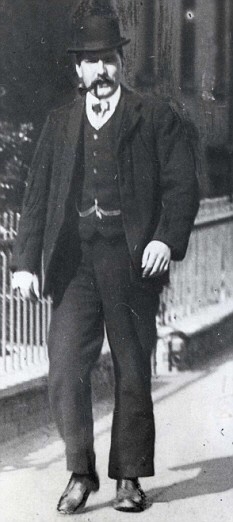
Before the death penalty was abolished in Britain the job of hangman was surprisingly quite a sought after position… Obviously a successful applicant had to meet a strict criteria; as well as having a strong sense of discretion he had to work well under pressure, be psychologically sound and have a cast-iron stomach. Whilst every effort was made to recruit the right candidates occasionally situations arose that were beyond the tolerances of even those most qualified…. One such instance was that of the execution of Edith Thompson, it affected everyone present who witnessed it – not least the hangman John Ellis – the whole episode had a profound affect on him….
John Ellis was born on the 4th of October 1874 in Balderstone, Rochdale in Lancashire. As a young man he had several casual jobs, labouring around the Manchester area, working in mills and even trying his father’s trade of barber and hairdresser…. Later, after getting married he was to open a newsagents, which he ran with his wife and children…. But it was whilst working in a textile factory, when during a break he and some colleagues were discussing a recent hanging case, he announced “that’s the kind of job I’d like”…. His work mates laughed and pooh-poohed the idea. Ellis on a previous occasion had been heard to say “I couldn’t kill a chicken, and once when I tried to drown a kitten I was so upset for the rest of the day that my mother said I was never to be given a similar job again”….
It was at the age of 22 that Ellis applied to the Home Office to become an executioner – he passed the initial background checks and attended training at Newgate Prison. His wife was shocked – she asked “why on Earth do you want to be an executioner?” – his mother was equally outraged….
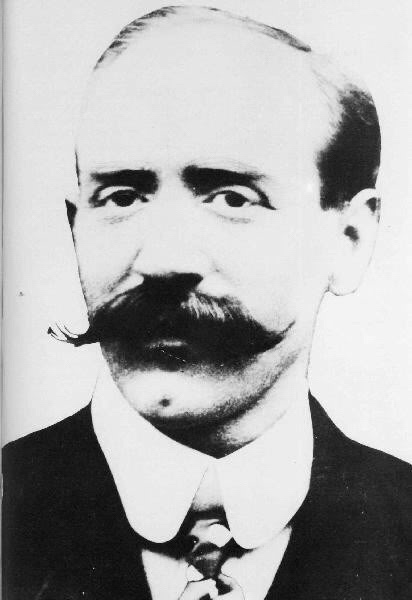
Ellis had a 23 year career as an executioner, from 1901 until 1924. The first hanging he attended was in the role of assistant to William Billington in December 1901; from 1907 he then served as chief executioner and was involved in 203 executions. He was committed to ending the condemned person’s life with humanity and with as little fuss and pain as possible – but at the same time he was a strong believer in capital punishment and would often attend trials in the capacity of observer….
John Ellis – Source: own work author Loubreezer via Wikimedia
Ellis performed many high-profile executions in his time, including several members of the IRA in the 1920s. He hanged George Smith on the 13th of August 1915 at Maidstone Prison. Better known as the ‘Brides in the Bath’ case, Smith married then drowned Alice Burnham, Beatrice Constance, Annie Mindy and Margaret Elizabeth Lofty in succession, for financial gain on account of their wills and insurance policies…. Ellis also hanged at Pentonville Prison on the 23rd of November 1910 the infamous Dr. Hawley Harvey Crippen. Dubbed the ‘Crime of the Century’ Crippen was caught by the use of the new wireless telegraph system, whilst he was making his escape to Quebec, Canada aboard S.S.Montrose – with his new lover Ethel Le Neve, after he had murdered his wife, Cora Crippen….
For all his conscientiousness there were times when Ellis’s colleagues claimed to have found him difficult to work with. One altercation he had led to a very prominent executioner of the time, Henry Pierrepoint, being struck off the Home Office list of executioners. Pierrepoint had arrived at Chelmsford Prison to perform a hanging on the 13th of July 1910 slightly worse for wear and picked an argument with his acting assistant, John Ellis. Things escalated and others present had to intervene to prevent Pierrepoint from beating Ellis up. As a consequence the Home Secretary of the time, Winston Churchill, had Pierrepoint removed from the list. Pierrepoint’s brother, Thomas, also an executioner (and father of Albert – Britain’s longest ever serving executioner) stated that it was impossible to work with Ellis….
John Ellis may have been cool and collected within his role as executioner but once in a while a case would come along that would ‘rattle’ him…. One such was that of 18-year-old Henry Jacobs, who was convicted for the murder of Lady Alice White in a robbery in 1922. Ellis had watched young Jacobs playing cricket with warders in the prison…. Another case that ‘got’ to him was the execution of Edith Thompson….
Born Edith Jessie Graydon on the 25th of December 1893 in Dalston, London, Edith was the eldest of five children. Her father, William Eustace Graydon was a clerk with the Imperial Tobacco Company and his wife, Ethel Jesse Liles, the daughter of a police constable. Edith had a happy childhood, she showed a talent for acting and dancing and excelled at arithmetic in school. She left education in 1909 and joined a firm of clothing manufacturers. In 1911 she started working for Carlton and Prior, a milliners then based in the Barbican – and she did very well for herself. She was promoted to become chief buyer for the company and regularly made trips to Paris….
It was in 1909, when she was just 15-years-old, that Edith met Percy Thompson, who was three years older than her. After a six-year engagement they married in 1916 at St. Barnabas in Manor Park. At first the couple lived in Westcliff, Southend-on-Sea, Essex but then bought 41, Kensington Crescent, a fashionable address in Ilford – they were doing OK….
Edith’s brother had a school friend, Frederick Edward Francis Bywaters, he was nine years Edith’s junior. Upon leaving school Freddy joined the merchant navy and was soon full of tales of his exotic travels – Edith found him exciting – he wasn’t a bit like her boring 29-year-old husband….
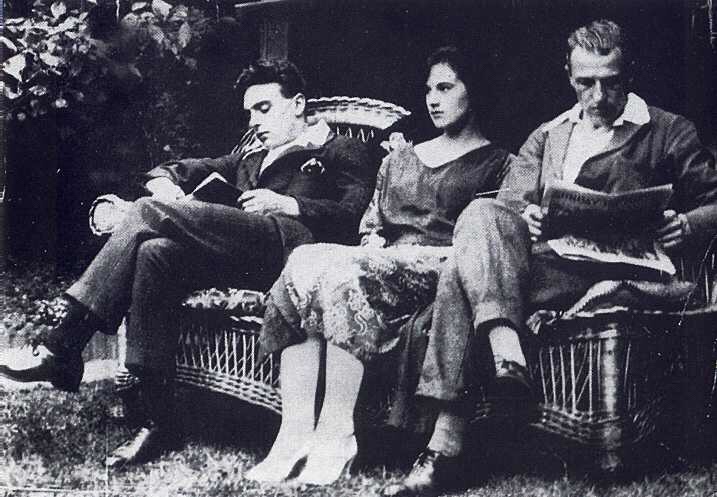
Left to right: Freddy Bywaters, Edith Thompson, Percy Thompson Courtesy of Associated Newspapers Public Domain
Freddy was to accompany the Thompsons and other members of Edith’s family on a holiday to the Isle of Wight. Percy took a shine to him and invited him to lodge with them at their Ilford home; it did not take long for Edith and Freddy to become lovers…. Percy discovered their affair and naturally was angry…. Freddy demanded that Percy divorce his wife – Percy’s response was to throw Freddy out and then give his wife a thorough beating – actually throwing her across the room….
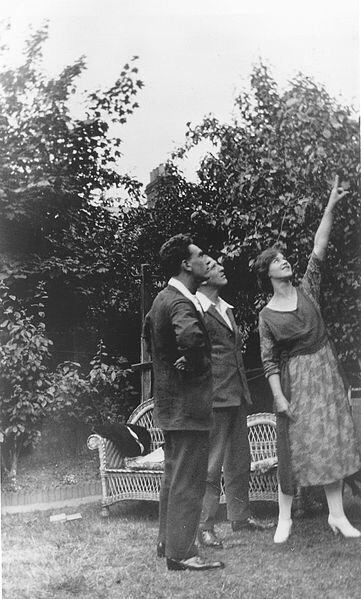
In the garden at 41, Kensington Crescent, Ilford Author: Uclerew via Wikimedia
Freddy returned to sea and was away for a year, from September 1921 to September 1922. He and Edith exchanged frequent letters and upon his return they met….
It was on the 3rd of October 1922 that the Thompsons attended a performance at the Criterion Theatre, Piccadilly Circus, London. Afterwards they returned to Ilford by train and then as they were walking home from the station they were attacked by a man. Edith was knocked to the ground and in the struggle that followed Percy was fatally stabbed….and the attacker fled….
When the police arrived Edith was hysterical. She told them she knew who had done it and named Frederick Bywaters; she told them of her history with him – believing herself a witness and that she was doing the right thing…. Freddy was arrested; from the onset he co-operated well with the police, even leading them to where he had hidden the murder weapon. They also found amongst his possessions the letters Edith had written to him….she was duly arrested as an accomplice. Freddy insisted that Edith was not involved and continued to do so throughout the duration of the trial that was to follow….
The trial began on the 6th of December 1922 at the Old Bailey before Mr. Justice Shearman; Freddy continued to co-operate…. “I waited for Mrs Thompson and her husband. I pushed her to one side, also pushing him into the street. We struggled. I took my knife from my pocket and we fought and he got the worst of it”…. When questioned as to why he had done it…. “The reason I fought with Mr Thompson was because he never acted like a man to his wife. He always seemed several degrees lower than a snake. I loved her and I could not go on to see her leading that life. I did not intend to kill him. I only meant to injure him. I gave him the opportunity of standing up to me like a man but he wouldn’t”….
The letters were used as evidence at the trial as to Edith’s involvement. Edith had written over 60 intimate letters to Freddy, in them she used endearing terms, such as ‘darlingest’ and ‘darlint’. She referred to times she had tried to murder her husband by attempting to poison him and adding ground glass to his food. She had also sent press cuttings about murders committed through poisoning. Freddy told the Court he did not believe that Edith had really tried to kill her husband – he thought she was fantasising…. Another admission Edith made in her letters was that she had performed an abortion upon herself….
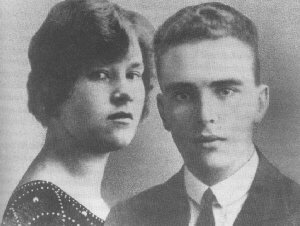
Edith and Freddy Public Domain
On summing up Mr. Justice Shearman described the letters as “full of outpourings of a silly but at the same time, a wicked affection”…. Obviously being a man of high Victorian morals he emphasised the adultery. In concluding he instructed the Jury…. “You will not convict her unless you are satisfied that she and he agreed that this man should be murdered when he could be, and that she knew that he was going to do it, and directed him to do it, and by arrangement between them he was doing it”…. The law of the time stated that if two people wished the death of another person and one carried out the deed, they were both guilty….
The Jury retired to consider….two hours later they returned a guilty verdict on both of them. Even after the verdict had been read out Freddy noisily defended Edith; the death sentence was passed….
Edith was returned to Holloway Prison and Freddy to Pentonville; both lodged appeals – both were refused. Although Edith was an adulteress, had undergone an abortion and had supposedly attempted to poison her husband, the public and press (who had up until now been totally against her) changed their opinion. A campaign for a reprieve was launched and a petition with a vast amount of signatures was presented to the Government – but still the Home Secretary refused to reprieve her…. All the while Freddy continued to protest that he alone had killed Thompson….
At 9am on the 9th of January 1923 Edith and Frederick were hanged in their respective prisons. Freddy faced his execution with bravery; his hangman was William Willis – until his last moments he still proclaimed Edith’s innocence. Meanwhile, Edith was a hysterical mess — she had lost all control of herself – she screamed and sobbed….
Edith had been convinced that she would get a reprieve – as had most of those around her. On the morning of her execution she had to be heavily sedated; when John Ellis arrived to pinion her arms she was only semi-conscious. He too had thought that she would be granted a reprieve….
Edith had to be carried to the gallows by four warders, she then had to be supported on the trapdoor whilst Ellis made his final preparations. The procedure of the execution was carried out…. The after report stated that the cause of death was fracture/dislocation of the neck and mentions some bruising. In this respect there was nothing untoward with regards to the execution procedure itself – but it was what else that happened that had such an adverse affect on all of those present….
The method of hanging used was the ‘long drop’ – as her body fell it was if though her innards came away from within her…. Blood poured down her legs…. Depending on which account of the events you read there are various reasons suggested as to why this happened. Some say she was pregnant – she had in fact gained weight whilst in prison, despite having hardly eaten…. Others think it is possible she suffered an inversion of the uterus – she had admitted to having an abortion, perhaps damage had occurred then…. If she had been pregnant she would undoubtedly have known as she would have been at least 3 months gone by then and used the pregnancy to her advantage in getting a stay of execution – and increase the likelihood of a reprieve…. Later research, carried out on condemned women in Germany just before WW2 showed that the stress these women were under often stopped them from menstruating and then the shock of the actual hanging could bring on an excessively heavy bleed. Maybe this is what happened to Edith…. Whatever the reason it is why all future condemned women in British prisons were required to wear heavily padded underwear at the time of their execution to prevent another similar occurrence….
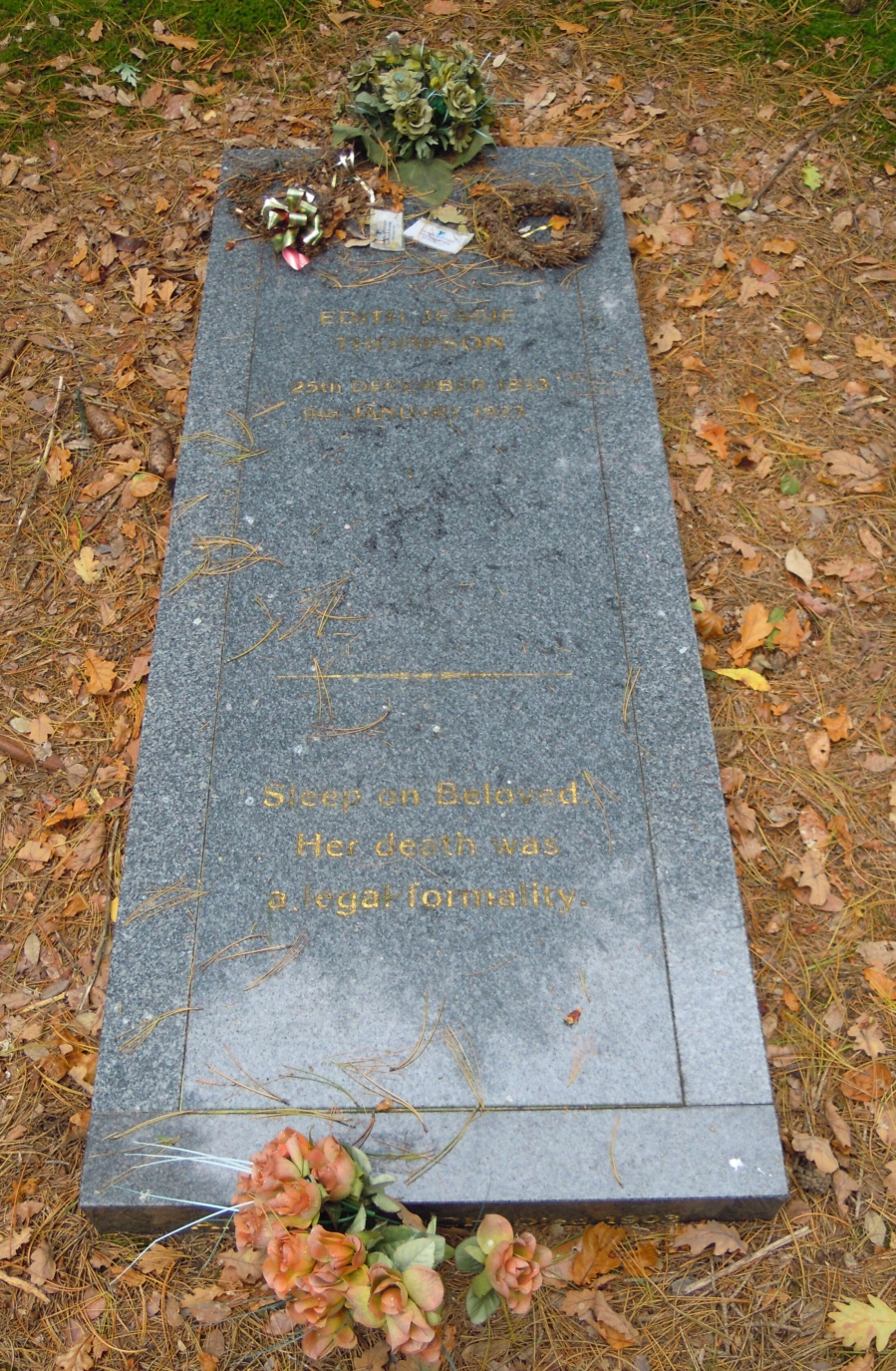
Edith was buried in the precincts of the prison but in 1970 when Holloway was rebuilt her remains were moved to Brookwood Cemetery, in Surrey….
Grave of Edith Thompson Public Domain Source: own work by original uploader Jack1956 via Wikimedia
Several of the prison officers who were present at that fateful hanging took early retirement. Ellis himself resigned from the post of hangman the following year, blaming ill-health – some believe it was because of Edith Thompson’s execution. However, despite this he carried out a further eleven executions before finally tending his resignation in March 1924. The last execution he carried out was that of John Eastwood at Armley Prison, Leeds on the 28th of December 1923, for the murder of his wife….
Ellis started to drink heavily and became depressed; later in 1924 he attempted to take his own life for the first time by shooting himself in the jaw. As suicide was a crime at the time he was convicted for 12 months and the Judge asked for and received an undertaking that he would never attempt such a thing again….
John Ellis went on to write his memoirs – “Diary of a Hangman”….and even attempted at an acting career, playing the part of William Marwood (the executioner) in a play entitled “The Life and Adventures of Charles Peace” which featured a mock hanging. The play was ill-received being regarded as being in bad taste and closed after just a few days…. Ellis had put his own money into the production and so took his ‘gallows’ out on the road – putting on performances at venues such a seaside resorts and charging sixpence a view…. This particular public may have loved it – but the Government did less so as it made a mockery of the justice system…. Ellis claimed there was “no pension for the hangman” and he had to earn a living….
Ellis continued to have financial problems, still suffered from depression and all the while carried on drinking. It was on the 20th of September 1932 after one particularly heavy bout of drinking that he threatened to behead his wife and daughter with a razor…. He proceeded to turn the razor on himself, slashed his own throat, almost decapitating himself….
During his role as executioner Ellis felt it was his duty to ‘help’ the poor wretches through their ordeals…. It seems there was nobody there to help him through his own wretched ordeal. After he had given 23 years of service nobody from the Home Office even attended his funeral….
Please…. If you have read this through to the end then I assume you have found it of interest and I hope you’ve enjoyed it…. If you have found this via Facebook a little ‘like’ for the Cottage Capers page would be very much appreciated…. I’m not trying to sell you anything – I’m simply a blogger trying to establish myself…. Many thanX….
Many of us would have read Thomas Hardy’s Tess of the d’Urbervilles at some point – if not we’ve probably seen a film adaptation – be it the one directed by Roman Polanski or another version…. There is little doubt that we have all heard of Thomas Hardy and his story of a complicated love triangle between Tess Durbeyfield, Angel Clare and Alec d’Urberville….which ends in murder, for which Tess takes the consequences…. A story of a beautiful young woman who kills the man who ruined her life….
Scene from Tess of the d’Urbervilles – a 1913 American silent drama film – Public DomainThomas Hardy between 1910 & 1915 – Public Domain
Hardy’s Tess of the d’Urbervilles was published in 1891, 35 years after a 16 year old Thomas Hardy witnessed the hanging of convicted murderess Martha Brown, at Dorchester Prison in 1856….
Elizabeth Martha Brown (nee Clark) was born in 1811, to a dairyman, John Clark and mother, Martha…. There is little information available on her early life but she married Bernard Bearn of Powerstock and had two sons who died in infancy….she became a widow in 1851…. Martha met John Brown, some 20 years her junior when they were both working as servants together…. They married – she was an attractive older woman, with beautiful curly hair, looking younger than her years – and she had some money put by – which is perhaps why he married her. They lived in Birdsmoorgate, in the Marshwood Vale, near to Beaminster in Dorset. From the onset it was a turbulent marriage, she was to express regret at marrying him…. Before long she was to suspect him of having an affair with a neighbour, a married woman named Mary Davies….some sources say she actually caught them in bed together…. Understandably they had a row – he stormed out and later came home drunk ~ another arguement ensued…. He lost control and hit her with his whip – this was just too much for Martha, she retaliated and hit him over the head with an axe that they used for chopping coal….
Upon her arrest Martha claimed that a horse had kicked her husband in the head; her story was not believed and a murder charge was brought against her. She came to trial at Dorchester Assizes; a guilty verdict was returned and she was then taken to Dorchester Prison to await execution, which was set for 9 am, Saturday the 9th of August 1856 – just 13 days after the death of her husband….
There was much public sympathy for Martha; the case caused sensationalism in newspapers of the time, sparking debates as to the validity of capital punishment and the treatment of women within the justice system. She was a victim of abuse who had been pushed to the edge….but was caught up in her own lie – that a horse had kicked Brown in the head — meaning that the Home Secretary was to refuse a reprieve; diminished responsibility as a defence did not come into English law until a century later…. Martha admitted her guilt whilst in her prison cell – in her confession she said ~ “I was much enraged, and in an ungovernable passion, on being so abused and struck, I directly seized a hatchet which was lying close to where I sat, and which I had been using to break coal with to keep up the fire and keep his supper warm, and with it I struck him several violent blows on the head. I could not say how many”…. Martha would have been attended by two matrons (female warders) in her prison cell and would have been looked after well; she was also frequently visited by a chaplain, the Reverend D. Clemenston….
Martha’s executioner was to be our old friend William Calcraft ~ Calcraft and his assistant travelled to Dorchester by train the day before to make their preparations. The gallows were erected over the gates of Dorchester Prison the night before….in the place that is today the car park in North Square, Dorchester….
It was a grey drizzling start to the day on Saturday the 9th of August but still a crowd of between three and four thousand gathered to witness the execution; it was quite rare for a woman to hang by this time…. Martha chose to wear a long, close fitting black silk dress ~ she shook hands with the officials at the prison gates and then climbed the first set of steps to the scaffold….a total of 11 steps. Here she was met by Calcraft; he pinioned her arms in front of her and then led her up the remaining 19 steps to the gallows and finally on to the trapdoor. Next he placed a white hood over her head and the noose around her neck…. Calcraft turned and started back down the steps to withdraw the bolts of the trapdoor (this was a time prior to there being a lever) – it was at this point he had to be reminded that he had forgotten to pinion her legs ~ decency always being of the utmost importance in Victorian times…. Calcraft returned and secured her legs ~ she all the while stood poised and with dignity on the trapdoor, with a male warder on either side….
Rain had made the hood covering Martha’s head damp – it clung to her face accentuating her features….and no doubt would have made breathing difficult for her. Her dress would have been moulded to her body – causing her to resemble a statue….
Calcraft descended the steps and pulled the bolts; Martha dropped a foot or two ~ there was a ‘thud’ and for a few seconds she struggled ~ and then lost consciousness. At least she was spared the agonising and humiliating 10 to 20 minutes ordeal that accompanied some of the executions conducted by Calcraft – which he engineered to entertain his audience…. In fact Calcraft was later quoted as saying that he “never saw a criminal die so easily”…. Martha Brown was the last woman to be publicly hanged at Dorchester Prison….
To the 16 year old Thomas Hardy the hanging of Martha was a mesmerising sight. He later wrote “what a fine figure she showed against the sky as she hung in the misty rain, and how the tight black gown set off her shape as she wheeled half round and back”…. Of the hood that covered her head he said “I saw – they had put a cloth over her face – how, as the cloth got wet, her features came through it. That was extraordinary”…. Hardy’s experience of the day was to haunt him all of his life, he was still writing about it in his eighties. He was morbidly fascinated with executions; just two years after the hanging of Martha he was to witness another….that of 19 year old James Seale. He was executed for the murder of Sara Guppy, aged 23, on the 10th of August 1858. Fire had been discovered billowing from Sara’s cottage and she was found inside with her throat slit – the suspicion fell on Seale….
Thomas Hardy wrote some 70 years later after witnessing Martha’s death that he was ashamed to have been at the hanging. In a letter to his friend, Lady Hester Pinney, he stated “my only excuse being that I was but a youth, and had to be in the town at that time for other reasons”….
In his book Tess of the d’Urbervilles Hardy does not describe Tess’s death in detail – instead he describes how onlookers watched as a black flag was raised…. “A few minutes after the hour had struck something moved slowly up the staff, and extended itself upon the breeze. It was a black flag. ‘Justice’ was done”….
Martha Brown would have been buried close to the point of her execution, at the outside walls of the prison precincts. She would have been 1 of 47 buried at Dorchester Prison. The prison closed in 2013, ready to be redeveloped for housing; it was whilst work was being undertaken that human remains were found. The developers wanted to build houses over where the remains lay – but it was actor Julian Fellowes (he of Downton Abbey fame and President of the Hardy Society) who intervened. He wrote to the Bishop of Salisbury urging the Church to take care of the remains buried at the prison. In March 2018 it was ruled that the bodies would be interred in a common grave at nearby Poundbury Cemetery, with a service of Christian committal….
Fellowes actually went as far to say that he would like to see DNA testing carried out to determine Martha Brown’s remains, so that she could be buried in the village churchyard where Thomas Hardy’s heart is interred….
Hardy’s wish was to be buried in his hometown of Stinsford, Dorset….but he was actually laid to rest in Westminster Abbey. As a compromise his heart was buried at Stinsford….but this is another story….
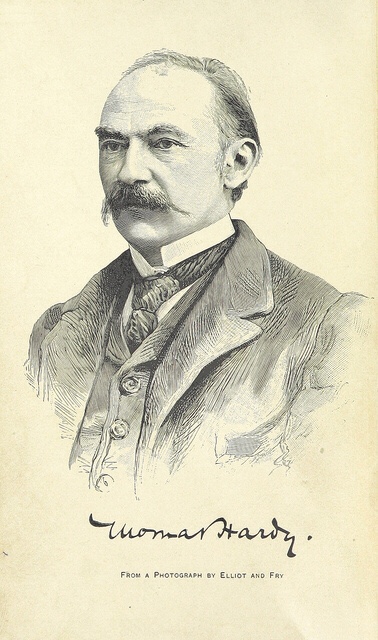
Image: Signed sketch of Thomas Hardy – The British Library via flickr.com
Please…. If you have read this post through to the end then I assume you have found it of interest and I hope you have enjoyed it…. If you have found this via Facebook, a little ‘like’ for Cottage Capers would be very much appreciated…. I’m not trying to sell you anything – I’m simply a blogger trying to establish myself…. Many thanX