On this day in history : 30th July 1966 – Nearly 97,000 spectators, including the Queen and Prince Philip, fill Wembley Stadium to watch England win the World Cup Final….
A further 400 million watched around the world on television – 32.3 million of those were in Britain and it remains the most-ever watched event on British TV…. And it is the only time that England have ever won the World Cup since the start of the tournament in 1930….
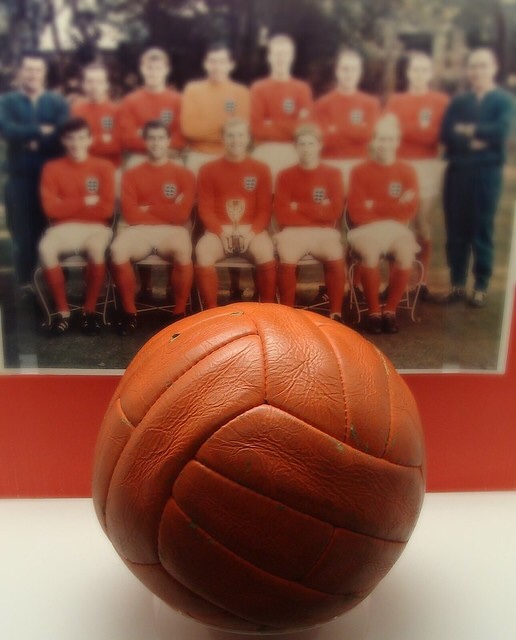
The match ball from the 1966 World Cup Final – Image credit : Ben Sutherland via Flickr
West Germany had taken an early lead – but Geoff Hurst had equalised by half time…. Martin Peters scored a second goal 13 minutes from time – but a free kick to Germany just 15 seconds from full time gave a close range shot to the West German team…. Wolfgang Weber took the shot and put a goal into Gordon Banks’ net – taking the score to 2-2 and the game into extra time….
Eleven minutes into extra time saw Hurst score what was to become a controversial goal – one that has been debated ever since…. Alan Ball put in a cross and Hurst swivelled and shot from close range…. The ball struck the underside of the crossbar and bounced down….leaving Swiss referee, Gottfried Dienst, uncertain if it was a goal…. Only after consultation with his linesman, Tofiq Bahramov, was the goal allowed…. Even to this day photographic evidence has been unable to give decisive confirmation….
However, a third goal from Hurst in the final moments of extra time was deciding…. Geoff Hurst was the first man ever to score a hat trick in a World Cup Final….and the final score was 4-2 to England…. Captain Bobby Moore lifted the Jules Rimet Trophy as it was presented to him by Her Majesty the Queen….
Queen Elizabeth II presents the Jules Rimet Trophy to England’s team captain Bobby Moore – National Media Museum UK – no restrictions
On this day in history : 29th July 1565 – Mary, Queen of Scots, marries her cousin, Henry Stuart Lord Darnley…. It is the second of her three marriages – and is not a popular, or happy union….
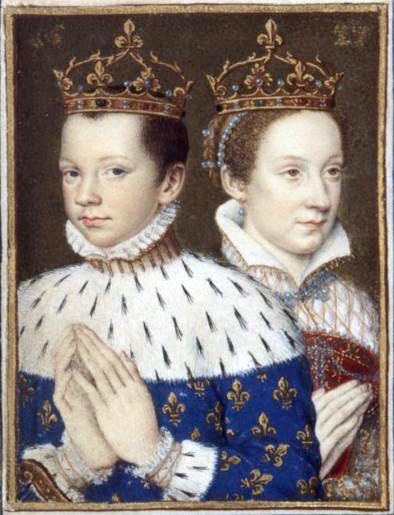
Mary was just 15-years-old when she was first married to Francis II of France – the pair had been betrothed for ten years…. Mary’s father, King James V of Scotland had died when she was five days old – and so her French mother, Marie de Guise, had returned to France, taking her baby daughter with her…. Growing up in the French royal court Mary knew her intended husband well….a union that had been arranged by her mother…. Francis, being the eldest son of King Henry II of France, was heir to the French throne….
Mary and Francis (from Catherine de’Medici’s book of hours c.1558) – Public domain
The wedding took place in Norte Dame Cathedral in 1558; within a year King Henry II had died and the newly wed Francis and Mary became King and Queen of France…. However, on the 5th of December 1560 Francis was to die from an ear infection…. Mary returned to Scotland to claim the Scottish throne – and Francis’s 10-year-old brother became the King of France….
In February 1565 Mary was to meet her cousin, Henry Stuart Lord Darnley, at Wemyss Castle – it was ‘love at first sight’…. After a whirlwind romance they were married in the chapel at Holyrood Palace just five months later; he was 19, she was 22…. Being first cousins it meant the marriage would strengthen their claims on both the Scottish and English thrones…. But not everybody was pleased…. Darnley’s mother, Queen Elizabeth I of England, was far from happy – and both Scottish and English Protestants were angered….
Darnley and Mary Queen of Scots – Painting c.1565 – Public domain
Within two months Mary was pregnant with the future King James VI….but Mary and Darnley’s happiness was not to last…. He may have had the looks – but Darnley was not a pleasant character…. He liked to live the good life, drank too much and was a womaniser…. He was arrogant, jealous and quick-tempered…. It did not take long for him to become a hated man in Scotland….
Darnley in his late teens – Public domain
On the 9th of February 1567 Darnley was found dead outside of a lodging house near to the Kirk O’Field…. A large quantity of gun powder had been used to cause an enormous explosion that had torn the building apart…. Darnley was discovered outside in his nightgown – it looked as though he had been strangled…. Nearby two servants also lay dead – and there was a chair and a length of rope….
1567 drawing of Kirk o’ Field after the murder of Darnley – Public domain
There were those who believed Mary had been involved in Darnley’s murder….she had certainly visited him the night before…. Unhappy in her marriage but being Catholic divorce was not an option – she may have looked for another way out…. Also suspected was James Hepburn, Earl of Bothwell, who was arrested and tried for the murder – only to be acquitted through lack of evidence…. Meanwhile Mary’s popularity was rapidly declining….
Just over three months later, on the 15th of May 1567, Mary married the Earl of Bothwell…. With a force of 800 men Bothwell had kidnapped Mary whilst she was travelling between Linlithgow and Edinburgh and had taken her to Dunbar Castle – saying it was for her own safety…. Stories differ to what happened between the two – some believe Mary gave herself willingly to him – others say Bothwell raped her…. Nevertheless, the pair were married; Bothwell and his first wife, Jean Gordon, had divorced just twelve days earlier….
Portrait of the Earl of Bothwell, 1566 – Public domain
Scottish nobility was deeply divided by the union – to the point of confrontation…. The two opposing sides were to clash at Carberry Hill on the 15th of June; Bothwell fled, Mary was never to see him again – he died as a prisoner at Dragshold Castle, Denmark, in 1578….
Mary herself fled to England – to seek the protection of Elizabeth I – only to find herself a prisoner for the next nineteen years…. On February the 8th 1587 Mary was executed at Fotheringhay for plotting against the Queen…. She was 46-years-old….
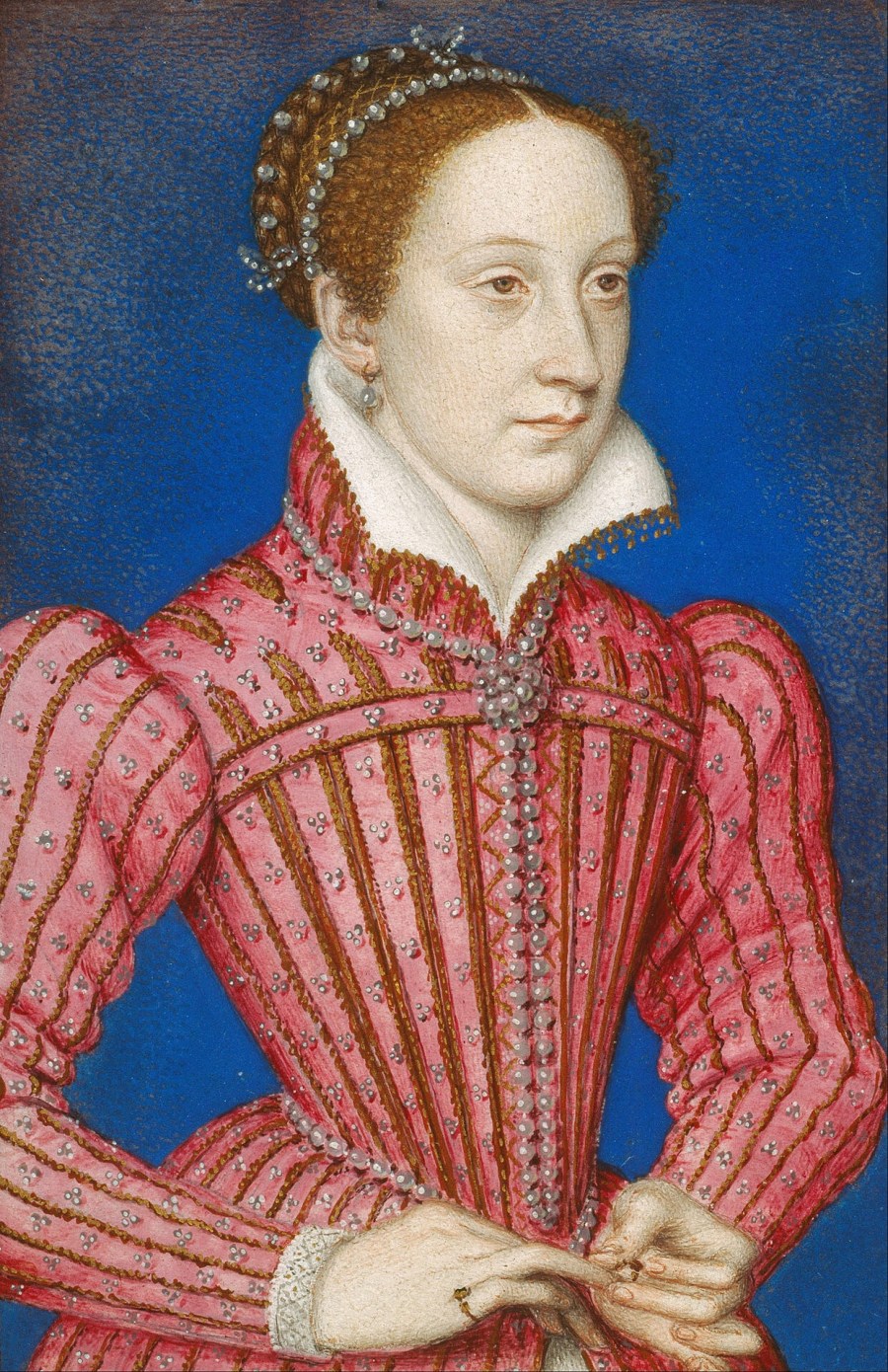
A scaffold was erected in the Great Hall…. The first blow of the executioner’s axe struck the back of her head…. The second severed her neck but not enough to decapitate her…. The executioner cut through and then lifted her head high by her auburn locks with the words “God save the Queen”…. Only it turned out Mary was wearing a wig – her head fell to the floor – revealing short grey hair!
Mary, Queen of Scots – Portrait by Francois Clouet – Public domain
On this day in history : 28th July 1865 – Scotland’s last public execution takes place…. A crowd of reportedly 100,000 watch as Dr Edward Pritchard is hanged for the murder of his wife and mother-in-law….
Public domain
Pritchard, born on the 8th of December 1825 in Southsea, Hampshire was the son of a sea captain….and claimed to have studied at King’s College Hospital, London, graduating in 1846…. How much truth is in this is unclear – but he did manage to secure the position of assistant surgeon onboard HMS Victory – and went on to serve on various other ships, which enabled him to travel the world….
On returning to Portsmouth he met Mary-Jane Taylor, the daughter of a wealthy silk merchant from Edinburgh…. The couple were married in 1851 and went on to have five children….
Pritchard took a job in Yorkshire as a GP…. During this time he wrote several books on his travels whilst in the Navy…. He also wrote about ‘water cure’ – or hydrotherapy….and had numerous articles published in The Lancet…. In 1859 he moved his family to Glasgow – it seems with his reputation tarnished as it appears some kind of ‘incident’ had occurred….
On the 5th of May 1863 a fire broke out in the family home at 11, Berkeley Terrace, Glasgow…. It started in the room of 25-year-old servant Elizabeth McGrain…. Strangely she made no attempt to escape – which would suggest she was unconscious or perhaps even already dead…. No charges were ever brought but there were those who had their suspicions….
The family moved to a new address in Glasgow, 131 Sauchiehall Street….and in early 1865 Pritchard’s wife, Mary, became ill…. Pritchard, aided by his colleague Dr Paterson,treated her at home…. On the 10th of February 70-year-old Jane Taylor arrived to nurse her sick daughter – but on the 28th of February she herself was to unexpectedly die…. Just over three weeks later, on the 18th of March, 38-year-old Mary-Jane also passed away….
Paterson, his suspicions aroused, refused to sign the death certificates, although he did not go to the authorities…. Pritchard however, had no such qualms at signing…. The death certificates recorded that Jane had died from paralysis and apoplexy – and his wife from gastric fever…. Both were buried at Grange Cemetery in Edinburgh….
Although Paterson had not publicly reported his suspicions the authorities did however receive an anonymous letter…. The information in contained was enough to prompt an order for the bodies to be exhumed…. Both were found to contain the poisons tartanised antimony, aconite and opium…. It appears Pritchard had been poisoning the food of his wife and mother-in-law….
The trial of Dr Edward William Pritchard – wood engraving, 1865 – Credit : The Wellcome Collection CC-BY
Pritchard’s five day trial took place in Edinburgh in July and was presided over by Lord Justice Clerk, Lord Glencorse…. He was found guilty and sentenced to hang…. Following his conviction Pritchard wrote a confession but claimed innocence at the murder of Jane Taylor….
He described how he had been having an affair with servant Mary McLeod…. It had begun in the summer of 1863 and in 1864 she had become pregnant…. Pritchard helped ‘produce a miscarriage’…. He claimed his wife knew of the affair – but his mother-in-law had caught the pair together in his consulting room…. He also implicated that McLeod was an accomplice in the murder of his wife….
However, nine days before his execution date Pritchard made a further confession, exonerating McLeod saying he alone was responsible for both of the murders…. At 8am on the 26th of July at North Prison, Saltmarket, Glasgow – in front of a crowd of possibly 100,000 – Pritchard met his executioner….one Mr William Calcraft….
William Calcraft c.1870 – Wheaton (New York) – Public domain
On this day in history : 27th July 1949 – The first jet-propelled airliner, the de Havilland Comet makes its maiden flight out of Hatfield Aerodrome, Hertfordshire….
The first de Havilland DH.106 Comet prototype at Hatfield in 1949 – British official photographer – Public domain
British official photographer – Public domain
The flight lasted for 31 minutes and was piloted by Chief Test Pilot John Cunningham – who was also known as ‘Cats Eyes Cunningham’ – having been a famous night-fighter pilot during World War 2…. He also flew the de Havilland Comet at the Farnborough Air Show in 1949 before the start of its flight trials….
John Cunningham – RAF photographer – public domain
The de Havilland DH106 Comet was the world’s first commercial jet airliner…. With its four de Havilland Ghost turbo jet engines, the quiet, smooth, vibration-free flight that it gave – compared to that of other propellor airliners – was quite a novelty for passengers at the time…. The pressurised cabin, with its large, square, picture windows gave its passengers a feeling of comfort and luxury virtually unknown in travel at that time…. There was a galley that could serve hot and cold drinks and meals, separate men’s and women’s loos and individual life jackets underneath the seats as well as several life rafts stowed onboard….
However, in the first 12 months of service three aircraft were lost in highly publicised accidents – two of which were found to be caused by structural failure due to metal fatigue in the air-frame – causing the planes to break up….
The de Havilland Comets were taken out of service and largely redesigned…. The large square windows were replaced with smaller oval ones, as this was one area identified as a structural weakness….
Sales for the aircraft never truly recovered…. However, an improved Comet 2 and then Comet 3 resulted in the redesigned Comet 4, which made its debut in 1958…. This proved to be a highly successful aircraft, with over 30 years of service…. As well as being used as an airliner it was also adapted for military purposes – such as for VIP travel and medical transport….
Comet 3 G-ANLO in BOAC markings at Farnborough Airshow, September 1954 – RuthAS CC BY-3.0
Dan-Air Comet 4C, exhibited at the Flugausstellung Hermeskeil in Germany – Klaus Nahr CC BY-SA 2.0
On this day in history : 26th July 1745 – The first ever recorded ladies’ cricket match takes place, near to Guildford, Surrey – between the villages of Hambledon and Bramley….
The Reading Mercury reported a few days later….
“The greatest cricket match that was played in this part of England was on Friday 26th of last month, on Gosden Common, near Guildford, between eleven maids of Bramley and eleven maids of Hambledon, all dressed in white. The Bramley maids had blue ribbons and the Hambledon maids red ribbons on their heads. The Bramley girls got 119 notches and the Hambledon girls 127. There was of both sexes the greatest number that was ever seen on such an occasion. The girls bowled, batted, ran and catches as well as most men could do in that game”….
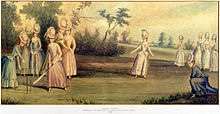
A 1779 cricket match played by the Countess of Derby and other ladies – Public domain
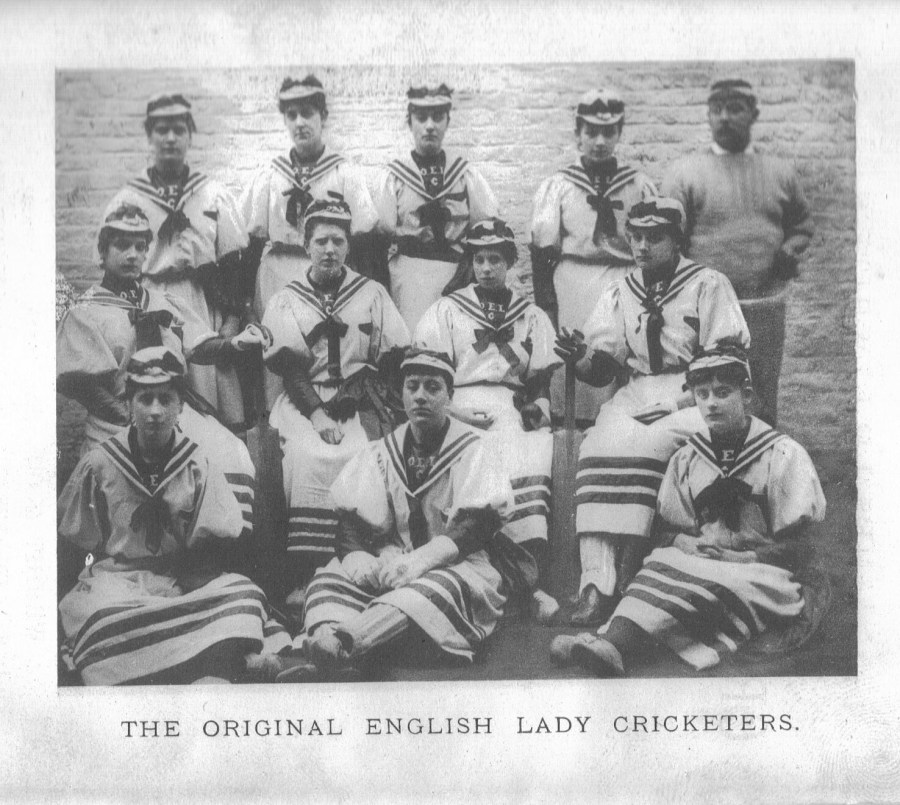
The first known women’s cricket club was formed in Yorkshire in 1887 – and was called ‘The White Heather Club’…. Three years later a team known as the ‘Original English Lady Cricketers’ was formed…. This first-ever recorded paid women’s cricket team toured England between 1890 and 1892 – and apparently made quite a tidy sum…. However, their manager absconded with the money….
The Original English Lady Cricketers, 1890 – Public domain






 Cottage Capers