Blog

On this day in history….28th May 1907

On this day in history : 28th May 1907 – The first Isle of Man Tourist Trophy Motorcycle Races take place – ten laps of a 15 mile 1,430 yard course; a total distance of 158.125 miles….

Motor racing had begun on the Isle of Man in 1904, after an Act of Parliament imposed a restriction of 20 mph on mainland Britain’s roads…. The Secretary of the Automobile Car Club of Britain and Ireland approached the Isle of Man authorities as to holding races on public roads…. Permission was granted for a 52.15 mile Highlands course for the 1904 Gordon Bennett Trial; races were to take place on the open highway but the roads closed to the public for the duration….

Initially the races were for cars only – but in 1905 it was decided to trial motorcycles with a view to forming a British team for the International Motor Cycle Cup Races…. The following year the Cup Races were held in Austria – but amid claims of foul-play and cheating…. As a result an idea was formed for motorcycle races based on the same principle as the car races held on the Isle of Man…. It was proposed the races, in time-trial format, would run in two classes:- single-cylinder with an average 90 mpg and twin-cylinder 75 mpg fuel consumption….
img_3254
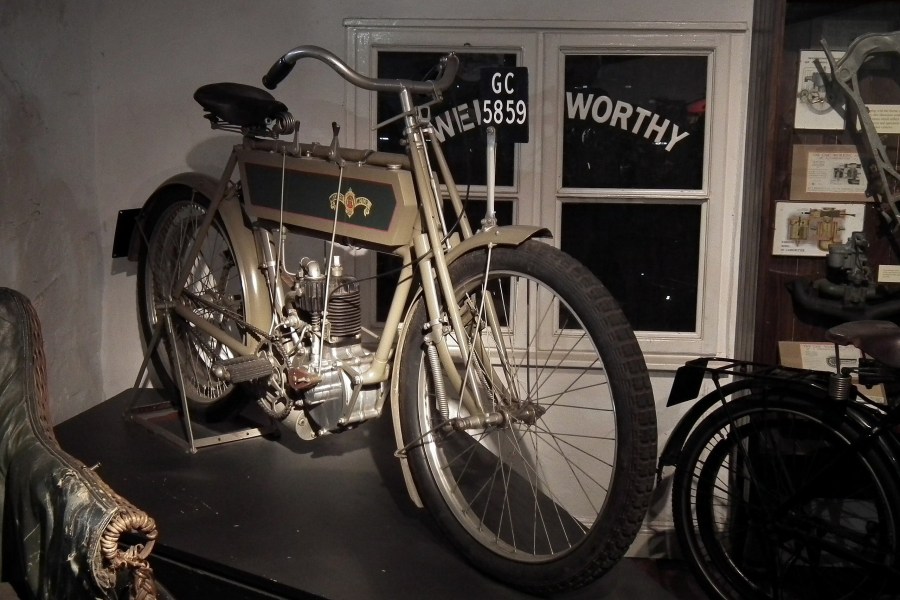
1905 Matchless Motorcycle – image credit: sv1ambo CC BY 2.0

The very first TT race started at 10am on the 28th May 1907 over the ‘St Johns Short Course’ – a total of 158 1/8 miles….25 riders on road-legal touring motorcycles…. From the off the race was peppered with mishaps and dramas; the first lap saw a fall and a puncture, in lap 2 a rider had to stop and adjust a drive-belt, only to retire in lap 3…. During a compulsory 10 minute replenishment stop rider Oliver Godfrey’s Rex motorcycle caught fire….

The race was won by Charlie Collier in the single-cylinder class, on his Matchless motorcycle, in 4 hours, 8 minutes and 8 seconds….his speed averaged at 38.21 mph…. Charlie from Plumstead, London raced Matchless motorcycles along with his brother, Harry – which were manufactured by their father’s company H.Collier & Sons…. Harry also took part in the 1907 race but had to retire in lap 9 with engine problems…. Charlie was to take a second TT victory in 1910….

img_3253
Charlie Collier – Fair use

The twin-cylinder race was won by Rem Fowler on his Peugeot-engine Norton motorcycle…. Rem, a skilled toolmaker from Birmingham, had nearly given up during the race after suffering problems with drive-belts and spark-plugs…. Then on lap 7 he crashed at almost 60 mph after bursting a tyre…. It was only because a spectator informed him he was leading the twin-cylinder race by half an hour that he decided to carry on…. He won his class in a time of 4 hours, 21 minutes and 52 seconds….
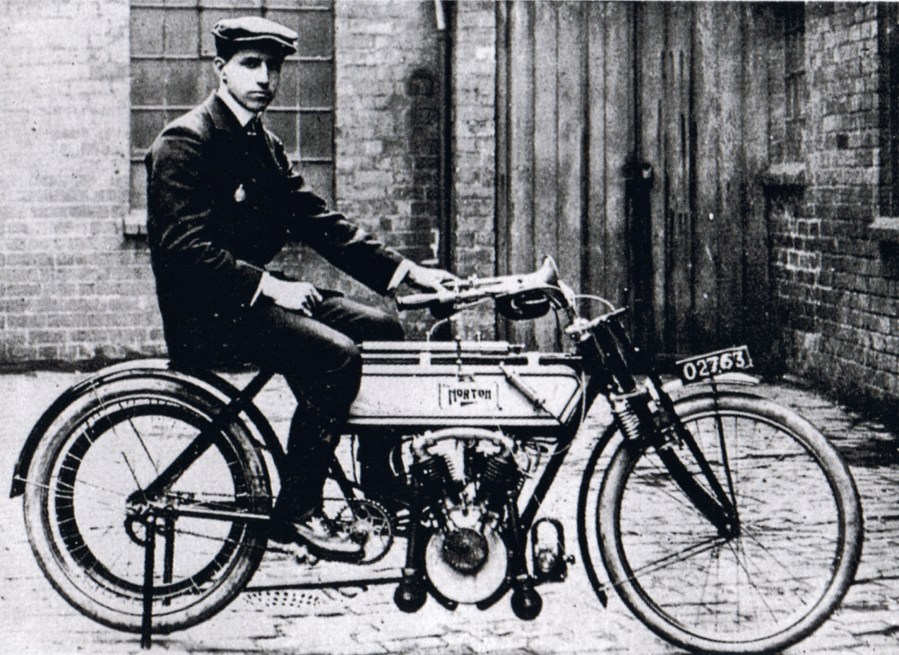
img_3255
Rem Fowler on his Peugeot-engine Norton – public domain

On this day in history….27th May 1919

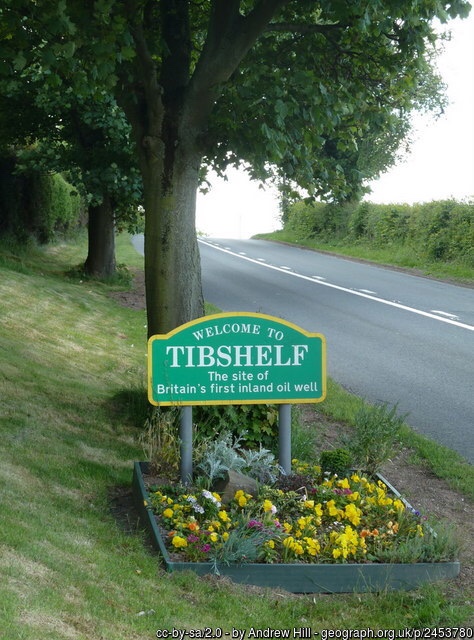
On this day in history : 27th May 1919 – Oil is struck at Britain’s first on-shore oil well, at Hardstoft, near to Tibshelf in Derbyshire….img_3247

In 1911 Winston Churchill was First Lord of the Admiralty….and it was under him that the decision was taken to change the fuel used by Royal Navy ships from coal to oil – giving ships more speed, range and greater efficiency….

At the time Britain had to rely on importing oil from the Empire, such as Burma and Trinidad – and then later mainly from Persia…. When World War 1 broke out obviously demand for oil increased considerably – but there was a problem, in the shape of German submarines….who posed a great threat to the supply….

Panicking the Government commissioned S.Pearson & Sons, a company owned by Lord Cowdray – of the Cowdray Estate in Midhurst, West Sussex – to do a study of potential areas in Britain where oil might be found…. Lord Cowdray also owned the Mexican Eagle Oil Company….

img_3249
Weetman Pearson, Viscount Cowdray – Public domain

Three areas were identified; the Lothians in Scotland, the Potteries Region of Staffordshire and the Derbyshire Coalfields…. It was decided that the Government would fund 11 exploratory wells; 2 in Scotland, 2 in Staffordshire and a further 7 in Derbyshire….

The first drill site was to be at Hardstoft in Derbyshire, on land belonging to the Chatsworth Estate and owned by the Duke of Devonshire…. It took three and a half years before an agreement was signed on the 10th of September 1918 – by now the War was coming to an end….

Britain had no experience of oil drilling and certainly did not have the equipment to do it – so it had to be brought over from the United States…. Hardstoft No.1 was finally ‘spudded’ (meaning drilling commenced) on the 15th of October 1918….using a cable drill rig….

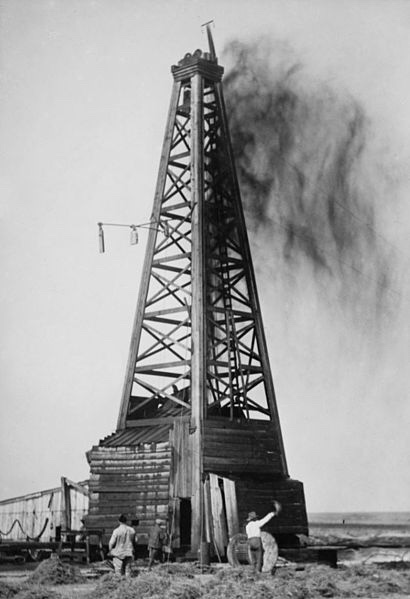
It was on the night of the 27th of May that oil was struck, at a depth of 3,070 ft and the first oil flowed on the 7th of June 1919…. It was proudly announced in the House of Commons that the well was producing 11 barrels a day…. Nowadays some 250 operating wells in the UK can produce up to 25,000 barrels per day…. (based on 2015 statistics)….

img_3252
Oil well gusher in 1922 – Public domain

Legal difficulties and political differences held up production in the early days; a dispute arose over who owned the oil….the landowner or the Crown? The first oil produced had to be stored in a tank on site until the decision was made…. A Petroleum Production Bill was defeated in Parliament after Labour objected to royalties being paid to landowners…. Lord Cowdray was most put out – he told the House of Lords “I had expected a Rockefeller fortune”….

Between June 1919 and December 1927 the Carboniferous Limestone yielded some 20,000 barrels of oil, roughly 50 a week…. It was said to be of a quality to rival the high grade oil of Pennsylvania….img_3248

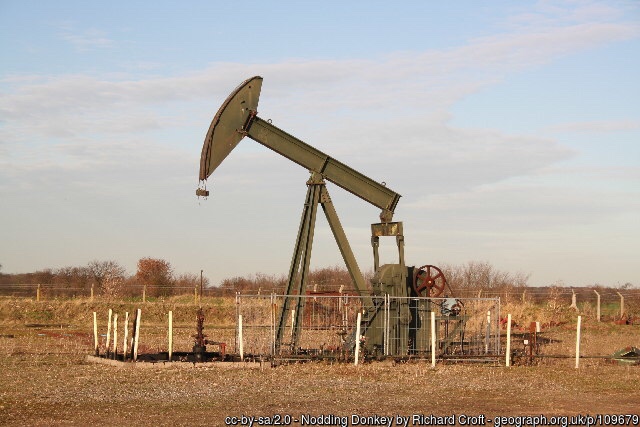
Lord Devonshire took over the drilling operations….a nodding donkey was installed…. Eventually the oil flow began to decline before the well ceased to produce oil commercially in 1945…. The disused well is now situated within the grounds of a plant nursery – aptly named ‘The Oilwell Nurseries’….just a short section of rusty pipe in an oily puddle can be seen….

Ironically the current Lord Cowdray has recently been involved in a dispute when he refused an oil company permission to carry out oil exploration on his land…. Nowadays, oil extraction methods are often very different to the old traditional ways – fracking has become a very controversial topic….

On this day in history….26th May 1950

On this day in history : 26th May 1950 – Petrol rationing finally comes to an end in Britain after its introduction at the beginning of World War 2…. Motorists tear their ration books into confetti on the forecourts….

img_3238
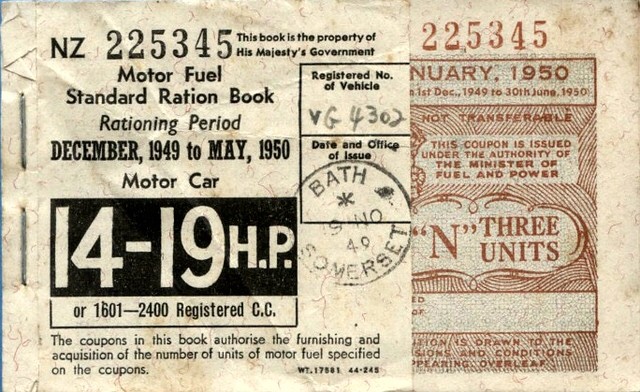
Motorists’ petrol coupons 1949-50 – Image credit: Paul Townsend via Flickr

When war broke out in September 1939 petrol was the first commodity to be rationed…. Coupons could be collected from the Post Office on the 15th of September – but couldn’t be used until the 16th, when rationing came into force…. Two coupons were issued, 1 per month and the vehicle’s registration book had to be produced – as the coupons were issued according to the rating stated in the book…. Each coupon represented a unit and was only valid for the stated period – meaning they could not be rolled-over or hoarded – it was a case of use them or lose them….

By 1942 petrol for private use had been withdrawn altogether….it was only available for work that was deemed essential – and a special permit was needed…. Red dye was added to the fuel for those approved users in an effort to combat the black market….

On the 1st of June 1948 petrol was able to be bought again – but it was rationed once more…. By the end of the 1940s it had become a controversial matter as to whether rationing was still needed and featured heavily as a hot topic of debate in the 1950 general election campaign…. The Conservatives argued that it was no longer necessary to ration whereas the Labour Government insisted Britain could not afford supplies from the United States….

img_3239
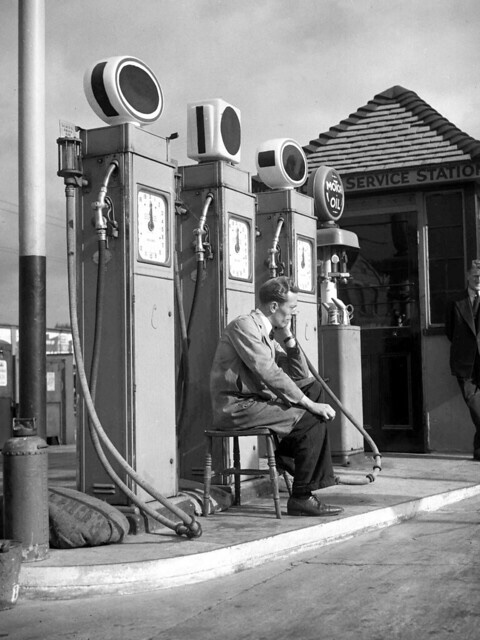
A garage attendant waits for customers at a garage somewhere in London on Sept. 24, 1939, after petrol rationing was enforced. Image credit – Billy Black via Flickr

Labour lost their majority….and it became all too obvious the public were no longer willing to tolerate rationing…. Minister of Fuel and Power, Philip Noel-Barker, announced to Parliament that a deal had been done with two American oil companies…. The Standard Oil Company, New Jersey and the California Texas Oil Company had agreed to supply oil, accept payment in Sterling and re-invest the money in British goods, such as equipment, oil tankers and services….

When the news broke on the 26th of May 1950 that rationing was to be lifted long queues formed at the garage forecourts – some petrol stations ran dry…. Motorists ripped up their ration books in jubilation whilst they waited….

Petrol rationing was reintroduced again in 1957 for a five month period during the Suez Crisis, when Egypt and Syria blocked supplies from getting through….

There was one bright side to petrol rationing though – cars being a rarity on the roads meant kids got to play safely in the streets….

On this day in history….25th May 1962

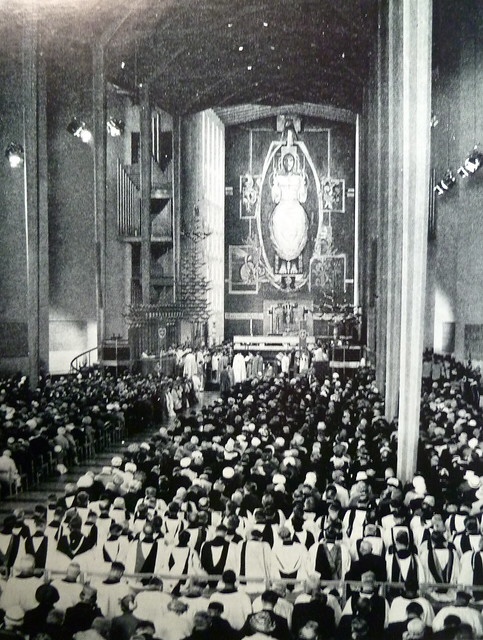
On this day in history : 25th May 1962 – Coventry’s Cathedral Church of St. Michael is consecrated…. The new Cathedral replaces the original St. Michael’s which was destroyed in World War II….

img_3233
Coventry Cathedral 1962 | The Service of Consecration – Herry Lawford via flickr

The Coventry Blitz began during the evening of November the 14th, 1940; it was the most severe bombing raid to hit Coventry during WW2, involving 515 German bombers and was given the name Operation Mondscheinsonate (Moonlight Sonata)…. The intention of the Germans had been to destroy Coventry’s factories and industrial infrastructure….

At around 8pm Coventry’s Cathedral was set on fire by incendiaries; volunteer firefighters managed to put the flames out…. However, more hits followed and new fires started….soon the blaze was out of control….

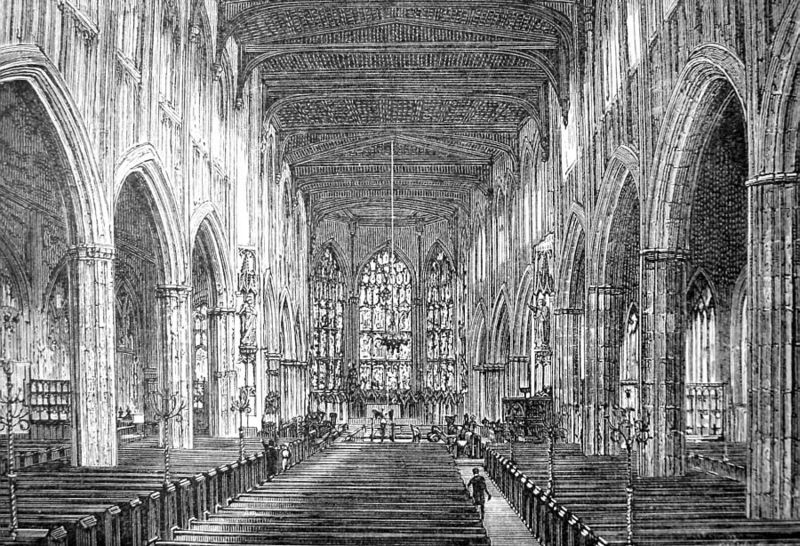
img_3234
Coventry Cathedral in 1891 – public domain

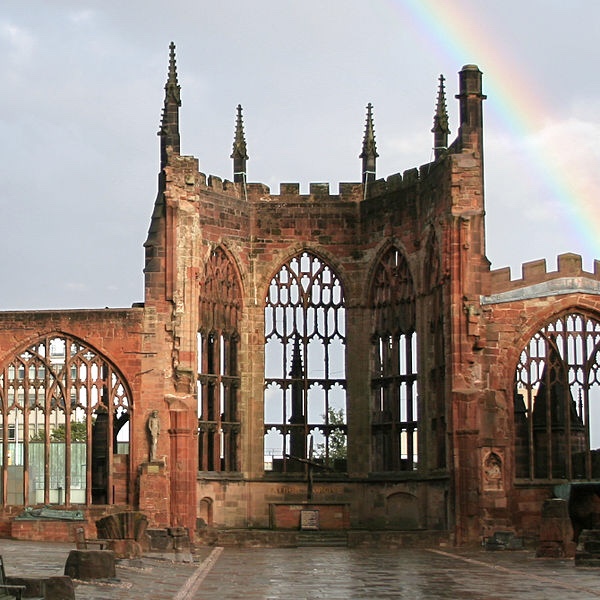
The Cathedral could not be saved; all that remained was the spire, tower and outer wall…. It had been constructed in the late 14th and early 15th centuries and was one of the largest Parish churches in England…. In 1918 it had been given the status of Cathedral…. It now stood a ruin….

img_3237
Photo credit: Andrew Walker CC BY-SA 2.5

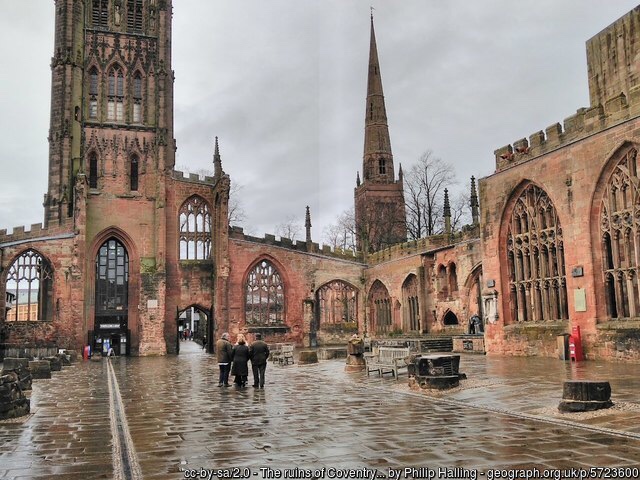
In 1950 a competition was launched to find an architect to design a replacement…. Out of over 200 entries submitted the design of Scottish architect Basil Spence was chosen…. Spence insisted that the old Cathedral, which stood on hallowed ground and with a Grade 1 listing, remain – as a garden of remembrance….img_3236

The foundation stone for the new Cathedral was laid by Her Majesty Queen Elizabeth II on the 23rd of March 1956…. It was built by John Laing and Hollington sandstone was used…. The modern design raised a few eyebrows – but upon opening the Cathedral won the hearts of the people…. For its consecration on the 25th of May 1962 Benjamin Britten composed his ‘War Requiem’….which was premiered in the Cathedral on the 30th of May….img_3235

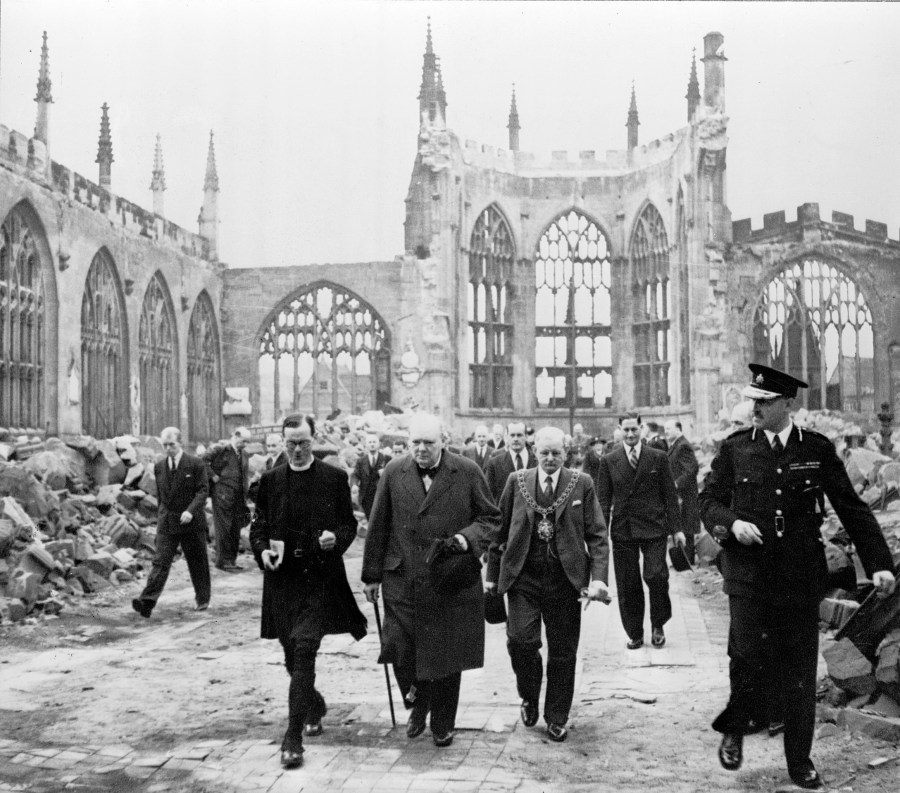
Like its predecessor the modern Cathedral is Grade 1 listed…. The two stand side by side….the ruins a reminder to the pointless waste of war…. Behind the altar of the ruined Cathedral can be seen the words ‘Father Forgive’ – which Provost Richard Howard had inscribed upon the wall after the bombing….

img_3232
Provost Richard Howard (left) with Winston Churchill in the ruins of Coventry Cathedral – Photograph: Horton (Capt) – War Office official photographer – Public domain
img_3231
Image credit: DeFacto CC BY-SA 4.0

On this day in history….24th May 1809

On this day in history : 24th May 1809 – Dartmoor Prison is opened….after being purposely built to accommodate the thousands of French prisoners captured during the Napoleonic wars….

img_3223
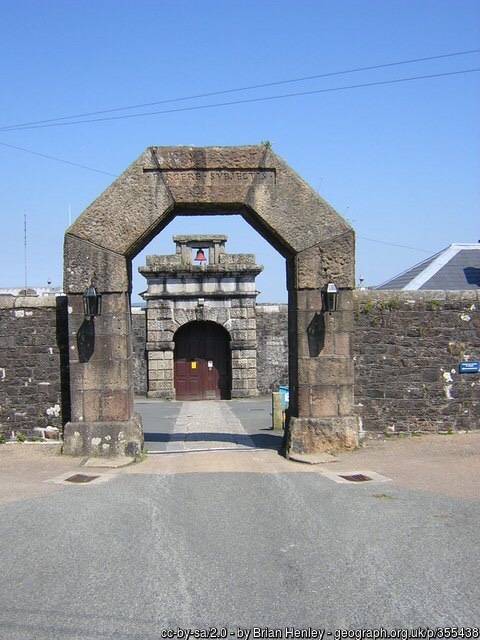
The entrance to Dartmoor Prison

Britain and France were at war between 1803 and 1815…. At first prisoners of war were held in redundant warships that had been converted into floating prisons….they were known as ‘the hulks’…. Conditions onboard were beyond terrible; overcrowding, lack of sanitation, malnutrition, hardly any exercise, little fresh air and rife disease meant the death rate became unacceptably high…. It became obvious a permanent prison was needed on dry land….

img_3229
Beached convict hulk ‘Discovery’ at Deptford – Public domain

Many of the hulks were located at Plymouth and it was decided a good place for the new prison would be at Princetown on Dartmoor – land which happened to belong to the Prince of Wales (the future King George IV)…. The foundation stone was laid on the 20th of March 1806 – and the intention had been that it would be built in 18 months…. However, due to disputes involving labour and the inclement Dartmoor weather the actual construction time was double that….

img_3224
Drawing of Dartmoor Prison published 1879 – Public domain

The first prisoners arrived in May 1809….and by the end of the year the prison was full and had soon become over crowded…. In April 1813 American prisoners of war started to arrive – and the conditions became even worse…. At one point there were almost 6,000 men crammed into the prison; diseases such as typhoid, smallpox and pneumonia claimed many lives…. In all over 1,200 Frenchmen and 271 Americans died…. The dead were buried on the moor….

The wars ended and the prisoners returned to their homelands, the last leaving in early 1816…. The prison remained empty until reopening in 1850 to take convicts…. At first prisoners came from the prison ships on the Thames and at Gosport….the majority had some form of disability – and it was thought the fresh Dartmoor air would do them some good….

img_3230
The ‘Warrior’ hulk – HMS Warrior as a prison ship

New iron cells were constructed, replacing the old stone ones – and gradually the old stone prison buildings were replaced by the Victorian ones which make up much of the prison today….img_3225

At some time around 1852 the graves of the war prisoners were exhumed – and the remains re-buried in two graveyards to the rear of the prison…. This was done on account of the new prison farm which was about to be established….

During the years of World War I the prison became a Home Office work centre….. Conscientious objectors could attend a tribunal to state their objections to serving the Country, on moral or religious grounds…. Sometimes they would be able to sign an agreement to work at a labour camp…. Dartmoor accommodated 1,000 such men….the locks were removed from the cell doors and they were able to move freely around…. Warders were merely supervisors, the ‘Conchies’ wore their own clothes and during their free time they were able to visit the village – although generally they were despised by society – being seen as cowards….img_3226

The prison re-opened as a penal detention establishment in 1920 and housed some of Britain’s most notorious criminals…. Nowadays the prison holds low category prisoners….

img_3228
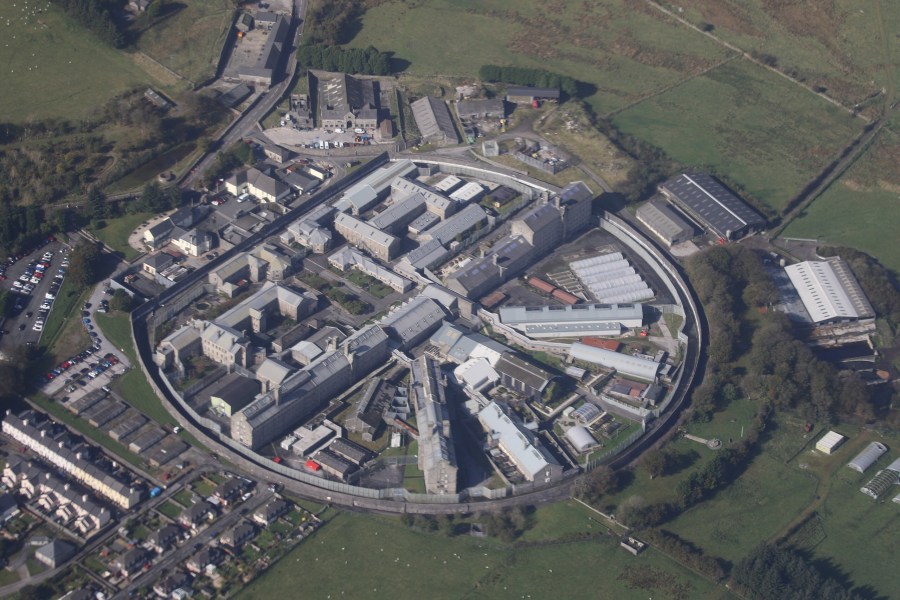
Dartmoor Prison from the air – andrewrabbott CC BY-SA 4.0