Blog

On this day in history….9th May 1671

On this day in history : 9th May 1671 – Irishman Colonel Thomas Blood attempts to steal the Crown Jewels from the Tower of London…. Although caught red-handed he receives a Royal Pardon….

img_3114
Thomas Blood by G. Scott – Public domain

Blood was born in County Meath in 1618 into a respectful family; his father was a blacksmith and his grandfather a Member of Parliament….

In 1642, when the English Civil War broke out, he travelled to England to fight for King Charles I…. However, when it became obvious Cromwell was going to win he switched sides and joined the Roundheads…. After Cromwell came to power Blood was given a large estate and made a Justice of the Peace….
img_3115
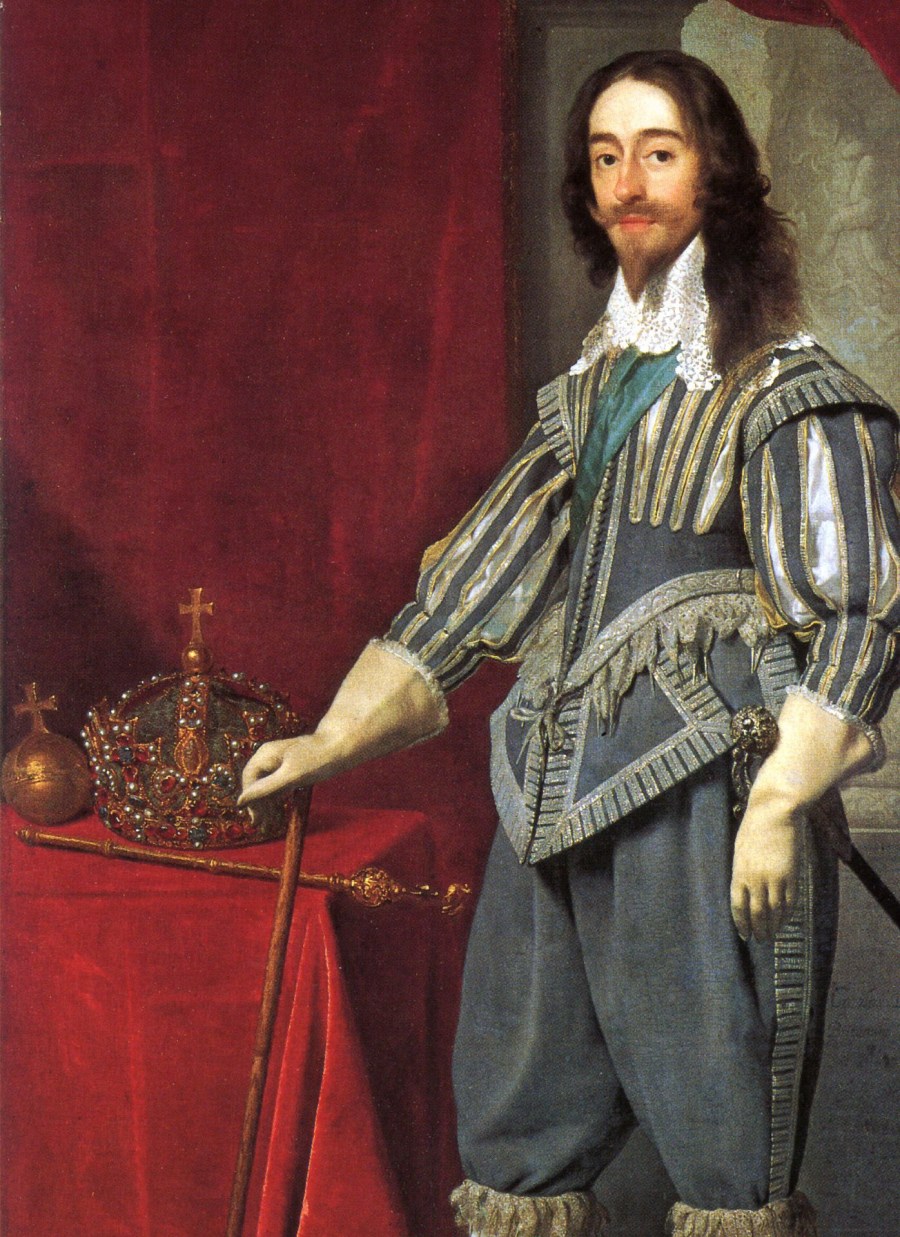
Charles I standing beside Henry VIII’s crown and a gold orb and sceptre, 1631 – Daniel Mytens – Public domain

When Charles II was restored to the throne Blood fled back to Ireland, taking with him his wife and son…. Back on Irish soil he joined a group of Cromwell supporters and a plan was hatched to seize Dublin Castle and kidnap Lord Ormonde…. Only the plan failed and Blood was to flee once again, this time to Holland….

In 1670, under the name of Thomas Ayloffe, he returned to London and set up as a ‘doctor’ in Romford…. Later that same year another plot to capture Lord Ormonde once more failed – and so Blood came up with the idea of stealing the Crown Jewels….which had a reputed value of £100,000 – a colossal amount of money in the day….

One April day in 1671 he visited the Tower of London dressed as a parson and was accompanied by a female companion, possibly his wife…. For a small fee it was possible to request to view the Crown Jewels…. The Keeper of the Jewels was one Talbot Edwards, who lived with his family on the two floors above the basement where the Jewels were kept….

Blood’s ‘wife’ feigned feeling unwell, complaining of a violent stomach-ache…. She was taken upstairs to the Edwards’ apartments to rest…. A few days later Blood returned with four pairs of white gloves for Mrs Edwards to say ‘thank you’…. A friendship developed between Blood and the family….and it was suggested that a meeting between Blood’s wealthy ‘nephew’ and the Edwards’ daughter, Elizabeth, should take place…. So, a breakfast date was arranged….

At 7am, on the morning of the 9th of May, Blood arrived with his ‘nephew’ and two other men – one of which was his brother-in-law, Hunt…. Whilst his ‘nephew’ was getting acquainted with Elizabeth the others asked to see the Jewels….

Once in the basement room Edwards was struck unconscious with a mallet – and stabbed…. The men then ripped away the iron grill in place to protect the Jewels and removed the crown, orb and sceptre…. The crown was flattened with the mallet and concealed within a bag, the orb went down Blood’s breeches and they attempted to saw the sceptre in two – as it was too large to hide….

At this point Edwards regained consciousness and began to shout for help…. Blood and the other men ran….dropping the sceptre in the process…. After unsuccessfully attempting to shoot a guard Blood was detained whilst trying to escape through one of the Tower gates…. Once imprisoned he refused to answer questions – saying he would only speak to the King himself….
img_3116
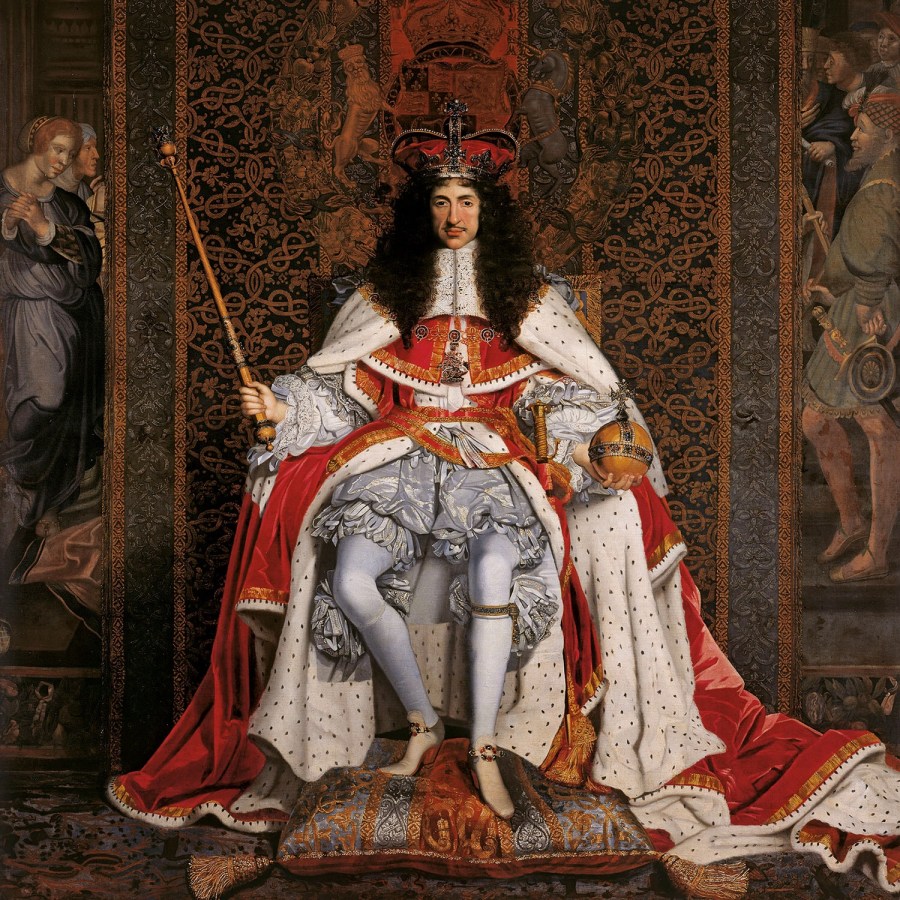
Charles II holding the orb in 1661 – John Michael Wright – Public domain

Blood was brought before King Charles II and other members of the Royal Family, including Prince Rupert, the Duke of York…. Blood turned on his Irish charm and the King found him rather amusing…. The scoundrel even had the nerve to tell the King that in his opinion the Crown Jewels were not worth £100,000 – more like £6,000….

The King asked of Blood “What if I should give you your life?”…. to which Blood replied “I would endeavour to deserve it, Sire!”…. In return for his bare-faced cheek he received a pardon, land in Ireland worth £500 per year and became a frequent visitor to Court…. As for Edwards, he made a full recovery – was rewarded well by the King – and dined out on his story for a long while afterwards….

img_3117
Gryffindar CC BY-SA 3.0

On this day in history….8th May 1701

On this day in history : 8th May 1701 – The controversial trial of Captain Kidd begins at the Old Bailey…. He is to be found guilty of piracy and the murder of a member of his crew….

img_3107
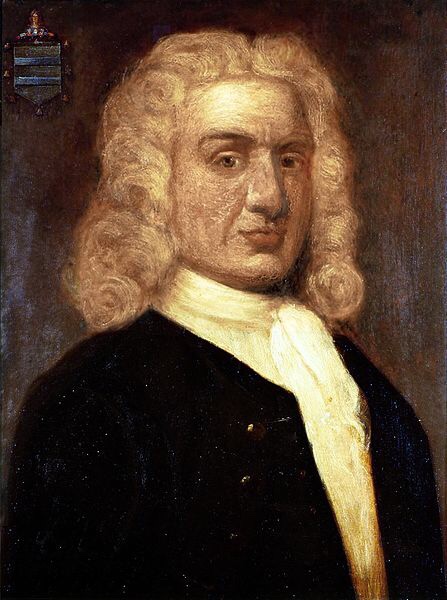
William Kidd – 18th Century portrait by Sir James Thornhill – Public domain

Born in Dundee, Scotland in 1645 William Kidd, the son of a seaman, went to sea himself at an early age…. On becoming a captain his first ship was the ‘Antigua’….

In the 1680s Kidd settled in New York, where he married wealthy widow Sarah Bradley Cox Oort….

During the war between France and England of the 1690s he became recognised as a successful privateer…. At the time, approved by the government, privately owned warships could attack enemy vessels…. In charge of the ‘Blessed William’ Kidd was responsible for protecting the trade routes of the West Indies for British and American trade….

He was commissioned by the British government to rid the Indian Ocean of pirates….it is likely he would also have been expected to capture any enemy ships he encountered suspected of carrying valuable cargo….a sort of ‘legalised’ piracy…. On the 6th of September 1696 Kidd left New York aboard ‘Adventure Galley’ – a 32-gun ship with a crew of 150, bound for the Indian Ocean…. One particular pirate he was after was Robert Culliford and his side-kick, surgeon Jon Death….

Culliford proved too difficult to track down – as indeed did any pirates for that matter…. The morale of Kidd’s men declined rapidly – until they were on the verge of mutiny…. In one explosive incident a furious Kidd struck ship’s gunner, William Moore, with an iron-bound bucket….fracturing his skull…. Moore died within 24 hours….

img_3109
Internet Archive Book Images via Flickr

Finally being worn down by his mutinous crew Kidd himself turned to piracy…. Conditions onboard ‘Adventure Galley’ had deteriorated and the ship itself was leaking badly…. In January 1698 they attacked the ‘Quedah Merchant’ – a ship carrying a cargo of sugar, opium, iron, silk and other valuable commodities…. It is thought the cargo had a value of around £70,000…. Kidd took the ship, renamed it ‘Adventure Prize’ – and sank his own leaking ship….

By now the men had been at sea for the best part of two years…. Laws around piracy had changed – English law now deemed it a criminal act…. Kidd arrived in the West Indies in 1699 to find himself a wanted man….the American colonies were on a mammoth pirate hunt…. He managed to secure a pardon with the English authorities but on arriving in Boston the New England governor, Lord Richard Bellomont – who had actually invested in Kidd’s voyage – had him arrested…. For the next few months Kidd was kept in prison in such appalling conditions that it nearly sent him insane….

In February 1700 he was sent back to England on the frigate ‘Advice’ to face trial….which took place starting on the 8th of May 1701 and lasted for two days…. He was found guilty on several accounts of piracy and the murder of William Moore…. All other members of his crew charged with piracy were cleared, with the exception of Irishman Darby Mullins…. Some of Kidd’s men testified against him in regards to Moore’s ‘murder’ to save themselves….

Whilst held at Newgate Gaol awaiting his execution, which had been set for the 23rd of May, Kidd wrote numerous letters to King William, pleading for clemency…. He was to be disappointed….

On the afternoon of the 23rd Kidd, Mullins and two condemned Frenchmen were taken to Execution Dock, Wapping – where a permanent gallows for pirates was kept…. It is said the authorities were rather surprised when Kidd arrived apparently the worse for wear with drink…. At the first attempt to hang him the rope snapped and he fell to the ground….so he had to be strung up again….

Afterwards his body was left to rot hanging at the mouth of the River Thames – a deterrent to other would-be pirates….

img_3110
Captain Kidd hanging in chains – National Maritime Museum, London CC BY-SA 3.0

It has long since been debated as to whether Kidd had a fair trial…. He became a legend….a large part of which centres around speculation as to where he buried his treasure….if indeed he had hidden any in the first place….

img_3108
‘Buried Treasure’ – Captain Kidd overseeing a treasure burial – from Howard Pyle’s Book of Pirates – Public domain

On this day in history….7th May 1860

On this day in history : 7th May 1860 – The birth of Tom Norman (born Thomas Noakes) – freak showman and the last exhibitor of Joseph Merrick, also known as the ‘Elephant Man’….

img_3102
Tom Norman – Fair use

Norman was born in Dallington, Sussex – the eldest of 17 children…. At the age of 12 he left school to go and work for his father, a butcher….

A couple of years later he decided to travel and look for work as a performer….but having no success ended up in London, taking a job as a butcher’s assistant….

Norman liked to gamble – and so thought he would try his luck as a professional gambler…. He moved to Berkshire and spent his days at Ascot Racecourse…. However, before long he was back in London, penniless, looking for a job….

He found employment at a butcher’s shop….and it was at this time he developed an interest in freak shows…. Next door to his workplace was a penny gaff – a popular form of entertainment in Victorian society for the lower classes…. Often held in the back rooms of public houses, performances of a theatrical nature with singing, dancing and clowning around would be held…. Sometimes accompanying acts of a more curious nature would be included – as was the case in the establishment next to Norman’s place of employment…. Mlle Electra was billed as ‘The Only Electric Lady – A Lady Born Full of Electricity’…. Whoever in the audience was brave enough to shake hands with the Mademoiselle would receive an electric shock….

Eventually Norman found out the act was a fake; Mlle Electra was plugged into the electricity supply…. Realising how much money could be made from such performances Norman quit his job and went into business with her manager…. It was around this time he changed his name, possibly not wanting to bring disrepute to the family name with his new shady career….

It wasn’t long before Norman realised he would be better off if he went it alone…. He found an ‘Electric Lady’ of his own and set up a penny gaff in Hammersmith – with a good deal of success….

His new business grew and in time he had a series of travelling shows and several shops in Nottingham and London…. The acts varied from giants, dwarves and fat ladies to performing fleas…. As well as the more ‘typical’ acts of a freak show he had his special attractions…. Eliza Jenkins – the ‘Skeleton Woman’ – a ‘Balloon Headed Baby’ and a rather gruesome act where a woman bit the heads off of live rats…. He had a group of retired white seamen who were painted black and spoke a made-up language, calling themselves the ‘Savage Zulus’ and a family of midgets – who were really two men and a borrowed baby….

Norman wasn’t beyond telling the audience a few fibs to bolster his show…. One of his favourites was that the show had been booked by Barnum….the ‘Greatest Show on Earth’…. Unbeknown to him, on one occasion the great P.T. Barnum himself was in the audience…. Luckily Barnum found it all rather amusing and on noticing the silver necklace Norman always wore nicknamed him the ‘Silver King’….

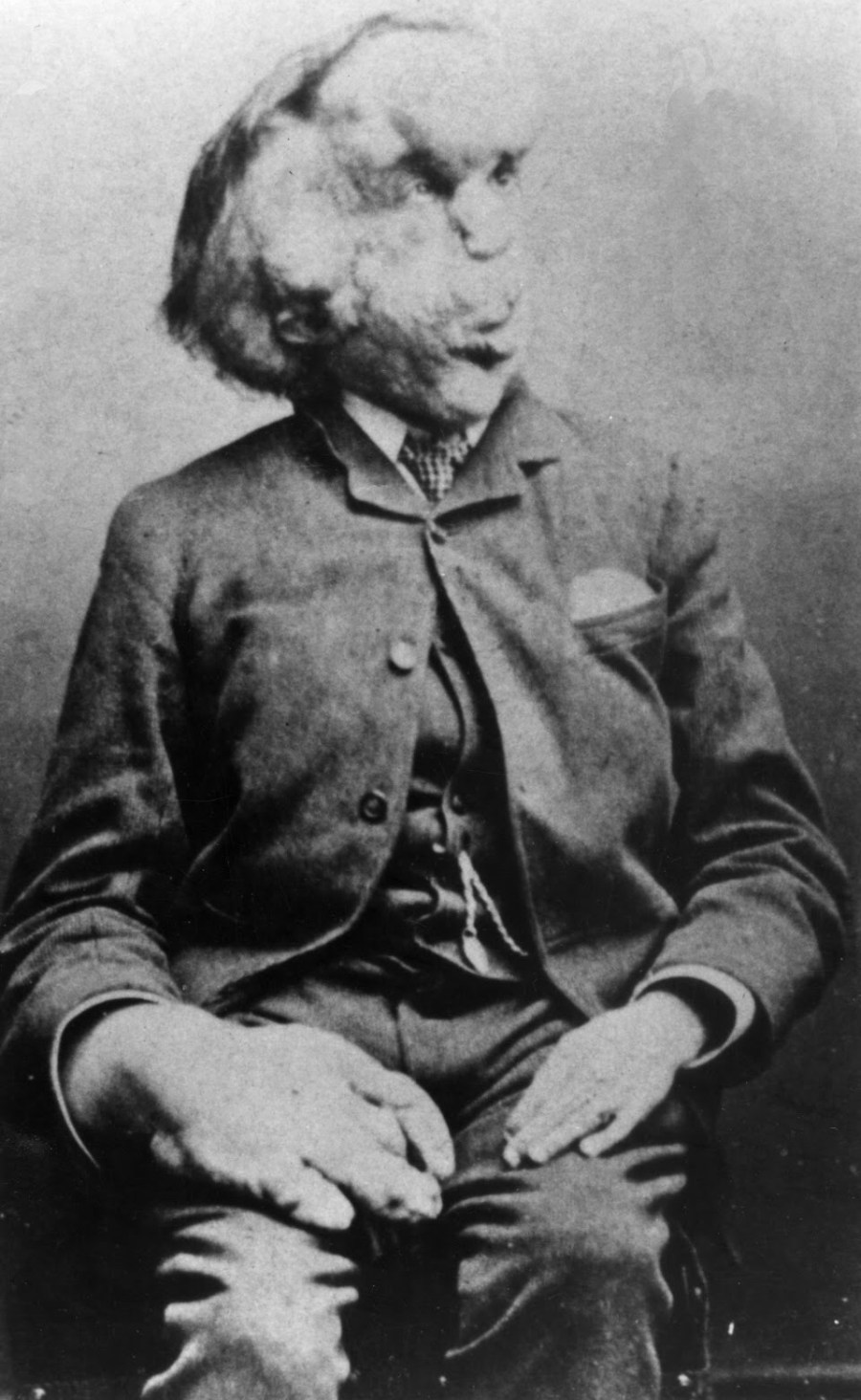
It was in 1884 that Norman encountered Joseph Merrick…. The young man from Leicester had such severe deformities that he was unable to find employment…. For four years he was in the workhouse – before getting himself out and presenting himself to ‘Little George’ Hitchcock, a showman – and who with two music hall proprietors, Sam Tor and J. Ellis, ran a penny gaff…. They exhibited Merrick as ‘The Elephant Man….Half-a-Man and Half-an-Elephant’…. Aware that his novelty would soon wear off they contacted Norman, who with his many travelling shows and shops could offer Merrick more work…. Norman took over Merrick’s management….

img_3106
Joseph Merrick – Public domain

On meeting Merrick for the first time Norman was so shocked at his appearance that he was at first hesitant of showing him…. In the end he exhibited him at a penny gaff in Whitechapel – which happened to be opposite the London Hospital – and so was often frequented by doctors and medical students…. One such was a surgeon by the name of Frederick Treves, who took much interest in Merrick and his condition…. Wanting to examine him closer it was arranged for Merrick to visit the hospital…. He went two of three times but after that refused, saying he felt as if he were being treated like some kind of animal….

img_3103
Sir Frederick Treves, Bt – Public domain

The Merrick ‘Elephant Man’ exhibition was reasonably successful – but at this time public opinion of freak shows was beginning to change….many finding them distasteful…. As it was, after only a few weeks , the police forced the show to close down…. Treves arranged for Joseph Merrick to live at London Hospital until his death in 1890….

Norman remained in the showman business for ten more years or so…. In 1896 he married theatre performer Amy Radnor and they had ten children…. After moving to Croydon Norman took semi-retirement, selling off part of his business…. On the 24th of August 1930 he died of throat cancer…. Five of his children followed in his footsteps with circus and fairground careers….

On this day in history….6th May 1954

On this day in history : 6th May 1954 – 25-year-old medical student, Roger Bannister, becomes the first man to run a mile in less than four minutes….

img_3099
Roger Bannister (United Press International) – Public domain

It was whilst at Oxford University that Bannister caught the attention of coaches when he was acting as a pacemaker for a mile race in 1947…. Normally a pacemaker will drop out before the end of a race but Bannister proved that he had the stamina to continue…. He beat the rest of the field by 20 yards….

For Bannister, nothing was more important than his studies and because of this he missed running the 1500m at the London Olympics in 1948…. He took part in the 1952 Helsinki Olympics, taking fourth place in the 1500m – something the British Press were particularly critical of…. This made Bannister determined to break the 4-minute mile – at the time believed by many to be an impossible record to achieve – but one several athletes were striving for, all wanting to be the first to succeed….

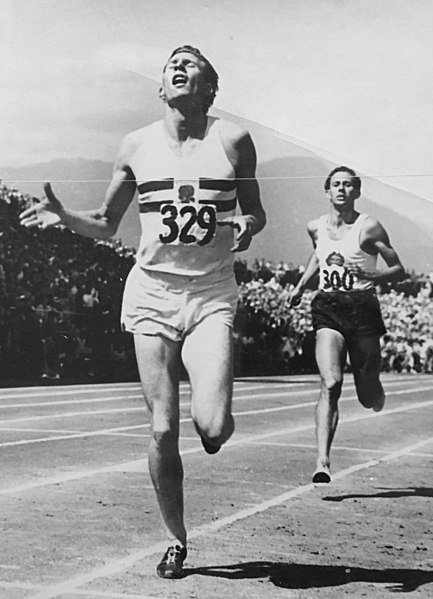
Roger Gilbert Bannister, born on the 23rd of March 1929 in Harrow, Middlesex was the man to just that…. At Iffley Road Sports Ground, Oxford on the 6th of May 1954 he ran the 4-lap race on a cinder track in 3 minutes and 59.4 seconds….

He may have only held the record for 46 days – his time was beaten by Australian John Landy, who ran 1.5 seconds faster at Turku, Finland – but he had secured his place in the history books….

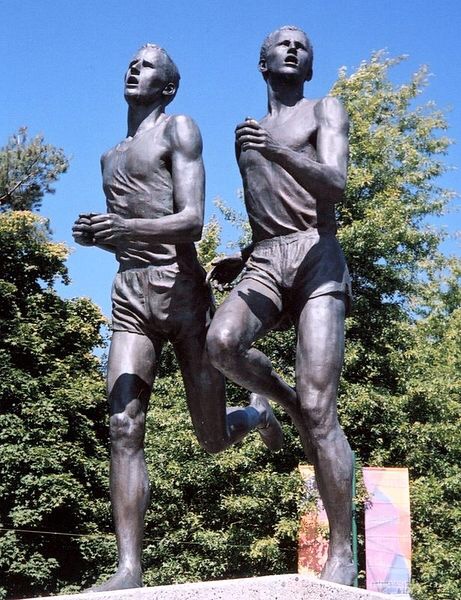
In August 1954 he and Landy completed against each other at the British Empire and Commonwealth Games at the Vancouver Exhibition; both men finished the race in under 4 minutes – the first time this had ever happened – it became known as the ‘Miracle Mile’….

img_3100
Statue of Roger Bannister and John Landy in Vancouver – Photo by Paul Joseph CC BY-SA 3.0

At the end of summer 1954, after winning the 1500m at the European Championships in Bern, Switzerland, Bannister stunned the World by announcing his retirement…. Now having graduated medical school his focus was on his career….

He went on to become a leading consultant neurologist and served for many years as director for the National Hospital for Nervous Diseases in London….

The man who had prepared his own training regime from what he had learned at medical school did not retire from the sporting world though…. Between 1971 and 1974 he served as chairman of the British Sports Council and between 1976 and 1983 President of the International Council of Sport Science and Physical Recreation….

Bannister’s achievements were recognised in 1975 with a Knighthood and he became Sir Roger Bannister…. Sadly he was diagnosed with Parkinson’s disease in 2011 – and died on the 3rd of March 2018 at the age of 88….

img_3101
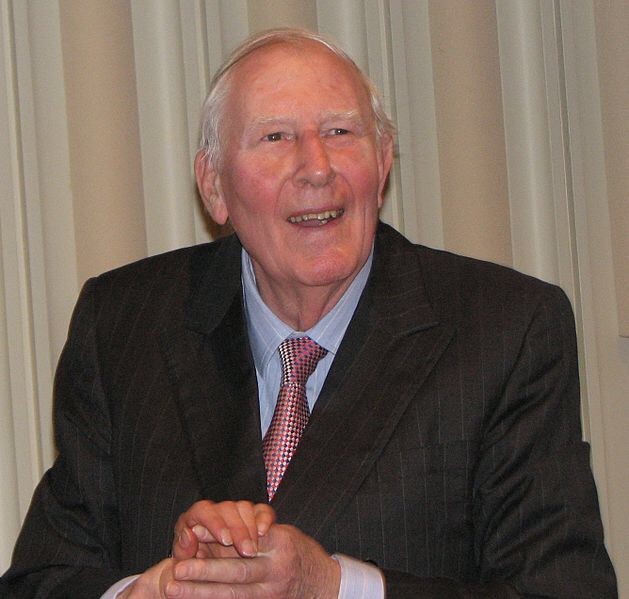
Sir Roger Bannister, 2009 – Photo: Pruneau/Wikimedia Commons/CC BY-SA 3.0

On this day in history….5th May 1760

On this day in history : 5th May 1760 – The public hanging at Tyburn, London, by the new ‘drop’ method, of Earl Ferrers….who is executed for the murder of his servant…. He is the last Peer to be hanged….

img_3095
4th Earl Ferrers – Public domain

Laurence Shirley, 4th Earl Ferrers was born on the 18th of August 1720 into a family of long-established nobility…. At the age of 20 he left his Oxford education to live a life of debauchery in Paris….

When 25 he inherited his title from an insane uncle along with estates in Northamptonshire, Derbyshire and Leicestershire…. He returned to England to take up residence at Staunton Harold Hall in Leicestershire….

He married Mary in 1752….it was to be far from a happy marriage. Although he could be reasonably normal when sober he was a heavy drinker and became violent…. He was also a womaniser and had a long-term mistress, Margaret Clifford, with whom he had 4 illegitimate daughters…. This relationship continued after he was married….

In 1758 Mary had endured enough and obtained a separation by Act of Parliament on the grounds of his cruelty…. She must have had a strong case as this was almost unheard of at the time…. As part of the separation agreement Mary was granted a proportion of the rents from the Estate….An old family steward, John Johnson, was appointed to collect the rents on her behalf…. Not surprisingly Ferrers dislike Johnson and hated the fact that he had authority over the Estate….

It is thought the tipping point came when Johnson paid Mary £50 without Ferrers’s consent….he asked to see Johnson at the Hall….Prior to the appointed meeting time on the 18th of January 1760 Ferrers sent Margaret and their daughters (who had moved in after Mary left) out, along with all the male servants of the household…. When Johnson arrived he was shown to the study where Ferrers awaited him…. Before long an argument broke out over the £50 and at around 3pm Ferrers shot the steward…. Johnson did not die immediately and a doctor was sent for and he was treated at the Hall…. Also sent for was Sarah, Johnson’s daughter….

img_3097
Lord Laurence Earl Ferrers shooting his steward, Mr Johnson. Credit: Wellcome Collection CC BY

Ferrers had been sober at the time of the shooting but afterwards turned to the bottle. As the day wore into evening he continued to shout and rant at Johnson, before finally falling into a drunken stupor…. Dr. Kirkland and Sarah were then able to take Johnson back to his own home, where he died the next morning….

Ferrers was arrested; being a Peer he could not be dealt with at the Leicester Assizes and so was taken to the Tower of London to await trial….

On the 16th of April 1760 Ferrers was brought before Lord High Steward, Lord Henley at Westminster Hall; the trial lasted two days…. Ferrers ran his own defence, as was normal practice in those days, he tried to plead insanity…. Witnesses for the prosecution included Dr. Kirkland, Sarah Johnson and three female servants who had been at the Hall at the time…. Ferrers seemed incapable of understanding that it was not acceptable, even for a man of his position, to shoot a servant….

On being found guilty there was only one sentence applicable in accordance with the Murder Act 1752 – death by hanging…. A date was set for the 5th of May…. Ferrers was utterly appalled by the thought of public hanging at Tyburn – this was the death of a common criminal…. He pleaded with the King to be beheaded instead – the death of a nobleman…. But the sentence was upheld….

Ferrers was held at the Tower of London whilst awaiting execution….and would have been treated well and enjoyed relative luxury…. He wrote his Will, leaving £16,000 to his daughters and £200 to Sarah Johnson….

New gallows were constructed; instead of the barbaric cart, ladder and three-cornered gibbet – known as the ‘Tyburn Tree’ – a scaffold, covered with black material and reached by stairs, was built…. On the platform was a box, designed to sink into the structure, leaving the condemned suspended….

img_3098
The ‘Tyburn Tree’ – Public domain

At 9am, on the morning of the 5th of May, the call was sent to the Tower for Ferrers to be brought to his place of execution…. An enormous crowd had gathered….the execution of a nobleman was a rarity…. Ferrers arrived in a carriage drawn by six horses….he wore his wedding suit of light coloured satin embroidered with silver thread…. He was accompanied by the Tower’s chaplain – also in the procession was a mourning coach carrying six of his friends and a hearse….

He was led to the scaffold and up the steps….the Lord’s Prayer was said and he mounted the drop…. His arms were tied with a black silk sash and the rope placed around his neck…. A white nightcap, which he had supplied himself, was pulled down over his head…. Around noon, having declined to give the signal himself, the Sheriff gave the command and the platform sank…. The mechanism didn’t quite work correctly – Ferrers’s feet were almost touching the platform; he was left writhing and took about 4 minutes to die….

His body was left for an hour, as was the custom before being taken down and put into the coffin…. He was taken to Surgeon’s Hall for dissection – and then his body was put on display until the evening of the 8th of May…. His remains were then returned to his family for burial at St. Pancras Church – and in 1782 he was reinterred at the family vault in Staunton Harold….

img_3096
The body of Earl Ferrers, displayed upright in his coffin. Credit: Wellcome Collection CC BY