On this day in history : 12th January 1950 – A British submarine and Swedish oil tanker collide in the Thames Estuary – resulting in the sinking of the submarine – and 64 deaths….
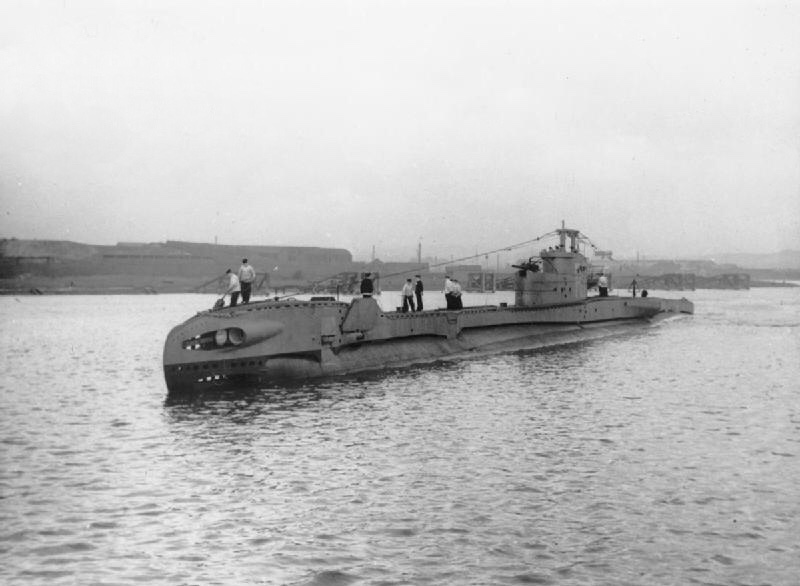
HMS Truculent was returning to Sheerness having undergone trials at Chatham following a refit…. As well as her usual crew the submarine was carrying an additional 18 workers from the dock yard….
HMS Truculent 1942 – Image from the collections of the Imperial War Museums
It was 7pm and Truculent was making her way along the surface of the Estuary – when a ship showing 3 lights appeared ahead in the Channel…. Crew on board the submarine believed the vessel to be stationary – and aware they could not pass on the starboard side, for fear of running aground – the order was given to turn to port…. Too late it became obvious the ship was not anchored and was in fact moving – and the extra light was to indicate she was carrying explosive material….
The two vessels collided; the bow of the 643 ton Swedish oil tanker – the ‘Divina’ – striking HMS Truculent – and the two remained locked together for several seconds before the submarine sank to the bottom of the Estuary…. The crew of the Divina – which was on route to Ipswich from Purfleet with a cargo of Paraffin – immediately went into action…. Ropes and life belts were thrown to the men thrashing in the water…. Divina’s lifeboat was launched and 15 men were picked up – a further 5 were rescued by the Dutch ship ‘Almdijk’….
Ironically very few died as a direct result of the immediate impact….the majority managed to escape. Out of the 64 men who died most lost their lives through drowning or by perishing in the freezing conditions on the mudflats of the Estuary….
The 1,000 ton submarine was salvaged on the 14th of March 1950 – and 10 more bodies were recovered. In May 1950 she was sold as scrap….
An inquiry into the incident put 75% of the blame on to HMS Truculent…. Later the disaster was to lead to the introduction of the ‘Truculent light’ on the bow of British submarines – to make them visible to other ships….
HMS Truculent Memorial Service 2014 – Image credit : Matthew via Flickr
On this day in history : 11th January 1569 – England’s first state lottery takes place….outside the doors of the west wing of the Old Saint Paul’s Cathedral….
Queen Elizabeth I had been on the throne for just over a decade and had so far enjoyed a relatively smooth reign….whereas in Europe things were a ‘little’ more unsettled…. France and Holland particularly had suffered severe conflict and revolts…. But – now Anglo-Spanish relations were breaking down….and England’s harbours and coastal defences were in a sorry state – and in desperate need of repair….
It was also a time of expansion in England’s export market – although trade was being compromised in Europe because of recent events – there was still plenty of potential for trade in other parts of the World…. More ships were needed to transport goods – and more ports needed to be built to accommodate them….
The Queen had a dilemma…. In order to fund all the necessary work she had to either raise taxes – or come up with another way of finding money….
Lotteries had been common practice on the Continent for at least the last 100 years – merchants would often use them to shift expensive stock that was not selling…. So, Queen Elizabeth I and her advisors came up with the idea of a state lottery – far more palatable than raising taxes….
The lottery was advertised as…. “A very rich Lotterie generall, without any Blanckes, contayning a great number of good prizes”…
The first prize was a jackpot of £5,000….£3,000 of which was in “ready money” – £700 in “plate gilte and white” and the rest in good “Tapillarie meete for hangings and other couertures and certaine lottes of good linnen cloth”….
Every ticket was guaranteed a prize – and these ranged from money, to silver plate, tapestries and good linen cloth…. To help with the promotion all ticket holders were promised freedom from arrest for any crimes they may have committed – other than murder, treason or piracy….
So, on the 11th of January 1569 people gathered outside of St. Paul’s Cathedral to see what they had won – in England’s first state lottery draw….
Old Saint Paul’s Cathedral
The ‘ticket’ would have been a blank piece of paper on which the holder would write their name – along with some unique words….maybe a couple of lines of poetry….or a prayer…. A named ticket would then be drawn from an urn – to be ‘married-up’ with a prize ticket drawn from another urn…. This process would then be repeated until all tickets and prizes had been allocated….
England’s first national lottery was not overly successful….out of the 400,000 tickets available only 10% sold…. At 10 shillings each they were remarkably expensive – although it was possible to buy a share in a ticket ~ the first ‘lottery syndicates’….
But – what was even more off-putting for would be punters – the odds in winning the jackpot – or a high prize….1 in 16,000 – so they didn’t even bother to try…. If you play today’s National Lottery your chance is 1 in 14 million….or 1 in over 45 million if you’re going for the Jackpot….
On this day in history : 10th January 1863 – The World’s first underground railway line – ‘The Metropolitan Railway’ – opens in London….
The line opened between Paddington (then called Bishop’s Road) and Farringdon Street and served 6 intermediate stations…. Nowadays there are 270 stations on 11 lines….employing over 27,000 people….
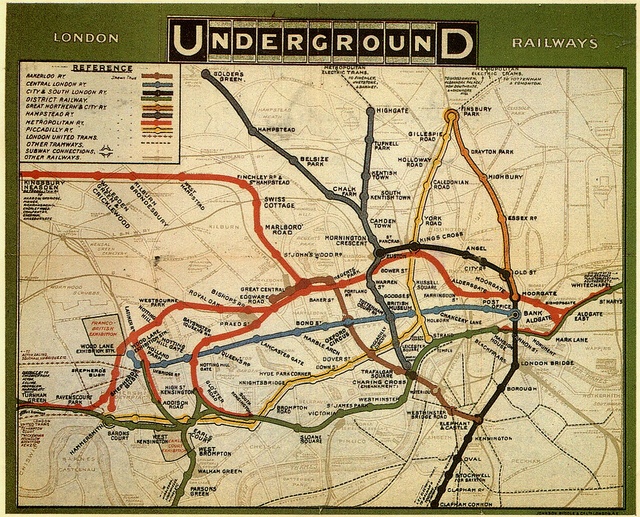
London Underground Map (1908) Image credit : Roger W via Flickr
Metropolitan was a private company who financed the venture themselves….the Underground was completely funded by private companies until the 1930s….
Five more underground lines were authorised by Parliament between 1891 and 1893 – but Waterloo & City was the only other line to be built before 1900…. It took 21 years (1863 – 1884) to finally complete the inner circle of lines in central London – and by 1884 over 800 trains were travelling around it every day….
Baker Street & Waterloo Railway in its first week of opening – The Graphic 1906
Much of the network was completed in the first 50 years…. The total length of the network is 400.7km….the longest tunnel, between East Finchley and Morden is 27.7km…. The longest distance between stops is 6.3km – between Chesham and Chalfont & Latimer on the Metropolitan line…. The shortest distance is 260m – between Leicester Square and Covent Garden – the journey takes just 20 seconds…. Only 45% of the Underground network is actually in tunnels….
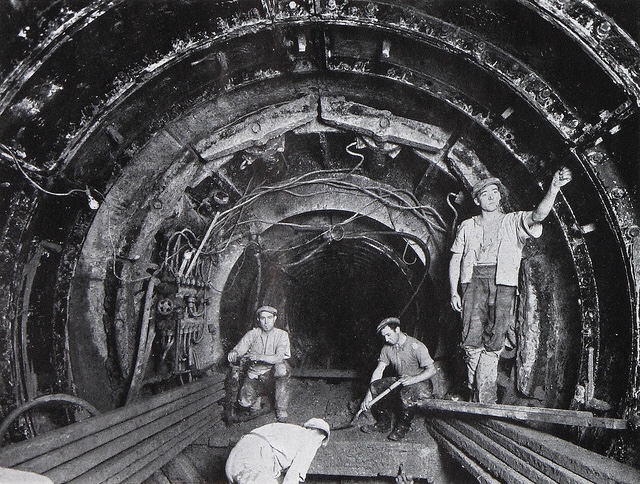
Construction of Tube at Mile End – Circa 1946 Image credit : The National Archives UK via Flickr
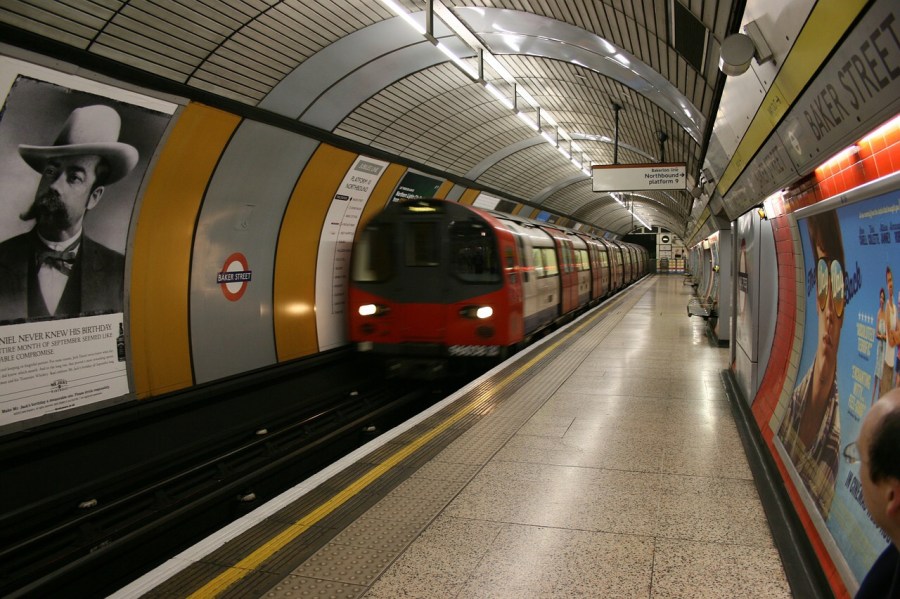
Less than 10% of the stations are located south of the River Thames…. The District line has the most stations, with 60 – whilst Waterloo & City line has the fewest…. In central London the deepest station below street level is ‘Bank’, at 41.4m deep….in outer London it is Hampstead, at 58.5m…. Baker Street has the most platforms – with 10 – (4 of which are overground)….
1907
The original trains to operate were steam – the network did not become fully electrified until 1961.. The first deep-level electric line was installed in 1890…. In 1903 the Central line became the first railway in Britain to be entirely worked by multiple-unit trains ~ meaning trains no longer had to be turned around upon reaching the end of the line…. By 1905 all tube lines were operating them….
On the first ever day of service some 40,000 passengers were carried…. In 1918 there were 70% more passengers than there had been in 1914…. Nowadays it is more like 1,107 million per year using the Underground network….
The ‘Tube’ became the affectionate name for the Underground in the early 1900s – when the Central London Railway (Central line) became nicknamed ‘The Twopenny Tube’ – a phrase coined by the Daily Mail….
Postcard for the Central London Railway – via Wikimedia
In Cockney rhyming slang it is known as ‘the Oxo’ (Oxo cube)…. The ‘Underground’ name first appeared in 1908 – and the Tube’s logo is called the ’roundel’…. In the early days the carriages – which were very claustrophobic – became known as ‘padded cells’….
It was in September 1940 that underground stations were first used as air-raid shelters against the bombing attacks of World War 2…. During the War years a section was closed between Holborn – Aldwych and was used to store treasures from the British Museum…. The Central line was converted into a factory to produce fighter aircraft….and was complete with its own railway system…. This remained an official secret right up until the 1980s…. Over 200,000 children were evacuated from the Capital using the Underground….
The first baby to be born on the Underground was in 1924…. Marie Cordery came into the World on board a train at Elephant & Castle on the Bakerloo line…. Another baby to be born was American talk-show host Jerry Springer – his mother gave birth during a WW2 air-raid at East Finchley Station….
And here are a few more random facts for you :-
The original recording of “Mind the gap” was made in 1968 and features the voice of Peter Lodge – who was a sound recordist…. Many stations still use it today….
Manually operated doors were phased out in 1929 – to be replaced by air operated ones….
Aldgate Station, on the Circle & Metropolitan line, is built on a huge plague pit – containing 1,000 bodies….
The tunnels beneath the City curve because they follow the old Medieval street plan….
Queen Elizabeth II was the first Monarch to travel on the Underground – In May 1939 (when she was 13-years-old) she travelled on the Victoria line from Green Park – along with Princess Margaret and governess Marion Crawford….
The Jubilee line was named to celebrate the Queen’s Silver Jubilee in 1977 – but did not actually open until 1979….
The most commonly used film location on the Underground is Aldwych – which is a disused station….
Busking has been licensed since 2003…. It is rumoured that Sting and Paul McCartney have both busked in disguise….
The fictional ‘Walford East’ of the soap Eastenders is supposed to be on the District Line….
Over 47 million litres of water are pumped from the Underground each day….enough to fill an average sized swimming pool every 15 minutes….
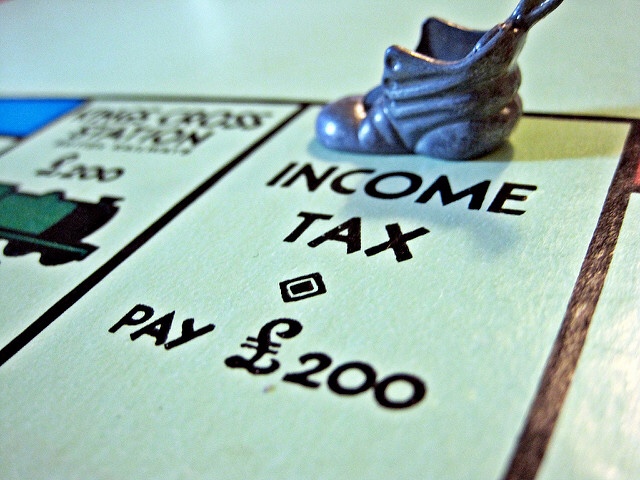
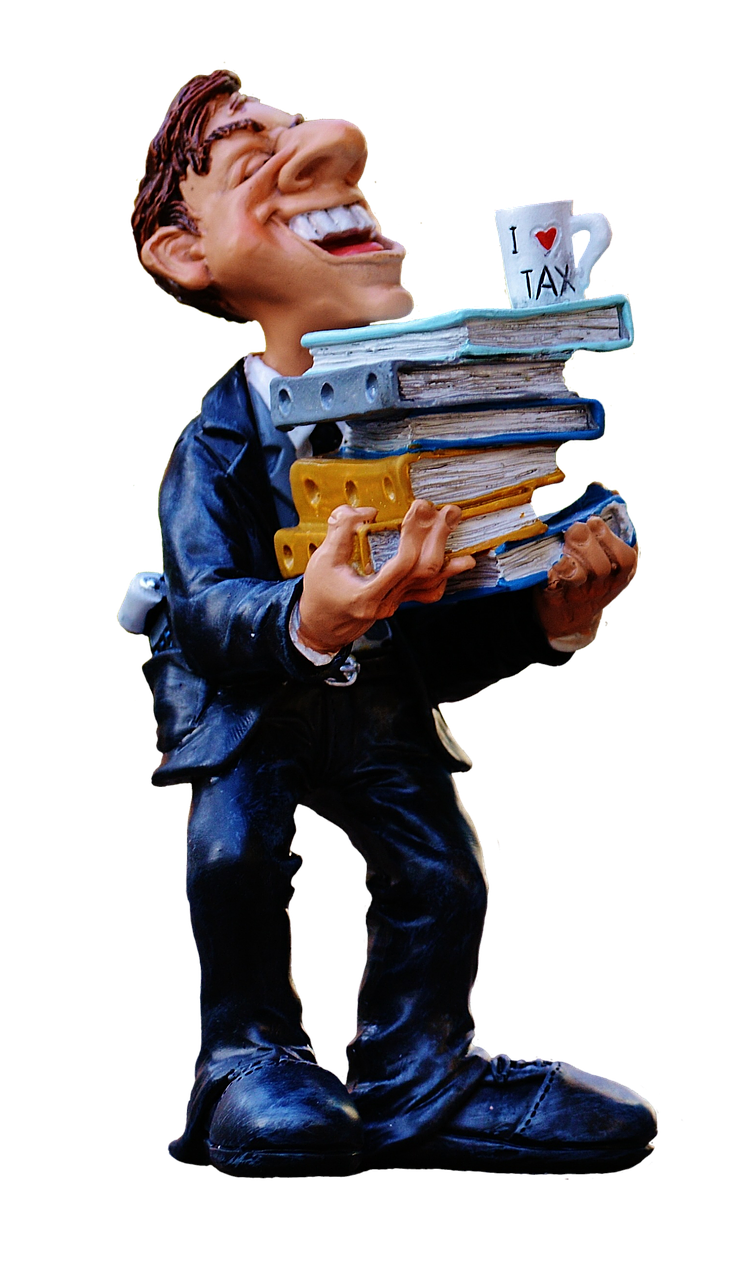
On this day in history : 9th January 1799 – Income Tax is introduced to Britain by Prime Minister William Pitt the Younger…. It is established to raise money for the Napoleonic Wars and is meant to be a temporary measure….
Believe it or not, it is still a ‘temporary’ measure….expiring each year on the 5th of April and having to be renewed as a provision in the annual Finance Bill….
Image credit : Images Money via Flickr
Income Tax was implemented by Pitt the Younger in his December 1798 budget – to pay for weapons and equipment for the forth-coming war with France…. It was a complicated taxation system, taking into consideration property owned, land, profession and finally income…. It was based on a flat rate but varied depending on whether the Country was at war or not…. On its introduction incomes over £60 per annum were levied at 2 old pence in the pound – whereas incomes over £200 were required to pay 2 shillings in the pound (or 10%)…. The government had hoped to raise £10 million but in fact only realised £6 million….
Image credit : alphastockimages.com
Henry Addington abolished the tax in 1801 – during the ‘Peace of Amiens’ – but it was to be short-lived, as it was reintroduced again in 1803 when hostilities with France flared up once more…. It was also at this time that Addington introduced deduction at source….
Income Tax was repealed in 1816, a year after the Battle of Waterloo – and for a while Britain enjoyed an Income Tax free period…. However, in 1842 Sir Robert Peel, faced with an enormous public deficit of 63% as a result of the Crimea Conflict, reintroduced it…. Admittedly it was only for the wealthy, those earning more than £150 per annum – and was only 3d in the £1 (3%) – and it remained this way for many years….
At the beginning of the 20th Century there were less than a million tax payers in Britain…. In 1907 Herbert Asquith introduced a whole new range of taxes….by 1909 Income Tax had raised to 8% and a new ‘Super Tax’ or ‘Surtax’ was introduced for the wealthy…. (This was to stay in place until 1973 – when it was replaced by the Higher Rate of Income Tax)….
World War 1 saw an increase in the rate to over 50%….but by 1918 it had settled back down to 30% – but more people were having to pay…. By 1930 ten million people had become eligible for Income Tax….and by the start of World War 2 that number had risen to twelve million….
Image credit : alphastockimages.com
In 1944 Pay As You Earn (PAYE) was introduced (previously tax would be paid every 6 months – or even annually)…. Along with PAYE came the P45 – and tax codes, to tell employers what percentage to deduct…. A basic rate of 33% remained in place after the war – and it wasn’t until Margaret Thatcher came to power that we saw a reduction….when it was lowered to 25% – and the Higher Rate from 83% to 40%…. It was lowered again to 22% and Gordon Brown then reduced it even further to 20%…. But of course, they always get us in other ways!
On this day in history : 8th January 1921 – David Lloyd George becomes the first Prime Minister to reside in Chequers – the 16th Century Manor House in Buckinghamshire….which was given to the Nation by Lord and Lady Lee of Fareham….
Image credit : Stephen Simpson
Chequers – or Chequers Court to give its full title, is located 41 miles from Downing Street, at the foot of the Chiltern Hills – near to the village of Ellesborough, just outside Great Missenden….
William Hawtrey – High Sheriff of Buckinghamshire – had the current house built circa 1565…. Possibly it may have been constructed around an earlier building already there – as it is thought a house has been on the site since Roman times….
In the 19th Century it underwent alterations to give it a Gothic style…. The Tudor windows and panelling were replaced with battlements and pinnacles….but by the end of the 19th Century it had passed to the Astley family….and Bertram Astley had the house restored back to its Elizabethan origins….
Shortly after it had been built and become the residence of William Hawtrey it also became a place of confinement – for the great-granddaughter of King Henry VII…. Lady Mary Grey was banished from Court by Queen Elizabeth I – for marrying without the Monarch’s consent…. Her room at Chequers is still kept today exactly as it was when she occupied it between 1565 and 1567….
In 1715 the owner at the time married Oliver Cromwell’s grandson, John Russell…. There is a large collection of Cromwell memorabilia to be found at Chequers….
It became the home of Arthur Lee and his American heiress wife in 1901….and they allowed it to be used as a hospital and then a convalescent home for officers during World War 1…. After the war it became the Lees’ private house once again….
KONICA MINOLTA DIGITAL CAMERA
The Lees did not have any children – so no future inheritances to consider…. By now they had become Lord and Lady Lee of Fareham – and it was their wish to do something for the Nation…. They came up with an idea….
Before WW1 Britain’s Prime Ministers generally came from aristocratic backgrounds and had their own country estates where they could entertain foreign dignitaries…. Or indeed, retreat away from the stresses of daily life….and relax. After the War it was to become a new breed of politician – politics had become more accessible to all the classes…. Of course, not many ordinary folk have large country houses at their disposal…. So, after much negotiation with David Lloyd George and his government Chequers was given to the Nation, under the ‘Chequers Estate Act 1917’ – for the use of the serving Prime Minister….
Lord and Lady Lee of Fareham left Chequers on the 8th of January 1921 – but before they departed they had commissioned a stained glass window – which is to be found in the long gallery…. It bears the inscription….
“This house of peace and ancient memories was given to England as a thank-offering for her deliverance in the Great War of 1914-1918 as a place of rest and recreation for her Prime Ministers for ever”….
Image credit : Number 10 via Flickr
The name ‘Chequers’ has a couple of possibilities as to its origin…. An early owner of the Manor House that stood there in the 12th Century was Elias Ostiarius (or de Scaccario)…. “Ostiarius” meaning “Usher of the Court of the Exchequer”….”Scaccario” has the meaning of “chessboard” in Italian…. Elias Ostiarius had a chequerboard feature within his coat of arms – so maybe the estate was named for him….
Another theory is that it was named after the Wild Service trees (Sorbus torminalis) or ‘Chequers’ – which grow in the grounds….
The Wild Service tree is native to Britain but rarely seen – to come across one often indicates ancient woodland…. The fruits are known a ‘Chequers’ – and were given to children as a sweet treat as they are said to taste like dates…. They can also be made into an alcoholic drink – which may explain why so many public houses are called ‘The Chequers’….
Image credit : Hornbeam Arts via Flickr
Chequers Court may not be massive in terms of a stately home – it only has ten bedrooms….but it does sit in 1,500 acres of land….
It is grade 1 listed and houses a huge art collection – of some 190 pieces dating from the early 16th Century…. There is even a 1937 piece by Winston Churchill….
Cabinet meeting at Chequers – Image credit : Number 10 via Flickr
It has hosted many World leaders and public figures ~ Richard Nixon, Mikhail Gorbachev, Vladimir Putin, Robert Mugabe, Xi Jinping, Angela Merkel to name but a few….
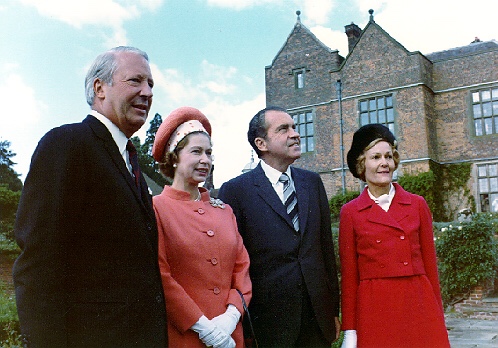
Queen Elizabeth II, Prime Minister Edward Heath joined by US President Richard Nixon and First Lady Pat Nixon during the Nixons’ visit to the UK in 1970…. Image credit : White House photo by Ollie Atkins
Margaret Thatcher said of it ~ “I do not think anyone has stayed long at Chequers without falling in love with it”….
Norma Major (wife of former Prime Minister John Major) loved it so much she wrote a book entitled “Chequers : The Prime Minister’s Country House and Its History”….










 Cottage Capers