On this day in history : 21st January 1966 – The Monte Carlo Rally ends in uproar over the disqualification of the British cars due to the way their headlamps dip….
The first four cars to cross the finishing line were all British; Timo Makinen (from Finland) in a Mini Cooper took first place…. Roger Clark came second in a Ford Lotus Cortina, followed by Rauno Aaltonen and Paddy Hopkirk both driving Mini Coopers….
Timo Makinen – 1966 Eric Koch / Anefo CC BY-SA 3.0
All four were ruled out of the prizes; as was Rosemary Smith in her Hillman Imp – disqualified from 6th place after winning the ‘Coupe des Dames’ – the Ladies’ Class…. In total ten British cars were disqualified….
The controversy centred around alleged infringements over the way the British cars’ headlamps dipped…. Non-dipping single filament quartz iodine bulbs had been used instead of the standard double filament dipping glass bulbs as fitted to cars leaving the production line….
The race organisers had recently brought in a rule saying that all cars had to be exactly as they were when first built – i.e. no modifications…. The confusion came when the organisers said the 1966 rally would run under the old rules and only announced the switch after entries for the race had been accepted….
Mini Cooper 1966 Monte Carlo Rally 1966 via Pinterest ( classiccarcatalogue.com )
Incidentally, the official winner – Paul Toivonen of Finland (but living in Paris) – had similar lamps on his Citroen ID to those used on the British cars…. Only he was not disqualified because some of the Citroens that came off the production line were fitted with them as standard….
The British team objected – arguing that these bulbs had been used in previous rallies – but their protests were rejected…. Prince Rainier of Monaco, who always attended the prize-giving ceremony, left early to show his disgust at the decision…. The British team boycotted the traditional official farewell dinner – and the headline in ‘Motor Sport’ proclaimed “The Monte Carlo Fiasco”….
On the 13th of October 1966 a tribunal upheld the disqualifications as the Federation Internationale de l’Automobile ruled that the bulbs fitted to the British cars were not standard….
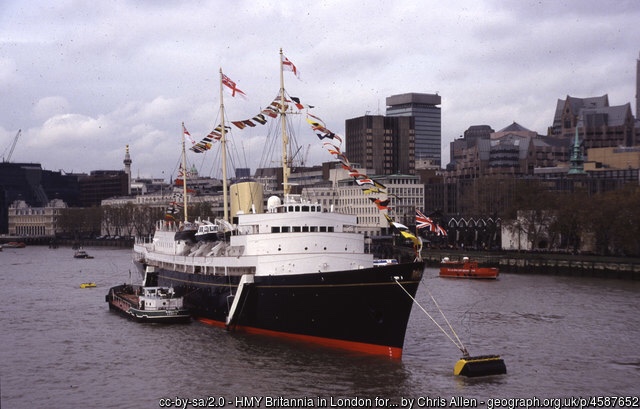
On this day in history : 20th January 1997 – Her Majesty Queen Elizabeth II’s Royal Yacht Britannia begins her final official voyage – before she is due to be de-commissioned later in the year….
Her Majesty’s Yacht Britannia
This last foreign mission was to bring home the Prince of Wales and Chris Patten, who was the last Governor of Hong Kong before the handover to China on the 1st of July 1997….
HMY Britannia was originally commissioned for King George VI – the Queen’s father – but sadly he died even before the keel was laid…. One of the first things Her Majesty did on becoming Monarch was to change the plans for the decor of the Royal apartments of Britannia – she viewed the proposed plans as too formal and ‘stuffy’…. Instead she opted for white-painted walls, mahogany woodwork, brass fittings and chintz covered armchairs and sofas…. She wanted to create the feeling of a ‘country home at sea’…. The only thing she would have liked – but because of regulations was not allowed – was an open fire in the drawing room….instead she had to settle for an electric fire….
Image credit: gray_um via Flickr
The Queen and the Royal Family loved HMY Britannia…. Her Majesty once described the yacht as being the one place she felt she could truly relax…. The Royal apartments were filled with personal photographs and heirlooms….
HMY Britannia was built at Clydebank, West Dunbartonshire and was launched by Queen Elizabeth on the 16th of April 1953…. She first went into service in 1954; her maiden voyage was from Portsmouth to Grand Harbour, Malta – departing on the 14th of April and arriving eight days later…. She carried Princess Anne and Prince Charles to meet their parents who had just completed a Commonwealth Tour…. Queen Elizabeth and the Duke of Edinburgh embarked on the 1st of May 1954 for the very first time….
Ship’s Bridge Image credit: Salicia via Flickr
During her 43 year service HMY Britannia sailed some 1,087,623 nautical miles…. The 412ft long yacht, which weighs nearly 6,000 tons, completed 696 foreign visits and 272 official voyages on British waters….including annual Royal family holidays…. Known as the ‘Western Isles Tour’, each year Britannia would take the Royals on a cruise around the islands off of the west coast of Scotland…. She was also used for four Royal honeymoons…. Princess Margaret and Anthony Armstrong Jones sailed to the West Indies upon her in 1960 and Princess Anne and Captain Mark Phillips were also carried to the Caribbean in 1973…. In 1981 Prince Charles and Princess Diana enjoyed a Mediterranean cruise for their honeymoon, followed by the Duke and Duchess of York, who sailed to the Azores in 1986…. As recently as 2011 the yacht was used as part of Royal Wedding celebrations when Zara Phillips and Mike Tyndall held a pre-wedding reception onboard…. She has a capacity for 250 guests….
When HMY Britannia was launched she was the largest yacht in the World…. In order for her to sail a crew of 21 Officers and 250 Royal Yachtsmen were required…. When the Royal Family were aboard they would be accompanied by up to 45 household staff, including a hairdresser, surgeon and chauffeur – (yes, a Royal limousine was carried onboard)…. The Royal party would travel with around five tons of luggage….and when she sailed Britannia would always be accompanied by a Royal Navy warship….
The crew, who were accommodated at the front of the yacht away from the Royal apartments, wore plimsolls to keep a tranquil ambience…. Orders were given by hand signals and shouting was forbidden – as was running…. Any work that needed to be done near the apartments had to be done in silence and completed by 8am….
However, HMY Britannia earned her keep…. She was built so she could be converted in to a hospital ship, able to accommodate approximately 200 patients if required during wartime…. Fortunately her services in this capacity were never needed…. In event of a nuclear war the intended plan (with the code name ‘Python System’) was for the Queen and Duke of Edinburgh – along with the Home Secretary – to take refuge onboard the yacht off the north-west coast of Scotland….
She was also used to entertain dignitaries…. American Presidents Dwight D. Eisenhower, Gerald Ford, Ronald Reagan and Bill Clinton all enjoyed hospitality onboard…. Used by the government to entertain prominent business figures HMY Britannia was an Ambassador for British trade and industry….during the period of 1991-1995 she earned some £3 billion for the Exchequer….
Nowadays she earns her keep as an award-winning visitor attraction…. Berthed at Ocean Terminal, Leith, Edinburgh she receives 300,000 visitors per year….
In 1997 the Conservatives committed to replacing her if re-elected…. Labour did not divulge their proposed plans…. On winning the election Tony Blair’s Labour Government announced HMY Britannia’s retirement and that there would be no replacement….
A de-commissioning ceremony was held on the 11th of December 1997 at Portsmouth Dockyard…. At 15.01 Her Majesty was piped ashore for the last time and all the clocks onboard HMY Britannia were stopped…. The Queen openly cried as The Band of HM Royal Marines played ‘Highland Cathedral’….
Since the de-commissioning of HMY Britannia the Queen twice chartered MV Hebridean Princess – a private charter cruise ship – for a family holiday in the Scottish islands…. But surely, it was never be the same for Her Majesty, was it….
On this day in history : 19th January 1917 – An explosion in a munitions factory in Silvertown, West Ham, London kills 73 people and injures 400 more…. It also destroys the nearby fire station and a gasometer….
Memorial to the Silvertown Explosion in its new location in the middle of the Royal Wharf development. 2016. Author: Neddyseagoon via Wikipedia CC BY-SA 3.0
The factory, belonging to Brunner-Mond had been built in 1893 to produce soda crystals and caustic soda…. By 1912 the production of caustic soda had ceased and so the factory was not running to full capacity….
At the time there were strict controls in place in the City of London as to where dangerous explosives and substances could be processed and manufactured…. However, Silvertown, although heavily populated fell outside of this main central area – and being over half way through the war Britain was running low on ammunition…. With this in mind the War Office decided to take over the vacant part of the factory – even though it was opposed by Brunner-Mond….
The factory in Silvertown was used to purify TNT – an extremely dangerous process…. The manufacture of TNT is a risky enough procedure in itself – but to purify it carries even more risk…. It was, perhaps, an accident waiting to happen….
And happen it did…. A fire broke out in the factory – and although every effort was being made by fireman from the nearby fire station – at 6.52pm 50 tonnes of TNT (much of which was being stored in railway trucks, awaiting transportation) ignited…. The factory was destroyed instantly….as were many of the surrounding buildings; some 900 were immediately destroyed or had to be demolished – and a further 70,000 were damaged…. Many of the buildings were nearby warehouses – but also included were people’s homes and the Silvertown fire station…. A gas holder containing 200,000 cubic metres of gas was damaged – causing a massive fireball to erupt…. The gasometer was later repaired….and remained in situ until 1986….
The Millennium Mills in the aftermath of the Silvertown Explosion Author: Avery, John, 1917-01-25 Fair Use
The death toll, in one of the worst disasters in Britain during World War 1, could have been much higher…. 69 people died instantly (including the firemen attending the original fire) and 4 more died of their injuries later….over a further 400 people were injured…. However, because of the time of day, being almost 7pm on a Friday evening, the warehouses and factory were mainly empty…. Had it of been during the working day many, many more people would have lost their lives….
Image credit: Gordon Joly via Flickr
The blast could be heard 100 miles away, as far as Sandringham, Norfolk – and fires could be seen from Guildford and Maidstone…. An investigation could find no single cause but did conclude that the TNT had not been stored safely enough…. Although most of London could not have failed to notice the explosion happening – it took the Press three days to report it….
On this day in history : 18th January 1882 – The birth of Alan Alexander Milne….who brought to us that loveable little bear Winnie the Pooh….
Winnie the Pooh Image credit: Paul K via Flickr
A.A. Milne was born in Kilburn, London and attended Westminster School and later Trinity College, Cambridge – graduating with a B.A. in mathematics….
Whilst at University he edited and wrote for a student magazine – and it wasn’t long before he came to the attention of British humour publication ‘Punch’…. A.A. Milne became a contributor to the magazine and went on to become its assistant editor….
A.A. Milne in 1922. Public domain
In 1913, just before the First World War, Milne married Dorothy (Daphne) de Selincourt…. As war broke out he joined the Royal Warwickshire Regiment as an officer – but his suffering of a debilitating illness meant a transfer to the Royal Corps of Signals…. After receiving an injury at the Battle of the Somme he was invalided back to England…. Once he had recovered he spent the remainder of the war in military intelligence, writing propaganda for MI7….
In August 1920 a son, Christopher Robin, was born to the Milnes….and in 1925 the family moved to a new country home – Cotchford Farm, Hartfield, East Sussex. The farm lay adjacent to the northern edge of Five Hundred Acre Wood in Ashdown Forest….which became Milne’s inspiration for his Hundred Acre Wood, the home of Winnie the Pooh and his friends….
Milne and his son Christopher Robin and Pooh Bear, at Cotchford Farm, their home in Sussex. Photo by Howard Coster, 1926. Fair use.
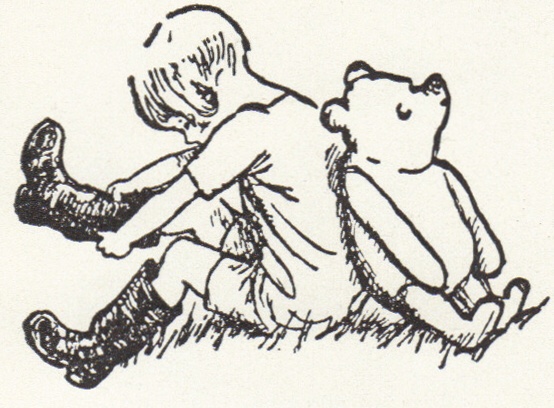
Christopher Robin owned a teddy bear, purchased in Harrods of London – and given to him as a first birthday present in 1921…. Originally the bear was called ‘Edward’….but he underwent a name change…. The Milnes were frequent visitors to London Zoo – and it was there that Christopher Robin fell in love with a certain Canadian black bear – called Winnie….so named for her previous owner….who came from Winnipeg, Canada….
Canadian Lieutenant Harry Colebourn had bought the bear as a cub from a hunter for 20 dollars…. Lt. Colebourn was on route to England during WW1….and the bear cub became the unofficial mascot for the Fort Gary Horse Regiment – a Canadian Army Reserve armoured regiment….
Harry Colebourne and Winnie, 1914
It was whilst the regiment were away in France that Winnie came to be in London Zoo, as she was left there for safe-keeping. Once the war was over she was officially donated to the zoo and became a much-loved attraction….
The other part of Winnie the Pooh’s name came from a swan called Pooh that the Milnes encountered on a family holiday….
Christopher Robin and Winnie the Pooh Image credit: Thoth God of Knowledge via Flickr
As we know Winnie the Pooh is usually shortened to just ‘Pooh’….and this might be the reason why….
“But his arms are so stiff….they stayed up straight in the air for more than a week, and whenever a fly came and settled on his nose he had to blow it off. And I think – but I am not sure – that that is why he is always called Pooh”…
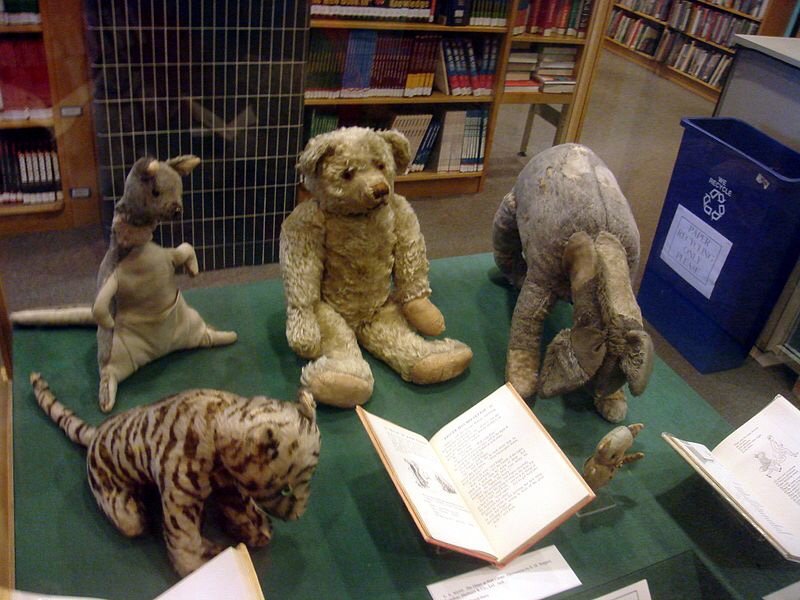
Pooh’s friends – Piglet, Eeyore, Kanga, Roo, and Tigger are all based on Christopher Robin’s other stuffed toy animals….Owl and Rabbit came from Milne’s imagination…. The original toys, Pooh, Eeyore, Piglet, Tigger and Kanga (unfortunately Roo got lost) can be seen at the New York Public Library – as they were gifted to them by American publisher E.P. Dutton in 1987…. They now receive over 750,000 visitors a year….
Original Winnie the Pooh stuffed toys : Clockwise from bottom left : Tigger, Kanga, Edward Bear (a.k.a. Winnie the Pooh), Eeyore and Piglet
On this day in history : 17th January 1912 – British explorers, led by Captain Robert Falcon Scott, reach the South Pole….only to discover a Norwegian team, led by Roald Amundsen had got there before them….
Scott, a naval officer and explorer, had unsuccessfully tried to reach the South Pole on a previous occasion, in 1902. His party had been forced to turn back because of ill-health and severe sub-zero weather conditions….
It was on the 15th of June 1910 that his converted whaling ship the ‘Terra Nova’ left Cardiff to begin the journey south….carrying on board – dogs, ponies and mechanical sledges – as well as the explorers and all of their supplies. It was Scott’s intention to carry out a series of scientific experiments and studies – he wished to learn more about the biology, geology and meteorology of the Antarctic…. He also wanted to test the newly motorised sledges they were taking with them…. Having a go at being the first to reach the South Pole was to be an added bonus….
Captain Robert Falcon Scott, in polar gear 1911 – Public domain
However, Scott had a rival – one that he was initially blissfully unaware of…. Roald Engelbregt Gravning Amundsen was a respected Norwegian explorer. It had been his original intent to take an expedition to the North Pole….but then two Americans, Frederick Cook and Robert Peary made separate claims as to having reached the North Pole – (claims that were later to be dismissed)…. Amundsen, being a competitive adventurer, kept his plans a well-guarded secret; it wasn’t until his ship ‘Fram’ left Oslo on the 3rd of June 1910 – supposedly bound for the North Pole – that he revealed his true intent to his team…. He knew that in the eyes of many his open challenge to Scott on racing to be the first to the South Pole would not have been entirely acceptable….
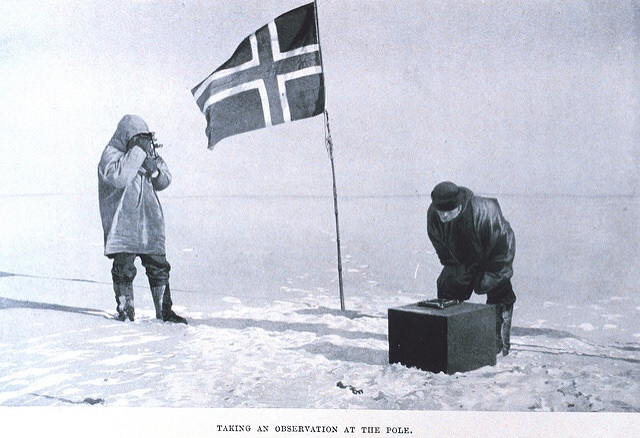
The first Scott knew of this rival expedition was when he reached Melbourne and found a telegram waiting for him…. It simply read – “Beg leave to inform you Fram proceeding Antarctic. Amundsen”…. Scott was understandably shocked – but was determined to stick to the original plan – he had experiments and studies to conduct… Amundsen would have had little time for such matters as science and technical trials; as far as he was concerned it was all about the race to the South Pole…. Amundsen and his team reached the Pole on the 14th of December 1911….
Taking an Observation at the Pole (1911) Expedition of Norwegian team by Roald Amundsen – Image credit: Euclid vanderKroew via Flickr
Scott and his team set out 11 days after Amundsen – on the 1st of November 1911…. It was not long before it became evident the mechanical sledges and ponies could not cope – so the expedition continued without them…. In mid-December the dog teams turned back….leaving just Scott and four of his companions to journey onwards:- Henry Bowers, Edward Wilson, Edgar Evans and Lawrence Oates….
The team arrived at the South Pole on the 17th of January 1912….thirty-four days after Amundsen’s expedition had arrived there…. It was a day of bitter disappointment for Scott and his men….
“Great God! This is an awful place and terrible enough for us to have laboured to it without the reward of priority”….the words of Scott….
Last expedition of Robert Falcon Scott. The image shows Wilson, Scott and Oates (standing); and Bowers and Evans (sitting)
It would have been with heavy hearts that the five men would have begun the eight hundred mile journey back to base camp….the journey that was to be their last and one so full of tragedy….
As the men dragged their equipment over ice fields and glaciers their exhaustion increased by the hour…. Evans was the first to succumb…. Scott had noticed on the 7th of February and recorded in his journal that his colleague was repeatedly falling behind the rest of the group. Ten days later Scott found him on his knees….Evans died later that night – as a complete group they had made it as far as the base of the Beardmore Glacier. The cause of death was possibly a brain injury – which Evans may have sustained during a fall, which the others had not witnessed….
The weather took a turn for the worse….and the team were still hundreds of miles from base camp. The men were forced to spend much of their time huddled against the elements in their tent….with their food supplies rapidly dwindling away….
By mid-March Oates was suffering from severe frost bite and was barely able to walk – he would have been acutely aware that he was a hindrance to the others…. It was reputedly with the words “I am just going outside and may be some time” that Oates walked out into the blizzard…. The others tried to dissuade him – but in the words that Scott recorded “the act of a brave man and an English gentleman”….
Three weeks later the remaining team members – Scott, Bowers and Wilson – were caught in yet another raging blizzard; they were just 11 miles (3 days of walking) from the next supply depot…. But the three never made it out of their tent again….having been claimed by exhaustion, starvation and exposure….
Eight months later a party of explorers from base camp came across the bodies of the three men still within the tent…. Scott was lay in the middle, his colleagues on either side of him…. The tent was removed and a cairn of ice built over them – forming an icy tomb….
Image credit : Australian National Maritime Museum via Flickr
All three had written letters in their final hours – to family and friends. Scott’s last words written on the 29th of March….“It seems a pity, but I do not think I can write any more….R. Scott”….”For God’s sake look after our people”….
It wasn’t until February 1913 that word of the tragic events reached back to Britain. A memorial service at St. Paul’s was held soon afterwards…. King George V and the Archbishop of Canterbury were amongst the many dignitaries who attended…. Britain was in mourning – 10,000 people gathered outside the Cathedral….
Amundsen’s success was celebrated worldwide – he received personal telegrams from King George and President Theodore Roosevelt…. Scott was also recognised for his achievements – and was posthumously made a Knight Commander of the Order of the Bath….