On this day in history : 15th December 1982 – The Major Oak in Sherwood Forest – reputed to have been Robin Hood’s tree – is fitted with a fire alarm….
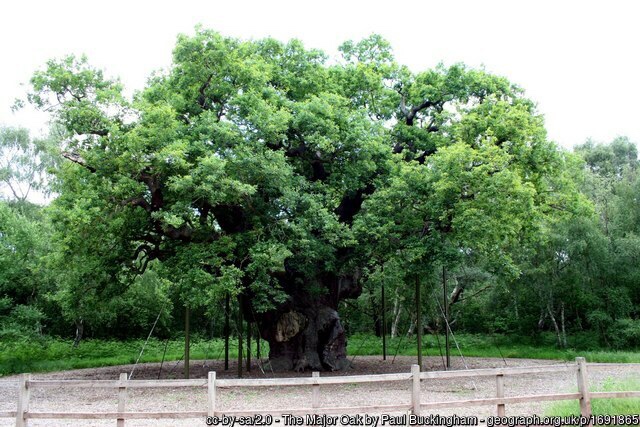
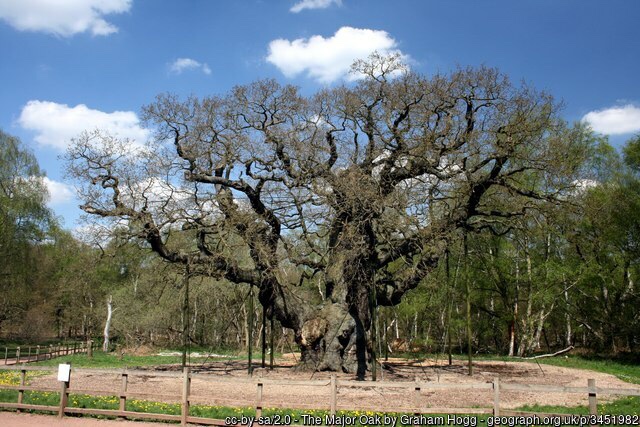
The Major Oak, an English oak (Quercus robur), is the largest oak tree in Britain and can be found in the heart of Sherwood Forest National Nature Reserve, not far from the Nottinghamshire village of Edwinstowe…. It is estimated to be between 800 and 1,000 years old – and has a canopy spread of 92ft (28m) and a girth of 33ft (10m)…. It weighs an estimated 23 tons and can produce some 150,000 acorns in a good year…. In 1908 chains had to be added to help support the tree and in the 1970s support beams were put up to help hold up the sprawling branches…. These beams were reinforced with metal in the 2000s…. It was fenced off in the 1970s as the thousands of footsteps of visitors compounding the surrounding ground were damaging the tree’s roots…. It is estimated around 350,000 visit the oak each year….
Over the centuries the Major Oak has survived storms, wars and deforestation…. Legend has it that it once sheltered Robin Hood and his band of Merry Men…. The trunk has a hollow interior that is big enough to climb inside – it was within here that in 1982 vandals lit a fire – and so as a future precaution a fire alarm was fitted to the tree…. Then, in the July of 2020, whilst the country was in ‘lockdown’ during the COVID-19 pandemic, vandals struck again…. A 3ft chunk of bark was ripped from the trunk by somebody climbing on the ancient oak…. Local people branded the vandalism as sacrilege…..
On this day in history : 23rd November 1990 – The death of much-loved children’’s author Roald Dahl…. But did you know he was also an ace fighter pilot, spy, medical inventor and chocolate historian?
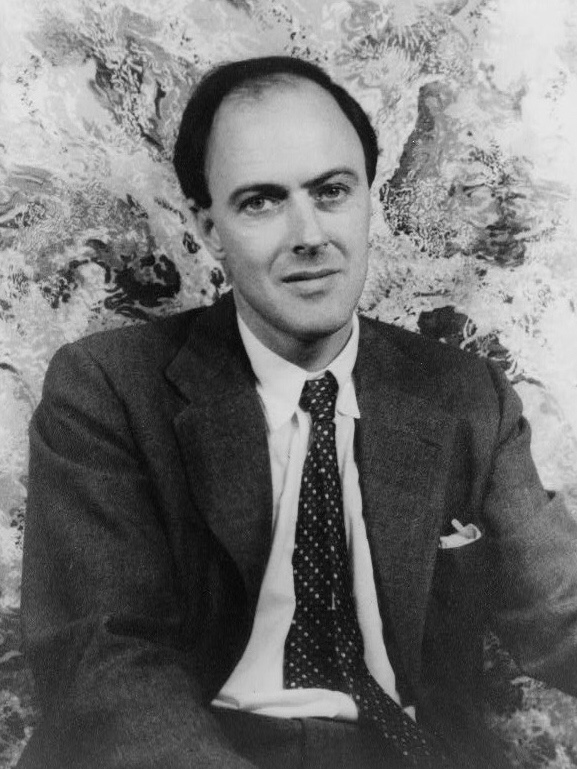
Roald Dahl in 1954 – Public domain
Roald was born on the 13th of September 1916 to Norwegian parents living in Llandoff, Wales…. He was named after Roald Amundson, the Norwegian adventurer and explorer who was the first man to reach the South Pole…. Norwegian was Roald’s first language, as this is what the family spoke at home….
When he was three years old his seven year old sister died from appendicitis – and then just a few weeks after his father succumbed to pneumonia…. Soon after his mother gave birth to another little sister…. His father had always believed that English schools were the best in the world and had wanted his children to be educated in them…. With this in mind his mother chose not to return to Norway but to remain in Wales so she could honour his wish…. Roald first attended Cathedral School in Llandoff before being sent to St. Peter’s Boarding School in Weston-Super-Mare…. He was desperately homesick and wrote to his mother every week – but never let on how unhappy he was…. Then in 1929, at the age of thirteen, he was sent even further away, to Repton School in Derbyshire…. He was even more miserable here; corporal punishment was frequently used – Roald detested the cruelty and found it hard to accept that beating children was permissible….
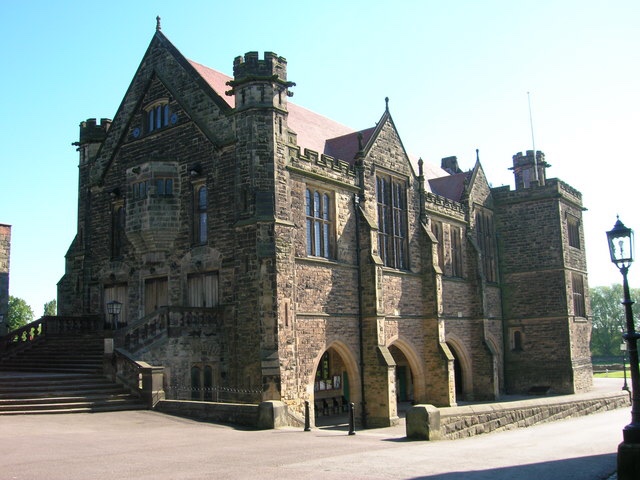
Repton School – Image credit : J. Thomas CC BY-SA 2.0
Roald’s talent for writing was not recognised during his schooling…. He was seen as an accomplished sportsman though; he was captain of the school’s squash team and was good at cricket, golf and football…. He grew tall, ending up at a height of 6ft 6in….
He had other varied interests; he was keen on photography – and he discovered a love of chocolate…. The Cadbury’s factory was near to the school and occasionally boxes of new chocolates would arrive for the boys to try out…. Roald would daydream about making up a chocolate bar of his own to wow Cadbury’s…. It was his passion for the confection that inspired his third children’s book in 1964 Charlie and the Chocolate Factory…. He would often refer to chocolate in his stories….
Fair use
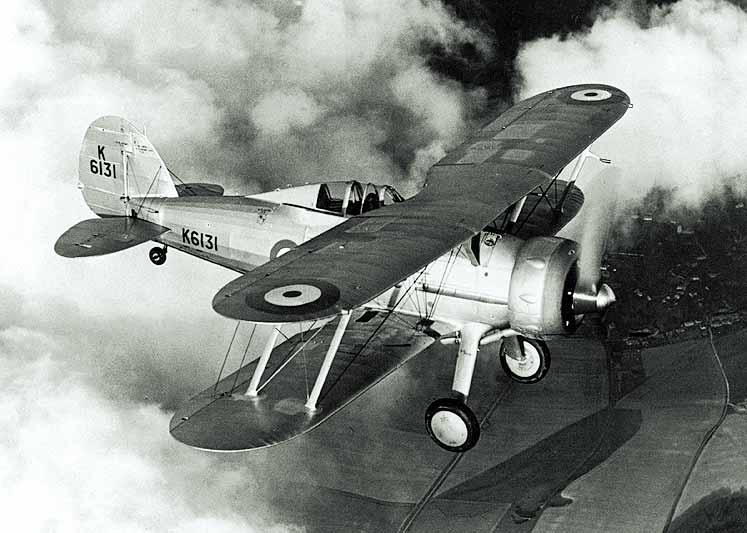
Roald left school in 1934 and started to work for the Shell Petroleum company, being posted to Kenya and Tanzania…. In August 1939, with World War Two approaching, he was still in Tanzania and was draughted as a lieutenant into the King’s African Rifles…. Then in the November of 1939 he joined the RAF to become a pilot…. After completing his training he was assigned to No.80 Squadron, flying the RAF’s last fighter bi-planes, Gloster Gladiators…. It was whilst flying one of these that on the 19th of September 1940 he was forced to make an emergency landing in the desert…. The aircraft crashed – Roald suffered a fractured skull and lost his vision…. He was rescued and taken to a Royal Naval hospital where he eventually regained his sight – and in February 1941 he was declared fit enough to fly again….
Gloster Gladiator – Public domain
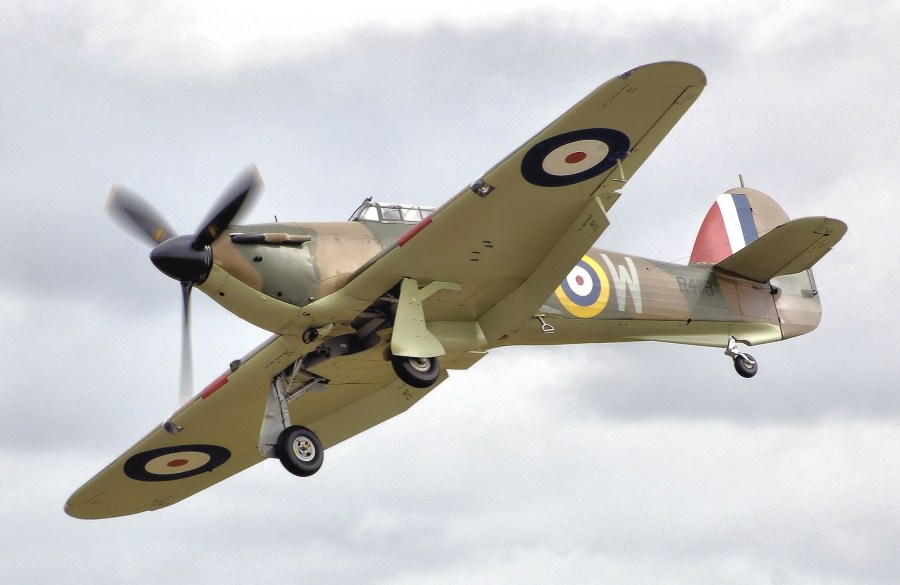
To rejoin his squadron Roald had to travel to Eleusina near to Athens – where they had been transferred to join the Greek Campaign…. This time he was to fly Hawker Hurricane aircraft and on the 15th of April 1941 he was to take part in his first aerial combat and in which he was to shoot down is first plane…. The following day he shot down another…. On the 20th of April he took part in the Battle of Athens….
Hawker Hurricane – Image credit : Arpingstone – own work – Public domain
By May the Germans were advancing and the squadron was evacuated to Egypt…. For over a month Roald was to fly sorties every day but during the second half of June he began to suffer severe headaches causing him to blackout…. He was invalided out of the squadron, returned to Britain and posted to an RAF training base at Uxbridge – with the idea of him becoming an instructor once his health had sufficiently recovered…. It was whilst on a trip to London in the late March of 1942 that he was to meet Major Harold Balfour, Under-Secretary of State for Air…. Balfour was so impressed by Roald that he appointed him assistant air attaché to the British Embassy in Washington DC….
While in the States Roald was to meet the writer C.S.Forester, who had been commissioned by the Saturday Evening Post to write a piece on Roald’s flying experiences…. He asked Roald to jot something down that he could work with…. However, when he received the account he was so impressed that Roald’s story was published exactly as he had written it – this was to be Roald’s first ever published work….
Roald was beginning to move within different circles…. He was to meet and work with British army officer Ian Fleming – author of the James Bond stories…. And he was then introduced to the world of espionage – and to Canadian spymaster William Stephenson, code name Intrepid….. It was Roald’s task to supply intelligence from Washington back to Prime Minister Winston Churchill and to MI6…. By now he had been promoted to Wing Commander and before long he had become Squadron Leader…. But in August 1946 his ongoing injuries from his aircraft crash meant him being invalided out of the RAF – as a flying ace having more than five victories to his name….
On the 2nd of July 1953 Roald married American actress Patricia Neal and they were to have four daughters and one son…. In December 1960 four month old Theo’s pram was struck by a New York taxi cab, leaving him with serious injuries…. Little Theo suffered with Hydrocephalus – an accumulation of cerebrospinal fluid in his brain…. Roald worked with neurosurgeon Kenneth Till from Great Ormond Street Children’s Hospital and hydraulic engineer Stanley Wade to develop a valve – the Wade-Dahl-Till Valve – which was used with a shunt to alleviate the condition…. The valve went on to be used to help nearly 3,000 children all around the world….
Patricia Neal and Roald Dahl – Public domain
In November 1962 Roald’s eldest daughter, Olivia, died from measles at the age of seven…. He was beside himself with grief and guilt at not being able to help her…. (His 1982 book, The BFG, is dedicated to her)…. Roald became a promoter of immunisation…. Then in 1965 his wife suffered three burst cerebral aneurysms whilst pregnant with their fifth child…. Roald had to help her learn how to walk and talk again – eventually she recovered enough to be able to return to her acting career…. A film was made about their story in 1981 The Patricia Neal Story – starring Glenda Jackson and Dirk Bogarde….
In 1972 Roald began an affair with Felicity d’Abreu Crosland – who he later married after he and Patricia divorced in 1983…. With his new wife he lived at Gypsy House, a home he had owned since 1954 in Great Missenden, Buckinghamshire…. His first children’s book, The Gremlins, had been published in 1943 – and he went on to write some of the best loved children’s stories of all time: Charlie and the Chocolate Factory, James and the Giant Peach, The BFG, Fantastic Mr Fox, Matilda, The Witches, The Twits, Danny Champion of the World and George’s Marvellous Medicine…. He also wrote stories for adults, which were often macabre – and many were adapted for TV and film, such as Tales of the Unexpected and Alfred Hitchcock Presents…. He wrote screenplays and for television…. Roald was a prolific writer – but then with his own life experiences he would never have been short of something to write about…. He has been named one of the 50 greatest British writers since 1945 and it is estimated over 250 million of his books have been sold; he has been published in some 60 different languages….
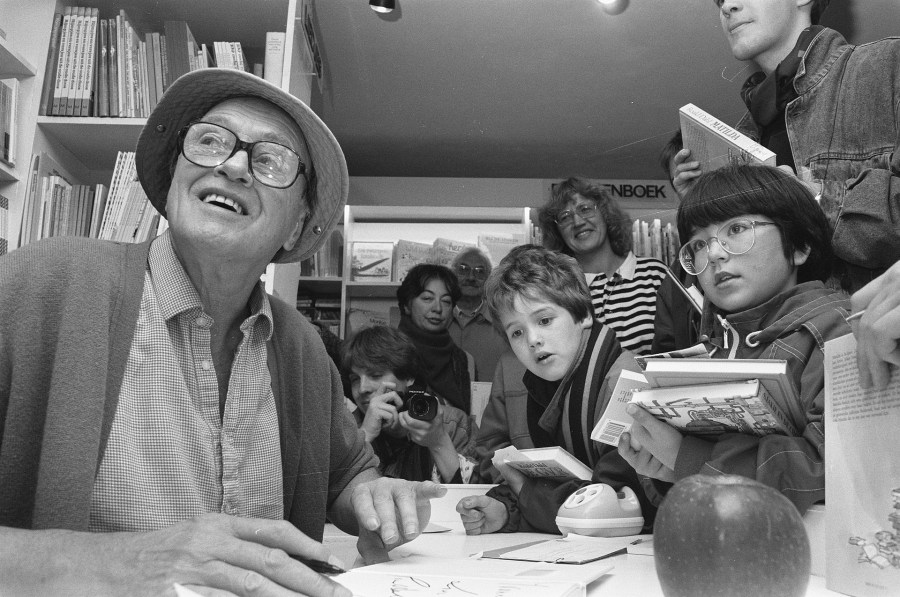
Roald book signing in Amsterdam – Image credit : Bob Bogaerts / Anefo CCO
On the 23rd of November 1990, at the age of 74, Roald died from a rare cancer of the blood…. He was buried at the Church of St. Peter and St. Paul in Great Missenden, Buckinghamshire – along with his snooker cues, a good bottle of Burgundy, some chocolates, HB pencils – and a power saw!
Image credit : MilborneOne – own work – CC BY-SA 3.0
On this day in history : 22nd November 1946 – The first British Biro ballpoint pen goes on sale…. It was manufactured by a British company but had originally been designed by Hungarian Laszlo Biro….
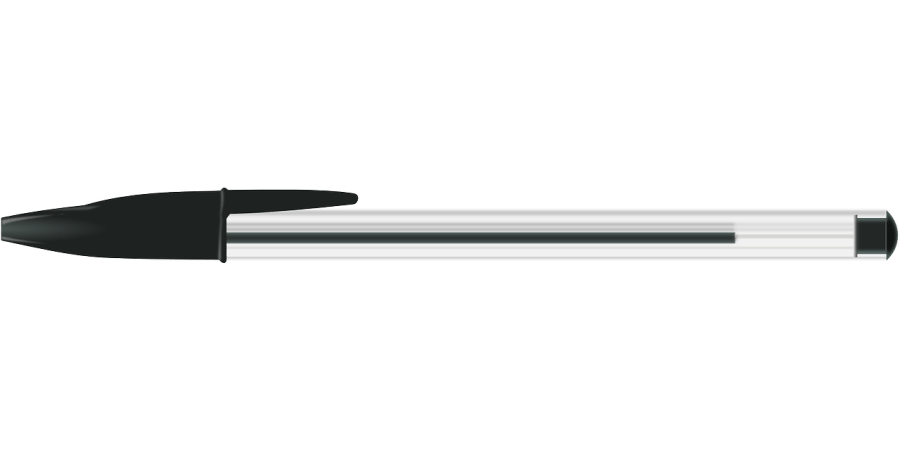
Biro’s invention – Image credit : Roberto Fiadone – edited by Daniel Schwen – CC BY-SA 2.5
Laszlo, who was a Hungarian-Jewish newspaper editor living in Germany, got frustrated with the amount of time he spent filling up his fountain pen with ink – and then cleaning up the mess afterwards…. He couldn’t help but notice that the ink used for printing newspapers did not smudge and so the paper it was used on stayed dry…. He approached his brother, Gyorgy, who was a chemist, to help him develop an ink that could be used in a pen….
Laszlo Biro circa 1978 – Public domain
The first patent for such a writing instrument had originally been issued in October 1888 to John J Loud – who had wanted something he could write with on coarse surfaces, such as wood, rough paper and leather…. His pen nib had a small rotating steel ball held by a socket…. However, it did not sell commercially and the patent expired…. Further attempts by others to create a reliable ballpoint which delivered ink properly failed – the ink would either be too thin, or would clog…. Very often the ball socket would be too tight, not allowing ink to reach the paper…. But the Biro brothers managed to get the formula just right – and a patent was filed on the 15th of June 1938….
In 1941 the brothers had to flee Germany and the Nazis…. Along with friend Juan Jorge Meyne they went to Argentina – and together they formed Biro Pens of Argentina, with a new patent filed in the US in 1943…. The pens were sold as the Birome in Argentina and are still known by this name there…. Britain soon cottoned on to this revolutionary new pen and started to produce them for use by RAF aircrews – as they could be used at high altitudes – whereas fountain pens leaked even more….
Advert in Argentine magazine ‘Leoplan’, 1945 – Image credit : Revista Leoplan, Argentina, ano 1945 – CC BY-SA 2.5
In 1946 Catalonian firm Vila Sevilla Hermanos began making ballpoint pens in contract with French firm Societe Bic – hence the name Bic-Biro….
On this day in history : 28th October 1986 – Jeremy Bamber is jailed for life for the White House Farm murders – where he killed five members of his own family….
Bamber shortly after his arrest – Fair use
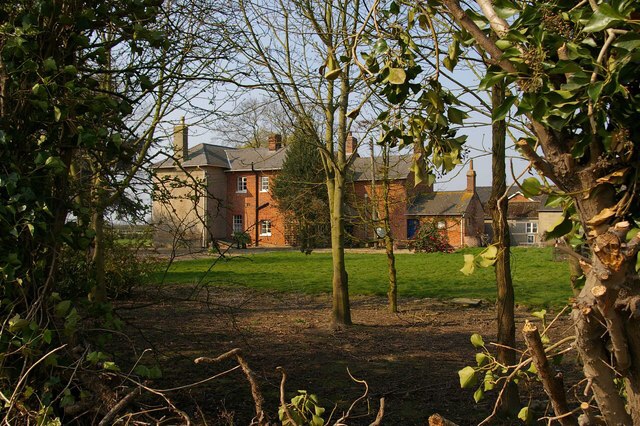
The Bambers were a wealthy farming family, living at White House Farm, a large Georgian property near to Tolleshunt D’Arcy in Essex…. Jeremy was legally adopted by the family as a baby…. Four years previously they had also adopted a baby girl, Sheila….
White House Farm (in 2007) – Image credit : Glyn Baker CC BY-SA 2.0
After leaving school Bamber’s adoptive father paid for him to travel to Australia and New Zealand…. Here he reputedly became involved in drug smuggling – and also broke into a jewellery shop, stealing two valuable watches….
Once he had returned to the UK and after a few casual jobs, Bamber began to work for the family farm…. However, he was resentful of the low wage – despite living rent free in one of the family’s cottages and having been given a car…. He further showed his lack of appreciation by committing a robbery at the caravan park owned by his family….
Bamber’s adoptive parents Neville and June Bamber – Fair use
Bamber’s adoptive sister, Sheila, had been treated in hospital for schizophrenia…. On the 7th of August 1985 at 3.30am 24-year-old Bamber phoned the police to say his father had phoned him and told him that Sheila had got hold of his gun and had gone berserk with it…. When the police arrived at the house they found her dead, with the gun lay on her chest – along with a Bible…. Her mother lay dead in the same room, her father was found dead in the kitchen and Sheila’s 6-year-old twin boys lay dead in their beds upstairs….
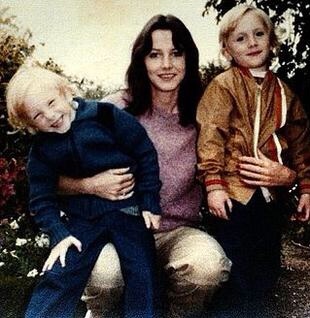
Sheila and her twin boys, Daniel and Caffell (around 1984) – Fair use
At first police believed that Sheila had killed them all before turning the gun on herself…. But when Bamber’s girlfriend came forward and said that he had talked about killing his parents forensic tests were carried out and revealed his fingerprints on the gun…. Bamber had been set to inherit £436,000….
As the guilty verdict was read out at Chelmsford Crown Court Bamber showed little reaction…. Judge Mr. Justice Drake described him as “Warped and evil beyond belief”…. He then handed down five life sentences….
Bamber has always protested his innocence…. In July 2001 an inquiry was launched into the case and it was referred back to the Court of Appeal…. In December 2002 Bamber lost his appeal….
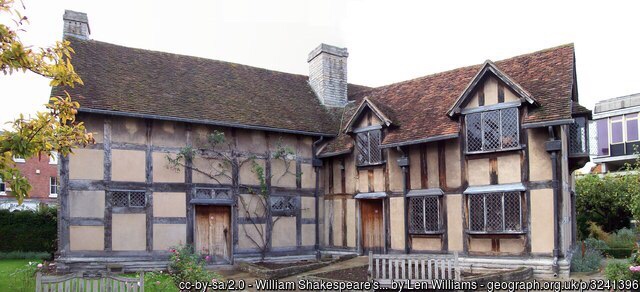
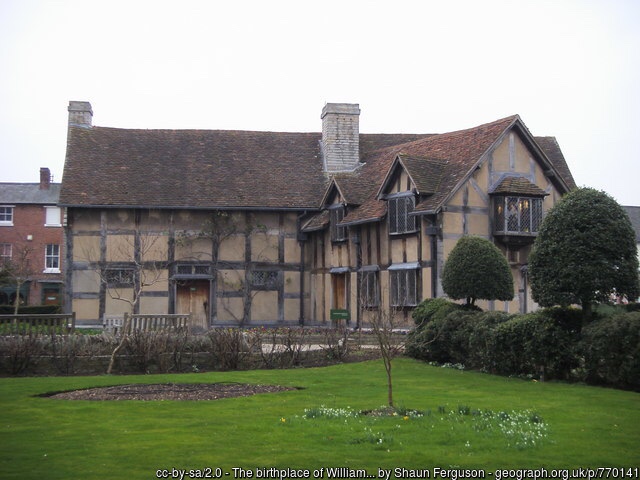
On this day in history : 16th September 1847 – The Shakespeare Birthplace Trust buys the house in which playwright William Shakespeare was born in Stratford-upon-Avon, Warwickshire, for £3,000….
The timbered house situated on Henley Street, Stratford-upon-Avon, is believed to be where Shakespeare was born in 1564 and where he spent his childhood….
It is thought the building dates to the 1400s…. At the time of Shakespeare’s birth his father was renting the house but ten years later was in a position to buy it along with another property in Henley Street…. The house remained in the family until 1806 when it was sold to Thomas Court, a butcher….
In the following years the house fell into disrepair – but interest in it sparked again when writers such as Charles Dickens, Sir Walter Scott, Isaac Watts and Thomas Carlyle visited, wanting to see Shakespeare’s birthplace….
1769 engraving of Shakespeare’s birthplace from Gentleman’s Magazine, July 1769 – Public domain
The house was put up for sale in 1846 – American showman P.T.Barnum planned to buy it and ship it back to the United States, where he intended to have it rebuilt…. To prevent this from happening the Shakespeare Birthday Committee was formed and with the help of the likes of Dickens the necessary £3,000 to buy it was raised – and restoration work began…. The committee later became the Shakespeare Birthplace Trust….
Nowadays Shakespeare’s birthplace is a museum and popular tourist attraction – it is often referred to as ‘a mecca for all lovers of literature’….












 Cottage Capers