On this day in history….23rd October 1843

On this day in history : 23rd October 1843 – Nelson’s Column in Trafalgar Square, erected to commemorate Admiral Horatio Nelson’s victory at Trafalgar in 1805, is finally completed….img_4388
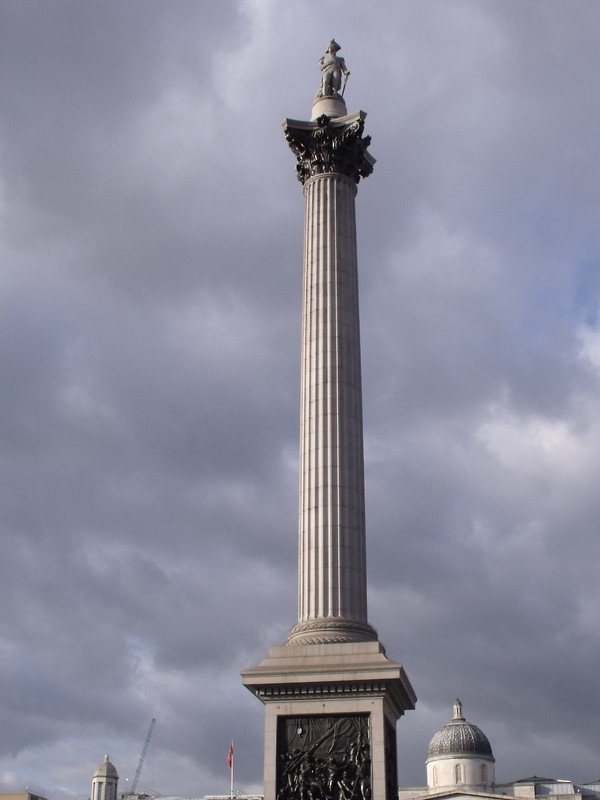
In February 1838 a group of 121 Peers, MPs and dignitaries formed a committee to organise a monument to Lord Nelson…. It was funded mainly from private donations, including very generous help from the Tsar of Russia – and the British Government agreed to provide a site in Trafalgar Square, in front of the National Gallery….

A competition was held for the design – with a budget guide of between £20K-£30K…. (The end cost was actually £47K, over £3 million in today’s terms)…. The winning design came from William Railton; however, after criticism of how the completion was organised, it had to be run again…. After making slight revisions to his original design, Railton still won….the wining entry was chosen by a sub-committee, led by the Duke of Wellington….

Excavation work on the site began in July 1840 and on the 30th of September 1840 the first stone was laid – by Charles Davison Scott, honourably Secretary of the committee and also the son of John Scott, who had been Nelson’s secretary….

img_4385
Nelson’s Column under construction 1843 – William Henry Fox Talbot – Public domain

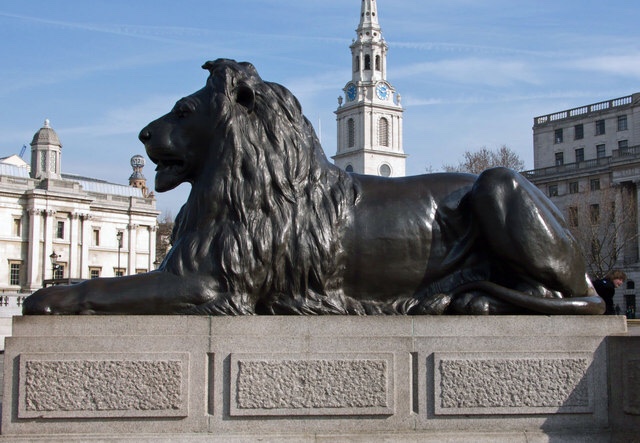
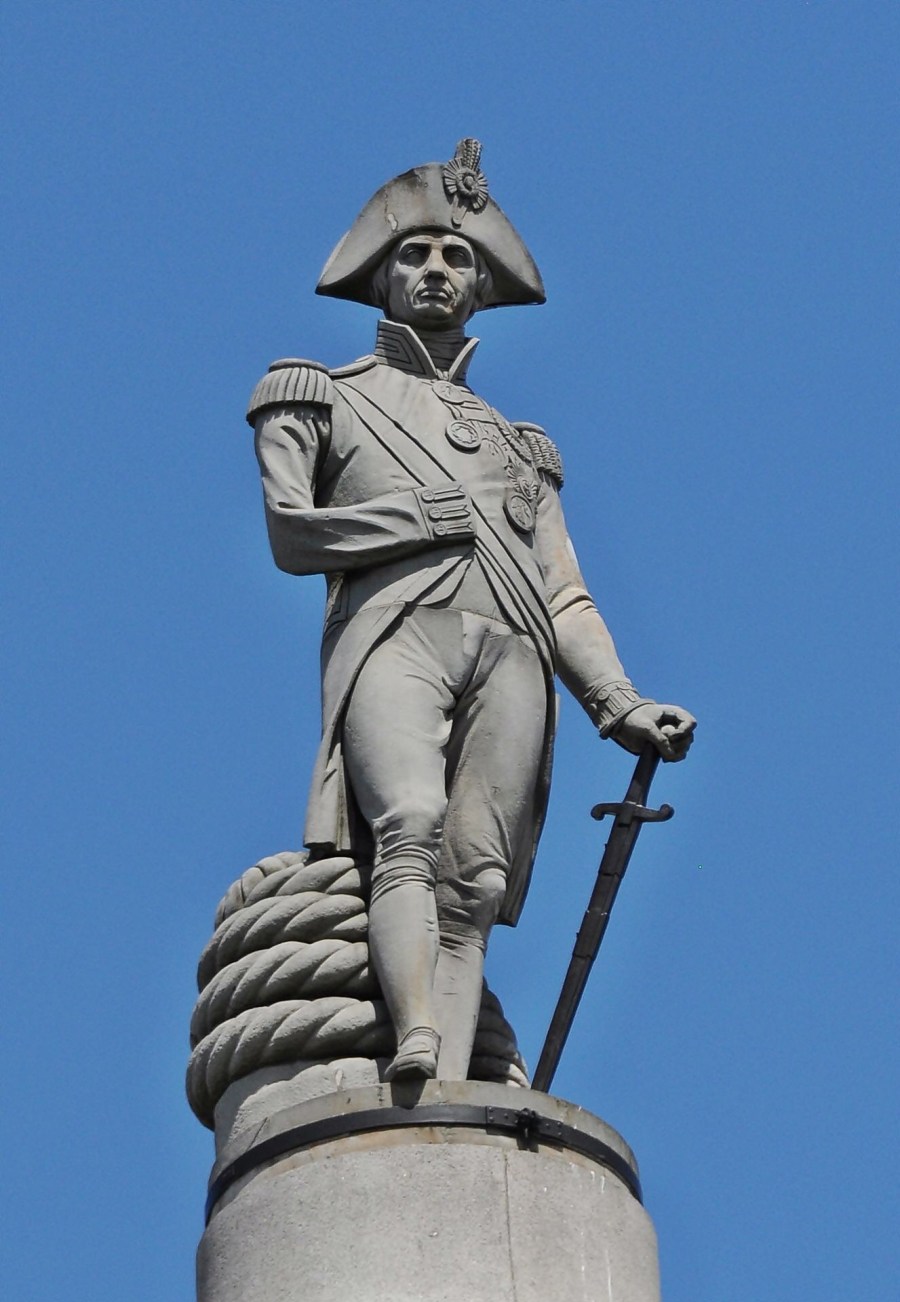
Built from Dartmoor granite, with a Craigleith sandstone statue of Nelson, designed by E.H.Baily, the monument has four bronze lions at the base – which were added in 1867…. The lions were designed by Sir Edwin Landseer and have come into some ridicule over the years…. Landseer had been given a dead lion by London Zoo, as a model to work from….but unfortunately it rotted and he had to resort to artistic licence….
img_4387
One of the lions at the base designed by Landseer – Image credit : Anthony O’Neil CC BY-SA 2.0

The pedestal is decorated by four bronze relief panels, one on each side….and were cast from captured French guns…. They depict the Battle of Cape St. Vincent, Battle of the Nile, Battle of Copenhagen and the death of Nelson at Trafalgar…. The statue of Nelson himself faces down Whitehall towards the South – to HMS Victory at Portsmouth – and further beyond towards Southern Spain and Cape Trafalgar…. Fourteen stone masons were responsible for hoisting the statue up to the top of the column – and they held a dinner party up there on the plinth before doing so….

During World War 2 the German Luftwaffe were ordered not to bomb Nelson’s Column – as the intention was to move it to Berlin after they had ‘won the war’….
img_4386
The sandstone statue of Nelson by Edward Hodges Baily – Image credit : Beata May CC BY-SA 3.0

On this day in history….22nd October 1877

On this day in history : 22nd October 1877 – An explosion at the High Blantyre Colliery sees Scotland’s worst ever mining disaster…. At least 218 men and boys are killed, the youngest just 11-years-old….img_4365

It was a gloomy Monday morning….230 men went down the mine to start work as usual at 5.30am…. At 8.45am a huge underground explosion occurred that could be heard from miles around, an explosion that lasted between 4 and 5 minutes…. Flames could be seen coming from 2 of the 5 pits….

The pit horn would have signalled the disaster….women would have rushed to the scene fearing for their menfolk…. As the news spread workers from neighbouring pits hurried to help… The rescue effort was led by James Gilchrist, manager of Mr John Watson’s Colliery – he had formerly been employed at Blantyre and so knew it well….

The presence of carbon dioxide and debris caused major difficulties but the rescuers persevered throughout the day and into the night….before eventually being forced to suspend the rescue mission due to ‘bad air’…. The search resumed the following morning – those that were brought out alive were so badly burnt or suffering from the effects of ‘choke-damp’ (carbon dioxide) that they died either on the way to or in Glasgow Infirmary….

The bodies recovered from the pit were taken to ‘the death house’ – a temporary mortuary…. They were washed and tended to by the women of the village…. It was here the womenfolk came to identify their husbands, sons, sweethearts and fathers…. For some women it meant several trips to find their loved ones – for many the entire male family members were taken from them…. The disaster left 106 widows and 300 fatherless children….img_4364

Once identified the bodies could be taken home – often in a handcart – so that funeral preparations could be made…. Little did they know that less than 2 years later, on the 9th of July 1879, another disaster was to strike at pit no.1 – claiming another 27 lives….

On this day in history….21st October 1958

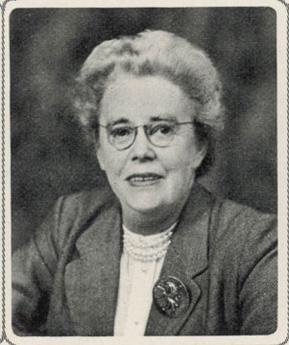
On this day in history : 21st October 1958 – Stella Isaacs, Marchioness of Reading and Baroness Swanborough is the first woman to take her seat in the House of Lords….

img_4360
House of Lords Chamber : Image : UK Parliament CC BY-SA 3.0

Baroness Swanborough had been heavily involved with charity work for most of her life, including founding the Women’s Voluntary Service in 1938….

“I have no right to speak, except for my experience over many years with a great number of very strong commonsensical women”…. – Stella Isaacs

img_4359
Lord and Lady Reading c.1935 – Public domain

After the passing of the Life Peerages Act, 1958 women were finally allowed to sit in the Upper House as life Peers…. Baroness Swanborough was not the first woman to be appointed (that went to Baroness Wootton of Abinger) – but she was the first woman to take her seat…. Before 1958 only male hereditary Peers were permitted to sit in the House of Lords, along with a small number of judges (Law Lords) and Bishops…. There were women hereditary Peers but of course they were not allowed to sit…. The Life Peerages Act was passed to address the problem of a decline in the number of members….by opening the way to include life Peers this also opened the channels for women…. Ironically, hereditary ‘Peeresses’ were still excluded until the Peerage Act, 1963….

img_4361
Baroness Wootton of Abinger – Fair use

With women now being allowed into the formerly male dominated establishment certain changes had to be made…. The House of Lords administration had to decide what to call their new female counterparts…. “Peeresses” was favoured by the establishment but the women fought hard to be known as Peers…. Even as late as 1970 there was still resistance to this….but eventually ‘Women Peers’ became accepted….

Another matter was ‘Oh what to wear!’…. It was decided ceremonial dress would consist of a scarlet robe, trimmed with ermine and gold oak leaf lace…. To complete the ensemble a Tricorne hat, designed and made by Ede and Ravenscroft….constructed from lightweight black velour and adorned on the left-hand side by a rosette of gold lace with a gold sequinned button at the centre….

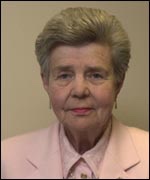
Bathroom facilities were an issue that needed to be addressed…. A ‘Peeresses retiring room’ was allocated, redecorated and furnished…. In 1958 four women took their seats in the House of Lords; by 1971 there were 46 women Peers and the facilities were desperately inadequate…. A letter from the Yeoman Usher of the Black Rod stated two baths and two lavatories were urgently required…. Nowadays there are approximately 200 women Peers…. The first female Chief Whip was Baroness Llewelyn-Davies of Hastoe in 1973 and the first woman leader of the House of Lords was Baroness Young in 1981….

img_4362
Baroness Young – Image : BBC – Fair use

On this day in history….20th October 1946

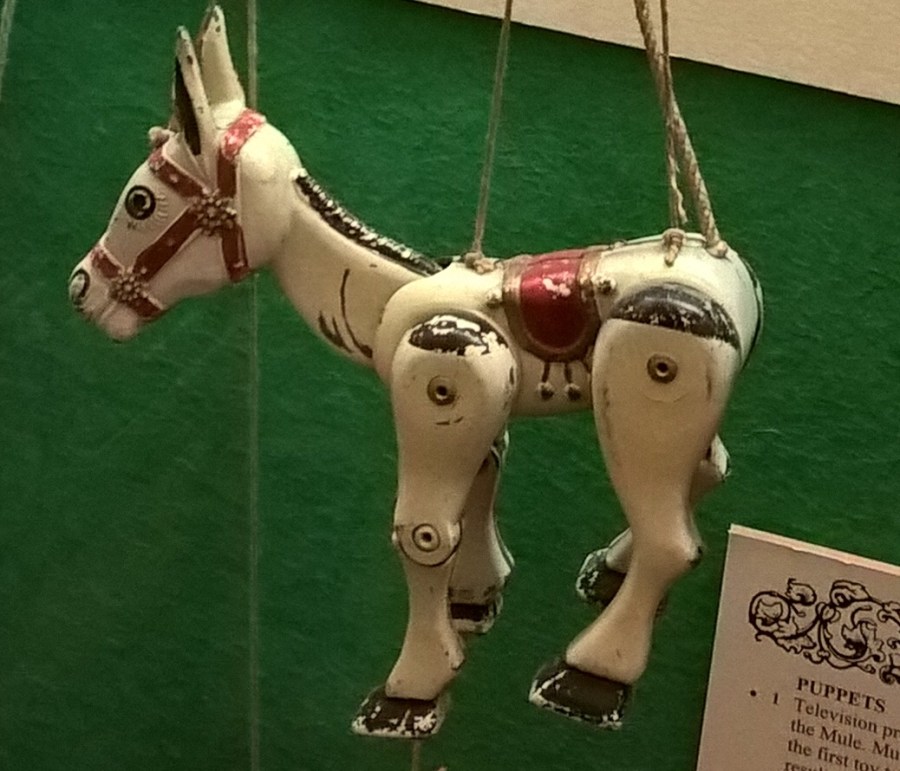
On this day in history : 20th October 1946 – Muffin the Mule appears on BBC Children’s Television for the first time….

img_4357
Muffin the Muke puppet toy, Museum of Childhood, Edinburgh – Image credit : Chemical Engineer CC BY-SA 4.0

Muffin was already 12-years-old before debuting on TV…. Hogarth Puppets, run by puppeteers Jan Bussell and his wife Ann Hogarth, were used as an experimental medium during the pioneering days of television in the 1930s…. The mule, which at that point remained nameless, was made by Fred Tickner (who also created Punch and Judy) and was added to the Hogarth collection in November 1934….

img_4358
Ann Hogarth – Fair use

It was in 1946 that Annette Mills, older sister of actor John Mills, joined the BBC…. Annette had been an accomplished and up and coming dancer – but her dancing days ended when she suffered a broken leg…. In a career change she took on the role as presenter of a show to entertain children by singing and telling stories….using the top of her grand piano as a ‘stage’ for the characters in her stories….

Annette and her colleague, producer Andrew Miller Jones, approached Jan Bussell and Ann Hogarth – and together as a team they devised the ‘Muffin the Mule Show’ using the mule puppet Fred Tickner had created….

Usually the show went out on air at Sunday teatime and ran on the BBC until Annette’s death in 1955…. Each 15 minute episode began with Annette singing the theme tune ~ “We want Muffin, Muffin the Mule…. Dear old Muffin, playing the fool” …. Ann Hogarth would operate the puppet, so that it would be dancing on the piano top, from behind a screen…. A story would then be told by Annette, usually featuring other puppet characters, such as Sally the Seal, Poppy the Parrot, Peregrine the Penguin and Katy the Kangaroo….

Muffin was one of the first stars of British television – and one of the first examples of character merchandise….including toys, books, playing cards, clothing and games, such as ‘Pin the Tail on Muffin’…. The puppet featured as a regular comic strip in the 1950s publication ‘T.V. Comic’ and there was even a Muffin the Mule Club to join….

On this day in history….19th October 1991

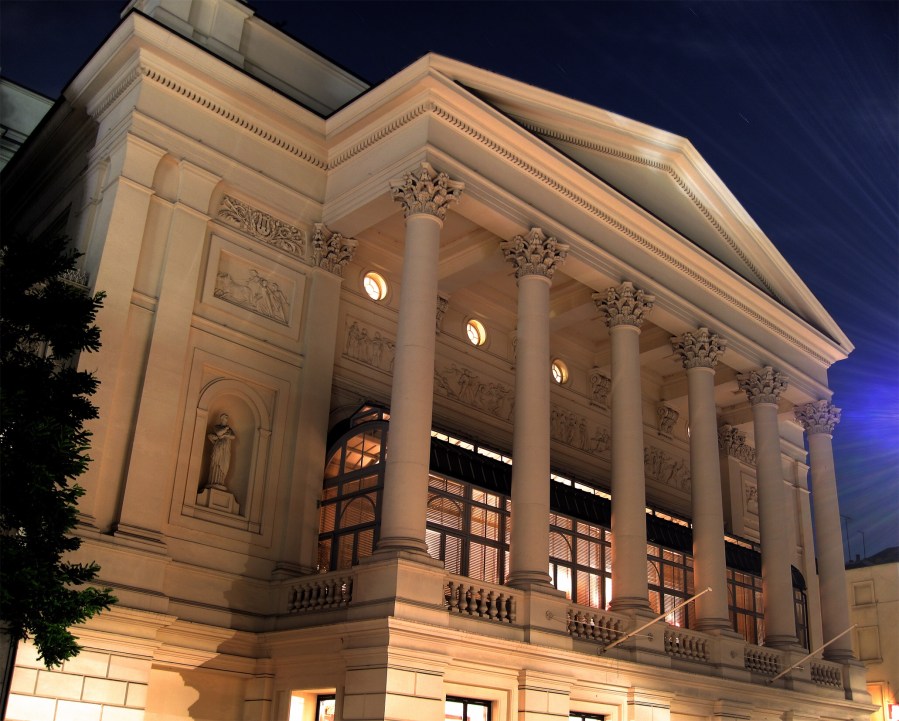
On this day in history : 19th October 1991 – Performances at London’s Royal Opera House are cancelled due to a pay dispute with orchestra members….

Royal Opera House at night
Royal Opera House – Peter Suranyi CC BY-SA 3.0

The 118 members of the orchestra argued that they were the only performers at Covent Garden who were expected to supply their own clothing and instruments…. They sought a 24% pay increase….

At the time the state-subsidised Royal Opera House was having acute financial difficulties…. On becoming Chairman in 1991 Sir Angus Stirling had inherited a £2.5 million accumulated deficit – because of this the ROH could only offer a 5.5% increase….

The orchestra retaliated by refusing to wear the required evening dress and dinner jackets for performances and turned up wearing jeans and casual clothing…. To take their protest even further they announced plans to observe all intermissions called for in the original score of any ballet or opera….thus ignoring the artistic discretion of the conductor and director…. For example: an upcoming production which was to start that coming week would have a total of ‘four’ intermissions instead of the proposed ‘one’ – and one of those breaks was to occur after an act of just eight minutes long….

As a result it was decided all performances would be cancelled until the orchestra ended its protest and the matter be resolved….

img_4356
User FAZO10 – Public domain