
On this day in history : 5th August 1860 – The birth of English artist Louis Wain – who is known to us mainly for his drawings of comical anthropomorphic cats….

Wain was born in Clerkenwell, London, to a French mother, Felicia Marie and an English father, William Matthew Wain, a textile merchant…. Wain had a troubled childhood; having been born with a cleft lip on the advice of doctors he did not start school until he was ten years old…. Then, once he had started, he found it hard to settle and would often play truant – and took to wandering around London…. However, despite this he did manage to get into the London School of Art and after finishing his studies stayed on to teach for a while….
When Wain was aged 20 his father died and it fell on his shoulders to support his mother and five sisters…. He became a freelance artist, specialising in the countryside and animals…. He carried out work for ‘The Illustrated Sporting and Dramatic News’ and then in 1886 began working for ‘The Illustrated London News’….
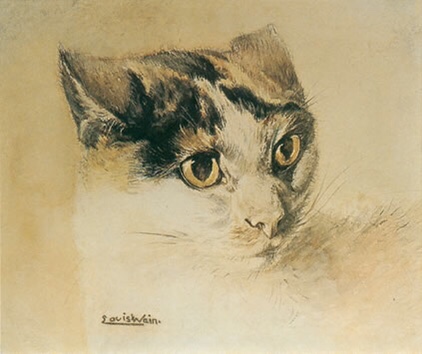
At the age of 23 Wain married Emily Richardson, governess to his sisters and ten years older than him…. Shortly after Emily became ill with breast cancer – and it was during this time that Peter came into their lives…. Peter was a tiny black and white scrap of a kitten that they rescued – this was at a time when cats were seldom kept as pets….but the kitten brought so much comfort to Emily…. To amuse her and raise her spirits Wain would draw sketches of Peter….delighted Emily encouraged him to publish them…. Emily died in 1887, so did not live long enough to see him do this…. However, in the Autumn of 1886, Wain had been commissioned to illustrate ‘Madame Tabby’s Establishment’ by Caroline Hughes, under the pen name of Kari…. Emily would have loved seeing Peter depicted in the book….
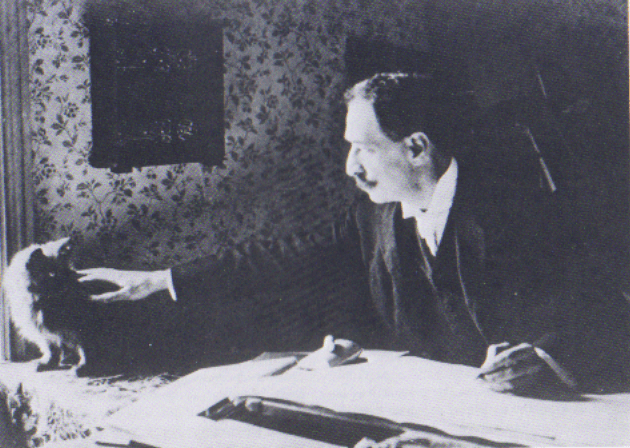
Wain’s first anthropomorphised cats picture that was published appeared in a Christmas edition of ‘The Illustrated London News’ and was entitled ‘A Kittens Christmas Party’….

At this stage his cats remained on all fours and had yet to gain the humanisation of his later drawings…. As time progressed his cats began to walk upright and have more human facial expressions – and indulged in human pursuits: playing golf, drinking tea, gong to the opera, smoking…. Humanising animals was a popular trait during Victorian times and continued into the Edwardian era…. For the following 30 years Wain was a prolific artist, producing over 600 illustrations a year…. His work appeared in journals and magazines, he illustrated over 100 children’s books and between 1901-1915 even had an annual of his own….
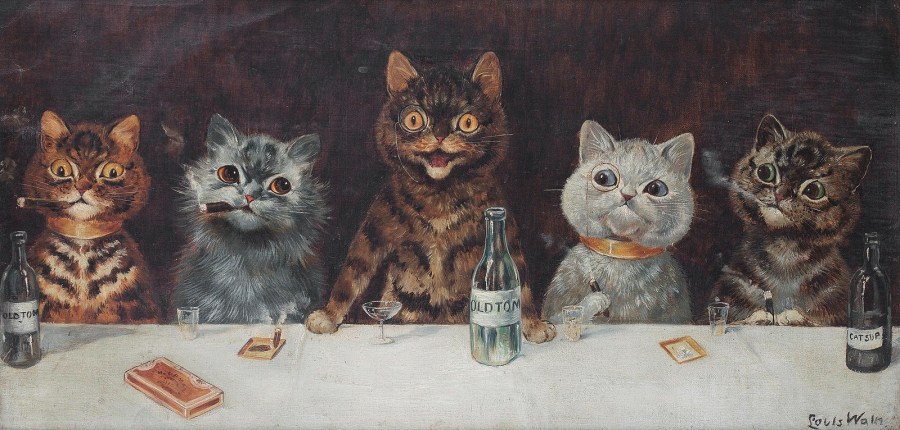


Despite his success Wain experienced continuous financial difficulties…. He was still supporting his mother and sisters, none of whom had married – and his youngest sister had been declared as mentally insane…. Not being a businessman Wain was easily persuaded to invest into non-starter money making schemes – he was easily taken in…. He would also invariably sell his work without retaining copyright….
Later in his life Wain began to display symptoms of mental illness himself…. His last job was producing a cartoon strip for the ‘New York Journal-American’ between 1907-1910…. By the beginning of WW1 his work had begun to become less popular and by the 1920s he found himself in poverty…. His mental health continued to deteriorate and sometimes his behaviour could be erratic or even violent…. In 1924 he was committed to the pauper ward of London’s Springfield Mental Hospital…. He still continued to draw cats but they became more and more abstract…. Some think this was on account of schizophrenia, or maybe dementia, or even Asperger’s Syndrome…. Little was understood about mental illness back then, the tendency being to commit to an asylum…. Of course, there is also always the possibility that Wain was simply experimenting with a new style of psychedelic work….

Wain spent the last 15 years of his life in institutions…. At first it was not common knowledge what had happened to him and then in 1925 it became widely publicised…. An appeal was launched to raise funds to help him – with personal interventions from Prime Minister Ramsay MacDonald and author H.G.Wells…. £2,300 was raised and Wain was moved to Bethlem Royal Hospital, which provided a much better quality of care…. Then in 1930 he was moved again, to Napsbury Hospital, St. Albans, Hertfordshire – which had gardens he could enjoy – and had a large family of cats….
Wain died on the 4th of July 1939 and was buried with his father at St. Mary’s Roman Catholic Cemetery, Kensall Green, London….
H.G.Wells once said of him…. “He has made the cat his own…. He invented a cat style, a cat society, a whole cat world…. English cats that do not look and live like Louis Wain cats are ashamed of themselves”….


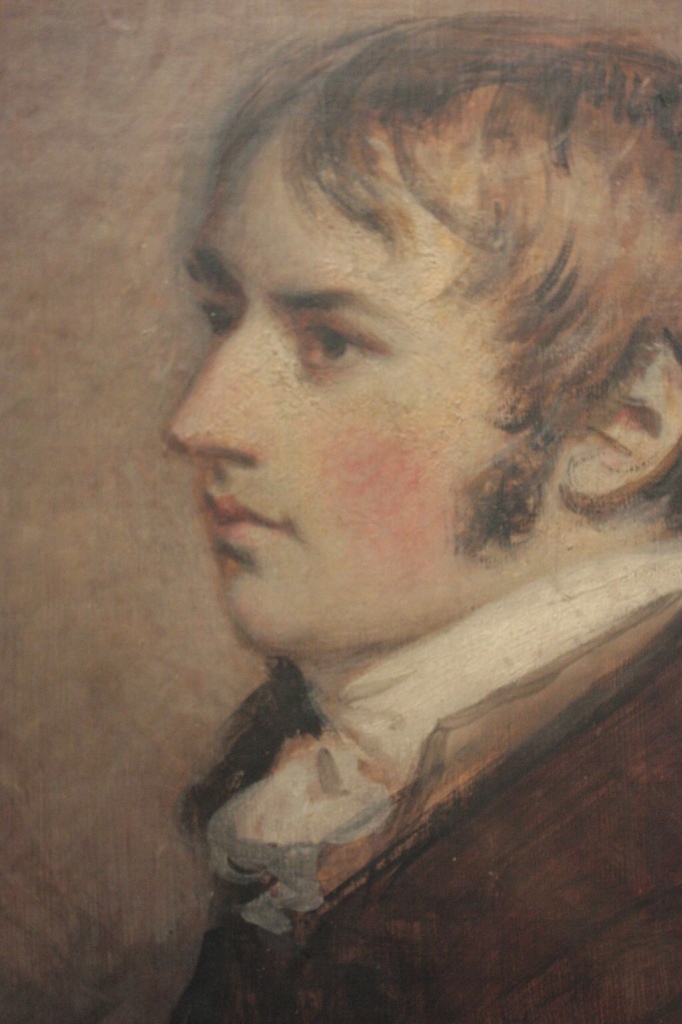



 Cottage Capers