On this day in history : 26th June 1817 – The birth in West Yorkshire of painter and poet Branwell Brontë – only son of the Brontë family and brother to writers Charlotte, Emily and Anne….
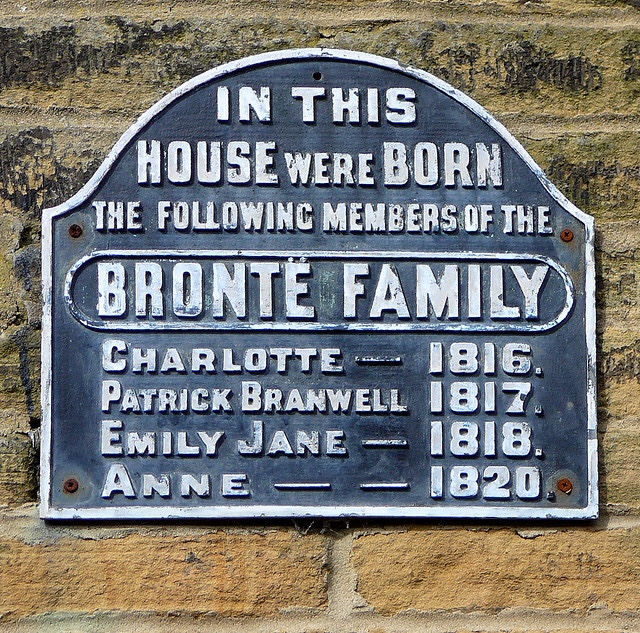
Bronte Birthplace Plaque – Tim Green via Flickr
Born in Thornton, near to Bradford, Patrick Branwell Brontë – known as Branwell – was the fourth of six children…. He was just 4-years-old when his mother died in 1821 – and his aunt Elizabeth Branwell moved in to look after the children…. He was then to be deeply affected when his two eldest sisters, Maria and Elizabeth, were to die from TB shortly before his eighth birthday…. The four remaining Brontë children were to become very close….
Branwell, always on the small side for his age and with flaming red hair, was quick-witted and a bit of a show-off in public…. His father decided to educate him at home and taught him in the classics – whilst his sisters were sent away to boarding school….
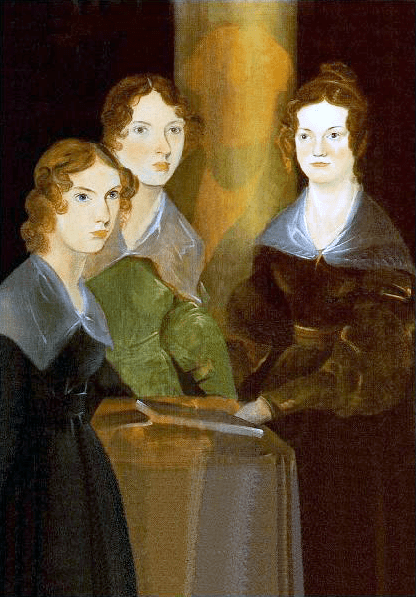
In 1829 the children’s father hired the services of John Bradley, a local artist of some repute, to teach his children to draw…. It was possibly then that Branwell began to aspire to become a portrait painter…. In 1834 he painted a portrait of his sisters and himself – only to paint out his own image as he was dissatisfied with it…. The portrait now hangs in the National Portrait Gallery and is recognised as one of the best known images of the sisters….
Branwell Bronte – Public domain
Branwell rented a studio in Bradford in 1838 and set himself up as a professional portrait painter…. Only he made a lot of friends in the artistic community and spent too much time in the pub and failed to make a living as an artist! In 1840 he took employment as tutor to the children of a wealthy family – but was sacked within a year…. Then for the next six months he worked as a clerk but again lost his job, over a discrepancy with the accounts….
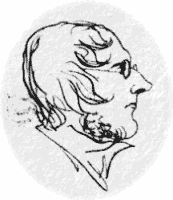
Branwell Bronte, self portrait, 1840 – Public domain
At the beginning of 1843 his sister Anne managed to secure him a job as a tutor – but once again, in 1845, he was sacked – seemingly after having an affair with his employer’s wife…. Returning to the family home in disgrace he fell into self-pity and soon became an alcoholic and addicted to opium…. Branwell died on the 24th of September 1848, possibly from TB….
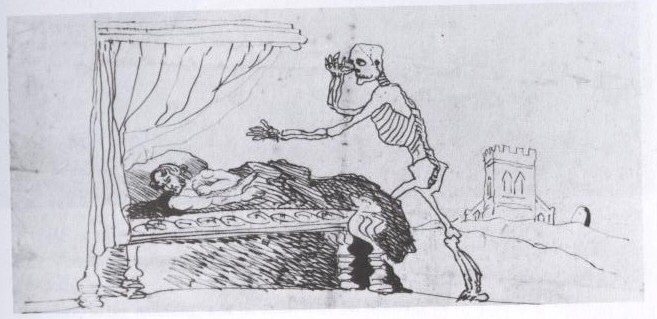
Self caricature of Branwell in bed waiting to die, 1847 – Patrick Branwell Bronte – Public domain
On this day in history : 12th May 1812 – The birth of Edward Lear, artist, author, illustrator, musician and the writer of nonsense verse, including the much-loved ‘The Owl and the Pussy-Cat’….
A Book of Nonsense (c.1875 James Miller edition)
Lear was born in the North London suburb of Holloway into a large middle class family; he was the second to last of 21 children and the youngest to survive…. Throughout his life he suffered health problems – asthma, bronchitis, poor eyesight and epilepsy…. He was acutely embarrassed by his epileptic fits….possibly this contributed to his bouts of melancholic depression, to which he referred to as ‘the morbids’….
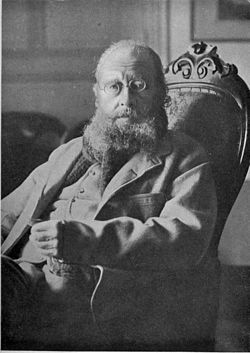
Edwaard Lear in 1866
His was a difficult childhood…. His father, a stockbroker, encountered severe financial difficulties….and due to the family’s economic situation Lear was entrusted to the care of his eldest sister, Ann, 21 years his senior…. Lear would sometimes tell people his father had gone to debtor’s prison – but there is no evidence this actually happened…. However, his mother never resumed her maternal duties towards him and her rejection affected him…. His sister continued to care for him until her death when she was aged 50….
At the age of 15 Lear began to earn a living as an artist…. He had received no formal education, just what Ann had taught him at home…. At first he produced drawings and paintings which he sold for a ‘crust’ – but was then employed by the Zoological Society as an ornithological illustrator…. He was the first major artist to draw live birds rather than dead specimens….
In 1832 he published a book of prints of parrots and came to the attention of Edward Stanley, who was later to become the 13th Earl of Derby…. Stanley had a menagerie at Knowley, the family estate in Lancashire…. Wanting an artist to draw his animals he offered Lear the job….and between 1832 and 1837 Lear lived and worked on and off at the estate….This provided him with many opportunities; he met many aristocrats who bought his paintings….and he made acquaintances with those within circles not usually open to the middle classes….
From his first book
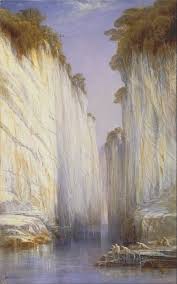
Lear would later travel….Greece, Egypt, India, Ceylon…. Having developed a passion for landscape painting he would make many colour-wash drawings to record what he saw, transforming them into oil and watercolour paintings on his return to his studio…. Many of these were used as illustrations in his books….
Oil on canvas by Edward Lear
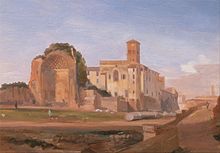
He was later to spend much of his time in Italy…. In 1842 he travelled through Lazio, Rome, Molise and other regions….and spent time in Sicily…. He studied the ancient monuments, the people, their way of life and traditions….his travels reflected in his work of the time….
Temple of Venus and Roma, Rome by Edward Lear
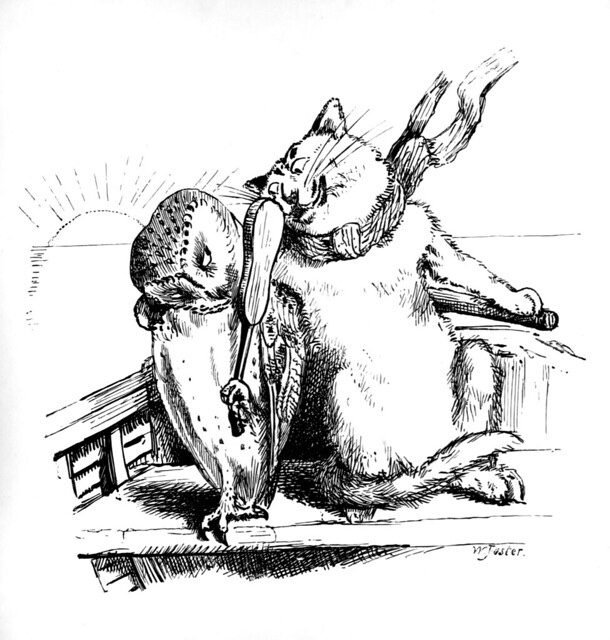
In 1846 he published ‘A Book of Nonsense’, the style of writing so many of us associate with Edward Lear…. 1871 saw the publication of ‘Nonsense Songs, Stories, Botany and Alphabets’….included amongst its poems was ‘The Owl and the Pussy-Cat’ – which was written for the children of the 13th Earl of Derby….
Nonsense drolleries : The owl and the pussy-cat ; The duck and the kangaroo / by Edward Lear ; with original illustrations by William Foster (1889) : Image credit Circasassy via flickr
Lear also composed music to accompany not only his own verse but the poems of other poets too…. He was an accomplished musician, mainly piano but could also play the flute, guitar and accordion….
In 1880 Lear eventually settled in San Remo, on the Italian Mediterranean coast, in a villa he named ‘Villa Tennyson’…. He never married, although he did propose to a woman 46 years his junior – twice! He found it difficult to forge close friendships, he had a tendency to be somewhat ‘obsessive’ in his relationships, male or female…. One close friendship he did maintain was with Giorgio, his Albanian chef…. He said of him….”A faithful friend but a thoroughly unsatisfactory chef!”….
Lear died in 1888 of heart disease – it had been a long illness…. By all accounts his was a lonely funeral – what friends he did have were unable to attend…. He is buried at Cemetery Foce in San Remo….
The Owl and the Pussy-Cat went to sea In a beautiful pea-green boat; They took some honey, and plenty of money Wrapped up in a five pound note. The Owl looked up to the stars above, And sang to a small guitar, "O lovely Pussy, O Pussy, my love, What a beautiful Pussy you are, You are, You are! What a beautiful Pussy you are!" Pussy said to the Owl, "You elegant fowl, How charmingly sweet you sing! Oh! let us be married; too long we have tarried, But what shall we do for a ring?" They sailed away, for a year and a day, To the land where the bong-tree grows; And there in a wood a Piggy-wig stood, With a ring on the end of his nose, His nose, His nose, With a ring on the end of his nose. "Dear Pig, are you willing to sell for one shilling Your ring?" Said the Piggy, "I will." So they took it away, and were married next day By the turkey who lives on the hill. They dined on mince and slices of quince, Which they ate with a runcible spoon; And hand in hand, on the edge of the sand, They danced by the light of the moon, The moon, The moon, They danced by the light of the moon....