On this day in history….23rd April 1915

On this day in history : 23rd April 1915 – The death of English poet Rupert Brooke, known for his sonnets written in World War I – especially ‘The Soldier’….

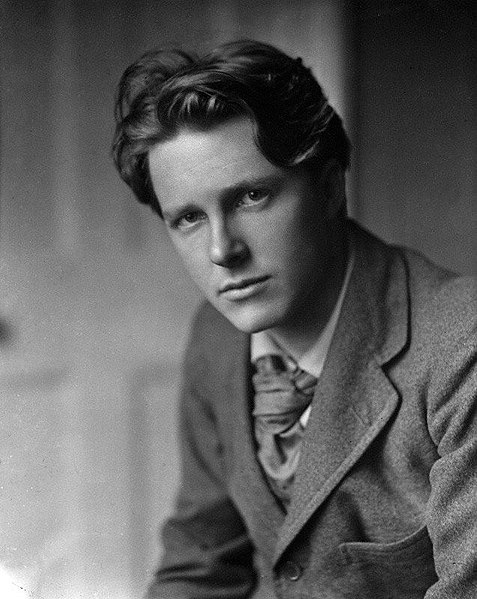
Rupert Chawner Brook was born in Rugby, Warwickshire on the 3rd of August 1887 – he was the third of four children…. He attended prep school and then went to Rugby and Cambridge University….
img_3022
From a photograph by Sherril Schell taken in 1913

Known for his boyish good looks, Brooke was a popular character – amongst his friends were the likes of mountaineer George Mallory and writer Virginia Woolf…. Brooke belonged to the Bloomsbury group of writers and to the Georgian Poets….he was also one of the most important of the ‘Dymock Poets’ and lived in the Gloucestershire village for a while…. In 1912 he suffered an emotional breakdown after his long-term relationship with Katherine Laird Cox, whom he had met at University, ended….

At the outbreak of World War I Brooke immediately enlisted and came into the public eye for his war poetry the following year…. The Times Literary Supplement had published two of his sonnets – ‘The Dead’ and ‘The Soldier’…. On Easter Sunday, the 4th of April 1915, ‘The Soldier’ was read as part of the service at St. Paul’s Cathedral….in less than three weeks time Brooke was to pass away….img_3020
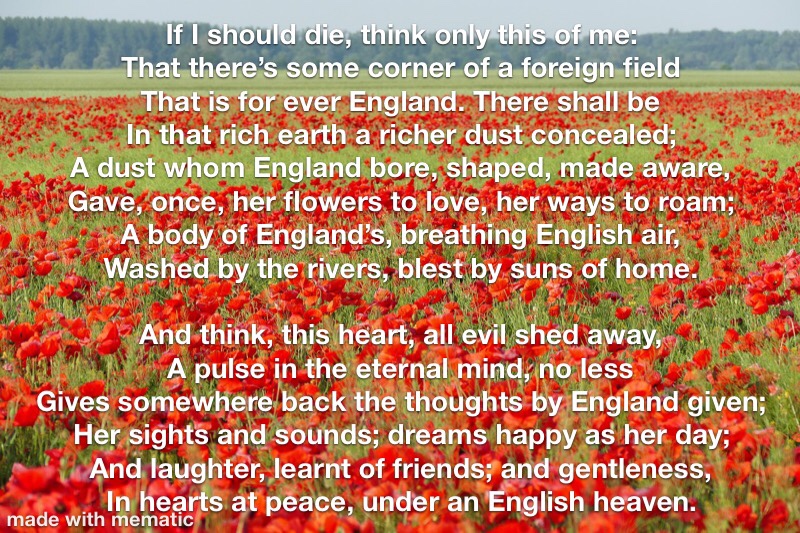
Coming to the attention of Winston Churchill, who was at the time First Lord of the Admiralty, Brooke was commissioned into the Royal Naval Volunteer Reserve….taking part in the Antwerp Expedition in October 1914…. On the 28th of February 1915 he sailed with the British Mediterranean Expeditionary Force bound for the Gallipoli Campaign….

It was during the voyage he developed sepsis from an infected mosquito bite…. At 4.46pm on the 23rd of April 1915, on board the ‘Duguay-Trouin’, a French hospital ship moored in a bay off of the Greek island of Skyros, Brooke died…. He was buried in an olive grove on the island at 11pm that night….
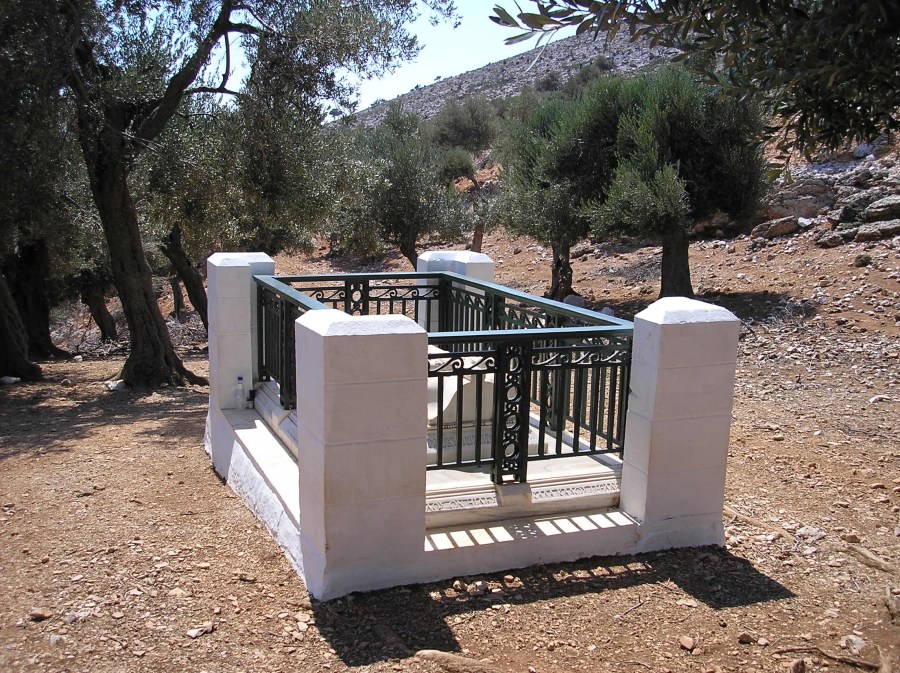
Grave of Rupert Brooke on the Greek island of Skyros

On the 11th of November 1985 he was one of sixteen World War I poets’ names to be commemorated at Poets’ Corner in Westminster Abbey…. The inscription on the slate monument reads the words ~ “My subject is War, and the pity of War. The poetry is in the pity” ~ ….and are by Brooke’s fellow war poet Wilfred Owen….

img_3021
Rupert Brooke – From the collections of the Imperial War Museums

On this day in history….22nd April 1969

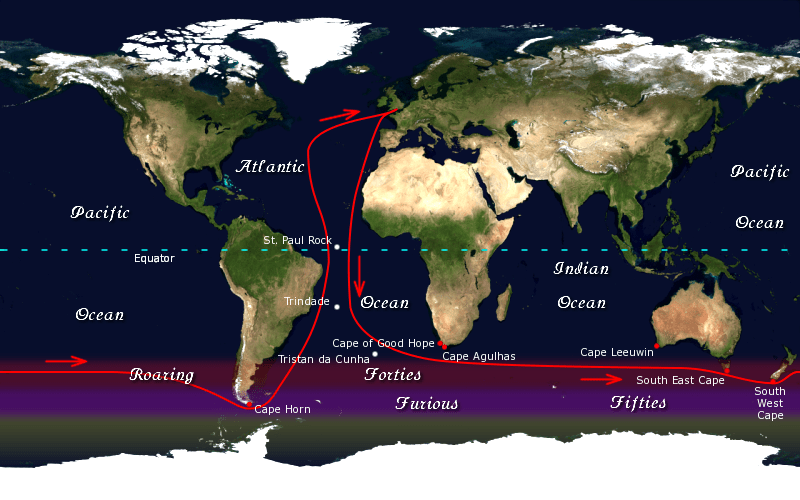
On this day in history : 22nd April 1969 – British yachtsman Robin Knox-Johnston sails into Falmouth Harbour completing the first non-stop solo circumnavigation of the World….

img_3005
Sir Robin Knox-Johnston – 2013 : Image credit – George Caulfield CC BY-SA 4.0

Robin had left Falmouth on the 14th of June 1968, one of nine sailors competing in the Golden Globe Race, the first single-handed round-the-world yacht race and sponsored by the Sunday Times….

img_3004
The route of the Golden Globe Race – Public domain

Out of the nine entrants Robin was the only one to finish the race…. Four retired in the early stages – whilst Chay Blythe, who had set off with no previous sailing experience, made it to just beyond the Cape of Good Hope before retiring…. One boat sank and another competitor abandoned the race…. Tragically, one competitor, Donald Crowhurst, suffered a mental breakdown during the race and committed suicide….

Robin’s 32 foot Bermudan ketch was one of the smallest yachts in the race…. Named ‘Suhaili’ – meaning ‘good wind’ – she was built in Bombay in 1963 and Robin still owns her today….

img_3003
Suhaili – May 2018 : Image credit – Thomas Keyser CC BY-SA

It wasn’t all plain sailing for Robin, there were problems encountered during the voyage, such as losing his self-steering gear off of Australia…. In recognition of his achievement Robin was awarded a C.B.E. – he donated his £5,000 prize money from the race to the family of Donald Crowhurst….

On this day in history….21st April 1959

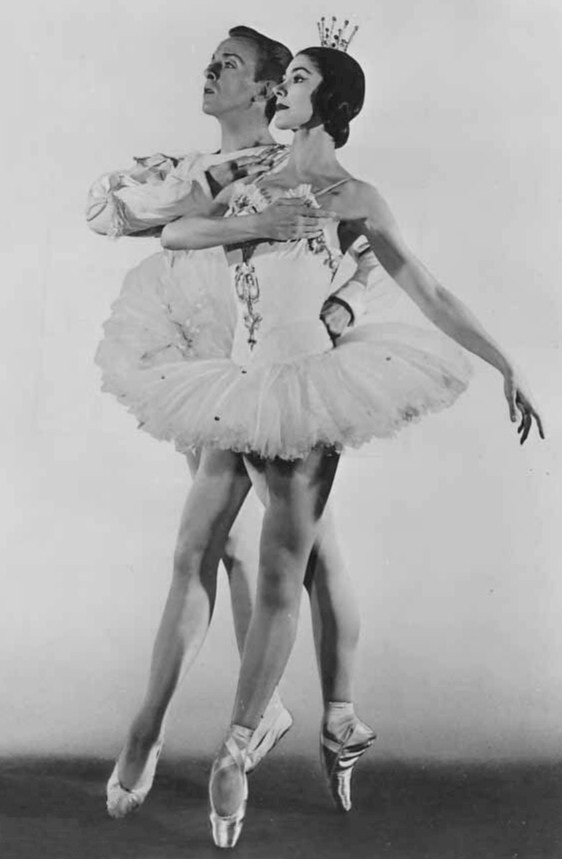
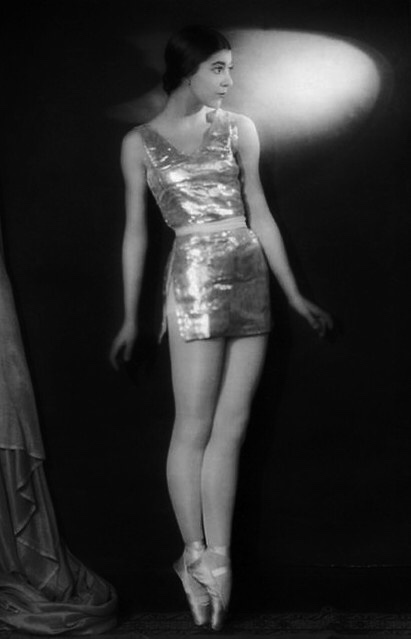
On this day in history : 21st April 1959 – Dame Margot Fonteyn, the world-famous English ballerina, is jailed for 24 hours in Panama while police look for her husband who is accused of plotting a coup….

img_2999
Fonteyn and Helpmann, The Sleeping Beauty, Sadler’s Wells 1950 U.S. tour – Sol. Hurok / Sadler’s Wells Ballet – Public domain

Fonteyn had married Dr. Robert Arias, the son of a former Panamanian President in February 1955…. His family opposed the strict regime of the then President, Ernesto de la Guardia….

Whilst on holiday in Panama Arias and Fonteyn had set out on a supposed fishing trip onboard their luxury yacht ‘Nola’….only Arias was to strangely ‘disappear’…. When Fonteyn returned to port at Balboa Harbour, Panama City she claimed to have no knowledge of her husband’s whereabouts…. and then found herself being arrested…. She was detained in prison by the Panamanian National Guard – but it turned out she wasn’t as innocent as it seems….

img_3002
Prima Ballerina, Dame Margot Fonteyn – Kristine via Flickr

On learning of her arrest British Ambassador to Panama, Sir Ian Henderson, rushed to the prison to try and see her – but was initially denied access…. Eventually at 9pm that evening he was granted permission…. It appeared she had been very well looked after – having been allocated a ‘suite’ usually reserved for political prisoners, even being provided with fresh flowers….and she was only too keen to tell him what she and Arias had been up to….

Her husband had been planning a coup against the President of Panama involving 125 rebel fighters…. During a trip to Cuba in January 1959 she and Arias had met with Fidel Castro who had promised to help by providing men and arms….

The ‘fishing trip’ onboard ‘Nola’ had really been in order to collect weapons which had been concealed within a buoy – only the couple had been witnessed by some fishermen who reported them…. It was therefore decided that Arias should disappear….and that night he ‘jumped ship’, making his escape on a shrimp vessel named ‘Elaine’…. Fonteyn then used ‘Nola’ as a decoy to divert the attention away from her husband whilst he made his getaway…. She then turned up at the port realising she had to risk the consequences….

Sir Ian Henderson managed to secure her release and she was flown to New York….from there she returned to London…. Arias took refuge in the Brazilian Embassy and in June 1959 the couple were reunited in Rio de Janeiro….

img_3001
Dame Margot Fonteyn in the 1960s – Hurok Concerts (U.S.) – Public domain

On this day in history….20th April 1964

On this day in history : 20th April 1964 – BBC2 television is launched – only things don’t go quite to plan – as a fire breaks out at Battersea Power Station causing a major power cut….

Much publicity had surrounded the coming launch of Britain’s third TV channel – the two kangaroo mascots used to herald its arrival ~ ‘Hullabaloo’ the mother kangaroo and her joey ‘Custard’ ~ were a familiar sight….img_2998

And a right hullabaloo it was too…. The evening had been planned to start at 7.20pm with a news bullet-in and then continue with a programme schedule of music and comedy – including a special of ‘The Alberts’, a performance of ‘Kiss me, Kate’ and was to be rounded off with a celebratory firework display from Southend Pier….

However, just over half an hour before the launch was set to air a fire broke out at Battersea Power Station…. At the same time a 60,000 volt cable carrying electricity from the Midlands to the south of England developed a fault in Buckinghamshire – the result being a total blackout in the west of London and much of the city centre….

As it happened, news anchorman Gerald Priestland, who was to deliver the opening news bullet-in, was not broadcasting from Television Centre…. Instead he was in the north London studios at Alexandra Palace – which still had power…. Amidst the mayhem and chaos he bravely soldiered on – over the next couple of hours TV screens across the land displayed the words ‘Will Start Shortly’ – broken intermittently with news bullet-ins…. Eventually at 9.30pm the evening’s schedule was abandoned….

Power was restored for the channel to launch properly the following day…. At 11am the first complete programme to air was ‘Play School’….


On this day in history….19th April 1824

On this day in history : 19th April 1824 – Leading figure of the Romantic Movement, Lord Byron, dies from a fever whilst assisting the Greeks in their fight for independence from the Turks….

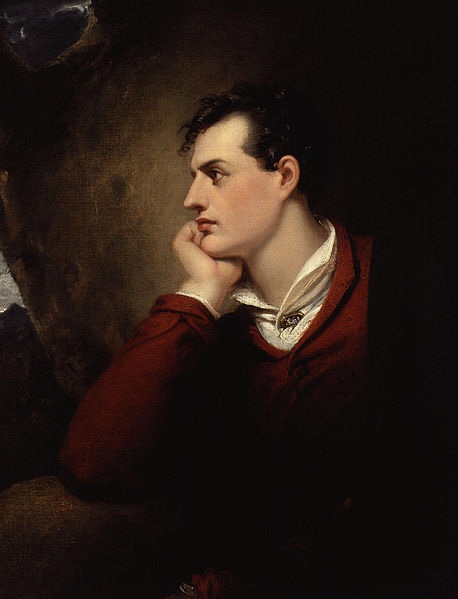
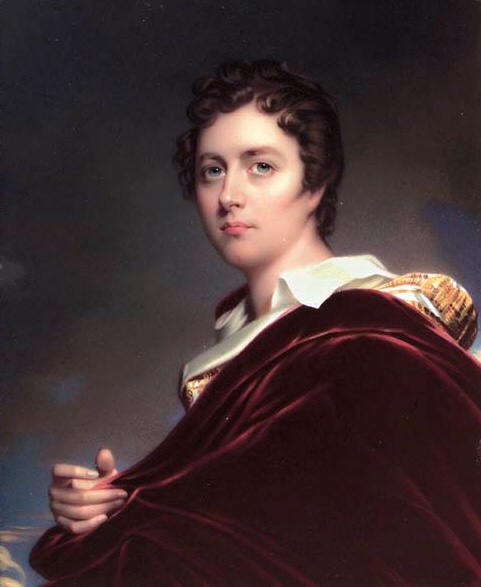
George Gordon Byron was born in Aberdeen in 1788; at the age of 10 he inherited his great uncle’s title and became 6th Baron Byron….or ‘Lord Byron’….

img_2994
George Gordon Byron, 6th Baron Byron by Richard Westall – Public domain

After attending Harrow and then Trinity College, Cambridge he was to embark on what can be described as a flamboyant life journey…. The great poet, peer and politician was renowned for his often scandalous behaviour….he ran up enormous debt and had countless affairs with both men and women…. Married twice (for money rather than love) he had one legitimate child – and at least two illegitimate…. His very name coined a word – ‘Byronic’ – meaning romantic, arrogant, dark and cynical….

By all accounts he was a beautiful man – something he was obviously aware of, even to the point of vanity – he apparently wore curlers in his hair whilst he slept! His beauty no doubt detracted from his limp – due to a deformed foot he had from birth….

img_2996
Lord Byron by Henry Pierce Bone – Public domain

His life was full of exotic travel – and adventure…. At the age of 36 he found himself in Messolonghi, Greece, training troops – even though he had little military experience himself…. He was there to help the Greeks gain independence – a cause he also helped to fund….

img_2995
Lord Byron in Albanian dress by Thomas Phillips – Public domain

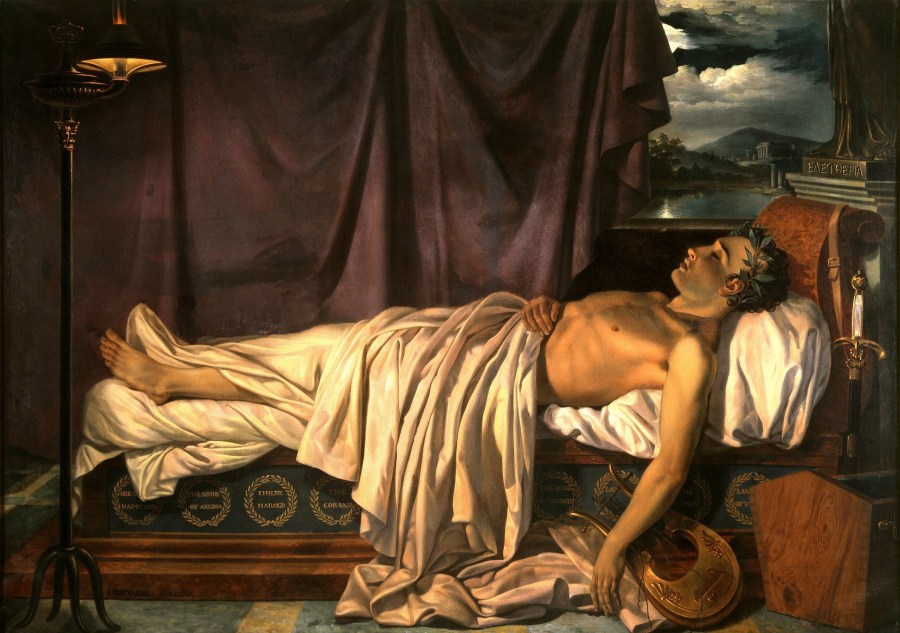
In the February of 1824 he had become ill; possibly he had contracted malaria…. The ‘cure’ for many ailments at the time involved bloodletting; this in itself would have left him weak…. Although he recovered enough to travel to Messolonghi on his arrival he caught a heavy cold – once again bleeding was carried out…. Of course the equipment would not have been sterilised and it is believed this may have led to sepsis….which in turn led to a fit of fever – from which he died….

img_2997
Lord Byron On His Deathbed, by Joseph Denis Odevaere c.1826 – Public domain

His body was embalmed and returned to England, accompanied by his faithful man-servant ‘Tita’…. Some say the Greeks wanted to keep a little part of him with them and so his heart remained in Messolonghi…. To the people of Greece Byron had become a national hero – after his death he was mourned by both the Greeks and British alike…. The Greek version of his name,’Vyron’, is still a popular choice of name for boys in Greece today – and a suburb in Athens, ‘Vyronas’, is named for him….

The intention had been for him to be buried in Westminster Abbey – but the Church authorities refused to allow this…. He lay in State in London and huge crowds visited…. Lord Byron was finally laid to rest in the Church of St. Mary Magdalene, Hucknall in Nottinghamshire – a slab of marble given by the King of Greece placed over his grave…. His legitimate daughter, Ada Lovelace, was later buried beside him….