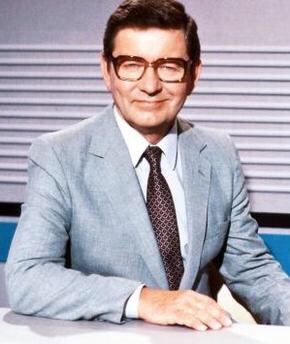
On this day in history : 5th July 1954 – The BBC broadcasts its first television news programme…. The twenty minute bullet-in is introduced by Richard Baker….
Richard Baker – Fair use
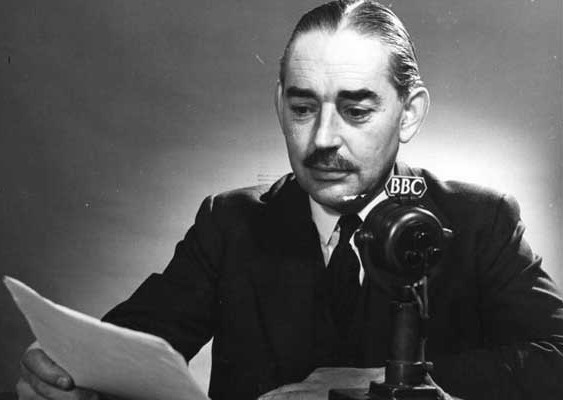
We are all very familiar with the format of today’s TV news programmes; the presenters, news stories from around the world and closer to home – and the film footage that almost always accompanies them…. But how different things were back then…. Richard Baker narrated the news story whilst a supporting relevant still photograph was broadcast for viewers to look at…. It was really like an illustrated summary of the news…. A customary news reel would be shown, usually with recorded commentary from John Snagge or occasionally Andrew Timothy….
John Snagge reading the news in 1944 – Public domain
The BBC’s new news programme certainly wasn’t popular with all…. Some described it as ‘absolutely ghastly!’ and ‘as visually impressive as the fat stock prices’…. BBC Radio 4 were also doubtful about this newfangled way of delivering news to the nation and insisted on keeping control over the editorial of the headlines and the programme content….
The very first programme to be broadcast included a story on French troop movements in Tunisia and covered the truce talks being held near to Hanoi…. The service was intended to be more up to date, as the previous ‘Television Newsreel’ programme often contained news stories several days old….
In 1955 other news readers were introduced, such as Kenneth Kendall – who was the first news presenter to be visually seen – and Robert Dougall…. Television news time also doubled during this period…. Shortly after this expansion by the BBC, on the 21st of September 1955, ITN launched their news programme….
On this day in history : 13th June 1910 – The birth of Mary Whitehouse, the educator, conservative activist and co-founder of the ‘Clean-Up TV’ campaign….
Mary Whitehouse, 1981 – Fair use
Whitehouse was born Constance Mary Hutchison in Nuneaton, Warwickshire and after finishing school she trained to become a teacher…. At the same time she became involved with evangelical Christian groups, such as the Student Christian Movement…. She qualified as a teacher in 1932….
It was at a meeting of the Oxford Group – a Christian organisation later to become known as Moral Re-Armament – that she met Ernest Raymond Whitehouse…. They married in 1940 and were to have five sons (two of whom died in infancy)….
In 1960 Whitehouse was working as a teacher in a school in Madely, Shropshire and was given the responsibility of sex education…. She was to be totally shocked by the lack of morals amongst many of her students…. It was at a time when sex scandals seemed to dominate the news headlines – particularly the exploits of Christine Keebler and Mandy Rice-Davies…. Whitehouse blamed the media, especially the BBC for exposing the nation to ‘such filth’….
In 1963 she wrote to the BBC asking for a meeting with the then Director-General, Hugh Greene…. But she had to make do with his deputy, Harman Grisewood – who she felt was sympathetic because he had good Catholic values…. However, she was to remain dissatisfied with the content she saw on television, so in 1964 she teamed up with vicar’s wife Norah Buckland and they launched the ‘Clean-Up TV’ campaign…. Appealing to the women of Britain they held their first public meeting on the 5th of May at Birmingham Town Hall…. Around 2,000 turned up, including several coach loads….
Whitehouse was to become a thorn in the side of Sir Hugh Greene…. According to her, he was ‘the devil incarnate’ and responsible for the moral collapse of the country – with its promiscuity, infidelity, indecency, violence, blasphemy, bad language and drinking…. She made some 300 speeches across the country each year – and the BBC, Downing Street and Buckingham Palace all received a bombardment of correspondence from her….
Hugh Green, 1968 – Fair use
She became General Secretary of the National Viewers’ and Listeners’ Association in 1965, an association with over 400,000 supporters including many professionals such as senior police officers and bishops….
Just about every programme shown on British television came under her scrutiny…. One of her absolute pet hates was sitcom ‘Til Death Us Do Part’ – and particularly Alf Garnett’s love of the word “bloody”…. Another one she had it in for was Benny Hill…. Comedian Dave Allen fared little better, who she described as ‘offensive, indecent and embarrassing’…. However, comedy writers began to turn the tables, seeing her as potential material for their humour…. The Goodies devoted a whole episode – ‘Gender Education’ – in 1971, purely with the intention of irritating her….
She even turned her attention to popular music…. She unsuccessfully tried to get the BBC to ban Chuck Berry’s ‘My Ding-a-Ling’ – but had a better result when she managed to stop Alice Cooper’s ‘School’s Out’ from being aired…. He responded by sending her flowers – as he was convinced it was this that helped his record reach the No.1 spot in the British charts….
Even family favourite ‘Dr Who’ attracted her wrath – which she referred to as ‘teatime brutality for tots’…. She objected to its violence! And within a week of Channel 4 launching in November 1982 she was having a go at the soap ‘Brookside’ for the amount of swear words in it….
Whitehouse retired in 1994….but even from her nursing home she still had plenty to say…. In her book, ‘Whatever Happened To Sex’, she explained, that as a happy family woman, she had nothing against sex itself – but was against its exploitation in the media…. To some Mary Whitehouse was a champion of Christian family values – indeed in 1980 she was awarded a CBE…. To others she was just an interfering busy body…. She died on the 23rd of November 2001 at the age of 91….
On this day in history : 25th May 1913 – The birth of Richard Dimbleby, pioneering journalist and broadcaster and the BBC’s first war correspondent – before becoming its main news presenter….
Richard Dimbleby – Fair use
Frederick Richard Dimbleby was born in Richmond, Surrey to Gwendoline and Frederick J.G. Dimbleby, who was a journalist…. After leaving school in 1931 he began working on the family newspaper, which had been acquired by his grandfather in 1894…. The Richmond and Twickenham Times remained in the family until 2002….
Richard worked on other papers, including the Southern Evening Echo in Southampton, before joining the BBC in 1936…. It was in 1937 that he married Dilys Thomas and they were to go on and have four children….two of whom became major broadcasters in their own right – David and Jonathan….
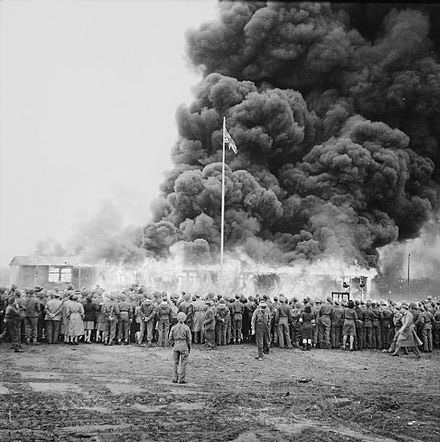
The BBC sent Richard to Spain to cover the Civil War…. At the time there was no official foreign correspondent and it was at the outbreak of World War 2 that the title ‘War Correspondent’ was created…. During the War Richard was to accompany the British Expeditionary Force to France, making broadcasts from the Normandy beaches during the D-Day landings….and from the Battle of El Alamein, North Africa…. He flew on some 20 raids with the RAF as an observer and in April 1945 he made one of the first reports during the liberation of the Bergen-Belsen concentration camp….He was a groundbreaking broadcaster, reporting from 14 countries during WW2…. He was among the first into Berlin and was to broadcast from the ruins of Hitler’s bunker….
Liberation of Bergen-Belsen, May 1945…. A crowd watches the destruction of the last camp hut – Image : Bert Hardy No.5 Army Film & Photographic Unit – Public domain
In 1946 Richard was awarded an OBE and then later in 1959 a CBE…. He was to become one of the most familiar and trusted faces on British television…. He was to lead the coverage for the majority of major state and political affairs, including Queen Elizabeth II’s Coronation, the Victory Parade of 1946 and the funerals of Sir Winston Churchill, King George VI and John Kennedy…. He was to be the anchorman on the coverage of the General Elections of 1955, 1959 and 1964…. He was also to become the presenter of ‘Panorama’ – the BBC’s flagship current affairs programme….
Of course there were lighter moments in his broadcasting career…. He took part in radio broadcasts on the panel of ‘Twenty Questions’ and hosted ‘Down Your Way’…. He was also involved in the now famous April Fools Day prank of 1957 when he provided the narration for the Spaghetti Tree Hoax….
In December 1965 Richard presented a documentary on the link between smoking and lung cancer…. It was at this time he revealed that he too was suffering from cancer – a subject that was still little talked about…. By talking about his own condition he helped raise public awareness and break the taboo…. Richard had been diagnosed five years earlier with testicular cancer….he was to die just two weeks after the documentary on the 22nd of December 1965 in St. Thomas’ Hospital, London…. He was just 52 years of age….
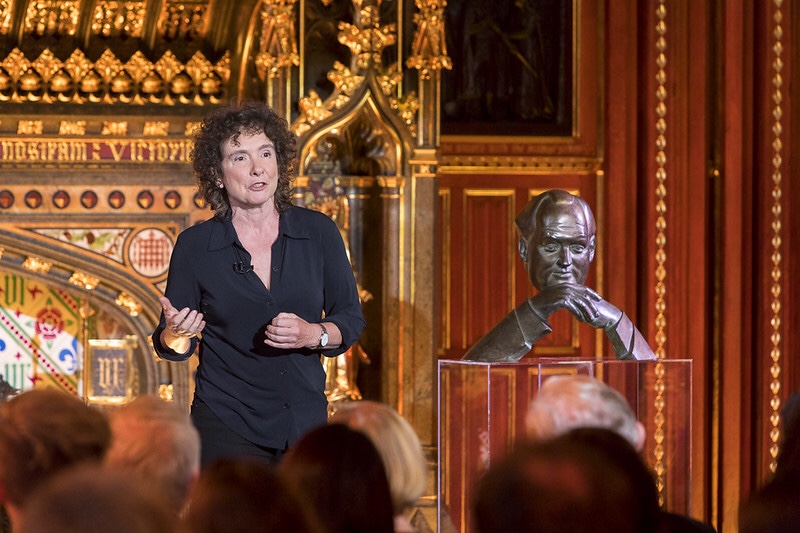
With funds from public donations the family set up the Richard Dimbleby Cancer Fund – which relaunched in 2008 as Dimbleby Cancer Care…. In 1972 the Richard Dimbleby Lecture, an annual televised lecture, was founded in his memory…. Every year it is delivered by an influential, respected person and over the years has included Prince Philip, Prince Charles, Lord Hailsham, Bill Clinton, Bill Gates, Sir Terry Pratchett and of course many, many others….
2018 BBC Richard Dimbleby Lecture – speaker Jeanette Winterson on the theme of women’s equality – Image: ukhouseoflords via Flickr
On this day in history : 30th April 1947 – The birth of English actor Leslie Grantham; who amongst his varied acting roles was to play ‘Dirty Den’ in the BBC1 soap opera ‘EastEnders’….
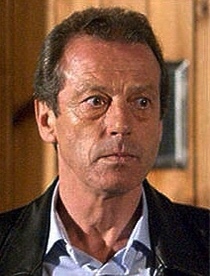
Grantham as ‘Den Watts’ – Fair use
Leslie Michael Grantham was born in Camberwell, South London and in 1965, at the age of 18, he joined the Army – enlisting with the Royal Fusiliers…. He was soon to be sent to Germany but the young Grantham found himself in the situation of being unable to cope financially and he quickly fell into debt…. In desperation he resorted to crime….
It was on the 3rd of December 1966 that things were to go so catastrophically wrong – resulting in a man losing his lie…. Felix Reese was a taxi driver and Grantham attempted to rob him at gunpoint…. A struggle occurred and the gun went off; Reese sustained a gunshot to the head…. Grantham was arrested and charged with murder – he claimed he did not know the gun was loaded….
Grantham came to trial in April 1967 and was convicted of murder, receiving a sentence of life imprisonment…. However, because the sentence was greater than two years it could not be served in Germany and he was transferred to a British prison – Leyhill Prison in Gloucestershire…. He was also dishonourably discharged from the Army….
After serving ten years Grantham was released in 1977…. Whilst in prison he had become involved in amateur dramatics, performing in plays for other inmates…. One of his fellow prisoners was disgraced Labour politician T. Dan Smith, who was serving time for corruption charges…. He spotted that Grantham had a natural flair for acting and encouraged him to pursue it…. Encouragement also came from the actress Louise Jameson, known for roles such as ‘Leela’ in Dr Who, ‘Susan Young’ in Bergerac, ‘Rosa de Marco’ in EastEnders, ‘Blanche Simmons’ in Tenko and for Emmerdale fans she plays the part of ‘Mary’…. Louise Jameson and Grantham were to become good friends….
Upon his release from prison the encouragement Grantham had received from his friends led him to enrol in the Webber Douglas Academy of Dramatic Art…. It was at stage school in 1977 that Grantham was to meet his wife, Jane Laurie…. The couple were married for 31 years before divorcing in 2013…. They had three sons, Spike, Jake and Daniel…. Daniel plays the part of ‘Reggie Jackson’ in the BBC’s Call the Midwife….
Grantham’s TV debut came in 1982 when he played the character ‘Boollie’ in Jake’s End, a production for BBC2’s Playhouse…. A number of minor roles followed; he played ‘Frank’ in the short-lived sitcom Goodnight and God Bless, ‘Davros’ in Dr Who and the part of a signals sergeant in the series The Jewel in the Crown….
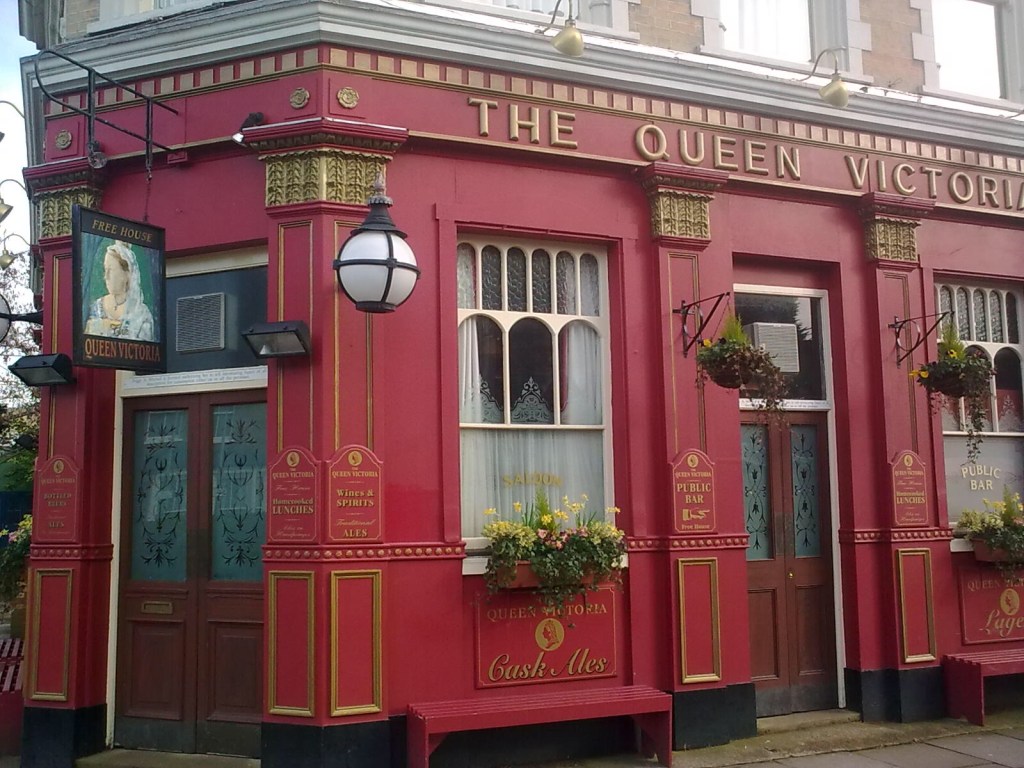
Then in 1984 Grantham’s big break came, when he auditioned for the BBC’s new soap opera EastEnders…. The original audition was for the role of market trader ‘Pete Beale’ (former husband of ‘Kathy Beale’ and father of ‘Ian Beale’)…. Grantham was not offered the part of Pete – but he was offered the part of ‘Den Watts’, landlord of the Queen Victoria public house…. His long suffering, alcoholic, onscreen wife ‘Angie’ was played by Anita Dobson…. Grantham’s character soon got the name ‘Dirty Den’, which was well-deserved with his long string of extramarital affairs…. One of the most memorable storylines being when he fathered the child of 16-year-old ‘Michelle Fowler’ (played by Susan Tully) who was the best friend of his own adopted daughter ‘Sharon’ (played by Letitia Dean)….
On Christmas Day 1986 some 30 million viewers (then more than half of the British population) watched ‘Den’ serve ‘Angie’ with divorce papers – delivering them with the words…. “Happy Christmas, Ange”….
Fair use
During 1988 his character began to be seen less of…. ‘Den’ had sold the pub and fewer main storylines were to come his way…. Grantham announced his intention to leave EastEnders, giving the producers of the soap a major headache – as Anita Dobson was also about to leave and they could not afford to lose two main characters in one go…. Therefore, intense advanced filming took place, enabling Grantham to move on in the autumn of 1988 – but leaving behind enough footage for his presence onscreen to continue into 1989….
The continuing plot of the soap saw ‘Den’ become involved with a criminal gang – imaginatively called ‘The Firm’…. The story unfolded over the summer of 1988…. ‘Den’ had to disappear from Albert Square after falling out with ‘The Firm’ – but was to ‘feel the heavy hand of the law’, landing him on remand in prison…. ‘The Firm’ ambushed the vehicle taking ‘Den’ to Court but somehow he managed to escape both the gang and the police…. But then, on the towpath beside the canal, he met his ‘demise’…. All we saw was a bunch of daffodils concealing a gun – and then with a splash ‘Dirty Den’ was gone…. No body was to be found – until a year later when a decomposed corpse turned up in the canal and it was presumed to be ‘Den’….
Fair use
We all thought ‘Dirty Den’ was finally pushing up daisies – but behind the scenes the BBC were trying to persuade Grantham to return to EastEnders…. In the meantime he had undertaken various other roles, such as Danny Kane in the TV crime series The Paradise Club (1989-90)…. He had a part in The Detectives in 1993 and produced and starred in the sci-fi mini series The Uninvited…. He co-hosted the game show Fort Boyard with Melinda Messenger from 1998-2001 and in 2000 co-starred with Anita Dobson in the two-part The Stretch on Sky One….
Then on the 29th of September 2003 – “Hello Princess”…. ‘Dirty Den’ had returned to Albert Square, walking into the E20 nightclub – now owned by his daughter ‘Sharon’…. It turned out he hadn’t died in the shooting but had survived and fled to Spain, aided by his mistress ‘Jan’…. The twists and turns of life on Albert Square continued, including ‘Den’ trying to get the Queen Vic pub back in December 2004 – which was now run by ‘Sam Mitchell’ – sister of ‘Phil’ and ‘Grant’…. Don’t mess with the ‘Mitchells’!
Photo credit : Matt Pearson – Flickr CC BY 2.0
It was in May 2004 that in real life Grantham became embroiled in a sex scandal, resulting in his three attempts at suicide…. It was confirmed that this time ‘Den’ would be leaving EastEnders for good…. On the 18th of February 2005 16.2 million viewers watched his second wife ‘Chrissie’ hit him over the head with a doorstop during a fight…. Grantham was bitter about EastEnders and spoke out against it – claiming it to be untrue to real life….
Fair use
After EastEnders Grantham appeared on stage in the Jeffrey Archer play Beyond Reasonable Doubt – and he also appeared in pantomime…. He appeared in a couple of episodes of ITV’s The Bill and did some film work…. In 2010 he played ‘Ebenezer Scrooge’ in A Christmas Carol at the Lincoln Theatre Royal….
Grantham was to play the part of ‘John’ in The English Neighbour – a series on Bulgarian TV – and Bulgaria was now where he had made his home…. In June 2018 he returned to England for treatment for lung cancer…. He died on the 15th of June 2018 at the age of 71….
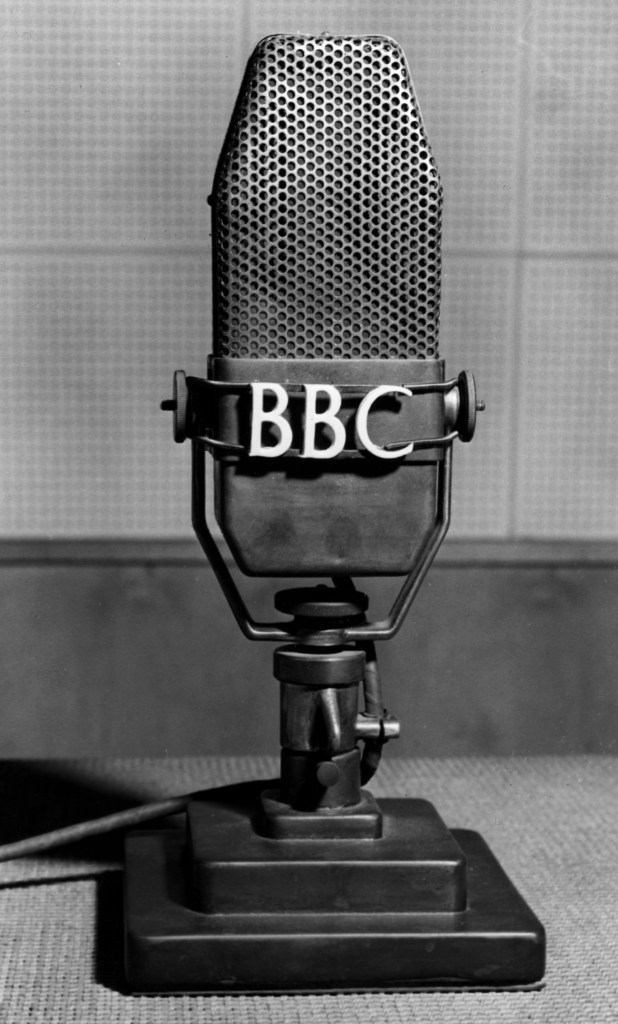
On this day in history : 18th April 1930 – During the evening’s regular scheduled news bulletin the BBC announces “There is no news!”….
Image : Pinterest
It seems ridiculous, doesn’t it? How could there be no news? But it appears the BBC had decided that there was nothing worth reporting on that day…. At 8.45pm, as families all over Britain settled down and tuned in their radios to hear the evening news, they were greeted with….
“Good evening. Today is Good Friday. There is no news….”
National Science and Media Museum via Flickr
Instead the fifteen minute programme was filled with Wagner’s opera Parsifal, performed on piano from the Queen’s Hall, London….
It is impossible to imagine that happening today….