On this day in history : 19th August 1975 – Headingley Cricket Ground, Leeds, is vandalised by campaigners calling for the release of robber George Davis from prison….
34-year-old East London mini-cab driver, George Davis, had been jailed for 20 years for his part in an armed robbery in Ilford, Essex – a police officer had been shot and injured…. However, it was claimed Davis was a case of mistaken identity – he had not been involved in the pay-roll robbery…. Since his imprisonment in Albany Prison on the Isle of Wight a series of marches, petitions and fund-raising events had been organised…. Even a 7 hour roof top demonstration on St. Paul’s Cathedral had been held by his brother-in-laws, Jim and Colin Dean….
Campaigners had gained entrance to the Headingley ground, had dug holes on the cricket pitch and had poured oil over one end of the wicket…. They had painted slogans on the walls demanding Davis’s release…. The damage was discovered by head groundsman, George Cawthray – and the final match of the series between England and Australia had to be abandoned…. This meant a draw was declared and England did not have the chance of winning back the Ashes….
Police travelled from London to Leeds to investigate – and four people were brought to trial…. Three received suspended sentences whilst the fourth, Peter Chappell, was given an 18 month prison sentence….
Image credit : sarflondondunk via Flickr
Following the incident an internal inquiry was set up to look into the handling of the Davis case…. In conclusion Home Secretary Roy Jenkins expressed serious doubt as to Davis’s identification, which had been based on the evidence of two police officers…. In May 1976 Davis was released from prison….
However, in July 1978 Davis was jailed for 15 years after pleading guilty to taking part in a bank robbery…. He was freed in 1984 – but three years later was to receive a further 18 month sentence for attempting to steal mailbags….
On this day in history : 28th July 1865 – Scotland’s last public execution takes place…. A crowd of reportedly 100,000 watch as Dr Edward Pritchard is hanged for the murder of his wife and mother-in-law….
Public domain
Pritchard, born on the 8th of December 1825 in Southsea, Hampshire was the son of a sea captain….and claimed to have studied at King’s College Hospital, London, graduating in 1846…. How much truth is in this is unclear – but he did manage to secure the position of assistant surgeon onboard HMS Victory – and went on to serve on various other ships, which enabled him to travel the world….
On returning to Portsmouth he met Mary-Jane Taylor, the daughter of a wealthy silk merchant from Edinburgh…. The couple were married in 1851 and went on to have five children….
Pritchard took a job in Yorkshire as a GP…. During this time he wrote several books on his travels whilst in the Navy…. He also wrote about ‘water cure’ – or hydrotherapy….and had numerous articles published in The Lancet…. In 1859 he moved his family to Glasgow – it seems with his reputation tarnished as it appears some kind of ‘incident’ had occurred….
On the 5th of May 1863 a fire broke out in the family home at 11, Berkeley Terrace, Glasgow…. It started in the room of 25-year-old servant Elizabeth McGrain…. Strangely she made no attempt to escape – which would suggest she was unconscious or perhaps even already dead…. No charges were ever brought but there were those who had their suspicions….
The family moved to a new address in Glasgow, 131 Sauchiehall Street….and in early 1865 Pritchard’s wife, Mary, became ill…. Pritchard, aided by his colleague Dr Paterson,treated her at home…. On the 10th of February 70-year-old Jane Taylor arrived to nurse her sick daughter – but on the 28th of February she herself was to unexpectedly die…. Just over three weeks later, on the 18th of March, 38-year-old Mary-Jane also passed away….
Paterson, his suspicions aroused, refused to sign the death certificates, although he did not go to the authorities…. Pritchard however, had no such qualms at signing…. The death certificates recorded that Jane had died from paralysis and apoplexy – and his wife from gastric fever…. Both were buried at Grange Cemetery in Edinburgh….
Although Paterson had not publicly reported his suspicions the authorities did however receive an anonymous letter…. The information in contained was enough to prompt an order for the bodies to be exhumed…. Both were found to contain the poisons tartanised antimony, aconite and opium…. It appears Pritchard had been poisoning the food of his wife and mother-in-law….
The trial of Dr Edward William Pritchard – wood engraving, 1865 – Credit : The Wellcome Collection CC-BY
Pritchard’s five day trial took place in Edinburgh in July and was presided over by Lord Justice Clerk, Lord Glencorse…. He was found guilty and sentenced to hang…. Following his conviction Pritchard wrote a confession but claimed innocence at the murder of Jane Taylor….
He described how he had been having an affair with servant Mary McLeod…. It had begun in the summer of 1863 and in 1864 she had become pregnant…. Pritchard helped ‘produce a miscarriage’…. He claimed his wife knew of the affair – but his mother-in-law had caught the pair together in his consulting room…. He also implicated that McLeod was an accomplice in the murder of his wife….
However, nine days before his execution date Pritchard made a further confession, exonerating McLeod saying he alone was responsible for both of the murders…. At 8am on the 26th of July at North Prison, Saltmarket, Glasgow – in front of a crowd of possibly 100,000 – Pritchard met his executioner….one Mr William Calcraft….
William Calcraft c.1870 – Wheaton (New York) – Public domain
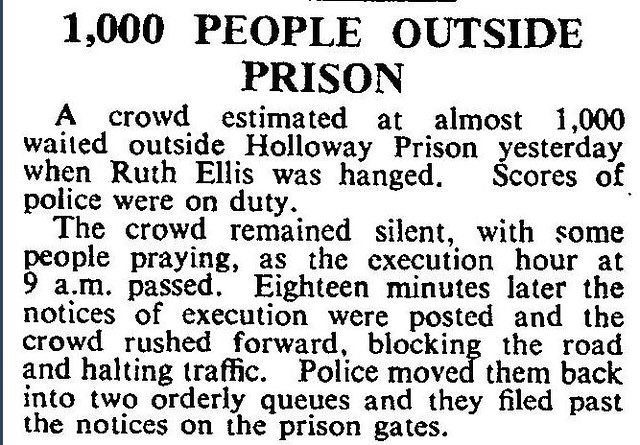
On this day in history : 13th July 1955 – Ruth Ellis, the last woman to be hanged in Britain, is executed at Holloway Prison for the murder of her lover, David Blakely….
Born on the 9th of October 1926 in Rhyl, North Wales, Ruth at a young age was then to move with her family to Basingstoke, Hampshire – where she went on to attend Fairfields Senior Girls’ School…. Leaving at 14 she found work as a waitress…. The family moved to London in 1941 – and when Ruth was 17 she became pregnant by a married Canadian soldier…. She gave birth to a son, who was initially brought up by Ruth’s mother….
Ruth took up nude modelling – and through this got a job as a nightclub hostess…. She also took up prostitution and in 1950 fell pregnant once again…. This time she had a backstreet abortion….
Ruth Ellis – Fair use
In November 1950 she married George Johnston Ellis, a dentist with two sons from a previous marriage…. He was a jealous, possessive and violent alcoholic and became convinced Ruth was having an affair….needless to say, it was a stormy marriage…. When Ruth gave birth to their daughter he refused to believe the baby was his…. Ruth took her son and daughter and moved back in with her parents…. She also returned to prostitution….
1953 saw Ruth become the manageress of a nightclub in Knightsbridge…. She had by now made a number of celebrity friends, among them racing driver Mike Hawthorn….and it was through him that she met his fellow racing driver friend, David Blakely…. Although he was already engaged to another, Blakely had soon moved into Ruth’s flat above the nightclub…. and it wasn’t long before she was pregnant again…. Once more she had a termination….
Ruth also started seeing former RAF pilot Desmond Cussen, who was now a director of the family business, a wholesale and retail tobacconists across London and also South Wales…. When Ruth was sacked from her nightclub job it was his Oxford Street home that she moved into…. All the while she continued to carry-on with Blakely…. This relationship was becoming increasingly violent as Ruth insisted on seeing other men…. In January 1955 she suffered a miscarriage after Blakely punched her in the stomach following an argument….
Blakely wanted to end the relationship and went to stay with friends – wanting to lie-low…. On Easter Sunday, the 10th of April 1955, Ruth, having an inkling of where he was hiding, went to the address in Hampstead, London…. She arrived just in time to see his car drive off…. With an idea of where he may be going she walked the quarter mile or so to the Magdala public house – and sure enough his car was outside…. Ruth waited and around 9.30pm he and friend Clive Gunnell left the pub…. Ruth stepped from the doorway of the newsagents where she had been waiting and said “Hello, David”…. Blakely ignored her and continued to fumble for his car keys…. Ruth shouted his name – she then took a .38 calibre Smith & Weston Victory Model revolver from her handbag – and fired 5 shots at Blakely….
Site of the Magdala pub (2008) which closed in 2016 – Steve Bowen – Public domain
The first shot missed…. Blakely ran…. Ruth fired again, this time the bullet struck Blakely and he collapsed on to the pavement…. Ruth stood over him and fired 3 more bullets into his body…. She fired one last bullet into the ground….which ricocheted off the road, hitting and injuring Gladys Kensington-Yule, a by-stander, in the thumb….
Ruth, in shock, asked “Will you call the police, Clive?” An off-duty police officer, Alan Thompson, who was at the scene, took the gun from Ruth – and arrested her….
Ruth’s trial took place in Court No.1 at the Old Bailey on the 20th of June 1955 – the jury took just 20 minutes to convict her…. Her execution was performed by Albert Pierrepoint….
On this day in history : 28th June 1830 – Constable Joseph Grantham is the first policeman in Britain to be murdered – when he goes to the aid of a woman involved in a fight between two drunken men….
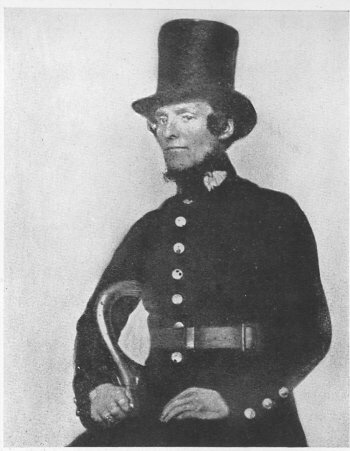
The Metropolitan Police Force had launched on the 29th of September 1829; Constable No.169 Joseph Grantham had joined S-Division on the 10th of February 1830…. On the night of Monday 28th of June he was called to Skinner Street, Smiths-Place in Somers Town to deal with a domestic disturbance…. 31-year-old Grantham had become the father of twins that very day….
Image credit : Leonard Bentley via Flickr
On arriving at the address the constable found two drunken Irishmen quarrelling….one of them had been beating his wife…. Grantham intervened and threatened to handcuff one of the men, a Michael Duggan – who did not take lightly to this threat…. In the scuffle that followed PC Grantham was knocked to the ground….and Duggan delivered a swift kick which struck Grantham’s right temple….
The constable was carried to a surgeon’s shop in Judd Street – but pronounced dead on arrival…. He was then moved to the Boot Public House in Cromer Street to await a coroner’s inquest…. Duggan was arrested and taken to a nearby police station – it transpired his real name was actually Michael Galvin and he had just completed an apprenticeship to a bricklayer….
He appeared before Magistrate Mr Griffith at Marylebone Police Station and was committed for trial on the charge of murder…. However, a post-mortem examination on Grantham concluded death had occurred through an apoplexy brought on by the ‘exertion and excitement of the moment’…. Galvin’s charge was changed to the lesser charge of assault….
1850s ‘Peeler’ – Public domain
On Saturday the 10th of July he was brought before the Middlesex Sessions charged with assaulting two police officers, Constable Grantham and Constable Bennett…. The Jury returned a guilty verdict on both counts…. Sentence was passed; six months imprisonment for the assault on Grantham and a further six weeks for that on Bennett…. You could say he got away with murder….
On this day in history : 5th May 1760 – The public hanging at Tyburn, London, by the new ‘drop’ method, of Earl Ferrers….who is executed for the murder of his servant…. He is the last Peer to be hanged….
4th Earl Ferrers – Public domain
Laurence Shirley, 4th Earl Ferrers was born on the 18th of August 1720 into a family of long-established nobility…. At the age of 20 he left his Oxford education to live a life of debauchery in Paris….
When 25 he inherited his title from an insane uncle along with estates in Northamptonshire, Derbyshire and Leicestershire…. He returned to England to take up residence at Staunton Harold Hall in Leicestershire….
He married Mary in 1752….it was to be far from a happy marriage. Although he could be reasonably normal when sober he was a heavy drinker and became violent…. He was also a womaniser and had a long-term mistress, Margaret Clifford, with whom he had 4 illegitimate daughters…. This relationship continued after he was married….
In 1758 Mary had endured enough and obtained a separation by Act of Parliament on the grounds of his cruelty…. She must have had a strong case as this was almost unheard of at the time…. As part of the separation agreement Mary was granted a proportion of the rents from the Estate….An old family steward, John Johnson, was appointed to collect the rents on her behalf…. Not surprisingly Ferrers dislike Johnson and hated the fact that he had authority over the Estate….
It is thought the tipping point came when Johnson paid Mary £50 without Ferrers’s consent….he asked to see Johnson at the Hall….Prior to the appointed meeting time on the 18th of January 1760 Ferrers sent Margaret and their daughters (who had moved in after Mary left) out, along with all the male servants of the household…. When Johnson arrived he was shown to the study where Ferrers awaited him…. Before long an argument broke out over the £50 and at around 3pm Ferrers shot the steward…. Johnson did not die immediately and a doctor was sent for and he was treated at the Hall…. Also sent for was Sarah, Johnson’s daughter….
Lord Laurence Earl Ferrers shooting his steward, Mr Johnson. Credit: Wellcome Collection CC BY
Ferrers had been sober at the time of the shooting but afterwards turned to the bottle. As the day wore into evening he continued to shout and rant at Johnson, before finally falling into a drunken stupor…. Dr. Kirkland and Sarah were then able to take Johnson back to his own home, where he died the next morning….
Ferrers was arrested; being a Peer he could not be dealt with at the Leicester Assizes and so was taken to the Tower of London to await trial….
On the 16th of April 1760 Ferrers was brought before Lord High Steward, Lord Henley at Westminster Hall; the trial lasted two days…. Ferrers ran his own defence, as was normal practice in those days, he tried to plead insanity…. Witnesses for the prosecution included Dr. Kirkland, Sarah Johnson and three female servants who had been at the Hall at the time…. Ferrers seemed incapable of understanding that it was not acceptable, even for a man of his position, to shoot a servant….
On being found guilty there was only one sentence applicable in accordance with the Murder Act 1752 – death by hanging…. A date was set for the 5th of May…. Ferrers was utterly appalled by the thought of public hanging at Tyburn – this was the death of a common criminal…. He pleaded with the King to be beheaded instead – the death of a nobleman…. But the sentence was upheld….
Ferrers was held at the Tower of London whilst awaiting execution….and would have been treated well and enjoyed relative luxury…. He wrote his Will, leaving £16,000 to his daughters and £200 to Sarah Johnson….
New gallows were constructed; instead of the barbaric cart, ladder and three-cornered gibbet – known as the ‘Tyburn Tree’ – a scaffold, covered with black material and reached by stairs, was built…. On the platform was a box, designed to sink into the structure, leaving the condemned suspended….
The ‘Tyburn Tree’ – Public domain
At 9am, on the morning of the 5th of May, the call was sent to the Tower for Ferrers to be brought to his place of execution…. An enormous crowd had gathered….the execution of a nobleman was a rarity…. Ferrers arrived in a carriage drawn by six horses….he wore his wedding suit of light coloured satin embroidered with silver thread…. He was accompanied by the Tower’s chaplain – also in the procession was a mourning coach carrying six of his friends and a hearse….
He was led to the scaffold and up the steps….the Lord’s Prayer was said and he mounted the drop…. His arms were tied with a black silk sash and the rope placed around his neck…. A white nightcap, which he had supplied himself, was pulled down over his head…. Around noon, having declined to give the signal himself, the Sheriff gave the command and the platform sank…. The mechanism didn’t quite work correctly – Ferrers’s feet were almost touching the platform; he was left writhing and took about 4 minutes to die….
His body was left for an hour, as was the custom before being taken down and put into the coffin…. He was taken to Surgeon’s Hall for dissection – and then his body was put on display until the evening of the 8th of May…. His remains were then returned to his family for burial at St. Pancras Church – and in 1782 he was reinterred at the family vault in Staunton Harold….
The body of Earl Ferrers, displayed upright in his coffin. Credit: Wellcome Collection CC BY





 Cottage Capers