On this day in history : 6th June 1936 – Gatwick Airport, Britain’s second largest international airport and one of the biggest in the World, opens officially for scheduled flights….
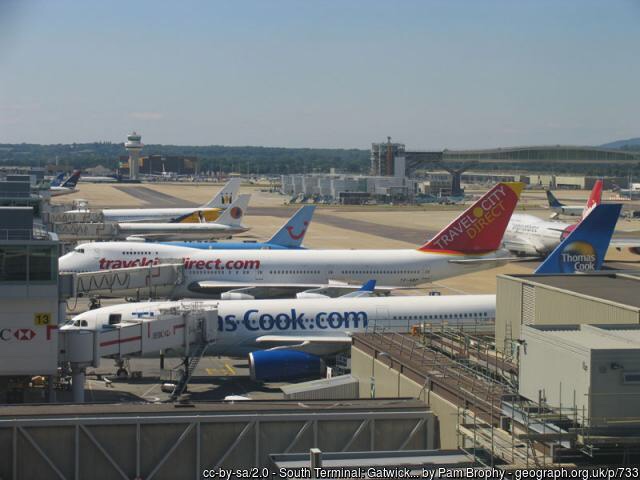
Gatwick had first been established as an aerodrome in the 1920s…. In September 1933 it was bought by Morris Jackaman, who owned several light aircraft…. He purchased the airfield for £13.5K and the Air Ministry approved commercial flights….
Up until this time a converted farmhouse had served as the aerodrome building – but Jackaman planned a purpose-built terminal building…. In October 1934 he submitted plans and a patent for the design – a unique circular building – which became known as ‘The Beehive’…. Construction began in 1935 – the airfield closed briefly to allow for the building work, which was completed in 1936…. The contracted opening date had been for October 1935 but this date was missed due to ongoing drainage issues and to coincide with the timing of a new railway station….
Building’s entrance – Image credit: Martyn Davies CC BY-SA 2.0
The Beehive from the east – Image credit: The Voice of Hassocks CCO
The airport reopened officially in June 1936 – although some services, including flights to Paris, had resumed in the May…. Newly formed British Airways had made Gatwick its operational base in 1935…. Jackaman had floated his Company, Airports Ltd, on the Stock Exchange to raise money for the developments….
During World War 2 Gatwick was requisitioned for military use…. After the War it was decided the site should become London’s second official airport after Heathrow…. The decision was announced in July 1952 and a programme of large scale land acquisition began…. Roads were diverted and a new station and terminal building were built…. The Beehive, no longer part of the main complex, was used for helicopters for a few years afterwards but nowadays the Grade II* listed building is used for offices….
During the 1960s some of Britain’s largest independent airlines, such as British United Airways and Dan Air were based at Gatwick…. The ’70s saw the likes of Caledonian and Laker Airways….
Image: Richard Goring via flickr
Image: Richard Goring via flickr
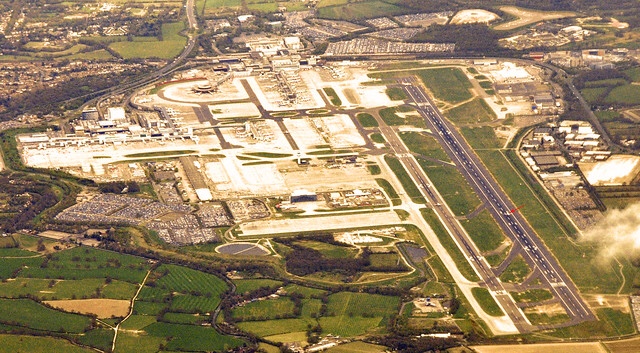
Today the airport runs as a single runway operation, although it does have two and is currently exploring options…. As well as British Airways Gatwick is used by many other airlines including EasyJet, Ryanair and Virgin Atlantic…. It has two terminal buildings and its flight statistics continued to rise year on year….(until the Covid pandemic hit us)…. Recent controversial expansion plans saw a recommendation that Heathrow Airport build a third runway rather than Gatwick – a decision that does not sit well with all….
Gatwick Airport – Mike McBey via flickr
On this day in history : 5th June 1944 – Ahead of the following day’s D-Day landings a small café in Bénouville is the first place to be liberated after British troops seize a vital canal bridge….
Every June 5th since, shortly before midnight – to celebrate the D-Day anniversary – Mme Arlette Gondrée has offered Champagne to everyone present in her café….many of whom have been veterans of the Normandy invasion….
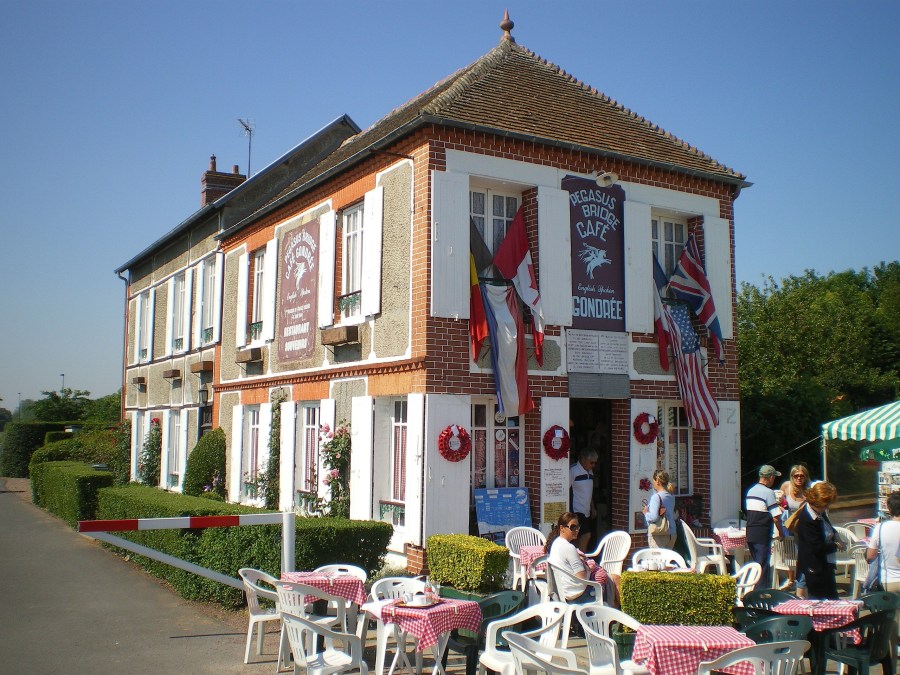
Cafe Gondree in 2009 : Runvald – Public domain
The walls of the quaint interior are covered with photographs, old uniforms, helmets and regimental insignia…. Now known as the Pegasus Bridge Café, the two-storey, red brick building was once called ‘The Café Gondrée’….
Georges and Thérèse Gondrée had met in Cannes…. Georges had been a banker, working at Lloyds and so his knowledge of the English language was excellent…. Thérèse being from Alsace was fluent in German…. They married and settled down to run a coffee shop in the Commune of Bénouville in the Normandy region of northwestern France…. Their little café being situated on the West Bank of the Caen canal – at the north end of the Bénouville Bridge (now called Pegasus Bridge)….
However, in 1940 France was invaded by Germany; Georges and Thérèse found life under German occupation intolerable…. They began to support the French Resistance in Caen and passed vital information via the French Underground Movement to British intelligence…. Thérèse did not let the Germans know she could speak their language – she and Georges were able to gather details on the German garrison and the defences of Bénouville Bridge….
On the eve of D-Day three gliders were released from 8,000 up into the pitch-black, stormy night…. Sixty paratroopers, a Glider Unit of the Oxfordshire and Buckinghamshire Light Infantry Regiment, British 6th Airborne Division under the command of Major John Howard, had orders to take and hold the bridge…. Howard had been able to put together a detailed plan with the information received from the Gondrées….
Horsa gliders, which had landed a hundred yards from the bridge. The cafe can be seen in the background – Royal Air Force Official Photographer – Public domain
All three gliders managed to land in a nearby field, the rough terrain causing considerable damage to the aircraft…. What followed then was a short but fierce battle in which the British troops managed to take control of the bridge…. It was not without loss of life, several died….the very first casualty of the D-Day operation is buried in the cemetery at nearby Ronville…. The taking of the bridge was a key part of the preparations for D-Day – as it made it extremely difficult for the Germans to launch a counter-attack during the days of the Normandy invasion….
The Benouville Bridge, 9 June 1944 – Christie (Sgt) No.5 Army Film & Photographic Unit – Public domain
The Gundrées had been woken in the early hours by the noise of the gliders landing and then the following gunfire…. Georges had looked out of the window to see what was happening and was shot at by a British soldier….he had been mistaken for a German…. Georges and Thérèse quickly bundled their three young daughters into the safety of the cellar and spent the next few hours trying to work out the nationality of the soldiers – as they knew they were not German….
At 6.20am there came a loud knocking on the door….and all was revealed – as there stood three British paratroopers…. Café Gondrée was officially the first French building to be liberated…. Georges responded by digging up 99 bottles of Champagne he had buried in the garden and for the rest of the day gave celebratory drinks to the passing soldiers….
Pegasus Cafe as approached from the bridge. Image credit: SIMCard25 at English Wikipedia CC BY-SA-3.0
In later years the café was taken over by Georges and Thérèse’s daughter, Arlette, who had been 5 at the time of the liberation…. It is because of Arlette that the café continues to honour the anniversary of D-Day, with Champagne of course….but I do believe the café serves a very decent cup of tea as well…. Of course, only the British would ensure that the first place to be liberated would be somewhere they could guarantee a great cuppa! The café became an Historic Monument on the 5th of June 1987….
The following video clip shows Mme Arlette Gondrée at the 6th of June 2011 Ceremony
On this day in history : 4th June 1913 – Militant suffragette Emily Wilding Davison runs out in front of King George V’s horse at the Epsom Derby…. She dies of her injuries a few days later….
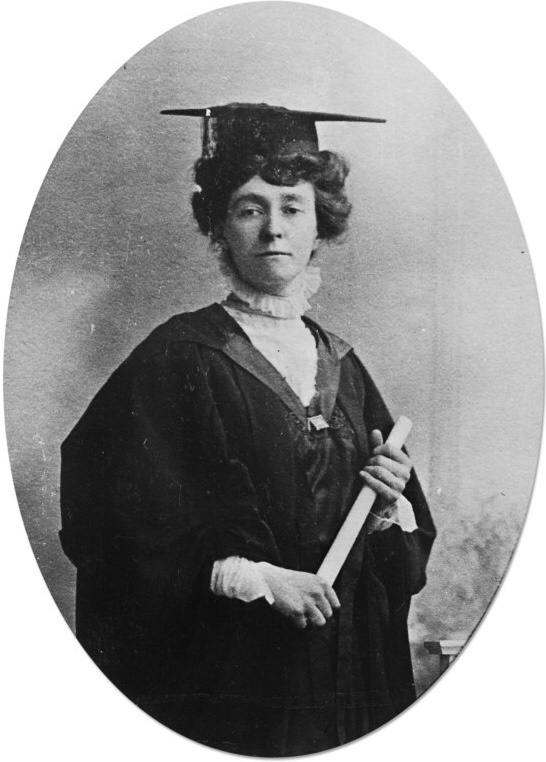
Emily was born on the 11th of October 1872 at Blackheath, London…. She won a scholarship to the Royal Holloway College, where she studied literature….she then continued on to Oxford University – but would have been unable to obtain a degree as it was not permissible for women to do so at the time…. She went on to become a teacher….
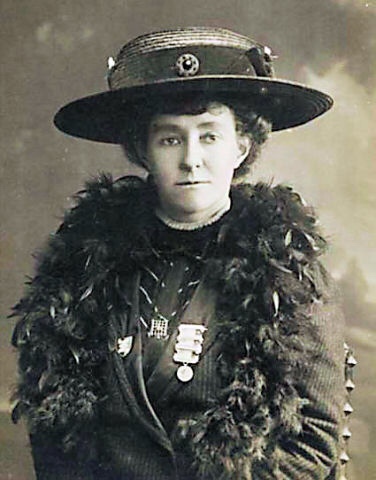
Emily Davison in 1908 – Public domain
In 1906 Emily joined the Women’s Social and Political Union (WSPU), which had been founded by Emmeline Pankhurst…. Three years later Emily had given up her job and was working full-time for the Cause…. Her activities saw her imprisoned several times and by 1911 she was becoming more militant….
She had certainly proved that she was prepared to die for the Movement…. In 1912 she was jailed for ten months after setting fire to post boxes in London…. Whilst in prison she went on hunger-strike and in response to force-feeding threw herself from a balcony….
“I did it deliberately, and with all my power, because I felt that by nothing but the sacrifice of human life would the nation be brought to realise the horrible torture our women face. If I had succeeded I am sure that forcible feeding could not in all conscience have been resorted to again”….
Emily Davison – Public domain
Thousands of people had attended the Epsom Derby….King George V and Queen Mary were amongst them…. One of the King’s horses, ‘Anmer’, was running in the Derby and they were there to watch…. Ridden by Herbert Jones, jockey and horse were easy to spot – sporting the King’s colours of purple, scarlet and gold….
Epsom racecourse has two long straights with a sweeping curve at one end – rather like a horseshoe in shape…. The bend where the curve turns to the home-straight is called ‘Tottenham Corner’….and this is where Emily had positioned herself….
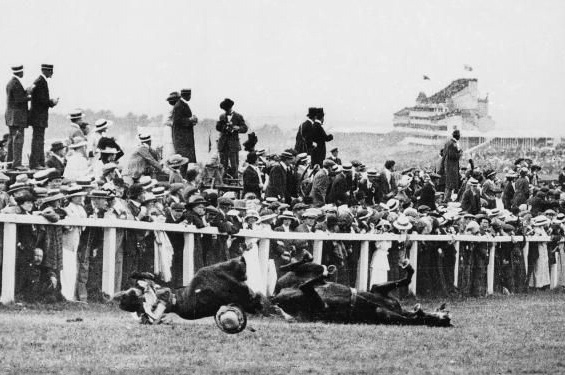
As the horses came around the corner with Anmer third from last, Emily – holding the purple, white and green flag of the Suffragette Movement – ducked under the guard rail and stepped into the path of the King’s horse and reached for the reins…. Anmer, who would have been travelling at around 35mph, crashed into her and fell…. Jones was thrown and knocked unconscious, the horse partially rolled on to him….but Anmer regained his feet and finished the race alone….
Image: Arthur Barrett – Public domain
Both Emily and Herbert Jones were rushed to Epsom Cottage Hospital…. Jones suffered broken ribs, bruising and concussion…. Emily was operated on but died of her injuries four days later….
Emily Wilding Davison under the King’s horse, 1913 – LSE Library via flickr – no known copyright restrictions
At the inquest the verdict was given:-
“That Miss Emily Wilding Davison died of a fracture of the base of the skull, caused by being accidentally knocked down by a horse through wilfully rushing on to the racecourse at Epsom Downs during the progress of the race for the Derby; death was due to misadventure”….
Emily Davison towards the end of her life – Public domain
It is not known if Emily had pre-planned her actions – she had not discussed her intention with anyone…. She had another two flags upon her person….and in her handbag was a return train ticket and an invitation to a suffragette function that evening…. Perhaps it was a spur of the moment decision – or it has been suggested that she intended to fix her flag to Anmer….
The return ticket found in Emily’s handbag – public domain
The King recorded in his diary that it was ‘a most regrettable and scandalous meeting’; Queen Mary in hers called Emily a ‘horrid woman’….
Jockey Herbert Jones never truly got over the incident – but was physically well enough to ride Anmer at Ascot racecourse two weeks later….
On this day in history : 3rd June 1971 – The premier in London’s West End of the longest-running comedy in history ~ “No Sex Please, We’re British”….starring Michael Crawford….
Written by Alastair Foot and Anthony Marriott and directed by Allan Davis the farcical play opened at the West End’s Strand Theatre….
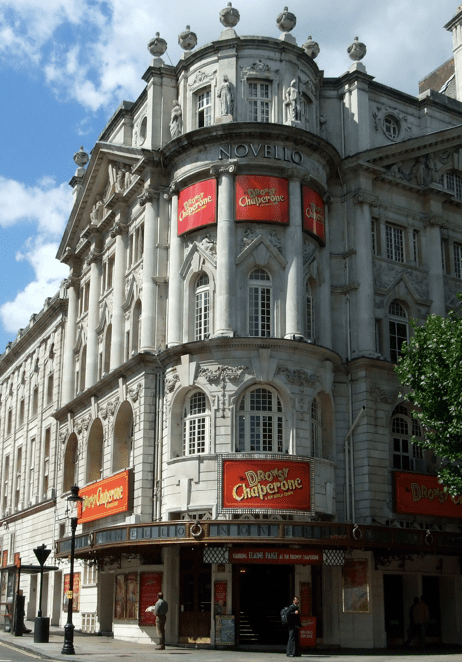
Strand Theatre (2007) – Turquoisefish CC By 3.0
The plot centred around Bank Manager Peter Hunter and his new wife, Frances, who live in a flat above the bank…. Frances sends away for some Scandinavian glass – but when it arrives it turns out to be not glass at all….but Scandinavian pornography…. A flood of photographs, books and films begins to arrive and the couple, along with the bank’s chief cashier, Brian Runnicles, desperately try to find a way to get rid of it…. Matters are complicated by Peter’s interfering mother, his boss, a bank inspector and a police superintendent….
The part of Brian Runnicles was at first played by Michael Crawford and later by David Jason…. Crawford used the character of Runnicles for his persona of Frank Spencer in “Some Mother’s Do ‘Ave ‘Em”…. He was offered the part of Frank after the success of “No Sex Please, We’re British” but had not been the first choice for the hit sit-com…. the part had been offered to Ronnie Barker and then Norman Wisdom – but both had turned it down…. However, it has to be said Michael Crawford made Frank Spencer his own….
Michael Crawford in Sydney, 2012 – Eva Rinaldi CC BY-SA 2.0
The character of Frances Hunter in “No Sex Please, We’re British” was initially played by Belinda Carroll…. The comedy ran until 1987, playing at full houses at three West End theatres:- The Strand, The Garrick and The Duchess, giving a total of 6,761 performances…. However, it did not enjoy the same level of success in America, closing after only sixteen performances on Broadway in 1973….
Also in 1973 a film version starring Ronnie Corbett as Brian was released with with changes to names, script and elements of the plot….
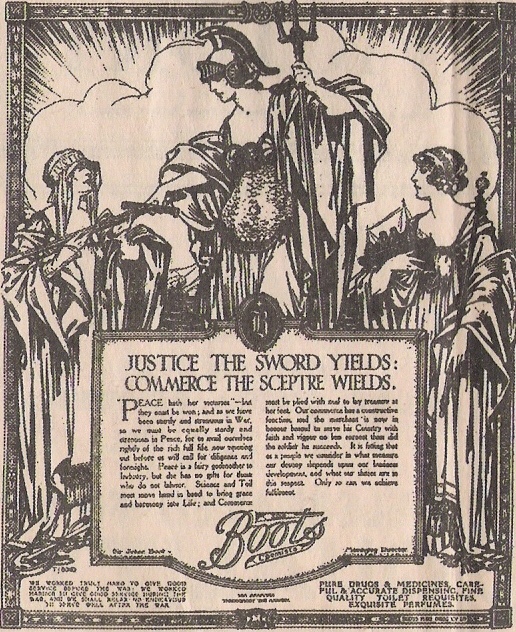
On this day in history : 2nd June 1850 – The birth of Jesse Boot – who transformed the business his father had founded into a national retailer – Boots – ‘Chemist to the Nation’….
John Boot had started out by making and selling herbal remedies from recipes his mother had taught him…. He opened his first shop in 1849 at Goose Gate, Nottingham and it was to become the roots of the Boots empire….
16-22 Goose Gate – Photo credit: Alan Murray-Rust CC BY-SA 2.0
He married Marry Wills and they had two children, Jesse and Jane…. Having suffered ill-health for most of his life John Boot died in 1860 – leaving his wife and 10-year-old Jesse to run the business, which they did as M & J Boot, Herbalists…. Jesse and his sister would go and collect herbs from the countryside….and as he got older he took on a larger role within the business until when in 1877 he took over….
Jesse wanted to make medicines available and affordable to all….and once he took over he began to put his big ideas into practice…. He started to buy ingredients in bulk…. On one occasion he bought a ton of Epsom salt – and it took the family a whole weekend to package it up and fill the shop window…. Advertised at a penny a pound – or seven pounds for sixpence – Jessie was ridiculed by his competitors, who all sold Epsom salt for a penny an ounce, they said he would soon go out of business…. In response he took out a large advertising campaign in the local Press and doubled his sales in a month….
The business became incorporated as Boot & Co. Ltd in 1883 and then Boots Pure Drug Company in 1888…. Jesse married Florence in 1885 and their son, John, was born in 1889…. His flagship store at Pelham Street, Nottingham opened in 1892…. Between them Jesse and Florence continued to grow the business – and began selling other associated products…. Florence concentrated on developing stationery lines and gift ideas – and she established Boots Booklovers Libraries…. She also took particular interest in the welfare of their staff….
By 1896 Jesse owned 60 shops in 28 towns – offering prescriptions, which doctors had previously had to make up themselves…. Jesse often worked up to 16 hours a day but having no chemist training himself employed qualified staff….
Jesse received a knighthood for his achievements in 1909…. By the beginning of World War 1 he had more than 560 branches and in 1917 was made a baronet….
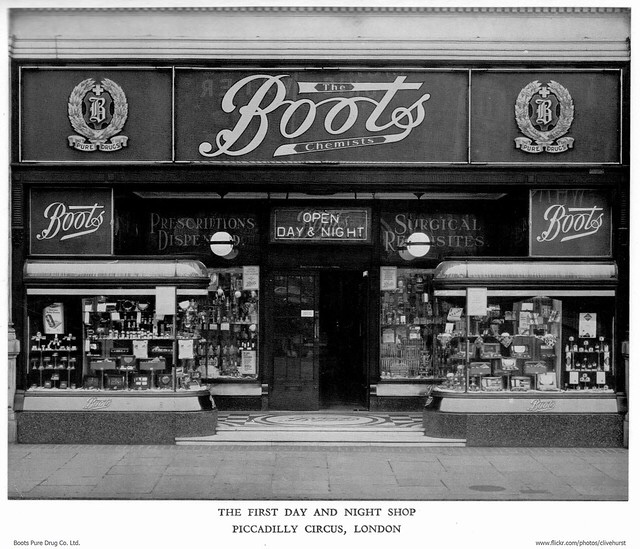
Piccadilly Circus, London – Image credit: Clive Hurst via flickr
By the time he was 70 Jesse was almost crippled with rheumatism….and in 1920 he sold his controlling share of the business to the United Drug Company of America, in a deal worth over £2m…. The Company employed some 1,500 staff by this time…. Despite his illness Jesse continued to work and in 1929 was made 1st Baron Trent…. He died two years later in 1931….
Jesse’s son had taken over as chairman of the Company in 1926 and upon his father’s death had inherited his title…. In the 1930s North America suffered a severe economic depression and in 1933 John made a successful bid to buy the Company back…. Shortly after Boots opened its 1,000th store….
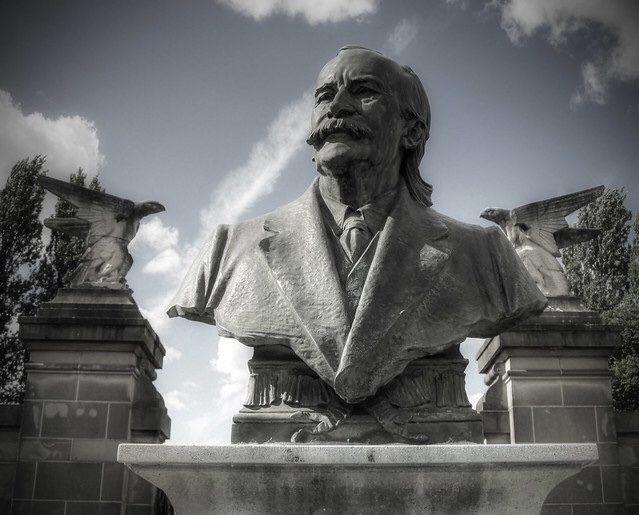
Bust of Jesse Boot, Nottingham – Photo credit : Addy Clarke via Flickr

 Gatwick had first been established as an aerodrome in the 1920s…. In September 1933 it was bought by Morris Jackaman, who owned several light aircraft…. He purchased the airfield for £13.5K and the Air Ministry approved commercial flights….









 Cottage Capers