On this day in history….29th March 1871

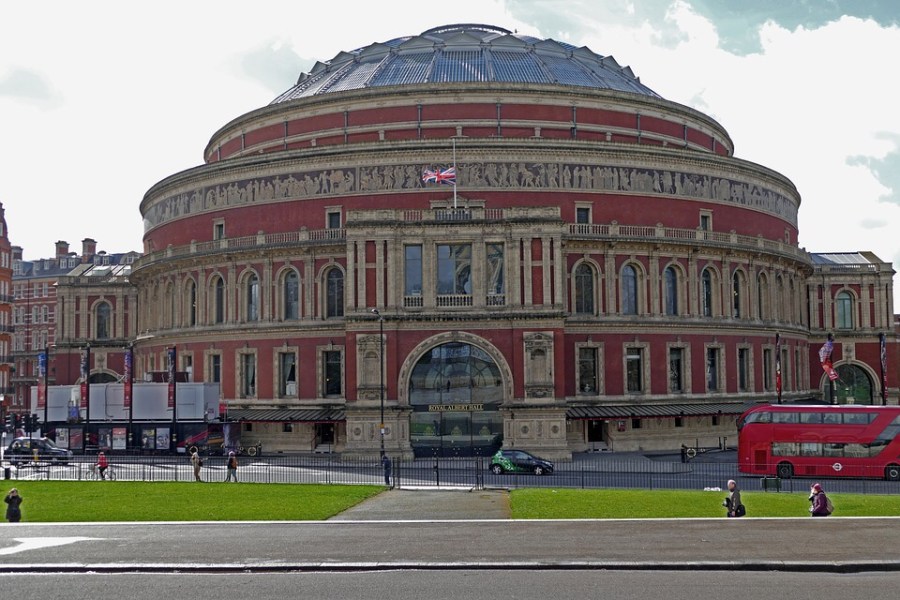
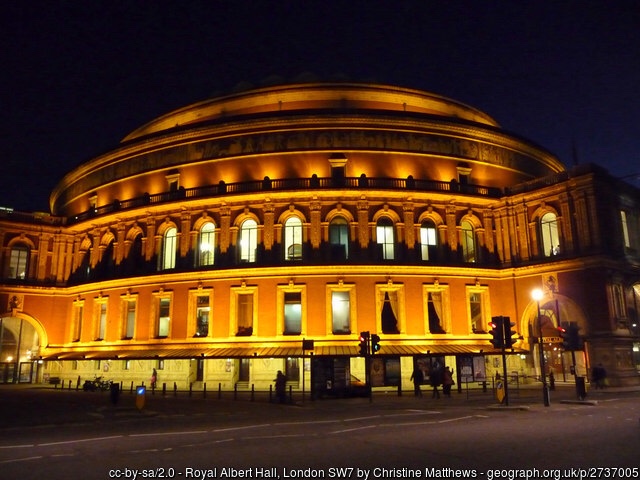
On this day in history : 29th March 1871 – The Royal Albert Hall in London is opened by Queen Victoria…. Originally it was to be called The Central Hall of Arts and Sciences….img_2677

Prince Albert, husband of Queen Victoria, had a vision borne from the success of the Great Exhibition of 1851 – a venue to promote the understanding and appreciation of the arts and sciences…. After his death from typhoid fever in 1861 the plans were shelved – but later revived by his collaborator on the Great Exhibition, Henry Cole…. Inspired by the ancient Roman amphitheatres Cole’s original intention had been for an establishment to hold 30,000 people – but this was revised to 7,000 for financial and practicality reasons; nowadays, due to safety regulations it has a capacity of 5,500….

On the 20th of May 1867 Queen Victoria laid the foundation stone…. A special marquee designed to accommodate 7,000 was erected – but it was more like 10,000 who packed in to witness Her Majesty lay the red Aberdeen granite block…. Beneath the stone was placed a time capsule which has lain undisturbed ever since…. Inside we know are some gold and silver coins and an inscription from Prime Minister Edward Smith-Stanley…. Of what else lies in the capsule little is known; the foundation stone is now located in the K stalls, row 11, under seat 87 in the main auditorium….img_2676

Queen Victoria, who was still in mourning and wearing all black, was rarely seen in public…. As the stone was laid she said “It is my wish that this Hall should bear his name to whom it will have owed its existence and be called The Royal Albert Hall of Arts and Science”…. The Archbishop of Canterbury gave the benediction and a composition by Prince Albert ‘Invocation to Harmony’ was performed by an orchestra…. The ceremony was closed by a 21 gun salute from Hyde Park and a trumpet fanfare by Her Majesty’s Life Guards….

img_2674
The Hall at the opening ceremony, seen from Kensington Gardens. Public domain

At the opening ceremony of the Royal Albert Hall, some four years later, Queen Victoria was so overcome with emotion that her son, Edward Prince of Wales, had to make a speech on her behalf…. Her only recorded words of the day being that it reminded her of the British constitution….img_2678

On this day in history….26th March 1885

On this day in history : 26th March 1885 – The first official British cremation takes place at Woking Crematorium in Surrey…. It is the first of only three cremations in this year….

img_2655
Woking Crematorium – Image courtesy of PicturePrince via Wikimedia

With the arrival of Christianity came the belief that cremation was a Pagan practice that made resurrection after death totally impossible…. However, by the late 19th century attitudes were changing – albeit very slowly…. Burial grounds were fast filling up – and there were those who raised concerns about the hygiene of burials…. Victorian funerals were elaborate, extremely expensive affairs – and for many, unaffordable….cremation offered a cheaper alternative to burial…. However, there were plenty who were terrified of the idea – of not actually being dead and being burned alive….

Woking Crematorium was founded in 1878 on land purchased by Sir Henry Thompson, Physician to Queen Victoria and a founder and President of the Cremation Society of Great Britain…. Seven years later the first cremation was to take place – that of a woman identified in The Times only as ‘a well-known figure in literary and scientific circles’….

img_2656
Sir Henry Thompson

The woman in question was writer and painter Jeanette Pickersgill…. Born Jeannette Caroline Grover in Amsterdam around 1814, she had married Henry Hall Pickersgill, an English artist, on the 20th of July 1837, in Soho, London…. Jeanette was an accomplished artist herself, her work being exhibited at the Royal Academy between 1848 – 1863….

Her cremation took place six days after her death – which had been certified by two doctors to be on the ‘safe side’ – and the cremation process was completed within an hour and a quarter…. Hers was the first of three cremations performed in 1885 – a year that saw a total of 597,357 recorded deaths in the United Kingdom….

In 1892 a further crematorium was established in Manchester, followed by Glasgow in 1895 and Liverpool in 1896…. By 1901 there were six functioning crematoriums – but even so, out of 551,585 deaths that year only 427 bodies were cremated…. London’s first crematorium, at Golders Green, came into operation in 1902…. Nowadays over 70% of those who die are cremated….

On this day in history….23rd March 1861

On this day in history : 23rd March 1861 – Horse drawn tramcars begin operating on London’s streets for the first time…. They were introduced by an American, Mr. George Francis Train…

America had been introduced to tramcars (streetcars) by George Francis Train some thirty years before he brought them to Britain…. The very first line he opened here was at Birkenhead in 1860…. Three demonstration lines were then installed in London; one along the Bayswater Road between Marble Arch and Porchester Terrace, another at Victoria and a further one between Westminster Bridge and Kennington….

The trams proved popular with many; thousands attracted by their novelty came to see them and ride upon them…. However, not everybody was happy….

Train had chosen fashionable, elite parts of London to trial his trams…. The wealthy residents had no need for public transport, as most owned their own carriages…. They complained of the crowds who got in their way, the noise and having to share the roads with this new form of transport…. Then there was the problem with the actual rails, which stood proud to the road surface causing difficulties for other road vehicles….

(London Tramways two-horse tram circa 1890)

The ‘sticking-up’ rail – or ‘step-rail’ – was actually designed in a way (with a wide bottom plate some 5 inches wide) to take any width of carriage wheel….which at the time came in several different gauges…. The idea was that they could accommodate all vehicles, not just Train’s trams…. Unfortunately many carriages had accidents trying to use them…..numerous complaints were made to the transport commissioners, so that eventually on the 4th of October 1861, after six months in operation, Train was told to remove his tramway….

The advantages of the tramway had not gone unnoticed by the planners…. Nine years later, in 1870, the first tram service began between Brixton and Kennington…. This time the steel rails lay flush to the road surface….

Being on rails meant the tramcars were easier than the omnibuses for the horses to pull…. This in turn meant more passengers could be carried at one time using the same amount of horses…. As a result the fare, which worked out at 1d per mile, was cheaper than that of the buses…. With the addition of the railways’ cheaper early morning workers’ tickets public transport became accessible to everyone…. Another advantage was that the tram travelled slightly faster at 6mph, compared to the bus at 4mph…. Workers began to travel further to work, many moved out of the crowded city to the suburbs…. The tramway network had grown considerably, connecting new housing developments on the outskirts to the city centre….

Initially tram services were operated by private companies, such as the Pimlico, Peckham and Greenwich Street Tramways or the North Metropolitan Tramways…. London County Council could see the social benefits of the system, the cheap fares, accessibility and reliability…. The council saw it as an important part of their policy and during the 1890s made compulsory purchases on many of the horse tram routes….

The tramways still had their problems; the installation and maintenance of the lines caused disruption, derailments were a hazard….and then there was the horsepower….

A single bus or tram needed a team of twelve horses to keep it on the road for twelve hours a day…. Horses were rotated every 3-4 hours….they needed stabling, feeding, watering, veterinary and blacksmith services…. 55% of the operators’ fees went on the cost of caring for the horses – an average of £20,000 was collectively spent per year on horseshoes alone…. 50,000 horses were used to keep the public transport system going on London’s streets….horses that ate the equivalent of a quarter of a million acres worth of foodstuff and produced 1,000 tonnes of droppings per year…. Much of this was collected up and dumped in poorer areas of the city….

Eventually the electrification of trams and the arrival of the motor bus just before World War I meant the demand for the working horse became less and less…. The last horse drawn trams were withdrawn in 1915….

On this day in history….7th March 1876

On this day in history – 7th March 1876 – Scottish-born inventor Alexander Graham Bell patents the telephone….

img_2524
An early telephone transmitter invented by Alexander Graham Bell around 1876. An improvement over Bell’s ‘gallows’ type instrument of 1875, it was Bell’s first device that could transmit intelligible speech – Public domain

Bell had worked with his father in London, who had developed a system to teach deaf people to speak. He in turn was most likely influenced by his own father, who had studied elocution and speech impediments…. It was an area that affected the Bell family in many ways….Bell’s own mother was almost totally deaf….

The Bells moved to the United States – Boston, Massachusetts – during the 1870s…. At first Bell worked as a teacher at the Pemberton Avenue School for the Deaf….it was here he met his wife, Mabel Hubbard – she was one of his students….

img_2522
Alexander Graham Bell and his family – Public domain

Bell began to explore the idea of transmitting speech over wires…. The downside of the telegraph system being the final message still had to be physically delivered after it had arrived at the receiving telegraph office…. With the help of electrician Thomas A. Watson, a prototype telephone was developed, which used electrical current and sound waves….

Unbeknown to Bell somebody else was working on a similar system….Elisha Gray had kept his work secret – Bell found out on the 11th February 1876, a Friday, that Gray intended to apply for a patent – and rushed to get the documentation completed for his own…. Both men applied for a patent on Monday the 14th of February….Bell’s solicitor obviously managed to file the paperwork first – records show his application was the 5th received at the Patent Office that day….whereas Gray’s was the 39th. Bell was granted US Patent No. 174,465 Improvement on Telegraphy on the 7th of March – Gray was left disappointed….

Three days later Bell made his first telephone call…. “Mr Watson….come here, I want you”…. Bell later wrote in his journal “To my delight he came and declared that he had heard and understood what I had said”….

img_2525
Watson in his later years, holding Bell’s original telephone – Public domain

There has long been controversy as to whether Bell ‘stole’ the patent…. It is indeed unusual for a patent to be issued before a device is fully working…. Three others all claimed to have invented the telephone first – Elisha Gray, Thomas Edison and Antonio Meucci – and said they had working devices…. There were more than 600 patent lawsuits brought against Bell – but each time the courts ruled in his favour….

Bell was never particularly interested in the commercial side of things – he was a scientist and inventor…. Among his other inventions were metal detectors, the Hydrofoil and Tetrahedral Kite…. His work also consisted of designs for aircraft, including helicopters…. Ironically he considered the telephone an intrusion….and refused to have one in his office….

img_2521
Public domain

On this day in history….25th January 1858

On this day in history : 25th January 1858 – The marriage of Princess Victoria – eldest daughter of Queen Victoria – and Crown Prince Frederick of Prussia takes place at St. James’s Palace….

Victoria Adelaide Mary Louisa was born on the 21st of November 1840 and was the eldest child of Queen Victoria and Prince Albert – born nine months after their wedding…. Vicky was christened on their first wedding anniversary and on the 19th of January 1841 she was made ‘Princess Royal’….

img_2262
Queen Victoria with the Princess Royal c.1844-45 public domain

Vicky first met her future husband Frederick (Fritz) when she was just 10-years-old….he was approaching 20. Fritz was the son of William of Prussia and Princess Augusta of Saxe-Weimar-Eisenach….and was second inline to the Prussian throne after his father – who was expected to succeed his childless brother….

Vicky and Fritz were introduced when he came to London with his family to visit the Great Exhibition in 1851…. Despite the age difference the pair got on well, although he spoke little English Vicky was fluent in German. She acted as his guide at the Exhibition….

Fritz spent quite a bit of time with the royal family during his four-week stay in England – and once he had returned to Germany began to regularly correspond with Vicky…. Queen Victoria and Prince Albert were delighted as they wished to forge a closer alliance with Prussia…. If Vicky and Fritz were to marry two important powers would be united, Britain and Prussia, Germany’s main principality….

In 1855 Fritz visited Vicky and her family at Balmoral Castle….she was 15 by then. Vicky was not a classic beauty – her mother worried Fritz might find her too plain….but there was no need to worry because there was an instant spark between them…. After just three days Fritz asked Queen Victoria and Prince Albert for permission to marry their daughter…. Of course, they were thrilled – but because of Vicky’s young age made the condition that they would have to wait until after her 17th birthday….

img_2260
The Princess Royal c.1855 – Public domain

The engagement was publicly announced on the 17th of May 1856…. The news was not generally well-received in either country…. Many in Britain criticised the Kingdom of Prussia for its neutrality during the Crimean War…. Whereas, in Germany there were those of a more conservative mind who wished their Crown Prince to marry a Russian grand duchess – those more liberally minded welcomed a union with the British Crown….

The day of the wedding dawned as a bright, crisp Winter’s day…. After breakfast Queen Victoria invited her daughter to her rooms – and they dressed together and had their hair styled…. Vicky wore a gown of white silk moire over a flounced lace petticoat adorned with wreaths of orange and myrtle blossoms…. A matching wreath held her veil in place and she had white satin ribbons upon her train…. For jewellery she wore diamond earrings, necklace and brooch…. Queen Victoria wore lilac silk moire with a velvet train, her outfit completed with the Crown diamonds….

img_2265
Queen Victoria, the Prince Consort and Victoria, Princess Royal in the dress they wore at the marriage of the Princess Royal – 1858 Author: Thomas Richard Williams. (Photographs at the time required the subject to remain absolutely still for up to a minute – something Queen Victoria evidently found difficult – hence her blurred image)

Thousands of people lined the short route of the procession from Buckingham Palace to St. James’s Palace…. They were treated to a delightful spectacle….18 carriages, over 300 soldiers and 220 horses…. In one carriage rode three of her sisters, Alice, Helena and Louise (Beatrice, not yet being a year old, did not attend) and all were dressed in white lace over pink satin…. Another carriage carried her brothers, Bertie, Alfred, Arthur and Leopold, attired in Highland dress….

img_2263
Victoria with her sisters, Alice, Louise and Helena. Portrait by Franz Xaver Winterhalter 1849

To trumpet fanfares and drumrolls the last coach in the procession, carrying Queen Victoria and Vicky, made its way to the Royal Chapel at St. James’s Palace…. There had been some discrepancy as to who should host the wedding – the Germans felt as Fritz was a future Monarch it should take place in Berlin. However, Queen Victoria had other ideas…. “The assumption of it being too much for a Prince Royal of Prussia to come over to marry the Princess Royal of Great Britain in England is too absurd, to say the least…. Whatever may be the usual practice for Prussian Princes, it is not everyday that one marries the eldest daughter of the Queen of England”…. Needless to say, Queen Victoria got her way….

Vicky was escorted down the aisle by her father and Godfather, her great-uncle, Leopold I of the Belgians…. Her groom was waiting for her and wore the dark blue tunic and white trousers of the Prussian Guard and was carrying his shining silver helmet….

It was a romantic wedding, one of love – unlike so many of the arranged royal weddings of the time…. The service was conducted by John Sumner, Archbishop of Canterbury – who was so nervous he left several parts out…. Queen Victoria later wrote in her journal that she was pleased “Vicky and Fritz spoke plainly”….

img_2261
Victoria’s Wedding by John Phillip – Public domain

After the service the bride and groom walked out of the chapel to Felix Mendelssohn’s Wedding March. Although it had been composed 16 years before it was the first time it was played at a royal wedding….and so there after it has become a popular choice at weddings ever since….

img_2258
Princess Victoria and Prince Frederick of Prussia 29th January 1858 – Public domain
img_2259
Vicky and Fritz 1860s – Public domain