On this day in history….7th September 1665

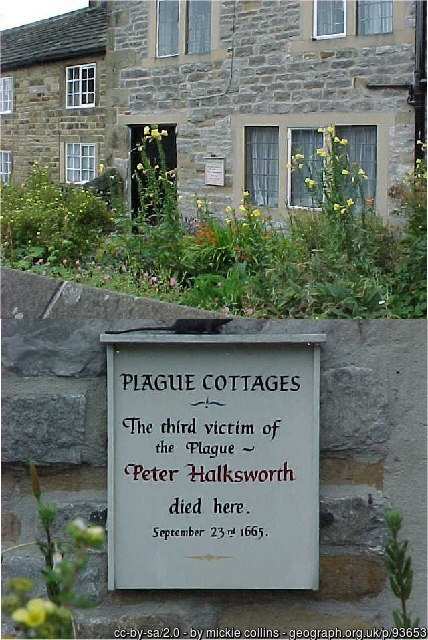
On this day in history : 7th September 1665 – Bubonic Plague claims its first victim in the Derbyshire village of Eyam – after the arrival of a bale of cloth that had been sent from London….
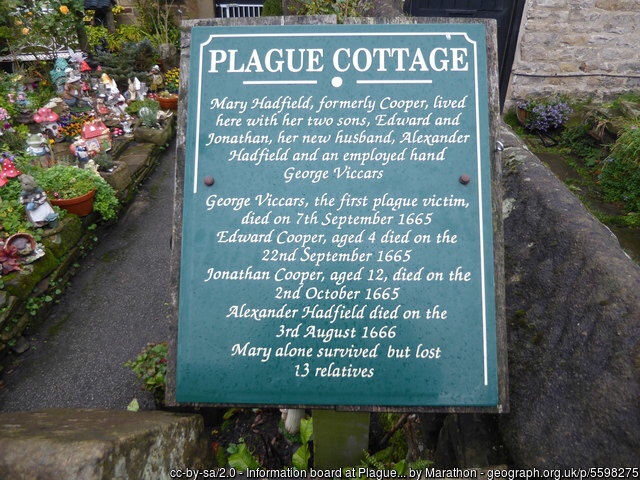
The cloth had been ordered by tailor Alexander Hadfield…. It was his assistant, George Viccars, who had the task of unpacking it…. On doing so he noticed it was a little damp – and so he spread it in front of the fire to dry out…. In doing so he released the hoards of plague-carrying fleas that had infested it…. George was to become the first of the many who were to die in the village – between September and December 1665 at least 42 had died – and by Spring the villagers were thinking of leaving their homes and livelihoods in order to escape the disease….

It was newly appointed rector William Mompesson who took it upon himself to prevent this from happening…. He knew that if the parishioners left then the disease would soon spread to the nearby towns of Bakewell and Sheffield – and many more thousands would likely fall victim…. He realised the only way to stop this was if the whole village were to quarantine – even if it meant staring into the face of death….

Eyam Church

Mompesson had come to the village at a difficult time…. He was a replacement for the previous rector, Thomas Stanley – who had been removed from his post as he, like most of the villagers, had been a supporter of Oliver Cromwell…. Puritan Stanley refused to use the Book of Common Prayer which had now been made mandatory by King Charles II…. Stanley had been much respected in the village, whereas Mompesson was not liked…. He knew to get people to listen to him he needed the assistance of Stanley – who was fortunately still living on the outskirts of the village…. He reached out and asked for his help….and together they came up with an admirable plan….

On the 24th of June 1666 Mompesson explained to his parishioners that they had to impose a quarantine – nobody must be allowed to leave or enter the village…. The Earl of Devonshire, who was living nearby at Chatsworth, had arranged to send food and supplies…. With Stanley at his side Mompesson promised that he would stay with the villagers and do all he could to alleviate their suffering…. He recognised he was asking them to agree to stay and quite likely die…. They would have to bury their own dead and church services would be held outside to allow distance to be maintained between people…. Reluctantly the villagers accepted the plan….

The plague lasted for 14 months…. Out of the population of around 350 some reports say only 83 survived – the church in Eyam has records of 273 individuals dying from plague…. There is no doubt that the actions of the people of Eyam saved the lives of so many more people…. Plague Sunday has been celebrated every year in the village since the bicentenary in 1866….
On this day in history….6th September 1952

On this day in history : 6th September 1952 – A de Havilland jet fighter disintegrates at the Farnborough Air Show – 31 people, including the pilot and the onboard flight test observer, are killed….

The prototype De Havilland DH.110 – Image : USN – US Navy Naval Aviation News July 1952 – Public domain

Pilot John Derry and flight observer Anthony Richards had collected the DH.110 prototype aircraft from de Havilland’s factory at Hatfield, Hertfordshire and had flown it to Farnborough, arriving just in time for their slot in the airshow’s schedule…. The plan had been to fly another prototype which had been used for the airshow the previous day – but it had developed technical faults…. The September 6th de Havilland display had nearly been cancelled….

Derry had been the first pilot in Britain to exceed the speed of sound, when flying a DH108 research aircraft in 1948…. During the performance at Farnborough he flew the DH110 in a supersonic dive, creating a sonic ‘boom’ and continued on a fly past at 40,000 feet…. He then completed a left bank, travelling at around 520mph and flew towards the 120,000 spectators at the airshow…. Next he pulled the jet into a climb – but within a second the aircraft had disintegrated – the outer wing sections, both engines and the cockpit separating from the airframe…. The cockpit landed, with both men still inside, in front of the crowd near to the runway – several spectators were injured….

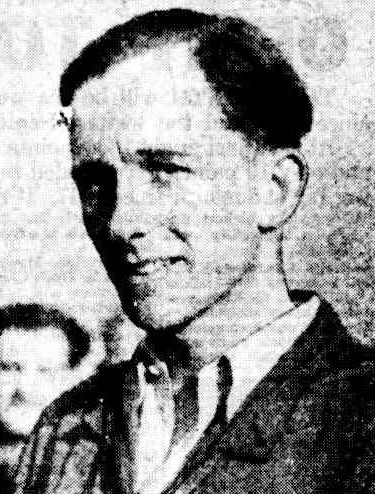
Pilot John Douglas Derry – National Library of Australia – Public domain

One engine crashed harmlessly…. The other carried on and ploughed into the crowd that had gathered on ‘Observation Hill’ – a vantage point outside of the airfield used by many locals to watch the display…. It was here that most of the fatalities occurred….

The emergency services were on the scene within minutes and after only a short break the air display continued! In total 31 people lost their lives, with many more injured….

On this day in history….5th September 1969

On this day in history : 5th September 1969 – The death of Scottish naturalist and writer Gavin Maxwell, author of Ring of Bright Water….the story of the otter he brought back from Iraq and raised in Scotland….

Gavin Maxwell c.1950 – Fair use

Maxwell was born into Scottish aristocracy – at The House of Elrig, near Port William, South Western Scotland…. He was the son of Lieutenant-Colonel Aymer Maxwell and Lady Mary Percy…. His maternal grandfather was the 7th Duke of Northumberland and his paternal grandfather was Sir Herbert Maxwell, 7th Baronet and a natural historian, archaeologist and politician….

The ‘House of Elrig’ – Photo credit : Les Dunford CC BY-SA 2.0

Maxwell had a public school education and from an early age had an interest in natural history…. Giving in to pressure from his family he attended Hertford College, Oxford, where he obtained a degree in estate management….

During World War 2 Maxwell was an instructor with the secret organisation ‘Special Operations Executive’ – he was invalided out in 1944 having reached the rank of Major…. After the War be bought the Isle of Soay, off of Skye and began to pursue his real passion in life, natural history….

In 1956 Maxwell travelled to Iraq, where he was to explore the reed marshes of Southern Iraq with explorer Wilfred Thesiger…. Maxwell had always had a desire to have an otter as a pet and whilst in Iraq he managed to obtain one…. However, sadly it was to die shortly after; Maxwell was devastated…. It was as he was preparing to return to England that Thesiger managed to find another one for him – a smooth coated otter, very dark in colour and about 6 weeks old…. Maxwell named him Mijbil and returned home to Scotland with him….

Maxwell and Mij settled into a new home, ‘Sandaig’, in the Glenreig Community, a remote part of mainland Scotland…. The property had originally been a small holding for the lighthouse keeper of the Sandraig Lighthouse…. It was here at Sandraig that Maxwell raised Mij – although in his books he calls his home ‘Camusfearna’ – ‘the bay of alders’….

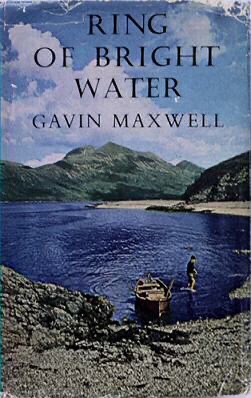
Mij seemed different to other otters and when Maxwell presented him to the London Zoological Society they confirmed that he was a previously unknown sub-species…. And so he was named Lutrogale perspicillatra maxwell – ‘Maxwell’s otter’…. Although Maxwell was to keep several other otters Mij became the focus of his life…. The title for his book ‘Ring of Bright Water’, which was first published in 1960, came from a poem by Kathleen Raine…. In 1969 a film of the same name, based loosely on Maxwell’s book, was released starring Virginia McKenna and Bill Travers….

Cover of first edition – Fair use

The relationship between Maxwell and Raine was complicated…. She was infatuated with him – and was to describe him as ‘the love of her life’…. Only she was to be left frustrated by his homosexuality…. They had a close friendship – but this was to deteriorate through her indirectly causing the death of Mij…. I wont spoil the story if you have not read the book – but it was a sad state of affairs…. The best-seller is both heart warming and a tear jerker…. It is described as a literacy masterpiece but at the same time it has a dark side…. Nowadays we have a different view about keeping wild animals and raising them as pets….

In February 1962 Maxwell married Lavinia Renton but not surprisingly this marriage ended within less than a year – they divorced in 1964…. The house at Sandraig was destroyed by fire in 1968 and Maxwell moved into the lighthouse keepers’ cottages situated on an island between Skye and the mainland…. He was to die of lung cancer the following year….

Statue of Maxwell’s otter at Montreith by Penny Wheatley – Photo credit : Roger Nunn CC BY-SA 2.0

On this day in history….4th September 1739

On this day in history : 4th September 1739 – The execution of Michael Curry for the murder of the landlord of the Three Horseshoes Inn at Hartley, near to Whitley Bay…. Curry was then gibbeted overlooking the scene of his crime….

Image credit : Draco2008

On the headland, overlooking the causeway towards St. Mary’s Bay, Whitley, North Tyneside a blue plaque can be found…. It reads:

‘On 4th September 1739 Michael Curry was executed for the murder of the landlord of the Three Horseshoes Inn, Hartley. His body was afterwards hung in chains from a gibbet at this spot within sight of the scene of his crime. Ever since that gruesome event this headland has been known as Curry’s Point’….

Image credit : Draco2008

The plaque was erected on the 4th of September 1989, to mark the 250th anniversary of the macabre happening…. Michael Curry was a glass worker at the local glassworks in Seaton Sluice…. Following his conviction for the murder of landlord Robert Shevill he was hanged in Newcastle….and then, as was common practice of the times, his tarred body was left in sight of the crime scene…. It was a practice known as ‘gibbeting’ – or ‘hanging in chains’….and was intended to discourage others from committing similar offences…. Gibbets were usually placed where they would be highly visible, frequently at crossroads or by busy waterways….

Captain Kidd hanging in chains – Public domain

The Murder Act 1751 made this practice into a regulated procedure…. ‘In no case whatsoever shall the body of any murderer be suffered to be buried’….meaning the corpse of the executed murderer had to be either publicly dissected or left to rot hanging in chains…. The practice was finally formally repealed by statute in 1834…. The last two men to be gibbeted in England were William Jobbing and James Cook – both in the same year of 1832….

On this day in history….2nd September 1807

On this day in history : 2nd September 1807 – The bombardment of Copenhagen – Britain attacks the Danish capital in order to prevent Denmark’s naval fleet from falling into the hands of Napoleon….

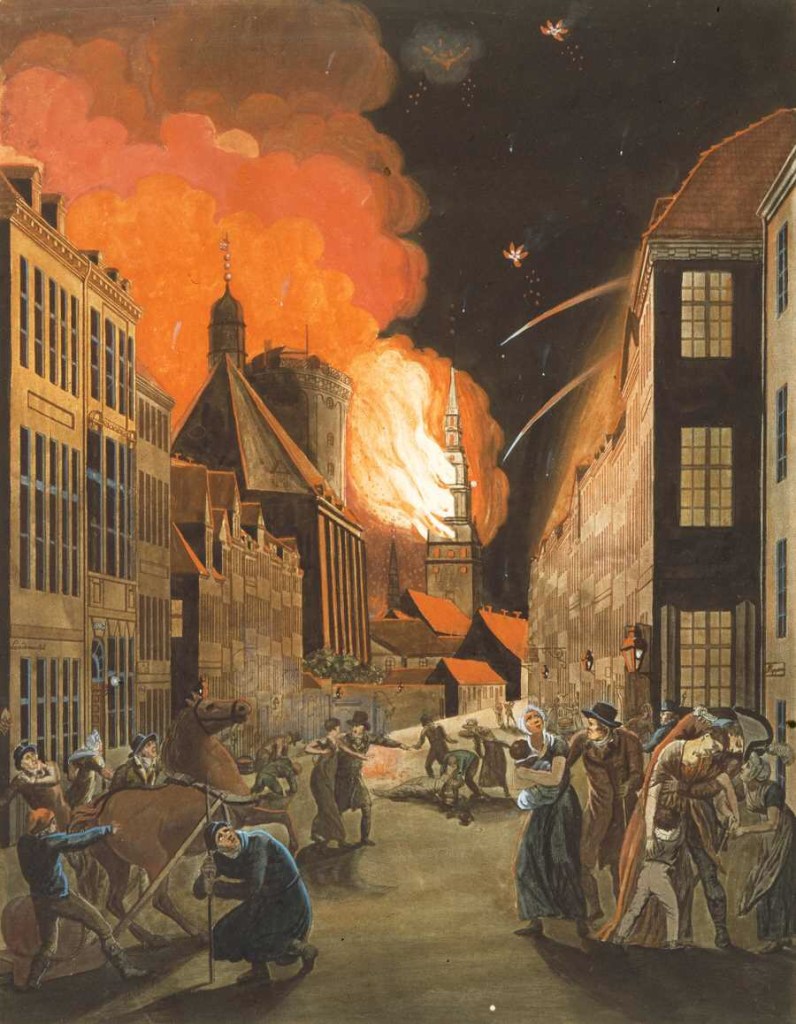
Battle of Copenhagen – Public domain

During the Napoleonic Wars Denmark was resolved to remain neutral…. In 1806 Napoleon had launched his campaign of destruction on British commerce in an attempt to paralyse Great Britain…. Under his Continental Blockade the allies of France and all neutral countries were prohibited from trading with Britain…. Whilst this was damaging to some British industries generally Napoleon was unsuccessful in maintaining his blockade, as Britain’s naval supremacy meant that French forces were spread too thinly….

Denmark was the weakest point in Napoleon’s coalition; still vowing to remain neutral the Danes were facing enormous pressure from France and Russia to surrender their fleet to Napoleon…. Britain was worried that Napoleon would force Denmark to close the Baltic Sea to British shipping severing a vital link with ally Sweden – an essential trading partner for raw materials…. Britain and Sweden tried to persuade Denmark to join them in a secret alliance – but the Danes remained firmly neutral…. Concerns began to grow that once Prussia was defeated, which looked increasingly likely, Denmark would fall under French control…. And then came the news that it appeared Napoleon had persuaded Alexander I of Russia to form an agreement with Denmark and Portugal against Britain…. Something had to be done….

Britain assembled a force of 25,000 troops – and offered Denmark a treaty of alliance and mutual defence…. In return for the protection of 21 British warships the Danes were expected to hand over their fleet after the war…. On the 31st of July 1807 Napoleon responded by telling Denmark it either prepared for war against Britain – or France would invade Denmark…. Britain retaliated by demanding the surrender of the Danish fleet…. Poor Denmark really was caught in the middle of it ~ things had to go one way or the other ~ and so the Danes responded with what was effectively a declaration of war against Britain….

Denmark had a strong naval fleet and around 10,000 troops based around Copenhagen…. Expecting an attack by the British most – but not all – civilians had been evacuated from the city…. On the 26th of August General Sir Arthur Wellesley led his own reserve, along with two light brigades of British artillery, one battalion, eight squadrons and one troop of horse artillery into battle…. On the 29th of August the British forces overpowered the Danish troops….

Contemporary Danish painting of the Battle as seen from land – Public domain

But still the Danes resisted British demands to give up its naval fleet – so the order was given that from the 2nd to the 5th of September Copenhagen would be bombarded…. During the bombardment of fire bombs and phosphorus rockets over 1,000 buildings were burned down…. On top of the expected military casualties 768 civilians were injured – and a further 195 were killed….

Public domain
Public domain

On the 5th of September Denmark surrendered and agreed to give up its navy….the capitulation was signed on the 7th…. In return Britain pledged to leave Copenhagen within six weeks – which it did on the 21st of October 1807…. However, Britain and Denmark remained at war until 1814….

After the bombardment – Public domain