On this day in history….9th June 1873

On this day in history : 9th June 1873 – After only being open to the public for 16 days Alexandra Palace in London is destroyed by fire…. Less than two years later a new Palace opens….

img_3347

The ‘Palace of the people’ had been an idea conceived in 1859 by Owen Jones, an English-born Welsh architect…. Designed to compliment South London’s Crystal Palace it was to provide the Victorians with a place of recreation, entertainment and education….

Alexandra Palace was built by Kelk and Lucas (who also built the Royal Albert Hall around the same time) – and many of the building materials used were recycled from the 1862 International Exhibition building in South Kensington, after it was demolished…. In 1871 work started on the Edgware, Highgate and London Railway to connect the site to Highgate Station…. Both Palace and railway were completed in 1873….

The grand opening took place on the 24th of May 1873, Queen Victoria’s 54th birthday….with concerts, recitals and fireworks…. In its first couple of weeks over 120,000 people were to visit….but then sixteen days after it opened disaster struck…. A fire in the dome quickly caught hold and all that was left standing were the outer walls…. Three members of staff lost their lives – and a loan exhibition of some 4,700 pieces of historic English pottery and porcelain was destroyed….

img_3349
Original Alexandra Palace on fire in 1873 – Illustrated London News – PD-US

However, the Victorians were never ones to hang around…. Within two years, on the 1st of May 1875, a new Palace opened…. Covering 7.5 acres, the new Palace and surrounding Park boasted many features….centred around the Great Hall with its new Henry Willis organ – one of the largest in Europe at the time…. As well as the Hall a museum, lecture hall, library, banqueting room, a large theatre and art galleries were all included…. The grounds held a Japanese village, boating lake, nine-hole pitch and put golf course – and even the Alexandra Palace Racecourse….London’s only racecourse from 1868 until its closure in 1970….

img_3350
Rebuilt Palace in 1875 – Illustrated London News PD-US

Of course the Ally Pally continues to be a leading venue for arts, sport and entertainment….but not without having to be largely rebuilt once again after being ravaged by fire…. In 1980 much of the building was destroyed when a fire broke out under the Henry Willis organ….

img_3348
Image: John Bointon CC BY-SA 2.0

On this day in history….8th June 793

On this day in history : 8th June 793 – The beginning of the Scandinavian invasion of England, when Vikings raid the monastery of Lindisfarne off the coast of Northumbria….

img_3341
Lindisfarne Abbey – and St Mary’s – Russ Hamer CC BY-SA 3.0

Although cited as the beginning of the Viking Age, which saw a reign of terror which was to last the next 200 years, Lindisfarne was not the first raid…. Previously in 789 three longships had arrived at Portland, Dorset….and on being sent to fetch the ‘Northmen’ to the West Saxon Court the King’s reeve had been killed by the strangers…. Evidently coming in peace had never been their intention – but the raid at Lindisfarne, also known as ‘Holy Island’ had entirely different connotations – being the ‘very place where the Christian religion began in our nation’….

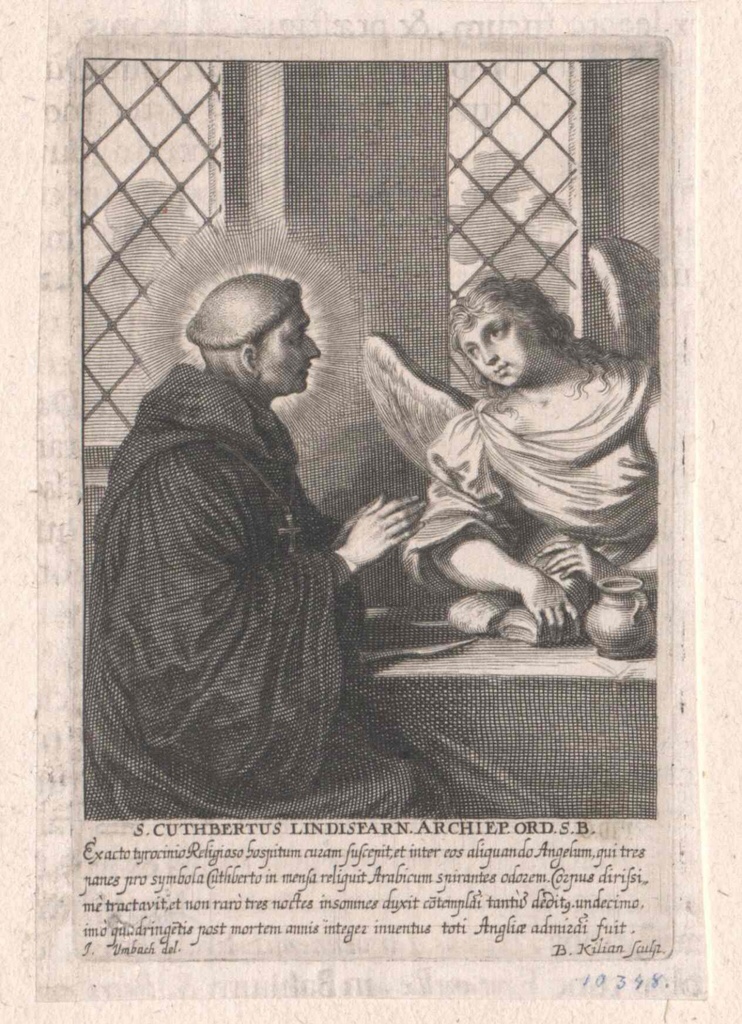
A monastery was founded at Lindisfarne around 634 by Irish monk Saint Aidan…. It became the Christian heartland where monks from the Irish community of Iona settled…. It was where Northumberland’s patron Saint Cuthbert was monk, abbot and then Bishop of Lindisfarne…. Where he died and was buried in 687 and his body revered as a saint – (his remains were later moved to Durham Cathedral)….

Cuthbert von Lindisfarne, Heiliger
Saint Cuthbert – image PICRYL

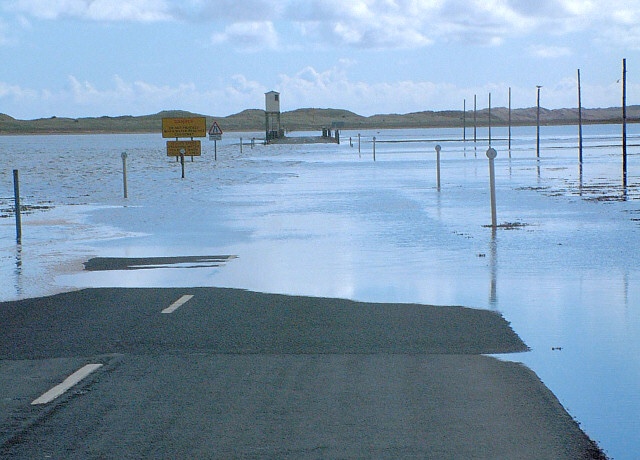
Lindisfarne lies in the North Sea, two miles off the Northumbrian coast – it is part of the county of Northumbria and is linked to the mainland by a causeway at low tide…. At the time it would have been wild, undefended and exposed….and totally unprepared for what was to come….

img_3340
The causeway flooding (with refuge box in distance) – Gary Rogers CC BY-SA 2.0

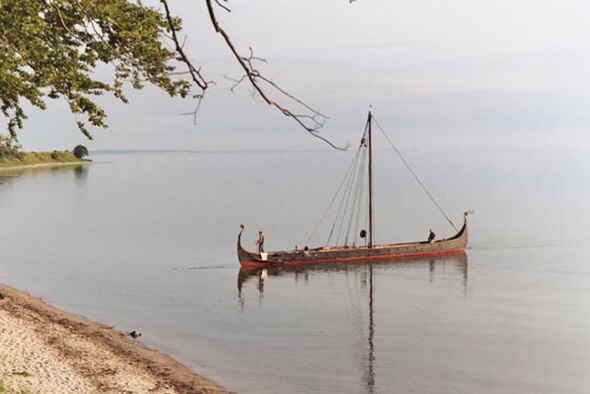
It has long been debated as to why the Vikings originally invaded England…. Possibly poor harvests in their own land had driven them further afield – but more likely they came to plunder to satisfy their own greed…. They could cross the North Sea in their longships in a matter of a couple of days to make a raid…. The attack on Lindisfarne was just the start of a long and terrifying plunderous campaign….the monks were either killed or taken as slaves and the monastery’s treasures carried away to the awaiting Viking ships….img_3345

The news reached Alcuin, a Northumbrian scholar living in a Frankish kingdom where he was tutor to King Charlemagne’s children…. He recorded “The heathens poured out the blood of saints around the altar, and trampled on the bodies of saints in the temple of God, like dung in the street”….

Worried that this was a message of wrath from Divine Powers he wrote to Higbald, Bishop of Lindisfarne…. He questioned why God had allowed such a thing to happen in “a place more sacred than any in Britain”….and advised Higbald to examine his conscience…. “Is this the outcome of the sins of those who live there?”…. Was he referring to the murder of the Northumbrian king in 788 by a group of conspirators led by Sicga? – Who then in 793 ‘perished by his own hand’….but then had been carried to the Holy Island for burial – just six weeks before the Vikings struck….

Despite the attack at Lindisfarne a Christian community managed to survive…. Raids became more and more frequent – and by 850 Viking armies were over-wintering in the northern parts of England…. By 870 the invasion and conquering of Anglo-Saxon kingdoms had begun in earnest….

On this day in history….7th June 1778

On this day in history : 7th June 1778 – The birth of George Bryon ‘Beau’ Brummell – English ‘dandy’, who was friends with the Prince of Wales – and credited for the modern men’s suit….

img_3304
English dandy George Bryan Brummell (1778 -1840), known as Beau Brummell. Public domain

George was born into a middle-class family – but his father, William, a politician, was determined his youngest son would grow-up to be a gentleman…. He sent George to Eton….where he proved to be very popular and became known as ‘Buck Brummell’…. From an early age George had paid attention to his attire – and customised his Eton uniform by wearing a gold buckle on his white necktie….

On returning to London, after a brief spell at Oxford University, he became close friends with the Prince of Wales, the future King Edward IV….whom he had been presented to at Eton…. The Prince gave George a commission of Cornet (once the lowest ranking officer – now abolished) in his own personal regiment, The Tenth Royal Hussars…. He worked his way up to the rank of Captain but resigned his commission immediately when it was announced the regiment was to relocate from London to Manchester…. In a show of snobbery he highlighted the city’s ‘undistinguished ambience and want of culture and civilty’….

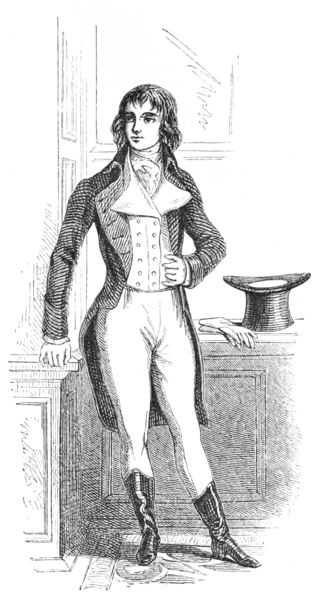
img_3308
Beau Brummell, in Harpers magazine, 1855 – Public domain

In 1799 he came into a small fortune, some £30,000 left to him by his father on his death…. George set himself up in a Mayfair bachelor pad…. With his friendship with the Prince of Wales and influence in fashion style he was at the centre of the most elite of social gatherings….

img_3306
A ball at Almack’s, supposedly 1815. It is thought the gentleman at the forefront on the left hand side is Brummell…. Rees Howell Gronow – Public domain

Being an arbiter of fashion, having influence over the Prince – and any self-respecting gentleman – he shunned the frills and frivolity of the ornate fashions of the time…. He preferred understated but perfect tailoring; dark coats, full length trousers (rather than knee breeches and stockings) and immaculate linen shirts – always with a knotted cravat at his throat…. He claimed it took him five hours to dress – and his boots were polished with Champagne….

When asked how much it cost to keep a single man in clothes he replied ‘it might be done for £800 per year’…. The average wage for a skilled craftsman at that time was £52 per year….

img_3305
1805 caricature of Brummell by Richard Dighton – Public domain

Eventually George’s extravagant lifestyle was to catch-up with him…. He was gambling hard and spending heavily to keep up with his wealthy friends; he could not maintain this way of life…. He also quarrelled with the now Prince Regent Edward – who had distanced himself from his old friends since elevating to this position…. The friendship that had already been strained ceased to be…. George did not drop out of society immediately – but his debts continued to increase and in 1816 he eventually had to flee to France to avoid his creditors….

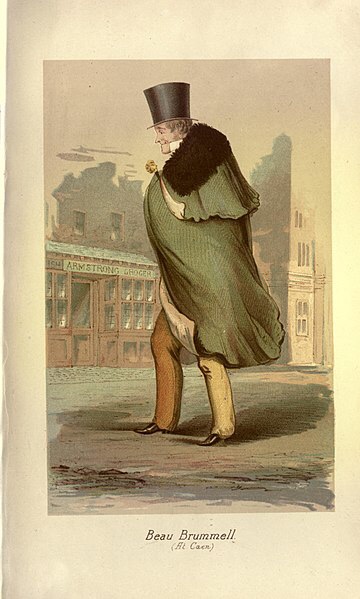
For the next few years he struggled financially…. He spent the first ten years of his self-imposed exile in Calais before securing a position with the Consulate in Caen…. Two years later he made the recommendation to the Foreign Office that the Consulate be abolished – expecting to be offered a better position elsewhere…. However, his plan backfired and once again he was left without an income….

img_3309
Beau Brummell in Caen – Public domain

Having lost his self-respect his interest in his appearance disappeared….he became dirty, scruffy and shabby…. In 1835 he was imprisoned for debt – his Calais creditors having caught-up with him…. Fortunately for him some of his old friends came to his rescue, bailing him out and providing him with a modest income….

But George was beginning to increasingly live in a fantasy world….he was making no sense…. By 1837 he was completely insane and was found a place in the Bon Sauveur Asylum in Caen….where on the 30th of March 1840 he died of syphilis…. He is buried at Cimetiere Protestant in Caen….

img_3307
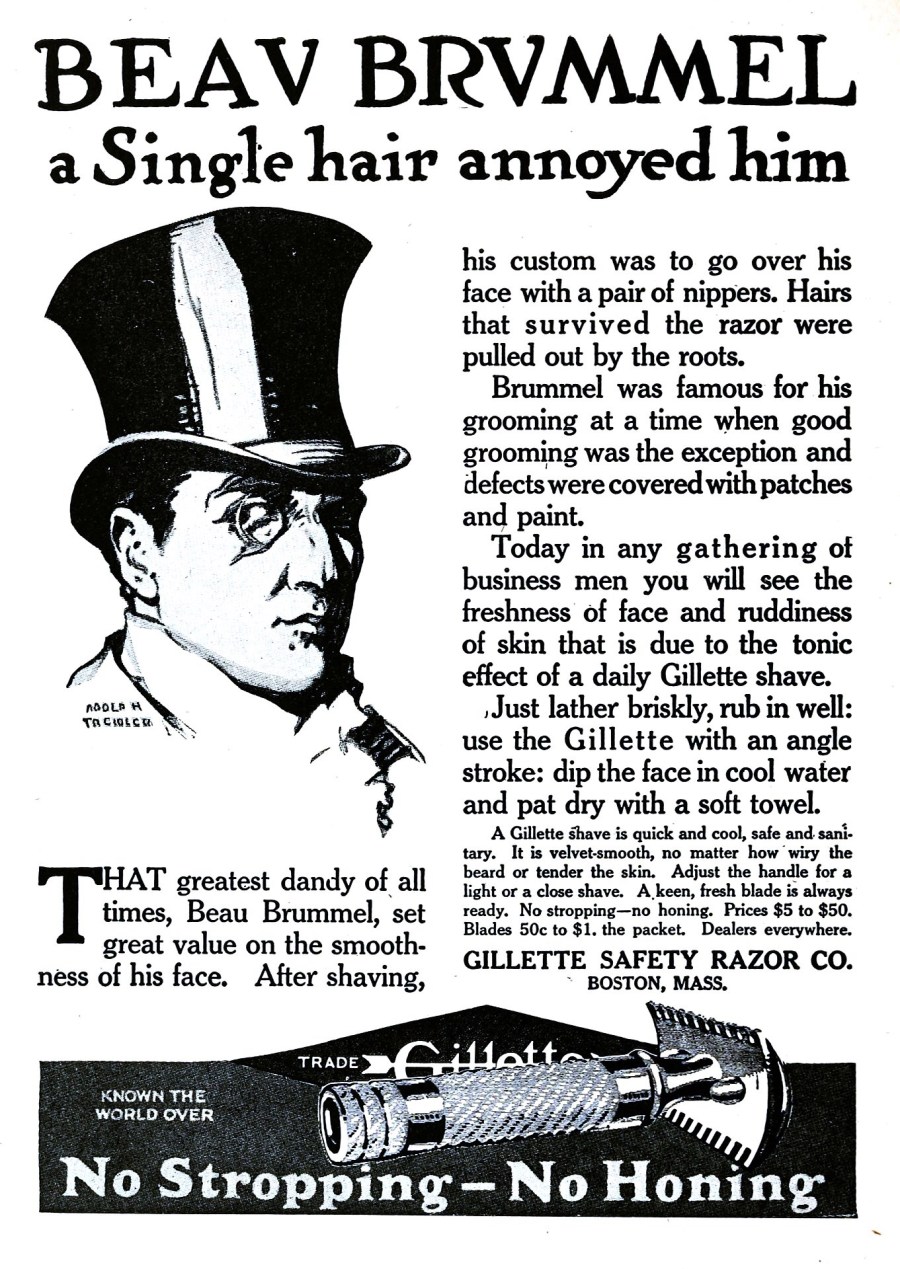
A Gillette advertisment, 1917 – Public domain

On this day in history….6th June 1936

On this day in history : 6th June 1936 – Gatwick Airport, Britain’s second largest international airport and one of the biggest in the World, opens officially for scheduled flights….

img_3303Gatwick had first been established as an aerodrome in the 1920s…. In September 1933 it was bought by Morris Jackaman, who owned several light aircraft…. He purchased the airfield for £13.5K and the Air Ministry approved commercial flights….

Up until this time a converted farmhouse had served as the aerodrome building – but Jackaman planned a purpose-built terminal building…. In October 1934 he submitted plans and a patent for the design – a unique circular building – which became known as ‘The Beehive’…. Construction began in 1935 – the airfield closed briefly to allow for the building work, which was completed in 1936…. The contracted opening date had been for October 1935 but this date was missed due to ongoing drainage issues and to coincide with the timing of a new railway station….

The airport reopened officially in June 1936 – although some services, including flights to Paris, had resumed in the May…. Newly formed British Airways had made Gatwick its operational base in 1935…. Jackaman had floated his Company, Airports Ltd, on the Stock Exchange to raise money for the developments….

During World War 2 Gatwick was requisitioned for military use…. After the War it was decided the site should become London’s second official airport after Heathrow…. The decision was announced in July 1952 and a programme of large scale land acquisition began…. Roads were diverted and a new station and terminal building were built…. The Beehive, no longer part of the main complex, was used for helicopters for a few years afterwards but nowadays the Grade II* listed building is used for offices….

During the 1960s some of Britain’s largest independent airlines, such as British United Airways and Dan Air were based at Gatwick…. The ’70s saw the likes of Caledonian and Laker Airways….

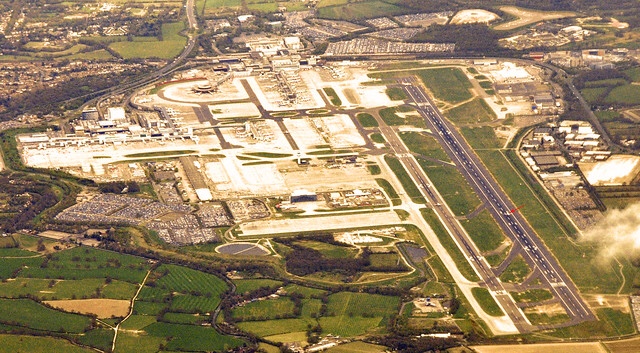
Today the airport runs as a single runway operation, although it does have two and is currently exploring options…. As well as British Airways Gatwick is used by many other airlines including EasyJet, Ryanair and Virgin Atlantic…. It has two terminal buildings and its flight statistics continued to rise year on year….(until the Covid pandemic hit us)…. Recent controversial expansion plans saw a recommendation that Heathrow Airport build a third runway rather than Gatwick – a decision that does not sit well with all….

img_3300
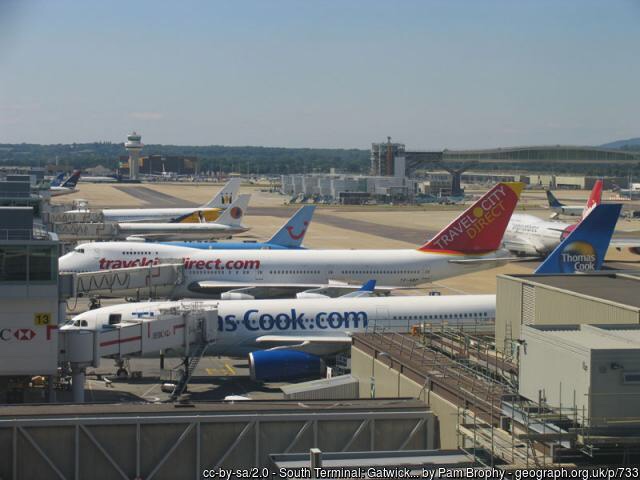
Gatwick Airport – Mike McBey via flickr

On this day in history….5th June 1944

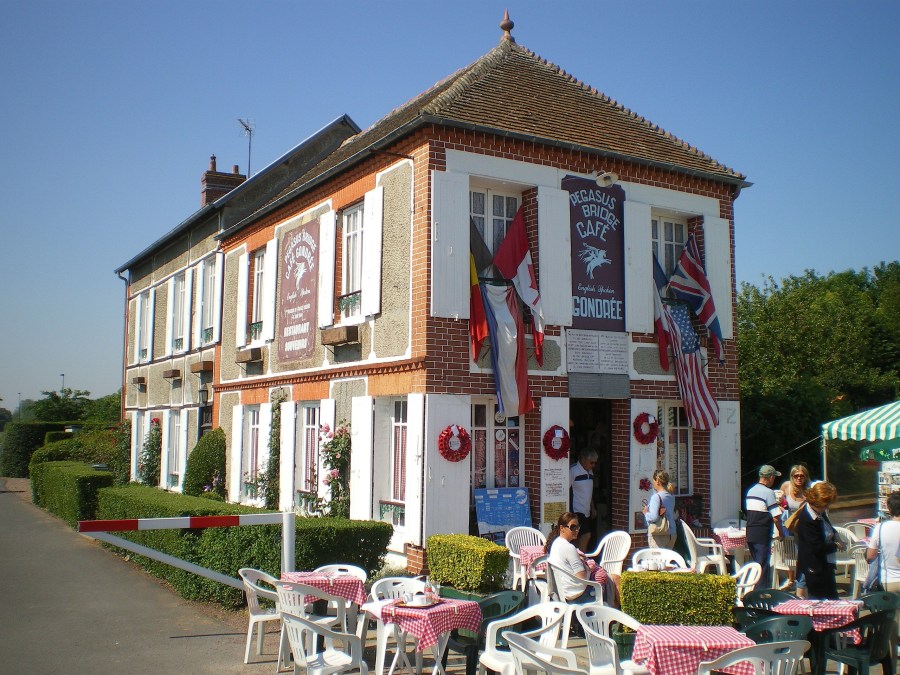
On this day in history : 5th June 1944 – Ahead of the following day’s D-Day landings a small café in Bénouville is the first place to be liberated after British troops seize a vital canal bridge….

Every June 5th since, shortly before midnight – to celebrate the D-Day anniversary – Mme Arlette Gondrée has offered Champagne to everyone present in her café….many of whom have been veterans of the Normandy invasion….

img_3294
Cafe Gondree in 2009 : Runvald – Public domain

The walls of the quaint interior are covered with photographs, old uniforms, helmets and regimental insignia…. Now known as the Pegasus Bridge Café, the two-storey, red brick building was once called ‘The Café Gondrée’….

Georges and Thérèse Gondrée had met in Cannes…. Georges had been a banker, working at Lloyds and so his knowledge of the English language was excellent…. Thérèse being from Alsace was fluent in German…. They married and settled down to run a coffee shop in the Commune of Bénouville in the Normandy region of northwestern France…. Their little café being situated on the West Bank of the Caen canal – at the north end of the Bénouville Bridge (now called Pegasus Bridge)….

However, in 1940 France was invaded by Germany; Georges and Thérèse found life under German occupation intolerable…. They began to support the French Resistance in Caen and passed vital information via the French Underground Movement to British intelligence…. Thérèse did not let the Germans know she could speak their language – she and Georges were able to gather details on the German garrison and the defences of Bénouville Bridge….

On the eve of D-Day three gliders were released from 8,000 up into the pitch-black, stormy night…. Sixty paratroopers, a Glider Unit of the Oxfordshire and Buckinghamshire Light Infantry Regiment, British 6th Airborne Division under the command of Major John Howard, had orders to take and hold the bridge…. Howard had been able to put together a detailed plan with the information received from the Gondrées….

img_3295
Horsa gliders, which had landed a hundred yards from the bridge. The cafe can be seen in the background – Royal Air Force Official Photographer – Public domain

All three gliders managed to land in a nearby field, the rough terrain causing considerable damage to the aircraft…. What followed then was a short but fierce battle in which the British troops managed to take control of the bridge…. It was not without loss of life, several died….the very first casualty of the D-Day operation is buried in the cemetery at nearby Ronville…. The taking of the bridge was a key part of the preparations for D-Day – as it made it extremely difficult for the Germans to launch a counter-attack during the days of the Normandy invasion….

img_3296
The Benouville Bridge, 9 June 1944 – Christie (Sgt) No.5 Army Film & Photographic Unit – Public domain

The Gundrées had been woken in the early hours by the noise of the gliders landing and then the following gunfire…. Georges had looked out of the window to see what was happening and was shot at by a British soldier….he had been mistaken for a German…. Georges and Thérèse quickly bundled their three young daughters into the safety of the cellar and spent the next few hours trying to work out the nationality of the soldiers – as they knew they were not German….

At 6.20am there came a loud knocking on the door….and all was revealed – as there stood three British paratroopers…. Café Gondrée was officially the first French building to be liberated…. Georges responded by digging up 99 bottles of Champagne he had buried in the garden and for the rest of the day gave celebratory drinks to the passing soldiers….

img_3297
Pegasus Cafe as approached from the bridge. Image credit: SIMCard25 at English Wikipedia CC BY-SA-3.0

In later years the café was taken over by Georges and Thérèse’s daughter, Arlette, who had been 5 at the time of the liberation…. It is because of Arlette that the café continues to honour the anniversary of D-Day, with Champagne of course….but I do believe the café serves a very decent cup of tea as well…. Of course, only the British would ensure that the first place to be liberated would be somewhere they could guarantee a great cuppa! The café became an Historic Monument on the 5th of June 1987….

The following video clip shows Mme Arlette Gondrée at the 6th of June 2011 Ceremony