The restoration and living in of an English country cottage
Author: cottagecapers
Hi, I'm Hazel....
I write purely for pleasure; I love to delve in history, customs, traditions and nature....or whatever else grabs my attention at the time....
I am in no way an expert on what I choose to write about - I simply love to find out about things.... Whilst I always endeavour to get the facts right - occasionally I may get things wrong.... I guess you could call this my disclaimer....
I hope you enjoy reading my blog posts.... If so please give me a follow on Twitter or sign up via email for future posts.... If you are on Facebook Cottage Capers has a page with lots of ‘mini blogs’ and snippets.... It’s where we ‘like-minded’ folk can interact.... Hope to meet you again soon....
On this day in history : 17th February 1883 – Mr. A Ashwell of Herne Hill, South London patents the ‘Vacant – Engaged’ lock for lavatory doors….
The story goes that Mr. Ashwell got the inspiration for his ‘Ashwell’s Patent Toilet Lock’ whilst travelling on a train between Herne Hill and London…. What was needed was a bolt that drives a cog-wheel and then turns a disc indicating whether the lavatory is occupied or not…. Come on, admit it ~ far better than having to sing in the loo….
It was in 1892 that John Nevil Maskelyne patented the coin-operated lock for public conveniences…. Maskelyne was actually an English stage magician as well as an inventor…. You could say he ‘coined’ the phrase ‘to spend a penny’….
On this day in history : 16th February 1927 – The birth of actress June Muriel Brown MBE – best known to us as the gossiping, chain-smoking busy-body Dot Cotton in EastEnders….
June Brown MBE in 2009 – image credit: Joe Freeman – Flickr CC BY 2.0
June was born in Needham Market, Suffolk to Louisa Ann and Henry William Melton Brown. She was one of five children but her baby brother died at just 15 days old and she also lost an elder sister….
After attending school in Ipswich June then won a scholarship to Ipswich High School…. She was evacuated to the Welsh village of Pontyates during World War 2 but spent the latter part of it in the Wrens (Royal Navy)….
June was classically trained as an actress at The Old Vic Theatre School in Lambeth…. When she was 23 she married actor John Garley – but tragically he died in 1957 having taken his own life after suffering from depression….
In 1958 June remarried, another actor named Robert Arnold and they had six children (one of whom died in infancy) in their 45-year marriage, before Robert sadly passed away in 2003…. June continued to live in their Surrey home….
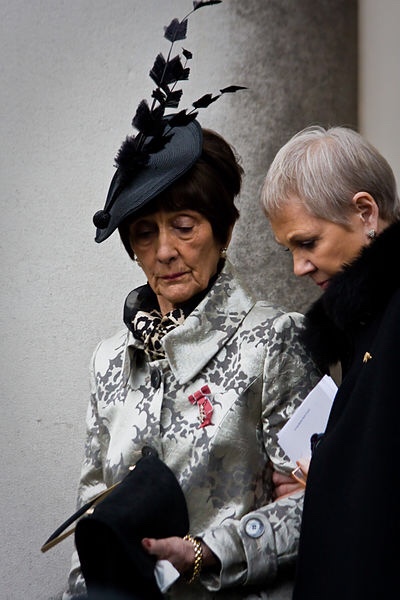
June Brown at the funeral service for actress Wendy Richard. 9th March 2009. Image credit: Gary Knight via Wikimedia
In her varied and extensive career June was seen in many TV shows:- Coronation Street, Angels, Minder, The Bill….the list is endless. She had parts in costume dramas such as The Duchess of Duke Street and Oliver Twist…. She also had roles in several big screen films and was active in British Theatre….
But the role we know June for most of all is that of Dorothy Branning in EastEnders – or as most of us called her….’Dot Cotton’…. The first ever episode of EastEnders was shown on the 19th of February 1985 and June joined the cast in July of the same year – her first screen appearance as Dot being on the 4th of July…. She was recommended to the producers of the show by Leslie Grantham, who played ‘Dirty’ Den Watts….
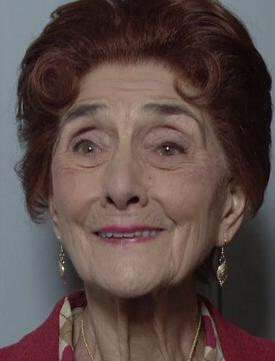
Dot Cotton – Fair use
June won several awards for her role in the soap, among them Lifetime Achievement Award in the 2005 British Soap Awards…. June was awarded an MBE in the 2008 Queen’s Birthday Honours List for her services to drama….
Dot Cotton – “You know me, I’m not one to gossip” – with her sometimes tragic storylines but often comical character was one of our TV favourites….. She was a national treasure, just like the real-life woman who played her….
June passed away on the 3rd of April 2022, aged 95….
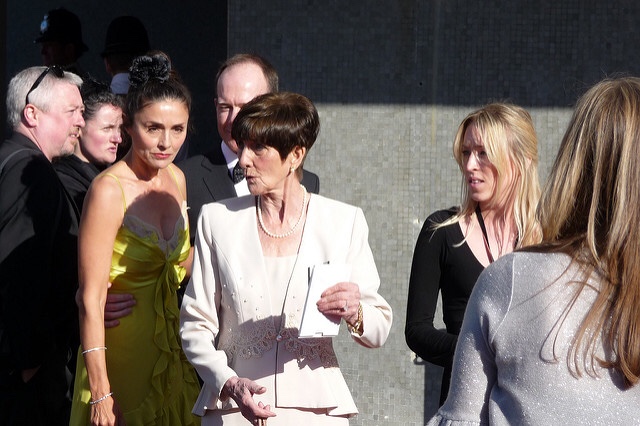
June Brown at the BAFTA’s 2009. Image credit: Damien Everett via Flickr
On this day in history….15th February 1971 – Britain wakes up to ‘D-Day’ and a new currency – over the next 18 months the old pounds, shillings and pennies are to be phased out….
Known as Decimal Day it was the time to say goodbye to the currency system that had been with us for over 1,000 years…. the old system dated back to Roman times when a pound of silver was divided into 240 denarius – which is where we got the old ‘d’ for a penny….
12 pennies to a shilling, 20 shillings to a pound was to be replaced by 100 pennies to a pound instead of the 240 pennies people were used to…. It was to be out with the guineas, crowns, half crowns and threepenny bits….to be superseded by a system inspired by Napoleonic France….
The USA and France had gone decimal in the 1790s…. Britain had considered doing so during the 1820s but had not proceeded…. The closest we got was when a florin worth 2 shillings was introduced in 1849 – 24d or 10 new pence…. It was followed by a double florin in 1887….
In the 1960s a number of commonwealth countries had gone decimal including New Zealand, Australia and South Africa. Although previous British governments had shied away from taking the plunge – because of the amount of disruption it would cause – in the end it took a conversation lasting just 20 seconds, between the then Prime Minister Harold Wilson and Chancellor of the Exchequer Jim Callaghan, to start the ball rolling….
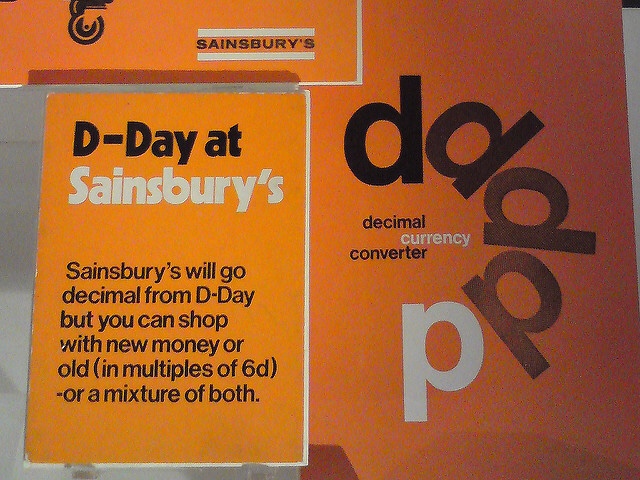
The decision was announced in Parliament in 1966 and a Decimal Currency Board was set up to manage the transition…. The DCB ran a public information campaign – and currency converters were made available to everybody….
From the Sainsbury Archive at the Museum of London, Docklands via Martin Deutsch via Flickr
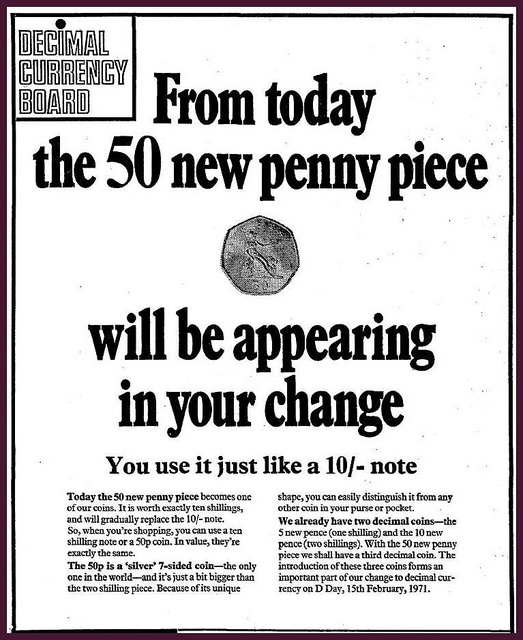
The first coins were introduced in 1968 with the new 5p and 10p pieces, which were the same size and value as the old shilling and two-shilling coins…. As it was engineered to be a gradual change-over a further coin was introduced in 1969 – the 50p – to replace the ten bob (shilling) note….
Ten Bob note – Ian May via Flickr
People referred to it as the ‘ten shilling coin’…. Then on Decimal Day itself, 15th February 1971, the last of the new coins were brought in – the 0.5p, 1p and 2p….
14th October 1969 – New 50p coin. Credit: Bradford Timeline via Flickr
Banks closed for four days beforehand to prepare – and at first prices were shown in shops in both currencies….Some people had feared shopkeepers might use it as a way to increase prices…. The elderly generation especially found it more difficult to adapt….but generally the change-over went without a hitch….
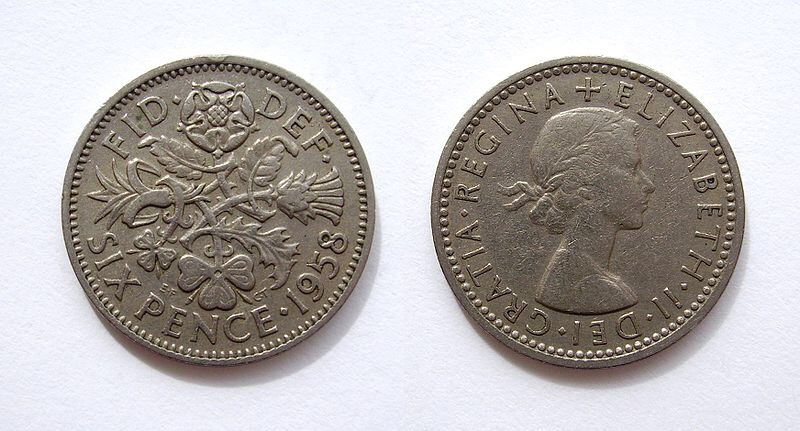
The old penny, half penny and threepenny bit officially went out of circulation in August 1971….but there was one particular coin that stayed with us right up until 1980…. Such affection did the British public have for the sixpence that they campaigned to keep it….as it was deemed as being part of our heritage….
On this day in history : 13th February 1987 – At the height of London’s property boom a converted broom cupboard in Knightsbridge is sold for £36,500….
The tiny flatlet, hardly big enough to fit a fully grown adult measures just 5ft 6in x 11ft….(so that made the price over £600 per square foot)…!
Situated on the 6th floor within a luxury apartment building on the Brompton Road, opposite Harrods, Flat H boasts two rooms…. The main, cleverly designed living area and a lavatory/shower room measuring 2.5 sq ft….
Image: Google maps
Image: Google maps
It was bought by a secretary and when it was sold again in 2006 fetched £120K…. In 2010 it was valued at up to £200K….
With London’s house prices more than 10 times the average salary and rents amongst the highest in the world, property developers think micro-flats ~ at almost half the size of the recommended minimum habitable space ~ could be the answer for young professionals….
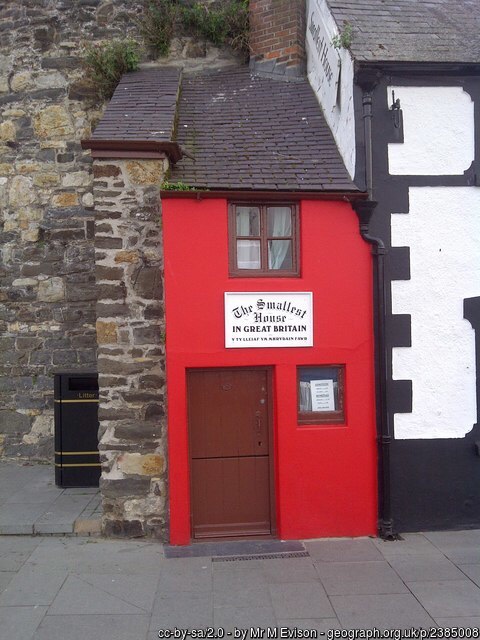
But is this such a new concept? Compare it to Britain’s smallest house….Quay House in Conwy, Wales…. Built in the 16th century this minuscule end of row terrace is just 10ft high and has a floor space of 10ft x 5.9ft….
Nowadays it is a tourist attraction but was lived in up until May 1900 by – wait for it – 6ft 3in fisherman Robert Jones…. Before that it was home to an elderly couple….
The fisherman was forced to move out by the council as the property was deemed unfit for human habitation….although it is still owned by the family…. The authorities intended to demolish the quaint little cottage as they had done to others like it…. However, local people put up a fight and this particular one was saved….
Recognised by the Guinness Book of Records as Britain’s smallest house it can fit only four people in at a time…. Inside is an open fire, a settle, a table and water tap…. A ladder type staircase leads to the tiny bedroom, which is just 6ft x 8ft….
But looking on the bright side….think how quickly you could get the house work done….
On this day in history : 12th February 1932 – Prime Minister Ramsay MacDonald introduces a bill to improve Youth Courts, raising the age of juveniles and banning whipping of under 14s….
Under the reform which came into power in 1933 the age of criminal responsibility was raised to the age of 8 years and the death penalty abolished below the age of 18….
The Children & Young Persons Act also introduced approved schools, for criminal and beyond parental control minors – replacing reformatories, industrial and training schools…. With no locked cells or bars at the windows approved schools were meant to be more like boarding schools…. In 1948 a law was passed that prevented under 17s from being sent to adult prisons….
Discipline in approved schools was strict…. Each establishment was required to keep a punishment book and these were checked by Home Office inspectors on a regular basis…. Punishment books of approved boys’ schools in the 1930s, 40s and 50s show an average of several canings per week…. Corporal punishment was used less in girls’ schools and when it was only the under 15s and across the hands…. Punishment in approved schools did not differ all that much to the discipline meted out in ordinary schools…. However, before the Children & Young Persons Act it was a very different story….
published in The Comic Almanack for 1839 – George Cruickshank – Public domain
From 1847 onwards birching could be ordered by ordinary local magistrates for a variety of offences – but was nearly always for stealing…. By 1879 it had become more regulated….and the punishment was often carried out immediately after sentencing…. The young offender (boys up to the age of 14 – and 16 in Scotland) would be taken to a nearby police station – or sometimes it would be carried out in the court itself – and the beating would be administered by a policeman…. The birch used would be smaller and lighter than those used in prisons….
Committal for birching – A magistrate’s committal for birching two children dated 4 December 1899 – displayed in West Midlands Police Museum, Sparkhill, Birmingham Credit: Oosoom at English Wikipedia
The birch was a bundle of twigs, bound at one end to form a handle – and came in three sizes…. For boys under 10-years-old the birch measured 34 inches long and weighed 6 ounces…. For 10-16 year-olds it was 40 inches long, weighing 9 ounces…. The adult version was 48 inches long with a weight of 12 ounces…. It would be administered to the unclothed buttocks…. In Scotland the tawse would be used instead of the birch – a leather strap with two or three tails….and boys could receive up to 36 strokes….
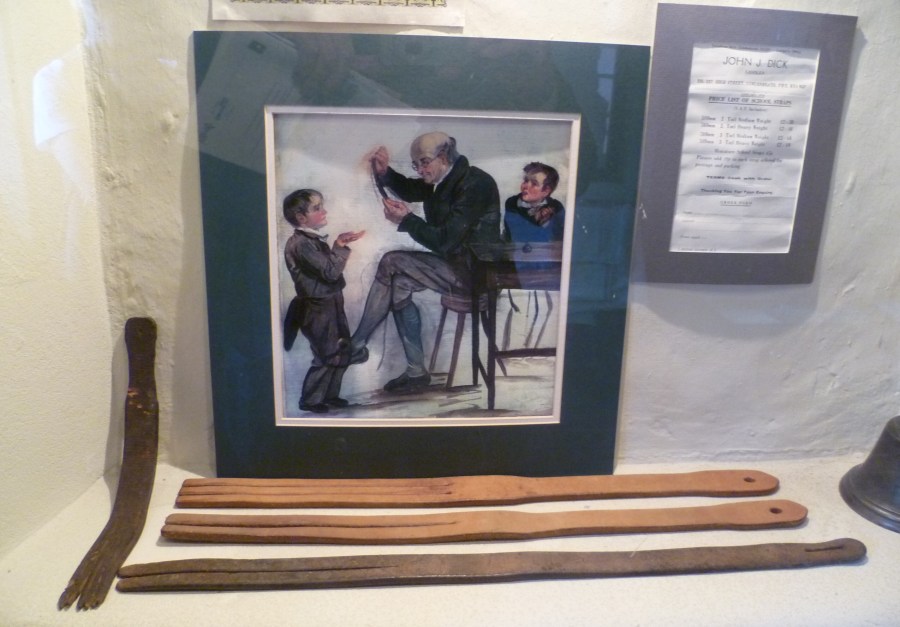
Museum specimens of the tawse. Kim Traynor CC BY-SA 3.0
Corporal punishment for juvenile crime was seen as a better alternative to prison – once the punishment had been carried out the recipient was free to go home having learned a very painful lesson….
From the 1860s only higher courts could order corporal punishment for males over 14-years-old….and had to specify the instrument to be used…. The birch was for offenders of any age but the cat-o’-nine-tails could only be used on those over 16-years of age….and the punishment had to be administered in prison….
The cat-o’-nine-tails had a total weight of 9 ounces and each of the 9 tails was a fine whipcord, each measuring 33 inches long….and the tip bound with silk (not knotted at the end – this is a common myth)…. The tails were attached to a 19″ handle….
Both the birch and cat were issued to prisons by the Home Office and were distributed from Wandsworth Prison….
The cat was applied to the bare upper back…. The birch was rarely used on adults to start with but eventually became more common place than the cat…. Some adults would have preferred the cat given the choice (but doubt if they were) as they felt it less humiliating than having to expose their buttocks….
Cat-o’-nine-tails United Kingdom 1700-1850 Credit: Science Museum London CC BY via Wellcome Collection
The birch and cat-o’-nine-tails were abolished in the UK in 1948 (but were still used in prisons for violent assaults on prison staff until 1967)…. One of the last cases was that of a 23-year-old man who was sentenced at the Old Bailey in 1947 to 6 strokes of the cat and 7 years imprisonment for an armed raid on a public house in South London….
The birch was last used as a punishment for an assault on a prison officer in 1962…. Before that during the 1950s there had been an average of 3 or 4 such punishments per year for similar offences….
The Channel Islands finally banned the birch in the 1960s, with the last case on Jersey being in 1966 and Guernsey in 1968…. It took the Isle of Man until 1976 to abolish it – the last case being that of a 13-year-old boy who stole 10p from another child….
It took state schools until 1986 to ban caning and 1998 in private schools…. Scotland’s schools followed in 2000 and Northern Ireland in 2003….
Digitised by State Library of Queensland – Public domain










 Cottage Capers