Blog

Feathering the nest….

A new year traditionally means a time for new beginnings and the start of 2013 was no exception for a certain swan. Gone were his bachelor days, Floppy now had new responsibilities. In the February, he and Lady started to build their first nest together….

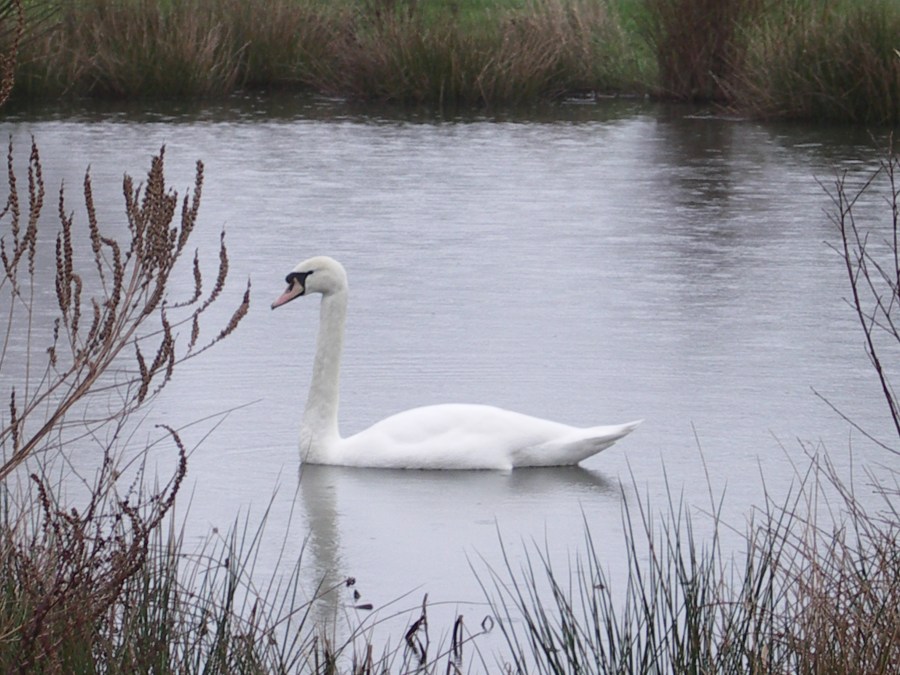
It is the female swan who constructs the nest – a large mound, with a bowl shaped indentation that she forms with her body. The male’s role is to gather and supply the material. Our pair chose the roadside pond as it had a plentiful supply of reeds and bulrushes, ideal nesting material. Swans are unable to carry anything in their beaks for any significant distance, so material has to be close to hand. This first year was very much a new experience for Floppy, he didn’t altogether get the ‘knack’ straight away. He would extend his long neck out, pluck a reed and then stretch back to the pile he was accumulating for Lady….Unfortunately, he hadn’t quite calculated his distances correctly, poor Lady had to keep clambering down off the half constructed nest to retrieve the necessary materials she needed. It was all rather comical for us to watch but thankfully he managed to get the hang of it eventually….

714

Prior to nest building, Lady had become very demanding where food was concerned. Female swans ‘feast’ before sitting on the nest, as during this period they are unlikely to feed properly, or indeed, if at all. Once on the nest, she will lay an egg every other day and a clutch will be anywhere between one and a dozen eggs. She will then sit on these eggs between 32-37 days….

So, for the next few weeks, Lady took up residence on her nest, while Floppy guarded her. Occasionally he would wander down to see us but he took his duty seriously and it was  seldom that he left Lady on her own for long. Her patience was unwavering  but as time wore on, it sadly became apparent that this first year together, parenthood was not to be…. Eventually, Lady abandoned the nest and it was then that we could see it had unfortunately become water-logged….

However, the pair took it all in their stride and spent the Summer enjoying each other’s company and strengthening the bond between them. As time has a habit of flying by so quickly, it seemed like no time at all before nest building activities resumed once again….

This time, they were far more successful. In May 2014, Floppy became a dad for the first time and oh…! What a proud dad he was….

Once again they had nested on the pond by the road. Jordan and I had got into the routine of stopping alongside on our way out on the school run every morning, to see if there were any developments. One day, as we drew up, to our delight, a little grey head popped out of Lady’s feathers….then a tiny cygnet emerged and proceeded to climb up its mother’s back. In what can only be translated as a gesture of annoyance, Lady plucked her errant offspring from her back and deposited it unceremoniously into the nest beside her….

Over the next few days a total of five cygnets appeared. As they grew and developed, it was to be, that there was one particular one that was far more confident and cheeky than its siblings. Jordan and I are convinced that this was the same, very first hatchling, that we had witnessed annoying its mother on that May morning….

Within a couple of days of hatching, Mum and Dad brought their brood down to the pond near us. Cygnets are independent from when just a few hours old, in as far as they can swim and feed themselves. Being a lovely Spring evening, I was outside in the garden, when I noticed the little troop making its way across the grass between the two ponds. Into the water they went, straight across and out the other side…. It then became apparent something very special was about to happen once again….

Obviously, Floppy was eager to show off his new family and he was determinedly leading them towards me. I stood at the gate as they approached and before I knew it, I had five tiny cygnets squirming around my feet, whilst Dad stood proudly looking on. Lady was more hesitant but seemed to accept Floppy’s judgement. It seems this has now become an annual ritual….each year I get a formal introduction to the new brood.

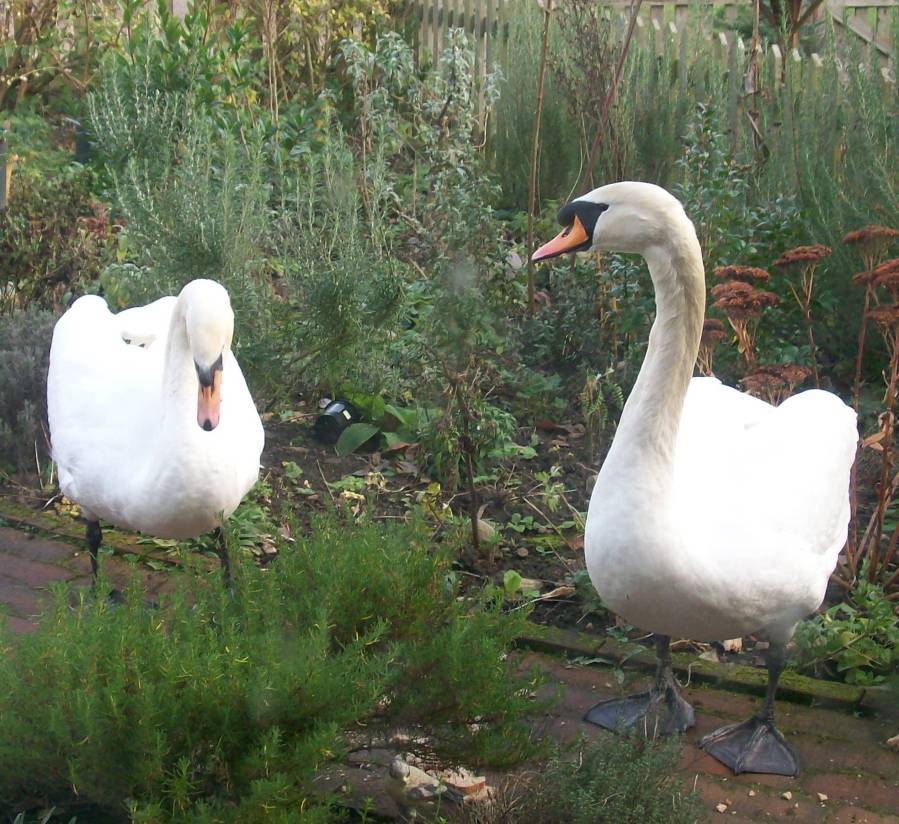
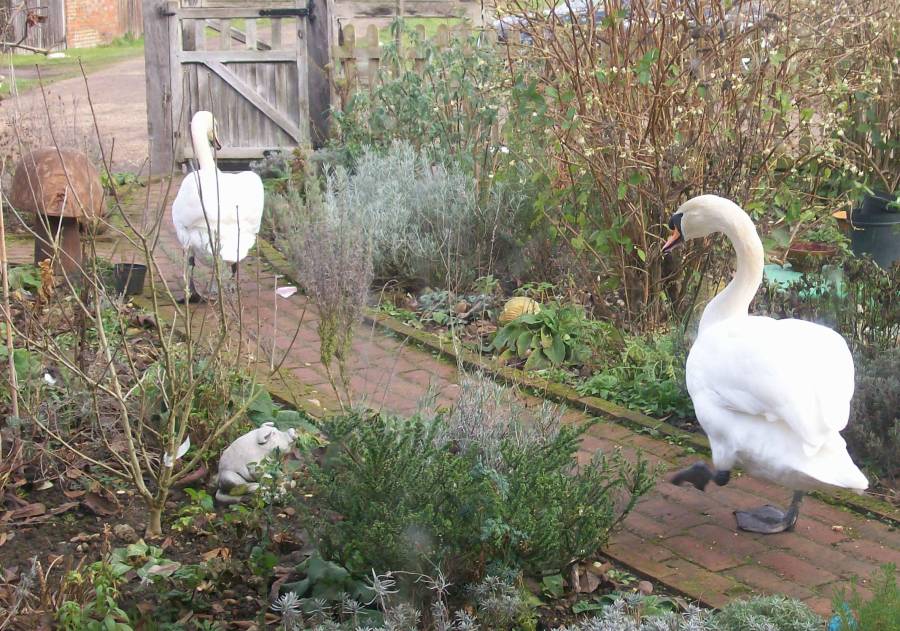
That first year was very much a learning curve for all of us but it soon became evident I was expected to play my role in helping to raise the youngsters. The family took over a patch in the front garden as their designated feeding ground and would appear at regular intervals through out the day. If I was busy and did not notice them straight away, they would just all sit and wait patiently. However, these early good manners did not last long…. Nowadays, if I haven’t responded immediately, one of the adults will come to the back door to fetch me….

These first cygnets stayed with their parents until just after New Year. Mum and Dad did a good job, teaching the youngsters to fly and how to behave like proper, grown-up swans….Witnessing the flying lessons had its entertaining moments but there were also some hair raising ones. Twice, there were incidents involving over head cables, one time the power was knocked out to a number of houses. Thankfully, no swan was hurt on either occasion. Another time, during a trainee ‘fly about’, a cygnet crash landed on the village tennis courts. Being enclosed by a high fence, the youngster was unable to get out. Fortunately, the gate had been left unlocked, so my neighbour and I were able to shepherd the hapless young swan back to the rest of its family….

Eventually, Mum and Dad decided it was time for their now adolescent offspring to leave home and began the task of driving them away. It is quite upsetting to witness this, I should know better but it is hard not to get attached. Nature can seem so cruel, the cygnets couldn’t understand why the adults had turned against them, they were completely bewildered…. Once the feathers become predominantly white, the parents view them as being ready to go out into the big, wide World….their job is done….

Mum and Dad finally succeeded in seeing their first born brood off….not that they went far….just down the road to a pond nearer to the centre of the village. To start with all five stayed together, then one flew off, (the ‘cheeky’ one – I suspect). Then, sadly, it became evident that one of them had sustained an injury. The RSPCA had to be called out but unfortunately, nothing could be done, the cygnet was suffering too much. Nobody knows what had happened to it, whether it was a fox or dog attack or if it had been injured in some other way….

That left three, who remained together until eventually taking off for pastures new. Usually, young swans will leave the breeding territory and fly until they encounter a new group of swans they can join. If the parents are solitary, as are our two, then the cygnets are very much on their own at this point. If the adults over winter in a colony, then their young will often fly with them to join the larger group. Generally speaking, swans pair up in the first two years of their lives….

Over the following few weeks after their departure, there were several reported sightings of three swans together on various local ponds. I would like to think this particular trio successfully made it through to adulthood….

Meanwhile, Mum and Dad were busy concentrating on making preparations for the next brood….

p1000426

Scottish Oatcakes….

With Hogmanay coming up, what better way to enjoy a little taste of Scottish fayre than with traditional oatcakes and a large chunk of your favourite cheese….?

Bake these golden oaty biscuits in just a few minutes….

Once traditionally eaten with every meal in Scotland, they make a great alternative to bread….


Ingredients

  • 250 g / 8 oz oat meal
  • 25 g / 1 oz melted butter
  • 1/2 teaspoon bicarbonate of soda
  • pinch of salt
  • 150 ml hot water (from a recently boiled kettle)


Method

Pre heat your oven to 180 degrees C

Place oat meal in a large mixing bowl along with the bicarbonate of soda and pinch of salt

Gradually add the melted butter and hot water, mixing with a wooden spoon, to form a paste

Dust your hands with a little flour and form the paste into a soft dough

Sprinkle your work surface with oats and a little extra flour

Roll out the dough to approximately 1/2 cm thick and use a cookie cutter to cut the rounds. The amount of oatcakes obtained will depend on the size of the cutter

Place on a baking sheet – a good tip is to line with baking parchment

Bake for approximately 20 minutes or until a light golden brown

Remove from oven and allow to cool slightly before transferring to a wire rack to finish cooling completely

Enjoy !


Will keep in an air tight container for a few days

New year, new beginnings, old traditions….

new-years-eve-4

As the New Year approaches, I find myself wondering about some of the traditional customs we associate with it, here in the British Isles and how they vary from region to region….

New Year is one of our oldest holidays, although the exact date of the festivities has changed over the times. Its origins can be traced back thousands of years to Ancient Babylon, when, starting on the first day of Spring, (which was determined by the cycle of the Sun and Moon), an eleven day long festival was held. These early, mostly Pagan, celebrations were in honour of the Earth’s cycles….

January the 1st became the common day for celebrating New Year with the introduction of the Julian Calendar, implemented by Julius Ceasar….

The Julian Calendar has its flaws, namely that it does not accurately record the actual time it takes for the Earth to circle once around the Sun (tropical year). It is because of this, that in 1582 the Gregorian Calendar was first introduced. Also known as the Western or Christian Calendar, it is the most commonly used one in the World today. It is named after its founder, Pope Gregory XIII but it was not adopted by the whole World immediately. In fact, it took over 300 years for it to become used to the extent it is today. France, Italy and Spain were amongst the first to employ it, the United Kingdom, United States and Canada did not start using it until 1752. Turkey was the last and it wasn’t until 1927 that they followed suit….

After the fall of the Roman Empire the date for New Year changed in Britain to March the 25th. It wasn’t until the adoption of the Gregorian Calendar that January 1st became the official day once again. It took until 1974 for it to become a public bank holiday….

There have always been superstitions associated with New Year, evolving in their own particular ways, from one part of the country to another. Most of them relate to luck and new beginnings….

Making New Year’s resolutions goes back to ancient times. Other customs and beliefs have come to us along the way…. Some are more general, such as opening the door at midnight to let the old year out and the new one in….

‘First Footing’ is also a widely observed custom but one that has its variations depending on its whereabouts in the country. Most commonly though, it is believed that the first person to cross the threshold after midnight, should have dark hair, to bring good luck. Ideally, they should bring coal, to symbolise warmth for the coming year, bread to represent food and salt for money – (hence the saying “worth his salt”). Many believe that if a blonde person were to be the first, ill luck would be forth coming. Many Scottish people believe the First Footer should be a stranger. In Wales, where it is known as ‘Nos Galan’, it is considered that if the first visitor is a woman and the door is opened by a man, this will bring bad luck. The Welsh also believe that bad luck will also be brought if the First Footer is a red head. Another belief is that all debt must be paid by the end of the year. To start a new year owing, would mean a whole year will be spent in debt….

Another popular superstition was – ‘the cream of the well’. It was believed that if a woman washed in the first water drawn from the well on New Year’s Day, she would become beautiful….

Some traditions are very regional. In Yorkshire, just before midnight, people say “black rabbits, black rabbits, black rabbits”. Then immediately after the clock has struck, “white rabbits, white rabbits, white rabbits”. By saying these words, good luck is ensured for the coming year. This is where the saying “white rabbit” comes from, said by so many of us on the first day of every month….

Herefordshire once had an old tradition of ‘burning a bush’. A young farmer, rising before day break, would cut down a hawthorn bush and set fire to it, to guarantee a good harvest later in the coming year….

Fire seems to feature in many of our New Year’s customs and beliefs. Northumberland for instance, has the Allendale Tar Barrel Festival. On the 31st of December, whisky barrels are filled with kindling, sawdust and burning tar, they are then paraded through the streets, on the heads of barrel carriers, called ‘Guisers’….

In Perthshire, the town of Comrie has its Flambeaux Procession. Eight, flaming torches are carried through the town and then are flung from a bridge into the River Earn, this is meant to cast out any evil spirits….

Stonehaven, near Aberdeen, has a Fireball and Chain Festival. Sixty, kilt clad marchers, swing about their heads, sixteen pound balls of fire attached to wire ropes, whilst parading through the streets accompanied by pipes and drums….

The Welsh people have their own gift giving tradition of ‘Calennig’. Some think this custom goes back to Pagan times. The name ‘Calennig’ is thought to come from the Latin ‘calends’ or ‘kalends’ – meaning first day of the month, which is also where we get the word ‘calendar’ from. A Calennig is a small decoration made from an apple, (or perhaps, nowadays, an orange), which has been studded with cloves and supported on three twigs. A sprig of box foliage is then inserted into the top of the fruit. It is meant as a token to ensure a future good harvest and is either displayed in the house or given as a traditional New Year’s gift….

Welsh children often get up early on New Year’s Day, (Dydd Calan), in order to go and sing songs to their neighbours, perhaps taking calennig decorations as gifts. In return, they receive sweets and money….

Another Welsh tradition, especially in South Wales, first recorded in 1800 and known as ‘Mari Lwyd’ (Venerable Mary), was not always so welcome! The skull of a horse, decorated with colourful streamers, would be carried on a pole and made so that the jaws could be snapped open and shut. The bearer would be covered in a white sheet, draped from the skull. Then, accompanied by a group of men, the ‘horse’ would go from house to house. The home owners would be challenged to a contest in song and rhyme, each taking a turn to banter in a more and more humorous and witty way as the contest progressed. The idea was for the group to be invited into the house to partake in ‘merriment’, in the form of food and drink. Obviously, having a group of boisterous, probably drunk, rabble of men, turn up on the doorstep, late at night, wielding a horse’s skull and expecting fun and banter….did not appeal to all! So, this custom began to decline at the beginning of the 20th Century. It was also discouraged by some of the Christian clergy, who frowned upon its Pagan origins….

Then, of course, we come to Scotland’s Hogmanay – the Scots word for the last day of the year. The exact origins of the name are unknown, the earliest references come from the 1600’s, with many spellings, such as ‘hagmane’, ‘hog ma nae’ and ‘hagmonay’….

Christmas, as we know it, was not celebrated as a festival in Scotland. In fact, from the end of the 17th Century, right up to the 1950’s, it was more or less banned…. Most Scottish people had to work over the Christmas period and instead celebrated the Winter Solstice holiday of New Year. The reason being, the Kirk (Church) viewed Christmas as a Catholic feast and as the Scottish Church had its roots in the Protestant Reformation, the festivities had to be banned….

‘Hand Selling’ was once the Scottish custom of giving gifts, it would happen on the first Monday of the year but this has now died out. Instead, New Year became the time for Scots to gather, exchange gifts, feast and hold celebrations. An important part of the festivities was (and indeed still is today), to welcome both friends and strangers into the home, to enjoy warmth and hospitality….

Hundreds of years ago, Pagan festivities would include lighting bonfires and rolling tar barrels, that had been set ablaze, down hillsides. These traditions are reflected in the magnificent firework displays and torch light processions, held every year, in Edinburgh and many other Scottish cities. Even more Pagan was the act of wrapping animal hide around a stick and setting it alight. The smoke was believed to ward off evil spirits, the smoking stick was known as a ‘Hogmanay’. Other customs would involve people dressing up in cowhides and running around the village whilst being beaten with sticks! Some of the more rural, remote communities, especially the Highlands and Islands, still continue a form of these old traditions today. For example, in the Outer Hebrides, on the Isle of Lewis, young boys divide into groups, the leader dresses in a sheepskin and they move from house to house, with a sack in which they collect a type of fruit bun, called a bannock….

In other parts of Scotland, it is traditional to give children a Hogmanay Oatcake on New Year’s Eve – this represents the time when they would of gone from door to door asking for oatcakes and bread….

“Get up, goodwife, and shake your feathers,
And dinna think that we are beggars;
For we are bairns come out to play,
Get up and gie’s our Hogmanay!”

One of the oldest traditions (and one shared by many cultures), is the cleaning of the house until it is spotless, on New Year’s Eve, making sure every task is finished. Symbols for what is desired for the coming year may be left out, such as food, so there will be plenty to come, coins for wealth and dolls, for the hope of being surrounded by family. Many Scots fast, or perhaps just have a very small breakfast, on New Year’s Eve. Then, once the magical hour of midnight arrives, all the windows and doors of the house are flung open to welcome in the New Year and to let out the old. Then a huge feast is partaken of….but not of course until the traditional “Auld Lang Syne” has been sung….

Nowadays, Auld Lang Syne has been adopted as the official New Year’s song, by just about every English speaking nation of the World….

It was in 1788, that Robert Burns first recorded the lyrics on paper and sent them to the Scots Musical Museum. He had based his famous poem on an earlier song, printed by James Watson in 1711. There is doubt as to whether the tune we all know and sing the words to, is actually the melody Burns intended….

Roughly translated, “Auld Lang Syne” means “for old times sake”. It is about looking back over the previous year and preserving friendships….


“Should auld acquaintance be forgot
And never brought to mind?
Should old acquaintance be forgot
And auld lang syne


For auld lang syne, my jo
For auld lang syne,
We’ll tak a cup o’ kindness yet,
For auld lang syne….

On that note….it just remains for me to wish you, in whatever way you choose to celebrate it – A very happy and prosperous New Year!


                                                                                   new-years-day-6               


All’s fair in love and war….

Generally, swans mate for life. However, this is not always the case….

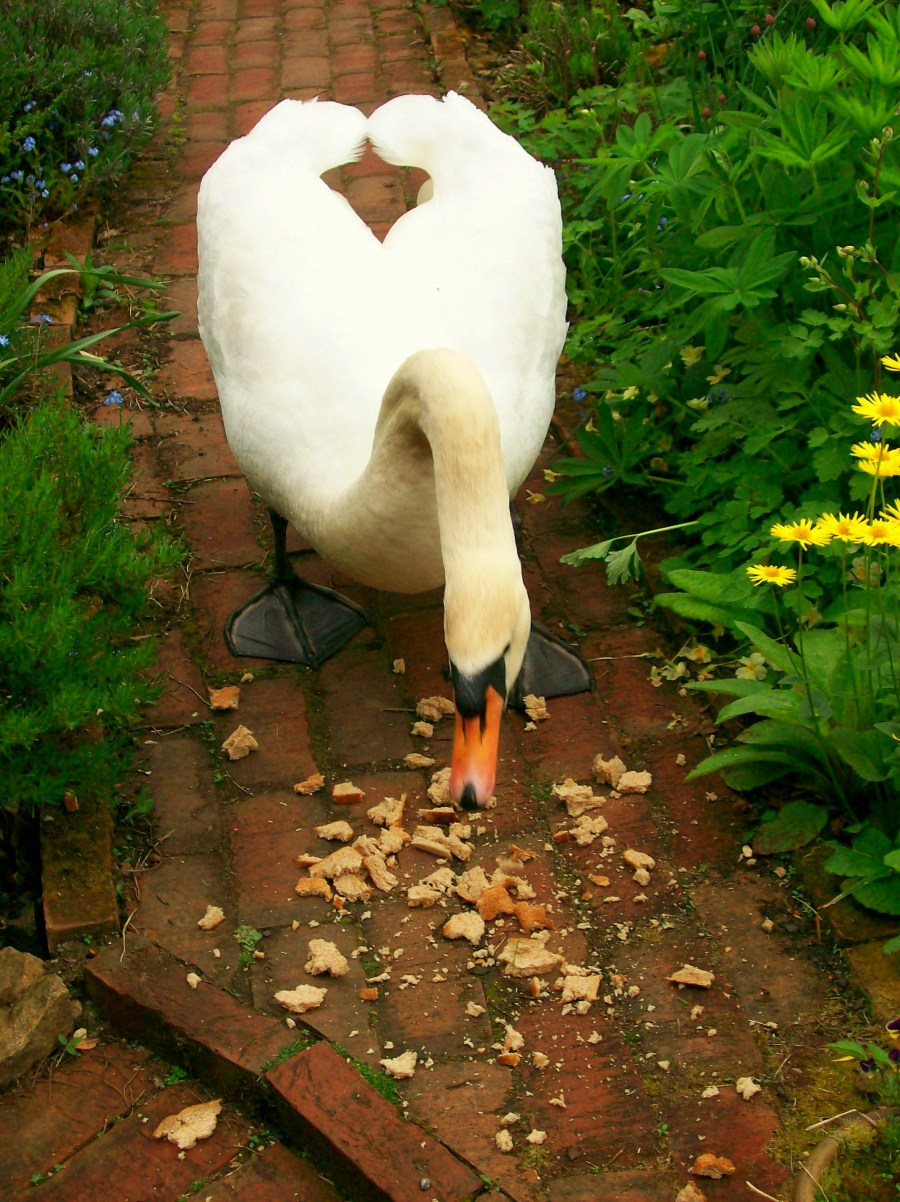
Floppy, as we had now taken to calling him – (Penelope no longer seemed appropriate, for obvious reasons) – settled down and seemed to become resigned to being alone. I carried on making sure he was well fed….a diet of mixed corn and wholemeal bread….he grew into a magnificent specimen….

244

He became a regular companion  when we worked in the garden. If I was indoors, I would often spy him through the window, waiting patiently for food, at the top of the steps by the back door….

001

Then, one summer’s day in 2011, another pair of mute swans arrived on the scene. For a couple of weeks, chaos reigned. Floppy was extremely interested in making friends with the female but her mate was having none of it. The two males fought constantly, it was quite distressing to witness….

It soon became obvious the intention of the new comers was to oust Floppy from his home, they wanted his territory for themselves. So, collectively, the residents of the Corner began to actively discourage them. Not cruelly, of course, just plenty of loud hand clapping and a little bit of chasing, enough to show them they were unwanted. Fortunately, they soon got the message and departed…. and our boy was able to claim his home back….

Evidently though, Floppy had made an impression on a certain lady swan. It was the Autumn of 2012 and he had gone off on one of his ‘jaunts’, as he still did from time to time – (I no longer worried as he always returned eventually). One Sunday morning, I was doing a spot of clearing up in the front garden, when my neighbour stopped on his way past the gate. He had just walked across the Common and he remarked that “all hell was breaking loose in the village”. Apparently, three swans were fighting in the middle of the main road…. Naturally, I was concerned but I didn’t have to be for long….

It was about half an hour later when I saw two swans determinedly making their way across the Common in our direction. As they approached, I recognised the one in the lead as Floppy and he was making a ‘bee line’ for the garden gate. What happened next I can only describe as an honour…. He brought his new lady friend directly to me, in order for us to meet….I am sure she was from the same pair that had landed here the previous year. I later learned that the other swan had flown off, accompanied by a cygnet…. Floppy had won the contest and procured himself a wife. I couldn’t help but feel a little sorry for the other male and I had to raise an eyebrow at the morals of this new spouse of Floppy’s…. So much for swans mating for life….

This new female became known to us as ‘Lady’…. although I’m not quite sure if she actually deserved that name, as by deserting her original family she had hardly behaved like one…. However, she has obviously found happiness with Floppy as they have been inseparable ever since….

p1000060

Pond life….

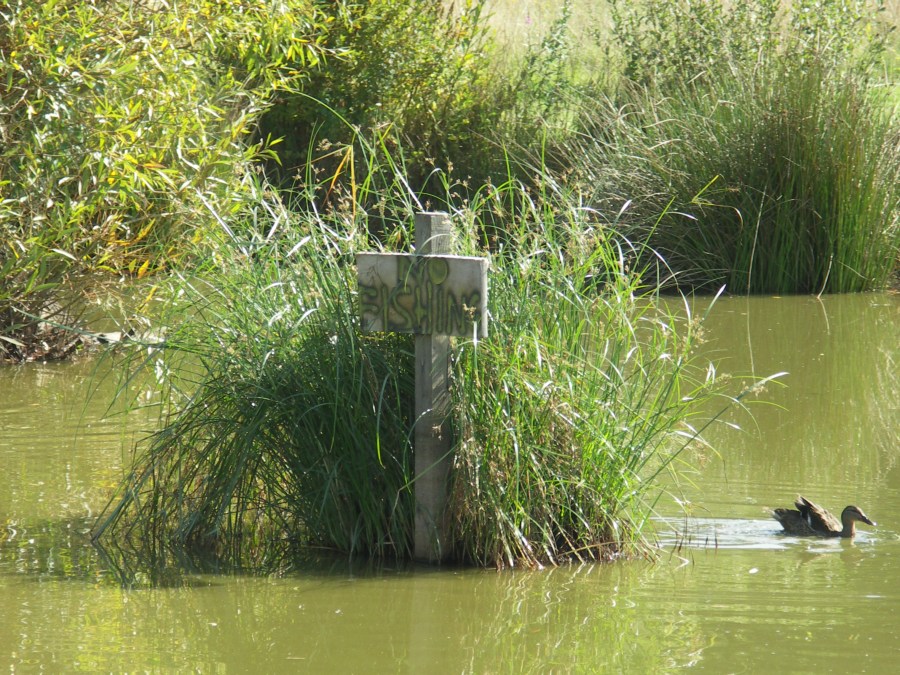
In the early days of our living at No.3, the nearby pond, a part from the odd coot or moorhen, was pretty much devoid of birdlife. All that was to change in the Autumn of 2006, with the arrival of two mute swans….

Being an animal lover, I couldn’t resist feeding them. It didn’t take long for them to realise they were on to a good thing. Not being content for me to decide when it was meal time, they would come and find me when they were hungry.

1190

Naturally, they acquired names, “Cobblers” and “Penelope” – a play on the terms for a male and female swan (cob and pen) – cheesy, I know….

Not knowing an awful lot about swans at that time, we assumed we knew which was which of the pair…. One had a much darker orange beak than the other and the ‘knob’ located at the top of the beak, was far more prominent. So this was obviously the male….

“Cobblers” was ringed. He had a certain gentleness to his nature, willingly accepted food from the hand and seemed used to people. “Penelope”, on the other hand, was not ringed and much wilder….

The pair would divide their time between the nearby pond and the one a little further up, by the main road. They seemed quite content with their lot….

369
“Come on dear, it’s time we were going…”


Then, a few months later – the unspeakable happened…. The two of them had chosen to spend the night on the roadside pond – during the early hours, “Cobblers” was shot dead. As it is a criminal offence to harm, let alone kill a swan, the police attempted to find out who was responsible for such a despicable act but sadly to no avail….

A post mortem was carried out by a local vet and from this, through his ring, it was discovered that “Cobblers” originated from Hampton Court…. He had indeed been,  a very Royal swan….

“Penelope” was understandably very subdued after losing her companion, swans grieve, just as we do. I carried on with the feeding but a few weeks later, she disappeared and I thought that was that. Imagine my delight, when a couple of months later, I glanced out of the window and saw a swan on the pond. I grabbed some bread and rushed out….

KONICA MINOLTA DIGITAL CAMERA

I know this might sound daft….but something ‘clicked’ with that bird in that instance. “Penelope” made eye contact and held my stare…. It was a surreal moment, one I will never forget – I felt as if I was being ‘read’. A bond was formed, one that holds fast to this day….

A few weeks later, she disappeared again, once more to return a while later. This became the pattern for the next year or so….

Over that time, “Penelope” underwent some changes. She appeared to get bigger, her neck thickened, her beak became darker and the caruncle (the correct term for the knob on the beak) increased in size. You have probably guessed where this is going by now…. “Penelope” was in fact a male….!!

1145

On his original arrival in 2006, he had obviously been a juvenile. Cygnets take up to a year to loose their brown feathers and become white. They are not ready to breed until they are about four years old. Whether “Cobblers” had actually been male or female, I don’t know….possibly the pair had been parent and son….

Luckily, “Penelope” seemed completely unconcerned by the mistaken identity….

KONICA MINOLTA DIGITAL CAMERA