On this day in history….19th April 1989

On this day in history : 19th April 1989 – The death, in Cornwall, of English author and playwright Dame Daphne du Maurier – perhaps best known for her novels ‘Jamaica Inn’ and ‘Rebecca’….

Daphne du Maurier, Schiphol 1947 – Image credit : Ben van Meerendonk / AHF, collectie IISG, Amsterdam.

Daphne was born in London on the 13th of May 1907, into an artistic family…. Both of her parents were actors, her father being Sir Gerald du Maurier, the actor and manager…. She was educated at home by a governess, along with her two sisters – the eldest of which also became a writer and her younger sister, an artist….

The girls were brought up in a social household, where influential friends such as Edgar Wallace and J.M. Barrie would often visit…. The sisters were cousins of the Llewelyn-Davies boys, on whom Barry drew the inspiration for Peter Pan from….

Daphne, an avid reader from an early age, began to write in her teens…. Her love affair with Cornwall no doubt began in childhood, as the du Mauriers would often holiday there as a family…. There were indications that whilst growing up she was confused about her own sexuality – and it has been suggested since her death that she may have been bi-sexual…. In her own memoirs she talks of her father’s desire for a son – Daphne was always a bit of a tomboy and had said that she wished she had been born a boy…. There are those who take these notions even further to claim she had an incestuous relationship with her father and that he was an abusive alcoholic….

Daphne du Maurier circa 1930 – No copyright restrictions

Her first novel ‘The Loving Spirit’ was published in 1931…. She is often categorised as a romantic novelist – a label she despised…. Indeed her work is often moody, deep, dark, full of suspense and sometimes even includes the supernatural…. ‘Jamaica Inn’ was published in 1936 and ‘Rebecca’, perhaps her most successful novel, was published in 1938 – and was an instant best-seller…. Between 1938-1965 it sold some three million copies and has never been out of print…. Her other notable works include ‘Frenchman’s Creek’ (1941), ‘Hungry Hill’ (1943), ‘The King’s General’ (1946), ‘My Cousin Rachel’ (1951), ‘The Scapegoat’ (1957) and ‘The House on the Strand’ (1969)…. Several of her books have been adapted for stage or screen – or indeed even both…. Alfred Hitchcock’s 1939 production of ‘Jamaica Inn’ gave actress Maureen O’Hara her first major screen role, whereas his 1940 adaptation of ‘Rebecca’ was his first American film…. His 1963 film ‘The Birds’ was adapted from one of Daphne’s short stories of the same name…. She was also to write three plays….

Reconstruction of Daphne du Maurier’s study at the Smugglers Museum, Jamaica Inn, Cornwall – Image : Martinvl – own work – CC BY-SA 4.0

In 1932 Daphne married Frederick Browning, a senior British Army Officer, often referred to as the ‘Father of the British Airborne Forces’…. With the marriage came the title ‘Lady Browning’ – but Daphne continued to write under the name du Maurier….

Sir Frederick Browning, October 1942 – From the collections of the Imperial War Mueseums

The story goes that Browning had read Daphne’s ‘The Loving Spirit’ – and so impressed was he by her description of the Cornish coast that he had to see it for himself – which he did so, by visiting it onboard his boat…. He decided to leave his boat moored in Cornwall over winter and returned in April 1932 to collect it…. On hearing that Daphne was in Cornwall, convalescing from an appendix operation, he invited her out for a day’s sailing…. What followed was a whirlwind romance and he proposed….only for Daphne to decline- as she did not particularly believe in marriage…. However, it appears she was quite happy for them to cohabit – until it was pointed out to her by Browning’s friend and fellow senior officer, Eric Dorman-Smith, that simply living together would be disastrous for his career…. So Daphne then proposed to Browning – and the couple were married at the Church of St. Willow, Lanteglos-by-Fowey, South Cornwall on the 19th of July 1932…. They were to have three children – two daughters, Tessa and Flavia and a son, Christian, who was known as Kits…. It was sometimes a difficult marriage – Daphne had a tendency to distance herself from her family, especially when she was immersed in her writing….

Daphne du Maurier – Image credit : gnovi via Flickr

Browning died in 1965 of a heart attack – and Daphne moved to Par in Cornwall…. She was awarded Order of the British Empire as Dame Commander in 1969…. She passed away at the age of 81 at her Cornish home…. Her cremated ashes were scattered off the cliffs of Cornwall….

On this day in history….18th April 1930

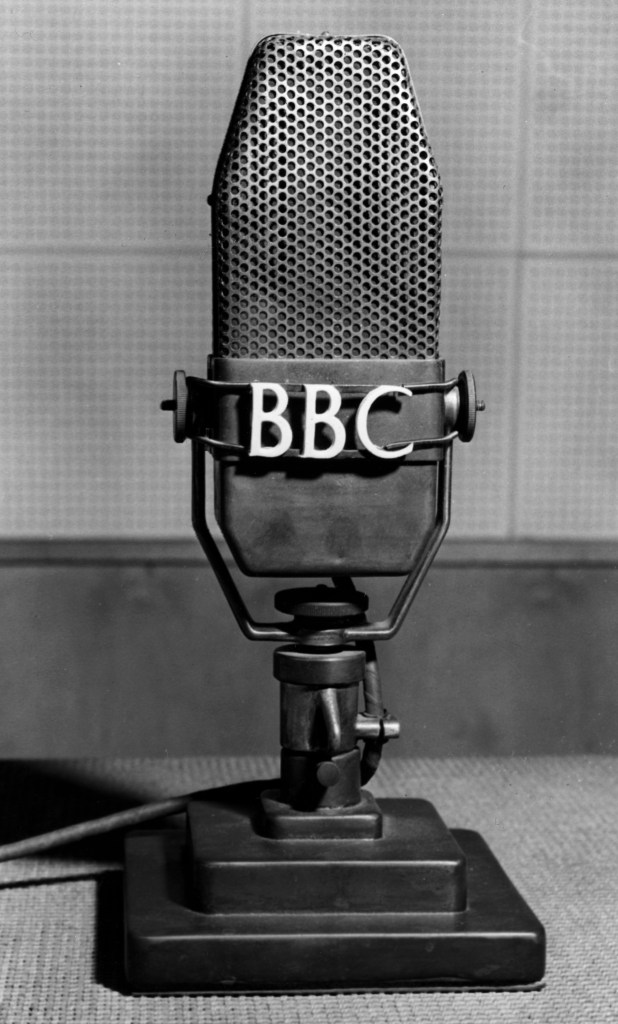
On this day in history : 18th April 1930 – During the evening’s regular scheduled news bulletin the BBC announces “There is no news!”….

Image : Pinterest

It seems ridiculous, doesn’t it? How could there be no news? But it appears the BBC had decided that there was nothing worth reporting on that day…. At 8.45pm, as families all over Britain settled down and tuned in their radios to hear the evening news, they were greeted with….

“Good evening. Today is Good Friday. There is no news….”

National Science and Media Museum via Flickr

Instead the fifteen minute programme was filled with Wagner’s opera Parsifal, performed on piano from the Queen’s Hall, London….

It is impossible to imagine that happening today….

On this day in history….17th April 1951

On this day in history : 17th April 1951 – British submarine, ‘The Affray’, goes missing off the south coast of England…. It is feared all 75 crew members onboard are dead….

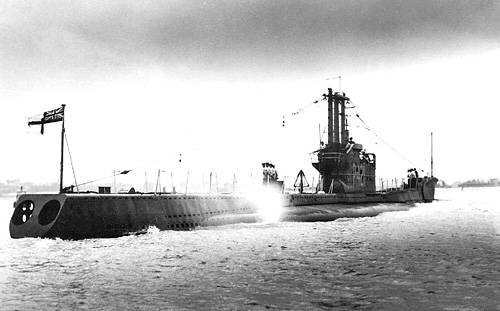
HMS Affray – Royal Navy photos – Public domain

The Amphion-class submarine belonged to the 5th Submarine Flotilla and had been commissioned on the 25th of November 1945…. She had left Portsmouth at around 4pm on the 16th of April 1951 on her way to a simulated war mission exercise – ‘Spring Train’…. Onboard was a reduced crew of 50 – as opposed to the usual 61 – but she also carried 25 naval officers undergoing training….

The Affray had submerged at 9.15pm around 30 miles south of the Isle of Wight – the last sighting of her had been by the destroyer HMS Contest, which was returning to Portsmouth…. The submarine was due to resurface at 8.30am on the 17th of April – but failed to appear….her position was unknown….

Crew of HMS Affray – Lieutenant John Blackburn (far right) was in command at the time of the disaster – Fair use

A large search party, led by HMS Agincourt and comprising of 24 ships and submarines from Britain, France, Belgium and the United States set out….accompanied by as many aircraft as could be mustered up…. It was thought the crew onboard the Affray could survive up to three days…. At one point in the search two of the searching ships received a morse code signal, reading ‘We are trapped on the bottom’ – but it gave no help in locating them…. After three days the search was scaled down….

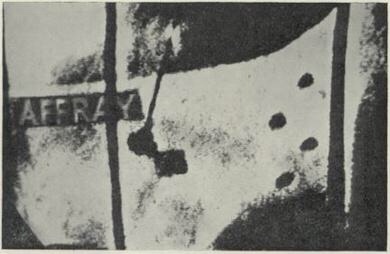
The Affray was eventually found two months later, 46 miles south of Portland, in 300ft of water – making it impossible to recover, due to the depth…. Remote control cameras were used during an investigation that was to last for three months…. One theory was that the submarine’s battery had exploded…. But the main conclusion was that the ‘snort mast’ (the tube allowing the Diesel engine to ‘breathe’) had snapped – allowing water to flood in….

Wreck of the Affray, as taken by remote control camera – Fair use

It was to be the worst British submarine disaster since World War 2….

A strange event occurred shortly after the time of the incident…. The wife of the captain of one of the Affray’s sister submarines experienced a visit from a ghost…. Dressed in dripping wet submarine officer’s uniform, she recognised him as an officer who had been killed during WW2 – and not from the crew of the Affray…. He told her the location of the missing submarine – and when it was eventually found – the location proved to be correct….

On this day in history….16th April 1965

On this day in history : 16th April 1965 – The death of actor and comedian Sydney Chaplin – who died on the birthday of his younger half-brother, Charlie Chaplin….

Promotional picture of Sydney Chaplin – Public domain

Sydney was born on the 16th of March 1885 in London…. His mother was 19-year-old Hannah Hill, a music hall entertainer…. She claimed his father to be Sydney Hawkes – but this was never to be confirmed…. A year later Hannah married Charles Chaplin Sr – and he became Sydney’s legal guardian and his name was changed to Chaplin…. When Sydney was 4-years-old a little brother arrived, Charlie…. The pair were always to be close as brothers….

Syd and Charlie were taken into care following their mother’s mental breakdown…. At the age of 12 Syd was trained for a life at sea, serving on the ‘Exmouth’, a training ship based at Grays, Middlesex…. He spent the next few years at sea as a steward….

However, entertainment was in Syd’s blood…. In 1905 he and Charlie appeared on stage together for the first time, in a production of ‘Sherlock Holmes’…. Then in 1906 Syd managed to get a contract with Fred Karno as a music hall comedian – performing with ‘The Speechless Comedians’, one of the most successful entertainment troupes of the time…. Syd enjoyed relative fame and secured his brother a place within the company – but Charlie’s time of fame was to come later….

Syd married his first wife, Minnie, at some time around 1914…. They had no children – and she was to die in the September of 1936, in France, following surgery for breast cancer….

By 1915 Charlie had become famous worldwide…. It was around this time that Syd and Charlie were contacted by their younger half-brother Wheeler Dryden, who was living in America…. Born to Hannah, in 1892, Wheeler had been brought up by his father, music hall entertainer Leo Dryden, as she was continuing to have mental health issues…. Syd and Charlie, along with their mother, emigrated to the US and the family was reunited….

Syd and Minnie settle in California…. He was to make a dozen or so films, including ‘A Submarine Pirate’ for Keystone in 1915 – one of the most successful Keystone comedies ever made….

Syd Chaplin at the periscope in a scene from ‘A Submarine Pirate’ – Public domain

Charlie’s fame continued to grow and soon Syd began to handle the majority of his business affairs and negotiate his contracts for him…. At the same time he was still making a few films himself, amongst them the highly successful ‘Shoulder Arms’ in 1918….

His later work included ‘Charley’s Aunt’ in 1925 and ‘The Better ‘Ole’ in 1927…. His last film ‘A Little Bit Of Fluff’ was made in England in 1928…. He was due to make a further film in 1929 but was accused of sexual assault by actress Molly Wright…. After settling out of court, seen as an admission of guilt by many, Syd retired from the screen and moved to the South of France, to escape the scandal…. He left behind a catalogue of unpaid debts and tax demands….and in 1930 he was declared bankrupt….

Fair use

After Minnie’s death Syd married Henriette, know as ‘Gypsy’…. He died after a long illness and was buried in the Clarens-Montreux Cemetery, close to Vevey…. Gypsy was later buried next to him….

Image credit : Gerbil – own work – CC BY-SA 3.0

On this day in history….15th April 1941

On this day in history : 15th April 1941 – Over 900 people are killed and a further 1500 injured during the Belfast Blitz – when 200 Luftwaffe bombers strike military and manufacturing targets in the city….

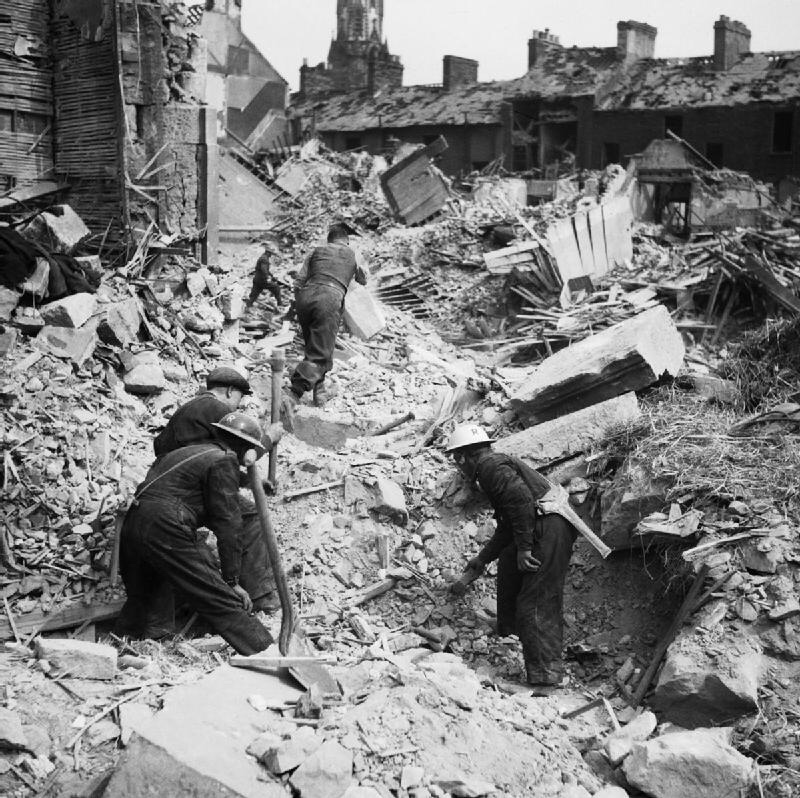
Rescue workers searching through rubble after an air raid on Belfast – From the collections of the Imperial War Museums

It was Easter Tuesday night, at around 10.40pm, when the air raid sirens sounded…. Many had believed that Belfast was out of reach of the Luftwaffe – and so the city was unprepared…. A smaller attack had taken place a few days before – possibly as a test of Belfast’s defences…. A cryptic warning had come across the airwaves from the traitor William Joyce, otherwise known as ‘Lord Haw-Haw’, when he announced in a radio broadcast from Hamburg, that there would be “Easter eggs for Belfast”….

The city played a great part in the war effort – with its large shipyard, aircraft manufacturing facilities and munition factories…. 200 Luftwaffe bombers had taken off from bases in occupied Northern France and the Netherlands…. The six hours of horror, death and destruction they were to unleash on Belfast resulted in the greatest loss of life in a single night’s raid – apart from London….

Visibility on the night was poor – which may account for the heavy civilian loss…. Over 55,000, half of Belfast City’s houses, were hit by bombs…. Streets were wiped away, all their occupants killed….over 100,000 were left homeless…. Many public buildings were destroyed , including the Ulster Hospital for Women and Children, the Strand Public Elementary School, the Belfast City Hall’s Banqueting Hall, countless of churches, railway stations, hotels….all obliterated….

Antrim Road corner of Duncairn Gardens, Belfast – Public Records of Northern Ireland

Few children had been evacuated from the city – some 80,000 still remained….

Mortuary services only had the capacity to deal with 200 bodies…. A further 150 corpses were buried in a mass grave, 123 of which remained unidentified…. St. George’s Market became a temporary mortuary for 255 of the dead…. Many more bodies and body parts were unidentifiable and were buried in mass graves in the city’s cemeteries….

Haw-Haw was later to announce…. “The Fuhrer will give you time to bury your dead before the next attack…. Tuesday was only a sample….”

A second massive air raid took place three weeks later…. A further 150 people lost their lives….

Soldiers clearing rubble after the May air raid – From the collections of the Imperial War Museums