On this day in history….10th March 1988

On this day in history….10th March 1988 – Prince Charles narrowly escapes death when an avalanche hits the royal ski party at Klosters, Switzerland….one of his close friends is killed….

img_2535
Prince Charles via Wikimedia – Public domain

The royal party consisted of the Prince of Wales, Major Hugh Lindsay, Mr and Mrs Palmer-Tomkinson, a Swiss policeman and Bruno Sprecher, one of the best local guides…. The Princess of Wales and Duchess of York were also on the holiday but were back at the royal party’s chalet in Davos….

img_2533
Klosters – image credit: Florian343 via Wikipedia CC BY-SA 4.0

Prince Charles and his friends were skiing ‘off piste’ – on one of the most difficult runs in the area – the Wang Run….on the steep slopes of Mount Gotschnagrat – which are among some of the steepest in Switzerland. This particular day was the first time the run had been opened that season….as it was rarely opened and considered to be suitable only for the most experienced of skiers…. Prince Charles being such a skier – having started to ski at the age of 14….

img_2534
Mount Gotschnagrat via Twitter

The previous day had seen a fresh snowfall and snow had built up on the mountain….but there had been no avalanche warnings issued…. At 2.45pm the avalanche started some 100 feet above where the party were skiing…. Prince Charles and most of the others managed to ski to safety – but Major Lindsay and Patti Palmer-Tomkinson were caught in it….and plunged 400m down the mountainside….

Once the avalanche had passed the party including the Prince of Wales desperately tried to help them – digging at the snow with their hands frantically trying to free them…. Both were airlifted by helicopter to Davos hospital….where Major Lindsay was pronounced dead…. Patti Palmer-Tomkinson suffered severe leg injuries….

Prince Charles had lost one of his close friends…. Major Hugh Lindsay was 34-years-old and former equerry to the Queen…. Having accompanied Her Majesty on many official engagements he was one of her favourites…. He had been married only two years and his wife was expecting their child in May…. Prince Charles, the Princess of Wales and Duchess of York flew back to RAF Northolt with Major Lindsay’s coffin…. The Queen sent a private message of sympathy to his widow….


On this day in history….9th March 1946

On this day in history : 9th March 1946 – Barriers collapse at an overcrowded football match at Burnden Park, home to Bolton Wanderers…. 33 fans are killed and hundreds more are injured….

The match was between Bolton Wanderers and Stoke City…. At 2.40pm the decision was taken to close the turnstiles as the ground had already filled to over-capacity…. But still the crowds came in, climbing over the turnstiles…. Then somebody – wanting to escape the crush – pricked the lock of a gate….as it opened more and more people poured in…. It is estimated 85,000 were packed into the ground – which should have had no more than 70,000….

A quarter of an hour after the game had started the crowd began to spill onto the pitch – play was temporarily stopped whilst the pitch was cleared…. It was just after then that two barriers collapsed and the crowd surged forwards….those knocked to the ground were crushed….

img_2532
Women and children being passed over the heads of the crowd during the crush – Fair use

The game had restarted – but a police officer went to speak to the referee, George Dutton, to explain there had been fatalities…. At that point the players returned to the dressing rooms….

The injured were removed from the crowd and the dead were lain along the touch-line and covered with coats…. A new touch-line was marked out with sawdust – and less than half an hour after leaving the pitch the players returned to restart the game! Just a line of sawdust separating them from the bodies….

At the end of the first half the teams swapped ends and immediately started the second half…. The match ended goalless…. Stanley Matthews, who was on the Stoke team, later said he was sickened that the game was allowed to continue….

Until the Ibrox Park disaster in 1971 Burnden Park was the deadliest stadium disaster in British history…. 33 dead, including one woman and over 400 injured…. Bolton played their last game there in 1997, before moving to a new stadium…. It was demolished in 1999 and the site is now occupied by a supermarket….

img_2531

img_2530
Image credit: Bradford Timeline via Flickr

On this day in history….8th March 1859

On this day in history : 8th March 1859 – The birth of Kenneth Grahame, the Scottish author who brought us tales of Toad, Ratty, Mole and Badger in ‘The Wind in the Willows’….

img_2527
Image credit : Paul K via Flickr

Kenneth was born in Edinburgh; his mother died when he was just 5-years-old. His father, an alcoholic, gave up the care of his children to their grandmother…. Kenneth, his brother, sister and a new baby went to live with ‘Granny Ingles’ near to Cookham, Berkshire….

It was a large tumble-down house – in a certain state of neglect – but it had a big rambling garden and was near to a river…. The children’s uncle, David Ingles – curate of the village church – introduced them to the delights of the riverbank and boating…. It was an idyllic place for a childhood and believed to be the setting for ‘The Wind in the Willows’…. Eventually though the family had to move, as the chimney stack of the dilapidated old house collapsed….

Kenneth had wanted to go to Oxford University – but because of finances this was not possible…. Instead he started work in 1879 at the Bank of England…. He worked his way up and by the time he retired (due to ill-health) in 1908 he had risen to the position of Secretary of the Bank of England….

In 1899 Kenneth married Elspeth Thomson – and the following year they had a son…. Alastair was born premature, he was blind in one eye and suffered from health problems throughout his life….

On retirement Kenneth took his family back to live where he had spent his childhood – Berkshire…. At his son’s bedtime he would tell the boy stories and it was then that the characters of ‘The Wind in the Willows’ were created…. Toad was based on Alastair himself – whilst Ratty was influenced by Kenneth’s good friend and fellow writer, Sir Arthur Quiller-Couch…. Kenneth frequently went on boating holidays – without his family – but when he was away he would write home to Alastair with more tales of Toad, Ratty, Mole and Badger…. Later he was to use theses stories as a basis for his book, which was first published in 1908….

img_2528
Ratty and Mole – Image credit : Amber Case via Flickr

Tragically, on the 7th of May 1920 Alastair committed suicide on a railway line…. It was five days before his 20th birthday – he was an undergraduate at Oxford University…. Out of a mark of respect to his parents the death was recorded as accidental….

Kenneth himself died in 1932 in Pangbourne, Berkshire. English novelist and playwright Anthony Hope – who happened to be Kenneth’s cousin – wrote his epitaph….

‘To the beautiful memory of Kenneth Grahame, husband of Elspeth and father of Alastair, who passed the river on the 6th of July, 1932, leaving childhood and literature through him the more blest for all time’….

On this day in history….7th March 1876

On this day in history – 7th March 1876 – Scottish-born inventor Alexander Graham Bell patents the telephone….

img_2524
An early telephone transmitter invented by Alexander Graham Bell around 1876. An improvement over Bell’s ‘gallows’ type instrument of 1875, it was Bell’s first device that could transmit intelligible speech – Public domain

Bell had worked with his father in London, who had developed a system to teach deaf people to speak. He in turn was most likely influenced by his own father, who had studied elocution and speech impediments…. It was an area that affected the Bell family in many ways….Bell’s own mother was almost totally deaf….

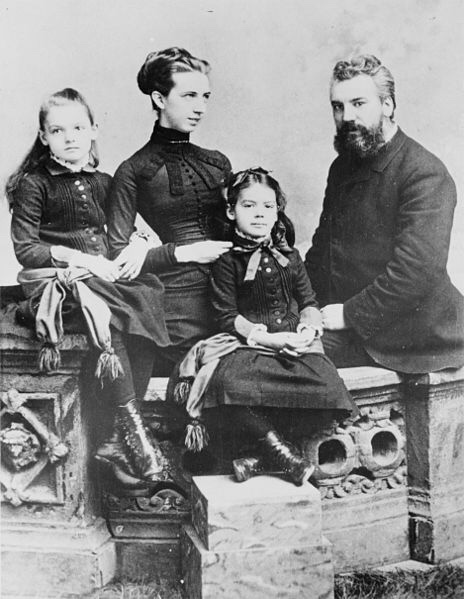
The Bells moved to the United States – Boston, Massachusetts – during the 1870s…. At first Bell worked as a teacher at the Pemberton Avenue School for the Deaf….it was here he met his wife, Mabel Hubbard – she was one of his students….

img_2522
Alexander Graham Bell and his family – Public domain

Bell began to explore the idea of transmitting speech over wires…. The downside of the telegraph system being the final message still had to be physically delivered after it had arrived at the receiving telegraph office…. With the help of electrician Thomas A. Watson, a prototype telephone was developed, which used electrical current and sound waves….

Unbeknown to Bell somebody else was working on a similar system….Elisha Gray had kept his work secret – Bell found out on the 11th February 1876, a Friday, that Gray intended to apply for a patent – and rushed to get the documentation completed for his own…. Both men applied for a patent on Monday the 14th of February….Bell’s solicitor obviously managed to file the paperwork first – records show his application was the 5th received at the Patent Office that day….whereas Gray’s was the 39th. Bell was granted US Patent No. 174,465 Improvement on Telegraphy on the 7th of March – Gray was left disappointed….

Three days later Bell made his first telephone call…. “Mr Watson….come here, I want you”…. Bell later wrote in his journal “To my delight he came and declared that he had heard and understood what I had said”….

img_2525
Watson in his later years, holding Bell’s original telephone – Public domain

There has long been controversy as to whether Bell ‘stole’ the patent…. It is indeed unusual for a patent to be issued before a device is fully working…. Three others all claimed to have invented the telephone first – Elisha Gray, Thomas Edison and Antonio Meucci – and said they had working devices…. There were more than 600 patent lawsuits brought against Bell – but each time the courts ruled in his favour….

Bell was never particularly interested in the commercial side of things – he was a scientist and inventor…. Among his other inventions were metal detectors, the Hydrofoil and Tetrahedral Kite…. His work also consisted of designs for aircraft, including helicopters…. Ironically he considered the telephone an intrusion….and refused to have one in his office….

img_2521
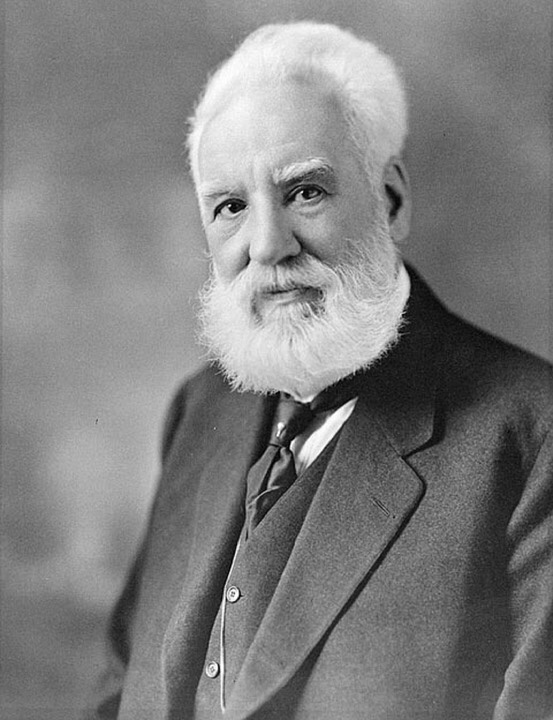
Public domain

On this day in history….6th March 1917

On this day in history : 6th March 1917 – The birth of Francis Alick Howard – who was better known to us as comedian and comic actor Frankie Howerd….

The son of a soldier, Howerd was born in York – and was educated at Shooter’s Hill Grammar School, London…. His first stage appearance was at the age of 13…. However, after failing to get into RADA a career in serious acting was not to be…. It was whilst serving in the army during WWII that he began to entertain….and it was also at this time that he changed his name to Howerd – apparently ‘just to be different’….

He began his professional entertainment career in 1946, in the touring show ‘For the Fun of It’…. He made his radio debut in December of the same year and his first screen role was in the film ‘The Runaway Bus’ in 1954, in which he starred opposite Petula Clark….

img_2519
Portrait by Allan Warren 1978 – CC BY-SA 3.0

With a mixture of jokes, impressions, comical songs and monologues Howerd hosted his own series of TV shows in the 1950s…. Known for his risqué double entendres he came across as a larger than life figure – however, this couldn’t be further from the truth in reality….

Howerd suffered from acute stage fright – (his close friend Cilla Black once said of him – ‘that it made him physically ill’)…. He was a painfully shy man, lacking in self confidence and prone to severe depression…. He was also terrified of his sexuality becoming common knowledge…. At a time when homosexuality between men was illegal (until 1967 in England and Wales and 1981 in Scotland) it would have ruined his career….

He met his partner, Dennis Heymer – 12 years his junior – in 1958. Heymer also became his manager and helped him to revive his flagging career during the 1960s…. The couple were together for over 30 years – until Howerd’s death on the 19th of April 1992, after suffering heart failure due to a respiratory illness…. Always their relationship remained discreet outside of their immediate circle…. Howerd is buried at St. Gregory’s Church, Weare, Somerset – Heymer, who died in May 2009, is buried close by….

img_2520
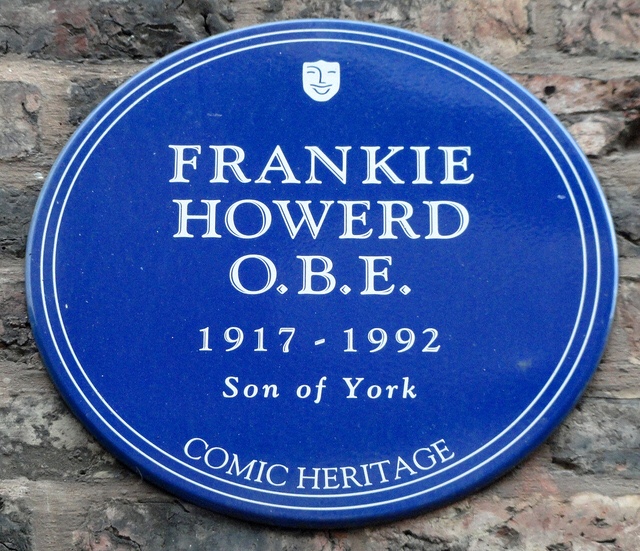
Frankie Howerd Blue Plaque, York – Image credit: Peter Hughes via Flickr