On this day in history….10th March 1988

On this day in history….10th March 1988 – Prince Charles narrowly escapes death when an avalanche hits the royal ski party at Klosters, Switzerland….one of his close friends is killed….

img_2535
Prince Charles via Wikimedia – Public domain

The royal party consisted of the Prince of Wales, Major Hugh Lindsay, Mr and Mrs Palmer-Tomkinson, a Swiss policeman and Bruno Sprecher, one of the best local guides…. The Princess of Wales and Duchess of York were also on the holiday but were back at the royal party’s chalet in Davos….

img_2533
Klosters – image credit: Florian343 via Wikipedia CC BY-SA 4.0

Prince Charles and his friends were skiing ‘off piste’ – on one of the most difficult runs in the area – the Wang Run….on the steep slopes of Mount Gotschnagrat – which are among some of the steepest in Switzerland. This particular day was the first time the run had been opened that season….as it was rarely opened and considered to be suitable only for the most experienced of skiers…. Prince Charles being such a skier – having started to ski at the age of 14….

img_2534
Mount Gotschnagrat via Twitter

The previous day had seen a fresh snowfall and snow had built up on the mountain….but there had been no avalanche warnings issued…. At 2.45pm the avalanche started some 100 feet above where the party were skiing…. Prince Charles and most of the others managed to ski to safety – but Major Lindsay and Patti Palmer-Tomkinson were caught in it….and plunged 400m down the mountainside….

Once the avalanche had passed the party including the Prince of Wales desperately tried to help them – digging at the snow with their hands frantically trying to free them…. Both were airlifted by helicopter to Davos hospital….where Major Lindsay was pronounced dead…. Patti Palmer-Tomkinson suffered severe leg injuries….

Prince Charles had lost one of his close friends…. Major Hugh Lindsay was 34-years-old and former equerry to the Queen…. Having accompanied Her Majesty on many official engagements he was one of her favourites…. He had been married only two years and his wife was expecting their child in May…. Prince Charles, the Princess of Wales and Duchess of York flew back to RAF Northolt with Major Lindsay’s coffin…. The Queen sent a private message of sympathy to his widow….


On this day in history….2nd March 1882

On this day in history : 2nd March 1882 – Scotsman Roderick Maclean attempts to assassinate Queen Victoria as she waits to board her train at Windsor railway station….

img_2503
Photograph by Alexander Bassano 1882. Public domain

Queen Victoria had just walked across the platform to the waiting carriage with her daughter, Princess Beatrice and other members of her court, when a shot rang out…. Roderick Maclean had stepped from a crowd of cheering onlookers, raised a gun and fired…. Before he could do so again the crowd, including a group of Eton schoolboys who hit him with umbrellas, managed to overcome him…. Maclean was then arrested by a Superintendent Hayes….

img_2506
Queen Victoria with Princess Beatrice. Public domain via Wikimedia

Maclean had not been quite right in the head since a childhood accident. His father was the proprietor of  ‘Fun’ magazine – a rival to ‘Punch’ – and so the family would have been comfortable and Roderick Maclean depended upon them financially…. When his parents died he had no means of an income and had to rely on handouts from his three brothers and sister….

As time passed by this help became less frequent, which frustrated Maclean – as a republican he directed his anger at the Monarchy…. He took to wandering from town to town and was becoming more and more like a tramp….

Maclean was also a ‘would-be’ poet and he sent some of his verse to Queen Victoria – but was angered by the response he received from the Palace….his work was returned to him accompanied by a curt note from a lady-in-waiting…. This appears to have finally tipped him over the edge…. Maclean sold his meagre possessions, bought himself a cheap and cheerful revolver….and then walked to Windsor….

In fact Maclean had already been certified as insane two years previously in June 1880….and had spent some time in a lunatic asylum. He had complained of headaches and thought that everybody in England was plotting against him…. He even had a problem with the colour blue and thought people who wore it did so to deliberately provoke him…. He had also sent some disturbing letters to his sister Caroline, in which he discussed murder….

Maclean went on trial in Reading on April the 20th 1882 on the charge of high treason….a crime then punishable by death…. However he was found ‘not guilty but insane’ – the jury took just five minutes to deliver their verdict…. Roderick Maclean spent the rest of his days in Broadmoor Asylum….he died of apoplexy in 1921….

img_2505
Asylum for Criminal Lunatics, Broadmoor. Image credit : Wellcome Collection CC BY

On this day in history….24th February 1981

On this day in history : 24th February 1981 – After months of speculation the engagement of the Prince of Wales and Lady Diana Spencer is officially announced by Buckingham Palace….

img_2462
Prince Charles and Lady Diana Spencer – Joe Haupt via Flickr

The couple had first met in 1977 – when Prince Charles was dating Lady Diana’s elder sister, Lady Sarah McCorquodale. In 1980 Charles and Diana met again at a country weekend – where she watched him play polo…. He then invited her for a weekend of sailing at Cowes, on board the Royal Yacht Britannia – and this was followed by an invitation to Balmoral Castle, to ‘meet the family’…. Lady Diana was received by the Queen, Duke of Edinburgh and the Queen Mother….

It was six months later, on the 3rd of February 1981, that Prince Charles proposed – at a private dinner at Windsor Castle…. Diana was about to go on a holiday to Australia and Charles suggested that she use that time to consider his proposal – but she didn’t need to – she accepted straight away…. The couple kept their engagement secret for three weeks….

The announcement came at 11 am on the 24th of February…. “It is with great pleasure that the Queen and Duke of Edinburgh announce the betrothal of their beloved son the Prince of Wales to the Lady Diana Spencer, daughter of the Earl Spencer and the Honourable Mrs Shand Kidd” – Lord Maclean, Lord Chancellor….

Lady Diana’s £30,000 engagement ring, set in 18-carat gold, held a 12-carat, oval, blue Ceylon sapphire surrounded by 14 diamonds…. Prince Charles said of his fiancée that he was “delighted and frankly amazed that Diana is prepared to take me on”….


19-year-old Diana moved out of her shared flat in Kensington to live at Clarence House until the wedding…. She also gave up her job as a kindergarten teacher….

They married on the 29th of July 1981….it was declared a national holiday. Two nights before the wedding a gala ball was held at Buckingham Palace, with dinner for 90 hosted by the Queen and a reception with dancing for 1,500 guests – including royal household members and staff…. On the eve of the wedding 150 heads of state and government were invited to dine with the Queen….

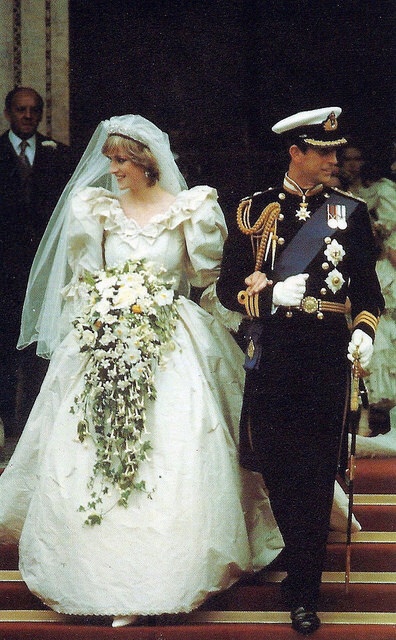
The wedding took place in St. Paul’s Cathedral…. 3,500 guests watched Prince Charles and Lady Diana Spencer – in a dress of ivory silk-taffeta and antique lace with a 25m train, designed by David and Elizabeth Emmanuel- exchange their vows…. It is estimated 750 million people around the World watched on TV….

img_2461
Princess Diana and Prince Charles – Joe Haupt via Flickr
img_2460
The Wedding of Prince Charles and Princess Diana – Joe Haupt via Flickr


On this day in history….9th February 1649

On this day in history : 9th February 1649 – The funeral of King Charles I, who was beheaded in Whitehall, London – the only English king to be executed….

img_2361
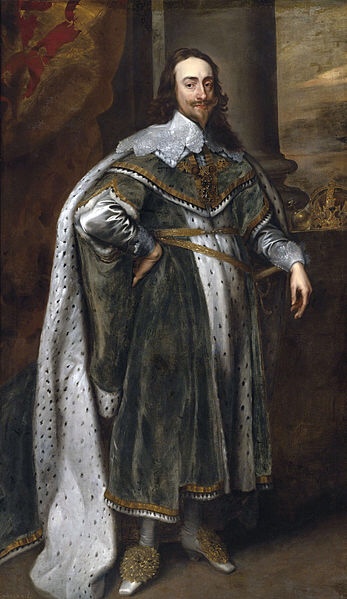
King Charles I by Sir Anthony van Dyck – Public domain

Like his father before him Charles believed in the ‘Divine Rights of Kings’…. It was his belief that kings were chosen by God – and so he only had God to answer to…. He refused to consider the views of others….especially in religious and parliamentary matters. He dissolved Parliament several times and governed the Country alone…. He was determined to hold on to his absolute power and thought it his sole right to make the Laws of the Land – and to go against him was a sin against God…. He was something of a dictator perhaps….

img_2356
King Charles I after original by van Dyck – Public domain

This of course made him unpopular both with the people and his own Parliament…. Eventually it was to lead to civil war….the Royalists against the Parliamentarians (Roundheads), led by Oliver Cromwell….

Gradually the Roundheads gained the upper hand…. Charles fled London but eventually surrendered to the Scots – who handed him over to Cromwell…. Charles was imprisoned in 1646 – and kept at Hampton Court Palace – but managed to escape…. He was recaptured and then held at Carisbrooke Castle, on the Isle of Wight….where he was treated well….

img_2355
Charles at Carisbrooke Castle, as painted by Eugene Lami in 1829 – Public domain

Charles refused to repent or admit defeat – and on the 1st of January 1649 he was put on trial at Westminster Hall….accused of being a “tyrant, traitor and murderer; and a public and implacable enemy to the Commonwealth of England”….

Charles refused to defend himself – not recognising the legality of the court…. His date of execution was set for the 30th of January 1649….

Charles is usually portrayed as an arrogant man – but by all accounts in private he was gentle and polite…. He was shy in public which came over as arrogance…. He was a particularly loving father to his six children and spent his last few days at St. James’s Palace consoling them….

img_2360
Five of the children of King Charles I after Sir Anthony van Dyck – Public domain

On the morning of the day of the execution, a bitterly cold Tuesday, he rose early…. He asked for two thick shirts as he didn’t want to shiver and have the crowds think he was shaking from fear…. At 10am he walked with his guards to Whitehall Palace where he was to wait in his bedchamber until the call to the scaffold was made….

The call came just before 2pm…. The scaffold was set up just outside Banqueting Hall in Whitehall – and was draped in black…. The executioner and his assistant were hooded, so as not to be recognised….

Despite the bitter January weather a huge crowd had gathered – but were held back at a considerable distance from the scaffold, in case of unrest…. So far away in fact, that few were able to catch the words of the King’s final speech….

….” I shall go from a corruptible to an incorruptible Crown, where no disturbance can be, no disturbance in the world”….

img_2357
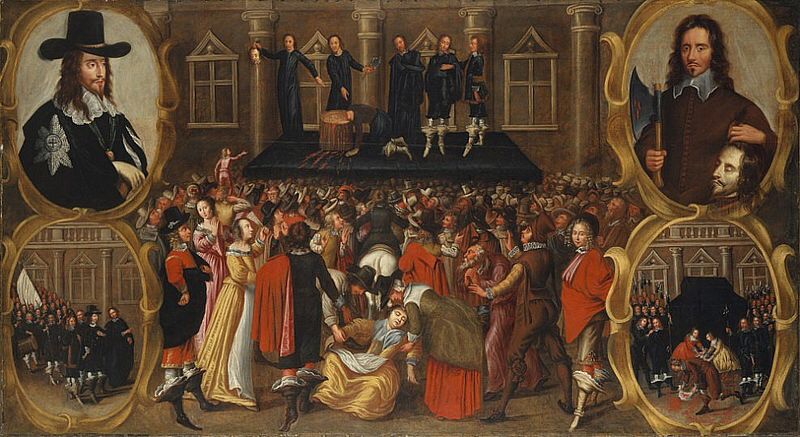
The Execution of Charles I of England – Scottish National Gallery – Public domain

At just after 2pm King Charles I was dead; beheaded with a single blow….and an audible groan was heard from the crowd…. Charles may not have been the most popular of kings but he had faced his death with courage – his personal dignity had won him much sympathy from the public….

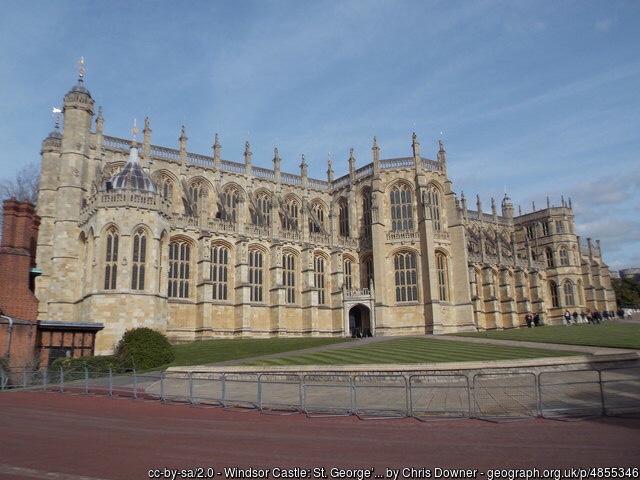
The King’s embalmed body – with head re-attached – remained on public view at St. James’s Palace until the 7th of February. The Committee of Parliament refused permission for a burial at Westminster Abbey but allowed his being laid to rest in St. George’s Chapel at Windsor Castle….

img_2359

Usually a king’s funeral would be filled with pomp and ceremony but the funeral of King Charles I was a very different affair. The only English king to have been tried and executed for treason is now buried in the vault of King Henry VIII and Jane Seymour…. On the 30th of January every year a Service of Commemoration is held at Banqueting House and a wreath laid at his statue outside the Banqueting Hall, the site of his execution….

img_2358
Statue of King Charles I at Banqueting House – image credit: CVB via Wikipedia CC BY-SA 4.0

On this day in history….3rd February 1014

On this day in history : 3rd February 1014 – The death of Sweyn Folkbeard – England’s shortest-reigning king, with a reign of just 40 days….

img_2328
Sweyn Folkbeard, detail of a mid-13th-century miniature. Cambridge University Library. Public domain.

Sweyn was born around 960 AD and was the son of Harald Bluetooth, the first Scandinavian king to be baptised a Christian….

Sweyn Folkbeard – (known as such because of his long clefted beard) – grew up to be a brutal and violent man….but then – they were brutal and violent times…. During the mid 980s AD he led a revolt against his father and seized the throne…. Harald went into exile and died soon after….

img_2329
Sweyn and the Jomsvikings at the funeral ale of his father Harald Bluetooth. Painting by Lorenz Frolich c.1883-86. Public domain.

It was during the 990s AD that Sweyn began a campaign of fear and mass destruction in England…. King of England at the time – Ethelred the Unready – attempted to rid himself of the troublesome Dane by paying him off…. The ‘Danegeld Tax’ was intended to pay tribute to the Vikings and save the land from being ravaged. Only it did not work….the Danes continued to raid Northern England, albeit on a smaller scale…. Some Danes even began to settle here….

Ethelred was advised in order to save England he must get rid of the Danes once and for all…. On the 13th of November 1002 he ordered the complete massacre of all Danes in England – men, women and children (St. Brice’s Day Massacre)…. Among those to be slaughtered was Gunhilde, Sweyn’s sister….

Sweyn swore revenge…. In 1003 he arrived with a massive invading force….landing at Sandwich (Kent). From there he ravaged much of Southern England….terrifying the natives and forcing them into submission. He then proceeded north to the Humber – Northumbria surrendered…. Next Sweyn made his way to Winchester and finally turned his attention to London….

Ethelred resisted at first, putting up a fierce fight….but his subjects were terrified of the consequences. The English Earls, not happy with how their King was handling matters, reluctantly declared Sweyn King of England…. Ethelred fled to the Isle of Wight and from there to Normandy – where he joined his wife and children….

img_2331
Ethelred the Unready in an early thirteenth-century copy of the Abingdon Chronicle. Public domain.

Sweyn was made King of England on Christmas Day 1013 (although he was never crowned)…. He ruled from a fortification at Gainsborough, Lincolnshire…. On the 3rd of February 1014 he died suddenly…. Some say he had a fall from his horse, whilst others believe he died from apoplexy (stroke). He had reigned for just 40 days….

He was buried in England but later his remains were moved to Roeskild Cathedral, Denmark. He was succeeded as King of Denmark by his son, Harald II….

img_2330
Viking longboat ‘Hugin’ at Pegwell Bay, near to Sandwich Kent…. A gift from the Danish government in 1949….