On this day in history….7th January 1928

On this day in history : 7th January 1928 – The River Thames bursts its banks and floods much of Central London…. Fourteen people lose their lives and thousands more are made homeless…. The Tower of London, Houses of Parliament and Tate Gallery are all swamped….

During Christmas 1927 heavy snow had fallen in the Cotswolds, where the Thames has its source…. A sudden thaw on New Years Eve, followed by excessive heavy rain meant there was double the usual volume of water coming down river…. This coincided with a high spring tide – but at the same time a storm surge, caused by a cyclone in the North Sea meant water levels were raised in the Thames Estuary….
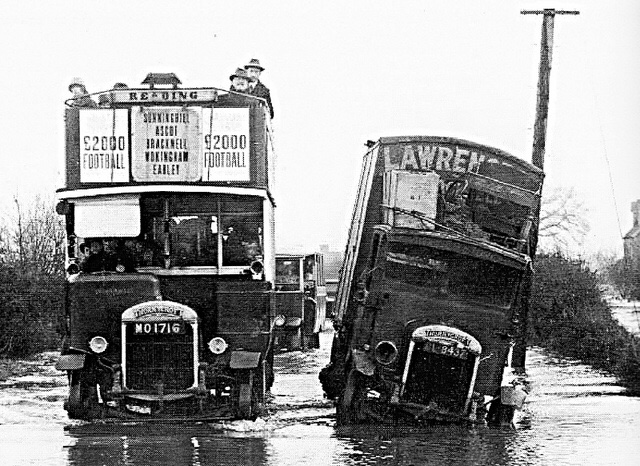
img_2095
Floods at Reading in January 1928 – showing the impact of the Thames flooding even further down river…. Image credit : Alan Farrow via Flickr

The situation was made even worse by dredging work that had been carried out in the Capital between 1909 and 1928 to deepen the river channel – to allow easier access for shipping in to the Port of London….

The river burst its banks just after midnight – when most Londoners were in their beds…. The first section to break was a 75ft stretch at Millbank – opposite the Tate Gallery…. Water poured into the gallery, up to 8ft deep on the ground floor….18 paintings were damaged beyond repair, 226 badly damaged and a further 67 received minor damage…. Many were by renowned artist J.M.W. Turner….

Westminster Hall and the House of Commons were flooded, as were most underground stations close to the river…. The Blackwall Tunnel was submerged, as was the Rotherhithe Tunnel…. The moat surrounding the Tower of London, which had been empty for over 80 years, was filled…. The flooding extended from the City of London and Southwark right to Putney and Hammersmith….
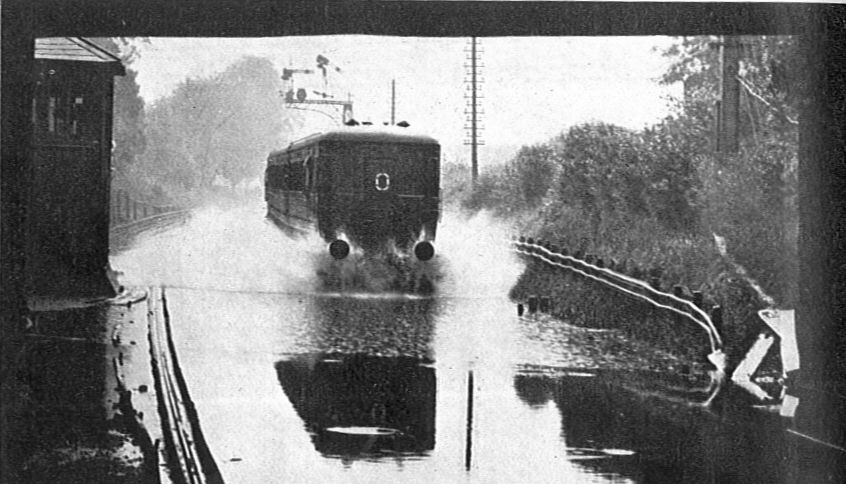
img_2090
A Southern Railway electric multiple unit tackles floods at Kew Bridge railway station Credit : Andy Dingley (scanner) – Public domain

However, the most devastating part of the disaster has to be the human cost…. As the embankment near to Lambeth Bridge broke floodwaters gushed onto the streets of the run-down working-class area between Southwark and Blackfriars, which backed on to the river…. Water poured into the basements….which were the homes of so many of London’s poorer people….

There was little time to escape; police went from door to door, urging people to leave….many did, wearing just their nightclothes….but for some it was too late….

As the water poured into these basements nine people drowned – and another died from a heart attack brought on by the shock…. Alfred Harding later had to identify the bodies of 4 of his daughters:- Florence Emily, 18 – Lillian Maude, 16 – Rosina, 6 and Doris, who was only 2-years-old….

Two more died in Hammersmith, domestic servants Evelyn Hyde, aged 20 and Annie Masters Moreton, aged 22 – who shared a basement room…. Another two people died in Fulham…. 4,000 were made homeless….

The flood peaked at 1.30am, at a level of over 18ft above the Ordnance Datum line….the highest water level ever recorded in the Thames at London…. The water had subsided by the end of the day – but it took a month to pump all of it away…. The damage took several years to repair….many of the old slum areas had to be demolished, Millbank and the surrounding area had to be virtually rebuilt…. Political rows broke out over who should pay for the clean-up operation – was it the responsibility of local or central government…. Arguments also occurred amongst authorities and politicians over the role the dredging work had played in the disaster….

img_2093
Thames flood level markers at Trinity Hospital, Greenwich

The embankments had once been marshland but were reclaimed during the Victorian era and had been developed for housing and commercial purposes…. As a result of the 1928 flood the river’s embankments were raised…. Thankfully it was the last major flood to occur in the city – but it came close again in 1953 – when the river almost broke the embankment – and did cause some flooding at Bermondsey and other low-lying areas…. A further flood occurred on the Lower Thames in 1959….

At last the government were prompted to consider flood defence – once again there were disagreements over who should foot the bill…. Plans were made in the mid 1960s for a flood barrier – and in 1974 work finally got underway…. The Thames Barrier officially opened in 1984….


On this day in history….3rd January 1911

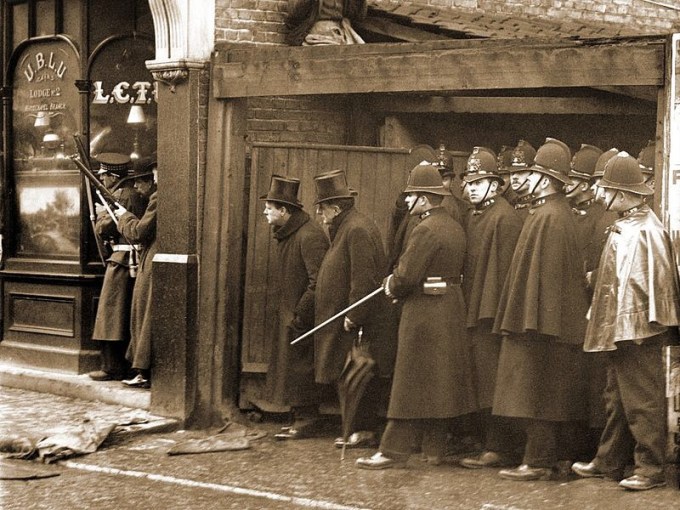
On this day in history : 3rd January 1911 – The Siege of Sidney Street takes place….a gun battle is waged on the streets of London as two Latvian anarchists hold out in an East End tenement for several hours – against over 200 armed police and a detachment of soldiers….

img_2059

The drama had begun to unfold three weeks previously, on the 16th of December 1910. A gang of Latvian revolutionaries had attempted to rob a jeweller’s shop in Houndsditch. The gang, calling itself ‘Leesma’, meaning ‘flame’, consisted of approximately thirteen people, including two women….their purpose was to commit robberies to raise money to help fund fellow activists in Latvia and Russia, who supported Lenin and the Bolshevik Movement….

The gang had rented rooms in a building annexing the back of the jeweller’s shop….the plan was to break through the common wall between the two adjoining properties. They chose to carry out their planned robbery on a Friday night….but being a predominantly Jewish neighbourhood – and Friday being the Jewish Sabbath – it was a particularly quiet time. Alerted by the noise the gang were making whilst attempting the robbery local residents called the police….

Eight unarmed police officers arrived, three sergeants and five Constables….the gang opened fire on them. Three policemen were killed and two were injured – the gang then made their escape…. One Latvian was injured – having been shot accidentally by another member of the gang. He was carried away by his friends but later died from his injuries – and was found dead in his lodgings the following morning….

The police immediately mounted a search and by the end of December had most of the gang in custody…. They then received a tip-off that two members, Fritz Svaars and William Sokolow, were hiding at 100 Sidney Street, which is located at the heart of Stepney. A room at the address was being rented by Betsy Gershan, the girlfriend of Sokolow. Being the East End of London the area was very overpopulated and the property itself overcrowded….fourteen people were registered at the address, two families with young children….

At midday on the 2nd of January two horse-drawn vehicles arrived in Sidney Street; concealed inside were armed policemen – and the building was placed under observation….

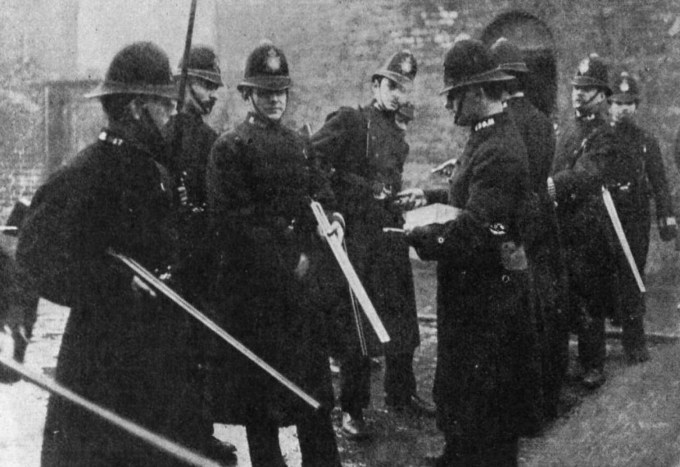
During the early hours of the 3rd of January a long snaking line of over 200 policemen made their way to 100 Sidney Street. Some were armed – but their weapons, such as revolvers, shotguns and tube guns, were old and antiquated. The men had not been briefed as to the nature of the task at hand – but they knew it was dangerous, as married men had been excluded from the operation….

img_2063

By dawn all was in place and the police were ready to take action. Somehow they managed to evacuate 100 Sidney Street and the surrounding properties without alerting Svaars and Sokolow, who were on the second floor…. The pair were Continue reading “On this day in history….3rd January 1911”

On this day in history….17th January 1912

On this day in history : 17th January 1912 – British explorers, led by Captain Robert Falcon Scott, reach the South Pole….only to discover a Norwegian team, led by Roald Amundsen had got there before them….

Scott, a naval officer and explorer, had unsuccessfully tried to reach the South Pole on a previous occasion, in 1902. His party had been forced to turn back because of ill-health and severe sub-zero weather conditions….

It was on the 15th of June 1910 that his converted whaling ship the ‘Terra Nova’ left Cardiff to begin the journey south….carrying on board – dogs, ponies and mechanical sledges – as well as the explorers and all of their supplies. It was Scott’s intention to carry out a series of scientific experiments and studies – he wished to learn more about the biology, geology and meteorology of the Antarctic…. He also wanted to test the newly motorised sledges they were taking with them…. Having a go at being the first to reach the South Pole was to be an added bonus….

img_2183
Captain Robert Falcon Scott, in polar gear 1911 – Public domain

However, Scott had a rival – one that he was initially blissfully unaware of…. Roald Engelbregt Gravning Amundsen was a respected Norwegian explorer. It had been his original intent to take an expedition to the North Pole….but then two Americans, Frederick Cook and Robert Peary made separate claims as to having reached the North Pole – (claims that were later to be dismissed)…. Amundsen, being a competitive adventurer, kept his plans a well-guarded secret; it wasn’t until his ship ‘Fram’ left Oslo on the 3rd of June 1910 – supposedly bound for the North Pole – that he revealed his true intent to his team…. He knew that in the eyes of many his open challenge to Scott on racing to be the first to the South Pole would not have been entirely acceptable….

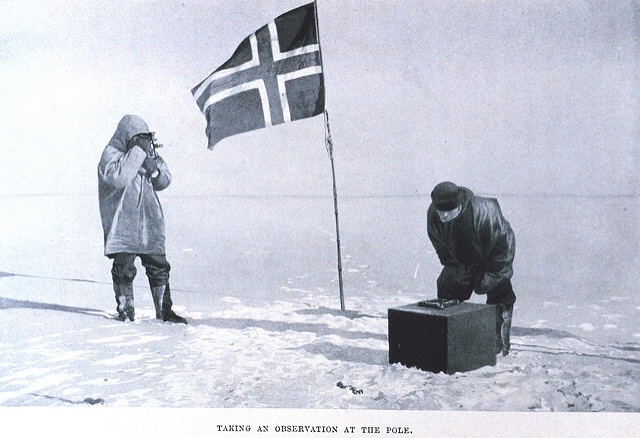
The first Scott knew of this rival expedition was when he reached Melbourne and found a telegram waiting for him…. It simply read – “Beg leave to inform you Fram proceeding Antarctic. Amundsen”…. Scott was understandably shocked – but was determined to stick to the original plan – he had experiments and studies to conduct… Amundsen would have had little time for such matters as science and technical trials; as far as he was concerned it was all about the race to the South Pole…. Amundsen and his team reached the Pole on the 14th of December 1911….

img_2184
Taking an Observation at the Pole (1911) Expedition of Norwegian team by Roald Amundsen – Image credit: Euclid vanderKroew via Flickr

Scott and his team set out 11 days after Amundsen – on the 1st of November 1911…. It was not long before it became evident the mechanical sledges and ponies could not cope – so the expedition continued without them…. In mid-December the dog teams turned back….leaving just Scott and four of his companions to journey onwards:- Henry Bowers, Edward Wilson, Edgar Evans and Lawrence Oates….

The team arrived at the South Pole on the 17th of January 1912….thirty-four days after Amundsen’s expedition had arrived there…. It was a day of bitter disappointment for Scott and his men….

“Great God! This is an awful place and terrible enough for us to have laboured to it without the reward of priority”….the words of Scott….

img_2182
Last expedition of Robert Falcon Scott. The image shows Wilson, Scott and Oates (standing); and Bowers and Evans (sitting)

It would have been with heavy hearts that the five men would have begun the eight hundred mile journey back to base camp….the journey that was to be their last and one so full of tragedy….

As the men dragged their equipment over ice fields and glaciers their exhaustion increased by the hour…. Evans was the first to succumb…. Scott had noticed on the 7th of February and recorded in his journal that his colleague was repeatedly falling behind the rest of the group. Ten days later Scott found him on his knees….Evans died later that night – as a complete group they had made it as far as the base of the Beardmore Glacier. The cause of death was possibly a brain injury – which Evans may have sustained during a fall, which the others had not witnessed….

The weather took a turn for the worse….and the team were still hundreds of miles from base camp. The men were forced to spend much of their time huddled against the elements in their tent….with their food supplies rapidly dwindling away….

By mid-March Oates was suffering from severe frost bite and was barely able to walk – he would have been acutely aware that he was a hindrance to the others…. It was reputedly with the words “I am just going outside and may be some time” that Oates walked out into the blizzard…. The others tried to dissuade him – but in the words that Scott recorded “the act of a brave man and an English gentleman”….

Three weeks later the remaining team members – Scott, Bowers and Wilson – were caught in yet another raging blizzard; they were just 11 miles (3 days of walking) from the next supply depot…. But the three never made it out of their tent again….having been claimed by exhaustion, starvation and exposure….

Eight months later a party of explorers from base camp came across the bodies of the three men still within the tent…. Scott was lay in the middle, his colleagues on either side of him…. The tent was removed and a cairn of ice built over them – forming an icy tomb….

img_2181
Image credit : Australian National Maritime Museum via Flickr

All three had written letters in their final hours – to family and friends. Scott’s last words written on the 29th of March….“It seems a pity, but I do not think I can write any more….R. Scott”….”For God’s sake look after our people”….

It wasn’t until February 1913 that word of the tragic events reached back to Britain. A memorial service at St. Paul’s was held soon afterwards…. King George V and the Archbishop of Canterbury were amongst the many dignitaries who attended…. Britain was in mourning – 10,000 people gathered outside the Cathedral….

Amundsen’s success was celebrated worldwide – he received personal telegrams from King George and President Theodore Roosevelt…. Scott was also recognised for his achievements – and was posthumously made a Knight Commander of the Order of the Bath….

On this day in history….13th January 1547

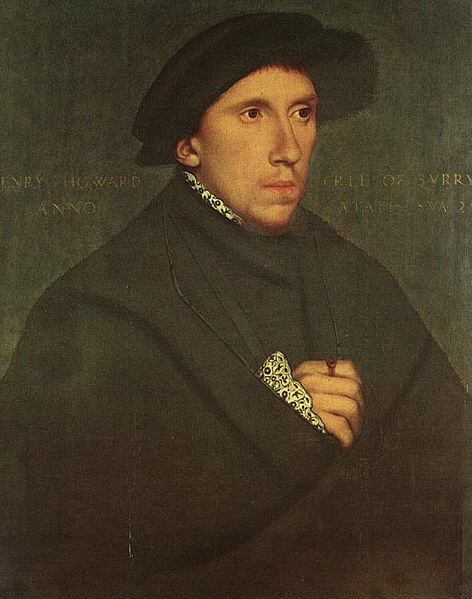
On this day in history : 13th January 1547 – Henry Howard, Earl of Surrey – courtier, soldier and poet – is found guilty of treason and is sentenced to death….

Born around 1517 in Hunsdon, Hertfordshire, Surrey was the eldest son of the 3rd Duke of Norfolk, Thomas Howard….and was descended from Royalty on both sides of his family…. It was upon the death of his grandfather, the 2nd Duke of Norfolk in 1524, that he gained the title of Earl of Surrey….

img_2137
Henry Howard, Earl of Surrey – Artist : Hans Holbein the Younger

Surrey was a bright child; at the age of 12 he could translate Latin, Italian, French and Spanish – his father made sure he had the best education…. It was around this time he became companion to Henry Fitzroy, Duke of Richmond – who was the illegitimate son of King Henry VIII…. The two boys spent their time at Windsor and became close friends….Surrey was even considered as a potential husband for the King’s daughter, Mary (later to become Queen Mary I) ~ a suggestion put forward by Surrey’s first cousin, Anne Boleyn….

In 1532 Surrey and Richmond accompanied King Henry to the court of King Francis I of France – and the pair of young men ended up staying in the French court for almost a year…. Here they gained cultural graces – and it is possible that it was when Surrey developed his passion for poetry….as he became acquainted with the work of Luigi Alamanni – Italian poet and statesman….

Surrey and Richmond returned to England in 1533 – and within a short time both were to be married – Richmond to Surrey’s sister, Mary – and Surrey himself to Lady Frances de Vere, daughter of the 15th Earl of Oxford…. However, Surrey and his new bride did not actually live together as man and wife until 1535 – on account of their young age…. They went on to have five children, two sons and three daughters….

img_2140
Frances de Vere by Hans Holbein the Younger C.1535 – public domain

1536 proved to be a turbulent year for Surrey; it was the year his first child was born, a son – but other events were not nearly as happy…. His cousin Anne Boleyn was executed – and his beloved friend Henry Fitzroy died, aged just 17…. In October 1536 Surrey served alongside his father to quash the ‘Pilgrimage of Grace’ – a rebellion protesting against King Henry VIII’s dissolution of the monasteries…. Surrey was a good soldier – and his family had a long history of loyalty to the Tudors….

By all accounts Surrey was an arrogant, vain, boorish, reckless, rash and ambitious man….with a contempt for the lower class of nobility – the ‘new men’ of the court – the likes of Thomas Cromwell and the Seymours, a family who were old rivals of the Howards’…. Surrey was a dashing and formidable character and although he had his enemies within the court, he also had plenty of friends….but his vanity and reckless ways were to eventually contribute to his downfall….

img_2135
Henry Howard, Earl of Surrey – 1546 Painting attributed to William Scrots

His troubles really began when Jane Seymour became King Henry’s Queen…. Surrey had always been popular with the King in the past – but his popularity declined as the Seymours rose is favour after the marriage…. The Seymour family began to scheme….in 1537 they accused the Howards of sympathising with the Pilgrimage of Grace…. An unwitting courtier happened to repeat the slander in court – Surrey reacted in his typical hot-headed way – by striking his fellow courtier….an action that landed him in imprisonment…. It was whilst confined in Windsor, by order of the privy council, that he penned one of his most well-known poems – ‘Prisoned in Windsor’ – in which he recounts his childhood days….

Surrey – (along with fellow poet and friend, Thomas Wyatt) – was responsible for the introduction of the sonnet to English poetry…. He has to be noted as one of the founders of English Renaissance Poetry and for his contribution to English literature…. Without his input the works of the likes of William Shakespeare would have undoubtedly been very different to how we know them – for it was Surrey who gave the rhyming meter and division into quatrains that gives us the Shakespearean sonnet…. Surrey was also the first poet to publish blank verse – regular metrical but un-rhyming lines…. Much of Surrey’s poetry would likely have been written during the two years he was held at Windsor….

By the 1540s he was back in favour at court….and was made a Knight of the Garter in May 1541 – and received the honour of Steward of the University of Cambridge…. But he was not to mellow – he still had his hot-headed moments and outbursts…. In 1542 he was imprisoned after quarrelling with another courtier….and again in 1543 after going on a drunken rampage – smashing windows in a London street…. It was during this particular stay in prison that he composed his ‘Satire against the Citizens of London:London, hast thou accused me’….

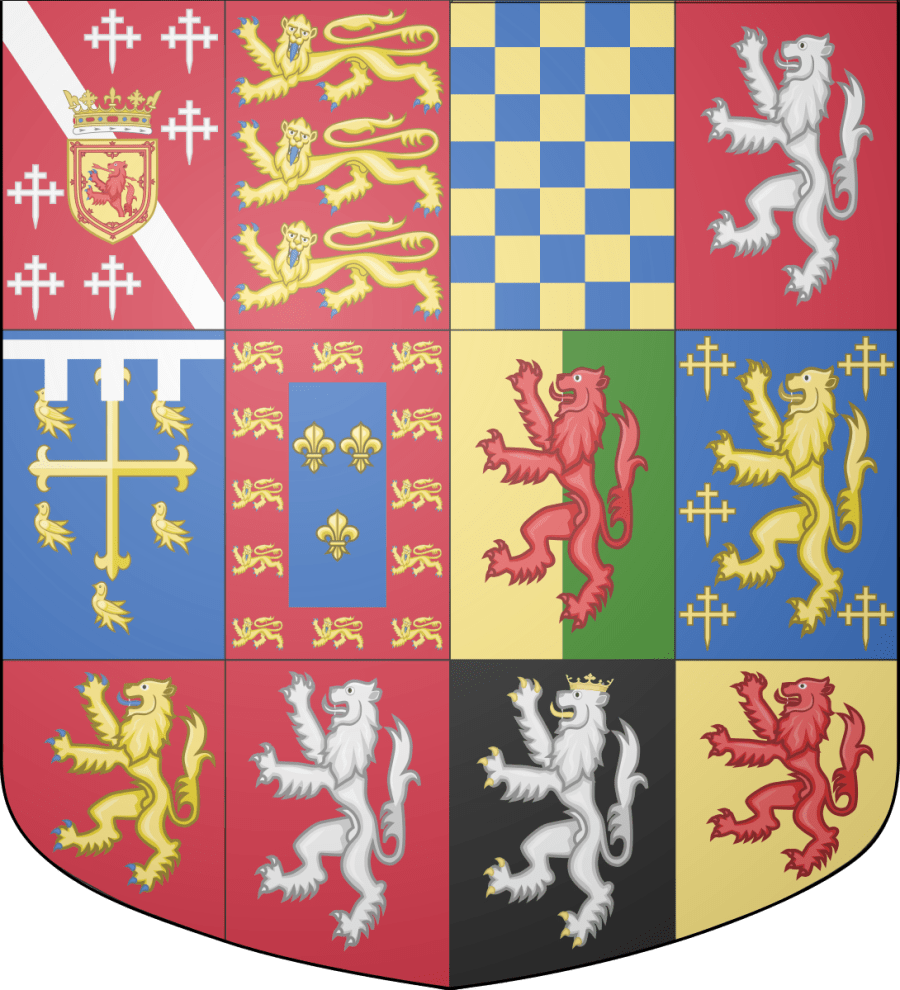
King Henry’s health was failing – and he began to view Surrey – with his powerful family connections – as a real threat, some would say to the point of paranoia…. He became convinced Surrey was going to attempt to usurp the crown from Prince Edward, his son and heir…. Things came to a head when Surrey foolishly incorporated Royal arms and insignia into his own heraldry – to prove a point as to his own Royal descent….

img_2139
The arms for which Surrey was attainted (Edward the Confessor’s arms are in the fifth quarter with a label of three points plain…. Silver&Gold CC BY SA 4.0

Surrey – and his father – were arrested and imprisoned in the Tower of London, on the charge of treason…. On the 13th of January 1547 they were found guilty and sentenced to death…. Surrey put up a spirited defence at his trial (which lasted a day) – but to no avail…. Several other claims were brought against him, such as being a secret papist….there was no real evidence to any of the charges – but he was still condemned….

Surrey was beheaded on the 19th of January – on Tower Hill…. His father was more fortunate; King Henry VIII died before the scheduled execution and the Duke of Norfolk was pardoned and released by Queen Mary I….

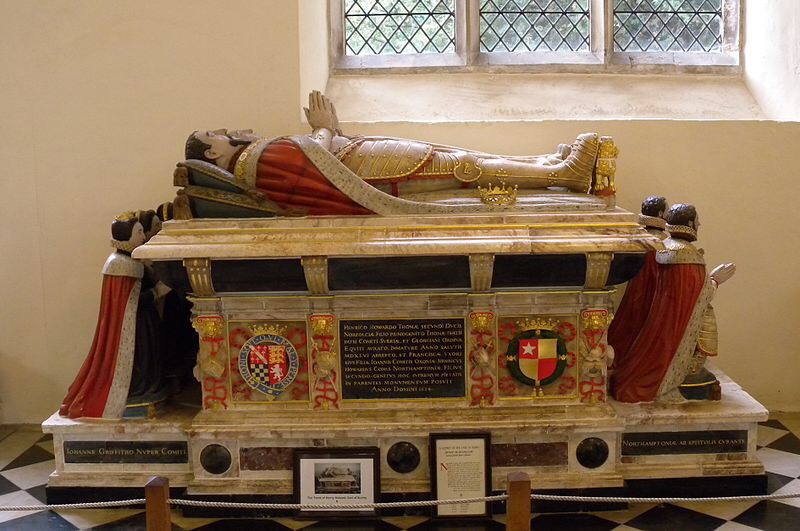
Surrey was buried at All Hallows’ Church in Barking…. However, in 1614 his second son, Henry, Earl of Northampton had his father’s remains moved to St. Michael’s at Framlingham, Suffolk – the family church…. Surrey was laid to his final rest in a magnificent tomb….

img_2134
Image credit : Steve Parker via Flickr

His poetry, although circulated at court, only became really known 10 years after his death…. Printer Richard Tottel published ‘Songs and Sonnets written by the Right Honourable Lord Henry Howard late Earl of Surrey and other’ – (now generally known as ‘Tottel’s Miscellany’) – a collection of 271 poems – 40 of which are by Surrey and 96 by Thomas Wyatt….

Alas! so all things now do hold their peace,Heaven and earth disturbed in no thing.
The beasts, the air, the birds their song do cease,
The nightes car the stars about doth bring.
Calm is the sea, the waves work less and less:
So am not I, whom love, alas, doth wring,
Bringing before my face the great increase
Of my desires, whereat I weep and sing
In joy and woe, as in a doubtful ease.
For my sweet thoughts sometime do pleasure bring,
But by and by the cause of my disease
Gives me a pang that inwardly doth sting,
When that I think what grief it is again
To live and lack the thing should rid my pain.
                               - Henry Howard
img_2136
Henry Howard, Earl of Surrey National Portrait Gallery

On this day in history….12th January 1950

On this day in history : 12th January 1950 – A British submarine and Swedish oil tanker collide in the Thames Estuary – resulting in the sinking of the submarine – and 64 deaths….

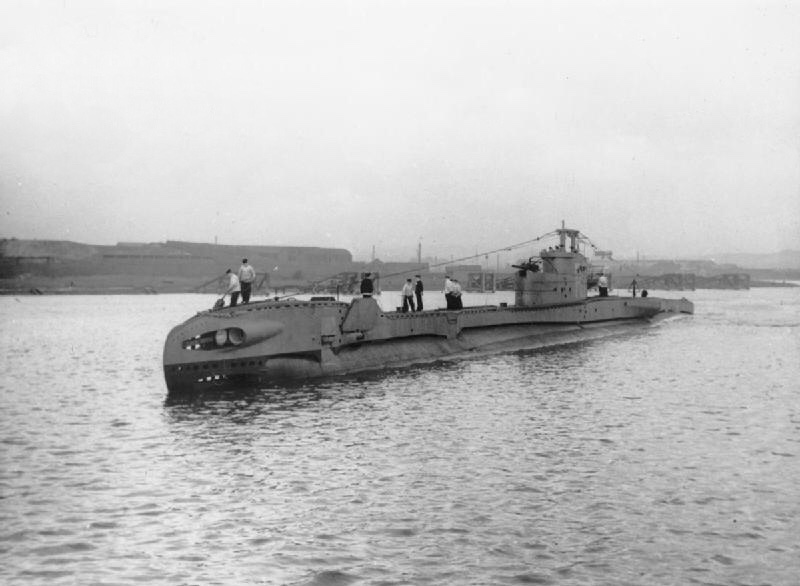
HMS Truculent was returning to Sheerness having undergone trials at Chatham following a refit…. As well as her usual crew the submarine was carrying an additional 18 workers from the dock yard….

img_2130
HMS Truculent 1942 – Image from the collections of the Imperial War Museums

It was 7pm and Truculent was making her way along the surface of the Estuary – when a ship showing 3 lights appeared ahead in the Channel…. Crew on board the submarine believed the vessel to be stationary – and aware they could not pass on the starboard side, for fear of running aground – the order was given to turn to port…. Too late it became obvious the ship was not anchored and was in fact moving – and the extra light was to indicate she was carrying explosive material….

The two vessels collided; the bow of the 643 ton Swedish oil tanker – the ‘Divina’ – striking HMS Truculent – and the two remained locked together for several seconds before the submarine sank to the bottom of the Estuary…. The crew of the Divina – which was on route to Ipswich from Purfleet with a cargo of Paraffin – immediately went into action…. Ropes and life belts were thrown to the men thrashing in the water…. Divina’s lifeboat was launched and 15 men were picked up – a further 5 were rescued by the Dutch ship ‘Almdijk’….


Ironically very few died as a direct result of the immediate impact….the majority managed to escape. Out of the 64 men who died most lost their lives through drowning or by perishing in the freezing conditions on the mudflats of the Estuary….

The 1,000 ton submarine was salvaged on the 14th of March 1950 – and 10 more bodies were recovered. In May 1950 she was sold as scrap….

An inquiry into the incident put 75% of the blame on to HMS Truculent…. Later the disaster was to lead to the introduction of the ‘Truculent light’ on the bow of British submarines – to make them visible to other ships….

img_2131
HMS Truculent Memorial Service 2014 – Image credit : Matthew via Flickr