On this day in history : 22nd June 1959 – Shareholders are urged by the directors of Harrods to vote for a merger with the Debenhams department store chain in a £34m deal….
Harrods was started by Charles Henry Harrod as a grocery business in 1849…. His son, Charles Digby took over in 1861 and started to sell a varied range, including furniture, china, cosmetics and perfumes…. Since the 1920s it has become one of the most famous and prestigious department stores in the world….
Fashion plate, 1909 – Fashionable Londoners walking in front of Harrods – Public domain
Over the years Harrods and Debenhams had become informally linked – an official merger would provide a way of cutting overhead costs, resources could be pooled when purchasing stock…. However, as it was Harrods was in the position that two merger possibilities were available to them – the one with Debenhams and a further unofficial one, as yet, with House of Fraser…. Harrods directors began to hold meetings to discuss the options…. The Debenhams deal included an offer of £34m – and would allow Harrods to continue to operate under its own name, with Sir Richard Burbridge as chairman…. Whereas the House of Fraser offer was for £32.5m and the deal would give Harrods directors far less power in the running of the merged company…. It was thought that a merger between Debenhams and Harrods would provide much improved services for the shopping public – the board urged its shareholders to vote for the Debenhams deal….
A third bid of £36m then came in from United Drapery Stores….but was later withdrawn…. The bidding war raged on with House of Fraser raising its bid to 37m and on the 24th of August 1959 it had acquired enough shares to see off the competition from Debenhams…. The battle was over….
In 1985 House of Fraser was bought by Mohammad al Fayed and his brother for £615m and Harrods returned to private ownership…. In 1994 all House of Fraser stores were floated on the Stock Exchange – with the exception of Harrods….
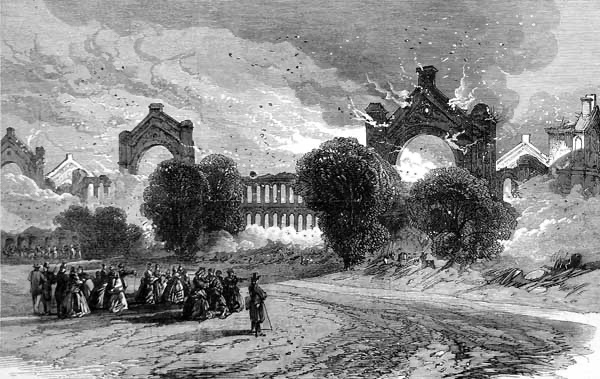
On this day in history – 9th June 1873 – Alexandra Palace, often referred to as the ‘Ally Pally’, is burned to the ground – just sixteen days after being opened to the public….
Original Alexandra Palace on fire – Illustrated London News – Public domain
In an idea conceived by architect Owen Jones in 1859, the intention was to build a counterpart to South London’s Crystal Palace…. It was to be North London’s centre of recreation, entertainment and education – ‘The People’s Palace’….
By 1860 The Great Northern Palace Company had been established – however, it was unable to raise the required finances to start work immediately…. The building materials were eventually acquired and recycled from the 1862 International Exhibition which had been demolished in South Kensington….
In 1863 the company managed to secure Tottenham Wood Farm as land on which to build its Park…. The Park opened to the public on the 23rd of July 1863 and was named after Alexandra of Denmark, the Princess of Wales and wife of the future King Edward VII….
The building of the Palace began and in 1871 construction started on the Edgware, Highgate & London Railway – to connect the site with Highgate Station…. The work on the Palace was undertaken by Kelk & Lucas – who also built the Royal Albert Hall around the same time…. Both Palace and railway were completed in 1873…. On the 24th of May 1873, just in time for Queen Victoria’s birthday, the Palace and Park officially opened to the public…. Some 120,000 people gathered for a performance by Victorian operatic singer Sims Reeves, to listen to recitals and watch a spectacular firework display….
Sixteen days later, at around lunchtime, workmen were working on the roof of the dome – when a burning ember escaped from a brazier they were using…. At first it was thought the fire could be contained – and so there was a delay in calling the fire service…. But the fire was to spread rapidly – staff rushed from room to room, tearing valuable paintings and tapestries from the walls and gathering up books and artefacts….
At 1.30pm the roof collapsed – falling on to the £30,000 organ below which had been designed by Henry Willis…. It is said the crash could be heard six miles away…. Three members of staff were killed and a priceless collection of some 4,700 pieces of historic English pottery and porcelain on loan to the Palace was destroyed….
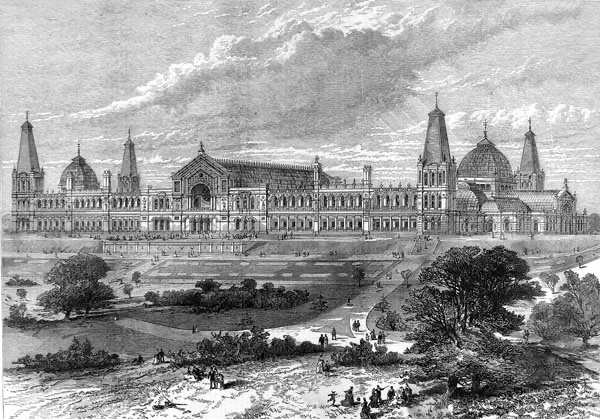
All that was left of Alexandra Palace were the outer walls…. Never-the- less, in true Victorian form, the Palace was rebuilt and reopened on the 1st of May 1875….
Rebuilt Palace 1875 – Illustrated London News – Public domain
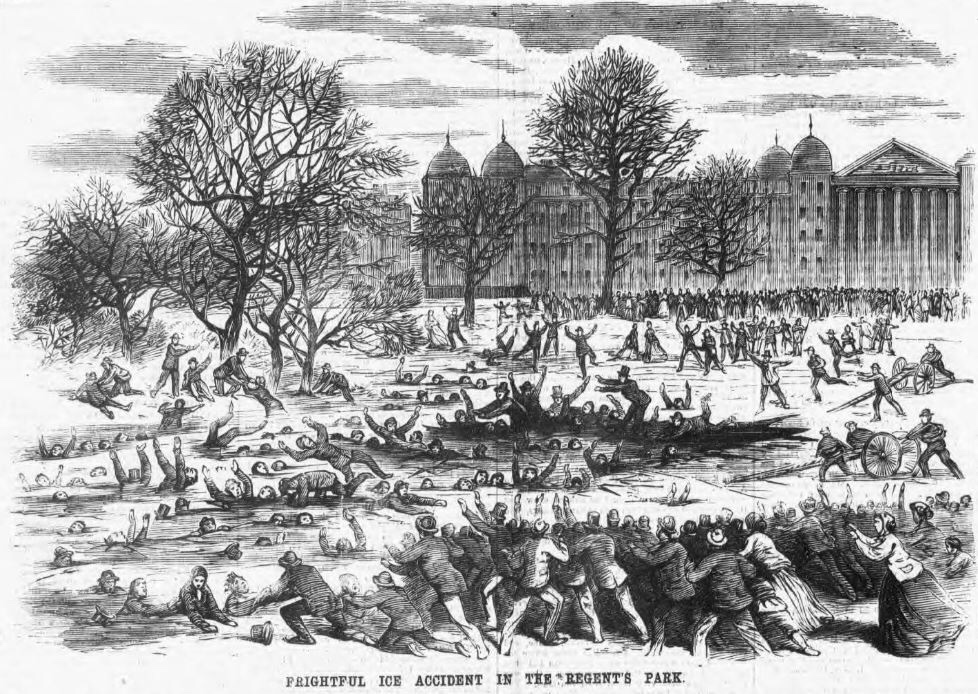
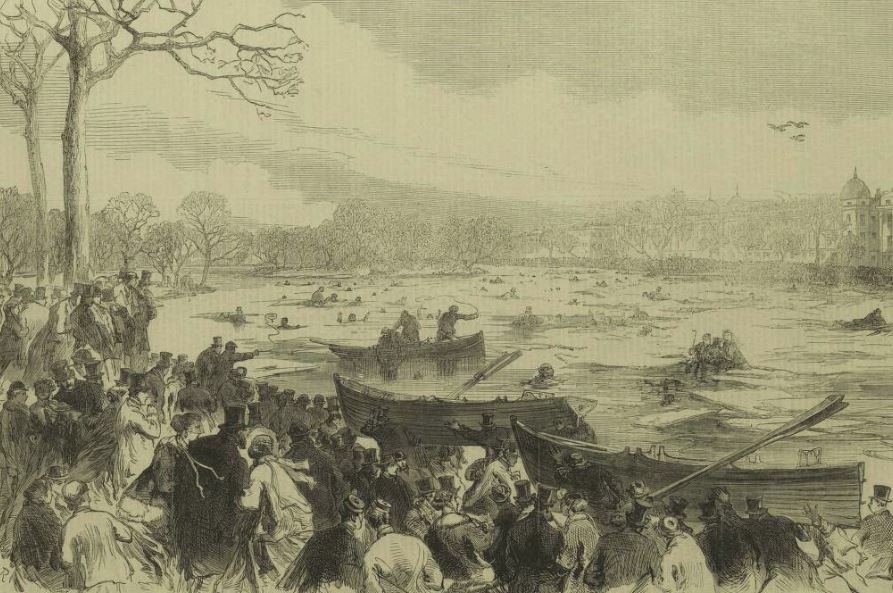
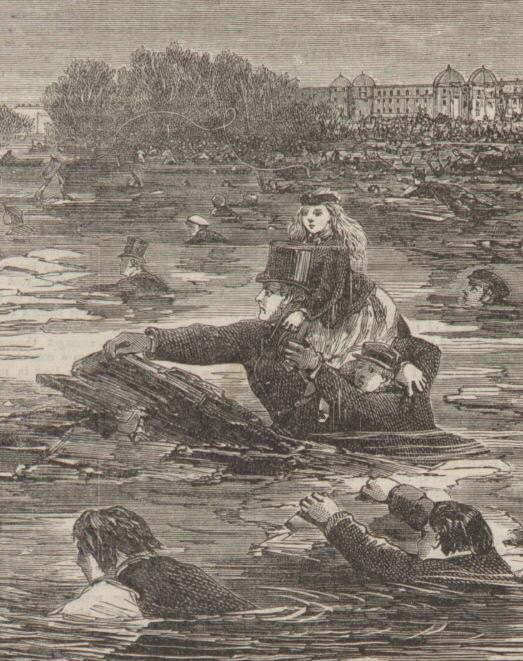
On this day in history : 15th January 1867 – Ice covering the boating lake at Regent’s Park gives way…. Hundreds of skaters are plunged into the icy water – 40 people lose their lives….
Illustrated Police News – 19 January 1867
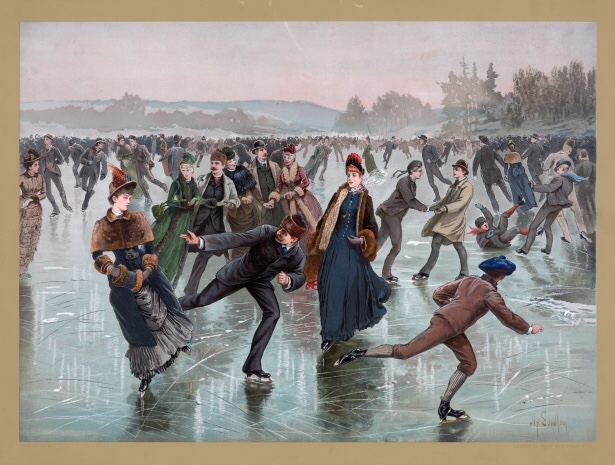
Ice skating was an extremely popular leisure activity during Victorian times – frozen ponds and lakes were often advertised in newspapers…. Up to 300 people were enjoying themselves on the ice in Regent’s Park this particular afternoon – skating, sliding, playing games of ice-hockey….
At around 4.15 the ice suddenly gave way with no warning – breaking into thousands of pieces…. Between 100-200 people were plunged into 12 foot of icy water – the weight of their heavy Victorian clothing dragging them down…. Boats were hurriedly launched to try and rescue those floundering in the water….passers-by reached out with branches broken from trees….
Illustrated London News – 26 January 1867
Those who lost their lives came from all walks of life, from gentry to the very poor…. Most were young men but there were also women and children among them…. 29-year-old James Griffin was on the ice selling oranges to the skaters – and another, John Bryon, was selling hot roasted chestnuts…. It took over a week to recover all of the bodies, fishermen from Kew were used to drag their nets along the bottom of the lake….
There was much debate at the later inquest, as to the cause of the accident…. Some blamed Skating Club members acting as stewards (known as ‘Icemen’) for breaking the ice around the edges to prevent access to the island…. They in turn blamed the ice-hockey players, people who had been jumping on the ice and even the sun for melting it…. Park keepers also came under scrutiny – as it was thought they may have broken the ice out of concern for the large collection of exotic water fowl housed on the lake…. But in truth the skaters themselves were chiefly to blame for their own misfortune….
Penny Illustrated Paper – 26 January 1867
The previous day 21 people had fallen through the ice – thankfully all had been rescued…. An overnight dusting of snow had covered the cracks so they were not visible…. Despite prominent signs being displayed, warning of the danger of thin ice, such was the enthusiasm to have fun that the signs were ignored….
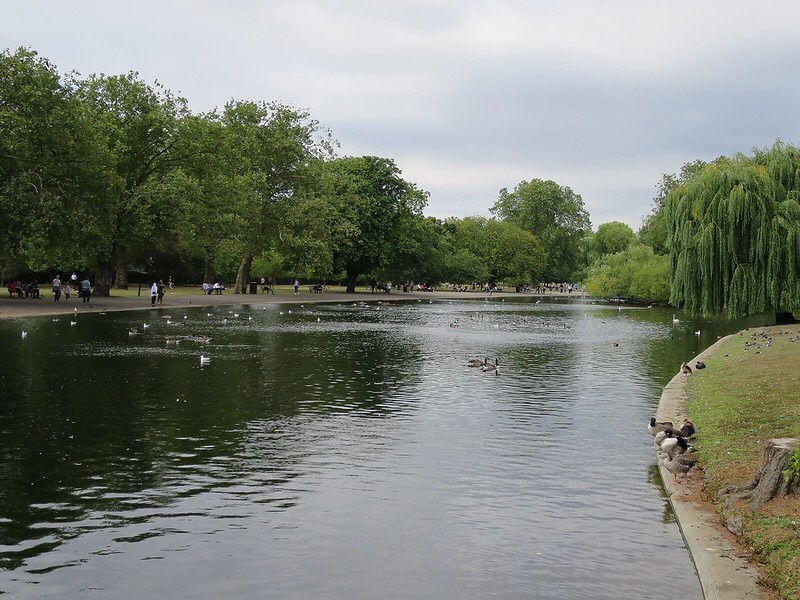
As a precaution to prevent such a tragedy from happening again the lake was drained and the depth reduced to 4 or 5 foot with soil and concrete…. However, the public were slow to learn – years later a similar incident was to happen….only this time because of the depth none of the 100 or so who fell in received anything more than a very cold bath….
Regent’s Park Boating Lake – Alan Stanton via Flickr
On this day in history : 7th January 1928 – The River Thames bursts its banks and floods much of Central London…. Fourteen people lose their lives and thousands more are made homeless…. The Tower of London, Houses of Parliament and Tate Gallery are all swamped….
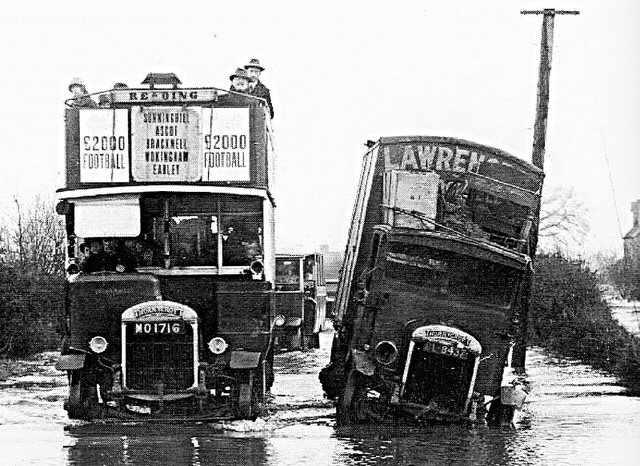
During Christmas 1927 heavy snow had fallen in the Cotswolds, where the Thames has its source…. A sudden thaw on New Years Eve, followed by excessive heavy rain meant there was double the usual volume of water coming down river…. This coincided with a high spring tide – but at the same time a storm surge, caused by a cyclone in the North Sea meant water levels were raised in the Thames Estuary….
Floods at Reading in January 1928 – showing the impact of the Thames flooding even further down river…. Image credit : Alan Farrow via Flickr
The situation was made even worse by dredging work that had been carried out in the Capital between 1909 and 1928 to deepen the river channel – to allow easier access for shipping in to the Port of London….
The river burst its banks just after midnight – when most Londoners were in their beds…. The first section to break was a 75ft stretch at Millbank – opposite the Tate Gallery…. Water poured into the gallery, up to 8ft deep on the ground floor….18 paintings were damaged beyond repair, 226 badly damaged and a further 67 received minor damage…. Many were by renowned artist J.M.W. Turner….
Westminster Hall and the House of Commons were flooded, as were most underground stations close to the river…. The Blackwall Tunnel was submerged, as was the Rotherhithe Tunnel…. The moat surrounding the Tower of London, which had been empty for over 80 years, was filled…. The flooding extended from the City of London and Southwark right to Putney and Hammersmith….
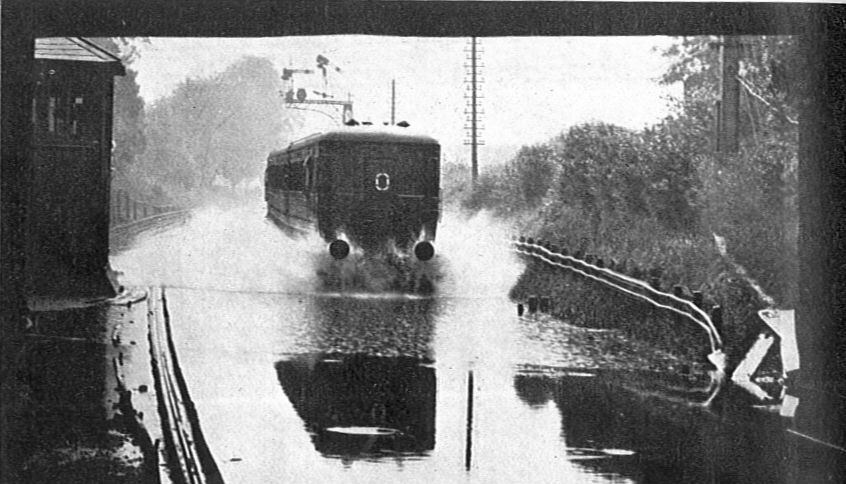
A Southern Railway electric multiple unit tackles floods at Kew Bridge railway station Credit : Andy Dingley (scanner) – Public domain
However, the most devastating part of the disaster has to be the human cost…. As the embankment near to Lambeth Bridge broke floodwaters gushed onto the streets of the run-down working-class area between Southwark and Blackfriars, which backed on to the river…. Water poured into the basements….which were the homes of so many of London’s poorer people….
There was little time to escape; police went from door to door, urging people to leave….many did, wearing just their nightclothes….but for some it was too late….
As the water poured into these basements nine people drowned – and another died from a heart attack brought on by the shock…. Alfred Harding later had to identify the bodies of 4 of his daughters:- Florence Emily, 18 – Lillian Maude, 16 – Rosina, 6 and Doris, who was only 2-years-old….
Two more died in Hammersmith, domestic servants Evelyn Hyde, aged 20 and Annie Masters Moreton, aged 22 – who shared a basement room…. Another two people died in Fulham…. 4,000 were made homeless….
The flood peaked at 1.30am, at a level of over 18ft above the Ordnance Datum line….the highest water level ever recorded in the Thames at London…. The water had subsided by the end of the day – but it took a month to pump all of it away…. The damage took several years to repair….many of the old slum areas had to be demolished, Millbank and the surrounding area had to be virtually rebuilt…. Political rows broke out over who should pay for the clean-up operation – was it the responsibility of local or central government…. Arguments also occurred amongst authorities and politicians over the role the dredging work had played in the disaster….
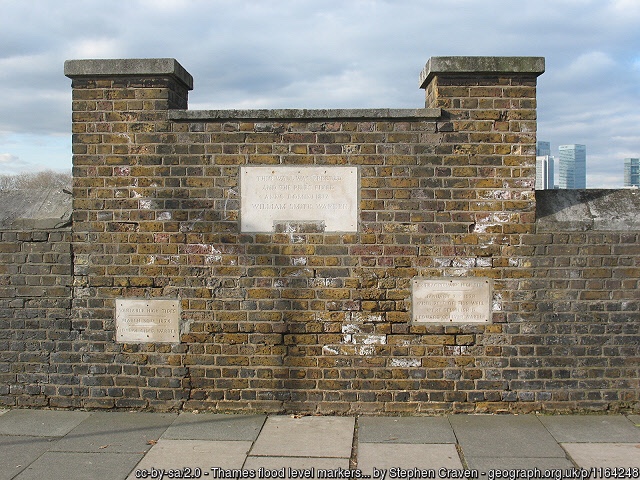
Thames flood level markers at Trinity Hospital, Greenwich
The embankments had once been marshland but were reclaimed during the Victorian era and had been developed for housing and commercial purposes…. As a result of the 1928 flood the river’s embankments were raised…. Thankfully it was the last major flood to occur in the city – but it came close again in 1953 – when the river almost broke the embankment – and did cause some flooding at Bermondsey and other low-lying areas…. A further flood occurred on the Lower Thames in 1959….
At last the government were prompted to consider flood defence – once again there were disagreements over who should foot the bill…. Plans were made in the mid 1960s for a flood barrier – and in 1974 work finally got underway…. The Thames Barrier officially opened in 1984….
On this day in history : 3rd January 1911 – The Siege of Sidney Street takes place….a gun battle is waged on the streets of London as two Latvian anarchists hold out in an East End tenement for several hours – against over 200 armed police and a detachment of soldiers….
The drama had begun to unfold three weeks previously, on the 16th of December 1910. A gang of Latvian revolutionaries had attempted to rob a jeweller’s shop in Houndsditch. The gang, calling itself ‘Leesma’, meaning ‘flame’, consisted of approximately thirteen people, including two women….their purpose was to commit robberies to raise money to help fund fellow activists in Latvia and Russia, who supported Lenin and the Bolshevik Movement….
The gang had rented rooms in a building annexing the back of the jeweller’s shop….the plan was to break through the common wall between the two adjoining properties. They chose to carry out their planned robbery on a Friday night….but being a predominantly Jewish neighbourhood – and Friday being the Jewish Sabbath – it was a particularly quiet time. Alerted by the noise the gang were making whilst attempting the robbery local residents called the police….
Eight unarmed police officers arrived, three sergeants and five Constables….the gang opened fire on them. Three policemen were killed and two were injured – the gang then made their escape…. One Latvian was injured – having been shot accidentally by another member of the gang. He was carried away by his friends but later died from his injuries – and was found dead in his lodgings the following morning….
The police immediately mounted a search and by the end of December had most of the gang in custody…. They then received a tip-off that two members, Fritz Svaars and William Sokolow, were hiding at 100 Sidney Street, which is located at the heart of Stepney. A room at the address was being rented by Betsy Gershan, the girlfriend of Sokolow. Being the East End of London the area was very overpopulated and the property itself overcrowded….fourteen people were registered at the address, two families with young children….
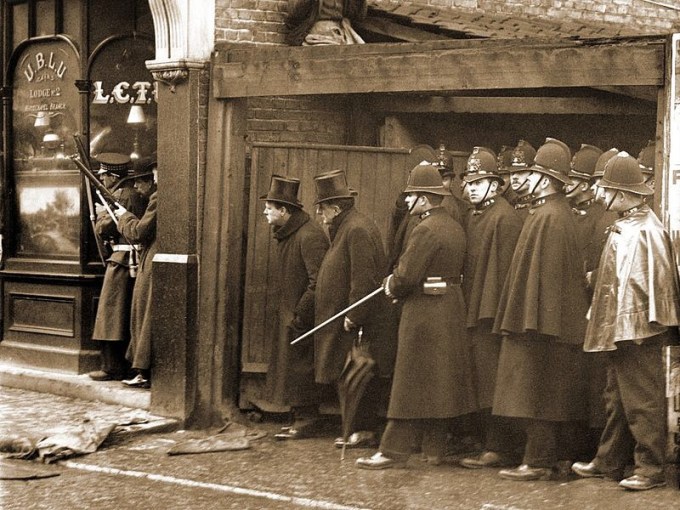
At midday on the 2nd of January two horse-drawn vehicles arrived in Sidney Street; concealed inside were armed policemen – and the building was placed under observation….
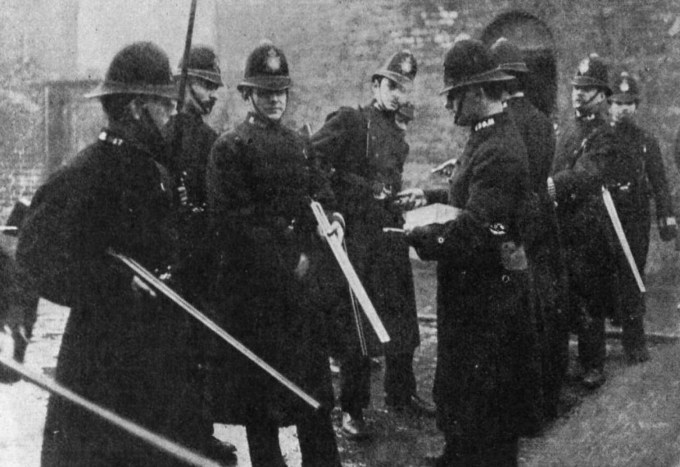
During the early hours of the 3rd of January a long snaking line of over 200 policemen made their way to 100 Sidney Street. Some were armed – but their weapons, such as revolvers, shotguns and tube guns, were old and antiquated. The men had not been briefed as to the nature of the task at hand – but they knew it was dangerous, as married men had been excluded from the operation….
By dawn all was in place and the police were ready to take action. Somehow they managed to evacuate 100 Sidney Street and the surrounding properties without alerting Svaars and Sokolow, who were on the second floor…. The pair were Continue reading “On this day in history….3rd January 1911”→