On this day in history : 12th September 1878 – Cleopatra’s Needle is erected in the City of Westminster, London…. It had originally been presented to the UK by the ruler of Egypt and Sudan in 1819….
An 1840 portrait of Muhammad Ali Pasha, leader of Egypt and Sudan – by Auguste Couder – Public domain
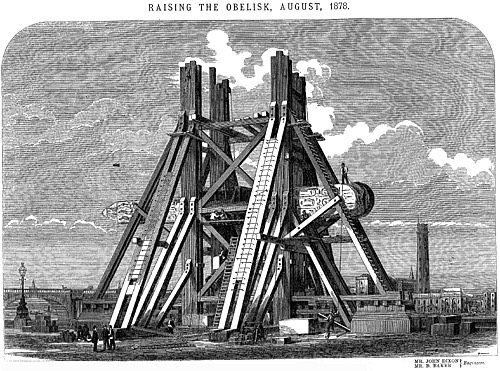
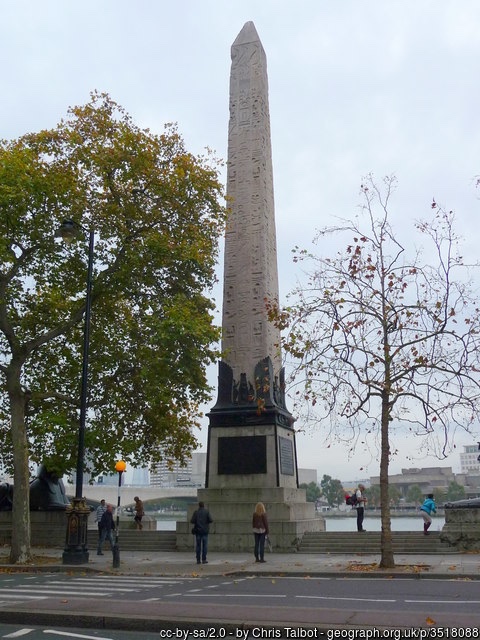
The red granite obelisk, which is over 2,000 years old, had been given to Britain to commemorate the victories of Lord Nelson (Battle of the Nile, 1798) and Sir Ralph Abercrombie (Battle of Alexandra, 1801) – but it had taken until 1877 to arrange for its transportation to Britain…. Standing at 69 feet high and weighing 224 tons this was no easy task; a special floating ‘pontoon’ had to be designed so it could be towed to London….
Encasing Cleopatra’s Needle for shipment to London – Flickr’s The CommonsLondon’s Needle being erected – Public domain
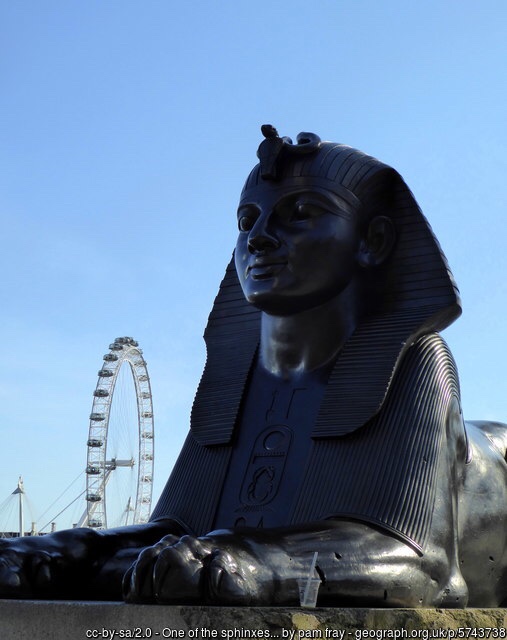
Cleopatra’s Needle is one of three similarly named obelisks; its counterparts can be found in Paris and New York…. London’s Needle is flanked by two bronze reproduction sphinxes, designed by English architect George John Villiamy…. Concealed in the pedestal, on which the obelisk stands, is a time capsule….contained within are items such as:- a portrait of Queen Victoria, a map of London, copies of newspapers, a set of British coins, a box of cigars, children’s toys, a box of hairpins and a dozen photographs of the most attractive women of the day….
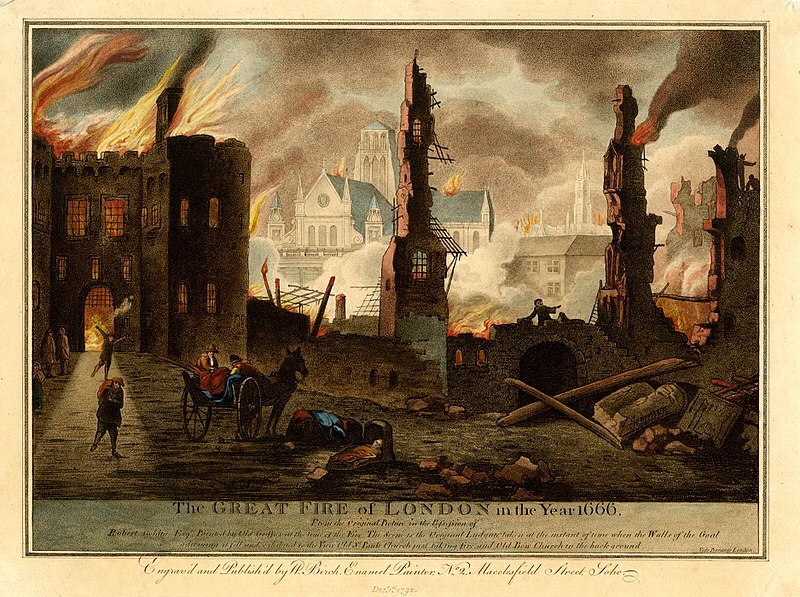
On this day in history : 2nd September 1666 – The Great Fire of London starts in a baker’s shop in Pudding Lane…. The fire blazes for four days and destroys over 13,000 buildings….
Unknown artist – Public domain
The fire started in the bakery of Thomas Farriner, shortly after midnight and rapidly spread across the old medieval city – the flames fanned by a strong easterly wind…. Fires were commonplace at the time and were usually quickly put out – but it had been a very hot summer and there had been no rain for weeks and the old timber and thatched roofs of the buildings were very dry and provided a ready fuel….
The main fire fighting technique of the time was to demolish buildings to create firebreaks…. However, hesitation by the Lord Mayor of the time, Thomas Bloodworth, who said -“Pish! A woman might piss it out!”- meant by the time demolition commenced it was too late to be effective….
Ludgate and old St Paul’s – Unknown artist – Public domain
As a last resort gunpowder was used to blow up houses in the path of the fire to create a larger firebreak – which in turn started rumours circulating that the French were invading! By the time the fire had finally been put out only a fifth of the old city was left standing…. 13,200 houses had been destroyed, 87 churches, St. Paul’s Cathedral and most of the city authorities buildings…. Out of 80,000 inhabitants living in the city at the time it is estimated around 70,000 were made homeless…. Surprisingly the death toll, although officially unknown, is not thought to have been particularly high – only six deaths were recorded at the time…. However, it could be argued this figure is irrelevant and the true number may well have been much higher than believed, as deaths of the poor were not usually reported…. Such was the intensity of the heat many of the remains would have been cremated beyond recognition of even being human….
On this day in history : 12th August 1949 – A flock of starlings take roost on the minute hand on one of the clock faces of Big Ben, slowing it down by four and a half minutes….
Photo credit : Pierre Selim CC BY-SA 3.0
Listeners to the BBC’s 9 O’Clock News were surprised to hear the bullet-in start without the customary chimes of Big Ben…. Later in the broadcast the BBC announced that “swarms of starlings are sitting on the hands holding them back”….
That evening the flock had decided the clock hand would make a good perch for the night and their combined weight had slowed the clock down so it was unable to chime at the correct time…. However, by midnight everything was ‘back to normal’….
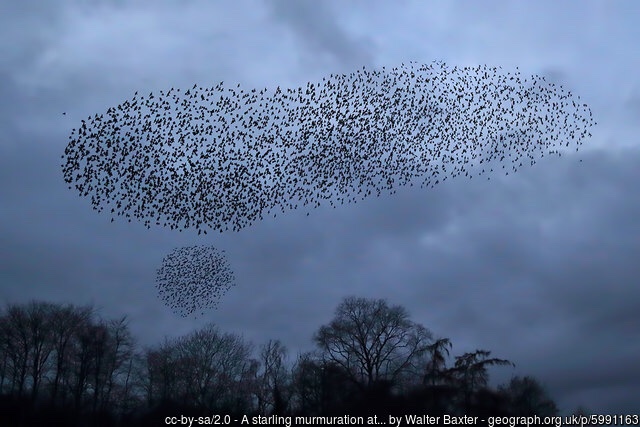
There was a time when the Capital was home to many flocks of starlings – who gave an impressive show with their murmurations…. To see starlings take to the sky in this way is one of nature’s most spectacular wonders…. The numbers were at their largest in the winter months when the birds joined forces to keep warm at night….
Starling murmuration
Sadly the starlings left London and in fact numbers across the whole of the UK are down by 70%…. Once such a common bird they are now on the critical red list…. Loss of permanent pasture, an increase in the use of chemicals, a shortage of food and nesting sites are all contributing factors…. The expansion of London itself pushes the birds further and further afield….
Incidentally, Big Ben was to run slow once again on New Year’s Eve 1962…. Snow jammed the north face clock and ice coated the minute hand….causing New Year to be rung in 10 minutes late…. To think Big Ben survived the Blitz – yet can be hampered by a bit of snow or a flock of birds….
On this day in history : 20th July 1837 – Euston Station, London’s first intercity railway station is opened – having been built on what was mostly farmland at the edge of an ever expanding city….
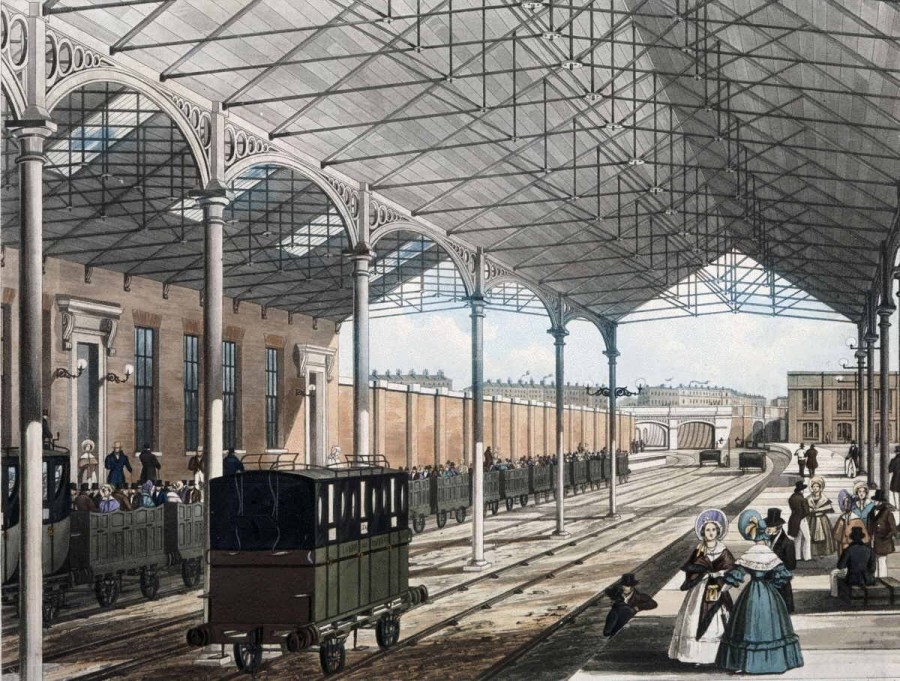
Early print of Euston, showing the wrought iron roof of the original station – Public domain
The site had been chosen in 1831 and the station was named after Euston Hall in Suffolk, the ancestral home of the Duke of Grafton – who was the main landowner in the area….
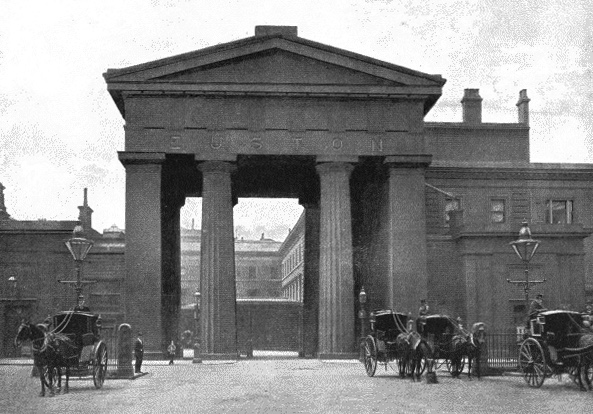
The original station was designed by classically trained architect Philip Hardwick….and built by William Cubitt, who also constructed Covent Garden and Fishmongers’ Hall…. The station housed a 200ft (61m) long train shed and two 420ft (130m) long platforms – one for arrivals and one for departures…. The main entrance portico – ‘Euston Arch’ – was also designed by Hardwick….it was to symbolise the arrival of a major new transport system – a ‘gateway to the north’…. At 72ft (22m) high, with four 44ft 2in (13.46m) by 8ft 6in (2.59m) columns made from Bradley Fall stone it was the largest of its kind and at a cost of £35K (over £4m today)…. It was described as being “Mightier than the Pyramids of Egypt”….
Euston Arch, 1896 – Public domain
In 1839 two hotels were added, again designed by Hardwick…. One stood at either side of the Arch – The Victoria with basic facilities and The Euston to cater for first class passengers….
The station expanded rapidly…. In 1838 it was handling some 2,700 parcels a month but by 1841 this had increased to over 52,000…. More and more staff had to be employed and more lines and platforms were added….
Plan of Euston Station from 1888 – Public domain
By the 1950s the station was considered ‘tired’ – it was old-fashioned and dirty from soot…. In 1953 a full redecoration and restoration program took place and modernised ticket machines were installed…. Then in 1959 British Rail announced a complete rebuild….to accommodate a fully electrified West Coast main line….
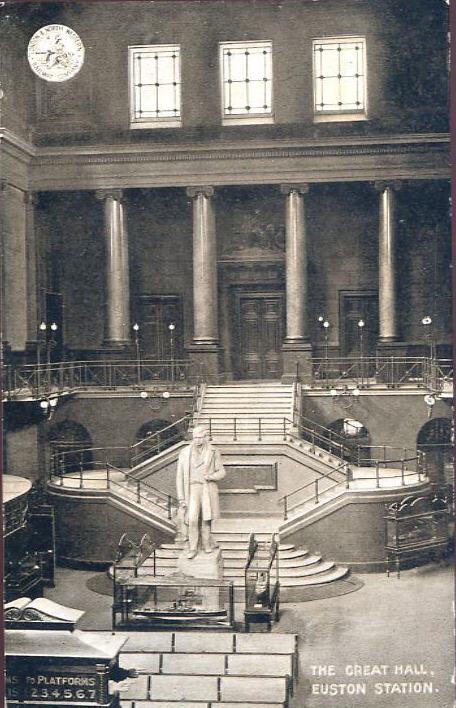
The Great Hall – L&NWR – Public domain
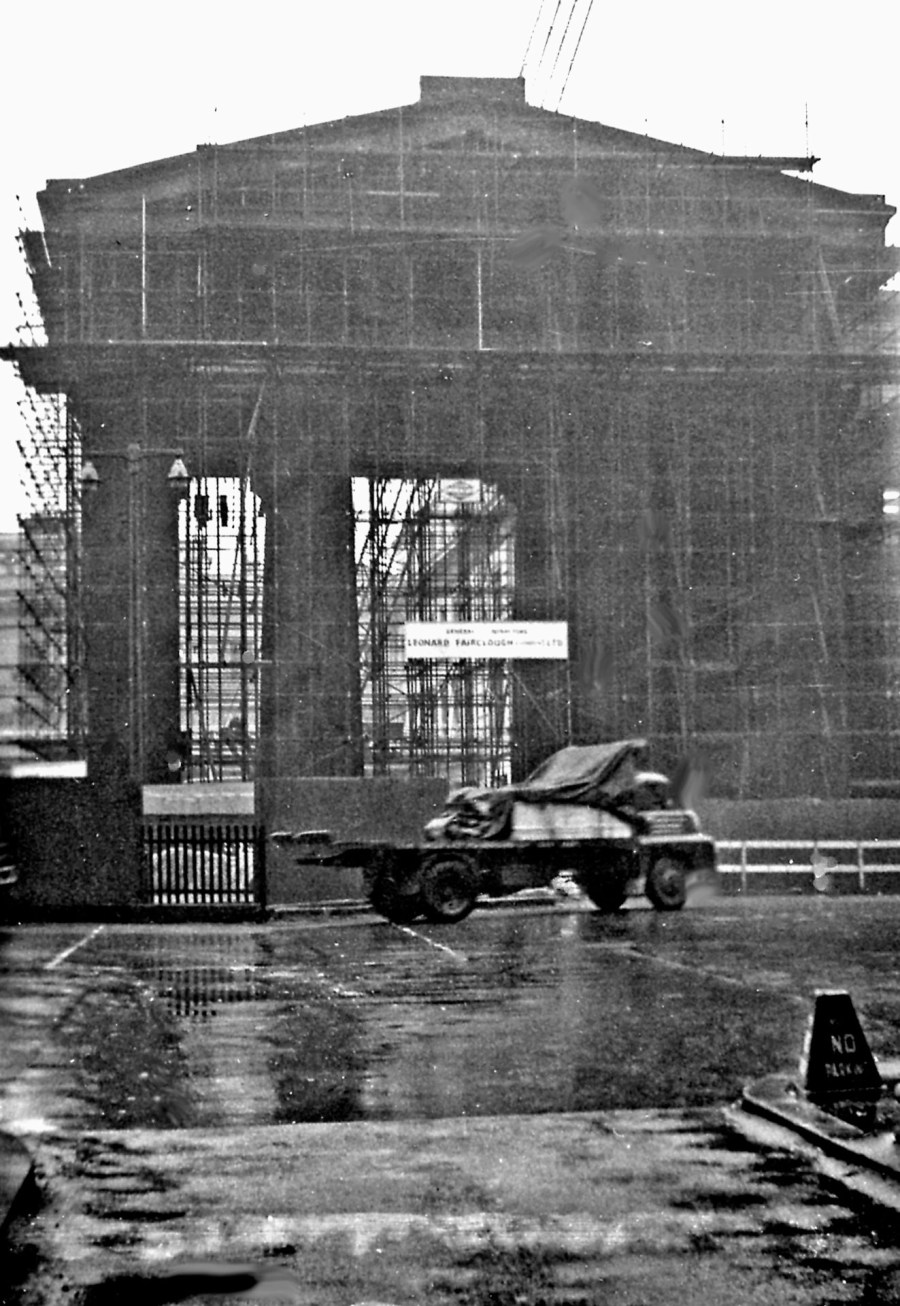
However, this was not without controversy…. In July 1961 it was announced that the Euston Arch and Great Hall were to be demolished…. On the 16th of October a demonstration including students and 75 architects took place in protest…. But to no avail – in the summer of 1962 work on the new station began….
The Euston Arch being demolished, February 1962 – Ben Brooksbank CC BY-SA 2.0
On this day in history : 11th July 1859 – Big Ben chimes for the first time….but just two months later it is to crack and is taken out of commission for nearly four years….
Big Ben – Image credit : D S Pugh CC BY-SA 2.0
Most people refer to the clock tower – (which was renamed Elizabeth Tower in 2012 for the Queen’s Diamond Jubilee) – as ‘Big Ben’ ~ but it is actually the name given to the bell housed inside…. It is believed to have been named after Sir Benjamin, First Commissioner for Works – and indeed his name is inscribed upon it….
Image credit : Diliff CC BY 2.5
However, the current bell is not the original one…. In August 1856 a bell was cast by Warners of Norton, Stockton-on-Tees….and it was originally to be called the ‘Royal Victoria’…. Unfortunately this first bell cracked during testing in October 1857 and a second bell had to be cast…. This time the honour went to George Mears at his Whitechapel Foundry in April 1858…. However, this bell cracked too – but the problem was solved by turning it a quarter clockwise and chiming it with a lighter hammer….
Big Ben finally went into service in July 1859 – but disaster struck with yet another crack in the following September…. According to the foundry manager, a hammer more than twice the maximum weight specified had been used….
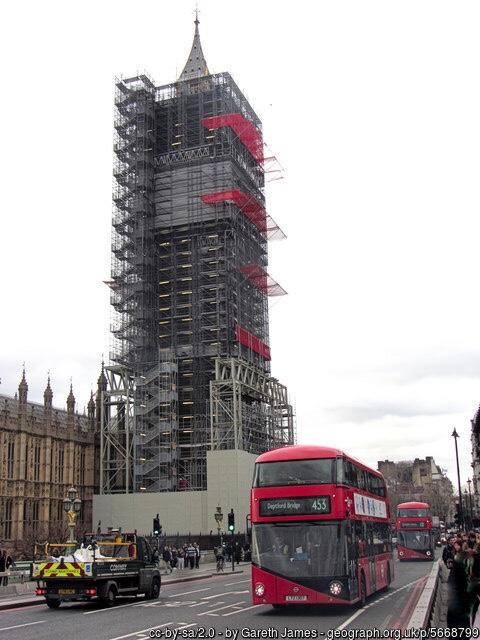
Since that time Big Ben has fallen silent on other occasions…. In 1976 it was taken out of commission for 9 months for repairs….and again for 7 weeks in 2007…. On Monday the 21st of August 2017, after the 12 noon chimes, Big Ben’s bongs temporarily ceased….as extensive repair, conservation and refurbishment work on the clock tower began….
.
Big Ben weighs a massive 13.7 tonnes, is 7.2ft (2.2m) tall and 8.9ft (2.7m) in diameter…. Its hammer weighs 200kg…. Elizabeth Tower is 96m tall and has 11 floors…. Each clock Face is 23ft (7m) in diameter and is made of 312 sections of opal glass…. The hour hand is 9.2ft (2.8m) in length and the minute hand is 14ft (4.3m)…. The clock is accurate to one second….












 Cottage Capers