On this day in history….27th April 1828

On this day in history : 27th April 1828 – The opening of the London Zoological Gardens in Regent’s Park – originally it was only intended for fellows of the Zoological Society but opened to the public in 1847….

img_3039
Gardens of the Zoological Society Regent’s Park 1828 Project – Public domain

We all know it as London Zoo (or Regent’s Zoo) and many of us have visited at one time or other – but the World’s oldest scientific zoo was never originally intended to be anything other than a collection for scientific study and research….

The Zoological Society of London was established by Sir Stamford Raffles ad Sir Humphrey Davy in 1826. The Zoological Gardens opened in Regent’s Park in 1828; unfortunately Raffles was never to see the completed project as he died in July 1826….

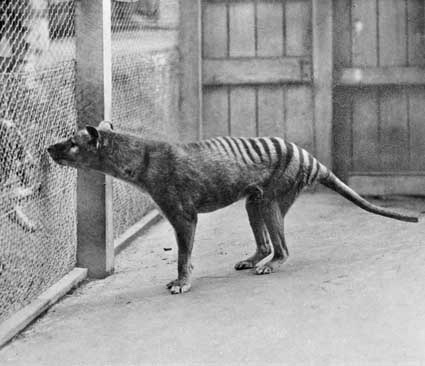
In the beginning it housed animals such as Arabian oryx, Greater kudu and orangutan; it also had the now extinct quagga and thylacine….

img_3040
Quagga – now extinct sub-species of zebra. Mare at London Zoological Gardens 1870. Public domain.
img_3041
The last known Thylacine photographed at Hobart (formerly Beaumais) Zoo in 1933. image credit: Kelly Garbato via Flickr

It was granted a Royal Charter by King George IV in 1829 – and a couple of years later, either 1831 or 32, it was decided to rehouse the animals from the Tower of London Menagerie at the Zoological Gardens…. It is thought that the decision was taken due to an incident which had occurred at the Tower…. Stories conflict slightly but either a soldier was bitten by a lion or a sailor by a monkey….whichever way, the 60 or so species of the Menagerie found a new home at Regent’s Park…. Nowadays London Zoo houses over 670 species….

In 1847 the London Zoological Gardens opened to the public to help aid funding…. In 1849 it opened the World’s first reptile house, the first public aquarium in 1853 and the first insect house in 1881…. The first children’s zoo was added in 1938….

Up until 1902 all of the animals were kept indoors as it was believed they could not survive the cold London climate…. However, when Dr. Peter Chalmers-Mitchell was appointed Secretary he embarked on a major reorganisation of the buildings and enclosures…. Many of the animals were introduced to the open air….a concept inspired by Hamburg Zoo….

img_3038
View of the Zoological Gardens 1835 – Public domain

On this day in history….29th March 1871

On this day in history : 29th March 1871 – The Royal Albert Hall in London is opened by Queen Victoria…. Originally it was to be called The Central Hall of Arts and Sciences….img_2677

Prince Albert, husband of Queen Victoria, had a vision borne from the success of the Great Exhibition of 1851 – a venue to promote the understanding and appreciation of the arts and sciences…. After his death from typhoid fever in 1861 the plans were shelved – but later revived by his collaborator on the Great Exhibition, Henry Cole…. Inspired by the ancient Roman amphitheatres Cole’s original intention had been for an establishment to hold 30,000 people – but this was revised to 7,000 for financial and practicality reasons; nowadays, due to safety regulations it has a capacity of 5,500….

On the 20th of May 1867 Queen Victoria laid the foundation stone…. A special marquee designed to accommodate 7,000 was erected – but it was more like 10,000 who packed in to witness Her Majesty lay the red Aberdeen granite block…. Beneath the stone was placed a time capsule which has lain undisturbed ever since…. Inside we know are some gold and silver coins and an inscription from Prime Minister Edward Smith-Stanley…. Of what else lies in the capsule little is known; the foundation stone is now located in the K stalls, row 11, under seat 87 in the main auditorium….img_2676

Queen Victoria, who was still in mourning and wearing all black, was rarely seen in public…. As the stone was laid she said “It is my wish that this Hall should bear his name to whom it will have owed its existence and be called The Royal Albert Hall of Arts and Science”…. The Archbishop of Canterbury gave the benediction and a composition by Prince Albert ‘Invocation to Harmony’ was performed by an orchestra…. The ceremony was closed by a 21 gun salute from Hyde Park and a trumpet fanfare by Her Majesty’s Life Guards….

img_2674
The Hall at the opening ceremony, seen from Kensington Gardens. Public domain

At the opening ceremony of the Royal Albert Hall, some four years later, Queen Victoria was so overcome with emotion that her son, Edward Prince of Wales, had to make a speech on her behalf…. Her only recorded words of the day being that it reminded her of the British constitution….img_2678

On this day in history….23rd March 1861

On this day in history : 23rd March 1861 – Horse drawn tramcars begin operating on London’s streets for the first time…. They were introduced by an American, Mr. George Francis Train…

America had been introduced to tramcars (streetcars) by George Francis Train some thirty years before he brought them to Britain…. The very first line he opened here was at Birkenhead in 1860…. Three demonstration lines were then installed in London; one along the Bayswater Road between Marble Arch and Porchester Terrace, another at Victoria and a further one between Westminster Bridge and Kennington….

The trams proved popular with many; thousands attracted by their novelty came to see them and ride upon them…. However, not everybody was happy….

Train had chosen fashionable, elite parts of London to trial his trams…. The wealthy residents had no need for public transport, as most owned their own carriages…. They complained of the crowds who got in their way, the noise and having to share the roads with this new form of transport…. Then there was the problem with the actual rails, which stood proud to the road surface causing difficulties for other road vehicles….

(London Tramways two-horse tram circa 1890)

The ‘sticking-up’ rail – or ‘step-rail’ – was actually designed in a way (with a wide bottom plate some 5 inches wide) to take any width of carriage wheel….which at the time came in several different gauges…. The idea was that they could accommodate all vehicles, not just Train’s trams…. Unfortunately many carriages had accidents trying to use them…..numerous complaints were made to the transport commissioners, so that eventually on the 4th of October 1861, after six months in operation, Train was told to remove his tramway….

The advantages of the tramway had not gone unnoticed by the planners…. Nine years later, in 1870, the first tram service began between Brixton and Kennington…. This time the steel rails lay flush to the road surface….

Being on rails meant the tramcars were easier than the omnibuses for the horses to pull…. This in turn meant more passengers could be carried at one time using the same amount of horses…. As a result the fare, which worked out at 1d per mile, was cheaper than that of the buses…. With the addition of the railways’ cheaper early morning workers’ tickets public transport became accessible to everyone…. Another advantage was that the tram travelled slightly faster at 6mph, compared to the bus at 4mph…. Workers began to travel further to work, many moved out of the crowded city to the suburbs…. The tramway network had grown considerably, connecting new housing developments on the outskirts to the city centre….

Initially tram services were operated by private companies, such as the Pimlico, Peckham and Greenwich Street Tramways or the North Metropolitan Tramways…. London County Council could see the social benefits of the system, the cheap fares, accessibility and reliability…. The council saw it as an important part of their policy and during the 1890s made compulsory purchases on many of the horse tram routes….

The tramways still had their problems; the installation and maintenance of the lines caused disruption, derailments were a hazard….and then there was the horsepower….

A single bus or tram needed a team of twelve horses to keep it on the road for twelve hours a day…. Horses were rotated every 3-4 hours….they needed stabling, feeding, watering, veterinary and blacksmith services…. 55% of the operators’ fees went on the cost of caring for the horses – an average of £20,000 was collectively spent per year on horseshoes alone…. 50,000 horses were used to keep the public transport system going on London’s streets….horses that ate the equivalent of a quarter of a million acres worth of foodstuff and produced 1,000 tonnes of droppings per year…. Much of this was collected up and dumped in poorer areas of the city….

Eventually the electrification of trams and the arrival of the motor bus just before World War I meant the demand for the working horse became less and less…. The last horse drawn trams were withdrawn in 1915….

On this day in history….18th March 1925

On this day in history : 18th March 1925 – Fire destroys two floors of Madame Tussaud’s in London and many of the waxworks melt – leaving a grotesque scene….

The fire was discovered at 10.30pm and by 11.30pm the top floor was a raging inferno. One eyewitness, as reported by the Guardian at the time said flames leapt 50 feet high from the roof of the building – “The wax models could be distinctly heard sizzling themselves to death”…. Those waxworks represented world leaders, members of parliament, historical characters, sports personalities….and infamous criminals. A macabre scene of melted faces, charred twisted limbs and broken torsos…. Also lost was an important collection of Napoleonic relics, including Napoleon’s deathbed and carriages….

img_2591
via imgur.com

Dozens of fire engines attended…. The fire chief, Mr. A.R. Dyer had been enjoying a night out at a nearby theatre and arrived to start tackling the fire in full evening dress…. It took and hour and a half to bring the blaze under control and by midnight it was out…. The whole top floor was destroyed, the roof had collapsed, leaving the Planetarium dome a mere skeleton. Lower floors of the building suffered severe water damage….

Thankfully nobody was injured…. One survivor was a parrot in a cage – at first nobody was sure if it was a waxwork or real…. However, a few moments after being brought outside into the ‘fresh’ air it fully revived…. Evidently it was a talking parrot because apparently on recovery its first words were “This is a rotten business”….

Luckily the Baker Street attraction of Madame Tussaud’s was insured. In 1928 it reopened – complete with new cinema and restaurant…. Thankfully all the moulds for the waxworks were stored at a separate site….


On this day in history….3rd March 1982

On this day in history : 3rd March 1982 – The opening of the Barbican Centre in London, by Her Majesty the Queen Elizabeth II…. It is Western Europe’s largest arts centre ….

img_2507

‘Barbican’ was the name of one of the streets in a busy commercial part of the Cripplegate ward…. At the end of the 19th Century it was the centre of London’s rag trade – bustling with fabric and leather merchants, furriers, glove makers and milliners….

It was during the Blitz that the area was to become completely destroyed…. On the 29th of December 1940 it was flattened by German bombers….fire swept through the warehouses…. By the end of World War II only a few buildings remained….one of which, although badly damaged, was the Church of St. Giles’ Cripplegate….

After the war plans were made to rebuild the stricken area – The Town and Country Planning Act 1947 gave local authorities the power to buy up large areas of land for redevelopment….

img_2509

In 1955 the first proposals for the Barbican Centre were submitted to the Corporation of London – the regeneration of five and a half acres of land in Cripplegate…. Four years later a design by architects Chamberlain, Powell & Bon was accepted…. The following year the Royal Shakespeare Company and the London Symphony Orchestra became involved in the planning as the centre was to become their new home….

Construction began in 1971 – with a proposed cost of £17m and an estimated six-year completion time…. It was finally finished in 1982 and had cost £153m to build…. With a concert hall to accommodate 2,000 people, 2 theatres, a cinema, library, conference centre and several galleries it was to become the largest cultural centre for the arts in Western Europe. By its 20th anniversary the Barbican had received more than 27 million visitors. It is a leading venue for classical music – and was home to the Royal Shakespeare Company until May 2001….

On unveiling the commemorative plaque when opening the centre in 1982 the Queen remarked – “What has been created here must be one of the wonders of the modern world”….

In 2003 a survey commissioned by the advertising agency Grey London named the Barbican as London’s ugliest building….

img_2508