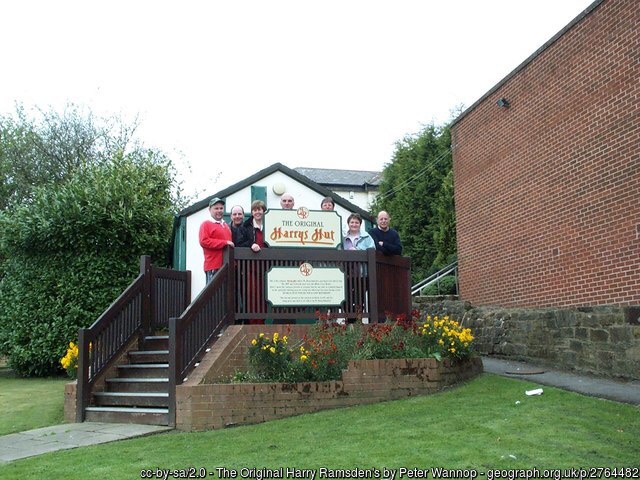
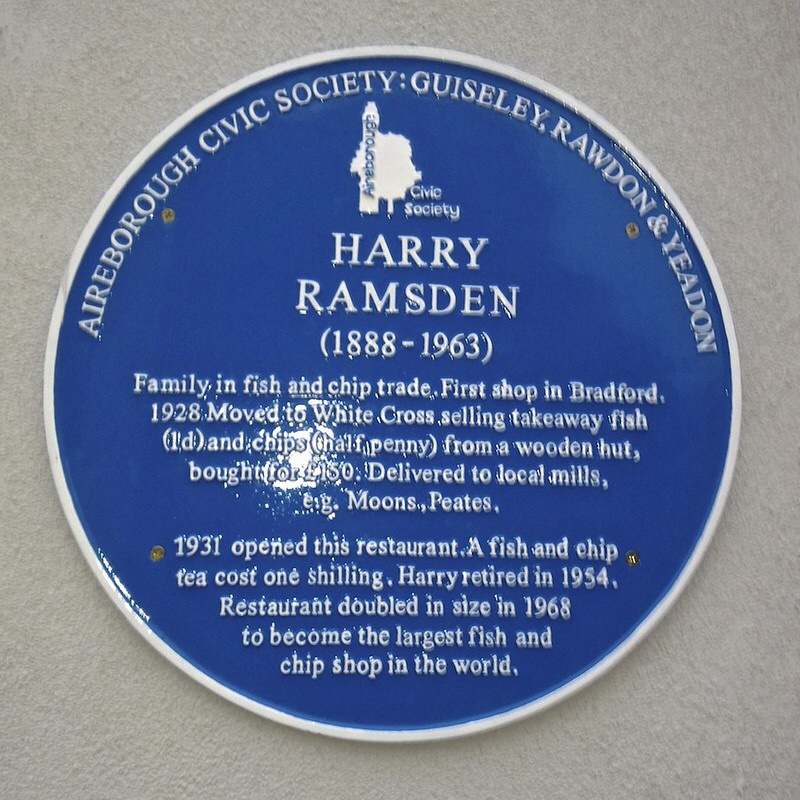
On this day in history : 20th December 1928 – Harry Ramsden launches his world famous fish and chip restaurant, in a wooden hut in White Cross, Guiseley, West Yorkshire….
Harry Ramsden, born in 1888, was the son of the owner of a fish and chip shop in Bradford, Yorkshire…. Before enlisting in the army he worked as a taxi driver and was also a publican…. Upon leaving the army in 1918 he opened his own small fish and chip shop in Bradford….
Business was good in Bradford but unfortunately his wife contracted tuberculosis – and they decided to move to the countryside for the benefit of her health…. Harry borrowed £150 to buy an old army hut which had been converted into a cafe…. The building measured just 10ft x 6ft – but the location provided an excellent opportunity….as it was situated next to a tram terminus, which was extremely busy with tourists visiting the Lake District and Yorkshire Dales…. Harry borrowed a further £400 to acquire the wasteland surrounding the hut….
In 1931 Harry built a large restaurant on the site – with the idea of taking the British favourite humble fish supper upmarket…. He succeeded – in 1937 his business turned over £7,825 – of which £5,104 came from the new restaurant….the rest coming from the original restaurant and its takeaway sales….
The original hut still stands next to the larger premises – which once held the Guinness World Record for the largest fish and chip shop in the world, able to accommodate 250 people – and serving almost a million a year…. In the early years diners would sometimes have been treated to entertainment in the form of piano music – played by Harry’s nephew – none other than Harry Corbett, he of ‘Sooty and Sweep’ fame….
Fish and chips at Harry Ramsden’s Bournemouth – Photo credit : Dave Beckett via FlickrImage : Theo K via Flickr
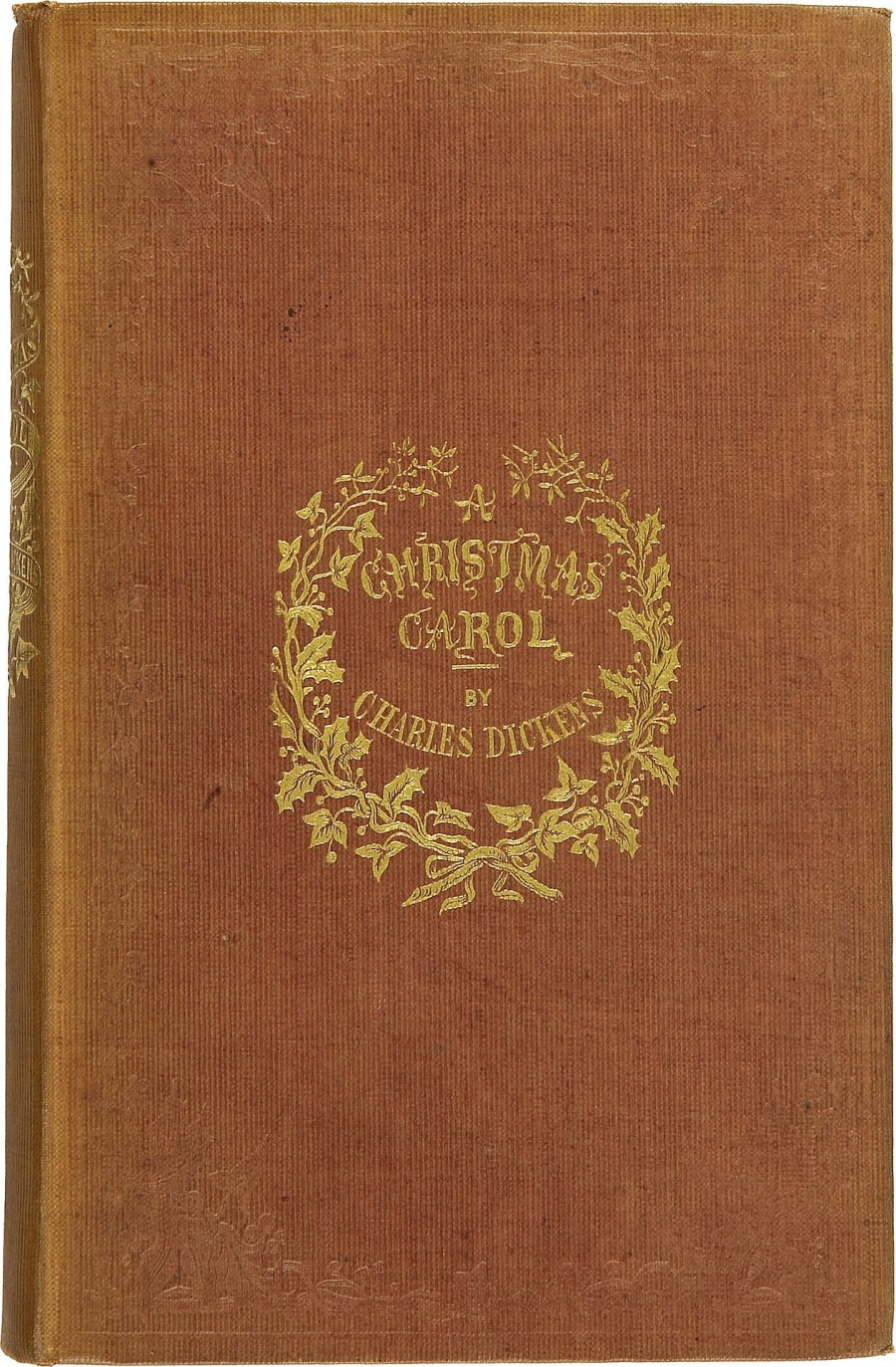
On this day in history : 19th December 1843 – The classic story ‘A Christmas Carol’ by Charles Dickens is published….
First edition cover – Photographer : Heritage Auctions, Dallas, Texas – Public domain
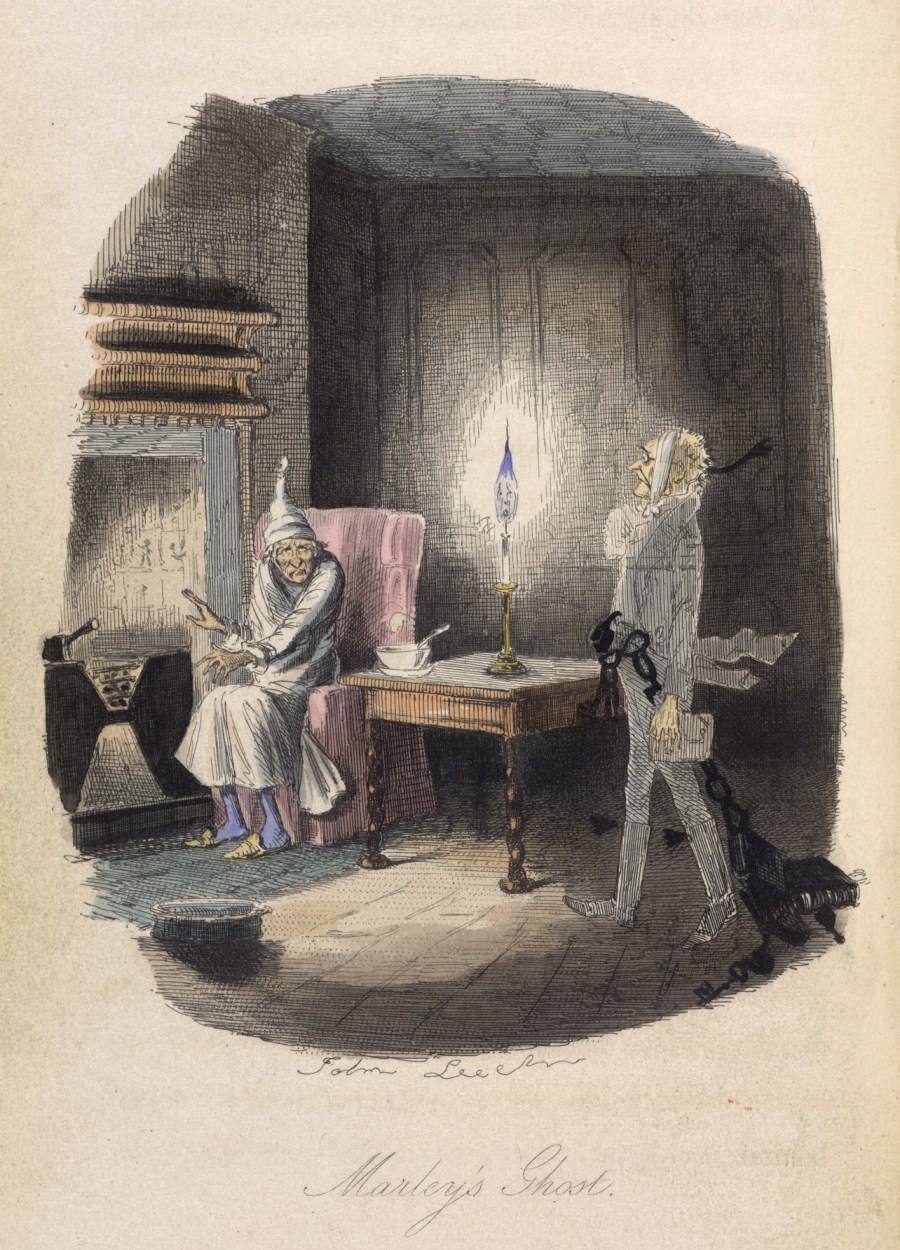
We are all familiar with the tale of how Ebenezer Scrooge, the miser, was visited by the ghost of Jacob Marley – chained and tormented, doomed to an eternity of wandering the earth as a punishment for his greed and selfishness when he was alive…. Then came the visits from the spirits of Christmas past, present and future….and how Scrooge was transformed into a better person….
Marley’s Ghost – original illustration by John Leech – Public domain
The story touched a chord with many Victorians, with its attitude towards poverty and the Christmas spirit…. Earlier in 1843 Dickens had read a government report on the abuse of child labourers in mines and factories – and it sickened him…. It was something that resonated with him – as at the age of 12 he had been sent to work in a factory after his father was thrown into debtors prison…. His memories and the report prompted Dickens to write ‘A Christmas Carol’ – something he did feverishly – it took him just six weeks….
The book was published by Chapman and Hall but funded by Dickens himself…. Dickens had already had many successful books published: ‘The Posthumous Papers of the Pickwick Club’, ‘Oliver Twist’, ‘Nicholas Nickleby’, ‘David Copperfield’, ‘Great Expectations’, ‘A Tale of Two Cities’…. But the publishers began to lose faith in his work when ‘Martin Chuzzlewit’ failed to live up to expectations…. they wanted to publish ‘A Christmas Carol’ in a less expensive format – or even serialised as part of a magazine…. However, Dickens was adamant he wanted it to be published as a proper book – and so struck a deal with Chapman and Hall…. It was agreed he would pay all printing and publishing costs and they would also receive a fixed commission on every book sold…. 6,000 copies were initially produced – and had sold out by Christmas Eve…. By the end of 1844 thirteen editions had been released….
John Leech – Public domain
In early 1844 ‘A Christmas Carol’ was published illegally by another company…. Dickens sued them and although he won the case, the rogue publishers declared themselves bankrupt….leaving Dickens to pick up all of the legal costs…. What with that and the high publishing costs Dickens made little money from ‘A Christmas Carol’….a story that is just as popular today as it ever was….
“Oh! But he was a tight-fisted hand at the grindstone, Scrooge! A squeezing, wrenching, grasping, scraping, clutching, covetous, old sinner! Hard and sharp as flint, from which no steel had ever struck out generous fire; secret and self-contained, and solitary as an oyster” ~ A Christmas Carol….
Charles Dickens in 1842 – Francis Alexander – Public domain
On this day in history : 18th December 1782 – Thomas Paine, radical political writer, is tried in his absence for treason – for publishing ‘The Rights of Man’ – in which he called for the abolition of the British Monarchy….and gave support for the French Revolution….
Thomas Paine – by Laurent Dabos – Public domain
Born in Thetford, Norfolk in 1737, Paine started his adult life as a corset maker and as a school teacher…. On becoming an excise officer he was compelled to write a 21 page booklet demanding better working conditions and pay for his co-workers….
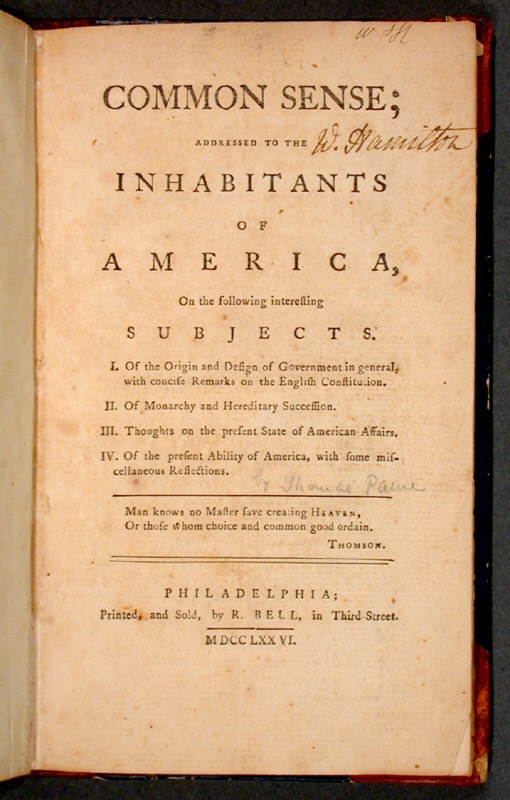
In 1774, whilst in London, he happened to meet one of the founding fathers of the US, Benjamin Franklin – who advised him to go to America…. He did so in the November of 1774 – at a time when American revolutionaries were beginning to take steps to break away from Britain…. Paine joined the revolution – and in 1776 he published ‘Common Sense’ – a short pamphlet – but one that gained him the name ‘The Father of the American Revolution’…. ‘Common Sense’ played an important role in persuading colonists to fight for independence from Britain…. By the end of 1776 – 150,000 copies had sold – a considerable number for the time – and was so influential that John Adams, the USA’s second president, declared “without the pen of the author of Common Sense, the sword of Washington would have been raised in vain”….
‘Common Sense’, published 1776 – Public domain
Paine had returned to London by 1787 – and when the French Revolution began in 1789 he took a strong interest in it….and in 1790 he travelled to France…. At the same time Irish writer, political theorist and philosopher, Edmund Burke, published his ‘Reflections on the Revolution in France’….which was highly critical of the French Revolution…. His publication sold 30,000 copies; in retaliation Paine responded with a 90,000 word book ~ ‘Rights of Man’, attacking the concept of monarchies and traditional social institutions…. It immediately became a success with democrats, reformers, Protestant dissenters and skilled workers alike – and the book sold nearly a million copies….
Thomas Paine, author of ‘The Rights of Man’ – from John Baxter’s ‘Impartial History of England’, 1796 – Das48 CC BY-SA 4.0
Naturally the government were none too happy with Paine and did their best to discredit him…. However, undeterred, he published the second part of his ‘The Rights of Man’ in February 1792…. This time it was marketed at a reduced price to ensure it reached as many people as possible….
Paine was hounded out of Britain by those opposing his view – and an indictment for ‘seditious libel’ was raised against him and his publishers…. Paine was ‘tried in absentia’ and found guilty of treason….a crime punishable by death at the time…. However, in recognition of the effect ‘The Rights of Man’ had on the ‘Cause’ of the French Revolution, Paine was granted an honorary French citizenship….
Things didn’t all go in his favour though…. At one point Paine was mistaken for an aristocrat – and narrowly escaped execution…. Again, in 1793, he was accused of treason – because of his opposition to the death penalty – he was arrested and imprisoned in Luxembourg…. He put this time to good use though – by beginning work on his next book ‘The Age of Reason’ – a work of three parts – questioning religion, which was to discredit him in the US, making him a hated man….
Thomas Paine by Matthew Pratt – circa 1785 – 1795 – Public domain
Paine was released from prison in 1794….and in 1802 he returned to America – where he was welcomed by President Thomas Jefferson, whom he had met in France…. However, American newspapers still damned him and he was loathed by many….
Paine died on the 8th of June 1809 whilst in New York – and he was buried on his own property in New Rochelle, with little ceremony….
In 1819 his remains were stolen….by radical writer and journalist William Cobbett – who brought them back to England…. Apparently the aim was of giving Paine a more fitting burial…. In order to raise money for a memorial, Cobbett planned to display the bones….he even made jewellery from hair removed from the skull, which he intended to sell…. Cobbett spent some time in Newgate Prison, for a libellous case, involving the flogging of local militiamen in Ely…and the bones ended up in his cellar…. Although rumours surface from time to time, nobody actually knows where the remains of Thomas Paine are today….
Oil painting by Laurent Dabos circa 1791 – Public domain
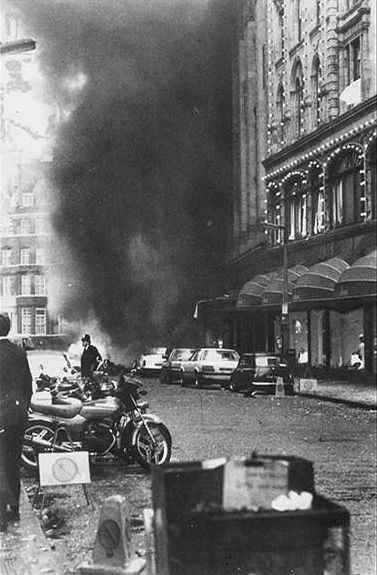
On this day in history: 17th December 1983 – An IRA terrorist car bomb explodes outside Harrods Department Store, in Knightsbridge, Central London – killing 6 people and injuring a further 92….
Elliott Brown via Flickr
At 12.44pm a call, using a code word, was made to the Central London branch of the Samaritans…. The caller said there was a car bomb outside Harrods and a further two bombs inside the store…. The car registration number was given but not a description of the car…. It was also claimed that further bombs had been placed on Oxford Street and in the Littlewoods store on Oxford Street…. Much of the message proved to be false information – and the police had already received 22 similar calls about suspicious devices that day – all of which were false alarms…. However, following receipt of the warning, the police immediately started to search – but did not evacuate the area….
At just before 1.30pm, on one of the busiest shopping days of the year, a Saturday just before Christmas, a car bomb containing 25-30lb of explosives and detonated by a timer, exploded…. It had been placed inside a 1972 blue Austin 1300 GT 4-door saloon car, parked close to the side entrance of Harrods, in Hans Crescent…. Five people died at the scene and another later in hospital…. Of these six, three were police officers and three were members of the public; a reporter, an American citizen and a young mother…. Another 92 people were injured, including 14 police officers….
Image via Pinterest
Home Secretary, Leon Brittan, expressed his revulsion at such a cold-blooded and cowardly attack…. The day following the bombing the IRA admitted responsibility….
As a result Scotland Yard increased security in Central London – hundreds of extra police and mobile bomb squads were drafted in…. Harrods, despite the damage, reopened three days later….the owners said they would not be defeated by acts of terrorism….
On this day in history : 16th December 1485 – Catherine of Aragon, the first of King Henry the VIII’s six wives, is born in Spain….
Catherine of Aragon – attributed to Joannes Corvus – Public domain
Born Catalina of Aragon, she was the daughter of King Ferdinand II of Aragon and Queen Isabella I of Castile – a union that had united Spain…. On her maternal side Catherine’s great-grandmother was Catherine of Lancaster, for whom she was named – and so was related to English royalty….
Catherine had a strong Roman Catholic upbringing and was an extremely well-educated young woman…. She was tutored by Alessandro Geraldini, a clerk in Holy Orders…. She studied classical literature, history, religion, theology, philosophy, arithmetic, law, genealogy and heraldry…. She could speak, read and write in both Spanish and Latin….and could converse in French and Greek…. She was able to cook, draw, sew, spin, weave, embroider and make lace…. She was educated in etiquette and music….
Portrait by Juan de Flandes – of what is thought to be of an 11-year-old Catherine – Public domain
Catherine was ideal material for a future Queen of England and at the age of three was betrothed to Arthur, the eldest son of King Henry VII – and who was a year younger than her…. In 1501, at 16-years-old, she arrived in England for the marriage, which took place in St. Paul’s Cathedral on the 14th of November 1501…. Afterwards they lived in Ludlow Castle, on the Welsh border – but sadly it was to be a short-lived marriage, as five months later Arthur became ill and died….
Rather than return to Spain, as was expected, Catherine remained in England….and became betrothed to Arthur’s younger brother, Henry – six years her junior…. A dispute between King Henry VII and her father King Ferdinand II, over her dowry, meant the pair were not to marry for a number of years….
King Henry VII died on the 21st of April 1509 and the young 17-year-old Henry came to the throne…. He married Catherine in a private ceremony on the 11th of June and a few days later, on the 24th of June, the newly-weds were crowned King and Queen of England in a joint Coronation at Westminster Abbey…. And for the first few years they were happy together….
16th Century woodcut of the Coronation of Henry VIII and Catherine of Aragon – Public domain
In January 1510 Catherine gave birth to a stillborn daughter…. Her second child, Prince Henry, was born in 1511….there was much celebration as a male heir had arrived – but the baby was to die soon after…. Catherine bore six children in total but only one was to survive – a daughter born in 1516, who was later to become Queen Mary I….
Henry was desperate for a male heir and he began to turn his attentions elsewhere- namely to Catherine’s lady-in-waiting, Anne Boleyn…. He blamed his doomed marriage on an old curse that a man should never marry his dead brother’s widow…. In 1527 he asked the Pope for an annulment of his marriage – but was refused…. There was much public sympathy for Catherine….
For seven years the Pope continued to deny Henry’s request…. It was in 1533 that King Henry VIII secretly married Anne Boleyn, who was already pregnant with their child…. He then passed the Act of Supremacy, declaring himself head of the English Church…. Thomas Cranmer was appointed Archbishop of Canterbury and he annulled the marriage with Catherine…. Anne Boleyn was crowned Queen in June 1533…. Catherine was re-titled Dowager Princess of Wales – a title she was never to accept – and was forced to leave Court…. She was also prevented from seeing her daughter…
Catherine spent the rest of her days cut off from the life she had previously known…. She died on the 7th of January 1536, probably from cancer, at Kimbolton Castle, Cambridgeshire…. She was given a small, unremarkable funeral and was buried in Peterborough Abbey….
Grave of Catherine of Aragon in Peterborough Cathedral – Photo credit : TTaylor – Public domain









 Cottage Capers