On this day in history : 15th January 1797 – John Hetherington, a London haberdasher wears his new top hat for the first time….and causes a riot….
As he stepped out onto the streets of London, wearing his hat in the shape of a stove-pipe, a large crowd gathered around him…. Soon such chaos broke out in the jostling mass that an officer of the law had to intervene…. He grabbed Hetherington by the collar and hauled him off to appear before the Court – on a charge of ‘breach of the peace’ and ‘inciting a riot’….
Hetherington had reportedly “appeared on the public highway wearing upon his head what he called a silk hat (which was shiny lustre and calculated to frighten timid people)”…. The Court was told that several ladies had fainted, children screamed and dogs yelped…. The young son of Cordwainer Thomas had even been pushed to the ground by the crowd and his right arm broken….
The haberdasher used in his defence that it was the right of every Englishman to wear whatever he chose upon his head…. He was fined the hefty sum of £500….(over £60,000 in today’s terms)….
The Times newspaper wrote the following day….“Hetherington’s hat points to a significant advance in the transformation of dress. Sooner or later, everyone will accept this headwear, we believe that both the Court and the police made a mistake here”….
This story first appeared in the Hatters’ Gazette during the late 1890s…. Stories can get twisted – John Hetherington is often erroneously credited with inventing the top hat….
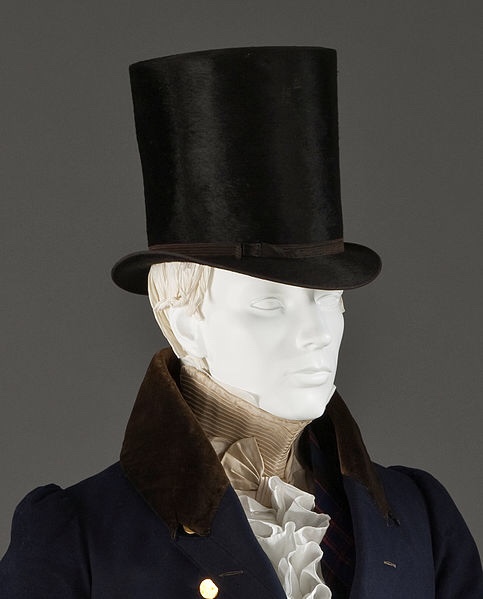
This style of hat had actually been worn since the 16th Century – but it was in the 1790s that it was first covered in silk plush…. The first silk hat can be credited to George Dunnage, a hatter from Middlesex…. Who knows, perhaps Mr. Hetherington was a customer of his….
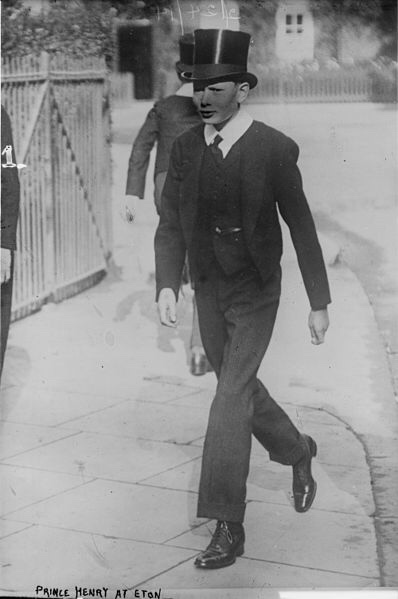
Henry Duke of Gloucester in Eton dress in 1914 – Image via Bain News Service, publisher
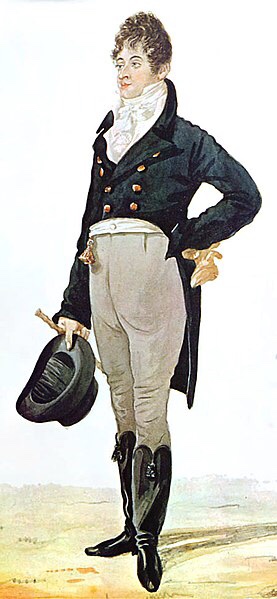
The Times was right though…. Sooner or later the top hat was accepted….largely because it was championed by famous English ‘dandy’ George ‘Beau’ Brummel…. George was a close friend of the Prince Regent, George IV – and known in Society for his trend-setting style…. Whereas most men of the day were still wearing the flamboyant, decadent fashions of the time, George Brummel chose to wear elegant, simple, tailored attire; beautifully cut jackets and breeches, with spotless, crisp white shirts…. He completed this ensemble with the ‘beaver’ – a new form of the top hat – so-called because its felt was made from the fur of a beaver….
George ‘Beau’ Brummell – watercolour by Richard Dighton (1805)
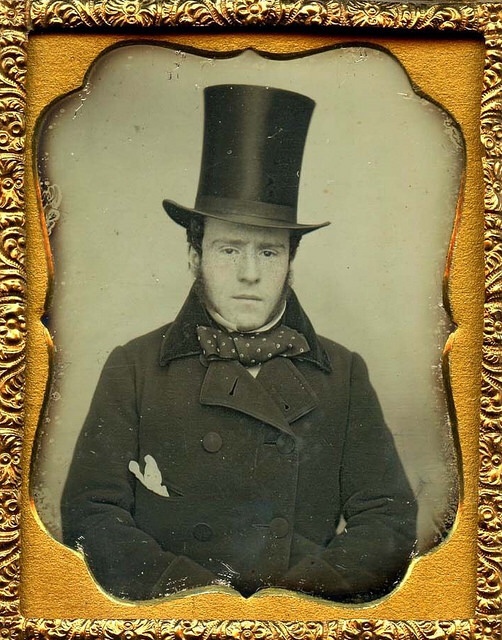
Between 1800-1850 top hats were much taller, with straight sides – and were often called ‘stovepipe hats’…. Some were so tall they could reach 20cm high….
Image credit : oakenwood via flickr
Around 1837 through to 1901 the height reduced, to typically between 16cm-17cm ~ and around 1890 the crown enlarged…. It was some thirty or so years later that the height reduced again, to between 12cm-13cm high – and this remains the same today….
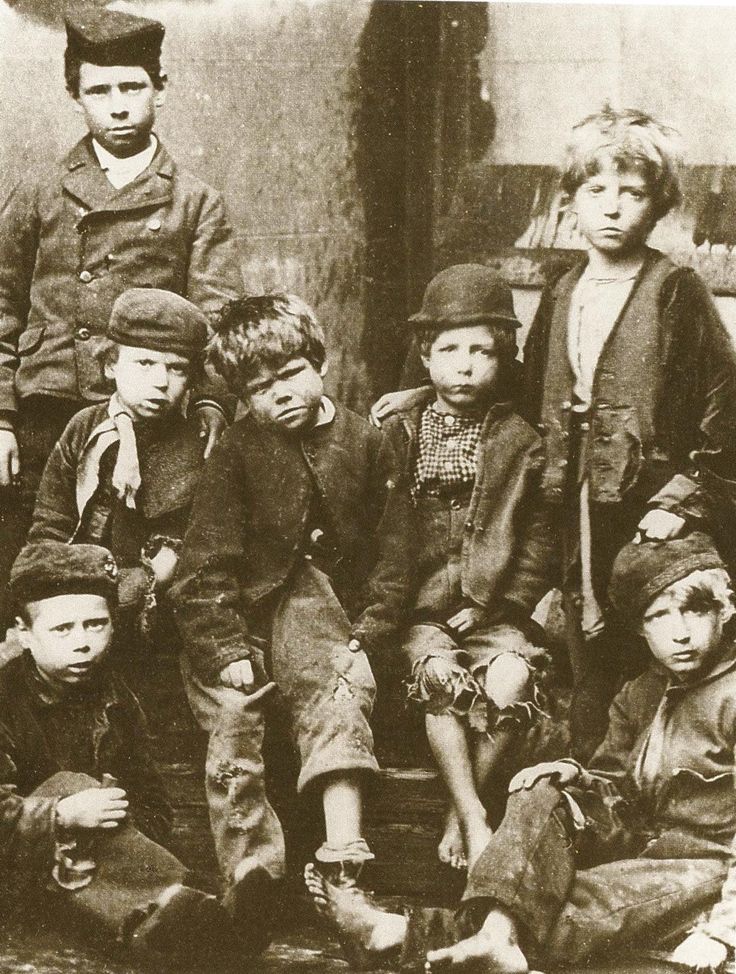
On this day in history : 1st January 1839 – The death of John Pounds – shoemaker, altruistic teacher – and the man originally responsible for the concept of the ‘Ragged Schools’….
John Pounds was born on the 17th of June 1766 and when he was 12-years-old his father arranged for him to enter into an apprenticeship as a shipwright at the Portsmouth Dockyard…. It was when he was 15 that Pounds was to have a life changing accident – he fell into a dry dock injuring his thigh and leaving him severely crippled…. Unable to continue working at the dockyard he became a shoemaker and was able to open a small shop on St Mary Street, Portsmouth – where he was to become known as ‘the Crippled Cobbler”….
It was in 1818 that he began to teach the poverty stricken children of Portsmouth – it is thought this may have come about after he had begun to educate his young disabled nephew out of concern for his welfare…. Pounds would scour the streets and quays of Portsmouth looking for homeless children – he would often take with him food, such as baked potatoes, to entice them…. He would then take them back to his shop where he would teach them the basics of reading, writing, and arithmetic…. He gave them religious instruction and lessons in skills such as carpentry, shoe making, cooking, clothes mending and toy making…. All for no fee – and sometimes there were up to forty children in his class at one time….
The inspiration behind the concept of Ragged Schools is often credited to the Reverend Thomas Guthrie. He had first come across the idea whilst acting as Parish Minister for St. John’s Church in Edinburgh in 1841 – when he had seen a picture of John Pounds in Fife…. He was inspired by Pounds’ work with the children. In his publication “Plea for Ragged Schools”, which he wrote to raise awareness and enlist public support for the cause in March 1847, he proclaimed John Pounds as the originator of the idea…. He wrote….
….”My first interest in the cause of Ragged Schools was awakened by a picture I saw in Anstruther, on the shores of the Firth of Forth, It represented a cobbler’s room; he was there himself, spectacles on nose, old shoe between his knees, the massive forehead and firm mouth indicating great determination of character; and Fromm between his bushy eyebrows benevolence gleamed out on a group of poor children, some sitting, some standing, but all at their lessons around him”…. (Quoted in Montague 1904)….
Guthrie opened his own ‘Edinburgh Original Ragged School’ in April 1847 – he is considered a core leader of the Ragged School Movement – although he was not the first to open such a school in Scotland….
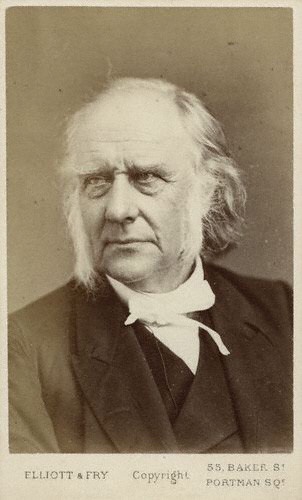
The Reverend Thomas Guthrie – early 1870s
In 1841 Sheriff Watson became frustrated by the amount of youngsters being brought before him in his Aberdeen Court Room for petty crimes…. Rather than keep sending them to prison he decided to make it compulsory for them to attend school. Initially he tried to incorporate them into ordinary day schools but teachers objected, not wanting these dirty, ragged, poor children in their classrooms…. Sheriff Watson established a school especially for these children; three meals a day were provided and lessons given in reading, writing, arithmetic and geology…. Children were taught trades such as shoe making and printing….with the hope of giving them a future…. At first the school was just for boys – but in 1843 a girls’ school was set up and in 1845 the two schools integrated…. It did not take long for the idea to spread to Dundee and to other parts of Scotland….
Around the same time, in 1841, a Ragged School began in Clerkenwell, London…. It has to be said that various organisations lay claim to having been first to offer free education…. Indeed back in the 1780s Sunday Schools began to emerge….often Christian but not always, they were to provide education for children who were otherwise working during the week….Thomas Cranfield, a tailor and former soldier, had gained his own education at a Sunday School in Hackney…. In 1798 Cranfield established a day school close to London Bridge, giving free education to London’s poor children…. By the time of his death in 1838 nineteen such schools had been set up across London, providing educations days, evenings and on Sundays….
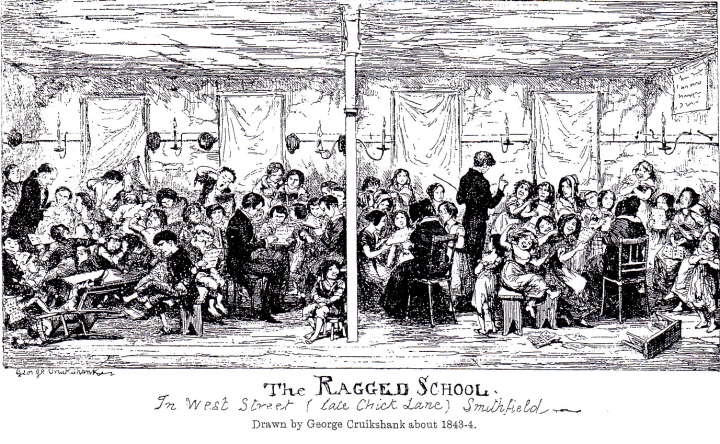
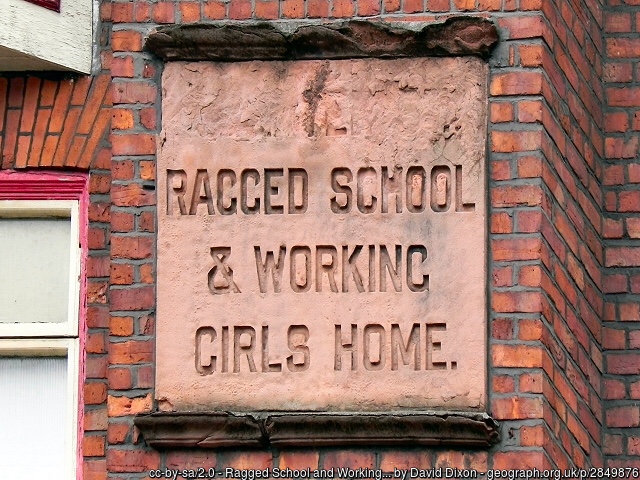
The term ‘Ragged School’ seems to have been first used by the London City Mission in 1840…. The Mission had been set up in 1835 to help the poor in London…. It ran soup kitchens, penny banks, helped provide clothing and education – using paid missionaries and agents…. Ragged School became the name commonly given to any independent school set up on a charitable basis…. By 1844 the London City Mission was responsible to looking after at least twenty Ragged Schools…. It became apparent a way was needed to bring together and organise all of the independent free schools that had been established….
In April 1844 a committee was formed….to look at welfare needs in the community….and most importantly, educational needs of the children. The committee comprised of Mr Locke – a woollen draper, Mr Moulton – who dealt in second hand tools, Mr Morrison – a City missionary and a Mr Starey…. On the 11th of April 1844 the Ragged Schools Union was formed….
At this gathering they resolved “to give performance regularity, and vigour to existing Ragged Schools, and to promote the formation of new ones throughout the metropolis, it is advisable to call a meeting of superintendents, teachers and others interested in these schools for this purpose”….
There was much support for the cause; from the wealthy, who could contribute financially (it became quite ‘fashionable’ to do so)….to famous names who helped promote it…. Charles Dickens was one such….he had visited the Field Lane Ragged School in London – it is said to be one of his inspirations for ‘A Christmas Carol’….
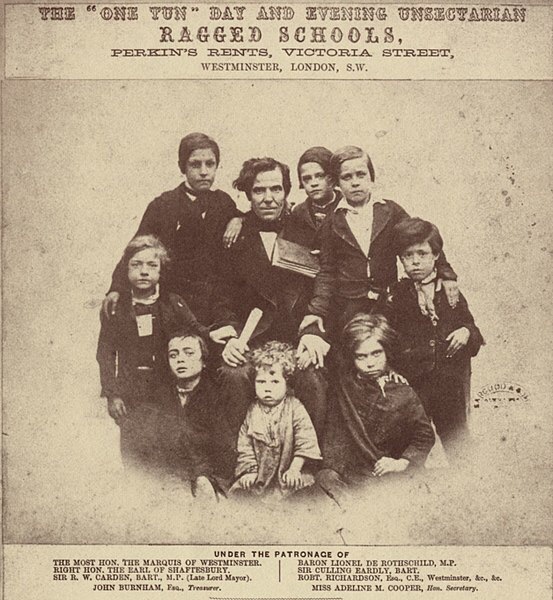
Later the Ragged Schools Union became known as the Shaftesbury Society…. The 7th Earl ofShaftesbury became chairman of the RSU and remained so for nearly forty years….in this time some 300,000 children benefitted from free education…. In 1844 the RSU began with 200 teachers….by 1851 it had 1600…. By 1867 there were 226 Sunday Ragged Schools, 204 day schools and 207 evening schools….providing free education for approximately 26,000 children….
In 1870 the Education Act was passed….over the next few coming years some 350 of the schools established by the Ragged Schools Union were absorbed into the new Board schools….
On this day in history : 8th August 1834 – The Poor Law Amendment Act is passed in Britain…. With the introduction of the Workhouse parishes are no longer responsible for the care of their poor….
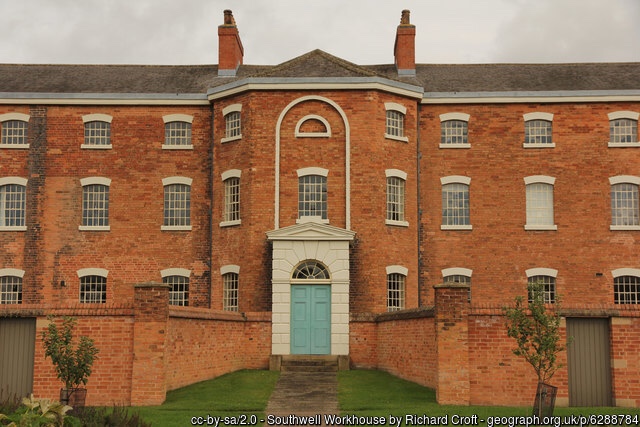
Southwell Workhouse
Poverty relief was in the hands of individual parishes prior to 1834…. The belief was that the badly organised system encouraged the poor to be lazy and take advantage…. This unfortunate attitude came from the more privileged classes – in truth nearly everybody in the working classes found themselves in poverty at some time in their lives – whether through unemployment, sickness or old age…. There was no welfare system such as we know today….
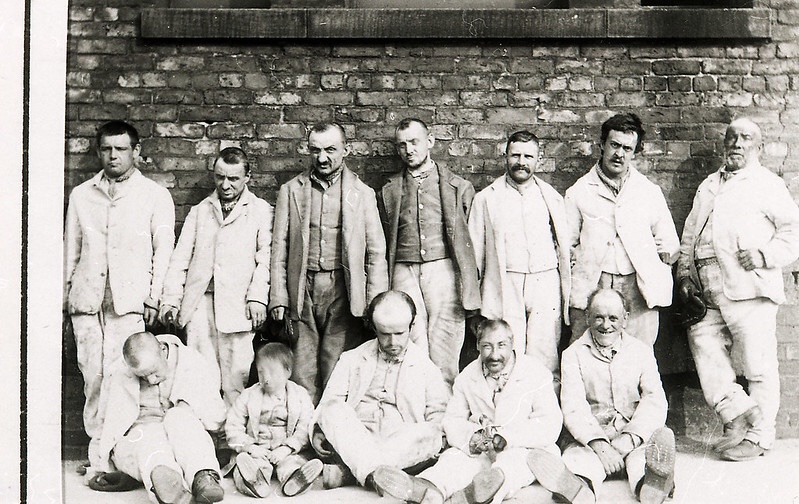
The Victorian Workhouse was a place of misery…. No able bodied person could now get poor relief unless they entered the Workhouse…. Where they had to work in slave labour conditions for their food and accommodation…. Families were separated; men, women and children were split into separate accommodation and punishments were harsh if they were caught talking to each other…. Inmates were made to wear a uniform, so that everyone looked the same; the working hours were long and the inadequate food provided in starvation rations….
Men at Crumpsall Workhouse c.1897 – Image credit : Manchester Archives via Flickr
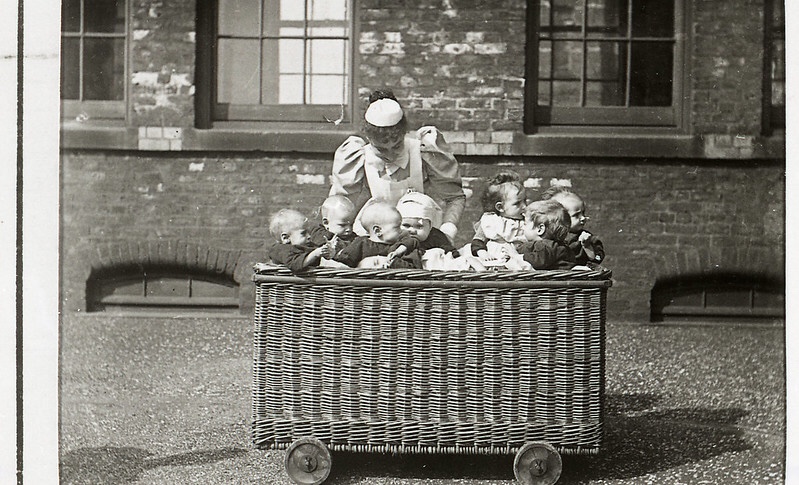
The Workhouse was self sufficient; usually with its own bakery, laundry, vegetable gardens and dairy…. It had workrooms for making clothes and shoes, communal dining rooms, a sick ward, nursery, chapel and even a mortuary…. As well as providing accommodation, what passed as food, clothes, medical care and a place of work, it also provided education for the children and training for a future job…. However, many children found themselves being hired out – or even sold – to factories and mines….
A Basketful of Babies….at Crumpsall Workhouse – Image credit : Manchester Archives via Flickr
Each Workhouse was run by a master and matron, a chaplain, school teacher, medical officer and porter…. There was little compassion and cruelty often arose…. The neglect was more than apparent and beatings frequent…. The mortality rate was high; diseases such as tuberculosis and small pox were rife…. It was a harsh system and was intended to put the fear of God into people – to make them do their utmost to keep out of the prison like conditions….
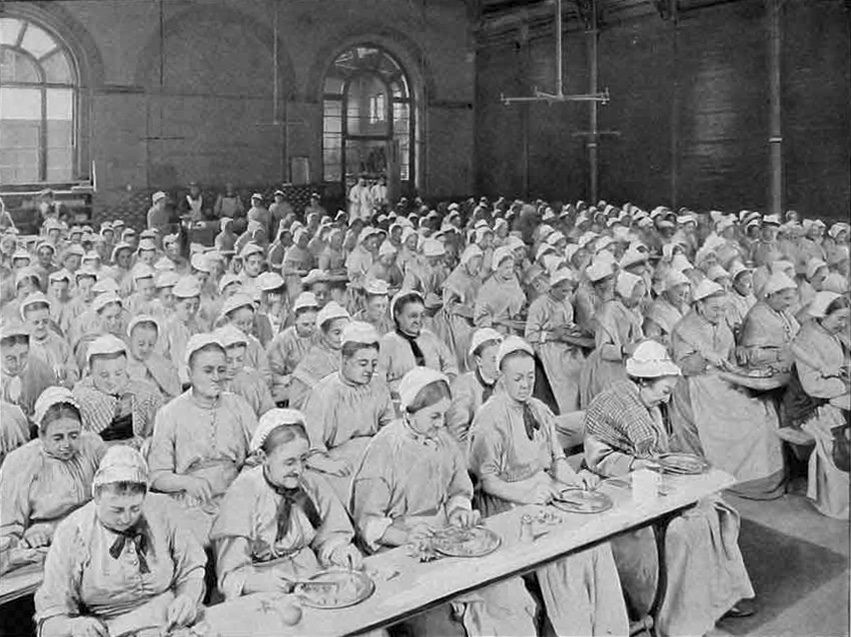
Women at mealtime, St Pancras Workhouse, London – Public domain
The Workhouse was focused on profit rather than solving the issues of the poor…. Many of the inmates were unskilled and were used as a labour force for hard manual tasks, such as crushing bones for making fertiliser or picking oakum from old ropes…. Workhouses were overseen by ‘Guardians’ – usually ruthless local businessmen seeking a profit….
Over time the Workhouse evolved and became a refuge for the sick and the elderly…. Attitudes changed towards the end of the 19th century, people expressed anger at the cruelty within them…. By 1929 new legislation had been introduced allowing local authorities to take over the running of workhouses as hospitals…. In 1930 the workhouses officially closed, although it was several years before the system totally stopped as so many people needed help…. In 1948, with the introduction of the National Assistance Act, the last of the Poor Laws were eradicated….
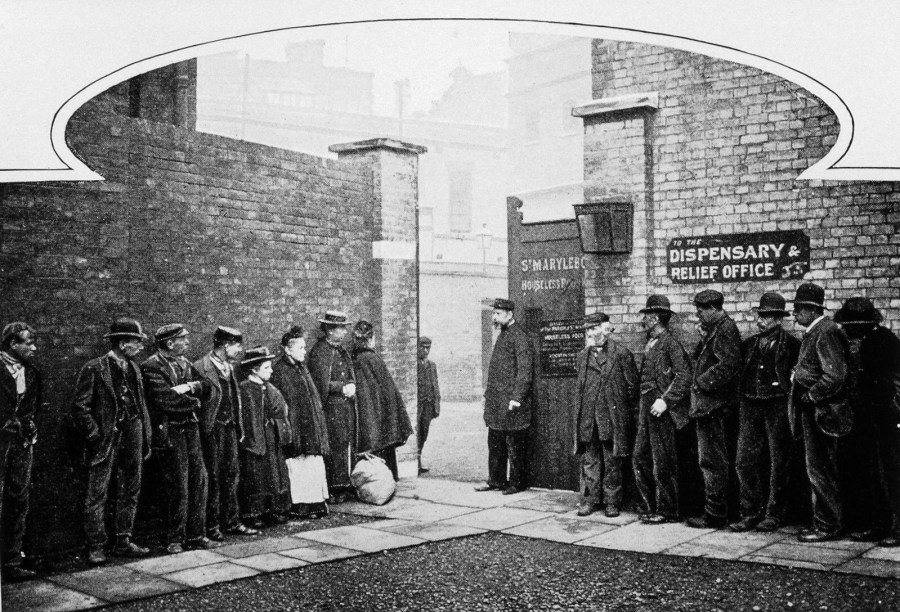
People queuing at South Marylebone Workhouse circa 1900 – Wellcome Collection CC BY 4.0
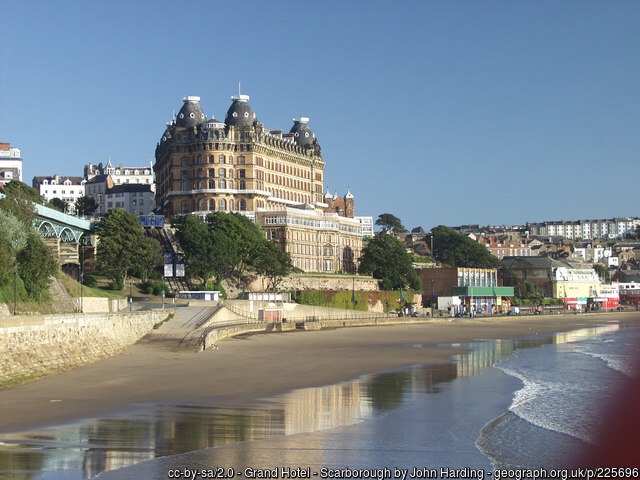
On this day in history….24th July 1867 – The opening of the Grand Hotel in Scarborough…. As well as being the largest hotel in Europe, at the time, it was also the largest brick structure….
OLYMPUS DIGITAL CAMERA
Scarborough, North Yorkshire….with its splendid sandy beaches – it is often described as the ‘gem of the North’…. It is the largest seaside resort on the Yorkshire coast and attracts thousands of visitors every year….
The town began to become popular in the early 17th century, when natural mineral waters were discovered in the area…. It was believed the waters had medicinal and healing benefits and so a spa house was built and Scarborough became recognised as a spa town…. As time went by the resort developed and became one of the first seaside holiday towns….
In the early 1860s a group of businessmen saw an opening for a luxurious hotel – and so the concept of the Grand was born….and in 1863 building work began…. Funding the project was an issue, which is why the £100,000 plus project took four years to complete….
Designed by architect Cuthbert Broderick from Hull, known for his design of Leeds Town Hall, the hotel was built in an unusual ‘V’ shape – to honour Queen Victoria…. It was also designed around the theme of ‘Time’…. It has 4 towers to represent the seasons, 12 floors for the months of the year and 52 chimneys for the weeks…. Originally it had 365 bedrooms – but following later renovation work this number was reduced to 280….
The Grand Hotel became quite the place to stay in Victorian Scarborough…. It was full of modern, luxurious amenities of the time – the bath taps even had an option of running sea water so as Victorian guests could benefit from the supposed health properties if they so chose….
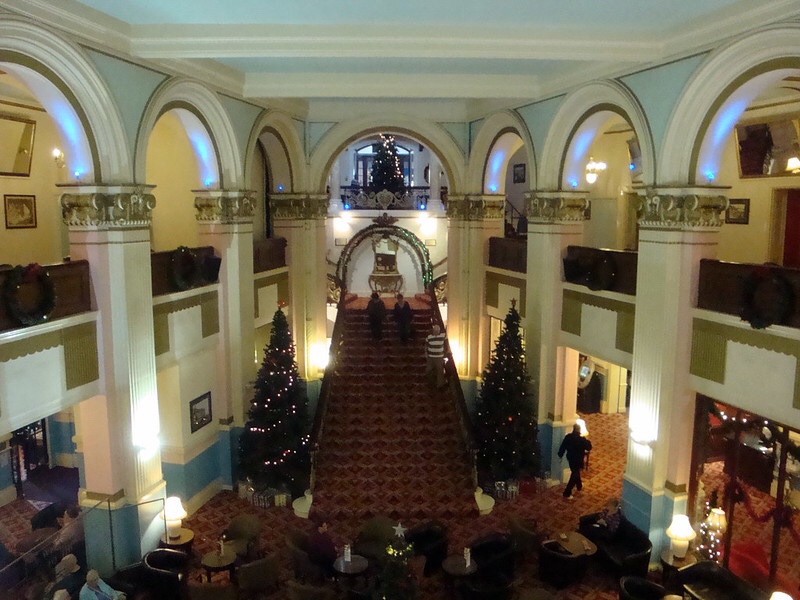
Interior of The Grand – Image credit : Roy via Flickr
In December 1914 the hotel was badly damaged by a German naval bombardment on the towns of Scarborough and Whitby – the Grand Hotel was hit at least 30 times…. The severe damage plunged the hotel into extreme financial difficulties….ownership changed hands twice in short succession…. Standards became more relaxed but despite this the hotel pulled through and continued to attract wealthy customers, such as the Prince of Wales, later to become King Edward VIII and several influential politicians, such as Winston Churchill….
During World War Two it was used to station RAF servicemen…. The 4 towers housed anti-aircraft guns and the building became a base for trainee cadets…. The advantage being that the hotel could be defended against a repeat performance of the bombardment experienced in World War One…. Following the War a renovation costing £100,000 was necessary to get the Grand back to its former glory….
In more recent years the hotel served as a base for the SAS during the Iranian Embassy Siege of 1980…. In 2017 the Grade II listed building was named by Historic Britain as one of the top 10 places to tell the story of England and its impact on the world….
There’s an old saying…. “Red shoes and no knickers!” What it is really referring to is someone who’s all for show but has no substance – they are bothered about the ‘flashiness’ of the look – but not the basics – like wearing knickers! We might chuckle at the idea of going ‘commando’ ~ or the slightly less liberated amongst us may raise an eyebrow and think only a loose woman would dare to do such a thing…. But there was a time when it was the complete opposite….until the mid 1800s it was considered improper for a woman to have anything between her legs ~ and that included knickers! (This is why women rode horses side-saddle)….
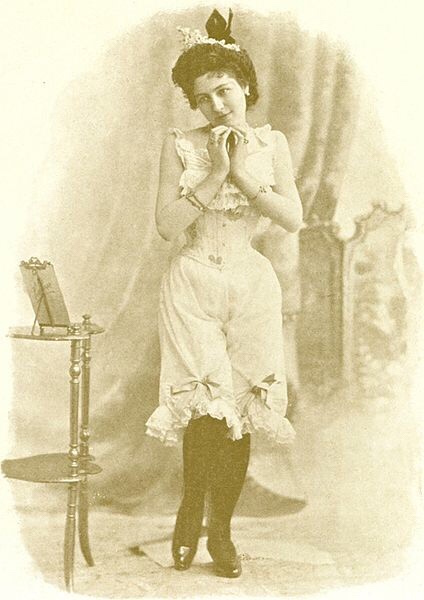
Fashion in 1898 – original photograph by Leopold-Emile Reutlinger – French photographer : Public domain
Roman men and women wore a ‘shorts’ like garment, resembling a loincloth, called a subligaculum. Women also wore a bandage of cloth or leather around the chest, called a strophium or mamilare – perhaps an ancient equivalent to the modern-day bra. It took until 1913 for the modern version to arrive – and was thanks to Mary Phelps Jacob with her pair of hankies tied together with ribbons….
During the 1400s men began to wear ‘braies’, adopted from a type of trouser originally worn by Celtic and Germanic tribes. Made of wool or leather (and later cotton or linen) they generally hung to the knee or mid-calf, resembling today’s shorts…. Women wore shifts and a chemise – any other form of underwear for the nether-regions was thought unnecessary – as warmth was the main priority and the thicker fabrics of skirts and dresses of the time was deemed sufficient….
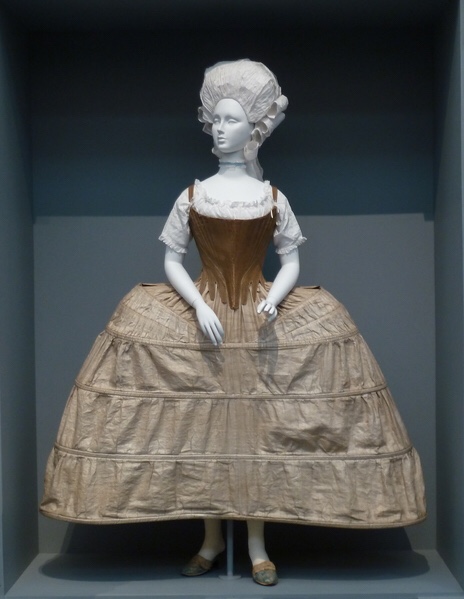
Stays or corset. English c.1780 Linen twill and baleen. Hoop petticoat or pannier, English 1750-80 Plain-woven linen and cane. Chemise, English 1775-1800 Plain-woven cotton. All – Los Angeles County Museum of Art Author: PKM via Wikimedia
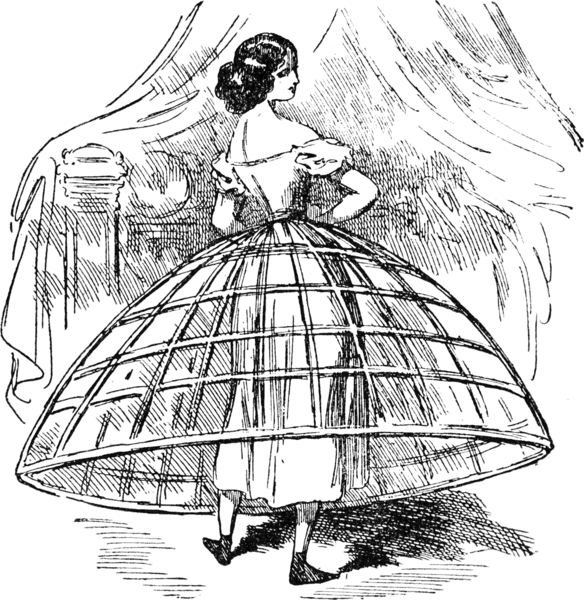
By 1600 ladies were wearing crinolines or farthingales – a frame of wire or whalebone; an easier, cheaper version was the ‘bum roll’ – a padded roll that was worn around the waist…. Very wealthy women wore silk stockings – (nylon stockings first emerged in 1939 and tights were invented in 1959). Clever ladies may have pinched their husband’s braies to wear underneath their crinolines to combat the droughts….
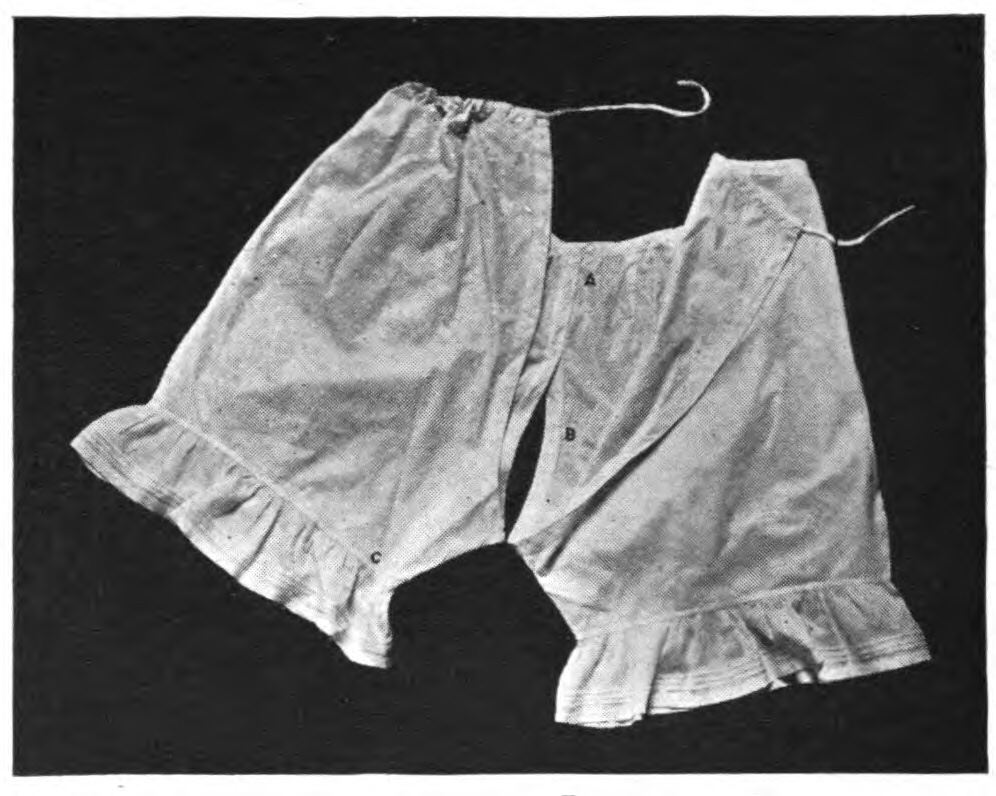
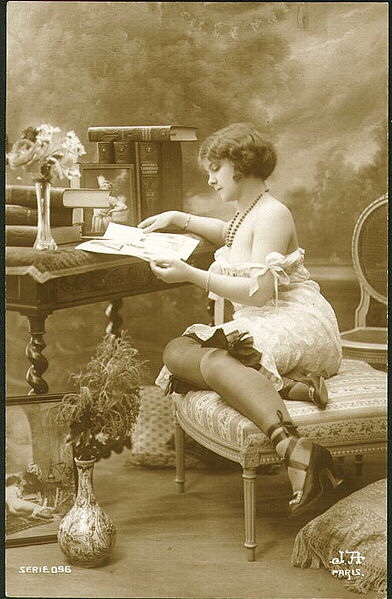
The first undergarments to become commonplace, emerging in the mid 1800s, were drawers – so named as they were literally drawn on to the body, with lacing at the back to pull in the waist. The legs were then sometimes gathered into a cuff well below the knee. They were basically two separate leg pieces joined at the waist ~ which is how we get the term ‘a pair’ of drawers, knickers or pants…. The seam running from back to front was left open….so those naughty Victorians actually invented crotchless knickers! By the 1850s drawers became more decorative and elaborate, even sometimes being made of silk – and by the end of the 1800s had become part of every day wear – even for poor women (who’s smalls may have been fashioned from scratchy sack cloth)…!
Open drawers. A. Two darts take in the fullness in the front B. Edge of drawers faced with garment bias facing; C. Ruffle sewed on with a receiving tuck. Circa 1919 Author: Celestine Leantine Schmit via Wikimedia
Meanwhile men’s braies had evolved – firstly into breeches, usually stopping just below the knee but in some cases reaching the ankles – and later, by the mid 1800s these were replaced by trousers….
The term ‘knickerbockers’ may have come from the 1809 book by Washington Irving “History of New York” featuring a Diedrick Knickerbocker, supposedly descending from the Dutch settlers of New York. Well-known caricaturist, George Cruikshank, illustrated the Knickerbocker men dressed in loose breeches, tied at the knee…. From the 1820s onwards breeches were often known as knickerbockers – and were especially popular for sporting activities…. It was not unheard of for ladies to borrow a pair of knickerbockers belonging to their husbands to wear under their dresses for a bit of added warmth – perhaps a tip handed down by their crinoline wearing grandmothers…. With the closed crotch seam of knickerbockers a new era arrived in the development of women’s underwear – and is where the name ‘knickers’ comes from….
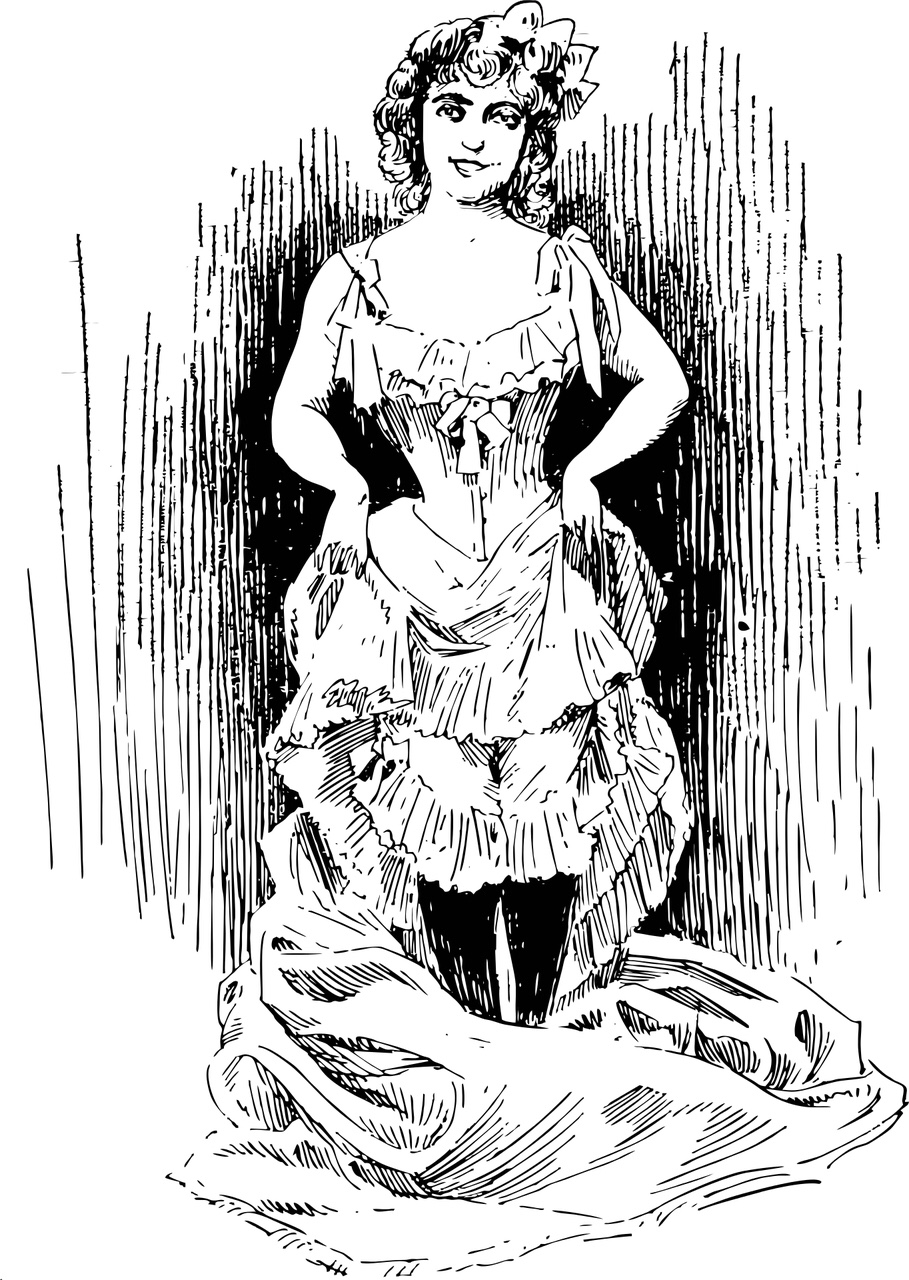
Queen Victoria became an advocate of knickers. Being a fashion icon in her younger days her style was often copied…her hair, her clothes, her love of tartan and her love of drawers – all the fashionable women started to wear them…. From the 1870s various all-in-one combinations started to emerge ~ in the form of camisole bodices being attached to drawers…. By the 1890s Victorian knickers had grown wider at the leg hem, generally with a width of around 20 inches, with a lace frill at the knee – sometimes as much as 10 inches deep. With the wide skirts and petticoats of the period they were easily accommodated….
Photo credit: express.co.uk
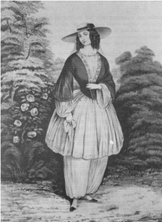
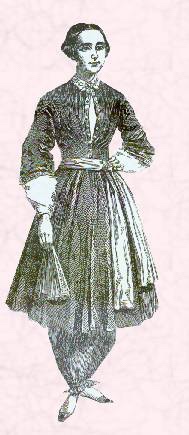
It was the Great Exhibition of 1851 that first introduced the British public to ‘bloomers’ – so named after the publisher of a ladies’ magazine ‘The Lily’ – American Amelia Jenks Bloomer – who was also a devotee of women’s rights…. Fellow feminist Elizabeth Smith Miller had designed a range of clothing aimed at freeing women from the restrictive garments society expected them to wear – namely the unreasonably tight corsets and cumbersome skirts…. She took her inspiration from the clothes worn by Middle Eastern and Central Asian women. One of the ideas she came up with was a pair of loose-fitting trousers that gathered at the ankle, which were to be worn under a tunic-type dress. Amelia Bloomer decided to promote this style and started to wear it in public ~ and by 1849 these ‘trousers’ had become known as ‘bloomers’….
“Bloomer” dress of the 1850s. Public domain via Wikipedia
However, although they were popular amongst the more liberated young women of Britain, they were soon to become undeservedly associated with loose morals and so generally were not accepted in Britain ~ and all because a campaign to promote them went terribly wrong….
On the 6th of October 1851 a grand Bloomer Ball was held at the Hanover Square Rooms in London, to launch and publicise this radical new form of women’s clothing…. Only ladies wearing bloomers were admitted – but unfortunately most of the ‘ladies’ that turned up wearing them were prostitutes…. As the evening wore on it developed into a fracas ~ men were forcing their way in to ‘carry on’ and cavort with the ‘ladies’ – in the end it turned into such an orgy of a brawl that the services of the Metropolitan Constabulary were required….
After this unfortunate event bloomers became condemned by the more refined women of society – they became associated with the loose and fallen…. Amelia Bloomer’s vision of practical, more relaxed apparel – suitable for sporting and leisure activities (such as her mountain climbing outfit – an open skirt reaching the knee, revealing the rest of the leg encased by a frilly legging) – was not for us Brits…. Good job we don’t have too many mountains here in the UK then….
Amelia Bloomer – September 1851. Source: ‘The Lily’. Public domain via Wikipedia
So, ladies’ knickers continued along the road of evolution to become as we know them today…. Brands started to appear – Triumph (have the bra for the way you are) started making underwear in 1886, Silhouette followed in 1887 and Pretty Polly first appeared in 1919…. Our ‘unmentionables’ became more talked about – words crept into our everyday vocabulary, such as ‘lingerie’ – coming from the French word for linen ‘lin’ – things made from linen….
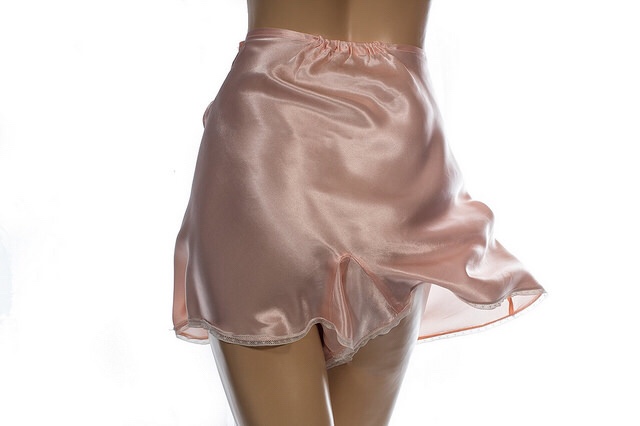
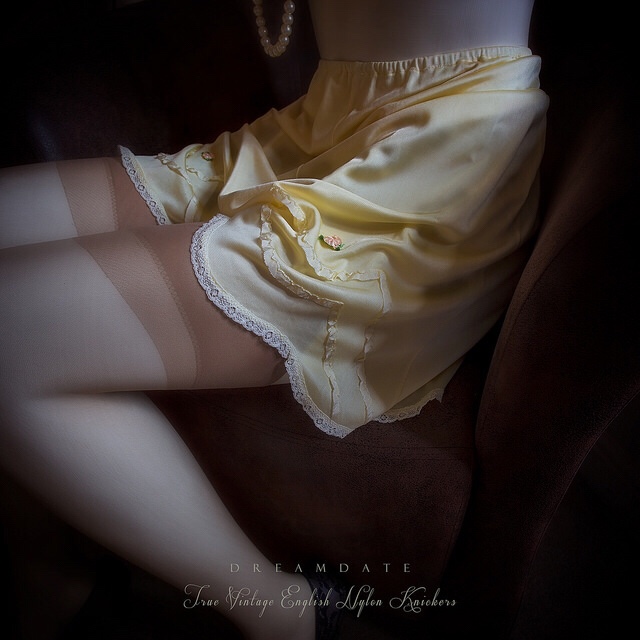
During the 1920s some women were still wearing drawers (those crotchless ones) but most found knickers more comfortable. Wider, shorter ones came into vogue; known as ‘French knickers’ or ‘ skirt knickers’ the style was more suitable for the shorter, closer fitting fashions of the Flapper era…. These replaced the cami-knickers popular in the Edwardian period; by this time much finer fabrics such as lawn were being used….
Image credit: Emma Benitez – DreamDate Art via flickr
Nylon was invented in 1935 by Wallace Carothers. The slinkier clothing of the 1930s demanded undergarments to provide a smoother line – it was early days for nylon but it helped enable this…. Skirts had become shorter and the hemline of knickers rose accordingly…. Around 1924 knickers also became known as ‘panties’….adopting the American term….
True Vintage English Nylon Knickers Image credit: Emma Benitez – DreamDate Art via flickr
With the onset of World War 2 – rationing meant drastic means had to be employed….many women had to resort to wearing knitted knickers ~ or if really lucky a best pair made from parachute silk….
Utility Underwear – Clothing Restrictions on the British Home Front, 1943…. A woman and two girls model utility underwear. Left to right: a woman’s wool vest (costing 4/2 and a half d and 3 coupons), and wool panties (costing 3/11 and 3 coupons; 11 year old girl’s wool vest (costing 4/-1/2d and 2 coupons) and rayon lock-knit panties (costing 3/4 and 2 coupons); 4 year old girl’s wool vest (costing 3/6 and a half d and 1 coupon) and wool knickers (costing 1/5 and a half d and 1 coupon) Date: 1943 Photo D 13088 from the collections of the Imperial War Museums
By the 1940s and 50s most women had started wearing ‘briefs’ and the majority of which were made of cotton and so could be included in the laundry boil wash…. Silk was kept for special occasions…. During the 1950s nylon and elastic became commonplace – and this really revolutionised underwear – more machine-made merchandise meant our smalls were more readily available….
1949 saw the first frilly knickers at Wimbledon. American tennis player Gertrude Moran – “Gorgeous Gussy” – scandalised Wimbledon officials with her saucy outfit – even prompting a debate in Parliament….
“1949 ‘Gorgeous’ Gussy Moran asked the Wimbledon organisers if she could wear coloured clothing. Her request was turned down, so tennis fashion designer Ted Tinling created a dress incorporating lace-trimmed knickers which even triggered a debate in parliament. Photographers lie flat on the ground in order to shoot her knickers”…. Via Mazzeo Construction & Tourism on pinterest.com
In the 1960s totally nylon knickers became the norm….and the double gusset arrived. Full briefs reached the waist – but a lower cut became known as ‘hip huggers’ – later they became cut even lower and were christened ‘bikini pants’…. With more figure hugging fashions VPL became an issue that needed to be addressed…. Elongated pants, known as ‘long johns’ or ‘demi johns’ were still being worn but only as practical pants to keep warm in winter….
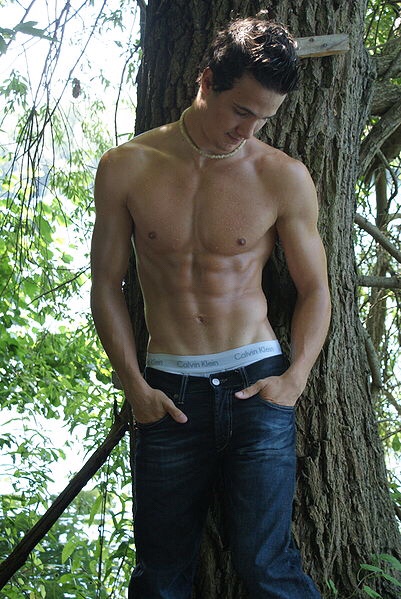
1974 saw the invention of the ‘thong’ – which was to become really popular in the ’90s…. The 1980s brought us designer knickers with the likes of Calvin Klein and Sloggi….the name emblazoned across the top so it could be viewed peeping above the top of the waistband of a garment – both men and women were guilty of this….
German model with sixpack Artist Kevin Goerner via Wikimedia
The ’80s also brought us that impractical contraption – the ‘teddy’…. An all-in-one body garment, usually made of silk or satin – but other cheaper options of silky polyesters were readily available ~ with fiddly snap fasteners under the crotch ~ an absolute nightmare if the call of nature needed to be answered urgently…. Teddies offered no support as we’d all supposedly started visiting the gym by then and were well toned and so didn’t need any extra support…. Perhaps it was a garment really designed and better designated to the bedroom – or the bin. Crotchless knickers had also made a come back by then…. The eighties had a lot to answer for….
Nowadays we have plenty of choice….briefs, bikinis, tangas, thongs, g-strings, boy shorts, hip huggers, Brazilians….. We can choose our own comfort…. Wonder what they’ll come up with next….
‘Manikins in Underwear’ Manikins in their underwear in Marks & Spencer in Exeter…. The Local People Photo Archive via flickr
Image credit: Emma Benitez – DreamDate Art via flickr
Image credit: Emma Benitez – DreamDate Art via flickr
Image credit: Emma Benitez – DreamDate Art via flickr
Please…. If you have read this post through to the end – then I assume you have found it of interest and I hope you’ve enjoyed it…. If you have found this via Facebook, a little ‘like’ for the Cottage Capers page would be very much appreciated…. I’m not trying to sell you anything ~ I’m simply a blogger trying to establish myself…. Many thanX….











 Cottage Capers