On this day in history….14th June 1991

On this day in history : 14th June 1991 – The death of legendary Academy award winning actress Dame Peggy Ashcroft, who appeared in both classic and modern stage plays – as well as in films….

Peggy Ashcroft in 1936 – Public domain

Peggy was born in Croydon on the 22nd of December 1907 – she was still a child when her father was killed during World War One…. At school she was encouraged in her love of Shakespeare however, was not encouraged, either by her teachers or her mother, in her desire to become an actress…. Nevertheless, at the age of 16, showing strong will and determination she joined the Central School of Speech and Drama…. A fellow pupil was Laurence Olivier….

She graduated from the Central School in 1927 with a Diploma of Dramatic Art from London University – having already made her stage debut at Birmingham’s Repertory Theatre opposite Ralph Richardson in J.M.Barrie’s ‘Dear Brutus’…. Her first main West End role was as Naemi in the play ‘Jew Suss’ in 1929….

It was also in 1929 that she married Rupert Hart-Davis….it was to be a short-lived marriage and ended in 1933…. They were to always remain close friends – he was later to blame the failure of their marriage on their young age – although it was he who filed for divorce on the grounds of her adultery with theatrical director Theodore Komisarjevsky…. She had also had other brief affairs with J.B.Priestly and American actor Paul Robeson….

In 1930 Peggy was cast as Desdemona in ‘Othello’ at the Savoy Theatre…. It was a production that was not generally well received but she gained excellent reviews…. She came to the attention of John Gielgud, who at the time was a newly established star in the West End…. On being invited by the Oxford University Dramatic Society to direct a production of ‘Romeo and Juliet’ he cast Peggy as Juliet – a performance that won her golden notices…. She went on to join the Old Vic Company for its 1932-33 season – a company known for its productions of the classics, especially Shakespeare….

In 1933 Peggy made her first film – ‘The Wandering Jew’…. However, she was not keen on this form of acting and so over the next 25 years she only made four more films, perhaps the most notable being Alfred Hitchcock’s ‘The 39 Steps’ in 1935…. She married Komisarjevsky in 1934 – but again it was to be short-lived, they parted in 1936….

Peggy Ashcroft, 1936 – Public domain

She went on to marry lawyer Jeremy Hutchinson in 1940 and gave birth to a daughter in 1941…. Her acting career took a back seat for a while, resuming briefly before her second child, a son, was born in 1946…. She returned to the stage in 1947 and had a run of successes, in classical, Shakespeare and modern productions…. By the mid 1960s her marriage was failing and Peggy threw herself more and more into her work….
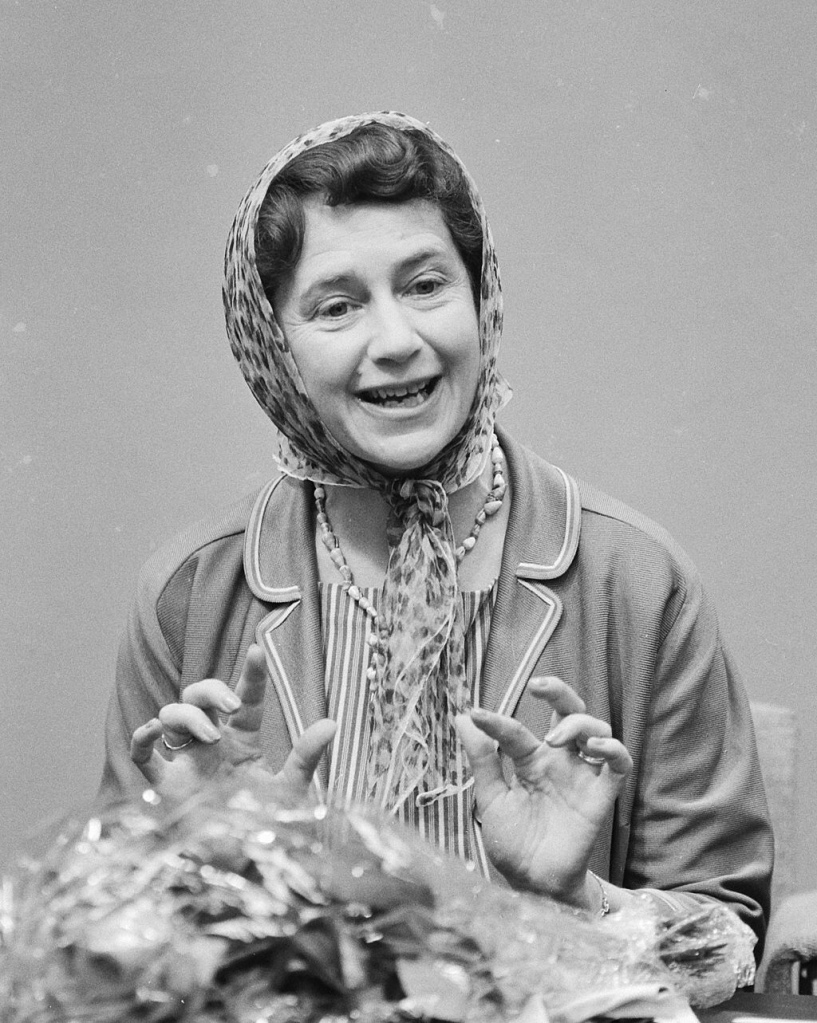
Peggy Ashcroft, 1962 – Dutch National Archives – CC BY-SA 3.0nl

During the 1980s she appeared on television in a few productions…. She won a BAFTA in 1984 as Best Actress in ‘The Jewel in the Crown’ – and another for ‘A Passage to India’ – for which she also received an Oscar for Best Supporting Actress….

Peggy died of a stroke in London, at the age of 83….

On this day in history….13th June 1910

On this day in history : 13th June 1910 – The birth of Mary Whitehouse, the educator, conservative activist and co-founder of the ‘Clean-Up TV’ campaign….

Mary Whitehouse, 1981 – Fair use

Whitehouse was born Constance Mary Hutchison in Nuneaton, Warwickshire and after finishing school she trained to become a teacher…. At the same time she became involved with evangelical Christian groups, such as the Student Christian Movement…. She qualified as a teacher in 1932….

It was at a meeting of the Oxford Group – a Christian organisation later to become known as Moral Re-Armament – that she met Ernest Raymond Whitehouse…. They married in 1940 and were to have five sons (two of whom died in infancy)….

In 1960 Whitehouse was working as a teacher in a school in Madely, Shropshire and was given the responsibility of sex education…. She was to be totally shocked by the lack of morals amongst many of her students…. It was at a time when sex scandals seemed to dominate the news headlines – particularly the exploits of Christine Keebler and Mandy Rice-Davies…. Whitehouse blamed the media, especially the BBC for exposing the nation to ‘such filth’….

In 1963 she wrote to the BBC asking for a meeting with the then Director-General, Hugh Greene…. But she had to make do with his deputy, Harman Grisewood – who she felt was sympathetic because he had good Catholic values…. However, she was to remain dissatisfied with the content she saw on television, so in 1964 she teamed up with vicar’s wife Norah Buckland and they launched the ‘Clean-Up TV’ campaign…. Appealing to the women of Britain they held their first public meeting on the 5th of May at Birmingham Town Hall…. Around 2,000 turned up, including several coach loads….

Whitehouse was to become a thorn in the side of Sir Hugh Greene…. According to her, he was ‘the devil incarnate’ and responsible for the moral collapse of the country – with its promiscuity, infidelity, indecency, violence, blasphemy, bad language and drinking…. She made some 300 speeches across the country each year – and the BBC, Downing Street and Buckingham Palace all received a bombardment of correspondence from her….

Hugh Green, 1968 – Fair use

She became General Secretary of the National Viewers’ and Listeners’ Association in 1965, an association with over 400,000 supporters including many professionals such as senior police officers and bishops….

Just about every programme shown on British television came under her scrutiny…. One of her absolute pet hates was sitcom ‘Til Death Us Do Part’ – and particularly Alf Garnett’s love of the word “bloody”…. Another one she had it in for was Benny Hill…. Comedian Dave Allen fared little better, who she described as ‘offensive, indecent and embarrassing’…. However, comedy writers began to turn the tables, seeing her as potential material for their humour…. The Goodies devoted a whole episode – ‘Gender Education’ – in 1971, purely with the intention of irritating her….

She even turned her attention to popular music…. She unsuccessfully tried to get the BBC to ban Chuck Berry’s ‘My Ding-a-Ling’ – but had a better result when she managed to stop Alice Cooper’s ‘School’s Out’ from being aired…. He responded by sending her flowers – as he was convinced it was this that helped his record reach the No.1 spot in the British charts….

Even family favourite ‘Dr Who’ attracted her wrath – which she referred to as ‘teatime brutality for tots’…. She objected to its violence! And within a week of Channel 4 launching in November 1982 she was having a go at the soap ‘Brookside’ for the amount of swear words in it….

Whitehouse retired in 1994….but even from her nursing home she still had plenty to say…. In her book, ‘Whatever Happened To Sex’, she explained, that as a happy family woman, she had nothing against sex itself – but was against its exploitation in the media…. To some Mary Whitehouse was a champion of Christian family values – indeed in 1980 she was awarded a CBE…. To others she was just an interfering busy body…. She died on the 23rd of November 2001 at the age of 91….

On this day in history….12th June 1819

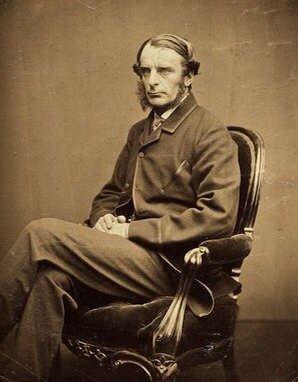
On this day in history : 12th June 1819 – The birth of English clergyman, university lecturer, historian, social reformer, novelist and poet Charles Kingsley – author of the classic ‘The Water Babies’….

Charles Kingsley – photograph by Charles Watkins – Credit : Wellcome Collection CC BY 4.0

Kingsley was born in Holne, Devon, the eldest son of the Reverend Charles Kingsley and Mary Lucas Kingsley…. His younger brother, Henry and sister, Charlotte were also to become writers…. His childhood was spent in Clovelly and then Barnack, Northamptonshire…. He was to develop a keen interest in geology and nature…. He attended grammar school before King’s College, London and then entering Cambridge University in 1838…. Upon graduating in 1842 he decided on a life in the Church and became Rector of Eversley, Hampshire in 1844….

St Mary’s, Eversley – Photo credit : Elisa Rolle, own work CC BY-SA 4.0

Influenced by the work of theologian Frederick Denison Maurice it was in 1848 that Kingsley became the founding member of the Christian Socialist Movement…. It was the Movement’s aim to seek ways of combatting the evils of industrialisation through Christian ethics….

In 1851 Kingsley’s first novel ‘Yeast’ was published – although it had been serialised in Fraser’s Magazine three years before…. It dealt with the social issues between the poor and the gentry…. The previous year his second novel ‘Alton Locke’ had been published – the story of a tailor, who was also a poet and who becomes a leader of the Chartist Movement in the fight against enforced long working hours and poor working conditions….

Kingsley was a great advocate of adult education…. He believed in the growth of the co-operative movement and he fought for improved sanitation and living conditions….

Charles Kingsley – photo by Cundall & Downes – Credit : Wellcome Collection CC BY 4.0

By the mid 1850s he had begun to write popular novels with ‘Hypatia’ being published in 1853 with a setting in early Christian Europe and ‘Westward Ho’ in 1854 and set in the Elizabethan period….

In 1859 Kingsley became Chaplain to Queen Victoria and was made Professor of Modern History at Cambridge University the following year…. In 1861 he became private tutor to the Prince of Wales…. Then in 1870 he was made Canon of Chester Cathedral where he served until 1873 – before being made Canon of Westminster Abbey….

He continued to pursue his other interests; he formed the Chester Society for National Science in 1872 – he had been one of the first to champion Charles Darwin’s ‘On Origin of Species’…. He remained highly critical of Roman Catholicism, which had controversially led to a public spat in print with theologian and poet Cardinal John Henry Newman…. Kingsley was a family man, he and wife Frances Eliza Grenfell had four children….

He continued to write throughout his life…. ‘Hereward the Wake’ was published in 1866 and was set in Anglo Saxon England at the time of the Norman Conquest…. But his most famous book, the children’s fantasy tale about a boy chimney sweep, ‘The Water Babies, A Fairy Tale For A Land Baby’ was published in 1863…. It is a story that combined so many elements of Kingsley’s life…. His interest in nature and his own theory on evolution, to his concerns on welfare reforms and the need for better sanitation….

1885 cover of The Water-Babies – Thomas Fisher Rare Book Library CC BY 2.0

Kingsley died in Eversley on the 23rd of January 1875….

On this day in history….11th June 1776

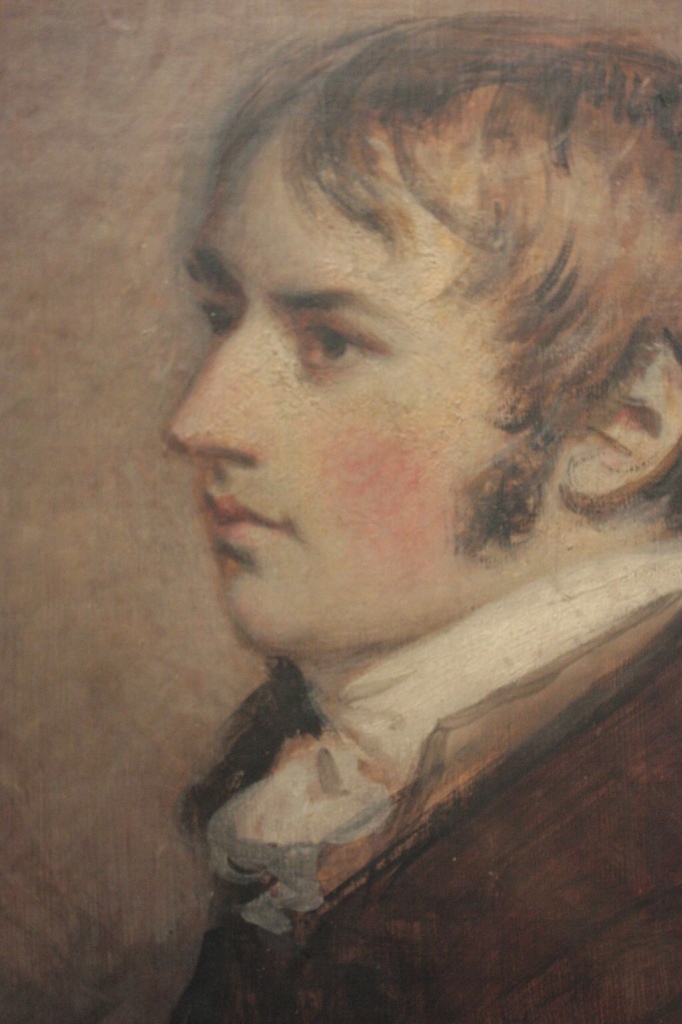
On this day in history : 11th June 1776 – The birth of English landscape artist John Constable – who’s most famous paintings include ‘The Hay Wain’, ‘Wivenhoe Park’ and ‘Dedham Vale’….

John Constable by Daniel Gardner, 1796 – Image credit : Stephencdickson, own work – CC BY-SA 4.0

Constable was born in the village of East Bergholt, on the River Stour in Suffolk…. His father, Golding Constable, was a wealthy corn merchant and mill owner, with a modest-sized ship that he used to transport corn to London…. John Constable was the fourth child and second eldest son – and was expected to take over the family business as his older brother had a learning disability…. After finishing his schooling, firstly at boarding school in Lavenham and then day school in Dedham, Constable joined the business….

From an early age Constable had a gift for sketching and showed a keen interest in nature and the countryside around him…. His natural talent was encouraged under the guidance of local amateur artist John Dunthorne…. He was further inspired when he met another amateur artist, Sir George Beaumont, who was also a collector of paintings by the Old Masters….

Constable persuaded his father to allow him to study at the Royal Academy Schools and he enrolled in 1799…. His work was first exhibited at the Royal Academy in 1802…. With his career now on a different path it was Constable’s younger brother who was to take over the family business….

In 1816, at the age of 40, Constable married Maria Bicknell…. The marriage was very much against the wishes of her father as Maria was a TB sufferer…. The couple lived in Hampstead as it was thought to be healthier than central London – and they also made frequent trips to Brighton so she could benefit from the sea air…. They were to have seven children….

Maria Bicknell by John Constable, 1816 : Tate Britain – Public domain

When painting Constable was always at his happiest when he was in locations known to him, especially the areas around the villages of Suffolk – East Bergholt, Dedham, Stratford St. Mary and Langham were all favourite haunts…. “I should paint my own places best”…. He also painted in Hampstead, Brighton and Salisbury – where he visited frequently on account of being good friends with the nephew of the Bishop of Salisbury….

Dedham Vale – John Constable : Victoria and Albert Museum – Public domain
Wivenhoe Park – John Constable : National Gallery of Art, Washington – Public domain

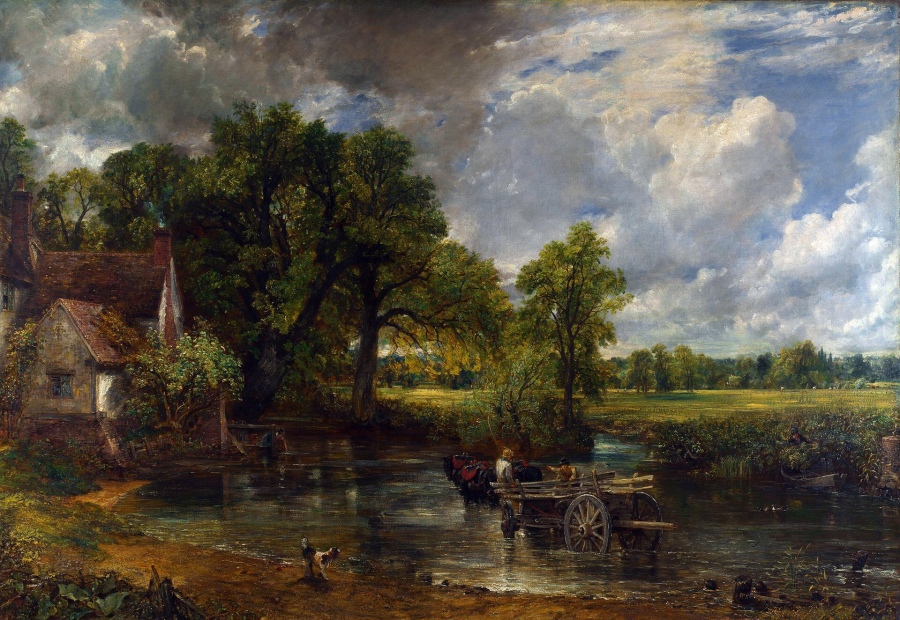
Maria died in 1828, after giving birth to their seventh child…. Constable was devastated…. The following year he was finally elected to a full membership of the Royal Academy…. His rival, William Turner, had achieved this honour much earlier in life, whilst in his 20s…. Constable gained little recognition for his work in Britain until after his death – he only sold twenty paintings in his lifetime in his own country…. He fared much better in France where in 1824 ‘The Hay Wain’ won a gold medal at The Salon, Paris…. Constable was to greatly influence the French Romantic artists…. However, he declined to travel to promote his work…. “I would much rather be a poor man in England than a rich man abroad”….

The Hay Wain : National Gallery, London – Public domain

He died on the 31st of March 1837, of what is thought to be heart failure…. He was buried with Maria in Hampstead….

Constable’s tomb – St John-at-Hampstead – Image credit : Stephencdickson CC BY-SA 4.0

On this day in history….10th June 1993

On this day in history : 10th June 1993 – The death of comedian, actor, presenter and writer Les Dawson – known for his deadpan comedy and for his deliberate playing of the piano off-key….

Les Dawson – Fair use

It is probably safe to say Les did not set out to become an entertainer and there must have been many a time when he nearly gave up altogether – as success did not come easily for him….

He was born in Collyhurst, Manchester on the 2nd of February 1931, to an Irish mother, Julia Nolan and English father, Leslie Dawson Sr, who was a low-paid labourer…. It was a close, loving family – but poor…. Les moved schools frequently as the family would often have to do a moonlight flit to avoid the rent man…. From an early age Les showed a natural talent for writing and enjoyed composing poetry – but he kept his passion quiet as he thought he would be teased by his classmates….

On leaving school at the age of 14 he found employment with the Manchester Co-op – and then later became an apprentice to an electrician…. However, this wasn’t something he particularly enjoyed and when he was called up to do his National Service it probably came as quite a relief….

After National Service he returned to Manchester with the idea of becoming a serious writer…. He submitted his poetry and essays to various magazines and publications – but with no success…. Feeling despondent and thinking a change of scenery might help he decided to move to Paris….

Les was an accomplished piano player and managed to land a job playing in a Parisian bar…. However, he couldn’t understand why there were never any customers…. It took a while for the penny to drop that the bar was actually a smoke screen for a brothel…. To amuse himself he began to play familiar classic tunes in an off-key comical way – and soon built himself a regular little fan club…. But the money he earned was not enough to survive on, so after four months he packed his bags and returned to Manchester….

Buoyed by his brief success as a comic pianist he decided to enter a talent contest – but his act fell flat on its face…. So Les got a job as a door-to-door salesman, selling vacuum cleaners – only to soon realise he wasn’t cut out for this kind of work…. Next he tried his hand at journalism, working for the Bury Times – but this didn’t suit him either….

Still hankering after a showbiz life he started to perform in working men’s clubs across the North…. His audiences were not always the most appreciative – but it was a good learning curve for him and slowly but surely he was beginning to come to the attention of those in ‘the business’…. It was also on the club circuit that he was to meet his first wife, Meg….with whom he was to have 3 children…. It was Meg who encouraged him to enter ‘Opportunity Knocks’ in 1965 – and although he didn’t win he certainly made an impression and was subsequently booked for the ITV show ‘Blackpool Night Out’…. Les Dawson, with his rubbery face contortions, mother-in-law jokes and comical piano playing had finally successfully launched his career as a comedian….

By the end of the 1960s he was a household name…. He now had his own series ‘Sez Les’ on Yorkshire TV – and from that came the two memorable characters of Cissie Braithwaite (played by Roy Baraclough) and Ada Shufflebottom…. The show ran for 11 series between 1969-1976 and then Les went on to do ‘Dawson’s Weekly’ before in 1978 being signed with the BBC for ‘The Les Dawson Show’ – which ran until 1989…. He became the presenter of the game show ‘Blankety Blank’ in 1984 after taking over from Terry Wogan….

Cissie and Ada – Fair use

In April 1986 Meg died from cancer and Les withdrew from public life to look after their children…. Being a heavy smoker and drinker he wasn’t in the best of health himself – and this was to lead to a heart attack….

Les remarried in May 1989 – and he and his wife, Tracy, were to have a daughter…. After another serious heart attack in 1992 his doctors advised him to stop working – but he was having none of it…. The 23rd of December 1992 saw him as the subject of ‘This Is Your Life’ – it was to be one of his last TV appearances….

On the 10th of June 1993 he was at hospital, waiting for his test results after having had a check-up, when he suffered another heart attack…. This time it was fatal….