The restoration and living in of an English country cottage
Author: cottagecapers
Hi, I'm Hazel....
I write purely for pleasure; I love to delve in history, customs, traditions and nature....or whatever else grabs my attention at the time....
I am in no way an expert on what I choose to write about - I simply love to find out about things.... Whilst I always endeavour to get the facts right - occasionally I may get things wrong.... I guess you could call this my disclaimer....
I hope you enjoy reading my blog posts.... If so please give me a follow on Twitter or sign up via email for future posts.... If you are on Facebook Cottage Capers has a page with lots of ‘mini blogs’ and snippets.... It’s where we ‘like-minded’ folk can interact.... Hope to meet you again soon....
On this day in history : 4th November 1987 – Multi-millionaire English entrepreneur Peter de Savary buys Land’s End, Cornwall….
Image credit : Louis Segal – own work CC BY-SA 3.0
During the 1980s de Savary had been in the process of building up his property portfolio…. As well as purchasing Land’s End he also bought John O’Groats and Skibo Castle in the Scottish Highlands….
Land’s End, part of the village of Sennen and located eight miles west of Penzance, at the end of the A30, has attracted tourists for over 300 years…. It was owned by a Cornish family until 1982, who then sold it to David Goldstone…. He then sold it to de Savary for almost £7m, who bought it after outbidding the National Trust, who also wanted to buy it and who own the cliffs to the east and west of Land’s End….
Image credit : Jakemete – own work – CC BY 3.0
De Savary built two new buildings and began work on the theme park that is now there before selling it on, along with John O’Groats, to businessman Graham Ferguson in 1991…. A company named Heritage Attractions Ltd was formed….
Nowadays the Land’s End tourist complex includes a visitor centre and indoor attractions such as an air-sea rescue motion theatre, galleries, shops, restaurants and cafes…. It has an RSPB wildlife discovery club and a farm…. Its hotel is a hugely popular wedding venue….
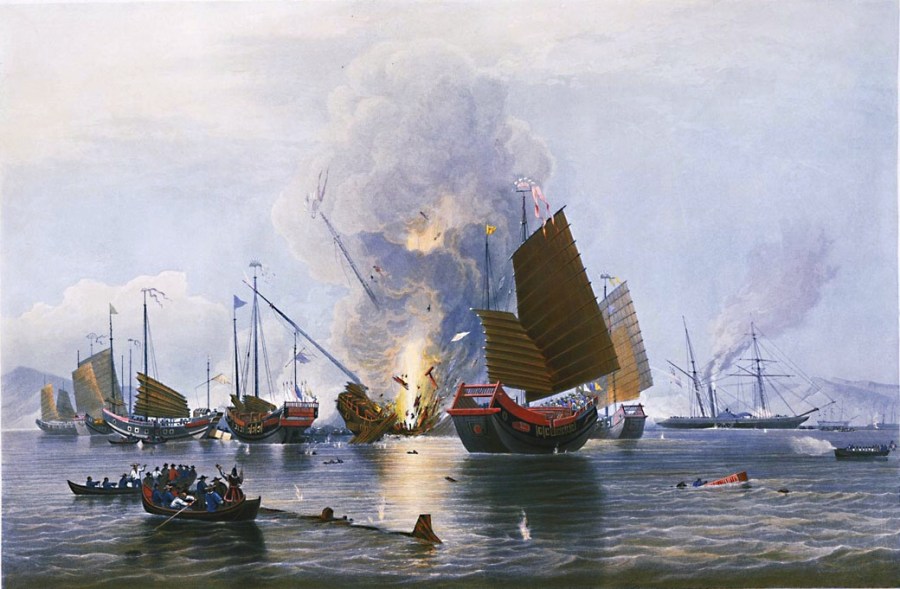
On this day in history : 3rd November 1839 – The first Opium War between China and Britain begins – after British warships destroy several Chinese junks forming a blockade of the Pearl River….
Artist : Edward Duncan – Public domain
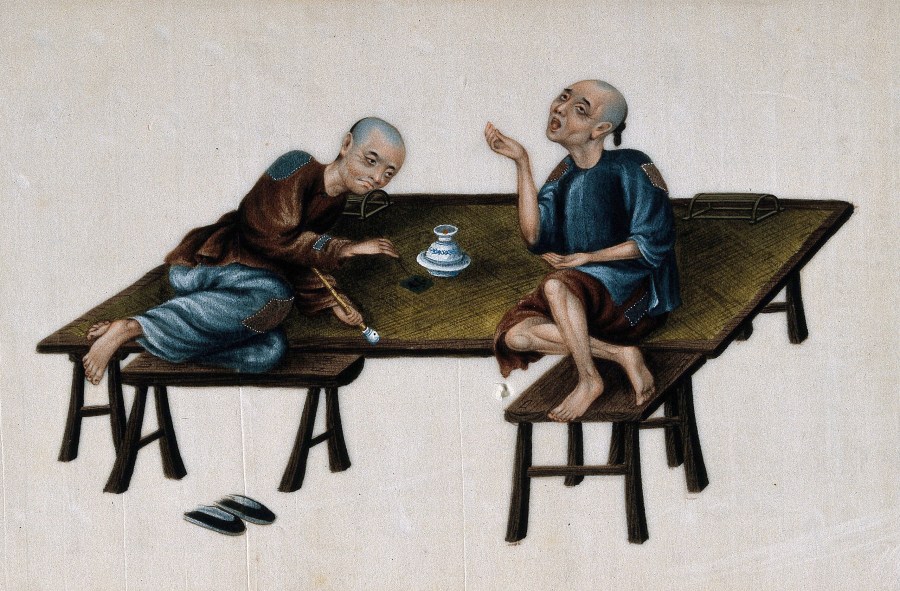
Foreign traders – but predominantly British – had been illegally exporting opium, mainly from India, to China since the 18th century…. The 1820s saw a dramatic increase in this ‘trade’…. In exchange for fuelling widespread opium addiction in China these unscrupulous merchants would demand silver, with which they would then buy tea, silk and other Chinese goods…. With the rise in addiction came moral decay, causing social and economic problems…. Something had to be done….
Chinese opium smokers – Wellcome Images CC BY 4.0
In the Spring of 1839 the Chinese government enforced a shutdown and blockade of the trading companies; over 20,000 barrels of opium stored in one warehouse alone in Canton were destroyed….
European factories, Canton – by William Daniell – Public domain
Then in July 1939 matters were made even worse when drunken British sailors murdered a Chinese villager…. The British refused to hand the sailors over to the Chinese authorities, escalating tensions…. Hostilities broke out in the November when British frigates blew up Chinese vessels forming a blockade in the Kowloon Estuary….
In June 1840 a British fleet arrived in Hong Kong and then travelled up the Pearl River to Canton…. Months of negotiations followed but then in May 1841 the British attacked and occupied the city…. Over the next year more British campaigns followed – the inferior Chinese forces were no match for the British troops – although they did put up a strong counter attack in the Spring of 1842…. However, the British eventually captured Nanking in August 1842 and this brought an end to the fighting (for now)….
Battleships approaching Canton in May 1841 – by Edward H Cree – Public domain
Following peace negotiations the Treaty of Nanking was signed on the 29th of August 1842…. Hong Kong was ceded to the British and an agreement was made to increase the number of ports in which merchants could be based to trade from…. Previously it had only been Canton but now four others were added, including Shanghai….
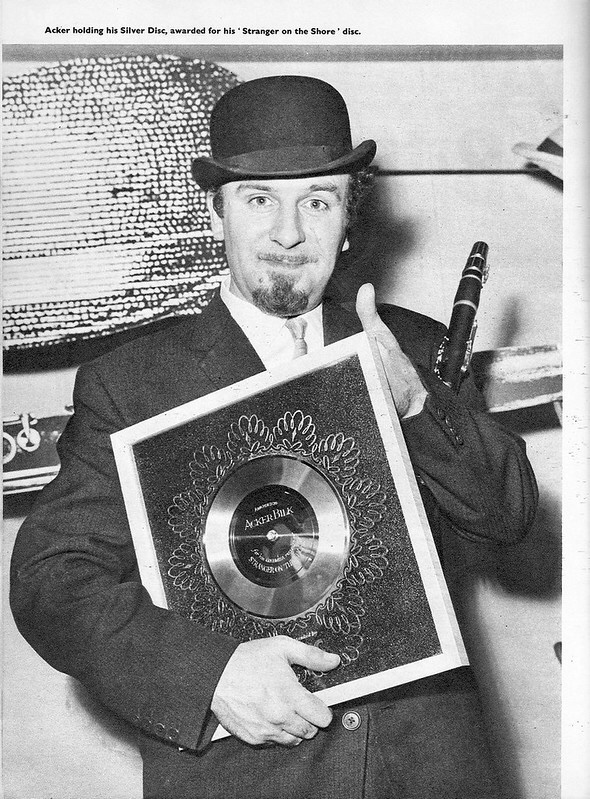
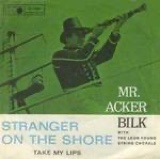
On this day in history : 2nd November 2014 – The death of English clarinetist and vocalist Acker Bilk – who has in the past been described as ‘the Great Master of the Clarinet’….
Image credit : Bradford Timeline via Flickr
Bilk’s most famous track, instrumental Stranger on the Shore, reached No.2 and stayed 55 weeks in the charts…. It was kept off the No.1 position by Cliff Richard’s The Young Ones but was to become the biggest selling single of 1962…. However, it did reach No.1 in the USA; Bilk always claimed that it would be his pension fund….
Image credit : Bradford Timeline via Flickr
Born Bernard Stanley Bilk in Pensford, Somerset on the 28th of January 1929, he acquired the nickname ‘Acker’ as it is Somerset slang for ‘mate’ or ‘friend’….
He learned to play the clarinet whilst doing his National Service with the Royal Engineers in the Suez Canal…. His first clarinet was one a friend had bought on a bazaar – it had no reed so they made one from a piece of wood…. He later ‘borrowed’ a clarinet from the army’s orchestra – and managed to keep hold of it after being demobbed…. After completing his National Service Bilk joined his uncle’s blacksmith business and became qualified in the trade himself…. He married his childhood sweetheart, Jean Hawkins, whom he had been at school with – and they went on to have two children, a boy and a girl….
Bilk began to play on the Bristol jazz circuit with a group of friends…. He then moved to London and joined the band of trumpet and cornet player Ken Colyer…. However, he didn’t care much for London and so returned to Pensford and formed his own band The Chew Valley Jazzmen…
But to achieve success meant having to return to London….which the band did in 1951, renaming themselves The Bristol Paramount Jazz Band…. They landed themselves a six week job in a Düsseldorf beer keller – and it was during this time that the band developed their own unique style and image, complete with bowler hats and striped waistcoats…. Along with his goaty beard this look stayed with Bilk throughout his career…. The band returned to the UK and the London jazz circuit and became part of the traditional jazz scene that was so popular in the late 1950s…. In 1960 their first hit single Summer Set was released and reached No.5; a string of hit singles were to follow….
Mr Acker Bilk & His Paramount Jazz Band – Image credit : Hans-Michael Tappan via Flickr
In 1962 Bilk composed Jenny; a melody he named for his daughter – he reputedly thought it up whilst travelling in the back of a taxi…. He was then asked to change the title so it could be used for a BBC children’s television series about a French au pair living in Brighton – the series was entitled Stranger on the Shore…. He then recorded it as the title track for his new album – it made him an international star, selling over a million copies and earning a gold disc…. The track was so successful that it had no need for lyrics…. Soon he had become such a big star that his PR operation became known as the Bilk Marketing Board – a humorous play on the work ‘Milk’….
Fair use
Bilk’s last chart appearance was in 1978 with the album Evergreen…. He continued to tour with his band and was awarded an MBE in 2001…. He said, in 2012, that after 50 years he was fed up with playing Stranger on the Shore…. However, I don’t think we, the public, will ever tire of hearing it….
Bilk died in Bath in 2014 at the age of 85… He had been treated for throat cancer in 1997 but had then developed bladder cancer and suffered a minor stroke….
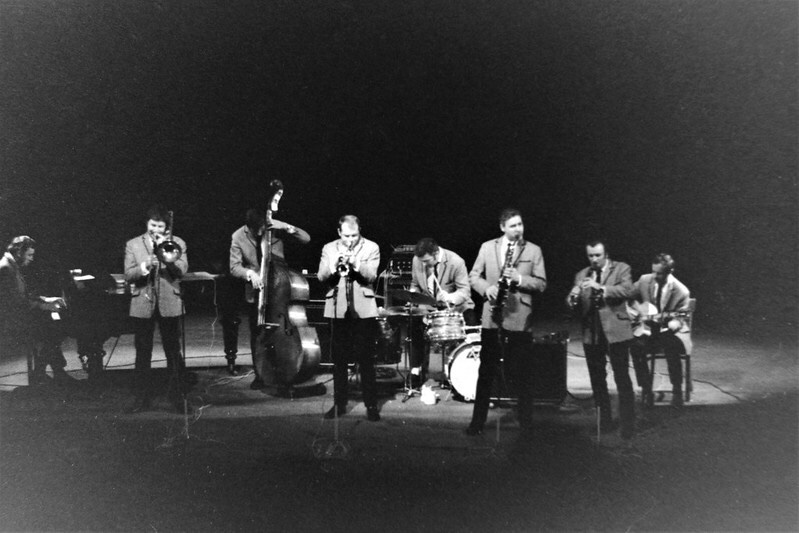
Image credit : Bradford Timeline via FlickrAcker Bilk performing in the Duke of Clarence Assembly Rooms during the 1960s – Image credit : Marquisofqueensbury at English Wikipedia CC BY-SA 3.0
On this day in history : 1st November 1887 – The birth of English artist L.S. Lowry – famous for his matchstick figures, mill scenes and industrial landscapes….
Millworkers by LS Lowry – Photo by Bruce Lamberton – own work – CC BY-SA 4.0
Laurence Stephen Lowry was born in Barrett Street, Stretford…. His father, Robert, was a clerk for a property company and his mother, Elizabeth, a teacher and talented pianist…. She was to suffer ill-health after the birth and had to give up work and all aspirations of becoming a concert pianist…. This made her resentful and added to the fact that she made it no secret that she had longed for another daughter and not the son she got – Lowry himself admitted that his childhood was not an overly happy one…. His father was introverted and meek, whereas his mother was domineering….
In 1898 the family moved to Victoria Park, a pleasant leafy suburb of South Manchester…. However, in 1909 financial difficulties forced a move to Pendlebury, the industrial area between Manchester and Bolton….
On leaving school Lowry took a couple of jobs working for chartered accountants but after being made redundant for a second time in 1910 he began to work as a rent collector for the Pall Mall Property Company…. He remained working for this firm until his retirement in 1952….
Lowry had always enjoyed drawing as a child and once he had started earning his own money he paid for private art lessons…. Then in 1905 he began evening classes at the Manchester Municipal College of Art, where he studied under French impressionist Pierre Adolfe Valette – a man he greatly admired….
Still Life (1906) – Fair use
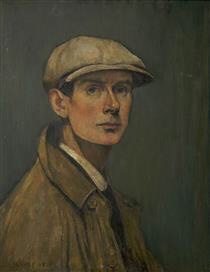
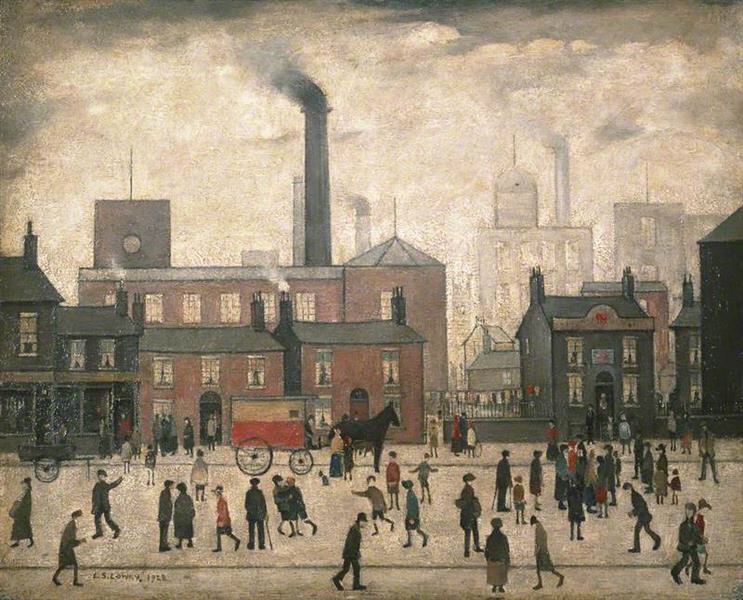
To further his art training he joined Salford’s Royal Technical Institute in 1915 and remained studying here until 1925 – by which time he had now developed his own unique style of urban landscapes, matchstick men and deep, brooding portraits….
Self Portrait (1925) – Fair useComing Home from the Mill (1928) – Fair use
Lowry’s father died inn 1932, leaving the family in debt and financial difficulty…. Before long his mother had become bedridden and it was Lowry who had to care for her…. The only time he got to himself was late at night – he would often paint into the early hours…. His mother never appreciated his talent; he had his first solo exhibition at the Lefevre Gallery, London, in 1939 – which was hugely successful and many of his paintings sold…. His mother did not live long enough to see his success – she died in October 1939….
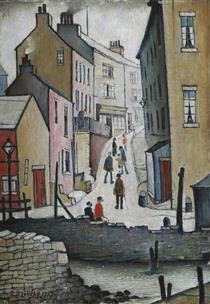
View of a Town (1936) – Fair useAn Old Street (1937) – Fair use
During World War 2 Lowry became an official war artist…. By now he was battling with depression; he stopped looking after his home – and in the end the neglect had become so bad that in 1948 he was evicted from the house by the landlord…. Fortunately Lowry was now financially secure and so he bought himself a house, ‘The Elms’, in a more rural area of Cheshire…. Although he claimed he didn’t much like the house or area he set up his studio here and remained until his death….
Going to Work (1943) – Fair use
Lowry liked to holiday each year in the same seaside hotel in Sunderland…. Here he painted beach scenes, the nearby ports and coal mines…. If he saw something that interested his artist’s eye and had no sketch pad to hand he would utilise whatever was available, maybe the back of an envelope or perhaps a napkin…. He would give these sketches away to whoever was present and taking an interest in what he was doing…. These drawings are now highly desirable and fetch a small fortune….
July, the Seaside (1943) – Fair use
Although regarded as a private person and a loner Lowry was a likeable character and made many long lasting friends in his lifetime…. He never married but did have lady friends…. He particularly befriended colleagues in the art world – and would go out of his way to encourage young artists, often by buying their work…. He would frequently act as a mentor…. Lowry was also football fan and a keen Manchester City supporter….
He retired from his job as a rent collector on his 65th birthday…. By now he was beginning to tire of painting industrial scenes and although he didn’t totally abandon his trademark theme he began to paint small groups of figures…. Influenced by his holidays in Sunderland he also started painting more and more empty landscapes….
Seascape (1950) – Fair use
Into his old age Lowry continued to paint and draw – it is perhaps evident he did so purely to please himself – and did not intend it for public display…. His work from this time has an intimate, private, even surreal quality to it…. ‘Mannequin’ drawings….young women in absurdly restrictive clothing; tight bodices they could hardly breathe in – or even dressed in men’s evening attire…. A large quantity of these pictures were found after his death….
Man Lying on a Wall (1957) – Fair use
Lowry was admitted to Woods Hospital, Glossop, following a stroke…. He died of pneumonia on the 23rd of February 1976…. He was buried at Southern Cemetery, Manchester, alongside his parents….
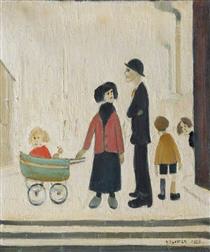
Family Group (1958) – Fair use
A major exhibition of his work was later held at the Royal Academy and attracted a record number of visitors for a British artist…. His works are often now sold for millions….
L S Lowry contemplating Stockport (a scan taken from a photograph by Crispin Eurich in 1962) – Image credit : Smabs Sputzer (1956 – 2017) via Flickr
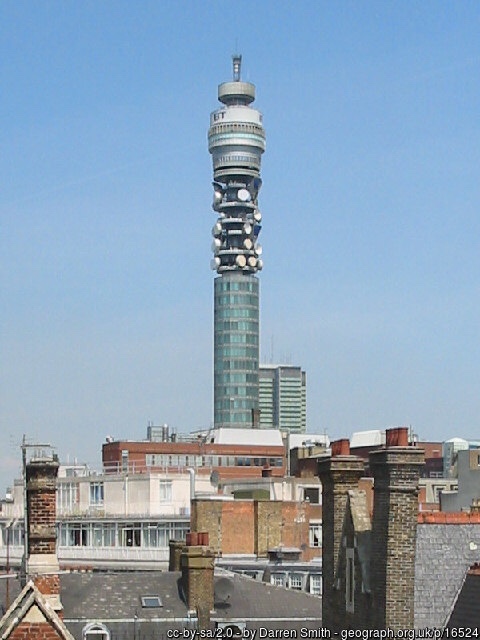
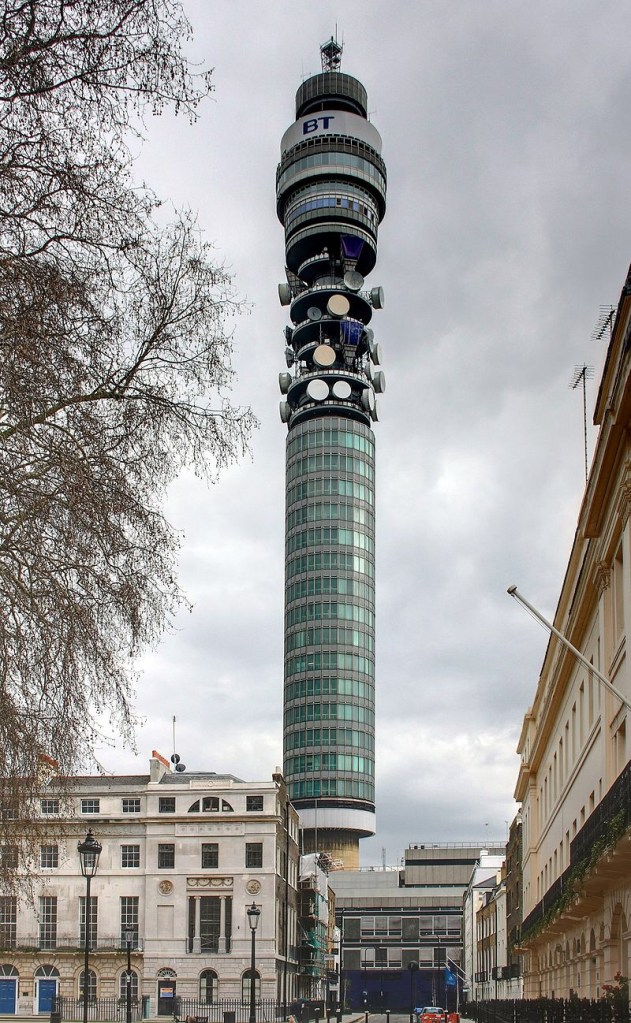
On this day in history : 31st October 1971 – A bomb explodes in the revolving restaurant at the top of London’s Post Office Tower….
The Tower had been open for six years and the restaurant, situated on the 34th floor and with its panoramic views across the city, proved popular with London’s fashionable diners….
Panoramic view from the Tower – Image credit : Colin – own work – CC BY-SA 3.0
According to the Manager of the restaurant around 100 hoax bomb threats had been made over the previous five years or so…. Only this time the threat was for real…. A warning had been given and the building searched – but nothing was found…. At 4.30am an explosion blasted holes in the outer walls of the restaurant and viewing galleries…. Buildings and parked cars up to 400m away were damaged and local residents were woken in their beds…. Thankfully nobody was hurt…. The police received a call shortly after from a man claiming to be from the Kilburn Battalion of the IRA…. The bombing had all the hallmarks of the IRA – although far left anarchist organisation the Angry Brigade also later claimed responsibility….
The bomb had been planted in the roof space of the men’s toilets on the lowest of the public viewing galleries…. It was thought a diner may have gained access to a restricted internal staircase in order to plant it….
The restaurant was closed to the public – and when the owner’s lease expired in 1980 it was closed permanently…. The revolving floor still remains functioning and nowadays the restaurant is used for occasional corporate entertaining….and is also used for part of the filming of the BBC’s annual Children in Need fundraising event….
Image credit : David Castor – own work – Public domain